1
A PROJECT ON PESTLE ANALYSIS OF “UAE” COUNTRY.
INDEX
SR NO. PARTICULARS PAGE NO.
1 Introduction 3
2 Political 7
3 Economic 10
4 Social 13
5 Technology 16
6 Legal 19
7 Environment 22
2
 INTRODUCTION OF UAE:
The United Arab Emirates (UAE), Is A Country In Western
Asia (The Middle East). It Is Located At The Eastern End Of
The Arabian Peninsula And Shares Borders With Oman And
Saudi Arabia, While Having Maritime Borders In The
Persian Gulf With Qatar And Iran. Abu Dhabi Is The Nation's
Capital, While Dubai, The Most Populated City, Is An International Hub.
The United Arab Emirates Is An Elective Monarchy Formed From A
Federation Of Seven Emirates, Consisting Of Abu Dhabi (The Capital),
Ajman, Dubai, Fujairah, Ras Al Khaimah, Sharjah And Umm Al Quwain.
Each Emirate Is Governed By A Ruler And Together The Rulers Form The
Federal Supreme Council. The Members
Of The Federal Supreme Council Elect A
President (As Of 14th May 2022, His
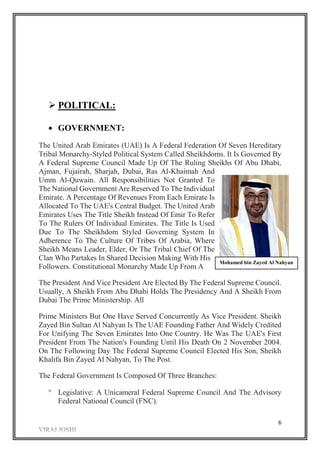
Highness Sheikh Mohamed Bin Zayed Al
Nahyan) And Vice President (His
Highness Sheikh Mohammed Bin Rashid
Al Maktoum) From Among Their
Members. In Practice, The Ruler Of Abu
Dhabi Serves As President While The
Ruler Of Dubai Is Vice President And Also Prime Minister. In 2013, The
Country Had A Population Of 9.2 Million, Of Which 1.4 Million Were Emirati
Citizens And 7.8 Million Were Expatriates. As Of 2020, The United Arab
Emirates Has An Estimated Population Of Roughly 9.9 Million.
The Area Which Is Today The United Arab Emirates Has Been Inhabited For
Over 125,000 Years. It Has Been The Crossroads Of Trading For Many
Civilizations, Including Mesopotamia, Persia, And India.
The United Arab Emirates' Oil And Natural Gas Reserves Are The World's
Sixth And Seventh-Largest, Respectively. Zayed Bin Sultan Al Nahyan, Ruler
Of Abu Dhabi And The Country's First President, Oversaw The Development
Of The Emirates By Investing Oil Revenues Into Healthcare, Education, And
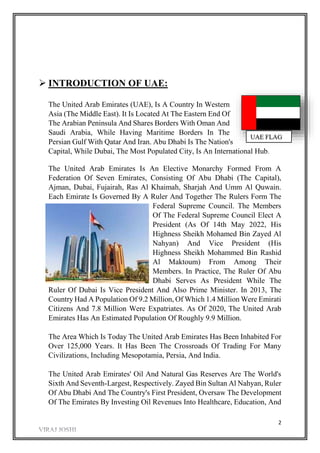
UAE FLAG
3
Infrastructure. The United Arab Emirates Has The Most Diversified Economy
Among The Members Of The Gulf Cooperation Council. In The 21st Century,
The Country Has Become Less Reliant On Oil And Gas And Is Economically
Focusing On Tourism And Business. The Government Does Not Levy Income
Tax, Although There Is A Corporate Tax In Place And A 5% Value-Added
Tax Was Established In 2018.
Human Rights Groups, Such As Amnesty International, Freedom House And
Human Rights Watch, Regard UAE As Generally Substandard On Human
Rights, With Citizens Criticising The Regime Imprisoned And Tortured,
Families Harassed By The State Security Apparatus, And Cases Of Forced
Disappearances. Individual Rights Such As The Freedoms Of Assembly,
Association, The Press, Expression, And Religion Are Also Severely
Repressed.
The UAE Is Considered A Middle Power. It Is A Member Of The United
Nations, Arab League, Organisation Of Islamic Cooperation, Opec, Non-
Aligned Movement, And Gulf Cooperation Council (GCC)
 HISTORY:
Human Occupation In The Region Has Been Traced Back To The Emergence Of
Anatomically Modern Humans From Africa Circa 124,000 Bce Through Finds
At The Faya-2 Site In Mleiha, Sharjah. Burial Sites Dating Back To The Neolithic
Age And The Bronze Age Include The Oldest Known Such Inland Site At Jebel
Buhais. Known As Magan To The Sumerians, The Area Was Home To A
Prosperous Bronze Age Trading Culture During The Umm Al Nar Period Which
Traded Between The Indus Valley, Bahrain And Mesopotamia As Well As Iran,
Bactria And The Levant. The Ensuing Wadi Suq Period And Three Iron Ages
Saw The Emergence Of Nomadism As Well As The Development Of Water
Management And Irrigation Systems Supporting Human Settlement In Both The
Coast And Interior. The Islamic Age Began With
The Expulsion Of The Sasanians And The
Subsequent Battle Of Dibba. The Region's History
Of Trade Led To The Emergence Of Julfar, In The
Present-Day Emirate Of Ras Al Khaimah, As A
Regional Trading And Maritime Hub In The Area.
The Maritime Dominance Of The Persian Gulf By
Arab Traders Led To Conflicts With European
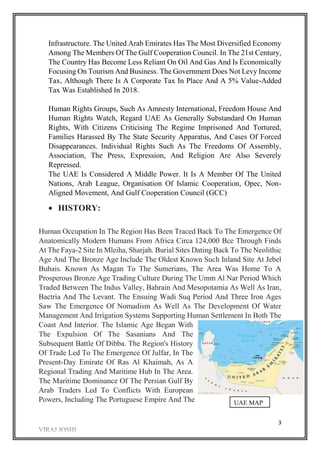
Powers, Including The Portuguese Empire And The UAE MAP
4
British Empire.
Following Decades Of Maritime Conflict, The Coastal Emirates Became Known
As The Trucial States With The Signing Of The General Maritime Treaty With
The British In 1820 (Ratified In 1853 And Again In 1892), Which Established
The Trucial States As A British Protectorate.
This Arrangement Ended With Independence And The Establishment Of The
United Arab Emirates On 2 December 1971 Following The British Withdrawal
From Its Treaty Obligations. Six Emirates Joined The UAE In 1971; The Seventh,
Ras Al Khaimah, Joined The Federation On 10 February 1972.
 RELIGION:
The Spread Of Islam To The North Eastern Tip Of The Arabian Peninsula
Is Thought To Have Followed Directly From A Letter Sent By The Islamic
Prophet, Muhammad, To The Rulers Of Oman In 630 Ce, Nine Years After
The Hijrah. This Led To A Group Of Rulers Travelling To Medina,
Converting To Islam And Subsequently Driving A Successful Uprising
Against The Unpopular Sassanids, Who Dominated The Coast At The
Time. Following The Death Of Muhammad, The New Islamic
Communities South Of The Persian Gulf Threatened To Disintegrate,
With Insurrections Against The Muslim Leaders. Caliph Abu Bakr Sent
An Army From The Capital Medina Which Completed Its Reconquest
Of The Territory (The Ridda Wars) With The Battle Of Dibba In Which
10,000 Lives Are Thought To Have Been Lost. This Assured The Integrity
Of The Caliphate And The Unification Of The Arabian Peninsula Under
The Newly Emerging Rashidun Caliphate.
In 637, Julfar (In The Area Of Today's Ras Al
Khaimah) Was An Important Port That Was
Used As A Staging Post For The Islamic
Invasion Of The Sasanian Empire. The Area
Of The Al Ain/Buraimi Oasis Was Known As
Tu'am And Was An Important Trading Post
For Camel Routes Between The Coast And The
Arabian Interior.
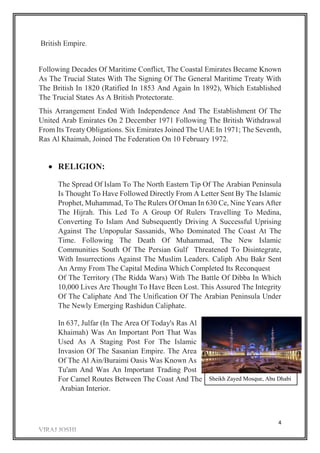
Sheikh Zayed Mosque, Abu Dhabi
5
The Earliest Christian Site In The UAE Was First Discovered In The
1990s, An Extensive Monastic Complex On What Is Now Known As Sir
Bani Yas Island And Which Dates Back To The Seventh Century. Thought
To Be Nestorian And Built In 600 Ce, The Church Appears To Have Been
Abandoned Peacefully In 750 Ce. It Forms A Rare Physical Link To A
Legacy Of Christianity, Which Is Thought To Have Spread Across The
Peninsula From 50 To 350 Ce Following Trade Routes. Certainly, By The
Fifth Century, Oman Had A Bishop Named John – The Last Bishop Of
Oman Being Etienne, In 676 Ce.
 INDEPENDENCE:
By 1966, It Had Become Clear The British Government Could No Longer Afford
To Administer And Protect The Trucial States, What Is Now The United Arab
Emirates. British Members Of Parliament (MPS)
Debated The Preparedness Of The Royal Navy To
Defend The Sheikhdoms. Secretary Of State For
Defence Denis Healey Reported That The British
Armed Forces Were Seriously Overstretched And
In Some Respects Dangerously Under-Equipped
To Defend The Sheikhdoms. On 24 January 1968,
British Prime Minister Harold Wilson Announced
The Government's Decision, Reaffirmed In March
1971 By Prime Minister Edward Heath, To End
The Treaty Relationships With The Seven Trucial
Sheikhdoms, That Had Been, Together With
Bahrain And Qatar, Under British Protection. Days
After The Announcement, The Ruler Of Abu
Dhabi, Sheikh Zayed Bin Sultan Al Nahyan, Fearing Vulnerability, Tried To
Persuade The British To Honour The Protection Treaties By Offering To Pay The Full
Costs Of Keeping .
The British Armed Forces In The Emirates. The British Labour Government
Rejected The Offer. After Labour MP Goronwy Roberts Informed Sheikh Zayed
Of The News Of British Withdrawal, The Nine Persian Gulf Sheikhdoms
Attempted To Form A Union Of Arab Emirates, But By Mid-1971 They Were
Still Unable To Agree On Terms Of Union Even Though The British Treaty
Relationship Was To Expire In December Of That Year.
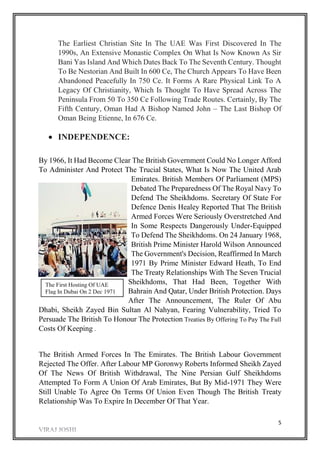
The First Hosting Of UAE
Flag In Dubai On 2 Dec 1971
The First Hosting Of UAE
Falg In Dubai On 2 Dec 1971
6
 POLITICAL:
 GOVERNMENT:
The United Arab Emirates (UAE) Is A Federal Federation Of Seven Hereditary
Tribal Monarchy-Styled Political System Called Sheikhdoms. It Is Governed By
A Federal Supreme Council Made Up Of The Ruling Sheikhs Of Abu Dhabi,
Ajman, Fujairah, Sharjah, Dubai, Ras Al-Khaimah And
Umm Al-Quwain. All Responsibilities Not Granted To
The National Government Are Reserved To The Individual
Emirate. A Percentage Of Revenues From Each Emirate Is
Allocated To The UAE's Central Budget. The United Arab
Emirates Uses The Title Sheikh Instead Of Emir To Refer
To The Rulers Of Individual Emirates. The Title Is Used
Due To The Sheikhdom Styled Governing System In
Adherence To The Culture Of Tribes Of Arabia, Where
Sheikh Means Leader, Elder, Or The Tribal Chief Of The
Clan Who Partakes In Shared Decision Making With His
Followers. Constitutional Monarchy Made Up From A
The President And Vice President Are Elected By The Federal Supreme Council.
Usually, A Sheikh From Abu Dhabi Holds The Presidency And A Sheikh From
Dubai The Prime Ministership. All
Prime Ministers But One Have Served Concurrently As Vice President. Sheikh
Zayed Bin Sultan Al Nahyan Is The UAE Founding Father And Widely Credited
For Unifying The Seven Emirates Into One Country. He Was The UAE's First
President From The Nation's Founding Until His Death On 2 November 2004.
On The Following Day The Federal Supreme Council Elected His Son, Sheikh
Khalifa Bin Zayed Al Nahyan, To The Post.
The Federal Government Is Composed Of Three Branches:
 Legislative: A Unicameral Federal Supreme Council And The Advisory
Federal National Council (FNC).
Mohamed bin Zayed Al Nahyan
7
 Executive: The President, Who Is Also Commander-In-Chief Of The
Military, The Prime Minister And The Council Of Ministers.
 Judicial: The Supreme Court And Lower Federal Courts.
The UAE E-Government Is The Extension Of The UAE
Federal Government In Its Electronic Form. The UAE's
Council Of Ministers Is The Chief Executive Branch Of
The Government Presided Over By The Prime
Minister. The Prime Minister, Who Is Appointed By
The Federal Supreme Council, Appoints The Ministers.
The Council Of Ministers Is Made Up Of 22 Members
And Manages All Internal And Foreign Affairs Of The
Federation Under Its Constitutional And Federal Law.
In December 2019, The UAE Became The Only Arab
Country, And One Of Only Five Countries In The
World, To Attain Gender Parity In A National
Legislative Body, With Its Lower House 50 Per Cent Women.
The UAE Is The Only Country In The World That Has A Ministry Of Tolerance,
A Ministry Of Happiness, And A Ministry Of Artificial Intelligence.[129] The
UAE Also Has A Virtual Ministry Called The Ministry Of Possibilities, Designed
To Find Solutions To Challenges And Improve Quality Of Life. The UAE Also
Has A National Youth Council, Which Is Represented In The UAE Cabinet By
The Minister Of Youth.
The UAE Legislative Is The Federal National Council Which Convenes
Nationwide Elections Every 4 Years. The Fnc Consists Of 40 Members Drawn
From All The Emirates. Each Emirate Is Allocated Specific Seats To Ensure Full
Representation. Half Are Appointed By The Rulers Of The Constituent Emirates,
And The Other Half Are Elected. By Law, The Council Members Have To Be
Equally Divided Between Males And Females. The Fnc Is Restricted To A
Largely Consultative Role.
 FOREIGN RELATIONS:
The UAE Has Broad Diplomatic And Commercial Relations With Most
Countries And Members Of The United Nations. It Plays A Significant Role In
OPEC, And Is One Of The Founding Members Of The Gulf Cooperation Council
(GCC). The UAE Is A Member Of The United Nations And Several Of Its
Specialized Agencies (Icao, Ilo, Upu, Who, Wipo), As Well As The World Bank,
Imf, Arab League, Organisation Of Islamic Cooperation (OIC), And The Non-
Aligned Movement. Also, It Is An Observer In The Organisation Internationale
Mohammed bin
Rashid Al Maktoum
8
De La Francophonie. Most Countries Have Diplomatic Missions In The Capital
Abu Dhabi With Most Consulates Being In UAE's Largest City, Dubai.
Emirati Foreign Relations Are Motivated To A Large Extent By Identity And
Relationship To The Arab World. The United Arab Emirates Has Strong Ties
With Bahrain, China, Egypt, France, India, Jordan, Pakistan, Russia, Saudi
Arabiaand The United States.
Following The British Withdrawal From The UAE In 1971 And The
Establishment Of The UAE As A State, The UAE Disputed Rights To Three
Islands In The Persian Gulf Against Iran, Namely Abu Musa, Greater Tunb, And
Lesser Tunb. The UAE Tried To Bring The Matter To The International Court
Of Justice, But Iran Dismissed The Notion. Pakistan Was The First Country To
Formally Recognize The UAE Upon Its Formation. The UAE Alongside Multiple
Middle Eastern And African Countries Cut Diplomatic Ties With Qatar In June
2017 Due To Allegations Of Qatar Being A State Sponsor Of Terrorism,
Resulting In The Qatar Diplomatic Crisis. Ties Were Restored In January 2021.
The UAE Recognized Israel In August 2020, Reaching A Historic Israel–United
Arab Emirates Peace Agreement And Leading Towards Full Normalization Of
Relations Between The Two Countries.
 MILITARY:
The United Arab Emirates Military Force Was Formed In 1971 From The
Historical Trucial Oman Scouts, Long A Symbol Of Public Order In Eastern
Arabia And Commanded By British Officers. The Trucial Oman Scouts Were
Turned Over To The United Arab Emirates, As The Nucleus Of Its Defence
Forces In 1971, With The Formation Of The UAE, And Was Absorbed Into The
Union Defence Force.
Although Initially Small In Number, The UAE Armed
Forces Have Grown Significantly Over The Years
And Are Presently Equipped With Some Of The Most
Modern Weapon Systems, Purchased From A Variety
Of Western Military Advanced Countries, Mainly
France, The Us And The Uk. Most Officers Are
Graduates Of The United Kingdom's Royal Military
Academy At Sandhurst, With Others Having Attended
The United States Military Academy At West Point,
The Royal Military College, Duntroon In Australia,
And St Cyr, The Military Academy Of France. France And The United States
Have Played The Most Strategically Significant Roles With Defence Cooperation
Agreements And Military Material Provision.
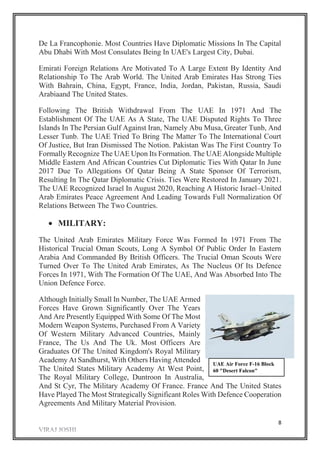
UAE Air Force F-16 Block
60 "Desert Falcon"
9
Examples Of The Military Assets Deployed Include The Enforcement Of The
No-Fly-Zone Over Libya By Sending Six UAE AF F-16 And Six Mirage 2000
Multi-Role Fighter Aircraft, Ground Troop Deployment In Afghanistan.
 ECONOMIC:
 BUSINESS AND FINANCE:
The UAE Offers Businesses A Strong Enabling Environment: Stable Political
And Macroeconomic Conditions, A Future-Oriented Government, Good General
Infrastructure And ICT Infrastructure. Moreover, The Country Has Made
Continuous And Convincing Improvements To Its Regulatory Environment And
Is Ranked As The 26th Best Nation In The World For Doing Business
By The Doing Business 2017 Report Published By
The World Bank Group. The UAE Are In The Top
Ranks Of Several Other Global Indices, Such As
The World Economic Forum's (WEF) Global
Competitiveness Index (GCI), The World
Happiness Report (WHR) And 33rd In The Global
Innovation Index In 2021. The Economist
Intelligence Unit (EIU), For Example, Assigns
The UAE Rank Two Regionally In Terms Of
Business Environment And 22 Worldwide. From
The 2018 Arab Youth Survey The UAE Emerges As The Top Arab Country In
Areas Such As Living, Safety And Security, Economic Opportunities, And
Starting A Business, And As An Example For Other
States To Emulate. The Weaker Points Remain The Level Of Education Across
The UAE Population, Limitations In The Financial And Labour Markets, Barriers
To Trade And Some Regulations That Hinder Business Dynamism. The Major
Challenge For The Country, Though, Remains Translating Investments And
Strong Enabling Conditions Into Knowledge, Innovation And Creative Outputs.
The UAE's Monetary Policy Stresses Stability And Predictability, As The Central
Bank Of The UAE (CbUAE) Keeps A Peg To The Us Dollar (Usd) And Moves
Interest Rates Close To The Federal Funds Rate. This Policy Makes Sense In The
Current Situation Of Global And Regional Economic And Geopolitical
Uncertainty. Also Considering The Fact That Exports Have Become The Main
Driver Of The UAE's Economic Growth (The Contribution Of International
Trade To GDP Grew From 31% In 2017 To 33.5% In 2018, Outpacing Overall
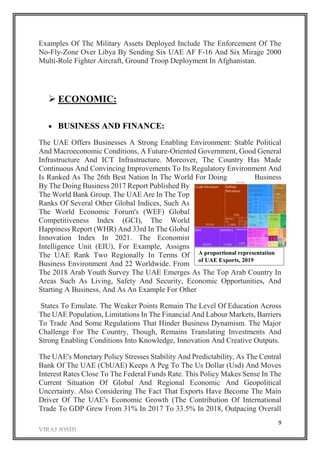
A proportional representation
of UAE Exports, 2019
10
Gdp Growth For The Period), And The Fact That The AED Is Currently
Undervalued, A Departure From This Policy – And Particularly The Peg – Would
Negatively Affect This Important Part Of The UAE Economy In The Short Term.
In The Mid- To Long Term, However, The Peg Will Become Less Important, As
The UAE Transitions To A Knowledge-Based Economy – And Becomes Yet
More Independent From The Oil And Gas Sector (Oil Is Currently Still Being
Traded Not In Aed, But In Usd). On The Contrary, It Will Become More And
More Important For The Government To Have Monetary Policy At Its Free
Disposal To Target Inflation, Shun Too Heavy Reliance On Taxes, And Avoid
Situations Where Decisions On Exchange Rates And Interest Rates Contradict
Fiscal Policy Measures – As Has Been The Case In Recent Years, Where
Monetary Policy Has Limited Fiscal Policy Effects On Economic Expansion.
 OIL AND GAS:
The UAE Leadership Has Driven Forward Economic Diversification Efforts
Already Before The Oil Price Crash In The 1980s, And The UAE Is Nowadays
The Most Diversified Economy In The Middle East And North Africa (Mena)
Region. Although The Oil And
Gas Sector Does Still Play An
Important Role In The UAE
Economy, These Efforts Have
Paid Off In Terms Of Great
Resilience During Periods Of
Oil Price Fluctuations And
Economic Turbulence.In 2018,
The Oil And Gas Sector
Contributed 26% To Overall
GDP. The Introduction Of The
Vat Has Provided The Government With An Additional Source Of Income –
Approximately 6% Of The Total Revenue In 2018, Or 27 Billion United Arab
Emirates Dirham (Aed) – Affording Its Fiscal Policy More Independence
From Oil- And Gas-Related Revenue, Which Constitutes About 36% Of The
Total Government Revenue. While The Government May Still Adjust The
Exact Arrangement Of The Vat, It Is Not Likely That Any New Taxes Will
Be Introduced In The Foreseeable Future. Additional Taxes Would Destroy
One Of The UAE's Main Enticements For Businesses To Operate In The
Country And Put A Heavy Burden On The Economy. The UAE's Carbon
Dioxide Emissions Per Capita Are High, Ranking Sixth Among Countries
Globally. The Barakah Nuclear Power Plant Is The First On The Arabian
Peninsula And Expected To Reduce The Carbon Footprint Of The Country.
 TOURISM:
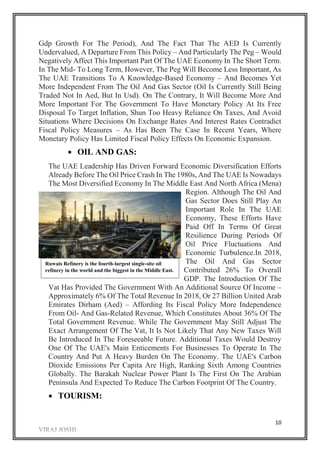
Ruwais Refinery is the fourth-largest single-site oil
refinery in the world and the biggest in the Middle East.
11
Tourism Acts As A Growth Sector For The Entire UAE Economy. Dubai Is
The Top Tourism Destination In The Middle East. According To The Annual
Mastercard Global Destination Cities Index, Dubai Is The Fifth Most Popular
Tourism Destination In The World. Dubai Holds Up To 66% Share Of The
UAE's Tourism Economy, With Abu Dhabi Having 16% And Sharjah 10%.
Dubai Welcomed 10 Million Tourists In 2013.
The UAE Has The Most Advanced And Developed Infrastructure In The
Region. Since The 1980s, The UAE Has Been Spending Billions Of Dollars
On Infrastructure. These Developments Are Particularly Evident In The
Larger Emirates Of Abu Dhabi And Dubai. The Northern Emirates Are
Rapidly Following Suit, Providing Major Incentives For Developers Of
Residential And Commercial Property.
The Inbound Tourism Expenditure In The UAE For 2019 Accounted For
118.6 Percent Share Of The Outbound Tourism Expenditure. Since 6 January
2020, Tourist Visas To The United Arab Emirates Are Valid For Five Years. It
Has Been Projected That The Travel And Tourism Industry Will Contribute
About 280.6 Billion United Arab Emirati Dirham To The UAE's Gdp By
2028.
 TRANSPORT:
 SEA:
The Major Ports Of The United Arab Emirates Are Khalifa Port, Zayed Port,
Port Jebel Ali, Port Rashid, Port Khalid, Port Saeed, And Port Khor
Fakkan.The Emirates Are Increasingly Developing Their Logistics And Ports
In Order To Participate In Trade Between Europe And China Or Africa. For
This Purpose, Ports Are Being Rapidly Expanded And Investments Are Being
Made In Their Technology.
The Emirates Have Historically Been And Currently Still Are Part Of The
Maritime Silk Road That Runs From The Chinese Coast To The South Via
The Southern Tip Of India To Mombasa, From There Through The Red Sea
Via The Suez Canal To The Mediterranean, There To The Upper Adriatic
Region And The Northern Italian Hub Of Trieste With Its Rail Connections
To Central Europe, Eastern Europe And The North Sea.
12
 HIGHWAY:
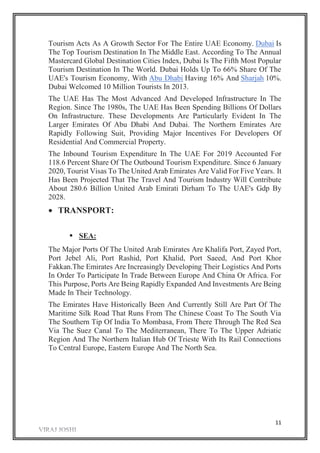
Abu Dhabi, Dubai, Sharjah, Ajman, Umm Al
Quwain, And Ras Al Khaimah Are
Connected By The E11 Highway, Which Is
The Longest Road In The UAE. In Dubai, In
Addition To The Dubai Metro, The Dubai
Tram And Palm Jumeirah Monorail Also
Connect Specific Parts Of The City. There Is
Also A Bus, Taxi, Abra And Water Taxi
Network Run By Rta. T1, A Double-Decker
Tram System In Downtown Dubai, Were Operational From 2015 To 2019.
 SOCIAL:
 CULTURE:
The United Arab Emirates Has A Diverse Society. Dubai's Economy Depends
More On International Trade And Tourism, And Is More Open To Visitors,
While Abu Dhabi Society Is More Domestic
As The City's Economy Is Focused On Fossil
Fuel Extraction.
Major Holidays In The United Arab Emirates
Include Eid Al Fitr, Which Marks The End
Of Ramadan, And National Day (2
December), Which Marks The Formation Of
The United Arab Emirates. Emirati Males
Prefer To Wear A Kandura, An Ankle-Length
White Tunic Woven From Wool Or Cotton,
And Emirati Women Wear An Abaya, A
Black Over-Garment That Covers Most Parts Of The Body.
Ancient Emirati Poetry Was Strongly Influenced By The Eighth-Century Arab
Scholar Al Khalil Bin Ahmed. The Earliest Known Poet In The UAE Is Ibn
Majid, Born Between 1432 And 1437 In Ras Al-Khaimah. The Most Famous
Emirati Writers Were Mubarak Al Oqaili (1880–1954), Salem Bin Ali Al
Owais (1887–1959) And Ahmed Bin Sulayem (1905–1976). Three Other
Poets From Sharjah, Known As The Hirah Group, Are Observed To Have
Been Heavily Influenced By The Apollo And Romantic Poets. The Sharjah
International Book Fair Is The Oldest And Largest In The Country.
E 311, one of major roads in the
UAE.
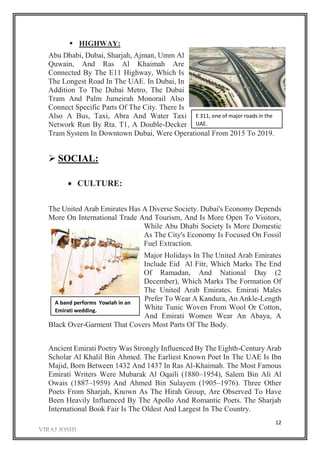
A band performs Yowlah in an
Emirati wedding.
13
The List Of Museums In The United Arab Emirates Includes Some Of
Regional Repute, Most Famously Sharjah With Its Heritage District
Containing 17 Museums, Which In 1998 Was The Cultural Capital Of The
Arab World. In Dubai, The Area Of Al Quoz Has Attracted A Number Of Art
Galleries As Well As Museums Such As The Salsali Private Museum.[324]
Abu Dhabi Has Established A Culture District On Saadiyat Island. Six Grand
Projects Are Planned, Including The Guggenheim Abu Dhabi And The
Louvre Abu Dhabi. Dubai Also Plans To Build A Kunsthal Museum And A
District For Galleries And Artists.
Emirati Culture Is A Part Of The Culture Of Eastern Arabia. Liwa Is A Type
Of Music And Dance Performed Locally, Mainly In Communities That
Contain Descendants Of Bantu Peoples From The African Great Lakes
Region.The Dubai Desert Rock Festival Is Also Another Major Festival
Consisting Of Heavy Metal And Rock Artists. The Cinema Of The United
Arab Emirates Is Minimal But Expanding.
 CUISINE:
The Traditional Food Of The Emirates Has Always Been Rice, Fish And Meat.
The People Of The United Arab Emirates Have Adopted Most Of Their Foods
From Other West And South Asian Countries Including Iran, Saudi Arabia,
Pakistan, India And Oman. Seafood Has Been The Mainstay Of The Emirati Diet
For Centuries. Meat And Rice Are Other Staple Foods, With Lamb And Mutton
Preferred To Goat And Beef. Popular Beverages Are Coffee And Tea, Which Can
Be Complemented With Cardamom, Saffron, Or Mint To Give Them A
Distinctive Flavour.
Popular Cultural Emirati Dishes Include Threed,
Machboos, Khubisa, Khameer And Chabab Bread
Among Others While Lugaimat Is A Famous Emirati
Dessert.With The Influence Of Western Culture, Fast
Food Has Become Very Popular Among Young People,
To The Extent That Campaigns Have Been Held To
Highlight The Dangers Of Fast Food Excesses. Alcohol
Is Allowed To Be Served Only In Hotel Restaurants And
Bars. All Nightclubs Are Permitted To Sell Alcohol.
Specific Supermarkets May Sell Alcohol, But These
Products Are Sold In Separate Sections. Likewise, Pork,
Which Is Haram (Not Permitted For Muslims), Is Sold In Separate Sections In
All Major Supermarkets.
Arabic Coffee With Lugaimat
(A Traditional Emirati Sweet)
14
 SPORTS AND RECREATION:
Sports Are Popular In The United Arab
Emirates And
Are Strongly
Supported By
The
Government.
The Ministry Of
Youth And
Sports Oversees And Encourages The Many
Groups, Clubs, And Associations That Provide Sports-Related Activities.
Football (Soccer) Is The Most-Watched Spectator Sport, And Horse Racing
Also Enjoys Widespread Popularity. The Federation Is Also A Major Centre
For Camel Racing, A Traditional Sport That Became
increasingly popular Late In The 20th Century, And For Falconry, Once An
Important Means Of Hunting. Jujitsu Became Popular And Widespread In
The 21st Century, Especially Because Of The Patronage Of Abu Dhabi’s
Ruling Nahyan Family. The Country Hosts Many International Sporting
Events, Most Notably For Golf, Jujitsu, Tennis, Rugby, And Boat Racing.
The United Arab Emirates Made Its Olympic
Debut At The 1984 Summer Games, And Its
National Football (Soccer) Team Qualified For
The World Cup In 1990. Abu Dhabi Began Hosting The Final Grand Prix Of
The Formula One World Championship Tournament In 2009. The Country
Hosted The FIFA Club World Cup In 2018, In Which The Club From Al-
Ain Played Real Madrid In The Final Match, And Hosted The Asian Cup
Tournament Months Later In 2019.
 EDUCATION:
The Education System Through Secondary Level Is Monitored By The Ministry
Of Education In All Emirates Except Abu Dhabi, Where It Falls Under The
Authority Of The Abu Dhabi Education
Council. It Consists Of Primary Schools,
Middle Schools And High Schools. The
Public Schools Are Government-Funded
And The Curriculum Is Created To Match
The United Arab Emirates' Development
Goals. The Medium Of Instruction In The
Public School Is Arabic With Emphasis
On English As A Second Language. There
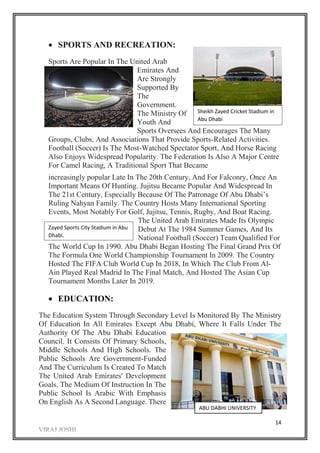
Sheikh Zayed Cricket Stadium in
Abu Dhabi
Zayed Sports City Stadium in Abu
Dhabi.
ABU DABHI UNIVERSITY
15
Are Also Many Private Schools Which Are Internationally Accredited. Public
Schools In The Country Are Free For Citizens Of The UAE, While The Fees For
Private Schools Vary.
The Higher Education System Is Monitored By The Ministry Of Higher
Education. The Ministry Also Is Responsible For Admitting Students To Its
Undergraduate Institutions. The Adult Literacy Rate In 2015 Was 93.8%.
The UAE Has Shown A Strong Interest In Improving Education And Research.
Enterprises Include The Establishment Of The CERT Research Centres And The
Masdar Institute Of Science And Technology And Institute.
 TECHNOLOGY:
 CLOUD COMPUTING:
The UAE Is One Of The Largest Data Center Hubs In The Middle East
And More Are Planned. Up To $1 Billion In Additional Investments Are
Projected By 2026. In 2019, Microsoft Azure Launched Two Cloud
Regions In Dubai And Abu Dhabi. In 2021, Amazon Web Services
Announced Plans For A New Data Center Region In The UAE. The New
Region Will Consist Of Three Availability Zones And Is Set To Open In
2022. In November 2021, Oracle Announced The Opening Of Its Second
Cloud Region In Abu Dhabi, Following Their Dubai Cloud Region.
Government-Owned Entities Etisalat And G42 Cloud Also Have Major
Data Centers.
With Aggressive Investments By The UAE Government In Cloud
Computing, The UAE’s Competitive Business Laws, And Their Strong
Technological Infrastructure, The ICT Sector Is Forecast To Continue
Expanding In The Years Ahead. Public Cloud Hosting In The UAE Has
Addressed Variations In Resources And Expertise Efficiently Through
Highly Specialized Solutions. Despite These Significant Expansions,
There Is Still Sizeable Room For Development That Will Require The
Expertise And Know-How Of U.S. Firms.
 CYBER SECURITY:
16
The UAE’s Geopolitical Position And Importance To The World Economy
In The Energy, Oil & Gas, And Aviation Industry Make The UAE
Vulnerable As A Target Of Cyberattacks, Driving Rapid Growth In The
Cybersecurity Market. The UAE Reports
The Highest Number Of Malware Incidents
Among Consumers In The GCC. To Protect
The UAE’s Critical Data Information
Infrastructure And Improve National
Cybersecurity, The Government Introduced
The UAE Information Assurance Standards
Which Are A Set Of Guidelines For Government Entities In Critical
Sectors. Compliance With These Standards Is Mandatory For All
Government Organizations And Businesses That Are Identified As Critical
Infrastructure In The UAE. Several Local Players Have Been Developing
Cybersecurity Capabilities To Capitalize On Rising Demand, While
International IT Security Firms Are Expanding Their Presence In The
Country. With Leading Technology Experts Stating That The Number One
Priority For UAE Firms Remains Cybersecurity, The Market Is Expected
To Continue Expanding. Many UAE Development Initiatives Also Drive
The Demand For Cybersecurity. These Factors And The Growing Demand
For Cybersecurity Solutions Provide Many Opportunities For American
Companies.
 INTERNET OF THINGS:
Internet Of Things (Iot) Opportunities Include Smart Services, The
Industrial Internet, And Machine-To-Machine Communications. There
Are Applications In The Public Sector For Smart Cities And Telehealth,
And Enterprise Applications Include Smart Metering, Asset Tracking, And
Production Optimization. The UAE Has Emerged As A Leading Global
Location For The Deployment Of Iot Solutions To Enhance Public
Infrastructure, Especially In Dubai As It Aims To Become A Leading
Smart City. There Is A Foundation Of Cooperation In Dubai And The UAE
Across Multiple Sectors Including ICT, Power, Transportation,
Infrastructure, Healthcare, And Government.
 ARTIFICIAL INTELLIGENCE :
17
Artificial Intelligence (AI) Is A Priority In The UAE. AI Is Forecast To
Play A Role To Contribute Almost 14% Of The National GDP By 2030
($96 Billion), And The Annual Growth In The AI Contribution To The
UAE Economy Is Forecast To Grow By 33.5% Between 2018 And 2030.
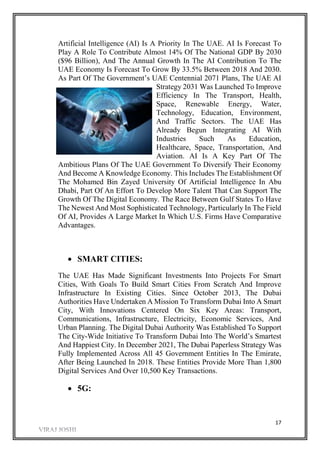
As Part Of The Government’s UAE Centennial 2071 Plans, The UAE AI
Strategy 2031 Was Launched To Improve
Efficiency In The Transport, Health,
Space, Renewable Energy, Water,
Technology, Education, Environment,
And Traffic Sectors. The UAE Has
Already Begun Integrating AI With
Industries Such As Education,
Healthcare, Space, Transportation, And
Aviation. AI Is A Key Part Of The
Ambitious Plans Of The UAE Government To Diversify Their Economy
And Become A Knowledge Economy. This Includes The Establishment Of
The Mohamed Bin Zayed University Of Artificial Intelligence In Abu
Dhabi, Part Of An Effort To Develop More Talent That Can Support The
Growth Of The Digital Economy. The Race Between Gulf States To Have
The Newest And Most Sophisticated Technology, Particularly In The Field
Of AI, Provides A Large Market In Which U.S. Firms Have Comparative
Advantages.
 SMART CITIES:
The UAE Has Made Significant Investments Into Projects For Smart
Cities, With Goals To Build Smart Cities From Scratch And Improve
Infrastructure In Existing Cities. Since October 2013, The Dubai
Authorities Have Undertaken A Mission To Transform Dubai Into A Smart
City, With Innovations Centered On Six Key Areas: Transport,
Communications, Infrastructure, Electricity, Economic Services, And
Urban Planning. The Digital Dubai Authority Was Established To Support
The City-Wide Initiative To Transform Dubai Into The World’s Smartest
And Happiest City. In December 2021, The Dubai Paperless Strategy Was
Fully Implemented Across All 45 Government Entities In The Emirate,
After Being Launched In 2018. These Entities Provide More Than 1,800
Digital Services And Over 10,500 Key Transactions.
 5G:
18
The UAE Was The First Country In The
Arab Region And Fourth Globally To
Launch Its 5G Network. Both Du And
Etisalat, The Nation’s Leading Telecom
Companies, Launched Limited 5G
Networks In 2019, Along With The 5G-
Enabled ZTE Axon 10 Pro Smartphone To Both Post-Paid And Pre-Paid
Customers. By The End Of 2023, It Is Estimated That 16 Million 5G
Smartphones Will Be Operational In The Region. With The UAE Being At
The Forefront Of Technological Advances And Given The Strong GDP
Per Capita, Demand For 5G Services Is Predicted To Be Strong Over The
Coming Years.
 LEGAL:
 UAE NATIONAL ACTION PLAN (NAP):
The UAE National Action Plan (NAP) For The Implementation Of UN
Security Council Resolution 1325 On Women, Peace And Security Aims To
Empower And Support Women Globally By Promoting The Adherence To
The UN Security Council Resolution 1325.
19
Resolution 1325 Stresses The Important Role Of Women In The Prevention
And Resolution Of Conflicts And In Post-Conflict Reconstruction. It Also
Emphasises On Women’s Equal Participation In All Efforts For The
Maintenance Of Peace And Security. It Calls On All Parties To Conflict To
Take Special Measures To Protect Women And Girls From Gender-Based
Violence And Other Forms Of Sexual Abuse.
The UAE National Action Plan Aims To:
1. Respond To Gender Perspectives In
Foreign Policies
2. Prevent And Combat Violent Extremism
3. Plan For Emergency Response And Crisis Situations
4. Incorporate Gender Analysis Into The Scope Of International Peace
Efforts
5. Promote Gender Equality In Humanitarian Aid
6. Achieve Effective Participation Of Women In Conflict Prevention
7. Increase Women’s Participation In Peacebuilding
8. Train Women Military Officers
9. Enhance Women's Participation In Politics In The Country.
The UAE Government Will Develop And Implement Various Campaigns To
Raise Awareness And Secure Support For The Objectives Of The UAE NAP.
It Will Also Build The Capacity Of Government Officials On The UN Agenda
Of Women, Peace And Security.
The UAE Is First Country Of Gulf Cooperation Council To Launch National
Programmes To Support The UN Agenda Of Women, Peace And Security.
 HUMAN RIGHTS:
Throughout Its History, The UAE Has Followed The Principles Of Justice
And Equality, Respect For Human Rights, Humanitarian Aid And Relief
Action In Line With The Principles Of The Universal Declaration Of Human
Rights. Since Its Inception, The UAE Has Ensured The Founding Of A
Tolerant And Multi-Cultural Community In Which Individuals From Across
The World Live In Harmony, Guaranteeing Via Its Constitution Their Civil
Liberties.
20
 APPLICATION OF LAWS:
The UAE Has Adopted A Codified System Of
Laws, Which Is Transparent And Protects The
Rights Of All Individuals. The UAE’s
Constitution Includes The Following
Provisions:
 All Persons Shall Be Equal Before The Law. No Discrimination Shall
Be Practised Between Citizens Of The Union By Reason Of Race,
Nationality, Religious Belief Or Social Position.
 No Person May Be Arrested, Searched, Detained Or Imprisoned,
Except In Accordance With The Provisions Of The Law. No Man Shall
Be Subjected To Torture Or Any Other Form Of Indignity.
 No Punishment Shall Be Imposed For Any Act Of Commission Or Act
Of Omission, Which Was Completed Before The Issue Of The Law
Providing For Such Punishment.
 Punishment Shall Be Applied To The Accused Person Only. An
Accused Shall Be Deemed Innocent Until He Has Been Convicted By
Means Of A Legal And Just Trial. The Accused Shall Have The Right
To Appoint A Person Who Shall Conduct His Defence During The
Trial. Physical And Mental Abuse Of An Accused Person Shall Be
Prohibited.
 CONSUMER PROTECTION LAW:
The Federal Law No. 15 Of 2020 On Consumer Protection Repeals The
Federal Law No. 24 Of 2006. The New Law Aims To Protect All Consumer
Rights, Including The Right To A Standard Quality Of Goods And Services
And The Right To Obtain Them At The Declared Price. It Further Seeks To
Preserve The Health And Safety Of The Consumer When Using The Goods
Or Receiving The Service. The Law Protects The Data Of The Consumers
And Prohibits Suppliers From Using It For Marketing.
 Scope Of The Law:
21
The Law Applies Covers All Goods And Services Sold Or Provided By
Suppliers, Advertisers And Commercial Agents Across The UAE’s Mainland
And Free Zones. I It Also Covers Goods Sold Through Ecommerce Platforms
Registered In The UAE. Meanwhile, The Law Does Not Apply To
Ecommerce Activities That Are Carried Out Between Customers In The UAE
And Ecommerce Businesses Registered Outside The UAE.
 Consumer Rights:
According To The Law, The UAE’s Consumers Are Granted The Following
Rights:
1. To Be Provided An Appropriate And Safe Environment When
Purchasing A Good Or Receiving A Service
2. To Obtain Correct Information About The Goods They Purchase, Use
Or Consume Or The Service They Receive
3. To Be Informed About Their Rights And Obligations
4. To Have The Right To Choose The Most Appropriate Product And
Service Available In The Market According To Their Wishes
5. To Obtain Fair Compensation For Damages They Suffer As A Result
Of Purchasing Or Using Defective Goods Or Receiving Inadequate Or
Unprofessional Services.
 ENVIRONMENT:
The Challenges To The Natural Environment Today Are Immense. The UAE
Faces The Impact Of Rapid Development And The Effects Of Climate Change
And Global Warming. Protection Of Environment And Sustainable
22
Development Are Key Topics Which Receive Great Attention From The UAE
Government.
The UAE's Rapid Economic Development Made The Country Face Serious
Environmental Challenges That Arise From The High Pace Of Population
Growth, The Increase In The Demand For Energy And Water And The Fast-
Paced Urban Development Accompanied With High Level Of GHG And
Other Emissions In The UAE.
 ENVIRONMENT VISION IN 2021:
Creating And Maintaining A Sustainable Environment And Infrastructure Is
A Pillar Of National Agenda In Line With Vision 2021. The UAE Government
Wants To Ensure Sustainable Development While Preserving The
Environment, And To Achieve A Perfect Balance Between Economic And
Social Development.
The UAE Has Set Key Performance Indicators (Kpis) To Measure Its
Performance Against Its Targets Of 2021. They Are:
 Improving The Air Quality Index
 Improving The Percentage Of Treated Waste Of Total Waste
Generated
 Improving The Share Of Clean Energy Contribution
 Decreasing The Water Scarcity Index
 Improving The Networked Readiness Index (Telecommunication
And It Sectors)
 Improving The Quality Of Air Transport Infrastructure
 Improving The Quality Of Port Infrastructure
 Improving The Logistics Performance Index
 Improving The Quality Of Overall Infrastructure (Such As
Transportation, Electricity And Telephone Lines)
 Improving The Online Services Index
 Decreasing The Time Taken To Obtain A Loan/House From The
Government For UAE Citizens
23
In Line With Vision 2021 And National Agenda, The UAE Needs To Generate
27 Percent Of The Energy Requirements From Clean Energy Sources, Reduce
Its Per Capita Greenhouse Gas Emissions And Achieve Average Oil
Consumption Of 5 Tonnes Per Person By 2021.
According To National Agenda, The Share Of Power Generation From Gas
Will Drop From 98 Per Cent In 2012 To Less Than 76 Per Cent In 2021 As
Clean Energy - Mainly Renewable And Nuclear Energy - Enter The Mix,
Along With Intensifying Energy-Efficiency Efforts.
The Vision Sets Five National Targets Related To Clean Energy, Water
Availability And Productivity, Reduction Of Carbon Emissions And Energy
Intensity.
 ENTITIES IN CHARGE OF ENVIRONMENT:
Ministry Of Climate Change And Environment Is The Federal Authority For
Environmental Planning And Action In UAE:
The Ministry, In Collaboration With The Competent Local Authorities
Concerned With Environment, Work On Developing Environmental
Programmes And Initiatives That Aim To Contribute To The Sustainability
Of Water, Enhance Food Security, Raise The Rates Of Bio-Security And
Enhance Environmental Security. The Action Plans Of The Ministry Emerge
From Its Vision To Ensure Sustainable Environment For Life.
The Ministry Also Launched Its National Environmental Education And
Awareness Strategy 2015-2021. The Strategy Is Based On Six Key Objectives
That Were Developed According To International Standards And The
Expectations Of The Parties Concerned. It Is Aimed At Educating The Youth
Of The UAE Towards A Sustainable Future And Strengthening The
Community's Commitment To Sustainability And Environmental Protection.
The Strategy Also Encourages The Active Participation Of Enterprises And
Economic Sectors In Moving Towards Environmental Sustainability And
Educates Governments And Key Stakeholders On Environmental Issues.
The Ministry Also Launched National Climate Change Plan Of The UAE
2017–2050 Which Serves As A Roadmap To Bolster Nationwide Actions For
Climate Mitigation. Through This Plan, The UAE Will Further Strive To Be
At The Frontline Of Global Efforts To Prove That Climate Action Can Go
24
Hand In Hand With Continuous Economic Development. The Document
Serves As A Complementary Plan Of Action That Specifically Addresses
Climate Change.
 ENVIRONMENT VISION 2030:
Environment Vision 2030 Identifies The Following 5 Priority Areas:
1.Climate Change - Minimising The Impact Of Climate Change.
2.Clean Air And Noise Pollution - Contributing To Safe And Healthy Living
Conditions.
3.Water Resources - Efficient Management And Conservation Of Water
Resources.
4.Biodiversity, Habitats And Cultural Heritage - Conserved For Current And
Future Generations.
5.Waste Management – Enhanced Value Creation Through Optimised
Material Flows And Waste Management.
The Priority Areas Are Further Divided Into Sub-Priorities, Which In Turn
Are Further Divided Into Environmental Outcomes. Each Outcome Has Three
Values Assigned To It:
1.Current Value - This Refers To Values Of The State Of Environment In
2010
2.Threshold Value - This Refers To A Realistic Target To Be Achieved By
2030
3.Sustainability Value - This Refers To The Ultimate Desirable Target For
The State Of Environment In Order To Be Sustainable.
25
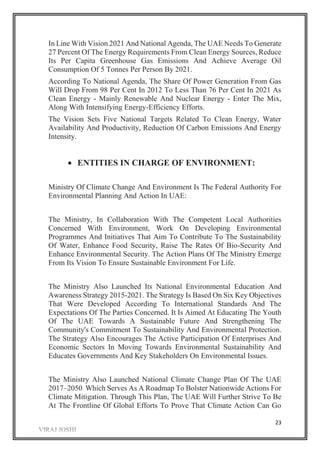
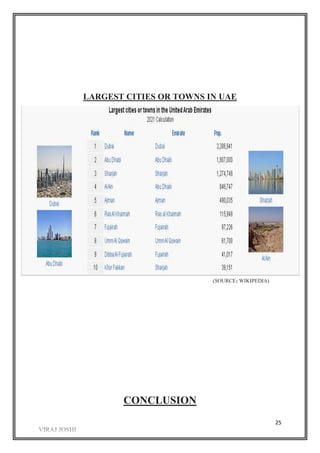
LARGEST CITIES OR TOWNS IN UAE
(SOURCE: WIKIPEDIA)
CONCLUSION
26
In This Project We Do Pestle Analysis Of UAE Country.
After An In-Depth Study Of The Pestle Analysis Of UAE,
We’ve Concluded That UAE Is Indeed The World’s Newly
Developed Country With An Extraordinary Growth Rate.
Environmental Challenges, Water Scarcity, Limited Civil
Liberties, Rules And Regulations Are Some Of The Top
Challenges They Faced. UAE Address These Issues &
They’re Presenting A Positive Image Of The Country.

A PROJECT ON PESTLE ANALYSIS.docx

  • 1.
    1 A PROJECT ONPESTLE ANALYSIS OF “UAE” COUNTRY. INDEX SR NO. PARTICULARS PAGE NO. 1 Introduction 3 2 Political 7 3 Economic 10 4 Social 13 5 Technology 16 6 Legal 19 7 Environment 22
  • 2.
    2  INTRODUCTION OFUAE: The United Arab Emirates (UAE), Is A Country In Western Asia (The Middle East). It Is Located At The Eastern End Of The Arabian Peninsula And Shares Borders With Oman And Saudi Arabia, While Having Maritime Borders In The Persian Gulf With Qatar And Iran. Abu Dhabi Is The Nation's Capital, While Dubai, The Most Populated City, Is An International Hub. The United Arab Emirates Is An Elective Monarchy Formed From A Federation Of Seven Emirates, Consisting Of Abu Dhabi (The Capital), Ajman, Dubai, Fujairah, Ras Al Khaimah, Sharjah And Umm Al Quwain. Each Emirate Is Governed By A Ruler And Together The Rulers Form The Federal Supreme Council. The Members Of The Federal Supreme Council Elect A President (As Of 14th May 2022, His Highness Sheikh Mohamed Bin Zayed Al Nahyan) And Vice President (His Highness Sheikh Mohammed Bin Rashid Al Maktoum) From Among Their Members. In Practice, The Ruler Of Abu Dhabi Serves As President While The Ruler Of Dubai Is Vice President And Also Prime Minister. In 2013, The Country Had A Population Of 9.2 Million, Of Which 1.4 Million Were Emirati Citizens And 7.8 Million Were Expatriates. As Of 2020, The United Arab Emirates Has An Estimated Population Of Roughly 9.9 Million. The Area Which Is Today The United Arab Emirates Has Been Inhabited For Over 125,000 Years. It Has Been The Crossroads Of Trading For Many Civilizations, Including Mesopotamia, Persia, And India. The United Arab Emirates' Oil And Natural Gas Reserves Are The World's Sixth And Seventh-Largest, Respectively. Zayed Bin Sultan Al Nahyan, Ruler Of Abu Dhabi And The Country's First President, Oversaw The Development Of The Emirates By Investing Oil Revenues Into Healthcare, Education, And UAE FLAG
  • 3.
    3 Infrastructure. The UnitedArab Emirates Has The Most Diversified Economy Among The Members Of The Gulf Cooperation Council. In The 21st Century, The Country Has Become Less Reliant On Oil And Gas And Is Economically Focusing On Tourism And Business. The Government Does Not Levy Income Tax, Although There Is A Corporate Tax In Place And A 5% Value-Added Tax Was Established In 2018. Human Rights Groups, Such As Amnesty International, Freedom House And Human Rights Watch, Regard UAE As Generally Substandard On Human Rights, With Citizens Criticising The Regime Imprisoned And Tortured, Families Harassed By The State Security Apparatus, And Cases Of Forced Disappearances. Individual Rights Such As The Freedoms Of Assembly, Association, The Press, Expression, And Religion Are Also Severely Repressed. The UAE Is Considered A Middle Power. It Is A Member Of The United Nations, Arab League, Organisation Of Islamic Cooperation, Opec, Non- Aligned Movement, And Gulf Cooperation Council (GCC)  HISTORY: Human Occupation In The Region Has Been Traced Back To The Emergence Of Anatomically Modern Humans From Africa Circa 124,000 Bce Through Finds At The Faya-2 Site In Mleiha, Sharjah. Burial Sites Dating Back To The Neolithic Age And The Bronze Age Include The Oldest Known Such Inland Site At Jebel Buhais. Known As Magan To The Sumerians, The Area Was Home To A Prosperous Bronze Age Trading Culture During The Umm Al Nar Period Which Traded Between The Indus Valley, Bahrain And Mesopotamia As Well As Iran, Bactria And The Levant. The Ensuing Wadi Suq Period And Three Iron Ages Saw The Emergence Of Nomadism As Well As The Development Of Water Management And Irrigation Systems Supporting Human Settlement In Both The Coast And Interior. The Islamic Age Began With The Expulsion Of The Sasanians And The Subsequent Battle Of Dibba. The Region's History Of Trade Led To The Emergence Of Julfar, In The Present-Day Emirate Of Ras Al Khaimah, As A Regional Trading And Maritime Hub In The Area. The Maritime Dominance Of The Persian Gulf By Arab Traders Led To Conflicts With European Powers, Including The Portuguese Empire And The UAE MAP
  • 4.
    4 British Empire. Following DecadesOf Maritime Conflict, The Coastal Emirates Became Known As The Trucial States With The Signing Of The General Maritime Treaty With The British In 1820 (Ratified In 1853 And Again In 1892), Which Established The Trucial States As A British Protectorate. This Arrangement Ended With Independence And The Establishment Of The United Arab Emirates On 2 December 1971 Following The British Withdrawal From Its Treaty Obligations. Six Emirates Joined The UAE In 1971; The Seventh, Ras Al Khaimah, Joined The Federation On 10 February 1972.  RELIGION: The Spread Of Islam To The North Eastern Tip Of The Arabian Peninsula Is Thought To Have Followed Directly From A Letter Sent By The Islamic Prophet, Muhammad, To The Rulers Of Oman In 630 Ce, Nine Years After The Hijrah. This Led To A Group Of Rulers Travelling To Medina, Converting To Islam And Subsequently Driving A Successful Uprising Against The Unpopular Sassanids, Who Dominated The Coast At The Time. Following The Death Of Muhammad, The New Islamic Communities South Of The Persian Gulf Threatened To Disintegrate, With Insurrections Against The Muslim Leaders. Caliph Abu Bakr Sent An Army From The Capital Medina Which Completed Its Reconquest Of The Territory (The Ridda Wars) With The Battle Of Dibba In Which 10,000 Lives Are Thought To Have Been Lost. This Assured The Integrity Of The Caliphate And The Unification Of The Arabian Peninsula Under The Newly Emerging Rashidun Caliphate. In 637, Julfar (In The Area Of Today's Ras Al Khaimah) Was An Important Port That Was Used As A Staging Post For The Islamic Invasion Of The Sasanian Empire. The Area Of The Al Ain/Buraimi Oasis Was Known As Tu'am And Was An Important Trading Post For Camel Routes Between The Coast And The Arabian Interior. Sheikh Zayed Mosque, Abu Dhabi
  • 5.
    5 The Earliest ChristianSite In The UAE Was First Discovered In The 1990s, An Extensive Monastic Complex On What Is Now Known As Sir Bani Yas Island And Which Dates Back To The Seventh Century. Thought To Be Nestorian And Built In 600 Ce, The Church Appears To Have Been Abandoned Peacefully In 750 Ce. It Forms A Rare Physical Link To A Legacy Of Christianity, Which Is Thought To Have Spread Across The Peninsula From 50 To 350 Ce Following Trade Routes. Certainly, By The Fifth Century, Oman Had A Bishop Named John – The Last Bishop Of Oman Being Etienne, In 676 Ce.  INDEPENDENCE: By 1966, It Had Become Clear The British Government Could No Longer Afford To Administer And Protect The Trucial States, What Is Now The United Arab Emirates. British Members Of Parliament (MPS) Debated The Preparedness Of The Royal Navy To Defend The Sheikhdoms. Secretary Of State For Defence Denis Healey Reported That The British Armed Forces Were Seriously Overstretched And In Some Respects Dangerously Under-Equipped To Defend The Sheikhdoms. On 24 January 1968, British Prime Minister Harold Wilson Announced The Government's Decision, Reaffirmed In March 1971 By Prime Minister Edward Heath, To End The Treaty Relationships With The Seven Trucial Sheikhdoms, That Had Been, Together With Bahrain And Qatar, Under British Protection. Days After The Announcement, The Ruler Of Abu Dhabi, Sheikh Zayed Bin Sultan Al Nahyan, Fearing Vulnerability, Tried To Persuade The British To Honour The Protection Treaties By Offering To Pay The Full Costs Of Keeping . The British Armed Forces In The Emirates. The British Labour Government Rejected The Offer. After Labour MP Goronwy Roberts Informed Sheikh Zayed Of The News Of British Withdrawal, The Nine Persian Gulf Sheikhdoms Attempted To Form A Union Of Arab Emirates, But By Mid-1971 They Were Still Unable To Agree On Terms Of Union Even Though The British Treaty Relationship Was To Expire In December Of That Year. The First Hosting Of UAE Flag In Dubai On 2 Dec 1971 The First Hosting Of UAE Falg In Dubai On 2 Dec 1971
  • 6.
    6  POLITICAL:  GOVERNMENT: TheUnited Arab Emirates (UAE) Is A Federal Federation Of Seven Hereditary Tribal Monarchy-Styled Political System Called Sheikhdoms. It Is Governed By A Federal Supreme Council Made Up Of The Ruling Sheikhs Of Abu Dhabi, Ajman, Fujairah, Sharjah, Dubai, Ras Al-Khaimah And Umm Al-Quwain. All Responsibilities Not Granted To The National Government Are Reserved To The Individual Emirate. A Percentage Of Revenues From Each Emirate Is Allocated To The UAE's Central Budget. The United Arab Emirates Uses The Title Sheikh Instead Of Emir To Refer To The Rulers Of Individual Emirates. The Title Is Used Due To The Sheikhdom Styled Governing System In Adherence To The Culture Of Tribes Of Arabia, Where Sheikh Means Leader, Elder, Or The Tribal Chief Of The Clan Who Partakes In Shared Decision Making With His Followers. Constitutional Monarchy Made Up From A The President And Vice President Are Elected By The Federal Supreme Council. Usually, A Sheikh From Abu Dhabi Holds The Presidency And A Sheikh From Dubai The Prime Ministership. All Prime Ministers But One Have Served Concurrently As Vice President. Sheikh Zayed Bin Sultan Al Nahyan Is The UAE Founding Father And Widely Credited For Unifying The Seven Emirates Into One Country. He Was The UAE's First President From The Nation's Founding Until His Death On 2 November 2004. On The Following Day The Federal Supreme Council Elected His Son, Sheikh Khalifa Bin Zayed Al Nahyan, To The Post. The Federal Government Is Composed Of Three Branches:  Legislative: A Unicameral Federal Supreme Council And The Advisory Federal National Council (FNC). Mohamed bin Zayed Al Nahyan
  • 7.
    7  Executive: ThePresident, Who Is Also Commander-In-Chief Of The Military, The Prime Minister And The Council Of Ministers.  Judicial: The Supreme Court And Lower Federal Courts. The UAE E-Government Is The Extension Of The UAE Federal Government In Its Electronic Form. The UAE's Council Of Ministers Is The Chief Executive Branch Of The Government Presided Over By The Prime Minister. The Prime Minister, Who Is Appointed By The Federal Supreme Council, Appoints The Ministers. The Council Of Ministers Is Made Up Of 22 Members And Manages All Internal And Foreign Affairs Of The Federation Under Its Constitutional And Federal Law. In December 2019, The UAE Became The Only Arab Country, And One Of Only Five Countries In The World, To Attain Gender Parity In A National Legislative Body, With Its Lower House 50 Per Cent Women. The UAE Is The Only Country In The World That Has A Ministry Of Tolerance, A Ministry Of Happiness, And A Ministry Of Artificial Intelligence.[129] The UAE Also Has A Virtual Ministry Called The Ministry Of Possibilities, Designed To Find Solutions To Challenges And Improve Quality Of Life. The UAE Also Has A National Youth Council, Which Is Represented In The UAE Cabinet By The Minister Of Youth. The UAE Legislative Is The Federal National Council Which Convenes Nationwide Elections Every 4 Years. The Fnc Consists Of 40 Members Drawn From All The Emirates. Each Emirate Is Allocated Specific Seats To Ensure Full Representation. Half Are Appointed By The Rulers Of The Constituent Emirates, And The Other Half Are Elected. By Law, The Council Members Have To Be Equally Divided Between Males And Females. The Fnc Is Restricted To A Largely Consultative Role.  FOREIGN RELATIONS: The UAE Has Broad Diplomatic And Commercial Relations With Most Countries And Members Of The United Nations. It Plays A Significant Role In OPEC, And Is One Of The Founding Members Of The Gulf Cooperation Council (GCC). The UAE Is A Member Of The United Nations And Several Of Its Specialized Agencies (Icao, Ilo, Upu, Who, Wipo), As Well As The World Bank, Imf, Arab League, Organisation Of Islamic Cooperation (OIC), And The Non- Aligned Movement. Also, It Is An Observer In The Organisation Internationale Mohammed bin Rashid Al Maktoum
  • 8.
    8 De La Francophonie.Most Countries Have Diplomatic Missions In The Capital Abu Dhabi With Most Consulates Being In UAE's Largest City, Dubai. Emirati Foreign Relations Are Motivated To A Large Extent By Identity And Relationship To The Arab World. The United Arab Emirates Has Strong Ties With Bahrain, China, Egypt, France, India, Jordan, Pakistan, Russia, Saudi Arabiaand The United States. Following The British Withdrawal From The UAE In 1971 And The Establishment Of The UAE As A State, The UAE Disputed Rights To Three Islands In The Persian Gulf Against Iran, Namely Abu Musa, Greater Tunb, And Lesser Tunb. The UAE Tried To Bring The Matter To The International Court Of Justice, But Iran Dismissed The Notion. Pakistan Was The First Country To Formally Recognize The UAE Upon Its Formation. The UAE Alongside Multiple Middle Eastern And African Countries Cut Diplomatic Ties With Qatar In June 2017 Due To Allegations Of Qatar Being A State Sponsor Of Terrorism, Resulting In The Qatar Diplomatic Crisis. Ties Were Restored In January 2021. The UAE Recognized Israel In August 2020, Reaching A Historic Israel–United Arab Emirates Peace Agreement And Leading Towards Full Normalization Of Relations Between The Two Countries.  MILITARY: The United Arab Emirates Military Force Was Formed In 1971 From The Historical Trucial Oman Scouts, Long A Symbol Of Public Order In Eastern Arabia And Commanded By British Officers. The Trucial Oman Scouts Were Turned Over To The United Arab Emirates, As The Nucleus Of Its Defence Forces In 1971, With The Formation Of The UAE, And Was Absorbed Into The Union Defence Force. Although Initially Small In Number, The UAE Armed Forces Have Grown Significantly Over The Years And Are Presently Equipped With Some Of The Most Modern Weapon Systems, Purchased From A Variety Of Western Military Advanced Countries, Mainly France, The Us And The Uk. Most Officers Are Graduates Of The United Kingdom's Royal Military Academy At Sandhurst, With Others Having Attended The United States Military Academy At West Point, The Royal Military College, Duntroon In Australia, And St Cyr, The Military Academy Of France. France And The United States Have Played The Most Strategically Significant Roles With Defence Cooperation Agreements And Military Material Provision. UAE Air Force F-16 Block 60 "Desert Falcon"
  • 9.
    9 Examples Of TheMilitary Assets Deployed Include The Enforcement Of The No-Fly-Zone Over Libya By Sending Six UAE AF F-16 And Six Mirage 2000 Multi-Role Fighter Aircraft, Ground Troop Deployment In Afghanistan.  ECONOMIC:  BUSINESS AND FINANCE: The UAE Offers Businesses A Strong Enabling Environment: Stable Political And Macroeconomic Conditions, A Future-Oriented Government, Good General Infrastructure And ICT Infrastructure. Moreover, The Country Has Made Continuous And Convincing Improvements To Its Regulatory Environment And Is Ranked As The 26th Best Nation In The World For Doing Business By The Doing Business 2017 Report Published By The World Bank Group. The UAE Are In The Top Ranks Of Several Other Global Indices, Such As The World Economic Forum's (WEF) Global Competitiveness Index (GCI), The World Happiness Report (WHR) And 33rd In The Global Innovation Index In 2021. The Economist Intelligence Unit (EIU), For Example, Assigns The UAE Rank Two Regionally In Terms Of Business Environment And 22 Worldwide. From The 2018 Arab Youth Survey The UAE Emerges As The Top Arab Country In Areas Such As Living, Safety And Security, Economic Opportunities, And Starting A Business, And As An Example For Other States To Emulate. The Weaker Points Remain The Level Of Education Across The UAE Population, Limitations In The Financial And Labour Markets, Barriers To Trade And Some Regulations That Hinder Business Dynamism. The Major Challenge For The Country, Though, Remains Translating Investments And Strong Enabling Conditions Into Knowledge, Innovation And Creative Outputs. The UAE's Monetary Policy Stresses Stability And Predictability, As The Central Bank Of The UAE (CbUAE) Keeps A Peg To The Us Dollar (Usd) And Moves Interest Rates Close To The Federal Funds Rate. This Policy Makes Sense In The Current Situation Of Global And Regional Economic And Geopolitical Uncertainty. Also Considering The Fact That Exports Have Become The Main Driver Of The UAE's Economic Growth (The Contribution Of International Trade To GDP Grew From 31% In 2017 To 33.5% In 2018, Outpacing Overall A proportional representation of UAE Exports, 2019
  • 10.
    10 Gdp Growth ForThe Period), And The Fact That The AED Is Currently Undervalued, A Departure From This Policy – And Particularly The Peg – Would Negatively Affect This Important Part Of The UAE Economy In The Short Term. In The Mid- To Long Term, However, The Peg Will Become Less Important, As The UAE Transitions To A Knowledge-Based Economy – And Becomes Yet More Independent From The Oil And Gas Sector (Oil Is Currently Still Being Traded Not In Aed, But In Usd). On The Contrary, It Will Become More And More Important For The Government To Have Monetary Policy At Its Free Disposal To Target Inflation, Shun Too Heavy Reliance On Taxes, And Avoid Situations Where Decisions On Exchange Rates And Interest Rates Contradict Fiscal Policy Measures – As Has Been The Case In Recent Years, Where Monetary Policy Has Limited Fiscal Policy Effects On Economic Expansion.  OIL AND GAS: The UAE Leadership Has Driven Forward Economic Diversification Efforts Already Before The Oil Price Crash In The 1980s, And The UAE Is Nowadays The Most Diversified Economy In The Middle East And North Africa (Mena) Region. Although The Oil And Gas Sector Does Still Play An Important Role In The UAE Economy, These Efforts Have Paid Off In Terms Of Great Resilience During Periods Of Oil Price Fluctuations And Economic Turbulence.In 2018, The Oil And Gas Sector Contributed 26% To Overall GDP. The Introduction Of The Vat Has Provided The Government With An Additional Source Of Income – Approximately 6% Of The Total Revenue In 2018, Or 27 Billion United Arab Emirates Dirham (Aed) – Affording Its Fiscal Policy More Independence From Oil- And Gas-Related Revenue, Which Constitutes About 36% Of The Total Government Revenue. While The Government May Still Adjust The Exact Arrangement Of The Vat, It Is Not Likely That Any New Taxes Will Be Introduced In The Foreseeable Future. Additional Taxes Would Destroy One Of The UAE's Main Enticements For Businesses To Operate In The Country And Put A Heavy Burden On The Economy. The UAE's Carbon Dioxide Emissions Per Capita Are High, Ranking Sixth Among Countries Globally. The Barakah Nuclear Power Plant Is The First On The Arabian Peninsula And Expected To Reduce The Carbon Footprint Of The Country.  TOURISM: Ruwais Refinery is the fourth-largest single-site oil refinery in the world and the biggest in the Middle East.
  • 11.
    11 Tourism Acts AsA Growth Sector For The Entire UAE Economy. Dubai Is The Top Tourism Destination In The Middle East. According To The Annual Mastercard Global Destination Cities Index, Dubai Is The Fifth Most Popular Tourism Destination In The World. Dubai Holds Up To 66% Share Of The UAE's Tourism Economy, With Abu Dhabi Having 16% And Sharjah 10%. Dubai Welcomed 10 Million Tourists In 2013. The UAE Has The Most Advanced And Developed Infrastructure In The Region. Since The 1980s, The UAE Has Been Spending Billions Of Dollars On Infrastructure. These Developments Are Particularly Evident In The Larger Emirates Of Abu Dhabi And Dubai. The Northern Emirates Are Rapidly Following Suit, Providing Major Incentives For Developers Of Residential And Commercial Property. The Inbound Tourism Expenditure In The UAE For 2019 Accounted For 118.6 Percent Share Of The Outbound Tourism Expenditure. Since 6 January 2020, Tourist Visas To The United Arab Emirates Are Valid For Five Years. It Has Been Projected That The Travel And Tourism Industry Will Contribute About 280.6 Billion United Arab Emirati Dirham To The UAE's Gdp By 2028.  TRANSPORT:  SEA: The Major Ports Of The United Arab Emirates Are Khalifa Port, Zayed Port, Port Jebel Ali, Port Rashid, Port Khalid, Port Saeed, And Port Khor Fakkan.The Emirates Are Increasingly Developing Their Logistics And Ports In Order To Participate In Trade Between Europe And China Or Africa. For This Purpose, Ports Are Being Rapidly Expanded And Investments Are Being Made In Their Technology. The Emirates Have Historically Been And Currently Still Are Part Of The Maritime Silk Road That Runs From The Chinese Coast To The South Via The Southern Tip Of India To Mombasa, From There Through The Red Sea Via The Suez Canal To The Mediterranean, There To The Upper Adriatic Region And The Northern Italian Hub Of Trieste With Its Rail Connections To Central Europe, Eastern Europe And The North Sea.
  • 12.
    12  HIGHWAY: Abu Dhabi,Dubai, Sharjah, Ajman, Umm Al Quwain, And Ras Al Khaimah Are Connected By The E11 Highway, Which Is The Longest Road In The UAE. In Dubai, In Addition To The Dubai Metro, The Dubai Tram And Palm Jumeirah Monorail Also Connect Specific Parts Of The City. There Is Also A Bus, Taxi, Abra And Water Taxi Network Run By Rta. T1, A Double-Decker Tram System In Downtown Dubai, Were Operational From 2015 To 2019.  SOCIAL:  CULTURE: The United Arab Emirates Has A Diverse Society. Dubai's Economy Depends More On International Trade And Tourism, And Is More Open To Visitors, While Abu Dhabi Society Is More Domestic As The City's Economy Is Focused On Fossil Fuel Extraction. Major Holidays In The United Arab Emirates Include Eid Al Fitr, Which Marks The End Of Ramadan, And National Day (2 December), Which Marks The Formation Of The United Arab Emirates. Emirati Males Prefer To Wear A Kandura, An Ankle-Length White Tunic Woven From Wool Or Cotton, And Emirati Women Wear An Abaya, A Black Over-Garment That Covers Most Parts Of The Body. Ancient Emirati Poetry Was Strongly Influenced By The Eighth-Century Arab Scholar Al Khalil Bin Ahmed. The Earliest Known Poet In The UAE Is Ibn Majid, Born Between 1432 And 1437 In Ras Al-Khaimah. The Most Famous Emirati Writers Were Mubarak Al Oqaili (1880–1954), Salem Bin Ali Al Owais (1887–1959) And Ahmed Bin Sulayem (1905–1976). Three Other Poets From Sharjah, Known As The Hirah Group, Are Observed To Have Been Heavily Influenced By The Apollo And Romantic Poets. The Sharjah International Book Fair Is The Oldest And Largest In The Country. E 311, one of major roads in the UAE. A band performs Yowlah in an Emirati wedding.
  • 13.
    13 The List OfMuseums In The United Arab Emirates Includes Some Of Regional Repute, Most Famously Sharjah With Its Heritage District Containing 17 Museums, Which In 1998 Was The Cultural Capital Of The Arab World. In Dubai, The Area Of Al Quoz Has Attracted A Number Of Art Galleries As Well As Museums Such As The Salsali Private Museum.[324] Abu Dhabi Has Established A Culture District On Saadiyat Island. Six Grand Projects Are Planned, Including The Guggenheim Abu Dhabi And The Louvre Abu Dhabi. Dubai Also Plans To Build A Kunsthal Museum And A District For Galleries And Artists. Emirati Culture Is A Part Of The Culture Of Eastern Arabia. Liwa Is A Type Of Music And Dance Performed Locally, Mainly In Communities That Contain Descendants Of Bantu Peoples From The African Great Lakes Region.The Dubai Desert Rock Festival Is Also Another Major Festival Consisting Of Heavy Metal And Rock Artists. The Cinema Of The United Arab Emirates Is Minimal But Expanding.  CUISINE: The Traditional Food Of The Emirates Has Always Been Rice, Fish And Meat. The People Of The United Arab Emirates Have Adopted Most Of Their Foods From Other West And South Asian Countries Including Iran, Saudi Arabia, Pakistan, India And Oman. Seafood Has Been The Mainstay Of The Emirati Diet For Centuries. Meat And Rice Are Other Staple Foods, With Lamb And Mutton Preferred To Goat And Beef. Popular Beverages Are Coffee And Tea, Which Can Be Complemented With Cardamom, Saffron, Or Mint To Give Them A Distinctive Flavour. Popular Cultural Emirati Dishes Include Threed, Machboos, Khubisa, Khameer And Chabab Bread Among Others While Lugaimat Is A Famous Emirati Dessert.With The Influence Of Western Culture, Fast Food Has Become Very Popular Among Young People, To The Extent That Campaigns Have Been Held To Highlight The Dangers Of Fast Food Excesses. Alcohol Is Allowed To Be Served Only In Hotel Restaurants And Bars. All Nightclubs Are Permitted To Sell Alcohol. Specific Supermarkets May Sell Alcohol, But These Products Are Sold In Separate Sections. Likewise, Pork, Which Is Haram (Not Permitted For Muslims), Is Sold In Separate Sections In All Major Supermarkets. Arabic Coffee With Lugaimat (A Traditional Emirati Sweet)
  • 14.
    14  SPORTS ANDRECREATION: Sports Are Popular In The United Arab Emirates And Are Strongly Supported By The Government. The Ministry Of Youth And Sports Oversees And Encourages The Many Groups, Clubs, And Associations That Provide Sports-Related Activities. Football (Soccer) Is The Most-Watched Spectator Sport, And Horse Racing Also Enjoys Widespread Popularity. The Federation Is Also A Major Centre For Camel Racing, A Traditional Sport That Became increasingly popular Late In The 20th Century, And For Falconry, Once An Important Means Of Hunting. Jujitsu Became Popular And Widespread In The 21st Century, Especially Because Of The Patronage Of Abu Dhabi’s Ruling Nahyan Family. The Country Hosts Many International Sporting Events, Most Notably For Golf, Jujitsu, Tennis, Rugby, And Boat Racing. The United Arab Emirates Made Its Olympic Debut At The 1984 Summer Games, And Its National Football (Soccer) Team Qualified For The World Cup In 1990. Abu Dhabi Began Hosting The Final Grand Prix Of The Formula One World Championship Tournament In 2009. The Country Hosted The FIFA Club World Cup In 2018, In Which The Club From Al- Ain Played Real Madrid In The Final Match, And Hosted The Asian Cup Tournament Months Later In 2019.  EDUCATION: The Education System Through Secondary Level Is Monitored By The Ministry Of Education In All Emirates Except Abu Dhabi, Where It Falls Under The Authority Of The Abu Dhabi Education Council. It Consists Of Primary Schools, Middle Schools And High Schools. The Public Schools Are Government-Funded And The Curriculum Is Created To Match The United Arab Emirates' Development Goals. The Medium Of Instruction In The Public School Is Arabic With Emphasis On English As A Second Language. There Sheikh Zayed Cricket Stadium in Abu Dhabi Zayed Sports City Stadium in Abu Dhabi. ABU DABHI UNIVERSITY
  • 15.
    15 Are Also ManyPrivate Schools Which Are Internationally Accredited. Public Schools In The Country Are Free For Citizens Of The UAE, While The Fees For Private Schools Vary. The Higher Education System Is Monitored By The Ministry Of Higher Education. The Ministry Also Is Responsible For Admitting Students To Its Undergraduate Institutions. The Adult Literacy Rate In 2015 Was 93.8%. The UAE Has Shown A Strong Interest In Improving Education And Research. Enterprises Include The Establishment Of The CERT Research Centres And The Masdar Institute Of Science And Technology And Institute.  TECHNOLOGY:  CLOUD COMPUTING: The UAE Is One Of The Largest Data Center Hubs In The Middle East And More Are Planned. Up To $1 Billion In Additional Investments Are Projected By 2026. In 2019, Microsoft Azure Launched Two Cloud Regions In Dubai And Abu Dhabi. In 2021, Amazon Web Services Announced Plans For A New Data Center Region In The UAE. The New Region Will Consist Of Three Availability Zones And Is Set To Open In 2022. In November 2021, Oracle Announced The Opening Of Its Second Cloud Region In Abu Dhabi, Following Their Dubai Cloud Region. Government-Owned Entities Etisalat And G42 Cloud Also Have Major Data Centers. With Aggressive Investments By The UAE Government In Cloud Computing, The UAE’s Competitive Business Laws, And Their Strong Technological Infrastructure, The ICT Sector Is Forecast To Continue Expanding In The Years Ahead. Public Cloud Hosting In The UAE Has Addressed Variations In Resources And Expertise Efficiently Through Highly Specialized Solutions. Despite These Significant Expansions, There Is Still Sizeable Room For Development That Will Require The Expertise And Know-How Of U.S. Firms.  CYBER SECURITY:
  • 16.
    16 The UAE’s GeopoliticalPosition And Importance To The World Economy In The Energy, Oil & Gas, And Aviation Industry Make The UAE Vulnerable As A Target Of Cyberattacks, Driving Rapid Growth In The Cybersecurity Market. The UAE Reports The Highest Number Of Malware Incidents Among Consumers In The GCC. To Protect The UAE’s Critical Data Information Infrastructure And Improve National Cybersecurity, The Government Introduced The UAE Information Assurance Standards Which Are A Set Of Guidelines For Government Entities In Critical Sectors. Compliance With These Standards Is Mandatory For All Government Organizations And Businesses That Are Identified As Critical Infrastructure In The UAE. Several Local Players Have Been Developing Cybersecurity Capabilities To Capitalize On Rising Demand, While International IT Security Firms Are Expanding Their Presence In The Country. With Leading Technology Experts Stating That The Number One Priority For UAE Firms Remains Cybersecurity, The Market Is Expected To Continue Expanding. Many UAE Development Initiatives Also Drive The Demand For Cybersecurity. These Factors And The Growing Demand For Cybersecurity Solutions Provide Many Opportunities For American Companies.  INTERNET OF THINGS: Internet Of Things (Iot) Opportunities Include Smart Services, The Industrial Internet, And Machine-To-Machine Communications. There Are Applications In The Public Sector For Smart Cities And Telehealth, And Enterprise Applications Include Smart Metering, Asset Tracking, And Production Optimization. The UAE Has Emerged As A Leading Global Location For The Deployment Of Iot Solutions To Enhance Public Infrastructure, Especially In Dubai As It Aims To Become A Leading Smart City. There Is A Foundation Of Cooperation In Dubai And The UAE Across Multiple Sectors Including ICT, Power, Transportation, Infrastructure, Healthcare, And Government.  ARTIFICIAL INTELLIGENCE :
  • 17.
    17 Artificial Intelligence (AI)Is A Priority In The UAE. AI Is Forecast To Play A Role To Contribute Almost 14% Of The National GDP By 2030 ($96 Billion), And The Annual Growth In The AI Contribution To The UAE Economy Is Forecast To Grow By 33.5% Between 2018 And 2030. As Part Of The Government’s UAE Centennial 2071 Plans, The UAE AI Strategy 2031 Was Launched To Improve Efficiency In The Transport, Health, Space, Renewable Energy, Water, Technology, Education, Environment, And Traffic Sectors. The UAE Has Already Begun Integrating AI With Industries Such As Education, Healthcare, Space, Transportation, And Aviation. AI Is A Key Part Of The Ambitious Plans Of The UAE Government To Diversify Their Economy And Become A Knowledge Economy. This Includes The Establishment Of The Mohamed Bin Zayed University Of Artificial Intelligence In Abu Dhabi, Part Of An Effort To Develop More Talent That Can Support The Growth Of The Digital Economy. The Race Between Gulf States To Have The Newest And Most Sophisticated Technology, Particularly In The Field Of AI, Provides A Large Market In Which U.S. Firms Have Comparative Advantages.  SMART CITIES: The UAE Has Made Significant Investments Into Projects For Smart Cities, With Goals To Build Smart Cities From Scratch And Improve Infrastructure In Existing Cities. Since October 2013, The Dubai Authorities Have Undertaken A Mission To Transform Dubai Into A Smart City, With Innovations Centered On Six Key Areas: Transport, Communications, Infrastructure, Electricity, Economic Services, And Urban Planning. The Digital Dubai Authority Was Established To Support The City-Wide Initiative To Transform Dubai Into The World’s Smartest And Happiest City. In December 2021, The Dubai Paperless Strategy Was Fully Implemented Across All 45 Government Entities In The Emirate, After Being Launched In 2018. These Entities Provide More Than 1,800 Digital Services And Over 10,500 Key Transactions.  5G:
  • 18.
    18 The UAE WasThe First Country In The Arab Region And Fourth Globally To Launch Its 5G Network. Both Du And Etisalat, The Nation’s Leading Telecom Companies, Launched Limited 5G Networks In 2019, Along With The 5G- Enabled ZTE Axon 10 Pro Smartphone To Both Post-Paid And Pre-Paid Customers. By The End Of 2023, It Is Estimated That 16 Million 5G Smartphones Will Be Operational In The Region. With The UAE Being At The Forefront Of Technological Advances And Given The Strong GDP Per Capita, Demand For 5G Services Is Predicted To Be Strong Over The Coming Years.  LEGAL:  UAE NATIONAL ACTION PLAN (NAP): The UAE National Action Plan (NAP) For The Implementation Of UN Security Council Resolution 1325 On Women, Peace And Security Aims To Empower And Support Women Globally By Promoting The Adherence To The UN Security Council Resolution 1325.
  • 19.
    19 Resolution 1325 StressesThe Important Role Of Women In The Prevention And Resolution Of Conflicts And In Post-Conflict Reconstruction. It Also Emphasises On Women’s Equal Participation In All Efforts For The Maintenance Of Peace And Security. It Calls On All Parties To Conflict To Take Special Measures To Protect Women And Girls From Gender-Based Violence And Other Forms Of Sexual Abuse. The UAE National Action Plan Aims To: 1. Respond To Gender Perspectives In Foreign Policies 2. Prevent And Combat Violent Extremism 3. Plan For Emergency Response And Crisis Situations 4. Incorporate Gender Analysis Into The Scope Of International Peace Efforts 5. Promote Gender Equality In Humanitarian Aid 6. Achieve Effective Participation Of Women In Conflict Prevention 7. Increase Women’s Participation In Peacebuilding 8. Train Women Military Officers 9. Enhance Women's Participation In Politics In The Country. The UAE Government Will Develop And Implement Various Campaigns To Raise Awareness And Secure Support For The Objectives Of The UAE NAP. It Will Also Build The Capacity Of Government Officials On The UN Agenda Of Women, Peace And Security. The UAE Is First Country Of Gulf Cooperation Council To Launch National Programmes To Support The UN Agenda Of Women, Peace And Security.  HUMAN RIGHTS: Throughout Its History, The UAE Has Followed The Principles Of Justice And Equality, Respect For Human Rights, Humanitarian Aid And Relief Action In Line With The Principles Of The Universal Declaration Of Human Rights. Since Its Inception, The UAE Has Ensured The Founding Of A Tolerant And Multi-Cultural Community In Which Individuals From Across The World Live In Harmony, Guaranteeing Via Its Constitution Their Civil Liberties.
  • 20.
    20  APPLICATION OFLAWS: The UAE Has Adopted A Codified System Of Laws, Which Is Transparent And Protects The Rights Of All Individuals. The UAE’s Constitution Includes The Following Provisions:  All Persons Shall Be Equal Before The Law. No Discrimination Shall Be Practised Between Citizens Of The Union By Reason Of Race, Nationality, Religious Belief Or Social Position.  No Person May Be Arrested, Searched, Detained Or Imprisoned, Except In Accordance With The Provisions Of The Law. No Man Shall Be Subjected To Torture Or Any Other Form Of Indignity.  No Punishment Shall Be Imposed For Any Act Of Commission Or Act Of Omission, Which Was Completed Before The Issue Of The Law Providing For Such Punishment.  Punishment Shall Be Applied To The Accused Person Only. An Accused Shall Be Deemed Innocent Until He Has Been Convicted By Means Of A Legal And Just Trial. The Accused Shall Have The Right To Appoint A Person Who Shall Conduct His Defence During The Trial. Physical And Mental Abuse Of An Accused Person Shall Be Prohibited.  CONSUMER PROTECTION LAW: The Federal Law No. 15 Of 2020 On Consumer Protection Repeals The Federal Law No. 24 Of 2006. The New Law Aims To Protect All Consumer Rights, Including The Right To A Standard Quality Of Goods And Services And The Right To Obtain Them At The Declared Price. It Further Seeks To Preserve The Health And Safety Of The Consumer When Using The Goods Or Receiving The Service. The Law Protects The Data Of The Consumers And Prohibits Suppliers From Using It For Marketing.  Scope Of The Law:
  • 21.
    21 The Law AppliesCovers All Goods And Services Sold Or Provided By Suppliers, Advertisers And Commercial Agents Across The UAE’s Mainland And Free Zones. I It Also Covers Goods Sold Through Ecommerce Platforms Registered In The UAE. Meanwhile, The Law Does Not Apply To Ecommerce Activities That Are Carried Out Between Customers In The UAE And Ecommerce Businesses Registered Outside The UAE.  Consumer Rights: According To The Law, The UAE’s Consumers Are Granted The Following Rights: 1. To Be Provided An Appropriate And Safe Environment When Purchasing A Good Or Receiving A Service 2. To Obtain Correct Information About The Goods They Purchase, Use Or Consume Or The Service They Receive 3. To Be Informed About Their Rights And Obligations 4. To Have The Right To Choose The Most Appropriate Product And Service Available In The Market According To Their Wishes 5. To Obtain Fair Compensation For Damages They Suffer As A Result Of Purchasing Or Using Defective Goods Or Receiving Inadequate Or Unprofessional Services.  ENVIRONMENT: The Challenges To The Natural Environment Today Are Immense. The UAE Faces The Impact Of Rapid Development And The Effects Of Climate Change And Global Warming. Protection Of Environment And Sustainable
  • 22.
    22 Development Are KeyTopics Which Receive Great Attention From The UAE Government. The UAE's Rapid Economic Development Made The Country Face Serious Environmental Challenges That Arise From The High Pace Of Population Growth, The Increase In The Demand For Energy And Water And The Fast- Paced Urban Development Accompanied With High Level Of GHG And Other Emissions In The UAE.  ENVIRONMENT VISION IN 2021: Creating And Maintaining A Sustainable Environment And Infrastructure Is A Pillar Of National Agenda In Line With Vision 2021. The UAE Government Wants To Ensure Sustainable Development While Preserving The Environment, And To Achieve A Perfect Balance Between Economic And Social Development. The UAE Has Set Key Performance Indicators (Kpis) To Measure Its Performance Against Its Targets Of 2021. They Are:  Improving The Air Quality Index  Improving The Percentage Of Treated Waste Of Total Waste Generated  Improving The Share Of Clean Energy Contribution  Decreasing The Water Scarcity Index  Improving The Networked Readiness Index (Telecommunication And It Sectors)  Improving The Quality Of Air Transport Infrastructure  Improving The Quality Of Port Infrastructure  Improving The Logistics Performance Index  Improving The Quality Of Overall Infrastructure (Such As Transportation, Electricity And Telephone Lines)  Improving The Online Services Index  Decreasing The Time Taken To Obtain A Loan/House From The Government For UAE Citizens
  • 23.
    23 In Line WithVision 2021 And National Agenda, The UAE Needs To Generate 27 Percent Of The Energy Requirements From Clean Energy Sources, Reduce Its Per Capita Greenhouse Gas Emissions And Achieve Average Oil Consumption Of 5 Tonnes Per Person By 2021. According To National Agenda, The Share Of Power Generation From Gas Will Drop From 98 Per Cent In 2012 To Less Than 76 Per Cent In 2021 As Clean Energy - Mainly Renewable And Nuclear Energy - Enter The Mix, Along With Intensifying Energy-Efficiency Efforts. The Vision Sets Five National Targets Related To Clean Energy, Water Availability And Productivity, Reduction Of Carbon Emissions And Energy Intensity.  ENTITIES IN CHARGE OF ENVIRONMENT: Ministry Of Climate Change And Environment Is The Federal Authority For Environmental Planning And Action In UAE: The Ministry, In Collaboration With The Competent Local Authorities Concerned With Environment, Work On Developing Environmental Programmes And Initiatives That Aim To Contribute To The Sustainability Of Water, Enhance Food Security, Raise The Rates Of Bio-Security And Enhance Environmental Security. The Action Plans Of The Ministry Emerge From Its Vision To Ensure Sustainable Environment For Life. The Ministry Also Launched Its National Environmental Education And Awareness Strategy 2015-2021. The Strategy Is Based On Six Key Objectives That Were Developed According To International Standards And The Expectations Of The Parties Concerned. It Is Aimed At Educating The Youth Of The UAE Towards A Sustainable Future And Strengthening The Community's Commitment To Sustainability And Environmental Protection. The Strategy Also Encourages The Active Participation Of Enterprises And Economic Sectors In Moving Towards Environmental Sustainability And Educates Governments And Key Stakeholders On Environmental Issues. The Ministry Also Launched National Climate Change Plan Of The UAE 2017–2050 Which Serves As A Roadmap To Bolster Nationwide Actions For Climate Mitigation. Through This Plan, The UAE Will Further Strive To Be At The Frontline Of Global Efforts To Prove That Climate Action Can Go
  • 24.
    24 Hand In HandWith Continuous Economic Development. The Document Serves As A Complementary Plan Of Action That Specifically Addresses Climate Change.  ENVIRONMENT VISION 2030: Environment Vision 2030 Identifies The Following 5 Priority Areas: 1.Climate Change - Minimising The Impact Of Climate Change. 2.Clean Air And Noise Pollution - Contributing To Safe And Healthy Living Conditions. 3.Water Resources - Efficient Management And Conservation Of Water Resources. 4.Biodiversity, Habitats And Cultural Heritage - Conserved For Current And Future Generations. 5.Waste Management – Enhanced Value Creation Through Optimised Material Flows And Waste Management. The Priority Areas Are Further Divided Into Sub-Priorities, Which In Turn Are Further Divided Into Environmental Outcomes. Each Outcome Has Three Values Assigned To It: 1.Current Value - This Refers To Values Of The State Of Environment In 2010 2.Threshold Value - This Refers To A Realistic Target To Be Achieved By 2030 3.Sustainability Value - This Refers To The Ultimate Desirable Target For The State Of Environment In Order To Be Sustainable.
  • 25.
    25 LARGEST CITIES ORTOWNS IN UAE (SOURCE: WIKIPEDIA) CONCLUSION
  • 26.
    26 In This ProjectWe Do Pestle Analysis Of UAE Country. After An In-Depth Study Of The Pestle Analysis Of UAE, We’ve Concluded That UAE Is Indeed The World’s Newly Developed Country With An Extraordinary Growth Rate. Environmental Challenges, Water Scarcity, Limited Civil Liberties, Rules And Regulations Are Some Of The Top Challenges They Faced. UAE Address These Issues & They’re Presenting A Positive Image Of The Country.