
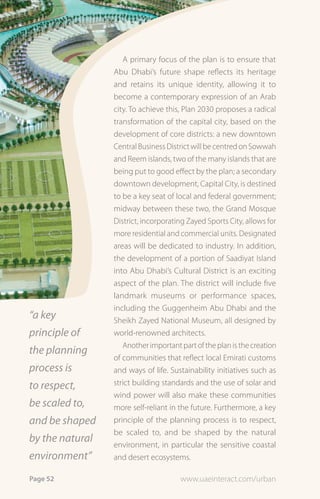
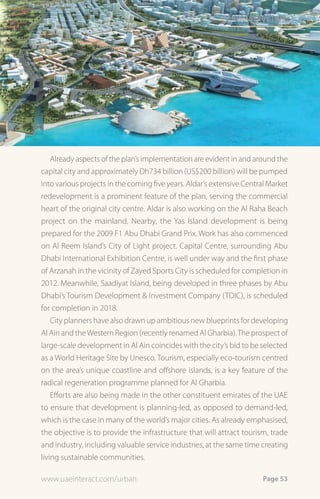
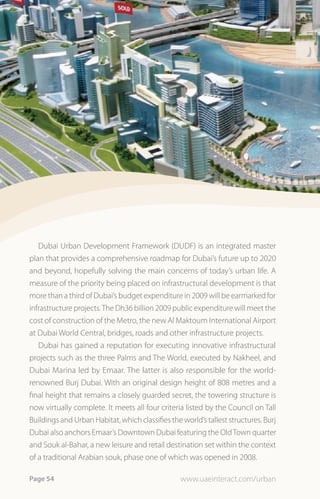
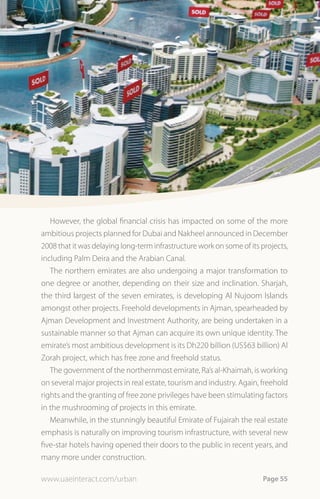
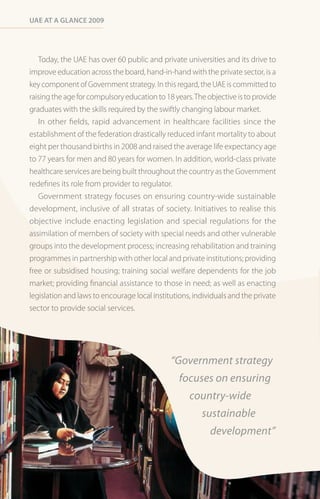
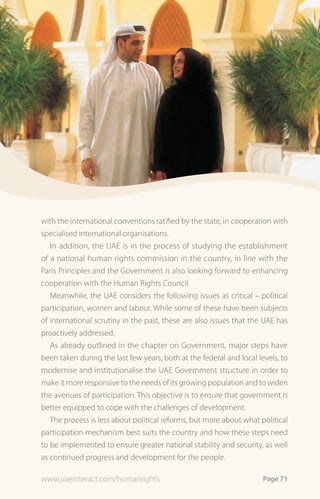


UAE
AT A GLANCE

2009
UAE at a
Glance
2009
Undertaken with the support and assistance of the National Media Council. This book
forms part of a multimedia publishing programme involving publication of the UAE
Yearbook in English, French and Arabic printed and electronic editions; management of
UAE Interact (www.uaeinteract.com), which contains news updates linked to pages of
the Yearbook; publication of UAE at a Glance, which summarises main data on the UAE;
and production of a DVD containing films and e-books on the UAE.

The publishers wish to acknowledge and thank the National Media Council for their
valuable encouragement and support for this multifaceted project.

Editor: Paula Vine
Associate Editors: Ibrahim Al Abed, Peter Hellyer, Peter Vine

Text copyright ©2009: Trident Press
Photographs ©: Emirates News Agency (WAM), Trident Press Ltd, The National, Gulf
News, Getty Images, Hanne & Jens Eriksen, Photolibrary, Frederic Froger, Fotosearch,
Grapheast, Abu Dhabi Urban Planning Council, BP Photographic Archives, Peter Vine

English edition design and typesetting: Noel Mannion
Layout copyright ©2009: Trident Press

This book contains information available at the time of printing. Whilst every effort
has been taken to achieve accuracy, the publishers cannot accept any liability for
consequences arising from the use of information contained in this book.

Statistics are based on available sources and are not necessarily official or endorsed by
the UAE Government.

British Library Cataloguing in Publication Data : A CIP catalogue record for this book is
available from the British Library.
ISBN: 1-905486-51-0
Published by Trident Press Ltd

175 Piccadilly, Mayfair, London WIJ 9TB        For further information please contact:
Tel: 020 7491 8770                             National Media Council
Fax: 020 7491 8664                             Abu Dhabi
E-mail: admin@tridentpress.com                 United Arab Emirates
Website: www.tridentpress.com                  Tel: 009712 4452922
                                               Fax: 009712 4450458
                                               E-mail: admin@extinfo.gov.ae
contents
u   History and Heritage   10

u   Government             20

u   the economy            36

u   infrastructure         50

u   People and society     66

u   media and culture      80

u   environment            86

u   sports and leisure     94

u   exhibitions and events 100
factfile
coUntry Profile
The United Arab Emirates is a federation of seven emirates (Abu Dhabi, Dubai, Sharjah,
Ajman, Umm al-Qaiwain, Ra’s al-Khaimah and Fujairah) that was formed in 1971.

¢    Country name:
     United Arab Emirates (UAE) or Dawlat al Imarat al Arabiyya al Muttahidah
¢    Capital: Abu Dhabi
¢    National Day: 2 December
¢    Time: four hours ahead of GMT
¢    Currency: Emirati dirham (Dh or AED)
¢    Exchange rate: Dh3.67 per US dollar. The UAE dirham has been o cially
     pegged to the US dollar since February 2002.
¢    Flag: three equal horizontal bands of green (top), white, and black with a wider
     vertical red band on the hoist side


GeoGraPHy
Situated towards the south-east of the Arabian Peninsula, the UAE is a roughly
triangular landmass whose coastlines form the south and south-eastern shores of
the Arabian Gulf and part of the western shores of the Gulf of Oman. The UAE thus
occupies a strategic location along southern approaches to the Straits of Hormuz.
The UAE also has land borders with Oman and Saudi Arabia.

¢    Latitude/Longitude: From 26.08˚ to 22.5˚N; 55.5˚ to 58.37˚E
¢    Area: approximately 82,880 square kilometres. Abu Dhabi accounts for 87 per
     cent of the country’s total landmass.
¢    Coastline: prior to construction of the ‘Dubai Palms’ and other schemes, the
     coastline of the UAE was approximately 1318 kilometres. Land reclamation
     projects are extending this gure so that the new coastline length is yet
     to be de ned.
¢    Climate: the UAE enjoys a desert climate, warm and sunny in winter, hot and
     humid during the summer months. Average rainfall is 100mm annually although
     it varies considerably across the country, with higher rainfall in the eastern
     mountains, where it is also generally cooler.
¢    Topography: a low-lying coastal plain merges into the rolling sand dunes of
     the Rub al-Khali desert with rugged mountains along the UAE’s eastern border
     with Oman and in the north.
¢    Elevation extremes: the country’s lowest point is at sea level and its highest
     point is 1527 metres at Jebal Yibir.
¢    Natural resources: the UAE’s most important natural resources are oil and
     natural gas, more than 90 per cent of which are located in Abu Dhabi.

Page 4
factfile
federal Government
The UAE enjoys a high degree of political stability and is the only state in the Arab
world to have a working federal system that has stood the test of time.

¢    Political system:
     a federation with speci c areas of authority constitutionally assigned to the
     UAE Federal Government and other powers reserved for member emirates.
¢    Constitution:
     adopted provisionally on 2 December 1971, made permanent in 1996.
¢    The Federal Supreme Council (FSC):
     the FSC, the highest constitutional authority in the UAE, has both legislative
     and executive powers and is made up of the rulers of the seven emirates.
¢    President: HH Sheikh Khalifa bin Zayed Al Nahyan, Ruler of Abu Dhabi
¢    Vice President & Prime Minister:
     HH Sheikh Mohammed bin Rashid Al Maktoum, Ruler of Dubai
¢    Deputy Prime Minister: HH Sheikh Sultan bin Zayed Al Nahyan
¢    Deputy Prime Minister: HH Sheikh Hamdan bin Zayed Al Nahyan
     The President and Vice President are elected by the Federal Supreme Council
     for ve-year terms, while the Prime Minister and Deputy Prime Minister are
     appointed by the President.
¢    Cabinet: Council of Ministers nominated by Prime Minister, appointed
     by the President
¢    Federal National Council (FNC): the FNC has both a legislative and
     supervisory role. Its 40 members are drawn from each emirate, half of whom are
     indirectly elected. 22.5% of FNC members are women.
¢    Federal judiciary: independent judiciary with the Federal Supreme Court at its
     apex (judges are appointed by the Federal Supreme Council) and also includes
     Courts of First Instance.
¢    Legal system: in addition to the federal court system introduced in 1971, all
     emirates have secular courts to adjudicate criminal, civil, and commercial matters,
     and Islamic courts to review family and religious disputes.
¢    Administrative divisions: each of the seven emirates has its own
     government with respective municipalities and departments.
¢    Foreign policy:
     the UAE’s foreign policy is derived from a set of guiding principles, amongst
     which are a deep belief in the need for justice in international dealings between
     states, including the necessity of adhering to the principle of non-interference in
     the internal a airs of others and the pursuit, whenever possible, of peaceful
     resolution of disputes, together with a support for international institutions, such
     as the United Nations.

                                                                                   Page 5
factfile
¢    Foreign aid: the UAE has provided over US$70 billion in loans, grants and
     assistance for development projects in some 100 countries. The UAE has also
     been a major contributor of emergency relief to regions a ected by con ict and
     natural disasters both at a governmental level and through NGOs. such as the
     UAE Red Crescent Society.
¢    International organisation participation: ABEDA, AFESD, AMF, FAO, G-
     77, GCC, IAEA, IBRD, ICAO, ICC, ICCT (signatory), ICRM, IDA, IDB, IFAD, IFC, IFRCS,
     IHO, ILO, IMF, IMO, Interpol, IOC, ISO, ITU, LAS, MIGA, NAM, OAPEC, OIC, OPCW,
     OPEC, UN, UNCTAD, UNESCO, UNIDO, UPU, WCO, WHO, WIPO, WMO, WTO

THE PEOPLE
Emiratis are a tolerant, forward-looking people with a strong sense of tradition.
They enjoy a high standard of living, including well-developed education and health
services. E orts are being made to develop human resources, e ect the empowerment
of women and provide social welfare to the more vulnerable in society.

¢    Population: 4.488 (2007); 4.76 million (est. 2008); 5.06 million (est. 2009)
¢    Nationals: 864,000 (est. 2007)
¢    Non-nationals: 3.62 million (est. 2007)
¢    Males: 3.08 million (est. 2007)
¢    Females: 1.4 million (est. 2007)
¢    Population under 15 years: 862,991 (est. 2007)
¢    Annual population growth rate: 6.31% (est. 2008–2009)
¢    National population growth rate: 3.4% (est. 2008–2009)
¢    Most populated emirate: Abu Dhabi with 1.493 million people (est. 2007)
¢    Least populated emirate: Umm al-Qaiwain with 52,000 inhabitants
¢    Language: Arabic
¢    Religion: Islam; practice of all religious beliefs is allowed.
¢    Life expectancy at birth: 78.5 years
¢    Under-five mortality rate: approx 8 per 1000 live births
¢    New-born (neonate) mortality: 5.54 per 1000
¢    Infant mortality rate: 7.7 per 1000
¢    Maternal mortality rate: 0.01 for every 100,000
¢    GDP per capita: Dh162,000 (2007)
¢    Percentage of women students at the UAE University: 75%
¢    Percentage of UAE women in labour force: approx. 30%
¢    School enrolment: 648,000 students in 1259 public and private schools
     (2007/08), of which over half are female
¢    No. of government and private universities: approx. 60
¢    Illiteracy rate: 7%

Page 6
factfile
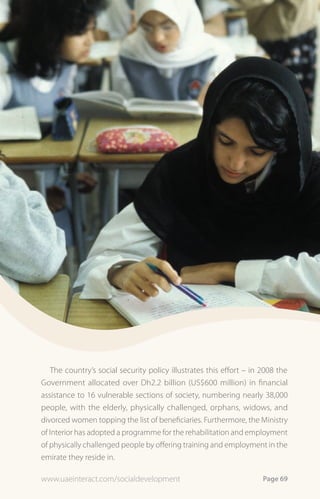
¢    Social security: in 2008 the Government allocated over Dh2.2 billion in
       nancial assistance to 16 vulnerable sections of society.
¢    UN Human Development Index ranking: 39 out of 177 countries (2008)
¢    Human rights conventions to which the country is a party:
     International Convention on the Elimination of All Forms of Racial Discrimination;
     International Covenant on Civil and Political Rights; Convention on the
     Elimination of All Forms of Discrimination Against Women; Convention on the
     Rights of the Child; Protocol to the Convention on the Rights of Person with
     Disabilities; Signatory to the Arab Charter on Human Rights; United Nations
     Convention against Transnational Organised Crime
¢    Labour rights conventions to which the country is a party:
     Elimination of forced and compulsory labour – Convention 29; Elimination of
     forced and compulsory labour – Convention 105; Elimination of discrimination
     in respect of employment and occupation – Convention 111; Abolition of child
     labour – Convention 138; Abolition of child labour – Convention 182

ECONOMY
The UAE has a vibrant free economy with a signi cant annual trade surplus. Successful
e orts have been made to diversify away from dependence on oil and gas exports and
a solid industrial base has been created together with a very strong services sector. The
establishment of free zones has been an important feature of this diversi cation policy
and reform of property laws has given a major boost to real estate and tourism sectors.

¢    Fiscal year: 1 January to 31 December
¢    GDP: Dh729.73 billion (2007, current prices)
¢    Real GDP growth rate: 5.2% (2007)
¢    Non-oil sector contribution to nominal GDP: 64.1% (2007)
¢    Industries: oil & gas, petrochemicals, aluminium, cement, ceramics, ship repair,
     pharmaceuticals, tourism, transport, real estate, nancial services
¢    Oil exports: 2.2 million barrels of crude oil per day, world’s third largest exporter
     of crude oil
¢    Oil reserves: 97.8 billion barrels, sixth largest in the world, of which Abu Dhabi
     holds 92.2 billion barrels or 94%
¢    Natural gas reserves: 6 trillion cubic metres, fth largest in the world
¢    Total exports FOB: Dh664.34 billion (est. 2007)
¢    Free-zone exports: Dh83.7 billion (est. 2007)
¢    Re-exports: Dh228.7 billion (est. 2007)
¢    Total Imports (FOB): Dh428.19 billion (2007)
¢    Value of oil exports: Dh261.42 billion
¢    Value of gas exports: Dh28.5 billion
¢    Weekend: Friday and Saturday for government institutions, many private
     companies operate a six-day week
                                                                                  Page 7
factfile
INFRASTRUCTURE

Commercial and residential areas, tourist facilities and industrial zones are being
built on an unprecedented scale and corresponding investment is taking place in
road and rail networks, airports and ports, telecommunications, electricity and water
plants, hospitals and educational facilities. To date, the Government has invested
heavily in infrastructure development, but it has also opened up its utilities and other
infrastructure to greater private sector involvement, so much so that public-private
partnerships are now the norm.

¢    Telecommunications: thriving deregulated market, modern bre-optic
     integrated services; digital network with highest mobile phone penetration
     in the Arab world
¢    International country code: 971
¢    Internet country code: ae
¢    Fixed line penetration rate: 30%
¢    Mobile phone subscribers: 9.2 million (est. 2008)
¢    Internet subscribers: 1.15 million (est. 2008)
¢    Main Ports: Mina Zayed, Jebel Ali, Mina Rashid, Fujairah, Khor Fakkan, Mina
     Saqr, Sharjah. Abu Dhabi is building a major new port, Khalifa Port & Industrial
     Zone, at Taweelah
¢    International airports: 7
¢    Available electricity generating capacity: 16,670 MW (UAE, 2007)
¢    Electricity generating capacity Abu Dhabi: 8000 MW (2007)
¢    Electricity generating capacity Dubai: 5500 MW (2007)
¢    Annual peak demand forecast Abu Dhabi: 18,574 MW (2010)
¢    Water production Abu Dhabi: 626 MIGD (2007)
¢    Water consumption: average of 550 litres per day


Page 8
history
   heritage
      and

 ‘He who does not know his past cannot make the best of
his present and future, for it is from the past that we learn.’
       The UAE has a long history, recent finds in the Hajar
       Mountains and in the Western Region of Abu Dhabi
       having pushed the earliest evidence of man in the Emirates
       back by hundreds of thousands of years, with a scatter of
       small sites from the Palaeolithic (Old Stone Age) period.

              The earliest known human occupation for which there
              is significant evidence dates from the Neolithic period,
              6000 BC or 8000 years ago, when the climate was wetter
              and food resources abundant. Even at this early stage, there
              is proof of interaction with the outside world, especially
              with civilisations to the north. These contacts persisted
              and became wide-ranging, probably motivated by trade
              in copper from the Hajar Mountains, commencing around
              3000 BC as the climate became more arid and fortified oasis
              communities focused on agriculture.
                 Foreign trade, the recurring motif in the history of this
              strategic region, seems to have flourished also in later
              periods, facilitated by domestication of the camel at the
              end of the second millennium BC. At the same time, the
              discovery of new irrigation techniques (falaj irrigation)

                                                                  Page 11
Uae at a Glance 2009


made possible the extensive watering of agricultural areas that resulted in
an explosion of settlement in the region.
   By the first century AD overland caravan traffic between Syria and cities in
southern Iraq, followed by seaborne travel to the important port of Omana
(perhaps present-day Umm al-Qaiwain) and thence to India was an alternative
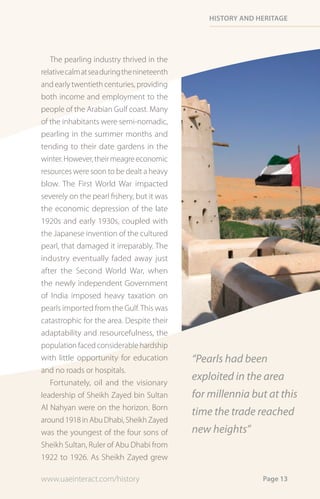
to the Red Sea route used by the Romans. Pearls had been exploited in the
area for millennia but at this time the trade reached new heights. Seafaring
was also a mainstay and major fairs were held at Dibba, bringing merchants
from as far afield as China.
   The arrival of envoys from the Prophet Muhammad in 630 AD heralded
the conversion of the region to Islam. By 637 AD Islamic armies were using
Julfar (Ra’s al-Khaimah) as a staging post for the conquest of Iran. Over many
centuries, Julfar became a wealthy port and pearling centre from which great
wooden dhows ranged far and wide across the Indian Ocean.
   The Portuguese arrival in the Gulf in the sixteenth century had bloody
consequences for the Arab residents of Julfar and east coast ports like Dibba,
Bidiya, Khor Fakkan and Kalba. However, while European powers competed
for regional supremacy, a local power, the Qawasim, was gathering strength.
At the beginning of the nineteenth century the Qawasim had built up a fleet
of over 60 large vessels and could put nearly 20,000 sailors to sea, eventually
provoking a British offensive to control the maritime trade routes between
the Gulf and India.
   Inland, the arc of villages at Liwa were the focus of economic and social
activity for the Bani Yas from before the sixteenth century. But by the early
1790s the town of Abu Dhabi had become such an important pearling centre
that the political leader of all the Bani Yas groups, the sheikh of the Al Bu Falah
(Al Nahyan family) moved there from the Liwa. Early in the nineteenth century,
members of the Al Bu Falasah, a branch of the Bani Yas, settled by the creek in
Dubai and established Maktoum rule in that emirate.
   Following the defeat of the Qawasim in 1820, the British signed a series of
agreements with the sheikhs of the individual emirates that, later augmented
with treaties on preserving a maritime truce, resulted in the area becoming
known as ‘The Trucial States’.

Page 12                                          www.uaeinteract.com/history
History and HeritaGe


   The pearling industry thrived in the
relative calm at sea during the nineteenth
and early twentieth centuries, providing
both income and employment to the
people of the Arabian Gulf coast. Many
of the inhabitants were semi-nomadic,
pearling in the summer months and
tending to their date gardens in the
winter. However, their meagre economic
resources were soon to be dealt a heavy
blow. The First World War impacted
severely on the pearl fishery, but it was
the economic depression of the late
1920s and early 1930s, coupled with
the Japanese invention of the cultured
pearl, that damaged it irreparably. The
industry eventually faded away just
after the Second World War, when
the newly independent Government
of India imposed heavy taxation on
pearls imported from the Gulf. This was
catastrophic for the area. Despite their
adaptability and resourcefulness, the
population faced considerable hardship
with little opportunity for education        “Pearls had been
and no roads or hospitals.
   Fortunately, oil and the visionary
                                             exploited in the area
leadership of Sheikh Zayed bin Sultan        for millennia but at this
Al Nahyan were on the horizon. Born
                                             time the trade reached
around 1918 in Abu Dhabi, Sheikh Zayed
was the youngest of the four sons of         new heights”
Sheikh Sultan, Ruler of Abu Dhabi from
1922 to 1926. As Sheikh Zayed grew

www.uaeinteract.com/history                                   Page 13
to manhood, he travelled widely throughout the country, gaining a deep
understanding of the land and of its people. In the early 1930s, when oil
company teams arrived to undertake preliminary geological surveys, he
obtained his first exposure to the industry that was to make possible the
development of today.
   In 1946, Sheikh Zayed was chosen as Ruler’s Representative in Abu Dhabi’s
Eastern Region, centred on Al Ain, 160 kilometres east of the island of Abu
Dhabi. He brought to his new task a firm belief in the values of consultation
and consensus and his judgements‘ were distinguished by their acute
insights, wisdom and fairness’.
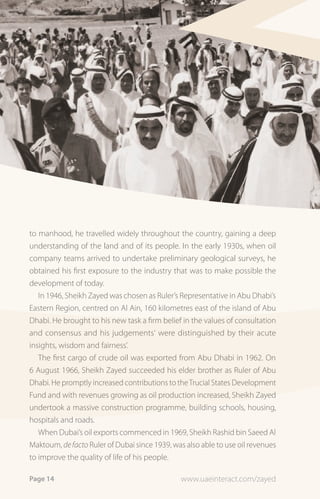
   The first cargo of crude oil was exported from Abu Dhabi in 1962. On
6 August 1966, Sheikh Zayed succeeded his elder brother as Ruler of Abu
Dhabi. He promptly increased contributions to the Trucial States Development
Fund and with revenues growing as oil production increased, Sheikh Zayed
undertook a massive construction programme, building schools, housing,
hospitals and roads.
   When Dubai’s oil exports commenced in 1969, Sheikh Rashid bin Saeed Al
Maktoum, de facto Ruler of Dubai since 1939, was also able to use oil revenues
to improve the quality of life of his people.

Page 14                                        www.uaeinteract.com/zayed
History and HeritaGe


                                                       Federation


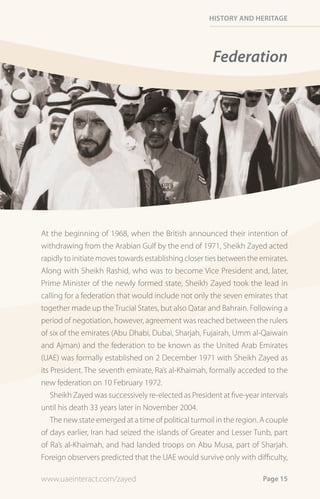
At the beginning of 1968, when the British announced their intention of
withdrawing from the Arabian Gulf by the end of 1971, Sheikh Zayed acted
rapidly to initiate moves towards establishing closer ties between the emirates.
Along with Sheikh Rashid, who was to become Vice President and, later,
Prime Minister of the newly formed state, Sheikh Zayed took the lead in
calling for a federation that would include not only the seven emirates that
together made up the Trucial States, but also Qatar and Bahrain. Following a
period of negotiation, however, agreement was reached between the rulers
of six of the emirates (Abu Dhabi, Dubai, Sharjah, Fujairah, Umm al-Qaiwain
and Ajman) and the federation to be known as the United Arab Emirates
(UAE) was formally established on 2 December 1971 with Sheikh Zayed as
its President. The seventh emirate, Ra’s al-Khaimah, formally acceded to the
new federation on 10 February 1972.
    Sheikh Zayed was successively re-elected as President at five-year intervals
until his death 33 years later in November 2004.
    The new state emerged at a time of political turmoil in the region. A couple
of days earlier, Iran had seized the islands of Greater and Lesser Tunb, part
of Ra’s al-Khaimah, and had landed troops on Abu Musa, part of Sharjah.
Foreign observers predicted that the UAE would survive only with difficulty,

www.uaeinteract.com/zayed                                              Page 15
Uae at a Glance 2009


pointing to disputes with its neighbours and to the wide disparity between
the seven emirates. Sheikh Zayed was more optimistic and the predictions
of those early pessimists were shown to be unfounded.
   There is no doubt that the prosperity, harmony and modern development
that today characterises the UAE is due to a very great extent to the formative
role played by Sheikh Zayed. During his years in Al Ain, Sheikh Zayed had
developed a vision of how the country should progress. He subsequently
spent over three and a half decades making that vision a reality.
   One foundation of Sheikh Zayed’s philosophy as a leader was that the
resources of the country should be used to benefit of the people. Under his
leadership society prospered and the country’s women accessed education
and came increasingly to play their part in political and economic life.
   Sheikh Zayed also believed in the need to preserve the traditional culture
of the people, in order to familiarise the younger generation with the ways
of their ancestors. He was also a firm proponent of the conservation of the
UAE’s environment, deriving this belief from his own upbringing where a
sustainable use of resources required man to live in harmony with nature.
   Sheikh Zayed imbibed the principles of Islam in his childhood and they
remained central to his beliefs throughout his life. He firmly opposed those
who pervert the message of Islam to justify harsh dogmas, intolerance and

Page 16                                         www.uaeinteract.com/zayed
History and HeritaGe


terrorism. In his view, such an approach was not merely a perversion of the
message but is in direct contradiction of it.
   Sheikh Zayed was also an eager advocate of tolerance and a better
understanding between those of different faiths and was an ardent advocate
of dialogue between Muslims and Christians.
   In the realm of foreign policy, his firmly held belief in eschewing rhetoric in
the search for solutions led the UAE to adopt an approach of seeking to find
compromises, and to avoid, wherever possible, a resort to the use of force,
whether in the Arab arena or more widely. Under his leadership, the country
became a major donor of overseas aid, both for infrastructural development
and for humanitarian relief, whether provided through civilian channels or,
occasionally, by sending units of the UAE Armed Forces as international
peacekeepers, such as to Kosovo in the late 1990s.
   The UAE, under his leadership, also showed its preparedness to fight to
defend justice, as was seen by its participation in the war to liberate Kuwait
from occupation in 1990–1991.
   Sheikh Zayed died in November 2004, being succeeded as the UAE’s
President and as Ruler of Abu Dhabi by his eldest son, HH Sheikh Khalifa bin
Zayed Al Nahyan. The principles and philosophy he brought to government,
however, remain at the core of the state, and of its policies, today.

www.uaeinteract.com/zayed                                                Page 17
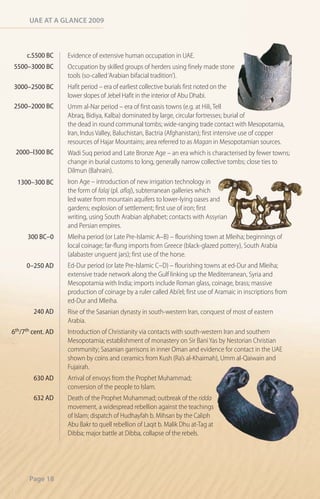
IMPORTANT DATES
      Uae at a Glance 2009


     c.5500 BC     Evidence of extensive human occupation in UAE.
5500–3000 BC       Occupation by skilled groups of herders using finely made stone
                   tools (so-called ‘Arabian bifacial tradition’).
3000–2500 BC       Hafit period – era of earliest collective burials first noted on the
                   lower slopes of Jebel Hafit in the interior of Abu Dhabi.
2500–2000 BC       Umm al-Nar period – era of first oasis towns (e.g. at Hili, Tell
                   Abraq, Bidiya, Kalba) dominated by large, circular fortresses; burial of
                   the dead in round communal tombs; wide-ranging trade contact with Mesopotamia,
                   Iran, Indus Valley, Baluchistan, Bactria (Afghanistan); first intensive use of copper
                   resources of Hajar Mountains; area referred to as Magan in Mesopotamian sources.
 2000–l300 BC      Wadi Suq period and Late Bronze Age – an era which is characterised by fewer towns;
                   change in burial customs to long, generally narrow collective tombs; close ties to
                   Dilmun (Bahrain).
  1300–300 BC      Iron Age – introduction of new irrigation technology in
                   the form of falaj (pl. aflaj), subterranean galleries which
                   led water from mountain aquifers to lower-lying oases and
                   gardens; explosion of settlement; first use of iron; first
                   writing, using South Arabian alphabet; contacts with Assyrian
                   and Persian empires.
      300 BC–0     Mleiha period (or Late Pre-Islamic A–B) – flourishing town at Mleiha; beginnings of
                   local coinage; far-flung imports from Greece (black-glazed pottery), South Arabia
                   (alabaster unguent jars); first use of the horse.
     0–250 AD      Ed-Dur period (or late Pre-Islamic C–D) – flourishing towns at ed-Dur and Mleiha;
                   extensive trade network along the Gulf linking up the Mediterranean, Syria and
                   Mesopotamia with India; imports include Roman glass, coinage, brass; massive
                   production of coinage by a ruler called Abi’el; first use of Aramaic in inscriptions from
                   ed-Dur and Mleiha.
        240 AD     Rise of the Sasanian dynasty in south-western Iran, conquest of most of eastern
                   Arabia.
6th/7th cent. AD   Introduction of Christianity via contacts with south-western Iran and southern
                   Mesopotamia; establishment of monastery on Sir Bani Yas by Nestorian Christian
                   community; Sasanian garrisons in inner Oman and evidence for contact in the UAE
                   shown by coins and ceramics from Kush (Ra’s al-Khaimah), Umm al-Qaiwain and
                   Fujairah.
        630 AD     Arrival of envoys from the Prophet Muhammad;
                   conversion of the people to Islam.
        632 AD     Death of the Prophet Muhammad; outbreak of the ridda
                   movement, a widespread rebellion against the teachings
                   of Islam; dispatch of Hudhayfah b. Mihsan by the Caliph
                   Abu Bakr to quell rebellion of Laqit b. Malik Dhu at-Tag at
                   Dibba; major battle at Dibba, collapse of the rebels.


      Page 18
HISTORY
                                                                       History and HeritaGe


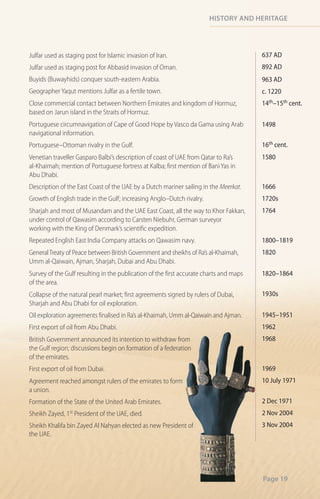
Julfar used as staging post for Islamic invasion of Iran.                               637 AD
Julfar used as staging post for Abbasid invasion of Oman.                               892 AD
Buyids (Buwayhids) conquer south-eastern Arabia.                                        963 AD
Geographer Yaqut mentions Julfar as a fertile town.                                     c. 1220
Close commercial contact between Northern Emirates and kingdom of Hormuz,               14th–15th cent.
based on Jarun island in the Straits of Hormuz.
Portuguese circumnavigation of Cape of Good Hope by Vasco da Gama using Arab            1498
navigational information.
Portuguese–Ottoman rivalry in the Gulf.                                                 16th cent.
Venetian traveller Gasparo Balbi’s description of coast of UAE from Qatar to Ra’s       1580
al-Khaimah; mention of Portuguese fortress at Kalba; first mention of Bani Yas in
Abu Dhabi.
Description of the East Coast of the UAE by a Dutch mariner sailing in the Meerkat.     1666
Growth of English trade in the Gulf; increasing Anglo–Dutch rivalry.                    1720s
Sharjah and most of Musandam and the UAE East Coast, all the way to Khor Fakkan,        1764
under control of Qawasim according to Carsten Niebuhr, German surveyor
working with the King of Denmark’s scientific expedition.
Repeated English East India Company attacks on Qawasim navy.                            1800–1819
General Treaty of Peace between British Government and sheikhs of Ra’s al-Khaimah,      1820
Umm al-Qaiwain, Ajman, Sharjah, Dubai and Abu Dhabi.
Survey of the Gulf resulting in the publication of the first accurate charts and maps   1820–1864
of the area.
Collapse of the natural pearl market; first agreements signed by rulers of Dubai,       1930s
Sharjah and Abu Dhabi for oil exploration.
Oil exploration agreements finalised in Ra’s al-Khaimah, Umm al-Qaiwain and Ajman.      1945–1951
First export of oil from Abu Dhabi.                                                     1962
British Government announced its intention to withdraw from                             1968
the Gulf region; discussions begin on formation of a federation
of the emirates.
First export of oil from Dubai.                                                         1969
Agreement reached amongst rulers of the emirates to form                                10 July 1971
a union.
Formation of the State of the United Arab Emirates.                                     2 Dec 1971
Sheikh Zayed, 1st President of the UAE, died.                                           2 Nov 2004
Sheikh Khalifa bin Zayed Al Nahyan elected as new President of                          3 Nov 2004
the UAE.


                                                                                        Page 19
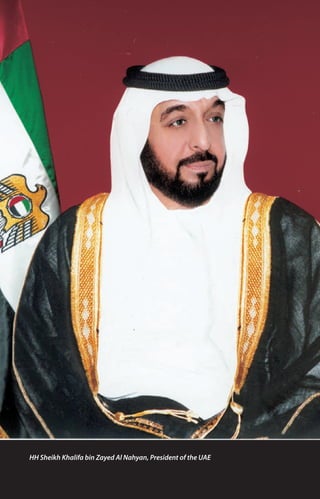
HH Sheikh Khalifa bin Zayed Al Nahyan, President of the UAE
Government


government
                         ‘Unity, progress and prosperity’

Since the establishment of the federation in 1971, the seven
emirates that comprise the United Arab Emirates (UAE), Abu
Dhabi, Dubai, Sharjah, Ajman, Umm al-Qaiwain, Ra’s al-
Khaimah and Fujairah, have forged a distinct national identity
through consolidation of their federal status and enjoy an
enviable degree of political stability.

             The UAE’s constitutionally-based federal system of
             government includes the following institutions: the
             Supreme Council, the Council of Ministers, the Federal
             National Council and the Federal Judiciary.
                The Supreme Council, which is made up of the rulers
             of each constituent emirate, is the top policy-making
             body in the state. It reaffirms the existing President and
             Vice President or elects new ones at five-yearly intervals.
             Sheikh Khalifa bin Zayed Al Nahyan, Ruler of Abu Dhabi,
             was elected as President of the UAE on 3 November
             2004. The current Vice President, Sheikh Mohammed
             bin Rashid Al Maktoum, also Prime Minister and Ruler
             of Dubai, has held the post since 3 January 2006.
                The Council of Ministers or Cabinet, headed by
             the Prime Minister, is the executive authority for the
             federation. The UAE’s parliament, the Federal National

                                                                Page 21
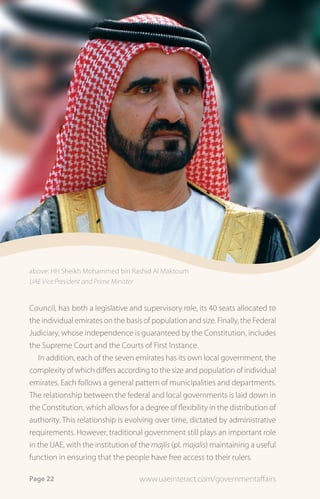
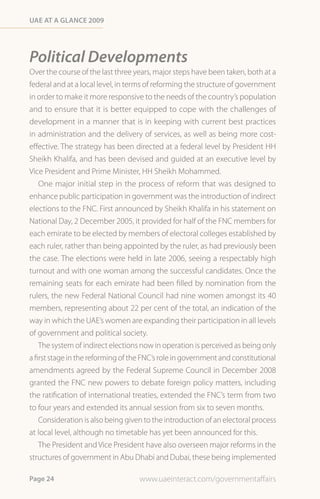
above: HH Sheikh Mohammed bin Rashid Al Maktoum
UAE Vice President and Prime Minister


Council, has both a legislative and supervisory role, its 40 seats allocated to
the individual emirates on the basis of population and size. Finally, the Federal
Judiciary, whose independence is guaranteed by the Constitution, includes
the Supreme Court and the Courts of First Instance.
   In addition, each of the seven emirates has its own local government, the
complexity of which differs according to the size and population of individual
emirates. Each follows a general pattern of municipalities and departments.
The relationship between the federal and local governments is laid down in
the Constitution, which allows for a degree of flexibility in the distribution of
authority. This relationship is evolving over time, dictated by administrative
requirements. However, traditional government still plays an important role
in the UAE, with the institution of the majlis (pl. majalis) maintaining a useful
function in ensuring that the people have free access to their rulers.

Page 22                             www.uaeinteract.com/governmentaffairs
Government


SUPREME COUNCIL MEMBERS

¢   HH President Sheikh Khalifa bin Zayed Al Nahyan, Ruler of Abu Dhabi
¢   HH Vice President and Prime Minister Sheikh Mohammed bin Rashid
    Al Maktoum, Ruler of Dubai
¢   HH Dr Sheikh Sultan bin Mohammed Al Qasimi, Ruler of Sharjah
¢   HH Sheikh Saqr bin Mohammed Al Qasimi, Ruler of Ra’s al-Khaimah
¢   HH Sheikh Hamad bin Mohammed Al Sharqi, Ruler of Fujairah
¢   HH Sheikh Saud bin Rashid Al Mu’alla, Ruler of Umm al-Qaiwain
¢   HH Sheikh Humaid bin Rashid Al Nuaimi, Ruler of Ajman


CROWN PRINCES

¢   HH General Sheikh Mohammed bin Zayed Al Nahyan, Crown Prince
    of Abu Dhabi and Deputy Supreme Commander of the UAE Armed Forces
¢   HH Sheikh Hamdan bin Mohammed Al Maktoum, Crown Prince of Dubai
¢   HH Sheikh Sultan bin Mohammed Al Qasimi, Crown Prince and Deputy
    Ruler of Sharjah
¢   HH Sheikh Saud bin Saqr Al Qasimi, Crown Prince and Deputy
    Ruler of Ra’s al-Khaimah
¢   HH Sheikh Mohammed bin Hamad Al Sharqi, Crown Prince of Fujairah
¢   HH Sheikh Ammar bin Humaid Al Nuaimi, Crown Prince of Ajman
¢ HH Sheikh Rashid bin Saud bin Rashid Al Mu’alla, Crown Prince of Umm al-Qaiwain


DEPUTIES OF THE RULERS

¢   HH Sheikh Hamdan bin Rashid Al Maktoum, Deputy Ruler of Dubai,
    Minister of Finance and Industry
¢   HH Sheikh Maktoum bin Mohammed Al Maktoum, Deputy Ruler of Dubai
¢   HH Sheikh Ahmed bin Sultan Al Qasimi, Deputy Ruler of Sharjah
¢   HH Sheikh Abdullah bin Salim bin Sultan Al Qasimi, Deputy Ruler of Sharjah
¢   HH Sheikh Sultan bin Saqr Al Qasimi, Deputy Ruler of Ra’s al-Khaimah
¢   HH Sheikh Hamad bin Saif Al Sharqi, Deputy Ruler of Fujairah
¢   HH Sheikh Abdullah bin Rashid Al Mu’alla, Deputy Ruler of Umm al-Qaiwain


                                                                            Page 23
Uae at a Glance 2009


Political Developments
Over the course of the last three years, major steps have been taken, both at a
federal and at a local level, in terms of reforming the structure of government
in order to make it more responsive to the needs of the country’s population
and to ensure that it is better equipped to cope with the challenges of
development in a manner that is in keeping with current best practices
in administration and the delivery of services, as well as being more cost-
effective. The strategy has been directed at a federal level by President HH
Sheikh Khalifa, and has been devised and guided at an executive level by
Vice President and Prime Minister, HH Sheikh Mohammed.
    One major initial step in the process of reform that was designed to
enhance public participation in government was the introduction of indirect
elections to the FNC. First announced by Sheikh Khalifa in his statement on
National Day, 2 December 2005, it provided for half of the FNC members for
each emirate to be elected by members of electoral colleges established by
each ruler, rather than being appointed by the ruler, as had previously been
the case. The elections were held in late 2006, seeing a respectably high
turnout and with one woman among the successful candidates. Once the
remaining seats for each emirate had been filled by nomination from the
rulers, the new Federal National Council had nine women amongst its 40
members, representing about 22 per cent of the total, an indication of the
way in which the UAE’s women are expanding their participation in all levels
of government and political society.
    The system of indirect elections now in operation is perceived as being only
a first stage in the reforming of the FNC’s role in government and constitutional
amendments agreed by the Federal Supreme Council in December 2008
granted the FNC new powers to debate foreign policy matters, including
the ratification of international treaties, extended the FNC’s term from two
to four years and extended its annual session from six to seven months.
    Consideration is also being given to the introduction of an electoral process
at local level, although no timetable has yet been announced for this.
    The President and Vice President have also overseen major reforms in the
structures of government in Abu Dhabi and Dubai, these being implemented

Page 24                             www.uaeinteract.com/governmentaffairs
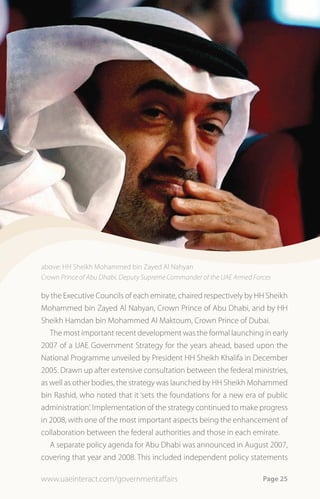
above: HH Sheikh Mohammed bin Zayed Al Nahyan
Crown Prince of Abu Dhabi, Deputy Supreme Commander of the UAE Armed Forces

by the Executive Councils of each emirate, chaired respectively by HH Sheikh
Mohammed bin Zayed Al Nahyan, Crown Prince of Abu Dhabi, and by HH
Sheikh Hamdan bin Mohammed Al Maktoum, Crown Prince of Dubai.
   The most important recent development was the formal launching in early
2007 of a UAE Government Strategy for the years ahead, based upon the
National Programme unveiled by President HH Sheikh Khalifa in December
2005. Drawn up after extensive consultation between the federal ministries,
as well as other bodies, the strategy was launched by HH Sheikh Mohammed
bin Rashid, who noted that it ‘sets the foundations for a new era of public
administration’. Implementation of the strategy continued to make progress
in 2008, with one of the most important aspects being the enhancement of
collaboration between the federal authorities and those in each emirate.
   A separate policy agenda for Abu Dhabi was announced in August 2007,
covering that year and 2008. This included independent policy statements

www.uaeinteract.com/governmentaffairs                                   Page 25
Uae at a Glance 2009


providing details of plans in areas such as economy, energy, tourism, health,
education, labour, civil services, culture and heritage, food control, urban
planning, transport, environment, health and safety, municipal affairs, police and
emergency services, electronic government, women, and legislative reform.
   The policy agenda was swiftly followed by the very detailed Plan Abu Dhabi
2030, covering the city of Abu Dhabi, the UAE’s federal capital, and adjacent
areas. An Al Ain Plan 2030 quickly followed, while work began in late 2008 on
a new Plan 2030 for the Western Region of Abu Dhabi, now officially called
Al Gharbia, in an effort to ensure that this large area receives its full share of
economic and social development.


Foreign Policy
The foreign policy of the UAE is based upon a belief in the need for justice in
international dealings between states, including the necessity of adhering
to the principle of non-interference in the internal affairs of others and the
pursuit, wherever possible, of peaceful resolutions of disputes, together with
a support for international institutions, such as the United Nations.
   Within the Arabian Gulf region, and in the broader Arab world, the UAE
has sought to enhance cooperation and to resolve disagreement through
dialogue. Thus one of the central features of the country’s foreign policy
has been the development of closer ties with its neighbours in the Arabian
Peninsula. The Arab Gulf Cooperation Council (AGCC), grouping the UAE,
Kuwait, Saudi Arabia, Bahrain, Qatar and Oman, was founded at a summit
conference held in Abu Dhabi in May 1981, and has since become, with
strong UAE support, an effective and widely respected grouping.
   In pursuit of its desire to work with other members of the international
community to promote the search for a just and lasting peace in the Middle
East, the UAE continued to urge other governments to become pro-active
on the issue throughout 2008. Leading UAE officials, including the President,
the Vice President and the Foreign Minister, have held discussions, both in the
UAE and elsewhere, with other global leaders, on ways to revitalise the peace
process. The election of a new US President in November 2008 brought the
hope that a new approach might be adopted in Washington during 2009.

Page 26                                   www.uaeinteract.com/foreignpolicy
Government


    At the same time, the UAE frequently reaffirmed its support for the
Palestinian people and for the Palestine Authority, while calling on the
Palestinians to unite so as to face effectively the challenges before them.
In particular, the UAE strongly condemned the Israeli attack on Gaza in
December 2008 and January 2009.
    The UAE was an active participant in the decision of the March 2008 Arab
summit, held in Damascus, to continue to promote the initiative agreed by
an earlier Beirut summit as a practical and real solution to the Middle East
crisis, noting that it took into account the fundamental factors that must be
included in any settlement.
    The UAE continued throughout 2008 to provide support to the Government
of Iraq. But this support was not confined simply to the political sphere. During
2008, the UAE was among the first Arab countries to re-open its diplomatic
mission in Baghdad while in August, on the instructions of President HH
Sheikh Khalifa, a decision was taken to write off debts and interest of over
US$7 billion owed by Iraq to the Emirates.
    The UAE also continued to offer support to the Government of Lebanon and
the Foreign Minister attended the session of the Lebanese Parliament in May
during which the country’s new President was elected after a long impasse.
    During the year, no visible progress was made on resolving the long-
running dispute with neighbouring Iran on the question of the three UAE
islands of Abu Musa and Greater and Lesser Tunb. Indeed, in August, the
UAE sent a letter of protest to the United Nations over a move by Iran to set
up two offices on Abu Musa in contravention of the 1971 Memorandum of
Understanding on the island.
    At the end of October, however, following an earlier visit to the UAE by
Iran’s President, the Foreign Minister visited Iran and signed a Memorandum
of Understanding with his Iranian colleague to establish a joint commission
between the two countries, which, it is hoped, may lead to some steps to
resolve the dispute.
    The UAE has also continued to express concern about Iran’s nuclear power
programme, and has sought reassurances that the programme is for peaceful
purposes only.

www.uaeinteract.com/foreignpolicy                                       Page 27
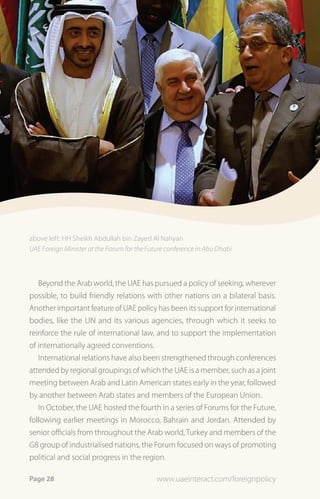
above left: HH Sheikh Abdullah bin Zayed Al Nahyan
UAE Foreign Minister at the Forum for the Future conference in Abu Dhabi


   Beyond the Arab world, the UAE has pursued a policy of seeking, wherever
possible, to build friendly relations with other nations on a bilateral basis.
Another important feature of UAE policy has been its support for international
bodies, like the UN and its various agencies, through which it seeks to
reinforce the rule of international law, and to support the implementation
of internationally agreed conventions.
   International relations have also been strengthened through conferences
attended by regional groupings of which the UAE is a member, such as a joint
meeting between Arab and Latin American states early in the year, followed
by another between Arab states and members of the European Union.
   In October, the UAE hosted the fourth in a series of Forums for the Future,
following earlier meetings in Morocco, Bahrain and Jordan. Attended by
senior officials from throughout the Arab world, Turkey and members of the
G8 group of industrialised nations, the Forum focused on ways of promoting
political and social progress in the region.

Page 28                                      www.uaeinteract.com/foreignpolicy
Government


   The UAE also hosted a major conference of parliamentarians from the North
Atlantic Treaty Organisation (NATO) for discussions on regional security.
   During the year, there was the usual steady flow of high-ranking visitors
from other countries to the Emirates, both from within the Gulf and Arab world,
and from further afield. Senior UAE officials, including President HH Sheikh
Khalifa, Vice President HH Sheikh Mohammed bin Rashid and the Crown
Prince of Abu Dhabi and Deputy Supreme Commander of the UAE Armed
Forces, HH Sheikh Mohammed bin Zayed, made numerous visits abroad.
   Throughout the year, the UAE continued to extend all possible support to
the international fight against terrorism, while emphasising the necessity both
of a clear definition of terrorism and of ensuring that terrorism perpetrated
by states should not be overlooked. Support has been offered to countries
suffering from terrorism, including collaboration in terms of exchanges of
information designed to help law enforcement authorities track down and
arrest suspects.
   The UAE believes, however, that the prevailing climate of misunderstanding
between different faiths and cultures is used by terrorists and those who
harbour them. It firmly supports, therefore, the promotion of intercultural
and interfaith dialogue.
   The country took part in the Interfaith Dialogue initiated during the year by
King Abdullah bin Abdul Aziz of Saudi Arabia. Supreme Council member HH
Sheikh Hamad bin Mohammed Al Sharqi led the UAE delegation, which also
included Foreign Minister HH Sheikh Abdullah bin Zayed Al Nahyan, to the
November 2008 conference on ‘The Culture of Peace and Dialogue among
Religions and Cultures’ held at the United Nations in November. At the same
time, the UAE has continued to argue that there is a need for different cultures
to avoid acts that can further deepen misunderstandings.
   During 2008, the UAE signed or ratified a number of international
conventions. Among these were the Protocol to the Convention on the Rights
of Persons with Disabilities and preparations were nearing completion at the
end of the year for the signing of the Convention against Torture and Other
Cruel, Inhuman or Degrading Treatment or Punishment.
   It also signed the UN Convention for Suppression of Nuclear Terrorism,

www.uaeinteract.com/foreignpolicy                                      Page 29
Uae at a Glance 2009


as part of measures designed to ensure that its own programme to
develop peaceful uses of nuclear energy, within the guidelines of the
International Atomic Energy Agency (IAEA), fully complied with all
applicable global agreements.
    While specific political issues, naturally, attracted much attention during
2008, the UAE has continued to maintain its focus on a range of topics with a
global relevance. Among these has been the issue of human trafficking, which
came to prominence early in 2008 with the holding of a special UN forum in
Vienna to launch the UN Global Initiative to Fight Trafficking, UN.GIFT.
    The UAE is working closely with international and regional law enforcement
agencies, as well as the authorities in other countries, to apprehend those
engaged in trafficking and the Government expended considerable effort
during 2008 in developing strategies with the source countries of migrant
labour to help to stamp out trafficking in the countries of origin. A conference
of Labour Ministers from source and host countries for migrant labour was
held in Abu Dhabi early in the year, at which an Abu Dhabi Declaration on
ways of regulating the flow of workers was agreed. This was followed in late
October by another major conference in Manila, Philippines, attended by the
UAE Minister of Labour.
    Another issue of global concern was economic in nature, rather than political,
following the depression that hit the world like a tsunami in the latter part of
the year. While moving to ensure that, as far as possible, the local economy
was insulated, the Government moved to work with multilateral institutions
like the International Monetary Fund (IMF) as well as on a bilateral basis, to
help to shore up the economies of the countries most seriously affected.
  During the year, the United Arab Emirates established diplomatic relations
with Montenegro and Kosovo, two of the successor states to the former
Yugoslavia, continuing its active involvement in this area of south-eastern
Europe. UAE forces earlier took part in peace-keeping activities in Kosovo.


Foreign Aid
Since the establishment of the UAE, the country has played an active role in
the provision of aid to developing countries and has been a major contributor

Page 30                                              www.uaeinteract.com/aid
Government


of emergency relief to regions affected by conflict and natural disasters.
The philosophy behind the aid policy is two-fold – first, a belief that help
for the needy is a duty incumbent on all Muslims and, second, that part of
the country’s wealth from oil and gas should be devoted to helping other
countries which have been less well-endowed.
   The main UAE governmental agency for foreign aid is the Abu Dhabi
Fund for Development (ADFD). Since its establishment in 1971, the ADFD
has provided over Dh12.6 billion (US$3.45 billion) in soft loans and grants to
countries around the world. In addition, the fund also manages 61 loans and
grants provided directly by the Abu Dhabi government. Since 1971, these
have accounted for a further Dh10 billion (US$2.72 billion), bringing the total
amount of the loans, grants and investments provided by the fund or the
Abu Dhabi government, and managed by the fund, to around Dh24 billion
(US$6.54 billion), covering 258 different projects in a total of 52 countries.
   Other assistance has also been provided through commitments made
at various multilateral donor conferences. Between 1994 to mid-2008, for
example, around Dh15.4 billion (US$ 4.2 billion) has been provided for the
Palestinians, including, most recently, US$300 million pledged at a donor
conference in Paris and an annual commitment of US$43 million to support
the Palestine National Authority.
   The UAE Federal Government also participates in a number of other
multilateral aid-giving institutions, including the International Development
Agency (IDA), and other bodies like the OPEC Fund for International
Development, the Arab Gulf Fund for the UN (AGFUND), the Arab Bank
for Economic Development in Africa (BADEA), the Abu Dhabi-based Arab
Monetary Fund (AMF) and the Islamic Development Bank (IDB). In recent years,
however, increasing attention has been paid to various forms of humanitarian
aid, destined for those in need because of natural disasters or conflict and
for those in such poverty and urgent need that longer-term development
projects will, quite simply, not deliver help in time.
   A key body in this process is the UAE Red Crescent Authority, chaired by the
country’s Deputy Prime Minister, HH Sheikh Hamdan bin Zayed Al Nahyan.
Over the last few years alone, the Red Crescent has spent over Dh2 billion

www.uaeinteract.com/aid                                                Page 31
Government


(US$545 million) on relief operations in a total of 95 countries throughout the
globe, with a special emphasis on those in need in Palestine, Iraq, Lebanon,
Afghanistan, Sudan and the Horn of Africa countries.
   Over the course of the last year, the UAE Red Crescent has continued
to be the country’s premier emergency relief agency, at least in terms of
the number of countries in which it operates, even though some of the
larger privately funded charitable foundations have disbursed more money.
During 2007, it provided a total of around Dh281 million (US$76.5 million)
in relief, humanitarian and development aid, 50 per cent higher than in the
previous year. Victims of natural disasters and armed conflicts in 40 countries
benefited. In the first half of 2008, a further Dh170.2 million (US$ 46.4 million)
was disbursed. It also handled the distribution and administration of funds
allocated by government and other private foundations, which amounted
to a substantially larger sum.
   It now ranks in the top ten member organisations of the International
Committee of the Red Cross in terms of the amount of relief assistance
provided – an impressive achievement for a country as small as the Emirates.
Other partners include the United Nations Development Programme (UNDP)
the UN High Commission for Refugees, (UNHCR) the United Nations Children’s
Fund (UNICEF), the UN Office for Coordination of Humanitarian Affairs (OCHA),
the United Nations Relief and Works Agency for Palestine Refugees in the
Near East (UNRWA), and the World Food Programme (WFP).
   A new initiative, The Sheikha Fatima bint Mubarak Fund for Refugee
Women, proposed by HH Sheikha Fatima, was launched during Ramadan
2008 by the UAE Red Crescent, acting in partnership with the Office of the UN
High Commissioner for Refugees. This is specifically designed to address the
needs of women and children displaced by conflict and natural disasters.
   The private humanitarian efforts of the UAE’s leading figures have also been
active during the course of the year. The Khalifa bin Zayed Charity Foundation,
established by President HH Sheikh Khalifa, made several major donations,
including Dh200 million (US$54.5 million dollars) to Afghanistan, to fund
sustainable social, economic, health, educational and utilities projects and
Dh184 million (US$50 million) in emergency assistance for China, following

www.uaeinteract.com/aid                                                  Page 33
Uae at a Glance 2009


the Sichuan earthquake. Other assistance included help in August for residents
of areas in Pakistan hit by floods, while in May, in a move designed to help
those suffering from the world shortage of wheat and consequent rising
prices, the President donated a million tonnes of wheat to Egypt and half a
million tonnes to Yemen.
    The Zayed bin Sultan Al Nahyan Charitable and Humanitarian Foundation,
established by the former President, focused its attention during 2008 on
projects inside the UAE, but still spent around 30 per cent of its budget
overseas. Over the last few years, the foundation has spent nearly Dh1.25
billion (US$340 million) on projects at home and abroad.
    A lead in terms of generosity in giving has also been shown by Vice
President and Prime Minister HH Sheikh Mohammed bin Rashid. His
Mohammed bin Rashid Charity and Humanitarian Foundation has provided
assistance for, amongst others, hospitals in Palestine and earthquake victims
in China and has also worked successfully to encourage Dubai-based
institutions to donate lavishly to its projects.
    Much more significant are two initiatives taken in the last couple of years
by HH Sheikh Mohammed that are designed to have a global reach. In 2007,
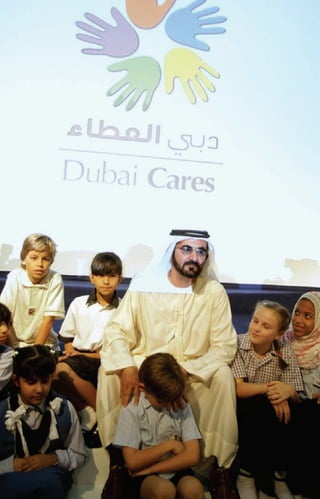
he launched the Dubai Cares campaign, with the initial goal of providing
primary education to one million underprivileged children around the world.
With well over Dh1 billion (US$273 million) raised to support its work, within
its first year of operations Dubai Cares had provided education to over
four million children in 13 countries across Africa and Asia, far exceeding
its original targets.
    This was followed in 2008 by another project, Noor Dubai (‘Light of
Dubai’). This initiative, which is being administered by the Dubai Health
Authority, is collaborating closely with the World Health Organisation (WHO),
the International Agency for the Prevention of Blindness (IAPB), Lions Club
International and Orbis to help at least one million people around the world
who are suffering from blindness and eye disease.
   It is not possible in a summary of a year’s events to give full details of
the extensive humanitarian assistance provided by all public and private
bodies and by individuals, both UAE citizens and expatriates, throughout

Page 34                                            www.uaeinteract.com/aid
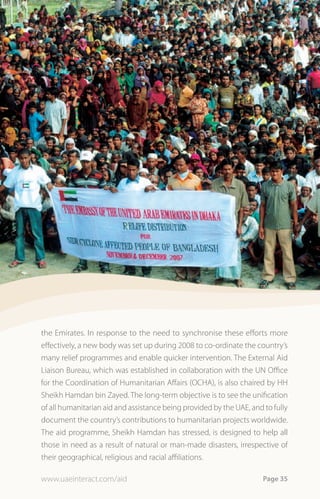
the Emirates. In response to the need to synchronise these efforts more
effectively, a new body was set up during 2008 to co-ordinate the country’s
many relief programmes and enable quicker intervention. The External Aid
Liaison Bureau, which was established in collaboration with the UN Office
for the Coordination of Humanitarian Affairs (OCHA), is also chaired by HH
Sheikh Hamdan bin Zayed. The long-term objective is to see the unification
of all humanitarian aid and assistance being provided by the UAE, and to fully
document the country’s contributions to humanitarian projects worldwide.
The aid programme, Sheikh Hamdan has stressed, is designed to help all
those in need as a result of natural or man-made disasters, irrespective of
their geographical, religious and racial affiliations.

www.uaeinteract.com/aid                                               Page 35
The
       economy
          ‘Diversification, growth and sustainability’

In 1971, the year of the UAE’s formation, the country’s GDP,
a measure of the total market value of all final goods and
services produced within the country in a single year, was
Dh6.5 billion. Thirty-seven years later it stood at around Dh753
billion, a multiple of 115 times its first year’s performance! By
any set of criteria that is very significant. But past growth rates
are unlikely to continue indefinitely. Instead, the UAE economy
is maturing and stabilising.

           The UAE’s real GDP percentage growth rates, year-on-year
           from 2004 to 2008 were 7.4, 8.2, 11.5, 5.2, and 7.5 per cent.
           Meanwhile, the projected growth rate for 2009 is around
           3.5 per cent. As these figures indicate, despite the impact of
           the global financial crisis being felt throughout the region,
           the UAE’s economy continues to expand and its financial
           fundamentals remain sound. These are underpinned by
           many years of prudent economic policy that have been
           responsible for building up the country’s significant assets,
           savings and investments.
               But, as the Governor of the Central Bank has been quick
           to acknowledge, there is no doubt that the economy is in
           ‘slow-down’ mode with the property market re-scheduling

                                                                 Page 37
some major projects and the banking sector reining in its lending activities,
at least for a while. However, ‘slow down’ is regarded by many as a positive
phenomenon and is valued as much for the opportunities it brings as the
challenges it presents.
   Fears of financial meltdown have been allayed by the UAE Government,
which has been playing a crucial role in mitigating the effects of the crisis
and stimulating recovery. Certainly, the Government wants to achieve
continued growth and its monetary policy remains expansionary, but the
percentage rise in GDP does not need to be in double digits, nor indeed
in high single digits. The aim is to keep moving forward and to achieve
balanced economic growth.
   Not only has the slow down encouraged the property development
sector to take stock of decisions made at a time of rampant growth and
surging inflation, it has also resulted in the stabilisation or reduction of prices
for many essential building materials, such as steel and cement, that had
rocketed in 2007 and the first half of 2008. And while the fall in fuel prices
has implications for the UAE budget, it also brings a reprieve for consumers
who were facing fuel surcharges on all forms of transport – involving both
people and goods. Instead of being discouraged by the economic downturn,
UAE government departments are more focused on locking in the savings
that can be achieved on undertaking major infrastructural projects in a less
frantic economic climate.

Page 38                        www.uaeinteract.com/economicdevelopment
By August 2008 it was also clear that UAE banks would be affected by signs
of cooling in the property sector. Prior to this, UAE banks had experienced
strong profit growth in recent years and the UAE banking sector had enjoyed
an extremely active year in 2007 with the aggregated balance sheet of banks
operating in the UAE increasing by 42.3 per cent.
   The UAE Government is making efforts to ensure that the over-heated
credit market does not get out of control in future and has brought in more
stringent guidelines for lending to both individuals and companies. UAE
banks are also reducing their exposure to foreign debt and in September
2008 the Central Bank and the Ministry of Finance launched an emergency
fund aimed at ensuring the banking system remained stable in the tight
credit environment. In addition, the UAE Cabinet’s decision to guarantee
banking deposits helped to steady the markets. The Government also plans
to support low interest rates so that the economy can continue to flourish.

 LIQUIDITY MEASURES

 ¢    22/09/08 UAE sets up Dh50 billion emergency facility
               for banks operating in the UAE
 ¢    08/10/08 Central Bank lowers its repo rate to 1.5% from 2.0%
 ¢    12/10/08 UAE guarantees deposits of local banks and foreign
               banks with core operations in UAE
 ¢    14/10/08 UAE announces it will inject Dh70 billion into
               banking system as long-term deposits


www.uaeinteract.com/economicdevelopment                              Page 39
Uae at a Glance 2009


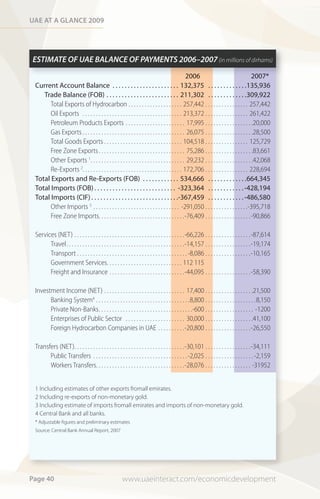
ESTIMATE OF UAE BALANCE OF PAYMENTS 2006–2007 (in millions of dirhams)
                                                                                              2006                                      2007*
 Current Account Balance . . . . . . . . . . . . . . . . . . . . . . 132,375 . . . . . . . . . . . . .135,936
    Trade Balance (FOB) . . . . . . . . . . . . . . . . . . . . . . . . 211,302 . . . . . . . . . . . . .309,922
       Total Exports of Hydrocarbon . . . . . . . . . . . . . . . . . . . . 257,442 . . . . . . . . . . . . . . . . 257,442
       Oil Exports . . . . . . . . . . . . . . . . . . . . . . . . . . . . . . . . . . . . . 213,372 . . . . . . . . . . . . . . . . 261,422
       Petroleum Products Exports . . . . . . . . . . . . . . . . . . . . . . 17,995 . . . . . . . . . . . . . . . . . .20,000
       Gas Exports . . . . . . . . . . . . . . . . . . . . . . . . . . . . . . . . . . . . . . 26,075 . . . . . . . . . . . . . . . . . .28,500
       Total Goods Exports . . . . . . . . . . . . . . . . . . . . . . . . . . . . . 104,518 . . . . . . . . . . . . . . . . 125,729
       Free Zone Exports . . . . . . . . . . . . . . . . . . . . . . . . . . . . . . . . 75,286 . . . . . . . . . . . . . . . . . .83,661
       Other Exports 1 . . . . . . . . . . . . . . . . . . . . . . . . . . . . . . . . . . . 29,232 . . . . . . . . . . . . . . . . . .42,068
       Re-Exports 2. . . . . . . . . . . . . . . . . . . . . . . . . . . . . . . . . . . . . 172,706 . . . . . . . . . . . . . . . . 228,694
 Total Exports and Re-Exports (FOB) . . . . . . . . . . . . 534,666 . . . . . . . . . . . . .664,345
 Total Imports (FOB) . . . . . . . . . . . . . . . . . . . . . . . . . . . -323,364 . . . . . . . . . . . . -428,194
 Total Imports (CIF) . . . . . . . . . . . . . . . . . . . . . . . . . . . . .-367,459 . . . . . . . . . . . . -486,580
       Other Imports 3 . . . . . . . . . . . . . . . . . . . . . . . . . . . . . . . . -291,050 . . . . . . . . . . . . . . . .-395,718
       Free Zone Imports. . . . . . . . . . . . . . . . . . . . . . . . . . . . . . . .-76,409 . . . . . . . . . . . . . . . . .-90,866

 Services (NET) . . . . . . . . . . . . . . . . . . . . . . . . . . . . . . . . . . . . . . . . .-66,226 . . . . . . . . . . . . . . . . .-87,614
       Travel. . . . . . . . . . . . . . . . . . . . . . . . . . . . . . . . . . . . . . . . . . . .-14,157 . . . . . . . . . . . . . . . . .-19,174
       Transport . . . . . . . . . . . . . . . . . . . . . . . . . . . . . . . . . . . . . . . . . -8,086 . . . . . . . . . . . . . . . . .-10,165
       Government Services. . . . . . . . . . . . . . . . . . . . . . . . . . . . 112 115
       Freight and Insurance . . . . . . . . . . . . . . . . . . . . . . . . . . . .-44,095 . . . . . . . . . . . . . . . . .-58,390

 Investment Income (NET) . . . . . . . . . . . . . . . . . . . . . . . . . . . . . . 17,400 . . . . . . . . . . . . . . . . . .21,500
       Banking System4 . . . . . . . . . . . . . . . . . . . . . . . . . . . . . . . . . . .8,800 . . . . . . . . . . . . . . . . . . .8,150
       Private Non-Banks. . . . . . . . . . . . . . . . . . . . . . . . . . . . . . . . . . .-600 . . . . . . . . . . . . . . . . . . -1200
       Enterprises of Public Sector . . . . . . . . . . . . . . . . . . . . . . 30,000 . . . . . . . . . . . . . . . . . .41,100
       Foreign Hydrocarbon Companies in UAE . . . . . . . . . .-20,800 . . . . . . . . . . . . . . . . .-26,550

 Transfers (NET). . . . . . . . . . . . . . . . . . . . . . . . . . . . . . . . . . . . . . . . .-30,101 . . . . . . . . . . . . . . . . .-34,111
       Public Transfers . . . . . . . . . . . . . . . . . . . . . . . . . . . . . . . . . . . -2,025 . . . . . . . . . . . . . . . . . . -2,159
       Workers Transfers. . . . . . . . . . . . . . . . . . . . . . . . . . . . . . . . .-28,076 . . . . . . . . . . . . . . . . . -31952


 1 Including estimates of other exports fromall emirates.
 2 Including re-exports of non-monetary gold.
 3 Including estimate of imports fromall emirates and imports of non-monetary gold.
 4 Central Bank and all banks.
 * Adjustable figures and preliminary estimates
 Source: Central Bank Annual Report, 2007


Page 40                                                www.uaeinteract.com/economicdevelopment
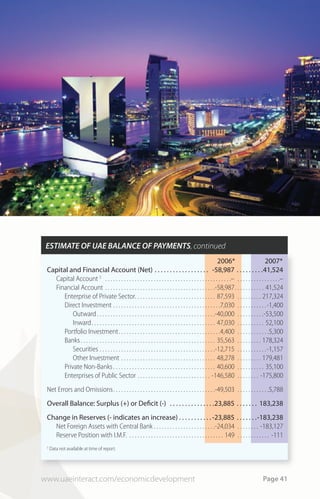
ESTIMATE OF UAE BALANCE OF PAYMENTS, continued
                                                                                                                2006*                     2007*
 Capital and Financial Account (Net) . . . . . . . . . . . . . . . . . . -58,987 . . . . . . . . .41,524
   Capital Account 5 . . . . . . . . . . . . . . . . . . . . . . . . . . . . . . . . . . . . . . . . . . . . . . .– . . . . . . . . . . . . . . . .–
   Financial Account . . . . . . . . . . . . . . . . . . . . . . . . . . . . . . . . . . . . . . . . .-58,987. . . . . . . . . . . 41,524
      Enterprise of Private Sector. . . . . . . . . . . . . . . . . . . . . . . . . . . . . . 87,593 . . . . . . . . . 217,324
      Direct Investment . . . . . . . . . . . . . . . . . . . . . . . . . . . . . . . . . . . . . . . .7,030 . . . . . . . . . . .-1,400
          Outward . . . . . . . . . . . . . . . . . . . . . . . . . . . . . . . . . . . . . . . . . . . .-40,000 . . . . . . . . . .-53,500
          Inward. . . . . . . . . . . . . . . . . . . . . . . . . . . . . . . . . . . . . . . . . . . . . . 47,030 . . . . . . . . . . 52,100
      Portfolio Investment. . . . . . . . . . . . . . . . . . . . . . . . . . . . . . . . . . . . . .4,400 . . . . . . . . . . . .5,300
      Banks . . . . . . . . . . . . . . . . . . . . . . . . . . . . . . . . . . . . . . . . . . . . . . . . . . 35,563 . . . . . . . . . 178,324
          Securities . . . . . . . . . . . . . . . . . . . . . . . . . . . . . . . . . . . . . . . . . . .-12,715 . . . . . . . . . . .-1,157
          Other Investment . . . . . . . . . . . . . . . . . . . . . . . . . . . . . . . . . . . 48,278 . . . . . . . . . 179,481
      Private Non-Banks . . . . . . . . . . . . . . . . . . . . . . . . . . . . . . . . . . . . . . 40,600 . . . . . . . . . . 35,100
      Enterprises of Public Sector . . . . . . . . . . . . . . . . . . . . . . . . . . . -146,580 . . . . . . . . -175,800
 Net Errors and Omissions. . . . . . . . . . . . . . . . . . . . . . . . . . . . . . . . . . . . . .-49,503 . . . . . . . . . . . .5,788
 Overall Balance: Surplus (+) or Deficit (-) . . . . . . . . . . . . . . .23,885 . . . . . . . 183,238
 Change in Reserves (- indicates an increase) . . . . . . . . . . . -23,885 . . . . . . .-183,238
   Net Foreign Assets with Central Bank . . . . . . . . . . . . . . . . . . . . . . .-24,034 . . . . . . . . -183,127
   Reserve Position with I.M.F. . . . . . . . . . . . . . . . . . . . . . . . . . . . . . . . . . . . 149 . . . . . . . . . . . . -111
 5
     Data not available at time of report.


www.uaeinteract.com/economicdevelopment                                                                                                Page 41
By December 2008, the UAE Central Bank had set up a task force, the Financial
Stability Unit, to ‘keep an eye’ on potential threats to the UAE’s financial system.
Proposals on the table include the introduction of ‘financial vehicles’ to
underpin real estate loans.
   Throughout 2007 and early 2008 the rate of inflation, which, at 11.1 per
cent in 2007, was relatively high by global standards, was influenced by a
major decline in the value of the US dollar, to which the UAE dirham is linked,
against other global currencies. However, a long-awaited reversal in the US
dollar’s international valuation, along with domestic measures introduced to
dampen inflation, brought some relief to the inflationary cycle in the second
half of the year.
   Stock markets in the UAE were also affected by the global turmoil in
financial markets in the second half of 2008, despite the fact that the UAE
has continued to raise standards of corporate governance and transparency,
thereby helping to underpin confidence in equity markets.

Page 42                        www.uaeinteract.com/economicdevelopment
Diversification
There is no doubt that revenues from oil exports
were instrumental in transforming the economy
of the country. Nevertheless, there is a deep
awareness that the security of future generations
depends on prudent investment both at home
and abroad.
   Strategic overseas investments by sovereign
wealth funds have been a critical component of
the UAE’s economic development strategy for
decades as the country has consistently made
an effort to diversify where and how it invests its
financial assets. Funds and companies such as
Abu Dhabi Investment Authority, International
Petroleum Investment Company, Abu Dhabi
National Energy Company (Taqa), Mubadala,
Dubai Holdings and Dubai International Capital
have all made their impact on the world stage.
Some are premier global institutional investors,
                                                      “It is worth
others take controlling interests in companies        remembering
in which they invest.
                                                      that diversification
   Economic diversification in the UAE has also
been a key plank of government strategy since         has been
the foundation of the state and is one of the         a necessity
major reasons why the UAE had the strength and
resources to weather the worldwide financial          rather than
storm that threatened to engulf all in its path in    a luxury for most
2008. In 2007 the non-oil sector accounted for
64.1 per cent of GDP (amounting to Dh467.9
                                                      of the emirates”
billion) and the hydrocarbon sector 35.9 per
cent. Remarkably, the non-oil sector figure was
achieved in a year when oil prices increased by
18.2 per cent, inevitably boosting earnings.

www.uaeinteract.com/economicdevelopment                          Page 43
Uae at a Glance 2009


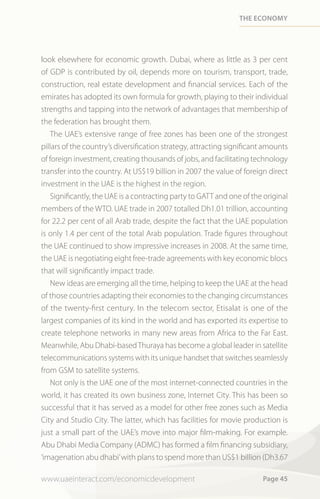
   To date, a wide range of industrial activities have been encouraged to
establish and grow in an environment that seeks to enhance, not obstruct,
entrepreneurial talents, enabling the UAE to diversify to an extent that it is
not totally at the mercy of the fluctuating world oil price or how much oil and
gas it pumps. Depending on the regional and global situation, the different
sectors may shift in terms of their importance, but there are enough varied
ingredients to support a fairly balanced economy.
   In 2007 the hierarchy of non-oil economic sectors was listed as follows,
starting with the largest: manufacturing (12 per cent); wholesale, retail and
maintenance (10 per cent); construction and real estate (each 8 per cent);
government services (7 per cent) and financial enterprises and transport/
storage/communications (both 6 per cent). Agriculture, electricity and water,
restaurants and hotels, together with social and private services, accounted
for around 6 per cent of total GDP.
   Besides hydrocarbons and the downstream petrochemicals sector, the
primary sectors attracting investment and providing the main driving
force for moving the economy forward are manufacturing, transport and
communications, and real estate.
   While some activities such as those involving the financial sector are
not so apparent to the general ‘man on the street’, nobody could miss the
forest of cranes that is evidence of the construction sector’s activities, or
the inescapable advertisements for new real estate projects. But the king of
the non-oil sector is still manufacturing: the UAE has pumped nearly Dh29
billion into manufacturing projects over the past four years in support of
more than 1000 projects. The sector includes huge industrial schemes such
as Dubal’s aluminium plant at Jebel Ali, the world renowned ceramics plant,
RAK Ceramics, in Ra’s al-Khaimah, large pharmaceutical plants, steel plants
and petrochemical production industries in Abu Dhabi, together with many
smaller scale but highly successful manufacturing units such as boat-builders,
furniture makers, food and clothes manufacturers.
   It is worth remembering that diversification has been a necessity rather
than a luxury for most of the emirates. With Abu Dhabi holding over 90 per
cent of the country’s hydrocarbon reserves, other emirates were forced to

Page 44                      www.uaeinteract.com/economicdevelopment
tHe economy


look elsewhere for economic growth. Dubai, where as little as 3 per cent
of GDP is contributed by oil, depends more on tourism, transport, trade,
construction, real estate development and financial services. Each of the
emirates has adopted its own formula for growth, playing to their individual
strengths and tapping into the network of advantages that membership of
the federation has brought them.
   The UAE’s extensive range of free zones has been one of the strongest
pillars of the country’s diversification strategy, attracting significant amounts
of foreign investment, creating thousands of jobs, and facilitating technology
transfer into the country. At US$19 billion in 2007 the value of foreign direct
investment in the UAE is the highest in the region.
   Significantly, the UAE is a contracting party to GATT and one of the original
members of the WTO. UAE trade in 2007 totalled Dh1.01 trillion, accounting
for 22.2 per cent of all Arab trade, despite the fact that the UAE population
is only 1.4 per cent of the total Arab population. Trade figures throughout
the UAE continued to show impressive increases in 2008. At the same time,
the UAE is negotiating eight free-trade agreements with key economic blocs
that will significantly impact trade.
   New ideas are emerging all the time, helping to keep the UAE at the head
of those countries adapting their economies to the changing circumstances
of the twenty-first century. In the telecom sector, Etisalat is one of the
largest companies of its kind in the world and has exported its expertise to
create telephone networks in many new areas from Africa to the Far East.
Meanwhile, Abu Dhabi-based Thuraya has become a global leader in satellite
telecommunications systems with its unique handset that switches seamlessly
from GSM to satellite systems.
   Not only is the UAE one of the most internet-connected countries in the
world, it has created its own business zone, Internet City. This has been so
successful that it has served as a model for other free zones such as Media
City and Studio City. The latter, which has facilities for movie production is
just a small part of the UAE’s move into major film-making. For example.
Abu Dhabi Media Company (ADMC) has formed a film financing subsidiary,
‘imagenation abu dhabi’ with plans to spend more than US$1 billion (Dh3.67

www.uaeinteract.com/economicdevelopment                                 Page 45
billion) developing, financing and producing as many as 40 feature films over
the next five years. Such examples are few of many that surprise first-time
visitors to the UAE.
   We should also mention the aviation industry, very well established already
and still growing with multi-award winning airlines such as Emirates and
Etihad operating out of two of the UAE’s seven international airports. Both
airlines have huge orders placed for Airbus and Boeing aircraft to facilitate
future expansion. There are even plans to build aircraft in the UAE.
   Some will recall the complete disbelief in international circles when the
UAE announced it was going to become a major tourism destination. But the
critics were forgetting that the authorities had done their homework. They
calculated that their safe and hospitable environment, beautiful and reliable
weather for over half the year, tropical seas, desert sands, cultural riches and
much more, together with their location, equidistant between China and
Europe and in comfortable flying time from both, would be enough to bring
visitors in their millions. They were right. The UAE is expecting to attract 11.2
million tourists by 2010. It has some of the world’s most famous and iconic
hotels, such as Emirates Palace, Burj Dubai and Atlantis. Shoppers flock to
the numerous malls and it is one of the world’s main centres for gold and
jewellery trading.

Page 46                       www.uaeinteract.com/economicdevelopment
Energy Sector
On the broader economic front, it is important to stress that the Government’s
strategy of economic diversification is not misunderstood as simply ‘moving
away from oil and gas’. On the contrary, the continued significance of
hydrocarbons to the economy is the means by which a broader diversification
will be achieved and supported, and not the reason it is necessary. The
Emirates exported around 2.6 million barrels of crude oil per day (bpd) in
2007 and had a production capacity of around 2.7 million bpd with work
well under way to raise that figure to 3.3 million bpd by 2010 and possibly to
over 5 million bpd by 2014. The country’s proven crude oil reserves stand at
97.8 billion barrels, or slightly less than 8 per cent of the world’s total reserves.
Abu Dhabi holds 94 per cent of this amount, or about 92.2 billion barrels.
Dubai contains an estimated 4 billion barrels, followed by Sharjah and Ra’s al-
Khaimah, with 1.5 billion and 100 million barrels of oil, respectively.
   Significantly, the country’s energy sector is no longer about just oil and
gas, although those are by far the most important ingredients at this stage.
The long-term future lies not in diminishing resources but in sustainable
renewable energy, and the UAE has plans to leverage its involvement in
the traditional energy sector to invest in, and acquire, production capacity,
facilities and expertise in all areas of alternative energy!

www.uaeinteract.com/oilgas                                                  Page 47
OIL PRODUCTION (thousand of barrels)


Page 48                                www.uaeinteract.com/oilgas
Who would have guessed that the UAE would be one of the first countries
on earth to attempt to design and build a ‘zero carbon’ city? This is not a
matter of altruism or high ideals, but of hard-headed business planning. The
UAE plans to be at the head of the posse in terms of what it has to offer, sell
or supply in the energy field, whether it is equipment, integrated operating
and storage systems, or actual megawatts.
   Abu Dhabi’s Masdar Initiative, which is responsible for the ‘zero carbon’ city,
is establishing an Institute of Science and Technology to address issues of
importance to the region in areas as critical as renewable energy, sustainability,
environment, water resources, systems engineering and management,
transport and logistics, and advanced materials. It will be an independent
non-profit, tax-exempt research and educational institution and is being
founded with the assistance and advice of the Technology and Development
Program at the Massachusetts Institute of Technology (MIT), all part of the
UAE’s carefully laid out plans for future growth and prosperity.

www.uaeinteract.com/oilgas                                               Page 49
infrastructure
                                     ‘Better cities, better lives’

The main thrust of the UAE’s infrastructure policies is to build
better cities, thereby providing a better life for the people of
the UAE. Through visionary leadership and the philosophy
of excellence ingrained in all infrastructural developments,
the intention is to lead the region and the world in shaping
sustainable urban centres.

              Abu Dhabi, the federal capital, has formulated an
              ambitious urban development strategy, ‘Plan Abu
              Dhabi 2030’, enabling city planners to respond to current
              and future development needs. A core feature of the
              plan is the concept of a sustainable city built around
              vibrant neighbourhoods. It is a concept that envisages
              concentrating growth, optimising transportation, creating
              mixed-use, pedestrian-friendly streets, implementing
              more sustainable, cost-effective infrastructure, and
              protecting and enhancing the natural environment.
                 Plan Abu Dhabi 2030 has created a structured and
              clearly articulated framework for the city’s long-term
              growth. It epitomises a fresh spirit of city building and an
              expansion programme that puts culture and community
              ahead of pure commercialisation.

                                                                 Page 51
A primary focus of the plan is to ensure that
                 Abu Dhabi’s future shape reflects its heritage
                 and retains its unique identity, allowing it to
                 become a contemporary expression of an Arab
                 city. To achieve this, Plan 2030 proposes a radical
                 transformation of the capital city, based on the
                 development of core districts: a new downtown
                 Central Business District will be centred on Sowwah
                 and Reem islands, two of the many islands that are
                 being put to good effect by the plan; a secondary
                 downtown development, Capital City, is destined
                 to be a key seat of local and federal government;
                 midway between these two, the Grand Mosque
                 District, incorporating Zayed Sports City, allows for
                 more residential and commercial units. Designated
                 areas will be dedicated to industry. In addition,
                 the development of a portion of Saadiyat Island
                 into Abu Dhabi’s Cultural District is an exciting
                 aspect of the plan. The district will include five
                 landmark museums or performance spaces,
                 including the Guggenheim Abu Dhabi and the
“a key           Sheikh Zayed National Museum, all designed by
principle of     world-renowned architects.
                    Another important part of the plan is the creation
the planning
                 of communities that reflect local Emirati customs
process is       and ways of life. Sustainability initiatives such as
to respect,      strict building standards and the use of solar and
                 wind power will also make these communities
be scaled to,    more self-reliant in the future. Furthermore, a key
and be shaped    principle of the planning process is to respect,
                 be scaled to, and be shaped by the natural
by the natural   environment, in particular the sensitive coastal
environment”     and desert ecosystems.

Page 52                               www.uaeinteract.com/urban
infrastrUctUre


   Already aspects of the plan’s implementation are evident in and around the
capital city and approximately Dh734 billion (US$200 billion) will be pumped
into various projects in the coming five years. Aldar’s extensive Central Market
redevelopment is a prominent feature of the plan, serving the commercial
heart of the original city centre. Aldar is also working on the Al Raha Beach
project on the mainland. Nearby, the Yas Island development is being
prepared for the 2009 F1 Abu Dhabi Grand Prix. Work has also commenced
on Al Reem Island’s City of Light project. Capital Centre, surrounding Abu
Dhabi International Exhibition Centre, is well under way and the first phase
of Arzanah in the vicinity of Zayed Sports City is scheduled for completion in
2012. Meanwhile, Saadiyat Island, being developed in three phases by Abu
Dhabi’s Tourism Development & Investment Company (TDIC), is scheduled
for completion in 2018.
   City planners have also drawn up ambitious new blueprints for developing
Al Ain and the Western Region (recently renamed Al Gharbia). The prospect of
large-scale development in Al Ain coincides with the city’s bid to be selected
as a World Heritage Site by Unesco. Tourism, especially eco-tourism centred
on the area’s unique coastline and offshore islands, is a key feature of the
radical regeneration programme planned for Al Gharbia.
    Efforts are also being made in the other constituent emirates of the UAE
to ensure that development is planning-led, as opposed to demand-led,
which is the case in many of the world’s major cities. As already emphasised,
the objective is to provide the infrastructure that will attract tourism, trade
and industry, including valuable service industries, at the same time creating
living sustainable communities.

www.uaeinteract.com/urban                                              Page 53
Dubai Urban Development Framework (DUDF) is an integrated master
plan that provides a comprehensive roadmap for Dubai’s future up to 2020
and beyond, hopefully solving the main concerns of today’s urban life. A
measure of the priority being placed on infrastructural development is that
more than a third of Dubai’s budget expenditure in 2009 will be earmarked for
infrastructure projects. The Dh36 billion 2009 public expenditure will meet the
cost of construction of the Metro, the new Al Maktoum International Airport
at Dubai World Central, bridges, roads and other infrastructure projects.
   Dubai has gained a reputation for executing innovative infrastructural
projects such as the three Palms and The World, executed by Nakheel, and
Dubai Marina led by Emaar. The latter is also responsible for the world-
renowned Burj Dubai. With an original design height of 808 metres and a
final height that remains a closely guarded secret, the towering structure is
now virtually complete. It meets all four criteria listed by the Council on Tall
Buildings and Urban Habitat, which classifies the world’s tallest structures. Burj
Dubai also anchors Emaar’s Downtown Dubai featuring the Old Town quarter
and Souk al-Bahar, a new leisure and retail destination set within the context
of a traditional Arabian souk, phase one of which was opened in 2008.

Page 54                                           www.uaeinteract.com/urban
However, the global financial crisis has impacted on some of the more
ambitious projects planned for Dubai and Nakheel announced in December
2008 that it was delaying long-term infrastructure work on some of its projects,
including Palm Deira and the Arabian Canal.
   The northern emirates are also undergoing a major transformation to
one degree or another, depending on their size and inclination. Sharjah,
the third largest of the seven emirates, is developing Al Nujoom Islands
amongst other projects. Freehold developments in Ajman, spearheaded by
Ajman Development and Investment Authority, are being undertaken in a
sustainable manner so that Ajman can acquire its own unique identity. The
emirate’s most ambitious development is its Dh220 billion (US$63 billion) Al
Zorah project, which has free zone and freehold status.
   The government of the northernmost emirate, Ra’s al-Khaimah, is working
on several major projects in real estate, tourism and industry. Again, freehold
rights and the granting of free zone privileges have been stimulating factors
in the mushrooming of projects in this emirate.
   Meanwhile, in the stunningly beautiful Emirate of Fujairah the real estate
emphasis is naturally on improving tourism infrastructure, with several new
five-star hotels having opened their doors to the public in recent years, and
many more under construction.

www.uaeinteract.com/urban                                              Page 55
Transport
Efficient transportation is at the very core of the UAE’s infrastructural planning
and current developments. Abu Dhabi’s five-year strategic plan for 2008–2012
creates guidelines for motor, maritime, civil aviation and public transport,
aimed at delivering an effective transport system that contributes to the
economic growth, quality of life and environmental sustainability of the
emirate. The plan includes a metro system, high-speed rail throughout Abu
Dhabi and linking to other emirates, buses, trams and water taxis.
    Road projects worth Dh20 billion (US$5.44 billion) are under way in Abu
Dhabi, including the network of highways that will be required to service the
massive new real estate, tourism and industrial developments taking place
in the city. The new road projects are focused on facilitating traffic flow on
main arteries into and out of the capital, such as Al Salam Street and Airport
Road. Another massive road project has been partially completed along
Corniche Street. The road bridge linking Saadiyat Island with Abu Dhabi
Island is nearing completion and Aldar and TDIC have formed a consortium
to construct the Dh1.83 billion (US$500 million), ten-lane Shahama–Saadiyat
highway and associated bridges, which will link the Central Business District,
Saadiyat Island, Yas Island, Al Raha and the airport.
    Dubai’s Road Transport Authority (RTA) has initiated a transport master
plan that will see the emirate spend about Dh80 billion (US$21.7 billion) by
2020 on expansion of the road network and development of a mass transport
system, including Dubai Metro, buses and marine transport. The challenge is
to cope with the expected increase in population from the current 1.4 million
to 5.2 million by 2020.

Page 56                                       www.uaeinteract.com/transport
The Dh15.5 billion (US$4.2 billion) Dubai Metro project is the most ambitious
part of the RTA’s integrated mass transport system. The 52-kilometre Red Line
viaduct was completed in August 2008 and track laying and stations’ fit-out
are under way to meet the 9 September 2009 deadline. Green, Purple and Blue
lines are also planned. In addition, at least eight to ten new monorails will be
installed in various part of Dubai.
   Elsewhere, massive mixed-use developments in some of the northern
emirates necessitate a restructuring and upgrading of road systems. Arterial
routes between Dubai and Sharjah have already been improved and highways
linking the northern emirates to their southern counterparts are constantly
being upgraded.
   Aviation is a key element of the UAE’s transport infrastructure with over
Dh77.5 billion (US$28.4 billion) earmarked to develop seven international
airports. This pattern of regional airport expansion is being fuelled by strong
economic growth and the rapid development of locally based aviation
companies, including Emirates Airline, Etihad Airways and low-cost operators
such as Air Arabia.
   When fully operational, Abu Dhabi International Airport’s new terminal will
accommodate 5 million passengers, bringing the total passenger capacity to
over 12 million. The new terminal, which is for the exclusive use of Etihad Airways
and is capable of handling wide-bodied aircraft, will meet Etihad’s needs until
the first phase of a huge Midfield Terminal Complex is completed in 2012. This
will boost the airport’s overall capacity to around 20 million passengers a year,
with room for further phased expansion to 40 million by 2016.

www.uaeinteract.com/transport                                             Page 57
Uae at a Glance 2009


   Abu Dhabi is also creating the Middle East’s first dedicated executive airport
at Al Bateen just 10 kilometres from Abu Dhabi city centre. And new airports
at island resorts such as Sir Bani Yas and Dalma are enabling easy access via
air taxis or air-shuttle services operating from both Bateen and Abu Dhabi
International Airport.
   Approximately 40 million passengers used Dubai International Airport
in 2008. A phased transition of Emirates Airline operations to the airport’s
impressive new Terminal 3, a multi-level underground structure with a 40
million passenger capacity, commenced in October 2008. This new terminal
is equipped to service wide-bodied aircraft. Dubai is also building a new
airport on the outskirts of the city. Al Maktoum International, when it is fully
operational, is expected to handle 120 million passengers a year.
   Sharjah International Airport (SIA) has also recorded steady growth in
passenger traffic and the launching of the very successful Air Arabia has
played a major role in overall activity at the airport. Ongoing developments
are expected to boost the capacity of SIA to handle more than 8 million
passengers a year.
   Ra’s al-Khaimah International Airport is implementing a four-year plan to
construct new arrival and departure lounges, a free zone, automated cargo
warehouses, parking lots, offices and restaurants. Plans are also in place to
construct a new five-star airport hotel and build a new runway. Fujairah is
planning a new airport near Siji, on the western side of the Hajar Mountains,
close to the new Fujairah–Dubai highway.
   Whilst the aviation industry is vital for the UAE economy, the vast bulk of
the UAE’s imports and exports pass through its sea ports of which the UAE
has 20, ranging from state-of-the-art oil terminals, world-class industrial ports
and container-handling facilities to smaller dhow and wooden-boat wharfs. All
UAE ports experienced record performances in 2008 as the region’s economic
boom meant that imports of the necessary materials, foodstuffs and luxury
goods flooded into the country.
   Eighty per cent of goods arriving into Abu Dhabi emirate do so by sea.
Until recently, Mina Zayed, on the edge of Abu Dhabi City, played the key role
in the emirate’s port operations. This is set to change in 2011 when Khalifa

Page 58                                       www.uaeinteract.com/transport
Port and Industrial Zone (KPIZ) will take over as the emirate’s primary port.
The Dh37 billion (US$10 billion) greenfield port project is being constructed
4.6 kilometres offshore of Taweelah on 3.4 square kilometres of reclaimed
land, roughly halfway between the two cities of Abu Dhabi and Dubai. The
adjacent industrial, logistics, commercial, educational and residential zones
are spread over 137 square kilometres.
   Meanwhile, Dubai’s Jebel Ali, the largest port in the Middle East, and Port
Rashid, also in Dubai, have been going through rapid expansion phases. As
with Mina Zayed, cargo operations at Port Rashid are being scaled down and
moved to a more efficient location, in this case Jebel Ali with its new container
terminal (T2) adding 3 million tonnes increased handling capacity. Between
them terminals 1 and 2 can now handle 15 million tonnes of cargo per year.
   Sharjah Container Terminal (Port Khalid) (SCT) on the Gulf and Khor Fakkan
Container Terminal (KCT) on the east coast have also undergone major
expansion to keep pace with demand. The Port of Fujairah, also on the east
coast has recently raised Dh900 million to expand existing operations.

www.uaeinteract.com/transport                                           Page 59
Electricity and Water
An adequate supply of electricity and water
is an absolute prerequisite to fuel the massive
economic and infrastructure developments
described above. It is no surprise, therefore, that
considerable effort is being expended to meet              “Despite the
burgeoning demand. The Federal Electricity and
Water Authority (Fewa) is the body responsible
                                                          scarcity of
for overseeing federal utilities, whilst authorities     natural water
in emirates such as Abu Dhabi (Adwea), Dubai
                                                         resources,
(Dewa) and Sharjah (Sewa) oversee power and
water generation in their individual areas.             residents of
    Residents in the UAE draw on around 11,000         the UAE
kilowatt hours per person per year. The national
annual peak demand for electricity is rising at        are among
an overall cumulative annual growth rate of            the highest
roughly 9 per cent per annum. But key centres
                                                       per capita
such as Abu Dhabi are seeing much higher rises
in consumption with peak demand predicted to             water users
reach 18,574 MW by 2010. Today, independent
                                                          in the world”
water and power projects (IWPPs) supply the
bulk of electricity and water in Abu Dhabi, and
Taweelah A-2, the UAE’s first IWPP, is being used
across the region as a blueprint for a successful
privatisation strategy. Overall industry estimates
expect electricity capacity in the UAE to rise to
26,000 MW by 2010, but this figure is constantly
under review.
    So far, Dubai has been able to meet demand
for electricity and water, which has been growing
in the emirate at a rate of 15 per cent and 12
per cent respectively, but this is set to escalate.

www.uaeinteract.com/elec_h2o                                     Page 61
Uae at a Glance 2009


Some of the northern emirates are currently experiencing power shortages,
a situation which is being rapidly addressed by local and federal authorities.
   Despite the scarcity of natural water resources, residents of the UAE
are among the highest per capita water users in the world, consuming
an average of 550 litres per day. The UAE relies on renewable and non-
renewable groundwater and desalinated water for supply. It plans to build
68 rechargeable dams in the coming five years to augment the 114 dams
in existence, all but two of which are rechargeable. Irrigation for agriculture,
forestry and amenity plantation accounts for a massive 83 per cent of
total groundwater use and it is generally recognised that this position is
untenable. Groundwater is being severely degraded and aquifers depleted.
However, desalination now supplies almost all of the water used for human
consumption and for industry. Five of the world’s top-ten desalination plants
are located in the UAE. Most desalination plants are co-generation projects
using excess heat from power production.
   The UAE’s investment in power and water projects increased by 20 per
cent from Dh42.64 billion (US$11.62 billion) in 2007 to Dh51.34 billion
(US$14 billion) in 2008, 50 per cent of which was earmarked for processing
wastewater, while water generation and transportation accounted for 36 per
cent and 13 per cent respectively.
   Most of the UAE’s power and desalination plants are fuelled by gas. As
we have already seen in the chapter on the Economy, the UAE has invested
heavily in projects to increase gas production over the past 20 years and the
country is also importing Qatari gas through Dolphin pipelines for supply to
power and water plants in Abu Dhabi, Fujairah and Oman.
   The Government recognises that the water issue is not just one of supply;
demand management is equally vital for sustainable development and long-
term water security. The aim is to reduce usage to 350 litres per capita per
day over the next five years.
   Alternative low-carbon energy sources, such as solar, wind and hydrogen
power, are becoming increasingly attractive in the UAE, especially since the
US$15 billion Masdar Initiative was launched in 2006, marking Abu Dhabi
as the first major hydrocarbon-producing nation to embrace renewable

Page 62                                      www.uaeinteract.com/elec_h2o
and sustainable energy. Masdar City will be powered entirely by renewable
energy. Covering an area of 6 square kilometres, electricity will be generated
by photovoltaic panels, some of which will be manufactured in Abu Dhabi,
while cooling will be provided via concentrated solar power. Water will be
supplied through a solar-powered desalination plant. Landscaping within
the city and crops grown outside the city will be irrigated with grey water
and treated wastewater produced by the city’s water treatment plant.
   In 2008, the UAE set up the Emirates Nuclear Energy Corporation (ENEC)
to assess and develop a peaceful nuclear energy programme with a view
to meeting future energy needs. The move followed consultations with
the International Atomic Energy Agency (IAEA) and the governments of
France, the US, the UK, Russia, China, Japan, Germany and South Korea. The
Government has stressed that it will work closely with the IAEA on the planned
peaceful nuclear power programme.

www.uaeinteract.com/elec_h2o                                          Page 63
infrastrUctUre


Communications
The UAE Government recognises that connectivity is a key component
of public infrastructure. Today, telecommunications across all platforms
in the UAE are fast and effective with fixed-line, internet and mobile
connectivity among the best in the world. The UAE is presently serviced
by two telecommunications operators, Etisalat and du. Etisalat has been
investing in communications infrastructure providing fixed-line telephony,
fixed and wireless secure internet access and mobile coverage to the UAE
since its establishment in 1976. Relative newcomer du offers voice, data
and entertainment on mobile networks and converged broadband, TV,
and landline.
   Abu Dhabi-based Thuraya Satellite Telecommunications Company is a
leading provider of cost-effective, satellite-based mobile telephone services
through dual-mode handsets and satellite payphones. The company launched
a third geosynchronous satellite in January 2008, thus extending its coverage
to nearly two-thirds of the globe’s population.
   Emirates Postal Corporation (EPC) has modified its business model and
operational strategies, including the introduction of integrated IT systems,
automated sorting centres and agreements with international postal
authorities, as well as the addition of new business streams in cargo and
logistics, financial services, direct marketing, mail fulfilment and other areas. A
holding company, Emirates Post Group, oversees a rapidly expanding family of
subsidiaries that now includes Emirates Post, the postal corporation, Empost,
the UAE’s national courier company, the Electronic Documentation Centre,
Emirates Marketing and Promotions, and the Wall Street Exchange Centre.
people
  society
and

                     ‘Our greatest asset is our people’

This chapter is based on the statement delivered before the
third Upper Working Group of the UN General Assembly in
November 2008 by Anwar Gargash, Minister of State for
Foreign Affairs, in which he reviewed social development
in the UAE and underlined the country’s commitment to
respect human rights enshrined in international conventions
and customary norms.

         The UAE believes that its people and their continued well-
         being are at the heart of a healthy and stable polity. Though
         the impact of social change has been significant and has
         resulted in several challenges, the UAE is proud to be a
         tolerant and open society that nonetheless cherishes its
         traditional roots.
             The UAE population enjoys a high standard of living and
         is now reaping the benefits of considerable investment in
         education, health and social services. For example, more
         than 648,000 students were enrolled in 1259 public and
         private schools in 2007/08 and the Government’s policy
         of guaranteeing free education up to university level for
         all citizens has resulted in a 93 per cent literacy rate.

                                                              Page 67
Uae at a Glance 2009


   Today, the UAE has over 60 public and private universities and its drive to
improve education across the board, hand-in-hand with the private sector, is a
key component of Government strategy. In this regard, the UAE is committed to
raising the age for compulsory education to 18 years. The objective is to provide
graduates with the skills required by the swiftly changing labour market.
   In other fields, rapid advancement in healthcare facilities since the
establishment of the federation drastically reduced infant mortality to about
eight per thousand births in 2008 and raised the average life expectancy age
to 77 years for men and 80 years for women. In addition, world-class private
healthcare services are being built throughout the country as the Government
redefines its role from provider to regulator.
   Government strategy focuses on ensuring country-wide sustainable
development, inclusive of all stratas of society. Initiatives to realise this
objective include enacting legislation and special regulations for the
assimilation of members of society with special needs and other vulnerable
groups into the development process; increasing rehabilitation and training
programmes in partnership with other local and private institutions; providing
free or subsidised housing; training social welfare dependents for the job
market; providing financial assistance to those in need; as well as enacting
legislation and laws to encourage local institutions, individuals and the private
sector to provide social services.


                                              “Government strategy
                                                 focuses on ensuring
                                                    country-wide
                                                        sustainable
                                                           development”
The country’s social security policy illustrates this effort – in 2008 the
Government allocated over Dh2.2 billion (US$600 million) in financial
assistance to 16 vulnerable sections of society, numbering nearly 38,000
people, with the elderly, physically challenged, orphans, widows, and
divorced women topping the list of beneficiaries. Furthermore, the Ministry
of Interior has adopted a programme for the rehabilitation and employment
of physically challenged people by offering training and employment in the
emirate they reside in.

www.uaeinteract.com/socialdevelopment                                Page 69
Uae at a Glance 2009


Human Rights Issues
Amid a rapid modernisation process, the UAE has had a challenging, but
progressive, track record on human rights issues. With a deep aspiration
to improve, the UAE is keen on tackling these issues head on. This stems
from a cultural heritage and religious values that enshrine justice, equality
and tolerance.
    The UAE respects the integrity of every individual residing in the country
and its commitment to guarantee equality and social justice for all citizens
is ingrained in the Constitution. The Constitution expressly outlines the
freedoms and rights of all citizens, prohibits torture, arbitrary arrest and
detention, respects civil liberties, including freedom of speech and press,
peaceful assembly and association, as well as the practicing of religion.
    In turn the Government has demonstrated its commitment through the
enactment of implementing legislation that safeguard these principles.
However, in recognition of the significance of its human rights record, the
Government is currently modernising laws and practices in line with best
practices. The Government is also aware that respecting human rights in
accordance with international human rights charters and customary norms
is a priority and in this regard, the UAE has already ratified a number of
international conventions. Moving forward, the UAE is committed to studying
the framework for accession to the UN Convention against Torture and other
Cruel, Inhuman or Degrading Treatment or Punishment.
   The UAE’s open-minded approach has ensured a healthy amalgam of its
own traditions and values, as well as those of the rest of the world. The net
result is the existence of a balance between Islamic traditions and heritage
and the practices of other countries.
   Human rights education is a key component of the UAE’s enforcement
strategy. To this end, the UAE is planning a human rights education syllabus
for students of Grades 1–12; colleges of law and police academies are required
to offer human rights courses; and a federal institute for judicial training
and studies has been established. The Government is also committed to
organising workshops focusing on spreading human rights principles in line

Page 70                                 www.uaeinteract.com/humanrights
with the international conventions ratified by the state, in cooperation with
specialised international organisations.
   In addition, the UAE is in the process of studying the establishment
of a national human rights commission in the country, in line with the
Paris Principles and the Government is also looking forward to enhancing
cooperation with the Human Rights Council.
   Meanwhile, the UAE considers the following issues as critical – political
participation, women and labour. While some of these have been subjects
of international scrutiny in the past, these are also issues that the UAE has
proactively addressed.
   As already outlined in the chapter on Government, major steps have
been taken during the last few years, both at the federal and local levels, to
modernise and institutionalise the UAE Government structure in order to
make it more responsive to the needs of its growing population and to widen
the avenues of participation. This objective is to ensure that government is
better equipped to cope with the challenges of development.
   The process is less about political reforms, but more about what political
participation mechanism best suits the country and how these steps need
to be implemented to ensure greater national stability and security, as well
as continued progress and development for the people.

www.uaeinteract.com/humanrights                                       Page 71
Uae at a Glance 2009


Women
Contrary to some misconceptions and stereotypes concerning the role
of women in UAE society, women are in fact to the forefront in both the
government and private sector. Furthermore, the Government is committed
to continuing the process of empowering women and utilising their skills in
the growing economy. Currently, nearly half the students registered in 1259
schools across the UAE are girls; about 75 per cent of all students attending
the UAE University are women; and, three out of every five students in the
public higher education system are women.
   UAE women account for nearly 30 per cent of the national workforce
and currently occupy posts ranging from civil servants to engineers and
bankers, as well as traditional jobs in teaching and health care. Women are also
increasingly visible in the law enforcement agencies and the Armed Forces.
   In addition, Emirati women are emerging as leaders in non-traditional
careers, from airline pilots to ambassadors. The judiciary has recently
appointed women to a number of high-level positions, including marriage
registrars, public prosecutors and judges. As far as political participation
is concerned, women hold a 22.5 per cent share of parliamentary seats,
compared to the world average of 17 per cent.
   In February 2008, the Cabinet reshuffle increased the number of women
ministers to four, which reflects the Government’s serious commitment to
nurturing the leadership role of women in society. Women form 60 per
cent of UAE Government sector employees, of which 30 per cent are in
high-level posts.
   Simultaneously, the Government’s holistic approach to women’s issues
has resulted in a number of social support initiatives across the country.
Amongst these, the Dubai Shelter for Women and Children was established
to provide support and psychological care to all women, both nationals and
expatriates, who are victims of human trafficking, domestic violence, family
neglect, employer abuse and other social problems.
   Under the umbrella of the UAE Red Crescent Authority, a similar shelter
has been established in Abu Dhabi. More such shelters are planned across

Page 72                                        www.uaeinteract.com/women
the country. Other organisations offering similar   “Emirati women
social services are the Social Support Centre of
the Abu Dhabi Police and the Human Rights Care      are emerging
Department of Dubai Police.                         as leaders in
   At a broader level, the UAE also championed
the cause of women in the region by hosting the
                                                    non-traditional
second Arab Women’s Organisation conference         careers, from
in November 2008. Furthermore, the Government
                                                    airline pilots
has ratified the United Nations Convention on
the Elimination of all Forms of Discrimination      to ambassadors”
against Women, an international benchmark for
high standards of non-discrimination.

www.uaeinteract.com/women                                     Page 73
Uae at a Glance 2009


Labour
A large part of the UAE’s population is made up of culturally diverse foreign
workers attracted by the positive employment opportunities and tolerant
social environment in the country. The UAE is proud to have developed
into an open, modern Arab and Islamic model for the region with over 200
nationalities among its workforce.
   However, such diversity also brings its challenges. For the UAE,
respecting labour rights is a moral, cultural and economic imperative.
As a member of the International Labour Organisation, the Arab Labour
Organisation and other labour-focused multilateral organisations, the UAE
seeks to work transparently and objectively with regard to its obligations.
Over the past few years, federal and local governments have instituted
sweeping reforms aimed at improving working conditions and workers’
rights, reflecting the UAE’s commitment to treating all guest workers with
dignity and respect.
   Most labour issues concern expatriate workers, especially the unskilled
segment, which has made a significant contribution to the growth of the
economy. More than 3.1 million foreign workers are contractually employed
in the UAE. As the country moves ahead on its development path, it is doing
its best to ensure that no person living, working and contributing to this
society undergoes any form of abuse or exploitation. The Government is
fully committed to creating the necessary mechanisms and safeguards to
protect all who reside and work in the UAE, and is focusing on several fronts
to address the challenges.
   The UAE considers enforcement of policies aimed at protecting the rights
of workers as critical. Ensuring the fair and on-time payment of workers is a
particular priority of the labour policy enforcement, which is beginning to
impact positively on the labour climate in the country. Improving working
conditions is another area for action that has seen noticeable progress. In
2007, 122,000 facilities were inspected by the Labour Ministry personnel,
resulting in penalties for 8588 violations related to working conditions and
workers’ rights.

Page 74                                www.uaeinteract.com/employment
Uae at a Glance 2009


   More importantly, the Government is working on a new law to protect
domestic workers, which will afford them far greater protection and
assurances. The new initiative will particularly benefit women who are a
major component of this segment of the workforce. This takes forward the
2006 decision of enforcing mandatory employment contracts to protect the
rights of domestic workers in relation to salary, accommodation, healthcare
and working hours. The UAE is also in the process of finalising a revised version
of Federal Labour Law No 8 of 1980, which has already seen amendments
in 1981, 1985 and 1986.
   In a move to ensure more accountability, efficiency and transparency
among its employees, the Ministry of Labour has introduced a complaints
hotline for the general public to record grievances.
   Furthermore, in recent years, the UAE has improved dialogue with
individual labour-exporting countries and established consultations at the
multilateral level to encourage a spirit of partnership. This includes a pilot
project aimed at studying the difficulties faced by workers from the point of
job recruitment in their countries until they return home after employment
in the UAE.
The Government is working hard towards managing and governing the
working environment in accordance with international conventions and
international labour standards. The unique challenge of demographics in
the UAE remains a key issue not only in terms of national identity but also
in terms of national security. Government policies must always take this
into account.
   Nonetheless, the country also takes pride in the range of multicultural
communities living and working in the UAE that contribute to its economic
and social fabric. To cite one example of efforts to ensure social cohesion,
the Constitution affirms freedom to exercise religious worship in Article 32.
Accordingly the Government has facilitated the establishment of places of
worship for various religions and sects, granting free land to build houses of
worship for many faiths. Today, in the UAE, there are a total of 59 churches,
two Hindu temples, and one Sikh temple.

www.uaeinteract.com/employment                                        Page 77
Uae at a Glance 2009


UN Initiative
Another closely related issue is that of human trafficking, a crime that the UAE
takes extremely seriously. In order to institutionalise the fight against human
trafficking and protect its victims, especially women, the Government enacted
Federal Law 51 in 2006. The law takes into account the existing federal laws
on entry and residency of foreigners, labour, and the exploitation of under-
age camel jockeys. It calls for strong punitive measures, including maximum
penalties of life imprisonment and covers all forms of human trafficking –
not just overt enslavement but also sexual exploitation, child labour, and
commerce in human organs.
PeoPle and society


   Furthermore, a Cabinet order established the UAE National Committee to
Combat Human Trafficking in 2007 to give teeth to Federal Law 51 and to
create a coordinating body for anti-human trafficking efforts at all levels in
the member emirates of the federation. The Government also worked with
UNICEF, source country embassies and NGOs to identify, rescue, rehabilitate,
and repatriate children who worked as camel jockeys in the past.
   Moreover, while the UAE has already ratified the United Nations Convention
against Transnational Organised Crime, the Government is committed to
ratifying the United Nations Protocol to Prevent, Suppress and Punish
Trafficking in Persons, especially Women and Children.
   In addition, as part of its effort to tackle this crime globally and take a
lead in this fight, the UAE contributed US$15 million to support the United
Nations Global Initiative to Fight Trafficking. This included sponsoring the UN
Conference on Trafficking in Persons in Vienna in February 2008 and actively
supporting the United Nation’s thematic debate on trafficking in New York
in June 2008.
   The UAE endeavours to improve training for law enforcement officers in
order to make them more aware of aspects of human trafficking, especially
in the areas of identifying and interviewing victims, and understanding the
transnational nature of this crime.
   The Government is also committed to a national media campaign to
enhance public awareness about the crime of human trafficking, to deter
criminals and to publicise the existence of helplines and shelters for victims.
   In conclusion, the UAE is acting on every front of its four-pillar strategy to
combat human trafficking: legislation, enforcement, victim support, bilateral
agreements and international cooperation. It will continue to demonstrate
resolve and to acknowledge where it still needs to improve. Simultaneously,
the UAE will continue to cooperate with all appropriate regional and
international law enforcement officials to eradicate this crime.


www.uaeinteract.com/humanrights                                         Page 79
media
  culture
and

  ‘Building on the cultural heritage of the past’
 The media and culture sectors are undergoing a
 period of reorganisation, revitalisation and renaissance
 in the UAE. Building on the cultural heritage of the
 past, major investment is being made in world-class
 resources, introducing international best practices into
 all areas of activity, stimulating and encouraging local
 participation, and at the same time forging bridges
 between East and West.

          In particular, the Abu Dhabi 2030 vision seeks to
          establish the emirate as a regional centre for culture.
             Following a period of government restructuring,
          the National Media Council (NMC) was established
          in 2006 to oversee media development in the UAE
          and to support media initiatives. All jurisdictions and
          responsibilities concerning media affairs that previously
          fell under the dissolved Ministry of Information and
          Culture were transferred to the NMC. In particular, the
          core media bodies of the old ministry, in the form of
          the Press and Publications Department, the External
          Information Department and the Emirates News Agency
          (WAM), are now under the authority of the NMC.

                                                          Page 81
Uae at a Glance 2009


   A number of carefully structured organisations are spearheading new
developments. These include Abu Dhabi Media Company (ADMC), the leading
multi-platform media and entertainment provider that is mentioned in the
chapter on the Economy in the context of the UAE’s blossoming film industry.
ADMC is a public joint stock company with operating units that include
television, radio, publishing, digital media, distribution and printing, along
with film.
   The UAE is the regional centre of the print, publishing and advertising
industries with a growth rate of 15 to 20 per cent expected year-on-year. A
wide range of English and Arabic-language newspapers and magazines are
produced in the country. In addition, ADMC launched two newspapers in 2008:
a quality daily broadsheet The National, which employs world-class journalists,
published its first issue on 20 April 2008, whilst Al Mal, the UAE’s first Arabic
language weekly financial newspaper, was launched on 23 June 2008.
   Despite the upsurge in print media (greatly assisted by a significant increase
in advertising spending in the first half of 2008), there is a general awareness
that journalism in the region requires assistance to develop. Groups such as
the Dubai Press Club are at the forefront of efforts to nurture local talent.
Indigenous television and radio channels, both satellite and terrestrial, are
also thriving in the UAE with homegrown TV production firms producing
some of the most successful programmes in the region.


                                                  “A wide range
                                                  of English and
                                                  Arabic-language
                                                  newspapers
                                                  and magazines
                                                  are produced
                                                  in the country”
ADMC owns and operates Abu Dhabi TV, Abu Dhabi Sports Channel,
Emirates TV, Abu Dhabi Radio, Emarat FM Radio, Holy Quran Radio, and Sawt
Al Musiqa, and it launched a new channel ‘Plus One’ in 2008. Noor Dubai, a
new free-to-air community television channel owned by Arab Media Group,
also commenced broadcasting at the beginning of Ramadan in 2008.
   Film, television and related media have been greatly facilitated by the
establishment of dedicated media free zones throughout the Emirates. Dubai’s
Tecom Business Parks brings under its ambit long-established and highly
successful media-related clusters such as Dubai Internet City, Dubai Media
City, Dubai Studio City and International Media Production Zone. Many of
the world’s top-class media companies operate from these zones. Fujairah
Creative City, on the other hand, is a media free zone that was established in
2007 under the auspices of the Fujairah Culture and Media Authority.
   The year 2008 also saw the launch of a new ‘Arab-centric’ media free zone
in Abu Dhabi, another milestone in pursuit of Abu Dhabi emirate’s strategy
to become a creative hub for the media, as well as for arts and culture. Set
up by Abu Dhabi Media Free Zone Authority, twofour54 (the geographical
coordinates of Abu Dhabi) was launched with the aim of becoming a centre
of excellence for Arabic content creation. A temporary campus is located near
Khalifa Park and a permanent 200,000 square metre media park containing
production studios and post production suites, as well as transmission services
for local regional and international film, broadcasting, digital publishing and
music industries, will be constructed by 2013 in the Mina Zayed area.

www.uaeinteract.com/media                                              Page 83
Uae at a Glance 2009


   Other organisations, public and private, have also been instrumental
in fostering media, art and culture in the country. For example, the Abu
Dhabi Authority for Culture and Heritage (ADACH), which was established
in 2005, is a government organisation with far-sighted aspirations – to
harness the pride of the people of the UAE through the development of its
cultural heritage, and to be the leading cultural development organisation
in the region. Internationally it is contributing to the strengthening of
intercultural dialogue by nurturing projects that encourage the sharing of
cultural traditions and experience.
   ADACH has a holistic vision of culture, which embraces both tangible
and intangible heritage. It is committing all its resources to the preservation
of architectural and archaeological assets as well as to the development of
Emirati and international arts, music, literature and cinema.
   In recognition of the significant role films can play in promoting the culture
and heritage of the UAE and the region, ADACH established The Circle in 2007.
The initiative is devoted to the production, financing and encouragement of
film-making talent in the Middle East. ADACH, in association with the world-
renowned New York Film Academy, also established a film and acting school
in 2008 that is devoted to developing the film industry in the UAE. New York
Film Academy – Abu Dhabi will assist ADACH to foster and support regional
artistic talent and to create an environment conducive to strong cultural and
artistic expression.
   The result of this focus is that Emirati film-makers are the beneficiaries of
an extraordinarily rapid build-up in the infrastructure and funding needed
to nurture a local film industry, which is also supported by UAE film festivals
such as MEIFF, held in Abu Dhabi and DIFF, held in Dubai.
   Significant support is also being extended to book publishing, especially
the translation into Arabic of important titles as a way to enhance knowledge
transfer to the Arab world. ‘Kalima’ is one such initiative organised by ADACH,
whilst the Mohammed bin Rashid Al Maktoum Foundation is pursuing an
ambitious target of translating more than 1000 books in three years.
   ADACH is also committed to presenting the finest performing arts from
around the world to the broadest possible audience and music features

Page 84                                         www.uaeinteract.com/culture
strongly in these plans. Abu Dhabi Music and Arts Festival and Al Ain Classical
Music Festival have been joined by a new dimension to the music scene, Abu
Dhabi Classics, a weekly blend of classic, symphony, jazz and ethnic music
that ran from October to May.
   Major international art exhibitions and events also help to promote young
artists and foster contemporary art. Tourism Development and Investment
Company (TDIC) cooperate successfully with ADACH in this regard, their
public programme laying the groundwork for the opening of the Cultural
District on Saadiyat Island, which will feature the Louvre Abu Dhabi in close
cooperation with the Louvre in Paris, the Guggenheim, and the Sheikh Zayed
National Museum.
   The UAE already has a wide range of museums that celebrate its unique
cultural heritage, some of which are located in renovated historic buildings
and old forts. Indeed. Sharjah’s renovation and restoration of architecturally
acclaimed heritage buildings in the Sharjah Arts Area and Sharjah Heritage
Area have earned it international acclaim. In all, Sharjah has 17 museums
ranging in subject coverage from Contemporary Arab Art to Natural History.

www.uaeinteract.com/culture                                            Page 85
environment
    ‘Launching long-term sustainability strategies’

During the course of the last year, efforts by government,
non-governmental organisations and private individuals to
promote the conservation of the UAE’s marine and terrestrial
habitats, and the fauna and flora that live within them have
continued to grow, to meet the increasing challenges faced
by the country’s rapid programme of development.


        These efforts have covered a wide variety of areas. One focus
        has been on the implementation of a tighter regulatory regime
        on industrial and other development activities that have an
        impact not only on the environment and wildlife but also on
        the country’s human population. Long-term environmental
        sustainability strategies have been launched, plans have been
        drawn up for a wider, and much larger, network of protected
        areas and there has also been a continuing programme of
        detailed scientific research.
           One much-welcomed measure in terms of regulation was
        the introduction of tight controls over the country’s quarrying
        industry. Largely situated in the mountain areas of Ra’s al-
        Khaimah and Fujairah, the quarries produce the rock and gravel

                                                               Page 87
Uae at a Glance 2009


used for major construction industry projects in the coastal areas, in particular
in Dubai. Besides their direct impact on the mountain environment and its
fauna and flora, the quarries also produce large quantities of dust that threaten
the health of nearby towns and villages.
   New regulations introduced by the Ministry of Environment and Water
cover air quality guidelines, noise, health and safety practices and the impact
on the environment of areas adjacent to quarry sites and their associated rock
crushers. They also give government authorities the power to order quarries
to cease work during periods when atmospheric conditions are likely to cause
dust to remain suspended in the air, threatening human health. Work close
to villages and towns will only be permitted during the day while tighter
controls have also been imposed on the use of explosives.
   Of the 80 or so quarries currently operating, a few, largely managed by
international companies, are already meeting, or nearly meeting, the new
guidelines, but over three quarters of the quarries will need to improve their
performance substantially or will be closed down.
   Another major initiative during the year was the launching by the
Environment Agency – Abu Dhabi (EAD) of the Abu Dhabi Environment
Strategy 2008–2012, which lays down the environmental policy agenda for
the next five years. Developed through a wide process of consultation with
major stakeholders, the strategy sets a benchmark for monitoring changes
over time, outlines the long-term vision, mission and goal of the emirate in
terms of environmental policy and provides an action plan for the future.
Two and five year targets have been identified for ten priority areas, including
environmental sustainability, water resource management, air quality,
hazardous materials and waste management, biodiversity management,
environmental awareness, an environmental health and safety management
system, and management of emergencies.
   As the country’s development programme occupies an ever-growing
proportion of the UAE’s land, so too is a larger proportion of the country’s
territory now being scheduled for protection as national parks. In Abu Dhabi,
which already has several thousand square kilometres of protected areas,
both onshore and in shallow coastal waters, EAD was finalising plans at the

Page 88                       www.uaeinteract.com/environmentandwildlife
Uae at a Glance 2009


end of the year for the formal designation of new areas that will more than
double the amount of land and sea being protected in the emirate. Much
of the newly designated area will be in the southern and western deserts,
but the area of mangroves adjacent mudflats and channels just to the east
of Abu Dhabi Island, an important habitat for breeding fish and for birds, is
also being proposed as the first of one of five new National Parks under the
Plan Abu Dhabi 2030.
   In the northern emirates of Sharjah, Ra’s al-Khaimah and Fujairah, parts of
the Hajar Mountains are also being prepared for designation as protected
areas, an important step, since the mountains are home to much of the UAE’s
endangered wildlife and provide key habitats. Large areas of Dubai’s deserts
are now also formally protected, although virtually the entire coastal zone
of that emirate has now been irrevocably altered by development. That is
not always a completely negative factor, however. For the first time in 2008,
three species of seabirds were recorded breeding in Dubai, on undeveloped
offshore islets that are part of The World project, and plans are now being
proposed to set aside islets specifically to encourage further breeding.
Another major initiative during the year was the launching by EAD of its
Environmental Sustainability Report, the first public sector report of its kind in
the Arab world. Drawn up in association with other government bodies and
public sector organisations, including the oil and gas industry, and based on
the world’s most widely accepted guidelines for sustainability reporting, the
Global Reporting Initiative’s G3 Guidelines, the report is an important step in
helping EAD to meet various aspects of its sustainability strategy.
   One of the major steps taken by EAD as part of the strategy outlined in the
report will be the promotion and implementation, in co-ordination with other
stakeholders, of an integrated Environment, Health and Safety Management
System within three years, to link all factors related to economic growth,
environmental protection, health and safety of workers, and community health.
A new Abu Dhabi Sustainability Excellence Group (SEG) with representatives
of the major sectors in Abu Dhabi, including oil and gas, real estate and
construction, large private companies and the banking sector, will work to
share best practices throughout Abu Dhabi.

Page 92                       www.uaeinteract.com/environmentandwildlife
environment


    Recognising that conservation programmes can only be truly successful
if they are multinational, the UAE was co-organiser, along with the UK, of
an international conference in Abu Dhabi in late October 2008 at which a
new multinational Memorandum of Understanding (MoU) was signed by
28 countries on conservation of birds of prey in Africa, Europe and Asia. The
formation of a new Mohammed bin Zayed Species Conservation Fund was
also announced at that time. With an initial endowment of Dh125 million
(US$34 million) provided by Abu Dhabi Crown Prince Sheikh Mohammed
bin Zayed Al Nahyan, the fund will provide grants for small-scale projects
throughout the world that are aimed at protecting individual endangered
species (http://www.mbzspeciesconservation.org/).
    Scientific research into aspects of the country’s environment has
continued to yield good results, with work being undertaken by government
agencies such as EAD, the Environment and Protected Areas Authority (EPAA)
in Sharjah and the Environment Protection and Industrial Development
Commission of Ra’s al-Khaimah, non-governmental organisations such as
the Emirates Wildlife Society and the Emirates Bird Records Committee and
independent observers.
    During 2008, for example,four new species were added to the UAE Bird
List, bringing the total to 445, a remarkable number for such a small and
arid country, while several species of reptiles, insects and molluscs new to
the country were also identified. It is probable that there is much more
that remains to be discovered, as investigations of the UAE’s remarkable
biodiversity continue.
    One important initiative was the signing in February of a MoU between
EAD and the Emirates Bird Records Committee (EBRC) under which the
agency will maintain the EBRC database of nearly a quarter of a million
records of wild birds seen throughout in the UAE since the late 1960s. To
be continually updated with the addition of new records, this will provide
EAD with one of the most extensive national databases of wild bird records
in the Arabian Peninsula. The two will also collaborate on the preparation
of the official national checklist of birds, in accordance with internationally
accepted standards.

www.uaeinteract.com/environmentandwildlife                             Page 93
sports
     leisure
          and

‘From community sports to world championships’

The UAE has already established itself on the international
sporting stage, hosting many of the world’s major events in
a wide range of sports. These events not only attract large
numbers of competing and sports enthusiasts from around
the globe to the UAE, they also see some of the country’s own
top sportsmen and women in action.

          Aside from the international circuit events, the UAE has a
          healthy indigenous sporting environment with the local
          community taking part in a wide variety of sporting activities
          at home and abroad. Teams from throughout the seven
          emirates regularly compete in national leagues and cups
          in a multiplicity of sports that are controlled by specialised
          governing bodies. Top sporting venues (both indoor and
          outdoor), along with a favourable climate, ensure that the
          activities continue throughout the winter season.
             In 2008, nine UAE athletes were proud to represent their
          country in the twenty-ninth Olympic Games in Beijing,
          pitching themselves against world-class sportsmen and
          women from over 200 countries.

                                                               Page 95
Uae at a Glance 2009


      Like any other sporting nation, the UAE has a huge interest in football.
   The Emirates was host to the eighteenth Gulf Cup in January 2007 and it
   proved to be a momentous occasion as the national team managed to pull
   off one of its biggest achievements in football, beating Oman 1–0 to win
   the coveted cup for the first time.
      Cricket is another very popular sport in the UAE with events being
   organised throughout the Emirates at purpose built venues such as the
   magnificent Zayed International Cricket Stadium, the new Cricket Stadium
   being built at Dubai Sports City and Sharjah’s world-class stadium.
      Plans to nurture a UAE tennis champion are being supported by Tennis
   Emirates, the governing body for the sport in the UAE. Tournaments, such as
   the annual Tennis Championship at Abu Dhabi International Tennis Complex,
   part of Zayed Sports City, are staged throughout the UAE with the aim of
   seeking out both new and undernourished talent. In the meantime, the
   UAE consistently attracts leading tennis players to compete in highly-rated
   WTA tournaments.
     Camel racing has developed into a professional sport with significant prize
   money and is also a big tourist attraction throughout the winter months.
     Horse racing is another traditional pastime that has evolved into a highly
   professional sport. Races for thoroughbreds and the legendary purebred
   Arabian horses take place in the country’s top equestrian clubs and courses,


                                              “In 2008, nine
                                               UAE athletes were
                                                proud to represent
                                                 their country in the
                                                  twenty-ninth Olympic
                                                   Games in Beijing”
but the highlight of the season is the Dubai International Racing Carnival,
   culminating in the world’s richest race, the US$6 million Dubai World Cup.
   Endurance racing, in which UAE teams have had considerable success on
   the world stage, is also extremely popular.
       Golf is definitely not a traditional sport but a multiplicity of top-class golf
   courses and the staging of prestigious PGA championships have guaranteed
   its popularity.
       The international motor sports’ calendar includes the Abu Dhabi Classic,
   the UAE Desert Challenge, the FIM Cross Country Rally’s World Championship
   for bikes and the Dubai International Rally. Abu Dhabi’s new world-class F1
   track on Yas Island will see its inaugural event in 2009, the Etihad Airways Abu
   Dhabi Grand Prix – the grand finale of the 18-race F1 calendar for 2009.
       With the Arabian Gulf on its western shores and the Indian Ocean along
   its eastern flanks, the UAE is particularly attractive for watersports’ fans. Both
   coasts are ideal for competitive watersports, from traditional dhow racing
   to jetskiing and powerboat challenges. Significantly, the UAE’s Victory team
   has met with considerable success over the years in the Class One World
   Powerboat Championships, which culminate in Dubai.

Page 98                                              www.uaeinteract.com/sports
exhibitions
  events
and

                            ‘A prime venue for all events’

 Investment in the exhibitions, events and conferences
 industry has reinforced the Government’s plan to position
 the region as a global centre of tourism and trade and a
 world leader in the MICE sector. Recent estimates conclude
 that the UAE has about half of the total covered exhibition
 space currently available in the Gulf Cooperation Council,
 but this will increase to 65 per cent by 2009.

         Abu Dhabi’s involvement in exhibitions has been boosted
         by the establishment of its National Exhibition Centre
         (ADNEC) – the Arabian Gulf’s largest exhibition venue.
         Although it is presently undergoing further development,
         including the construction of a marina, the futuristic location
         already hosts some of the Gulf’s largest and most significant
         international exhibitions.
            The capital city also has excellent meeting and conference
         facilities at its many luxury hotels, including the seven-star
         Emirates Palace Hotel with its 1200-capacity auditorium, a
         main ballroom that can accommodate up to 2800 people,

                                                              Page 101
48 meeting rooms, six large function terraces, a media centre and business
centre, all built within the heart of a beachfront hotel that stands on 100
hectares of landscaped gardens.
   Dubai World Trade Centre (DWTC), which was built in the 1980s and which
now includes the adjacent Dubai International Convention and Exhibition
Centre (DICEC), is dwarfed by new buildings. It, nevertheless, remains at
the epicentre of Dubai’s highly successful international trade and business
industry. Meanwhile, a new purpose-built venue, Dubai Exhibition City, is
under construction at Jebel Ali and many of Dubai’s extensive range of luxury
five-star hotels also boast impressive conference and meeting facilities.
   Sharjah’s Expo City, Ra’s al-Khaimah’s Convention and Exhibition Centre and
Fujairah’s Exhibition Centre have all received significant investment enabling
regional exhibitions to gain greater traction beyond the major cities of Abu
Dhabi and Dubai.
   The following is a small representative selection of the many exhibitions
that take place every year in the UAE:

Page 102                                  www.uaeinteract.com/exhibitions
eXHiBitions and events


¢   Adihex, also known as Abu Dhabi 2008, a four-day annual platform for the
    hunting and equine industries with a distinctive emphasis on heritage and
    traditional sports.
¢   Adipec, the biennial international petroleum show, one of the outstanding
    events of its kind in the world.
¢   Environment 2009, highlighting energy, water, waste, air and land
    management issues.
¢   Idex, the International Defence Exhibition and Conference, one of the largest
    and most important events for the global defence industry.
¢   Abu Dhabi Medical Congress, an important exhibition and conference
    for regional healthcare manufacturers, wholesalers, dealers and distributors.
¢   Abu Dhabi Motor Show, a biennial event showcasing a wide range of vehicles.
¢   Abu Dhabi Yacht Show, a yachting event of global standing to be
    held at ADNEC’s new marina.
¢   Middle East Communications Exhibition and Conference (Mecom),
    one of the largest dedicated business-to-business networking platforms
    for the communications industry in the Middle East.
¢   Najah Education Conference, billed as the most comprehensive
    education, training and careers event to be held in the UAE.
¢   Power Generation & Water Middle East, for companies involved
    in these sectors to exhibit their products, services and solutions.
¢   Roadex/Railex, focusing on all aspects of the transport industry.
¢   World Future Energy Summit (WFES), one of the world’s leading
    conferences and exhibitions on global energy policies and the development
    of alternative and renewable investment and infrastructure.
¢   Arabian Travel Market (ATM), universally recognised as the leading travel
    industry event for the Middle East and pan-Arab region.
¢   Cityscape, a major business-to-business real estate investment and
    development event in the Cityscape global brand with major exhibitions
    in both Dubai and Abu Dhabi.
¢   Dubai Airshow, a biennial event billed as the world’s third largest
    aerospace exhibition.
¢   Dubai International Boat Show, showcasing boats and companies
    from every part of the industry.
¢   Dubai Motor Show, a biennial event targeting the buoyant
    automobile market.
¢   Gulf Information Technology Exhibition (Gitex), one of the three
    biggest exhibitions of its kind in the world.


www.uaeinteract.com/exhibitions                                        Page 103
u   HISTORY AND HERITAGE

u   GOVERNMENT

u   THE ECONOMY

u   INFRASTRUCTURE

u   PEOPLE AND SOCIETY

u   MEDIA AND CULTURE

u   ENVIRONMENT

u   SPORTS AND LEISURE

u   EXHIBITIONS AND EVENTS

www.uaeinteract.com

Know UAE - At Glance

  • 1.
  • 3.
  • 4.
    Undertaken with thesupport and assistance of the National Media Council. This book forms part of a multimedia publishing programme involving publication of the UAE Yearbook in English, French and Arabic printed and electronic editions; management of UAE Interact (www.uaeinteract.com), which contains news updates linked to pages of the Yearbook; publication of UAE at a Glance, which summarises main data on the UAE; and production of a DVD containing films and e-books on the UAE. The publishers wish to acknowledge and thank the National Media Council for their valuable encouragement and support for this multifaceted project. Editor: Paula Vine Associate Editors: Ibrahim Al Abed, Peter Hellyer, Peter Vine Text copyright ©2009: Trident Press Photographs ©: Emirates News Agency (WAM), Trident Press Ltd, The National, Gulf News, Getty Images, Hanne & Jens Eriksen, Photolibrary, Frederic Froger, Fotosearch, Grapheast, Abu Dhabi Urban Planning Council, BP Photographic Archives, Peter Vine English edition design and typesetting: Noel Mannion Layout copyright ©2009: Trident Press This book contains information available at the time of printing. Whilst every effort has been taken to achieve accuracy, the publishers cannot accept any liability for consequences arising from the use of information contained in this book. Statistics are based on available sources and are not necessarily official or endorsed by the UAE Government. British Library Cataloguing in Publication Data : A CIP catalogue record for this book is available from the British Library. ISBN: 1-905486-51-0 Published by Trident Press Ltd 175 Piccadilly, Mayfair, London WIJ 9TB For further information please contact: Tel: 020 7491 8770 National Media Council Fax: 020 7491 8664 Abu Dhabi E-mail: admin@tridentpress.com United Arab Emirates Website: www.tridentpress.com Tel: 009712 4452922 Fax: 009712 4450458 E-mail: admin@extinfo.gov.ae
  • 5.
    contents u History and Heritage 10 u Government 20 u the economy 36 u infrastructure 50 u People and society 66 u media and culture 80 u environment 86 u sports and leisure 94 u exhibitions and events 100
  • 6.
    factfile coUntry Profile The UnitedArab Emirates is a federation of seven emirates (Abu Dhabi, Dubai, Sharjah, Ajman, Umm al-Qaiwain, Ra’s al-Khaimah and Fujairah) that was formed in 1971. ¢ Country name: United Arab Emirates (UAE) or Dawlat al Imarat al Arabiyya al Muttahidah ¢ Capital: Abu Dhabi ¢ National Day: 2 December ¢ Time: four hours ahead of GMT ¢ Currency: Emirati dirham (Dh or AED) ¢ Exchange rate: Dh3.67 per US dollar. The UAE dirham has been o cially pegged to the US dollar since February 2002. ¢ Flag: three equal horizontal bands of green (top), white, and black with a wider vertical red band on the hoist side GeoGraPHy Situated towards the south-east of the Arabian Peninsula, the UAE is a roughly triangular landmass whose coastlines form the south and south-eastern shores of the Arabian Gulf and part of the western shores of the Gulf of Oman. The UAE thus occupies a strategic location along southern approaches to the Straits of Hormuz. The UAE also has land borders with Oman and Saudi Arabia. ¢ Latitude/Longitude: From 26.08˚ to 22.5˚N; 55.5˚ to 58.37˚E ¢ Area: approximately 82,880 square kilometres. Abu Dhabi accounts for 87 per cent of the country’s total landmass. ¢ Coastline: prior to construction of the ‘Dubai Palms’ and other schemes, the coastline of the UAE was approximately 1318 kilometres. Land reclamation projects are extending this gure so that the new coastline length is yet to be de ned. ¢ Climate: the UAE enjoys a desert climate, warm and sunny in winter, hot and humid during the summer months. Average rainfall is 100mm annually although it varies considerably across the country, with higher rainfall in the eastern mountains, where it is also generally cooler. ¢ Topography: a low-lying coastal plain merges into the rolling sand dunes of the Rub al-Khali desert with rugged mountains along the UAE’s eastern border with Oman and in the north. ¢ Elevation extremes: the country’s lowest point is at sea level and its highest point is 1527 metres at Jebal Yibir. ¢ Natural resources: the UAE’s most important natural resources are oil and natural gas, more than 90 per cent of which are located in Abu Dhabi. Page 4
  • 7.
    factfile federal Government The UAEenjoys a high degree of political stability and is the only state in the Arab world to have a working federal system that has stood the test of time. ¢ Political system: a federation with speci c areas of authority constitutionally assigned to the UAE Federal Government and other powers reserved for member emirates. ¢ Constitution: adopted provisionally on 2 December 1971, made permanent in 1996. ¢ The Federal Supreme Council (FSC): the FSC, the highest constitutional authority in the UAE, has both legislative and executive powers and is made up of the rulers of the seven emirates. ¢ President: HH Sheikh Khalifa bin Zayed Al Nahyan, Ruler of Abu Dhabi ¢ Vice President & Prime Minister: HH Sheikh Mohammed bin Rashid Al Maktoum, Ruler of Dubai ¢ Deputy Prime Minister: HH Sheikh Sultan bin Zayed Al Nahyan ¢ Deputy Prime Minister: HH Sheikh Hamdan bin Zayed Al Nahyan The President and Vice President are elected by the Federal Supreme Council for ve-year terms, while the Prime Minister and Deputy Prime Minister are appointed by the President. ¢ Cabinet: Council of Ministers nominated by Prime Minister, appointed by the President ¢ Federal National Council (FNC): the FNC has both a legislative and supervisory role. Its 40 members are drawn from each emirate, half of whom are indirectly elected. 22.5% of FNC members are women. ¢ Federal judiciary: independent judiciary with the Federal Supreme Court at its apex (judges are appointed by the Federal Supreme Council) and also includes Courts of First Instance. ¢ Legal system: in addition to the federal court system introduced in 1971, all emirates have secular courts to adjudicate criminal, civil, and commercial matters, and Islamic courts to review family and religious disputes. ¢ Administrative divisions: each of the seven emirates has its own government with respective municipalities and departments. ¢ Foreign policy: the UAE’s foreign policy is derived from a set of guiding principles, amongst which are a deep belief in the need for justice in international dealings between states, including the necessity of adhering to the principle of non-interference in the internal a airs of others and the pursuit, whenever possible, of peaceful resolution of disputes, together with a support for international institutions, such as the United Nations. Page 5
  • 8.
    factfile ¢ Foreign aid: the UAE has provided over US$70 billion in loans, grants and assistance for development projects in some 100 countries. The UAE has also been a major contributor of emergency relief to regions a ected by con ict and natural disasters both at a governmental level and through NGOs. such as the UAE Red Crescent Society. ¢ International organisation participation: ABEDA, AFESD, AMF, FAO, G- 77, GCC, IAEA, IBRD, ICAO, ICC, ICCT (signatory), ICRM, IDA, IDB, IFAD, IFC, IFRCS, IHO, ILO, IMF, IMO, Interpol, IOC, ISO, ITU, LAS, MIGA, NAM, OAPEC, OIC, OPCW, OPEC, UN, UNCTAD, UNESCO, UNIDO, UPU, WCO, WHO, WIPO, WMO, WTO THE PEOPLE Emiratis are a tolerant, forward-looking people with a strong sense of tradition. They enjoy a high standard of living, including well-developed education and health services. E orts are being made to develop human resources, e ect the empowerment of women and provide social welfare to the more vulnerable in society. ¢ Population: 4.488 (2007); 4.76 million (est. 2008); 5.06 million (est. 2009) ¢ Nationals: 864,000 (est. 2007) ¢ Non-nationals: 3.62 million (est. 2007) ¢ Males: 3.08 million (est. 2007) ¢ Females: 1.4 million (est. 2007) ¢ Population under 15 years: 862,991 (est. 2007) ¢ Annual population growth rate: 6.31% (est. 2008–2009) ¢ National population growth rate: 3.4% (est. 2008–2009) ¢ Most populated emirate: Abu Dhabi with 1.493 million people (est. 2007) ¢ Least populated emirate: Umm al-Qaiwain with 52,000 inhabitants ¢ Language: Arabic ¢ Religion: Islam; practice of all religious beliefs is allowed. ¢ Life expectancy at birth: 78.5 years ¢ Under-five mortality rate: approx 8 per 1000 live births ¢ New-born (neonate) mortality: 5.54 per 1000 ¢ Infant mortality rate: 7.7 per 1000 ¢ Maternal mortality rate: 0.01 for every 100,000 ¢ GDP per capita: Dh162,000 (2007) ¢ Percentage of women students at the UAE University: 75% ¢ Percentage of UAE women in labour force: approx. 30% ¢ School enrolment: 648,000 students in 1259 public and private schools (2007/08), of which over half are female ¢ No. of government and private universities: approx. 60 ¢ Illiteracy rate: 7% Page 6
  • 9.
    factfile ¢ Social security: in 2008 the Government allocated over Dh2.2 billion in nancial assistance to 16 vulnerable sections of society. ¢ UN Human Development Index ranking: 39 out of 177 countries (2008) ¢ Human rights conventions to which the country is a party: International Convention on the Elimination of All Forms of Racial Discrimination; International Covenant on Civil and Political Rights; Convention on the Elimination of All Forms of Discrimination Against Women; Convention on the Rights of the Child; Protocol to the Convention on the Rights of Person with Disabilities; Signatory to the Arab Charter on Human Rights; United Nations Convention against Transnational Organised Crime ¢ Labour rights conventions to which the country is a party: Elimination of forced and compulsory labour – Convention 29; Elimination of forced and compulsory labour – Convention 105; Elimination of discrimination in respect of employment and occupation – Convention 111; Abolition of child labour – Convention 138; Abolition of child labour – Convention 182 ECONOMY The UAE has a vibrant free economy with a signi cant annual trade surplus. Successful e orts have been made to diversify away from dependence on oil and gas exports and a solid industrial base has been created together with a very strong services sector. The establishment of free zones has been an important feature of this diversi cation policy and reform of property laws has given a major boost to real estate and tourism sectors. ¢ Fiscal year: 1 January to 31 December ¢ GDP: Dh729.73 billion (2007, current prices) ¢ Real GDP growth rate: 5.2% (2007) ¢ Non-oil sector contribution to nominal GDP: 64.1% (2007) ¢ Industries: oil & gas, petrochemicals, aluminium, cement, ceramics, ship repair, pharmaceuticals, tourism, transport, real estate, nancial services ¢ Oil exports: 2.2 million barrels of crude oil per day, world’s third largest exporter of crude oil ¢ Oil reserves: 97.8 billion barrels, sixth largest in the world, of which Abu Dhabi holds 92.2 billion barrels or 94% ¢ Natural gas reserves: 6 trillion cubic metres, fth largest in the world ¢ Total exports FOB: Dh664.34 billion (est. 2007) ¢ Free-zone exports: Dh83.7 billion (est. 2007) ¢ Re-exports: Dh228.7 billion (est. 2007) ¢ Total Imports (FOB): Dh428.19 billion (2007) ¢ Value of oil exports: Dh261.42 billion ¢ Value of gas exports: Dh28.5 billion ¢ Weekend: Friday and Saturday for government institutions, many private companies operate a six-day week Page 7
  • 10.
    factfile INFRASTRUCTURE Commercial and residentialareas, tourist facilities and industrial zones are being built on an unprecedented scale and corresponding investment is taking place in road and rail networks, airports and ports, telecommunications, electricity and water plants, hospitals and educational facilities. To date, the Government has invested heavily in infrastructure development, but it has also opened up its utilities and other infrastructure to greater private sector involvement, so much so that public-private partnerships are now the norm. ¢ Telecommunications: thriving deregulated market, modern bre-optic integrated services; digital network with highest mobile phone penetration in the Arab world ¢ International country code: 971 ¢ Internet country code: ae ¢ Fixed line penetration rate: 30% ¢ Mobile phone subscribers: 9.2 million (est. 2008) ¢ Internet subscribers: 1.15 million (est. 2008) ¢ Main Ports: Mina Zayed, Jebel Ali, Mina Rashid, Fujairah, Khor Fakkan, Mina Saqr, Sharjah. Abu Dhabi is building a major new port, Khalifa Port & Industrial Zone, at Taweelah ¢ International airports: 7 ¢ Available electricity generating capacity: 16,670 MW (UAE, 2007) ¢ Electricity generating capacity Abu Dhabi: 8000 MW (2007) ¢ Electricity generating capacity Dubai: 5500 MW (2007) ¢ Annual peak demand forecast Abu Dhabi: 18,574 MW (2010) ¢ Water production Abu Dhabi: 626 MIGD (2007) ¢ Water consumption: average of 550 litres per day Page 8
  • 13.
    history heritage and ‘He who does not know his past cannot make the best of his present and future, for it is from the past that we learn.’ The UAE has a long history, recent finds in the Hajar Mountains and in the Western Region of Abu Dhabi having pushed the earliest evidence of man in the Emirates back by hundreds of thousands of years, with a scatter of small sites from the Palaeolithic (Old Stone Age) period. The earliest known human occupation for which there is significant evidence dates from the Neolithic period, 6000 BC or 8000 years ago, when the climate was wetter and food resources abundant. Even at this early stage, there is proof of interaction with the outside world, especially with civilisations to the north. These contacts persisted and became wide-ranging, probably motivated by trade in copper from the Hajar Mountains, commencing around 3000 BC as the climate became more arid and fortified oasis communities focused on agriculture. Foreign trade, the recurring motif in the history of this strategic region, seems to have flourished also in later periods, facilitated by domestication of the camel at the end of the second millennium BC. At the same time, the discovery of new irrigation techniques (falaj irrigation) Page 11
  • 14.
    Uae at aGlance 2009 made possible the extensive watering of agricultural areas that resulted in an explosion of settlement in the region. By the first century AD overland caravan traffic between Syria and cities in southern Iraq, followed by seaborne travel to the important port of Omana (perhaps present-day Umm al-Qaiwain) and thence to India was an alternative to the Red Sea route used by the Romans. Pearls had been exploited in the area for millennia but at this time the trade reached new heights. Seafaring was also a mainstay and major fairs were held at Dibba, bringing merchants from as far afield as China. The arrival of envoys from the Prophet Muhammad in 630 AD heralded the conversion of the region to Islam. By 637 AD Islamic armies were using Julfar (Ra’s al-Khaimah) as a staging post for the conquest of Iran. Over many centuries, Julfar became a wealthy port and pearling centre from which great wooden dhows ranged far and wide across the Indian Ocean. The Portuguese arrival in the Gulf in the sixteenth century had bloody consequences for the Arab residents of Julfar and east coast ports like Dibba, Bidiya, Khor Fakkan and Kalba. However, while European powers competed for regional supremacy, a local power, the Qawasim, was gathering strength. At the beginning of the nineteenth century the Qawasim had built up a fleet of over 60 large vessels and could put nearly 20,000 sailors to sea, eventually provoking a British offensive to control the maritime trade routes between the Gulf and India. Inland, the arc of villages at Liwa were the focus of economic and social activity for the Bani Yas from before the sixteenth century. But by the early 1790s the town of Abu Dhabi had become such an important pearling centre that the political leader of all the Bani Yas groups, the sheikh of the Al Bu Falah (Al Nahyan family) moved there from the Liwa. Early in the nineteenth century, members of the Al Bu Falasah, a branch of the Bani Yas, settled by the creek in Dubai and established Maktoum rule in that emirate. Following the defeat of the Qawasim in 1820, the British signed a series of agreements with the sheikhs of the individual emirates that, later augmented with treaties on preserving a maritime truce, resulted in the area becoming known as ‘The Trucial States’. Page 12 www.uaeinteract.com/history
  • 15.
    History and HeritaGe The pearling industry thrived in the relative calm at sea during the nineteenth and early twentieth centuries, providing both income and employment to the people of the Arabian Gulf coast. Many of the inhabitants were semi-nomadic, pearling in the summer months and tending to their date gardens in the winter. However, their meagre economic resources were soon to be dealt a heavy blow. The First World War impacted severely on the pearl fishery, but it was the economic depression of the late 1920s and early 1930s, coupled with the Japanese invention of the cultured pearl, that damaged it irreparably. The industry eventually faded away just after the Second World War, when the newly independent Government of India imposed heavy taxation on pearls imported from the Gulf. This was catastrophic for the area. Despite their adaptability and resourcefulness, the population faced considerable hardship with little opportunity for education “Pearls had been and no roads or hospitals. Fortunately, oil and the visionary exploited in the area leadership of Sheikh Zayed bin Sultan for millennia but at this Al Nahyan were on the horizon. Born time the trade reached around 1918 in Abu Dhabi, Sheikh Zayed was the youngest of the four sons of new heights” Sheikh Sultan, Ruler of Abu Dhabi from 1922 to 1926. As Sheikh Zayed grew www.uaeinteract.com/history Page 13
  • 16.
    to manhood, hetravelled widely throughout the country, gaining a deep understanding of the land and of its people. In the early 1930s, when oil company teams arrived to undertake preliminary geological surveys, he obtained his first exposure to the industry that was to make possible the development of today. In 1946, Sheikh Zayed was chosen as Ruler’s Representative in Abu Dhabi’s Eastern Region, centred on Al Ain, 160 kilometres east of the island of Abu Dhabi. He brought to his new task a firm belief in the values of consultation and consensus and his judgements‘ were distinguished by their acute insights, wisdom and fairness’. The first cargo of crude oil was exported from Abu Dhabi in 1962. On 6 August 1966, Sheikh Zayed succeeded his elder brother as Ruler of Abu Dhabi. He promptly increased contributions to the Trucial States Development Fund and with revenues growing as oil production increased, Sheikh Zayed undertook a massive construction programme, building schools, housing, hospitals and roads. When Dubai’s oil exports commenced in 1969, Sheikh Rashid bin Saeed Al Maktoum, de facto Ruler of Dubai since 1939, was also able to use oil revenues to improve the quality of life of his people. Page 14 www.uaeinteract.com/zayed
  • 17.
    History and HeritaGe Federation At the beginning of 1968, when the British announced their intention of withdrawing from the Arabian Gulf by the end of 1971, Sheikh Zayed acted rapidly to initiate moves towards establishing closer ties between the emirates. Along with Sheikh Rashid, who was to become Vice President and, later, Prime Minister of the newly formed state, Sheikh Zayed took the lead in calling for a federation that would include not only the seven emirates that together made up the Trucial States, but also Qatar and Bahrain. Following a period of negotiation, however, agreement was reached between the rulers of six of the emirates (Abu Dhabi, Dubai, Sharjah, Fujairah, Umm al-Qaiwain and Ajman) and the federation to be known as the United Arab Emirates (UAE) was formally established on 2 December 1971 with Sheikh Zayed as its President. The seventh emirate, Ra’s al-Khaimah, formally acceded to the new federation on 10 February 1972. Sheikh Zayed was successively re-elected as President at five-year intervals until his death 33 years later in November 2004. The new state emerged at a time of political turmoil in the region. A couple of days earlier, Iran had seized the islands of Greater and Lesser Tunb, part of Ra’s al-Khaimah, and had landed troops on Abu Musa, part of Sharjah. Foreign observers predicted that the UAE would survive only with difficulty, www.uaeinteract.com/zayed Page 15
  • 18.
    Uae at aGlance 2009 pointing to disputes with its neighbours and to the wide disparity between the seven emirates. Sheikh Zayed was more optimistic and the predictions of those early pessimists were shown to be unfounded. There is no doubt that the prosperity, harmony and modern development that today characterises the UAE is due to a very great extent to the formative role played by Sheikh Zayed. During his years in Al Ain, Sheikh Zayed had developed a vision of how the country should progress. He subsequently spent over three and a half decades making that vision a reality. One foundation of Sheikh Zayed’s philosophy as a leader was that the resources of the country should be used to benefit of the people. Under his leadership society prospered and the country’s women accessed education and came increasingly to play their part in political and economic life. Sheikh Zayed also believed in the need to preserve the traditional culture of the people, in order to familiarise the younger generation with the ways of their ancestors. He was also a firm proponent of the conservation of the UAE’s environment, deriving this belief from his own upbringing where a sustainable use of resources required man to live in harmony with nature. Sheikh Zayed imbibed the principles of Islam in his childhood and they remained central to his beliefs throughout his life. He firmly opposed those who pervert the message of Islam to justify harsh dogmas, intolerance and Page 16 www.uaeinteract.com/zayed
  • 19.
    History and HeritaGe terrorism.In his view, such an approach was not merely a perversion of the message but is in direct contradiction of it. Sheikh Zayed was also an eager advocate of tolerance and a better understanding between those of different faiths and was an ardent advocate of dialogue between Muslims and Christians. In the realm of foreign policy, his firmly held belief in eschewing rhetoric in the search for solutions led the UAE to adopt an approach of seeking to find compromises, and to avoid, wherever possible, a resort to the use of force, whether in the Arab arena or more widely. Under his leadership, the country became a major donor of overseas aid, both for infrastructural development and for humanitarian relief, whether provided through civilian channels or, occasionally, by sending units of the UAE Armed Forces as international peacekeepers, such as to Kosovo in the late 1990s. The UAE, under his leadership, also showed its preparedness to fight to defend justice, as was seen by its participation in the war to liberate Kuwait from occupation in 1990–1991. Sheikh Zayed died in November 2004, being succeeded as the UAE’s President and as Ruler of Abu Dhabi by his eldest son, HH Sheikh Khalifa bin Zayed Al Nahyan. The principles and philosophy he brought to government, however, remain at the core of the state, and of its policies, today. www.uaeinteract.com/zayed Page 17
  • 20.
    IMPORTANT DATES Uae at a Glance 2009 c.5500 BC Evidence of extensive human occupation in UAE. 5500–3000 BC Occupation by skilled groups of herders using finely made stone tools (so-called ‘Arabian bifacial tradition’). 3000–2500 BC Hafit period – era of earliest collective burials first noted on the lower slopes of Jebel Hafit in the interior of Abu Dhabi. 2500–2000 BC Umm al-Nar period – era of first oasis towns (e.g. at Hili, Tell Abraq, Bidiya, Kalba) dominated by large, circular fortresses; burial of the dead in round communal tombs; wide-ranging trade contact with Mesopotamia, Iran, Indus Valley, Baluchistan, Bactria (Afghanistan); first intensive use of copper resources of Hajar Mountains; area referred to as Magan in Mesopotamian sources. 2000–l300 BC Wadi Suq period and Late Bronze Age – an era which is characterised by fewer towns; change in burial customs to long, generally narrow collective tombs; close ties to Dilmun (Bahrain). 1300–300 BC Iron Age – introduction of new irrigation technology in the form of falaj (pl. aflaj), subterranean galleries which led water from mountain aquifers to lower-lying oases and gardens; explosion of settlement; first use of iron; first writing, using South Arabian alphabet; contacts with Assyrian and Persian empires. 300 BC–0 Mleiha period (or Late Pre-Islamic A–B) – flourishing town at Mleiha; beginnings of local coinage; far-flung imports from Greece (black-glazed pottery), South Arabia (alabaster unguent jars); first use of the horse. 0–250 AD Ed-Dur period (or late Pre-Islamic C–D) – flourishing towns at ed-Dur and Mleiha; extensive trade network along the Gulf linking up the Mediterranean, Syria and Mesopotamia with India; imports include Roman glass, coinage, brass; massive production of coinage by a ruler called Abi’el; first use of Aramaic in inscriptions from ed-Dur and Mleiha. 240 AD Rise of the Sasanian dynasty in south-western Iran, conquest of most of eastern Arabia. 6th/7th cent. AD Introduction of Christianity via contacts with south-western Iran and southern Mesopotamia; establishment of monastery on Sir Bani Yas by Nestorian Christian community; Sasanian garrisons in inner Oman and evidence for contact in the UAE shown by coins and ceramics from Kush (Ra’s al-Khaimah), Umm al-Qaiwain and Fujairah. 630 AD Arrival of envoys from the Prophet Muhammad; conversion of the people to Islam. 632 AD Death of the Prophet Muhammad; outbreak of the ridda movement, a widespread rebellion against the teachings of Islam; dispatch of Hudhayfah b. Mihsan by the Caliph Abu Bakr to quell rebellion of Laqit b. Malik Dhu at-Tag at Dibba; major battle at Dibba, collapse of the rebels. Page 18
  • 21.
    HISTORY History and HeritaGe Julfar used as staging post for Islamic invasion of Iran. 637 AD Julfar used as staging post for Abbasid invasion of Oman. 892 AD Buyids (Buwayhids) conquer south-eastern Arabia. 963 AD Geographer Yaqut mentions Julfar as a fertile town. c. 1220 Close commercial contact between Northern Emirates and kingdom of Hormuz, 14th–15th cent. based on Jarun island in the Straits of Hormuz. Portuguese circumnavigation of Cape of Good Hope by Vasco da Gama using Arab 1498 navigational information. Portuguese–Ottoman rivalry in the Gulf. 16th cent. Venetian traveller Gasparo Balbi’s description of coast of UAE from Qatar to Ra’s 1580 al-Khaimah; mention of Portuguese fortress at Kalba; first mention of Bani Yas in Abu Dhabi. Description of the East Coast of the UAE by a Dutch mariner sailing in the Meerkat. 1666 Growth of English trade in the Gulf; increasing Anglo–Dutch rivalry. 1720s Sharjah and most of Musandam and the UAE East Coast, all the way to Khor Fakkan, 1764 under control of Qawasim according to Carsten Niebuhr, German surveyor working with the King of Denmark’s scientific expedition. Repeated English East India Company attacks on Qawasim navy. 1800–1819 General Treaty of Peace between British Government and sheikhs of Ra’s al-Khaimah, 1820 Umm al-Qaiwain, Ajman, Sharjah, Dubai and Abu Dhabi. Survey of the Gulf resulting in the publication of the first accurate charts and maps 1820–1864 of the area. Collapse of the natural pearl market; first agreements signed by rulers of Dubai, 1930s Sharjah and Abu Dhabi for oil exploration. Oil exploration agreements finalised in Ra’s al-Khaimah, Umm al-Qaiwain and Ajman. 1945–1951 First export of oil from Abu Dhabi. 1962 British Government announced its intention to withdraw from 1968 the Gulf region; discussions begin on formation of a federation of the emirates. First export of oil from Dubai. 1969 Agreement reached amongst rulers of the emirates to form 10 July 1971 a union. Formation of the State of the United Arab Emirates. 2 Dec 1971 Sheikh Zayed, 1st President of the UAE, died. 2 Nov 2004 Sheikh Khalifa bin Zayed Al Nahyan elected as new President of 3 Nov 2004 the UAE. Page 19
  • 22.
    HH Sheikh Khalifabin Zayed Al Nahyan, President of the UAE
  • 23.
    Government government ‘Unity, progress and prosperity’ Since the establishment of the federation in 1971, the seven emirates that comprise the United Arab Emirates (UAE), Abu Dhabi, Dubai, Sharjah, Ajman, Umm al-Qaiwain, Ra’s al- Khaimah and Fujairah, have forged a distinct national identity through consolidation of their federal status and enjoy an enviable degree of political stability. The UAE’s constitutionally-based federal system of government includes the following institutions: the Supreme Council, the Council of Ministers, the Federal National Council and the Federal Judiciary. The Supreme Council, which is made up of the rulers of each constituent emirate, is the top policy-making body in the state. It reaffirms the existing President and Vice President or elects new ones at five-yearly intervals. Sheikh Khalifa bin Zayed Al Nahyan, Ruler of Abu Dhabi, was elected as President of the UAE on 3 November 2004. The current Vice President, Sheikh Mohammed bin Rashid Al Maktoum, also Prime Minister and Ruler of Dubai, has held the post since 3 January 2006. The Council of Ministers or Cabinet, headed by the Prime Minister, is the executive authority for the federation. The UAE’s parliament, the Federal National Page 21
  • 24.
    above: HH SheikhMohammed bin Rashid Al Maktoum UAE Vice President and Prime Minister Council, has both a legislative and supervisory role, its 40 seats allocated to the individual emirates on the basis of population and size. Finally, the Federal Judiciary, whose independence is guaranteed by the Constitution, includes the Supreme Court and the Courts of First Instance. In addition, each of the seven emirates has its own local government, the complexity of which differs according to the size and population of individual emirates. Each follows a general pattern of municipalities and departments. The relationship between the federal and local governments is laid down in the Constitution, which allows for a degree of flexibility in the distribution of authority. This relationship is evolving over time, dictated by administrative requirements. However, traditional government still plays an important role in the UAE, with the institution of the majlis (pl. majalis) maintaining a useful function in ensuring that the people have free access to their rulers. Page 22 www.uaeinteract.com/governmentaffairs
  • 25.
    Government SUPREME COUNCIL MEMBERS ¢ HH President Sheikh Khalifa bin Zayed Al Nahyan, Ruler of Abu Dhabi ¢ HH Vice President and Prime Minister Sheikh Mohammed bin Rashid Al Maktoum, Ruler of Dubai ¢ HH Dr Sheikh Sultan bin Mohammed Al Qasimi, Ruler of Sharjah ¢ HH Sheikh Saqr bin Mohammed Al Qasimi, Ruler of Ra’s al-Khaimah ¢ HH Sheikh Hamad bin Mohammed Al Sharqi, Ruler of Fujairah ¢ HH Sheikh Saud bin Rashid Al Mu’alla, Ruler of Umm al-Qaiwain ¢ HH Sheikh Humaid bin Rashid Al Nuaimi, Ruler of Ajman CROWN PRINCES ¢ HH General Sheikh Mohammed bin Zayed Al Nahyan, Crown Prince of Abu Dhabi and Deputy Supreme Commander of the UAE Armed Forces ¢ HH Sheikh Hamdan bin Mohammed Al Maktoum, Crown Prince of Dubai ¢ HH Sheikh Sultan bin Mohammed Al Qasimi, Crown Prince and Deputy Ruler of Sharjah ¢ HH Sheikh Saud bin Saqr Al Qasimi, Crown Prince and Deputy Ruler of Ra’s al-Khaimah ¢ HH Sheikh Mohammed bin Hamad Al Sharqi, Crown Prince of Fujairah ¢ HH Sheikh Ammar bin Humaid Al Nuaimi, Crown Prince of Ajman ¢ HH Sheikh Rashid bin Saud bin Rashid Al Mu’alla, Crown Prince of Umm al-Qaiwain DEPUTIES OF THE RULERS ¢ HH Sheikh Hamdan bin Rashid Al Maktoum, Deputy Ruler of Dubai, Minister of Finance and Industry ¢ HH Sheikh Maktoum bin Mohammed Al Maktoum, Deputy Ruler of Dubai ¢ HH Sheikh Ahmed bin Sultan Al Qasimi, Deputy Ruler of Sharjah ¢ HH Sheikh Abdullah bin Salim bin Sultan Al Qasimi, Deputy Ruler of Sharjah ¢ HH Sheikh Sultan bin Saqr Al Qasimi, Deputy Ruler of Ra’s al-Khaimah ¢ HH Sheikh Hamad bin Saif Al Sharqi, Deputy Ruler of Fujairah ¢ HH Sheikh Abdullah bin Rashid Al Mu’alla, Deputy Ruler of Umm al-Qaiwain Page 23
  • 26.
    Uae at aGlance 2009 Political Developments Over the course of the last three years, major steps have been taken, both at a federal and at a local level, in terms of reforming the structure of government in order to make it more responsive to the needs of the country’s population and to ensure that it is better equipped to cope with the challenges of development in a manner that is in keeping with current best practices in administration and the delivery of services, as well as being more cost- effective. The strategy has been directed at a federal level by President HH Sheikh Khalifa, and has been devised and guided at an executive level by Vice President and Prime Minister, HH Sheikh Mohammed. One major initial step in the process of reform that was designed to enhance public participation in government was the introduction of indirect elections to the FNC. First announced by Sheikh Khalifa in his statement on National Day, 2 December 2005, it provided for half of the FNC members for each emirate to be elected by members of electoral colleges established by each ruler, rather than being appointed by the ruler, as had previously been the case. The elections were held in late 2006, seeing a respectably high turnout and with one woman among the successful candidates. Once the remaining seats for each emirate had been filled by nomination from the rulers, the new Federal National Council had nine women amongst its 40 members, representing about 22 per cent of the total, an indication of the way in which the UAE’s women are expanding their participation in all levels of government and political society. The system of indirect elections now in operation is perceived as being only a first stage in the reforming of the FNC’s role in government and constitutional amendments agreed by the Federal Supreme Council in December 2008 granted the FNC new powers to debate foreign policy matters, including the ratification of international treaties, extended the FNC’s term from two to four years and extended its annual session from six to seven months. Consideration is also being given to the introduction of an electoral process at local level, although no timetable has yet been announced for this. The President and Vice President have also overseen major reforms in the structures of government in Abu Dhabi and Dubai, these being implemented Page 24 www.uaeinteract.com/governmentaffairs
  • 27.
    above: HH SheikhMohammed bin Zayed Al Nahyan Crown Prince of Abu Dhabi, Deputy Supreme Commander of the UAE Armed Forces by the Executive Councils of each emirate, chaired respectively by HH Sheikh Mohammed bin Zayed Al Nahyan, Crown Prince of Abu Dhabi, and by HH Sheikh Hamdan bin Mohammed Al Maktoum, Crown Prince of Dubai. The most important recent development was the formal launching in early 2007 of a UAE Government Strategy for the years ahead, based upon the National Programme unveiled by President HH Sheikh Khalifa in December 2005. Drawn up after extensive consultation between the federal ministries, as well as other bodies, the strategy was launched by HH Sheikh Mohammed bin Rashid, who noted that it ‘sets the foundations for a new era of public administration’. Implementation of the strategy continued to make progress in 2008, with one of the most important aspects being the enhancement of collaboration between the federal authorities and those in each emirate. A separate policy agenda for Abu Dhabi was announced in August 2007, covering that year and 2008. This included independent policy statements www.uaeinteract.com/governmentaffairs Page 25
  • 28.
    Uae at aGlance 2009 providing details of plans in areas such as economy, energy, tourism, health, education, labour, civil services, culture and heritage, food control, urban planning, transport, environment, health and safety, municipal affairs, police and emergency services, electronic government, women, and legislative reform. The policy agenda was swiftly followed by the very detailed Plan Abu Dhabi 2030, covering the city of Abu Dhabi, the UAE’s federal capital, and adjacent areas. An Al Ain Plan 2030 quickly followed, while work began in late 2008 on a new Plan 2030 for the Western Region of Abu Dhabi, now officially called Al Gharbia, in an effort to ensure that this large area receives its full share of economic and social development. Foreign Policy The foreign policy of the UAE is based upon a belief in the need for justice in international dealings between states, including the necessity of adhering to the principle of non-interference in the internal affairs of others and the pursuit, wherever possible, of peaceful resolutions of disputes, together with a support for international institutions, such as the United Nations. Within the Arabian Gulf region, and in the broader Arab world, the UAE has sought to enhance cooperation and to resolve disagreement through dialogue. Thus one of the central features of the country’s foreign policy has been the development of closer ties with its neighbours in the Arabian Peninsula. The Arab Gulf Cooperation Council (AGCC), grouping the UAE, Kuwait, Saudi Arabia, Bahrain, Qatar and Oman, was founded at a summit conference held in Abu Dhabi in May 1981, and has since become, with strong UAE support, an effective and widely respected grouping. In pursuit of its desire to work with other members of the international community to promote the search for a just and lasting peace in the Middle East, the UAE continued to urge other governments to become pro-active on the issue throughout 2008. Leading UAE officials, including the President, the Vice President and the Foreign Minister, have held discussions, both in the UAE and elsewhere, with other global leaders, on ways to revitalise the peace process. The election of a new US President in November 2008 brought the hope that a new approach might be adopted in Washington during 2009. Page 26 www.uaeinteract.com/foreignpolicy
  • 29.
    Government At the same time, the UAE frequently reaffirmed its support for the Palestinian people and for the Palestine Authority, while calling on the Palestinians to unite so as to face effectively the challenges before them. In particular, the UAE strongly condemned the Israeli attack on Gaza in December 2008 and January 2009. The UAE was an active participant in the decision of the March 2008 Arab summit, held in Damascus, to continue to promote the initiative agreed by an earlier Beirut summit as a practical and real solution to the Middle East crisis, noting that it took into account the fundamental factors that must be included in any settlement. The UAE continued throughout 2008 to provide support to the Government of Iraq. But this support was not confined simply to the political sphere. During 2008, the UAE was among the first Arab countries to re-open its diplomatic mission in Baghdad while in August, on the instructions of President HH Sheikh Khalifa, a decision was taken to write off debts and interest of over US$7 billion owed by Iraq to the Emirates. The UAE also continued to offer support to the Government of Lebanon and the Foreign Minister attended the session of the Lebanese Parliament in May during which the country’s new President was elected after a long impasse. During the year, no visible progress was made on resolving the long- running dispute with neighbouring Iran on the question of the three UAE islands of Abu Musa and Greater and Lesser Tunb. Indeed, in August, the UAE sent a letter of protest to the United Nations over a move by Iran to set up two offices on Abu Musa in contravention of the 1971 Memorandum of Understanding on the island. At the end of October, however, following an earlier visit to the UAE by Iran’s President, the Foreign Minister visited Iran and signed a Memorandum of Understanding with his Iranian colleague to establish a joint commission between the two countries, which, it is hoped, may lead to some steps to resolve the dispute. The UAE has also continued to express concern about Iran’s nuclear power programme, and has sought reassurances that the programme is for peaceful purposes only. www.uaeinteract.com/foreignpolicy Page 27
  • 30.
    above left: HHSheikh Abdullah bin Zayed Al Nahyan UAE Foreign Minister at the Forum for the Future conference in Abu Dhabi Beyond the Arab world, the UAE has pursued a policy of seeking, wherever possible, to build friendly relations with other nations on a bilateral basis. Another important feature of UAE policy has been its support for international bodies, like the UN and its various agencies, through which it seeks to reinforce the rule of international law, and to support the implementation of internationally agreed conventions. International relations have also been strengthened through conferences attended by regional groupings of which the UAE is a member, such as a joint meeting between Arab and Latin American states early in the year, followed by another between Arab states and members of the European Union. In October, the UAE hosted the fourth in a series of Forums for the Future, following earlier meetings in Morocco, Bahrain and Jordan. Attended by senior officials from throughout the Arab world, Turkey and members of the G8 group of industrialised nations, the Forum focused on ways of promoting political and social progress in the region. Page 28 www.uaeinteract.com/foreignpolicy
  • 31.
    Government The UAE also hosted a major conference of parliamentarians from the North Atlantic Treaty Organisation (NATO) for discussions on regional security. During the year, there was the usual steady flow of high-ranking visitors from other countries to the Emirates, both from within the Gulf and Arab world, and from further afield. Senior UAE officials, including President HH Sheikh Khalifa, Vice President HH Sheikh Mohammed bin Rashid and the Crown Prince of Abu Dhabi and Deputy Supreme Commander of the UAE Armed Forces, HH Sheikh Mohammed bin Zayed, made numerous visits abroad. Throughout the year, the UAE continued to extend all possible support to the international fight against terrorism, while emphasising the necessity both of a clear definition of terrorism and of ensuring that terrorism perpetrated by states should not be overlooked. Support has been offered to countries suffering from terrorism, including collaboration in terms of exchanges of information designed to help law enforcement authorities track down and arrest suspects. The UAE believes, however, that the prevailing climate of misunderstanding between different faiths and cultures is used by terrorists and those who harbour them. It firmly supports, therefore, the promotion of intercultural and interfaith dialogue. The country took part in the Interfaith Dialogue initiated during the year by King Abdullah bin Abdul Aziz of Saudi Arabia. Supreme Council member HH Sheikh Hamad bin Mohammed Al Sharqi led the UAE delegation, which also included Foreign Minister HH Sheikh Abdullah bin Zayed Al Nahyan, to the November 2008 conference on ‘The Culture of Peace and Dialogue among Religions and Cultures’ held at the United Nations in November. At the same time, the UAE has continued to argue that there is a need for different cultures to avoid acts that can further deepen misunderstandings. During 2008, the UAE signed or ratified a number of international conventions. Among these were the Protocol to the Convention on the Rights of Persons with Disabilities and preparations were nearing completion at the end of the year for the signing of the Convention against Torture and Other Cruel, Inhuman or Degrading Treatment or Punishment. It also signed the UN Convention for Suppression of Nuclear Terrorism, www.uaeinteract.com/foreignpolicy Page 29
  • 32.
    Uae at aGlance 2009 as part of measures designed to ensure that its own programme to develop peaceful uses of nuclear energy, within the guidelines of the International Atomic Energy Agency (IAEA), fully complied with all applicable global agreements. While specific political issues, naturally, attracted much attention during 2008, the UAE has continued to maintain its focus on a range of topics with a global relevance. Among these has been the issue of human trafficking, which came to prominence early in 2008 with the holding of a special UN forum in Vienna to launch the UN Global Initiative to Fight Trafficking, UN.GIFT. The UAE is working closely with international and regional law enforcement agencies, as well as the authorities in other countries, to apprehend those engaged in trafficking and the Government expended considerable effort during 2008 in developing strategies with the source countries of migrant labour to help to stamp out trafficking in the countries of origin. A conference of Labour Ministers from source and host countries for migrant labour was held in Abu Dhabi early in the year, at which an Abu Dhabi Declaration on ways of regulating the flow of workers was agreed. This was followed in late October by another major conference in Manila, Philippines, attended by the UAE Minister of Labour. Another issue of global concern was economic in nature, rather than political, following the depression that hit the world like a tsunami in the latter part of the year. While moving to ensure that, as far as possible, the local economy was insulated, the Government moved to work with multilateral institutions like the International Monetary Fund (IMF) as well as on a bilateral basis, to help to shore up the economies of the countries most seriously affected. During the year, the United Arab Emirates established diplomatic relations with Montenegro and Kosovo, two of the successor states to the former Yugoslavia, continuing its active involvement in this area of south-eastern Europe. UAE forces earlier took part in peace-keeping activities in Kosovo. Foreign Aid Since the establishment of the UAE, the country has played an active role in the provision of aid to developing countries and has been a major contributor Page 30 www.uaeinteract.com/aid
  • 33.
    Government of emergency reliefto regions affected by conflict and natural disasters. The philosophy behind the aid policy is two-fold – first, a belief that help for the needy is a duty incumbent on all Muslims and, second, that part of the country’s wealth from oil and gas should be devoted to helping other countries which have been less well-endowed. The main UAE governmental agency for foreign aid is the Abu Dhabi Fund for Development (ADFD). Since its establishment in 1971, the ADFD has provided over Dh12.6 billion (US$3.45 billion) in soft loans and grants to countries around the world. In addition, the fund also manages 61 loans and grants provided directly by the Abu Dhabi government. Since 1971, these have accounted for a further Dh10 billion (US$2.72 billion), bringing the total amount of the loans, grants and investments provided by the fund or the Abu Dhabi government, and managed by the fund, to around Dh24 billion (US$6.54 billion), covering 258 different projects in a total of 52 countries. Other assistance has also been provided through commitments made at various multilateral donor conferences. Between 1994 to mid-2008, for example, around Dh15.4 billion (US$ 4.2 billion) has been provided for the Palestinians, including, most recently, US$300 million pledged at a donor conference in Paris and an annual commitment of US$43 million to support the Palestine National Authority. The UAE Federal Government also participates in a number of other multilateral aid-giving institutions, including the International Development Agency (IDA), and other bodies like the OPEC Fund for International Development, the Arab Gulf Fund for the UN (AGFUND), the Arab Bank for Economic Development in Africa (BADEA), the Abu Dhabi-based Arab Monetary Fund (AMF) and the Islamic Development Bank (IDB). In recent years, however, increasing attention has been paid to various forms of humanitarian aid, destined for those in need because of natural disasters or conflict and for those in such poverty and urgent need that longer-term development projects will, quite simply, not deliver help in time. A key body in this process is the UAE Red Crescent Authority, chaired by the country’s Deputy Prime Minister, HH Sheikh Hamdan bin Zayed Al Nahyan. Over the last few years alone, the Red Crescent has spent over Dh2 billion www.uaeinteract.com/aid Page 31
  • 35.
    Government (US$545 million) onrelief operations in a total of 95 countries throughout the globe, with a special emphasis on those in need in Palestine, Iraq, Lebanon, Afghanistan, Sudan and the Horn of Africa countries. Over the course of the last year, the UAE Red Crescent has continued to be the country’s premier emergency relief agency, at least in terms of the number of countries in which it operates, even though some of the larger privately funded charitable foundations have disbursed more money. During 2007, it provided a total of around Dh281 million (US$76.5 million) in relief, humanitarian and development aid, 50 per cent higher than in the previous year. Victims of natural disasters and armed conflicts in 40 countries benefited. In the first half of 2008, a further Dh170.2 million (US$ 46.4 million) was disbursed. It also handled the distribution and administration of funds allocated by government and other private foundations, which amounted to a substantially larger sum. It now ranks in the top ten member organisations of the International Committee of the Red Cross in terms of the amount of relief assistance provided – an impressive achievement for a country as small as the Emirates. Other partners include the United Nations Development Programme (UNDP) the UN High Commission for Refugees, (UNHCR) the United Nations Children’s Fund (UNICEF), the UN Office for Coordination of Humanitarian Affairs (OCHA), the United Nations Relief and Works Agency for Palestine Refugees in the Near East (UNRWA), and the World Food Programme (WFP). A new initiative, The Sheikha Fatima bint Mubarak Fund for Refugee Women, proposed by HH Sheikha Fatima, was launched during Ramadan 2008 by the UAE Red Crescent, acting in partnership with the Office of the UN High Commissioner for Refugees. This is specifically designed to address the needs of women and children displaced by conflict and natural disasters. The private humanitarian efforts of the UAE’s leading figures have also been active during the course of the year. The Khalifa bin Zayed Charity Foundation, established by President HH Sheikh Khalifa, made several major donations, including Dh200 million (US$54.5 million dollars) to Afghanistan, to fund sustainable social, economic, health, educational and utilities projects and Dh184 million (US$50 million) in emergency assistance for China, following www.uaeinteract.com/aid Page 33
  • 36.
    Uae at aGlance 2009 the Sichuan earthquake. Other assistance included help in August for residents of areas in Pakistan hit by floods, while in May, in a move designed to help those suffering from the world shortage of wheat and consequent rising prices, the President donated a million tonnes of wheat to Egypt and half a million tonnes to Yemen. The Zayed bin Sultan Al Nahyan Charitable and Humanitarian Foundation, established by the former President, focused its attention during 2008 on projects inside the UAE, but still spent around 30 per cent of its budget overseas. Over the last few years, the foundation has spent nearly Dh1.25 billion (US$340 million) on projects at home and abroad. A lead in terms of generosity in giving has also been shown by Vice President and Prime Minister HH Sheikh Mohammed bin Rashid. His Mohammed bin Rashid Charity and Humanitarian Foundation has provided assistance for, amongst others, hospitals in Palestine and earthquake victims in China and has also worked successfully to encourage Dubai-based institutions to donate lavishly to its projects. Much more significant are two initiatives taken in the last couple of years by HH Sheikh Mohammed that are designed to have a global reach. In 2007, he launched the Dubai Cares campaign, with the initial goal of providing primary education to one million underprivileged children around the world. With well over Dh1 billion (US$273 million) raised to support its work, within its first year of operations Dubai Cares had provided education to over four million children in 13 countries across Africa and Asia, far exceeding its original targets. This was followed in 2008 by another project, Noor Dubai (‘Light of Dubai’). This initiative, which is being administered by the Dubai Health Authority, is collaborating closely with the World Health Organisation (WHO), the International Agency for the Prevention of Blindness (IAPB), Lions Club International and Orbis to help at least one million people around the world who are suffering from blindness and eye disease. It is not possible in a summary of a year’s events to give full details of the extensive humanitarian assistance provided by all public and private bodies and by individuals, both UAE citizens and expatriates, throughout Page 34 www.uaeinteract.com/aid
  • 37.
    the Emirates. Inresponse to the need to synchronise these efforts more effectively, a new body was set up during 2008 to co-ordinate the country’s many relief programmes and enable quicker intervention. The External Aid Liaison Bureau, which was established in collaboration with the UN Office for the Coordination of Humanitarian Affairs (OCHA), is also chaired by HH Sheikh Hamdan bin Zayed. The long-term objective is to see the unification of all humanitarian aid and assistance being provided by the UAE, and to fully document the country’s contributions to humanitarian projects worldwide. The aid programme, Sheikh Hamdan has stressed, is designed to help all those in need as a result of natural or man-made disasters, irrespective of their geographical, religious and racial affiliations. www.uaeinteract.com/aid Page 35
  • 39.
    The economy ‘Diversification, growth and sustainability’ In 1971, the year of the UAE’s formation, the country’s GDP, a measure of the total market value of all final goods and services produced within the country in a single year, was Dh6.5 billion. Thirty-seven years later it stood at around Dh753 billion, a multiple of 115 times its first year’s performance! By any set of criteria that is very significant. But past growth rates are unlikely to continue indefinitely. Instead, the UAE economy is maturing and stabilising. The UAE’s real GDP percentage growth rates, year-on-year from 2004 to 2008 were 7.4, 8.2, 11.5, 5.2, and 7.5 per cent. Meanwhile, the projected growth rate for 2009 is around 3.5 per cent. As these figures indicate, despite the impact of the global financial crisis being felt throughout the region, the UAE’s economy continues to expand and its financial fundamentals remain sound. These are underpinned by many years of prudent economic policy that have been responsible for building up the country’s significant assets, savings and investments. But, as the Governor of the Central Bank has been quick to acknowledge, there is no doubt that the economy is in ‘slow-down’ mode with the property market re-scheduling Page 37
  • 40.
    some major projectsand the banking sector reining in its lending activities, at least for a while. However, ‘slow down’ is regarded by many as a positive phenomenon and is valued as much for the opportunities it brings as the challenges it presents. Fears of financial meltdown have been allayed by the UAE Government, which has been playing a crucial role in mitigating the effects of the crisis and stimulating recovery. Certainly, the Government wants to achieve continued growth and its monetary policy remains expansionary, but the percentage rise in GDP does not need to be in double digits, nor indeed in high single digits. The aim is to keep moving forward and to achieve balanced economic growth. Not only has the slow down encouraged the property development sector to take stock of decisions made at a time of rampant growth and surging inflation, it has also resulted in the stabilisation or reduction of prices for many essential building materials, such as steel and cement, that had rocketed in 2007 and the first half of 2008. And while the fall in fuel prices has implications for the UAE budget, it also brings a reprieve for consumers who were facing fuel surcharges on all forms of transport – involving both people and goods. Instead of being discouraged by the economic downturn, UAE government departments are more focused on locking in the savings that can be achieved on undertaking major infrastructural projects in a less frantic economic climate. Page 38 www.uaeinteract.com/economicdevelopment
  • 41.
    By August 2008it was also clear that UAE banks would be affected by signs of cooling in the property sector. Prior to this, UAE banks had experienced strong profit growth in recent years and the UAE banking sector had enjoyed an extremely active year in 2007 with the aggregated balance sheet of banks operating in the UAE increasing by 42.3 per cent. The UAE Government is making efforts to ensure that the over-heated credit market does not get out of control in future and has brought in more stringent guidelines for lending to both individuals and companies. UAE banks are also reducing their exposure to foreign debt and in September 2008 the Central Bank and the Ministry of Finance launched an emergency fund aimed at ensuring the banking system remained stable in the tight credit environment. In addition, the UAE Cabinet’s decision to guarantee banking deposits helped to steady the markets. The Government also plans to support low interest rates so that the economy can continue to flourish. LIQUIDITY MEASURES ¢ 22/09/08 UAE sets up Dh50 billion emergency facility for banks operating in the UAE ¢ 08/10/08 Central Bank lowers its repo rate to 1.5% from 2.0% ¢ 12/10/08 UAE guarantees deposits of local banks and foreign banks with core operations in UAE ¢ 14/10/08 UAE announces it will inject Dh70 billion into banking system as long-term deposits www.uaeinteract.com/economicdevelopment Page 39
  • 42.
    Uae at aGlance 2009 ESTIMATE OF UAE BALANCE OF PAYMENTS 2006–2007 (in millions of dirhams) 2006 2007* Current Account Balance . . . . . . . . . . . . . . . . . . . . . . 132,375 . . . . . . . . . . . . .135,936 Trade Balance (FOB) . . . . . . . . . . . . . . . . . . . . . . . . 211,302 . . . . . . . . . . . . .309,922 Total Exports of Hydrocarbon . . . . . . . . . . . . . . . . . . . . 257,442 . . . . . . . . . . . . . . . . 257,442 Oil Exports . . . . . . . . . . . . . . . . . . . . . . . . . . . . . . . . . . . . . 213,372 . . . . . . . . . . . . . . . . 261,422 Petroleum Products Exports . . . . . . . . . . . . . . . . . . . . . . 17,995 . . . . . . . . . . . . . . . . . .20,000 Gas Exports . . . . . . . . . . . . . . . . . . . . . . . . . . . . . . . . . . . . . . 26,075 . . . . . . . . . . . . . . . . . .28,500 Total Goods Exports . . . . . . . . . . . . . . . . . . . . . . . . . . . . . 104,518 . . . . . . . . . . . . . . . . 125,729 Free Zone Exports . . . . . . . . . . . . . . . . . . . . . . . . . . . . . . . . 75,286 . . . . . . . . . . . . . . . . . .83,661 Other Exports 1 . . . . . . . . . . . . . . . . . . . . . . . . . . . . . . . . . . . 29,232 . . . . . . . . . . . . . . . . . .42,068 Re-Exports 2. . . . . . . . . . . . . . . . . . . . . . . . . . . . . . . . . . . . . 172,706 . . . . . . . . . . . . . . . . 228,694 Total Exports and Re-Exports (FOB) . . . . . . . . . . . . 534,666 . . . . . . . . . . . . .664,345 Total Imports (FOB) . . . . . . . . . . . . . . . . . . . . . . . . . . . -323,364 . . . . . . . . . . . . -428,194 Total Imports (CIF) . . . . . . . . . . . . . . . . . . . . . . . . . . . . .-367,459 . . . . . . . . . . . . -486,580 Other Imports 3 . . . . . . . . . . . . . . . . . . . . . . . . . . . . . . . . -291,050 . . . . . . . . . . . . . . . .-395,718 Free Zone Imports. . . . . . . . . . . . . . . . . . . . . . . . . . . . . . . .-76,409 . . . . . . . . . . . . . . . . .-90,866 Services (NET) . . . . . . . . . . . . . . . . . . . . . . . . . . . . . . . . . . . . . . . . .-66,226 . . . . . . . . . . . . . . . . .-87,614 Travel. . . . . . . . . . . . . . . . . . . . . . . . . . . . . . . . . . . . . . . . . . . .-14,157 . . . . . . . . . . . . . . . . .-19,174 Transport . . . . . . . . . . . . . . . . . . . . . . . . . . . . . . . . . . . . . . . . . -8,086 . . . . . . . . . . . . . . . . .-10,165 Government Services. . . . . . . . . . . . . . . . . . . . . . . . . . . . 112 115 Freight and Insurance . . . . . . . . . . . . . . . . . . . . . . . . . . . .-44,095 . . . . . . . . . . . . . . . . .-58,390 Investment Income (NET) . . . . . . . . . . . . . . . . . . . . . . . . . . . . . . 17,400 . . . . . . . . . . . . . . . . . .21,500 Banking System4 . . . . . . . . . . . . . . . . . . . . . . . . . . . . . . . . . . .8,800 . . . . . . . . . . . . . . . . . . .8,150 Private Non-Banks. . . . . . . . . . . . . . . . . . . . . . . . . . . . . . . . . . .-600 . . . . . . . . . . . . . . . . . . -1200 Enterprises of Public Sector . . . . . . . . . . . . . . . . . . . . . . 30,000 . . . . . . . . . . . . . . . . . .41,100 Foreign Hydrocarbon Companies in UAE . . . . . . . . . .-20,800 . . . . . . . . . . . . . . . . .-26,550 Transfers (NET). . . . . . . . . . . . . . . . . . . . . . . . . . . . . . . . . . . . . . . . .-30,101 . . . . . . . . . . . . . . . . .-34,111 Public Transfers . . . . . . . . . . . . . . . . . . . . . . . . . . . . . . . . . . . -2,025 . . . . . . . . . . . . . . . . . . -2,159 Workers Transfers. . . . . . . . . . . . . . . . . . . . . . . . . . . . . . . . .-28,076 . . . . . . . . . . . . . . . . . -31952 1 Including estimates of other exports fromall emirates. 2 Including re-exports of non-monetary gold. 3 Including estimate of imports fromall emirates and imports of non-monetary gold. 4 Central Bank and all banks. * Adjustable figures and preliminary estimates Source: Central Bank Annual Report, 2007 Page 40 www.uaeinteract.com/economicdevelopment
  • 43.
    ESTIMATE OF UAEBALANCE OF PAYMENTS, continued 2006* 2007* Capital and Financial Account (Net) . . . . . . . . . . . . . . . . . . -58,987 . . . . . . . . .41,524 Capital Account 5 . . . . . . . . . . . . . . . . . . . . . . . . . . . . . . . . . . . . . . . . . . . . . . .– . . . . . . . . . . . . . . . .– Financial Account . . . . . . . . . . . . . . . . . . . . . . . . . . . . . . . . . . . . . . . . .-58,987. . . . . . . . . . . 41,524 Enterprise of Private Sector. . . . . . . . . . . . . . . . . . . . . . . . . . . . . . 87,593 . . . . . . . . . 217,324 Direct Investment . . . . . . . . . . . . . . . . . . . . . . . . . . . . . . . . . . . . . . . .7,030 . . . . . . . . . . .-1,400 Outward . . . . . . . . . . . . . . . . . . . . . . . . . . . . . . . . . . . . . . . . . . . .-40,000 . . . . . . . . . .-53,500 Inward. . . . . . . . . . . . . . . . . . . . . . . . . . . . . . . . . . . . . . . . . . . . . . 47,030 . . . . . . . . . . 52,100 Portfolio Investment. . . . . . . . . . . . . . . . . . . . . . . . . . . . . . . . . . . . . .4,400 . . . . . . . . . . . .5,300 Banks . . . . . . . . . . . . . . . . . . . . . . . . . . . . . . . . . . . . . . . . . . . . . . . . . . 35,563 . . . . . . . . . 178,324 Securities . . . . . . . . . . . . . . . . . . . . . . . . . . . . . . . . . . . . . . . . . . .-12,715 . . . . . . . . . . .-1,157 Other Investment . . . . . . . . . . . . . . . . . . . . . . . . . . . . . . . . . . . 48,278 . . . . . . . . . 179,481 Private Non-Banks . . . . . . . . . . . . . . . . . . . . . . . . . . . . . . . . . . . . . . 40,600 . . . . . . . . . . 35,100 Enterprises of Public Sector . . . . . . . . . . . . . . . . . . . . . . . . . . . -146,580 . . . . . . . . -175,800 Net Errors and Omissions. . . . . . . . . . . . . . . . . . . . . . . . . . . . . . . . . . . . . .-49,503 . . . . . . . . . . . .5,788 Overall Balance: Surplus (+) or Deficit (-) . . . . . . . . . . . . . . .23,885 . . . . . . . 183,238 Change in Reserves (- indicates an increase) . . . . . . . . . . . -23,885 . . . . . . .-183,238 Net Foreign Assets with Central Bank . . . . . . . . . . . . . . . . . . . . . . .-24,034 . . . . . . . . -183,127 Reserve Position with I.M.F. . . . . . . . . . . . . . . . . . . . . . . . . . . . . . . . . . . . 149 . . . . . . . . . . . . -111 5 Data not available at time of report. www.uaeinteract.com/economicdevelopment Page 41
  • 44.
    By December 2008,the UAE Central Bank had set up a task force, the Financial Stability Unit, to ‘keep an eye’ on potential threats to the UAE’s financial system. Proposals on the table include the introduction of ‘financial vehicles’ to underpin real estate loans. Throughout 2007 and early 2008 the rate of inflation, which, at 11.1 per cent in 2007, was relatively high by global standards, was influenced by a major decline in the value of the US dollar, to which the UAE dirham is linked, against other global currencies. However, a long-awaited reversal in the US dollar’s international valuation, along with domestic measures introduced to dampen inflation, brought some relief to the inflationary cycle in the second half of the year. Stock markets in the UAE were also affected by the global turmoil in financial markets in the second half of 2008, despite the fact that the UAE has continued to raise standards of corporate governance and transparency, thereby helping to underpin confidence in equity markets. Page 42 www.uaeinteract.com/economicdevelopment
  • 45.
    Diversification There is nodoubt that revenues from oil exports were instrumental in transforming the economy of the country. Nevertheless, there is a deep awareness that the security of future generations depends on prudent investment both at home and abroad. Strategic overseas investments by sovereign wealth funds have been a critical component of the UAE’s economic development strategy for decades as the country has consistently made an effort to diversify where and how it invests its financial assets. Funds and companies such as Abu Dhabi Investment Authority, International Petroleum Investment Company, Abu Dhabi National Energy Company (Taqa), Mubadala, Dubai Holdings and Dubai International Capital have all made their impact on the world stage. Some are premier global institutional investors, “It is worth others take controlling interests in companies remembering in which they invest. that diversification Economic diversification in the UAE has also been a key plank of government strategy since has been the foundation of the state and is one of the a necessity major reasons why the UAE had the strength and resources to weather the worldwide financial rather than storm that threatened to engulf all in its path in a luxury for most 2008. In 2007 the non-oil sector accounted for 64.1 per cent of GDP (amounting to Dh467.9 of the emirates” billion) and the hydrocarbon sector 35.9 per cent. Remarkably, the non-oil sector figure was achieved in a year when oil prices increased by 18.2 per cent, inevitably boosting earnings. www.uaeinteract.com/economicdevelopment Page 43
  • 46.
    Uae at aGlance 2009 To date, a wide range of industrial activities have been encouraged to establish and grow in an environment that seeks to enhance, not obstruct, entrepreneurial talents, enabling the UAE to diversify to an extent that it is not totally at the mercy of the fluctuating world oil price or how much oil and gas it pumps. Depending on the regional and global situation, the different sectors may shift in terms of their importance, but there are enough varied ingredients to support a fairly balanced economy. In 2007 the hierarchy of non-oil economic sectors was listed as follows, starting with the largest: manufacturing (12 per cent); wholesale, retail and maintenance (10 per cent); construction and real estate (each 8 per cent); government services (7 per cent) and financial enterprises and transport/ storage/communications (both 6 per cent). Agriculture, electricity and water, restaurants and hotels, together with social and private services, accounted for around 6 per cent of total GDP. Besides hydrocarbons and the downstream petrochemicals sector, the primary sectors attracting investment and providing the main driving force for moving the economy forward are manufacturing, transport and communications, and real estate. While some activities such as those involving the financial sector are not so apparent to the general ‘man on the street’, nobody could miss the forest of cranes that is evidence of the construction sector’s activities, or the inescapable advertisements for new real estate projects. But the king of the non-oil sector is still manufacturing: the UAE has pumped nearly Dh29 billion into manufacturing projects over the past four years in support of more than 1000 projects. The sector includes huge industrial schemes such as Dubal’s aluminium plant at Jebel Ali, the world renowned ceramics plant, RAK Ceramics, in Ra’s al-Khaimah, large pharmaceutical plants, steel plants and petrochemical production industries in Abu Dhabi, together with many smaller scale but highly successful manufacturing units such as boat-builders, furniture makers, food and clothes manufacturers. It is worth remembering that diversification has been a necessity rather than a luxury for most of the emirates. With Abu Dhabi holding over 90 per cent of the country’s hydrocarbon reserves, other emirates were forced to Page 44 www.uaeinteract.com/economicdevelopment
  • 47.
    tHe economy look elsewherefor economic growth. Dubai, where as little as 3 per cent of GDP is contributed by oil, depends more on tourism, transport, trade, construction, real estate development and financial services. Each of the emirates has adopted its own formula for growth, playing to their individual strengths and tapping into the network of advantages that membership of the federation has brought them. The UAE’s extensive range of free zones has been one of the strongest pillars of the country’s diversification strategy, attracting significant amounts of foreign investment, creating thousands of jobs, and facilitating technology transfer into the country. At US$19 billion in 2007 the value of foreign direct investment in the UAE is the highest in the region. Significantly, the UAE is a contracting party to GATT and one of the original members of the WTO. UAE trade in 2007 totalled Dh1.01 trillion, accounting for 22.2 per cent of all Arab trade, despite the fact that the UAE population is only 1.4 per cent of the total Arab population. Trade figures throughout the UAE continued to show impressive increases in 2008. At the same time, the UAE is negotiating eight free-trade agreements with key economic blocs that will significantly impact trade. New ideas are emerging all the time, helping to keep the UAE at the head of those countries adapting their economies to the changing circumstances of the twenty-first century. In the telecom sector, Etisalat is one of the largest companies of its kind in the world and has exported its expertise to create telephone networks in many new areas from Africa to the Far East. Meanwhile, Abu Dhabi-based Thuraya has become a global leader in satellite telecommunications systems with its unique handset that switches seamlessly from GSM to satellite systems. Not only is the UAE one of the most internet-connected countries in the world, it has created its own business zone, Internet City. This has been so successful that it has served as a model for other free zones such as Media City and Studio City. The latter, which has facilities for movie production is just a small part of the UAE’s move into major film-making. For example. Abu Dhabi Media Company (ADMC) has formed a film financing subsidiary, ‘imagenation abu dhabi’ with plans to spend more than US$1 billion (Dh3.67 www.uaeinteract.com/economicdevelopment Page 45
  • 48.
    billion) developing, financingand producing as many as 40 feature films over the next five years. Such examples are few of many that surprise first-time visitors to the UAE. We should also mention the aviation industry, very well established already and still growing with multi-award winning airlines such as Emirates and Etihad operating out of two of the UAE’s seven international airports. Both airlines have huge orders placed for Airbus and Boeing aircraft to facilitate future expansion. There are even plans to build aircraft in the UAE. Some will recall the complete disbelief in international circles when the UAE announced it was going to become a major tourism destination. But the critics were forgetting that the authorities had done their homework. They calculated that their safe and hospitable environment, beautiful and reliable weather for over half the year, tropical seas, desert sands, cultural riches and much more, together with their location, equidistant between China and Europe and in comfortable flying time from both, would be enough to bring visitors in their millions. They were right. The UAE is expecting to attract 11.2 million tourists by 2010. It has some of the world’s most famous and iconic hotels, such as Emirates Palace, Burj Dubai and Atlantis. Shoppers flock to the numerous malls and it is one of the world’s main centres for gold and jewellery trading. Page 46 www.uaeinteract.com/economicdevelopment
  • 49.
    Energy Sector On thebroader economic front, it is important to stress that the Government’s strategy of economic diversification is not misunderstood as simply ‘moving away from oil and gas’. On the contrary, the continued significance of hydrocarbons to the economy is the means by which a broader diversification will be achieved and supported, and not the reason it is necessary. The Emirates exported around 2.6 million barrels of crude oil per day (bpd) in 2007 and had a production capacity of around 2.7 million bpd with work well under way to raise that figure to 3.3 million bpd by 2010 and possibly to over 5 million bpd by 2014. The country’s proven crude oil reserves stand at 97.8 billion barrels, or slightly less than 8 per cent of the world’s total reserves. Abu Dhabi holds 94 per cent of this amount, or about 92.2 billion barrels. Dubai contains an estimated 4 billion barrels, followed by Sharjah and Ra’s al- Khaimah, with 1.5 billion and 100 million barrels of oil, respectively. Significantly, the country’s energy sector is no longer about just oil and gas, although those are by far the most important ingredients at this stage. The long-term future lies not in diminishing resources but in sustainable renewable energy, and the UAE has plans to leverage its involvement in the traditional energy sector to invest in, and acquire, production capacity, facilities and expertise in all areas of alternative energy! www.uaeinteract.com/oilgas Page 47
  • 50.
    OIL PRODUCTION (thousandof barrels) Page 48 www.uaeinteract.com/oilgas
  • 51.
    Who would haveguessed that the UAE would be one of the first countries on earth to attempt to design and build a ‘zero carbon’ city? This is not a matter of altruism or high ideals, but of hard-headed business planning. The UAE plans to be at the head of the posse in terms of what it has to offer, sell or supply in the energy field, whether it is equipment, integrated operating and storage systems, or actual megawatts. Abu Dhabi’s Masdar Initiative, which is responsible for the ‘zero carbon’ city, is establishing an Institute of Science and Technology to address issues of importance to the region in areas as critical as renewable energy, sustainability, environment, water resources, systems engineering and management, transport and logistics, and advanced materials. It will be an independent non-profit, tax-exempt research and educational institution and is being founded with the assistance and advice of the Technology and Development Program at the Massachusetts Institute of Technology (MIT), all part of the UAE’s carefully laid out plans for future growth and prosperity. www.uaeinteract.com/oilgas Page 49
  • 53.
    infrastructure ‘Better cities, better lives’ The main thrust of the UAE’s infrastructure policies is to build better cities, thereby providing a better life for the people of the UAE. Through visionary leadership and the philosophy of excellence ingrained in all infrastructural developments, the intention is to lead the region and the world in shaping sustainable urban centres. Abu Dhabi, the federal capital, has formulated an ambitious urban development strategy, ‘Plan Abu Dhabi 2030’, enabling city planners to respond to current and future development needs. A core feature of the plan is the concept of a sustainable city built around vibrant neighbourhoods. It is a concept that envisages concentrating growth, optimising transportation, creating mixed-use, pedestrian-friendly streets, implementing more sustainable, cost-effective infrastructure, and protecting and enhancing the natural environment. Plan Abu Dhabi 2030 has created a structured and clearly articulated framework for the city’s long-term growth. It epitomises a fresh spirit of city building and an expansion programme that puts culture and community ahead of pure commercialisation. Page 51
  • 54.
    A primary focusof the plan is to ensure that Abu Dhabi’s future shape reflects its heritage and retains its unique identity, allowing it to become a contemporary expression of an Arab city. To achieve this, Plan 2030 proposes a radical transformation of the capital city, based on the development of core districts: a new downtown Central Business District will be centred on Sowwah and Reem islands, two of the many islands that are being put to good effect by the plan; a secondary downtown development, Capital City, is destined to be a key seat of local and federal government; midway between these two, the Grand Mosque District, incorporating Zayed Sports City, allows for more residential and commercial units. Designated areas will be dedicated to industry. In addition, the development of a portion of Saadiyat Island into Abu Dhabi’s Cultural District is an exciting aspect of the plan. The district will include five landmark museums or performance spaces, including the Guggenheim Abu Dhabi and the “a key Sheikh Zayed National Museum, all designed by principle of world-renowned architects. Another important part of the plan is the creation the planning of communities that reflect local Emirati customs process is and ways of life. Sustainability initiatives such as to respect, strict building standards and the use of solar and wind power will also make these communities be scaled to, more self-reliant in the future. Furthermore, a key and be shaped principle of the planning process is to respect, be scaled to, and be shaped by the natural by the natural environment, in particular the sensitive coastal environment” and desert ecosystems. Page 52 www.uaeinteract.com/urban
  • 55.
    infrastrUctUre Already aspects of the plan’s implementation are evident in and around the capital city and approximately Dh734 billion (US$200 billion) will be pumped into various projects in the coming five years. Aldar’s extensive Central Market redevelopment is a prominent feature of the plan, serving the commercial heart of the original city centre. Aldar is also working on the Al Raha Beach project on the mainland. Nearby, the Yas Island development is being prepared for the 2009 F1 Abu Dhabi Grand Prix. Work has also commenced on Al Reem Island’s City of Light project. Capital Centre, surrounding Abu Dhabi International Exhibition Centre, is well under way and the first phase of Arzanah in the vicinity of Zayed Sports City is scheduled for completion in 2012. Meanwhile, Saadiyat Island, being developed in three phases by Abu Dhabi’s Tourism Development & Investment Company (TDIC), is scheduled for completion in 2018. City planners have also drawn up ambitious new blueprints for developing Al Ain and the Western Region (recently renamed Al Gharbia). The prospect of large-scale development in Al Ain coincides with the city’s bid to be selected as a World Heritage Site by Unesco. Tourism, especially eco-tourism centred on the area’s unique coastline and offshore islands, is a key feature of the radical regeneration programme planned for Al Gharbia. Efforts are also being made in the other constituent emirates of the UAE to ensure that development is planning-led, as opposed to demand-led, which is the case in many of the world’s major cities. As already emphasised, the objective is to provide the infrastructure that will attract tourism, trade and industry, including valuable service industries, at the same time creating living sustainable communities. www.uaeinteract.com/urban Page 53
  • 56.
    Dubai Urban DevelopmentFramework (DUDF) is an integrated master plan that provides a comprehensive roadmap for Dubai’s future up to 2020 and beyond, hopefully solving the main concerns of today’s urban life. A measure of the priority being placed on infrastructural development is that more than a third of Dubai’s budget expenditure in 2009 will be earmarked for infrastructure projects. The Dh36 billion 2009 public expenditure will meet the cost of construction of the Metro, the new Al Maktoum International Airport at Dubai World Central, bridges, roads and other infrastructure projects. Dubai has gained a reputation for executing innovative infrastructural projects such as the three Palms and The World, executed by Nakheel, and Dubai Marina led by Emaar. The latter is also responsible for the world- renowned Burj Dubai. With an original design height of 808 metres and a final height that remains a closely guarded secret, the towering structure is now virtually complete. It meets all four criteria listed by the Council on Tall Buildings and Urban Habitat, which classifies the world’s tallest structures. Burj Dubai also anchors Emaar’s Downtown Dubai featuring the Old Town quarter and Souk al-Bahar, a new leisure and retail destination set within the context of a traditional Arabian souk, phase one of which was opened in 2008. Page 54 www.uaeinteract.com/urban
  • 57.
    However, the globalfinancial crisis has impacted on some of the more ambitious projects planned for Dubai and Nakheel announced in December 2008 that it was delaying long-term infrastructure work on some of its projects, including Palm Deira and the Arabian Canal. The northern emirates are also undergoing a major transformation to one degree or another, depending on their size and inclination. Sharjah, the third largest of the seven emirates, is developing Al Nujoom Islands amongst other projects. Freehold developments in Ajman, spearheaded by Ajman Development and Investment Authority, are being undertaken in a sustainable manner so that Ajman can acquire its own unique identity. The emirate’s most ambitious development is its Dh220 billion (US$63 billion) Al Zorah project, which has free zone and freehold status. The government of the northernmost emirate, Ra’s al-Khaimah, is working on several major projects in real estate, tourism and industry. Again, freehold rights and the granting of free zone privileges have been stimulating factors in the mushrooming of projects in this emirate. Meanwhile, in the stunningly beautiful Emirate of Fujairah the real estate emphasis is naturally on improving tourism infrastructure, with several new five-star hotels having opened their doors to the public in recent years, and many more under construction. www.uaeinteract.com/urban Page 55
  • 58.
    Transport Efficient transportation isat the very core of the UAE’s infrastructural planning and current developments. Abu Dhabi’s five-year strategic plan for 2008–2012 creates guidelines for motor, maritime, civil aviation and public transport, aimed at delivering an effective transport system that contributes to the economic growth, quality of life and environmental sustainability of the emirate. The plan includes a metro system, high-speed rail throughout Abu Dhabi and linking to other emirates, buses, trams and water taxis. Road projects worth Dh20 billion (US$5.44 billion) are under way in Abu Dhabi, including the network of highways that will be required to service the massive new real estate, tourism and industrial developments taking place in the city. The new road projects are focused on facilitating traffic flow on main arteries into and out of the capital, such as Al Salam Street and Airport Road. Another massive road project has been partially completed along Corniche Street. The road bridge linking Saadiyat Island with Abu Dhabi Island is nearing completion and Aldar and TDIC have formed a consortium to construct the Dh1.83 billion (US$500 million), ten-lane Shahama–Saadiyat highway and associated bridges, which will link the Central Business District, Saadiyat Island, Yas Island, Al Raha and the airport. Dubai’s Road Transport Authority (RTA) has initiated a transport master plan that will see the emirate spend about Dh80 billion (US$21.7 billion) by 2020 on expansion of the road network and development of a mass transport system, including Dubai Metro, buses and marine transport. The challenge is to cope with the expected increase in population from the current 1.4 million to 5.2 million by 2020. Page 56 www.uaeinteract.com/transport
  • 59.
    The Dh15.5 billion(US$4.2 billion) Dubai Metro project is the most ambitious part of the RTA’s integrated mass transport system. The 52-kilometre Red Line viaduct was completed in August 2008 and track laying and stations’ fit-out are under way to meet the 9 September 2009 deadline. Green, Purple and Blue lines are also planned. In addition, at least eight to ten new monorails will be installed in various part of Dubai. Elsewhere, massive mixed-use developments in some of the northern emirates necessitate a restructuring and upgrading of road systems. Arterial routes between Dubai and Sharjah have already been improved and highways linking the northern emirates to their southern counterparts are constantly being upgraded. Aviation is a key element of the UAE’s transport infrastructure with over Dh77.5 billion (US$28.4 billion) earmarked to develop seven international airports. This pattern of regional airport expansion is being fuelled by strong economic growth and the rapid development of locally based aviation companies, including Emirates Airline, Etihad Airways and low-cost operators such as Air Arabia. When fully operational, Abu Dhabi International Airport’s new terminal will accommodate 5 million passengers, bringing the total passenger capacity to over 12 million. The new terminal, which is for the exclusive use of Etihad Airways and is capable of handling wide-bodied aircraft, will meet Etihad’s needs until the first phase of a huge Midfield Terminal Complex is completed in 2012. This will boost the airport’s overall capacity to around 20 million passengers a year, with room for further phased expansion to 40 million by 2016. www.uaeinteract.com/transport Page 57
  • 60.
    Uae at aGlance 2009 Abu Dhabi is also creating the Middle East’s first dedicated executive airport at Al Bateen just 10 kilometres from Abu Dhabi city centre. And new airports at island resorts such as Sir Bani Yas and Dalma are enabling easy access via air taxis or air-shuttle services operating from both Bateen and Abu Dhabi International Airport. Approximately 40 million passengers used Dubai International Airport in 2008. A phased transition of Emirates Airline operations to the airport’s impressive new Terminal 3, a multi-level underground structure with a 40 million passenger capacity, commenced in October 2008. This new terminal is equipped to service wide-bodied aircraft. Dubai is also building a new airport on the outskirts of the city. Al Maktoum International, when it is fully operational, is expected to handle 120 million passengers a year. Sharjah International Airport (SIA) has also recorded steady growth in passenger traffic and the launching of the very successful Air Arabia has played a major role in overall activity at the airport. Ongoing developments are expected to boost the capacity of SIA to handle more than 8 million passengers a year. Ra’s al-Khaimah International Airport is implementing a four-year plan to construct new arrival and departure lounges, a free zone, automated cargo warehouses, parking lots, offices and restaurants. Plans are also in place to construct a new five-star airport hotel and build a new runway. Fujairah is planning a new airport near Siji, on the western side of the Hajar Mountains, close to the new Fujairah–Dubai highway. Whilst the aviation industry is vital for the UAE economy, the vast bulk of the UAE’s imports and exports pass through its sea ports of which the UAE has 20, ranging from state-of-the-art oil terminals, world-class industrial ports and container-handling facilities to smaller dhow and wooden-boat wharfs. All UAE ports experienced record performances in 2008 as the region’s economic boom meant that imports of the necessary materials, foodstuffs and luxury goods flooded into the country. Eighty per cent of goods arriving into Abu Dhabi emirate do so by sea. Until recently, Mina Zayed, on the edge of Abu Dhabi City, played the key role in the emirate’s port operations. This is set to change in 2011 when Khalifa Page 58 www.uaeinteract.com/transport
  • 61.
    Port and IndustrialZone (KPIZ) will take over as the emirate’s primary port. The Dh37 billion (US$10 billion) greenfield port project is being constructed 4.6 kilometres offshore of Taweelah on 3.4 square kilometres of reclaimed land, roughly halfway between the two cities of Abu Dhabi and Dubai. The adjacent industrial, logistics, commercial, educational and residential zones are spread over 137 square kilometres. Meanwhile, Dubai’s Jebel Ali, the largest port in the Middle East, and Port Rashid, also in Dubai, have been going through rapid expansion phases. As with Mina Zayed, cargo operations at Port Rashid are being scaled down and moved to a more efficient location, in this case Jebel Ali with its new container terminal (T2) adding 3 million tonnes increased handling capacity. Between them terminals 1 and 2 can now handle 15 million tonnes of cargo per year. Sharjah Container Terminal (Port Khalid) (SCT) on the Gulf and Khor Fakkan Container Terminal (KCT) on the east coast have also undergone major expansion to keep pace with demand. The Port of Fujairah, also on the east coast has recently raised Dh900 million to expand existing operations. www.uaeinteract.com/transport Page 59
  • 63.
    Electricity and Water Anadequate supply of electricity and water is an absolute prerequisite to fuel the massive economic and infrastructure developments described above. It is no surprise, therefore, that considerable effort is being expended to meet “Despite the burgeoning demand. The Federal Electricity and Water Authority (Fewa) is the body responsible scarcity of for overseeing federal utilities, whilst authorities natural water in emirates such as Abu Dhabi (Adwea), Dubai resources, (Dewa) and Sharjah (Sewa) oversee power and water generation in their individual areas. residents of Residents in the UAE draw on around 11,000 the UAE kilowatt hours per person per year. The national annual peak demand for electricity is rising at are among an overall cumulative annual growth rate of the highest roughly 9 per cent per annum. But key centres per capita such as Abu Dhabi are seeing much higher rises in consumption with peak demand predicted to water users reach 18,574 MW by 2010. Today, independent in the world” water and power projects (IWPPs) supply the bulk of electricity and water in Abu Dhabi, and Taweelah A-2, the UAE’s first IWPP, is being used across the region as a blueprint for a successful privatisation strategy. Overall industry estimates expect electricity capacity in the UAE to rise to 26,000 MW by 2010, but this figure is constantly under review. So far, Dubai has been able to meet demand for electricity and water, which has been growing in the emirate at a rate of 15 per cent and 12 per cent respectively, but this is set to escalate. www.uaeinteract.com/elec_h2o Page 61
  • 64.
    Uae at aGlance 2009 Some of the northern emirates are currently experiencing power shortages, a situation which is being rapidly addressed by local and federal authorities. Despite the scarcity of natural water resources, residents of the UAE are among the highest per capita water users in the world, consuming an average of 550 litres per day. The UAE relies on renewable and non- renewable groundwater and desalinated water for supply. It plans to build 68 rechargeable dams in the coming five years to augment the 114 dams in existence, all but two of which are rechargeable. Irrigation for agriculture, forestry and amenity plantation accounts for a massive 83 per cent of total groundwater use and it is generally recognised that this position is untenable. Groundwater is being severely degraded and aquifers depleted. However, desalination now supplies almost all of the water used for human consumption and for industry. Five of the world’s top-ten desalination plants are located in the UAE. Most desalination plants are co-generation projects using excess heat from power production. The UAE’s investment in power and water projects increased by 20 per cent from Dh42.64 billion (US$11.62 billion) in 2007 to Dh51.34 billion (US$14 billion) in 2008, 50 per cent of which was earmarked for processing wastewater, while water generation and transportation accounted for 36 per cent and 13 per cent respectively. Most of the UAE’s power and desalination plants are fuelled by gas. As we have already seen in the chapter on the Economy, the UAE has invested heavily in projects to increase gas production over the past 20 years and the country is also importing Qatari gas through Dolphin pipelines for supply to power and water plants in Abu Dhabi, Fujairah and Oman. The Government recognises that the water issue is not just one of supply; demand management is equally vital for sustainable development and long- term water security. The aim is to reduce usage to 350 litres per capita per day over the next five years. Alternative low-carbon energy sources, such as solar, wind and hydrogen power, are becoming increasingly attractive in the UAE, especially since the US$15 billion Masdar Initiative was launched in 2006, marking Abu Dhabi as the first major hydrocarbon-producing nation to embrace renewable Page 62 www.uaeinteract.com/elec_h2o
  • 65.
    and sustainable energy.Masdar City will be powered entirely by renewable energy. Covering an area of 6 square kilometres, electricity will be generated by photovoltaic panels, some of which will be manufactured in Abu Dhabi, while cooling will be provided via concentrated solar power. Water will be supplied through a solar-powered desalination plant. Landscaping within the city and crops grown outside the city will be irrigated with grey water and treated wastewater produced by the city’s water treatment plant. In 2008, the UAE set up the Emirates Nuclear Energy Corporation (ENEC) to assess and develop a peaceful nuclear energy programme with a view to meeting future energy needs. The move followed consultations with the International Atomic Energy Agency (IAEA) and the governments of France, the US, the UK, Russia, China, Japan, Germany and South Korea. The Government has stressed that it will work closely with the IAEA on the planned peaceful nuclear power programme. www.uaeinteract.com/elec_h2o Page 63
  • 67.
    infrastrUctUre Communications The UAE Governmentrecognises that connectivity is a key component of public infrastructure. Today, telecommunications across all platforms in the UAE are fast and effective with fixed-line, internet and mobile connectivity among the best in the world. The UAE is presently serviced by two telecommunications operators, Etisalat and du. Etisalat has been investing in communications infrastructure providing fixed-line telephony, fixed and wireless secure internet access and mobile coverage to the UAE since its establishment in 1976. Relative newcomer du offers voice, data and entertainment on mobile networks and converged broadband, TV, and landline. Abu Dhabi-based Thuraya Satellite Telecommunications Company is a leading provider of cost-effective, satellite-based mobile telephone services through dual-mode handsets and satellite payphones. The company launched a third geosynchronous satellite in January 2008, thus extending its coverage to nearly two-thirds of the globe’s population. Emirates Postal Corporation (EPC) has modified its business model and operational strategies, including the introduction of integrated IT systems, automated sorting centres and agreements with international postal authorities, as well as the addition of new business streams in cargo and logistics, financial services, direct marketing, mail fulfilment and other areas. A holding company, Emirates Post Group, oversees a rapidly expanding family of subsidiaries that now includes Emirates Post, the postal corporation, Empost, the UAE’s national courier company, the Electronic Documentation Centre, Emirates Marketing and Promotions, and the Wall Street Exchange Centre.
  • 69.
    people society and ‘Our greatest asset is our people’ This chapter is based on the statement delivered before the third Upper Working Group of the UN General Assembly in November 2008 by Anwar Gargash, Minister of State for Foreign Affairs, in which he reviewed social development in the UAE and underlined the country’s commitment to respect human rights enshrined in international conventions and customary norms. The UAE believes that its people and their continued well- being are at the heart of a healthy and stable polity. Though the impact of social change has been significant and has resulted in several challenges, the UAE is proud to be a tolerant and open society that nonetheless cherishes its traditional roots. The UAE population enjoys a high standard of living and is now reaping the benefits of considerable investment in education, health and social services. For example, more than 648,000 students were enrolled in 1259 public and private schools in 2007/08 and the Government’s policy of guaranteeing free education up to university level for all citizens has resulted in a 93 per cent literacy rate. Page 67
  • 70.
    Uae at aGlance 2009 Today, the UAE has over 60 public and private universities and its drive to improve education across the board, hand-in-hand with the private sector, is a key component of Government strategy. In this regard, the UAE is committed to raising the age for compulsory education to 18 years. The objective is to provide graduates with the skills required by the swiftly changing labour market. In other fields, rapid advancement in healthcare facilities since the establishment of the federation drastically reduced infant mortality to about eight per thousand births in 2008 and raised the average life expectancy age to 77 years for men and 80 years for women. In addition, world-class private healthcare services are being built throughout the country as the Government redefines its role from provider to regulator. Government strategy focuses on ensuring country-wide sustainable development, inclusive of all stratas of society. Initiatives to realise this objective include enacting legislation and special regulations for the assimilation of members of society with special needs and other vulnerable groups into the development process; increasing rehabilitation and training programmes in partnership with other local and private institutions; providing free or subsidised housing; training social welfare dependents for the job market; providing financial assistance to those in need; as well as enacting legislation and laws to encourage local institutions, individuals and the private sector to provide social services. “Government strategy focuses on ensuring country-wide sustainable development”
  • 71.
    The country’s socialsecurity policy illustrates this effort – in 2008 the Government allocated over Dh2.2 billion (US$600 million) in financial assistance to 16 vulnerable sections of society, numbering nearly 38,000 people, with the elderly, physically challenged, orphans, widows, and divorced women topping the list of beneficiaries. Furthermore, the Ministry of Interior has adopted a programme for the rehabilitation and employment of physically challenged people by offering training and employment in the emirate they reside in. www.uaeinteract.com/socialdevelopment Page 69
  • 72.
    Uae at aGlance 2009 Human Rights Issues Amid a rapid modernisation process, the UAE has had a challenging, but progressive, track record on human rights issues. With a deep aspiration to improve, the UAE is keen on tackling these issues head on. This stems from a cultural heritage and religious values that enshrine justice, equality and tolerance. The UAE respects the integrity of every individual residing in the country and its commitment to guarantee equality and social justice for all citizens is ingrained in the Constitution. The Constitution expressly outlines the freedoms and rights of all citizens, prohibits torture, arbitrary arrest and detention, respects civil liberties, including freedom of speech and press, peaceful assembly and association, as well as the practicing of religion. In turn the Government has demonstrated its commitment through the enactment of implementing legislation that safeguard these principles. However, in recognition of the significance of its human rights record, the Government is currently modernising laws and practices in line with best practices. The Government is also aware that respecting human rights in accordance with international human rights charters and customary norms is a priority and in this regard, the UAE has already ratified a number of international conventions. Moving forward, the UAE is committed to studying the framework for accession to the UN Convention against Torture and other Cruel, Inhuman or Degrading Treatment or Punishment. The UAE’s open-minded approach has ensured a healthy amalgam of its own traditions and values, as well as those of the rest of the world. The net result is the existence of a balance between Islamic traditions and heritage and the practices of other countries. Human rights education is a key component of the UAE’s enforcement strategy. To this end, the UAE is planning a human rights education syllabus for students of Grades 1–12; colleges of law and police academies are required to offer human rights courses; and a federal institute for judicial training and studies has been established. The Government is also committed to organising workshops focusing on spreading human rights principles in line Page 70 www.uaeinteract.com/humanrights
  • 73.
    with the internationalconventions ratified by the state, in cooperation with specialised international organisations. In addition, the UAE is in the process of studying the establishment of a national human rights commission in the country, in line with the Paris Principles and the Government is also looking forward to enhancing cooperation with the Human Rights Council. Meanwhile, the UAE considers the following issues as critical – political participation, women and labour. While some of these have been subjects of international scrutiny in the past, these are also issues that the UAE has proactively addressed. As already outlined in the chapter on Government, major steps have been taken during the last few years, both at the federal and local levels, to modernise and institutionalise the UAE Government structure in order to make it more responsive to the needs of its growing population and to widen the avenues of participation. This objective is to ensure that government is better equipped to cope with the challenges of development. The process is less about political reforms, but more about what political participation mechanism best suits the country and how these steps need to be implemented to ensure greater national stability and security, as well as continued progress and development for the people. www.uaeinteract.com/humanrights Page 71
  • 74.
    Uae at aGlance 2009 Women Contrary to some misconceptions and stereotypes concerning the role of women in UAE society, women are in fact to the forefront in both the government and private sector. Furthermore, the Government is committed to continuing the process of empowering women and utilising their skills in the growing economy. Currently, nearly half the students registered in 1259 schools across the UAE are girls; about 75 per cent of all students attending the UAE University are women; and, three out of every five students in the public higher education system are women. UAE women account for nearly 30 per cent of the national workforce and currently occupy posts ranging from civil servants to engineers and bankers, as well as traditional jobs in teaching and health care. Women are also increasingly visible in the law enforcement agencies and the Armed Forces. In addition, Emirati women are emerging as leaders in non-traditional careers, from airline pilots to ambassadors. The judiciary has recently appointed women to a number of high-level positions, including marriage registrars, public prosecutors and judges. As far as political participation is concerned, women hold a 22.5 per cent share of parliamentary seats, compared to the world average of 17 per cent. In February 2008, the Cabinet reshuffle increased the number of women ministers to four, which reflects the Government’s serious commitment to nurturing the leadership role of women in society. Women form 60 per cent of UAE Government sector employees, of which 30 per cent are in high-level posts. Simultaneously, the Government’s holistic approach to women’s issues has resulted in a number of social support initiatives across the country. Amongst these, the Dubai Shelter for Women and Children was established to provide support and psychological care to all women, both nationals and expatriates, who are victims of human trafficking, domestic violence, family neglect, employer abuse and other social problems. Under the umbrella of the UAE Red Crescent Authority, a similar shelter has been established in Abu Dhabi. More such shelters are planned across Page 72 www.uaeinteract.com/women
  • 75.
    the country. Otherorganisations offering similar “Emirati women social services are the Social Support Centre of the Abu Dhabi Police and the Human Rights Care are emerging Department of Dubai Police. as leaders in At a broader level, the UAE also championed the cause of women in the region by hosting the non-traditional second Arab Women’s Organisation conference careers, from in November 2008. Furthermore, the Government airline pilots has ratified the United Nations Convention on the Elimination of all Forms of Discrimination to ambassadors” against Women, an international benchmark for high standards of non-discrimination. www.uaeinteract.com/women Page 73
  • 76.
    Uae at aGlance 2009 Labour A large part of the UAE’s population is made up of culturally diverse foreign workers attracted by the positive employment opportunities and tolerant social environment in the country. The UAE is proud to have developed into an open, modern Arab and Islamic model for the region with over 200 nationalities among its workforce. However, such diversity also brings its challenges. For the UAE, respecting labour rights is a moral, cultural and economic imperative. As a member of the International Labour Organisation, the Arab Labour Organisation and other labour-focused multilateral organisations, the UAE seeks to work transparently and objectively with regard to its obligations. Over the past few years, federal and local governments have instituted sweeping reforms aimed at improving working conditions and workers’ rights, reflecting the UAE’s commitment to treating all guest workers with dignity and respect. Most labour issues concern expatriate workers, especially the unskilled segment, which has made a significant contribution to the growth of the economy. More than 3.1 million foreign workers are contractually employed in the UAE. As the country moves ahead on its development path, it is doing its best to ensure that no person living, working and contributing to this society undergoes any form of abuse or exploitation. The Government is fully committed to creating the necessary mechanisms and safeguards to protect all who reside and work in the UAE, and is focusing on several fronts to address the challenges. The UAE considers enforcement of policies aimed at protecting the rights of workers as critical. Ensuring the fair and on-time payment of workers is a particular priority of the labour policy enforcement, which is beginning to impact positively on the labour climate in the country. Improving working conditions is another area for action that has seen noticeable progress. In 2007, 122,000 facilities were inspected by the Labour Ministry personnel, resulting in penalties for 8588 violations related to working conditions and workers’ rights. Page 74 www.uaeinteract.com/employment
  • 78.
    Uae at aGlance 2009 More importantly, the Government is working on a new law to protect domestic workers, which will afford them far greater protection and assurances. The new initiative will particularly benefit women who are a major component of this segment of the workforce. This takes forward the 2006 decision of enforcing mandatory employment contracts to protect the rights of domestic workers in relation to salary, accommodation, healthcare and working hours. The UAE is also in the process of finalising a revised version of Federal Labour Law No 8 of 1980, which has already seen amendments in 1981, 1985 and 1986. In a move to ensure more accountability, efficiency and transparency among its employees, the Ministry of Labour has introduced a complaints hotline for the general public to record grievances. Furthermore, in recent years, the UAE has improved dialogue with individual labour-exporting countries and established consultations at the multilateral level to encourage a spirit of partnership. This includes a pilot project aimed at studying the difficulties faced by workers from the point of job recruitment in their countries until they return home after employment in the UAE.
  • 79.
    The Government isworking hard towards managing and governing the working environment in accordance with international conventions and international labour standards. The unique challenge of demographics in the UAE remains a key issue not only in terms of national identity but also in terms of national security. Government policies must always take this into account. Nonetheless, the country also takes pride in the range of multicultural communities living and working in the UAE that contribute to its economic and social fabric. To cite one example of efforts to ensure social cohesion, the Constitution affirms freedom to exercise religious worship in Article 32. Accordingly the Government has facilitated the establishment of places of worship for various religions and sects, granting free land to build houses of worship for many faiths. Today, in the UAE, there are a total of 59 churches, two Hindu temples, and one Sikh temple. www.uaeinteract.com/employment Page 77
  • 80.
    Uae at aGlance 2009 UN Initiative Another closely related issue is that of human trafficking, a crime that the UAE takes extremely seriously. In order to institutionalise the fight against human trafficking and protect its victims, especially women, the Government enacted Federal Law 51 in 2006. The law takes into account the existing federal laws on entry and residency of foreigners, labour, and the exploitation of under- age camel jockeys. It calls for strong punitive measures, including maximum penalties of life imprisonment and covers all forms of human trafficking – not just overt enslavement but also sexual exploitation, child labour, and commerce in human organs.
  • 81.
    PeoPle and society Furthermore, a Cabinet order established the UAE National Committee to Combat Human Trafficking in 2007 to give teeth to Federal Law 51 and to create a coordinating body for anti-human trafficking efforts at all levels in the member emirates of the federation. The Government also worked with UNICEF, source country embassies and NGOs to identify, rescue, rehabilitate, and repatriate children who worked as camel jockeys in the past. Moreover, while the UAE has already ratified the United Nations Convention against Transnational Organised Crime, the Government is committed to ratifying the United Nations Protocol to Prevent, Suppress and Punish Trafficking in Persons, especially Women and Children. In addition, as part of its effort to tackle this crime globally and take a lead in this fight, the UAE contributed US$15 million to support the United Nations Global Initiative to Fight Trafficking. This included sponsoring the UN Conference on Trafficking in Persons in Vienna in February 2008 and actively supporting the United Nation’s thematic debate on trafficking in New York in June 2008. The UAE endeavours to improve training for law enforcement officers in order to make them more aware of aspects of human trafficking, especially in the areas of identifying and interviewing victims, and understanding the transnational nature of this crime. The Government is also committed to a national media campaign to enhance public awareness about the crime of human trafficking, to deter criminals and to publicise the existence of helplines and shelters for victims. In conclusion, the UAE is acting on every front of its four-pillar strategy to combat human trafficking: legislation, enforcement, victim support, bilateral agreements and international cooperation. It will continue to demonstrate resolve and to acknowledge where it still needs to improve. Simultaneously, the UAE will continue to cooperate with all appropriate regional and international law enforcement officials to eradicate this crime. www.uaeinteract.com/humanrights Page 79
  • 83.
    media culture and ‘Building on the cultural heritage of the past’ The media and culture sectors are undergoing a period of reorganisation, revitalisation and renaissance in the UAE. Building on the cultural heritage of the past, major investment is being made in world-class resources, introducing international best practices into all areas of activity, stimulating and encouraging local participation, and at the same time forging bridges between East and West. In particular, the Abu Dhabi 2030 vision seeks to establish the emirate as a regional centre for culture. Following a period of government restructuring, the National Media Council (NMC) was established in 2006 to oversee media development in the UAE and to support media initiatives. All jurisdictions and responsibilities concerning media affairs that previously fell under the dissolved Ministry of Information and Culture were transferred to the NMC. In particular, the core media bodies of the old ministry, in the form of the Press and Publications Department, the External Information Department and the Emirates News Agency (WAM), are now under the authority of the NMC. Page 81
  • 84.
    Uae at aGlance 2009 A number of carefully structured organisations are spearheading new developments. These include Abu Dhabi Media Company (ADMC), the leading multi-platform media and entertainment provider that is mentioned in the chapter on the Economy in the context of the UAE’s blossoming film industry. ADMC is a public joint stock company with operating units that include television, radio, publishing, digital media, distribution and printing, along with film. The UAE is the regional centre of the print, publishing and advertising industries with a growth rate of 15 to 20 per cent expected year-on-year. A wide range of English and Arabic-language newspapers and magazines are produced in the country. In addition, ADMC launched two newspapers in 2008: a quality daily broadsheet The National, which employs world-class journalists, published its first issue on 20 April 2008, whilst Al Mal, the UAE’s first Arabic language weekly financial newspaper, was launched on 23 June 2008. Despite the upsurge in print media (greatly assisted by a significant increase in advertising spending in the first half of 2008), there is a general awareness that journalism in the region requires assistance to develop. Groups such as the Dubai Press Club are at the forefront of efforts to nurture local talent. Indigenous television and radio channels, both satellite and terrestrial, are also thriving in the UAE with homegrown TV production firms producing some of the most successful programmes in the region. “A wide range of English and Arabic-language newspapers and magazines are produced in the country”
  • 85.
    ADMC owns andoperates Abu Dhabi TV, Abu Dhabi Sports Channel, Emirates TV, Abu Dhabi Radio, Emarat FM Radio, Holy Quran Radio, and Sawt Al Musiqa, and it launched a new channel ‘Plus One’ in 2008. Noor Dubai, a new free-to-air community television channel owned by Arab Media Group, also commenced broadcasting at the beginning of Ramadan in 2008. Film, television and related media have been greatly facilitated by the establishment of dedicated media free zones throughout the Emirates. Dubai’s Tecom Business Parks brings under its ambit long-established and highly successful media-related clusters such as Dubai Internet City, Dubai Media City, Dubai Studio City and International Media Production Zone. Many of the world’s top-class media companies operate from these zones. Fujairah Creative City, on the other hand, is a media free zone that was established in 2007 under the auspices of the Fujairah Culture and Media Authority. The year 2008 also saw the launch of a new ‘Arab-centric’ media free zone in Abu Dhabi, another milestone in pursuit of Abu Dhabi emirate’s strategy to become a creative hub for the media, as well as for arts and culture. Set up by Abu Dhabi Media Free Zone Authority, twofour54 (the geographical coordinates of Abu Dhabi) was launched with the aim of becoming a centre of excellence for Arabic content creation. A temporary campus is located near Khalifa Park and a permanent 200,000 square metre media park containing production studios and post production suites, as well as transmission services for local regional and international film, broadcasting, digital publishing and music industries, will be constructed by 2013 in the Mina Zayed area. www.uaeinteract.com/media Page 83
  • 86.
    Uae at aGlance 2009 Other organisations, public and private, have also been instrumental in fostering media, art and culture in the country. For example, the Abu Dhabi Authority for Culture and Heritage (ADACH), which was established in 2005, is a government organisation with far-sighted aspirations – to harness the pride of the people of the UAE through the development of its cultural heritage, and to be the leading cultural development organisation in the region. Internationally it is contributing to the strengthening of intercultural dialogue by nurturing projects that encourage the sharing of cultural traditions and experience. ADACH has a holistic vision of culture, which embraces both tangible and intangible heritage. It is committing all its resources to the preservation of architectural and archaeological assets as well as to the development of Emirati and international arts, music, literature and cinema. In recognition of the significant role films can play in promoting the culture and heritage of the UAE and the region, ADACH established The Circle in 2007. The initiative is devoted to the production, financing and encouragement of film-making talent in the Middle East. ADACH, in association with the world- renowned New York Film Academy, also established a film and acting school in 2008 that is devoted to developing the film industry in the UAE. New York Film Academy – Abu Dhabi will assist ADACH to foster and support regional artistic talent and to create an environment conducive to strong cultural and artistic expression. The result of this focus is that Emirati film-makers are the beneficiaries of an extraordinarily rapid build-up in the infrastructure and funding needed to nurture a local film industry, which is also supported by UAE film festivals such as MEIFF, held in Abu Dhabi and DIFF, held in Dubai. Significant support is also being extended to book publishing, especially the translation into Arabic of important titles as a way to enhance knowledge transfer to the Arab world. ‘Kalima’ is one such initiative organised by ADACH, whilst the Mohammed bin Rashid Al Maktoum Foundation is pursuing an ambitious target of translating more than 1000 books in three years. ADACH is also committed to presenting the finest performing arts from around the world to the broadest possible audience and music features Page 84 www.uaeinteract.com/culture
  • 87.
    strongly in theseplans. Abu Dhabi Music and Arts Festival and Al Ain Classical Music Festival have been joined by a new dimension to the music scene, Abu Dhabi Classics, a weekly blend of classic, symphony, jazz and ethnic music that ran from October to May. Major international art exhibitions and events also help to promote young artists and foster contemporary art. Tourism Development and Investment Company (TDIC) cooperate successfully with ADACH in this regard, their public programme laying the groundwork for the opening of the Cultural District on Saadiyat Island, which will feature the Louvre Abu Dhabi in close cooperation with the Louvre in Paris, the Guggenheim, and the Sheikh Zayed National Museum. The UAE already has a wide range of museums that celebrate its unique cultural heritage, some of which are located in renovated historic buildings and old forts. Indeed. Sharjah’s renovation and restoration of architecturally acclaimed heritage buildings in the Sharjah Arts Area and Sharjah Heritage Area have earned it international acclaim. In all, Sharjah has 17 museums ranging in subject coverage from Contemporary Arab Art to Natural History. www.uaeinteract.com/culture Page 85
  • 89.
    environment ‘Launching long-term sustainability strategies’ During the course of the last year, efforts by government, non-governmental organisations and private individuals to promote the conservation of the UAE’s marine and terrestrial habitats, and the fauna and flora that live within them have continued to grow, to meet the increasing challenges faced by the country’s rapid programme of development. These efforts have covered a wide variety of areas. One focus has been on the implementation of a tighter regulatory regime on industrial and other development activities that have an impact not only on the environment and wildlife but also on the country’s human population. Long-term environmental sustainability strategies have been launched, plans have been drawn up for a wider, and much larger, network of protected areas and there has also been a continuing programme of detailed scientific research. One much-welcomed measure in terms of regulation was the introduction of tight controls over the country’s quarrying industry. Largely situated in the mountain areas of Ra’s al- Khaimah and Fujairah, the quarries produce the rock and gravel Page 87
  • 90.
    Uae at aGlance 2009 used for major construction industry projects in the coastal areas, in particular in Dubai. Besides their direct impact on the mountain environment and its fauna and flora, the quarries also produce large quantities of dust that threaten the health of nearby towns and villages. New regulations introduced by the Ministry of Environment and Water cover air quality guidelines, noise, health and safety practices and the impact on the environment of areas adjacent to quarry sites and their associated rock crushers. They also give government authorities the power to order quarries to cease work during periods when atmospheric conditions are likely to cause dust to remain suspended in the air, threatening human health. Work close to villages and towns will only be permitted during the day while tighter controls have also been imposed on the use of explosives. Of the 80 or so quarries currently operating, a few, largely managed by international companies, are already meeting, or nearly meeting, the new guidelines, but over three quarters of the quarries will need to improve their performance substantially or will be closed down. Another major initiative during the year was the launching by the Environment Agency – Abu Dhabi (EAD) of the Abu Dhabi Environment Strategy 2008–2012, which lays down the environmental policy agenda for the next five years. Developed through a wide process of consultation with major stakeholders, the strategy sets a benchmark for monitoring changes over time, outlines the long-term vision, mission and goal of the emirate in terms of environmental policy and provides an action plan for the future. Two and five year targets have been identified for ten priority areas, including environmental sustainability, water resource management, air quality, hazardous materials and waste management, biodiversity management, environmental awareness, an environmental health and safety management system, and management of emergencies. As the country’s development programme occupies an ever-growing proportion of the UAE’s land, so too is a larger proportion of the country’s territory now being scheduled for protection as national parks. In Abu Dhabi, which already has several thousand square kilometres of protected areas, both onshore and in shallow coastal waters, EAD was finalising plans at the Page 88 www.uaeinteract.com/environmentandwildlife
  • 92.
    Uae at aGlance 2009 end of the year for the formal designation of new areas that will more than double the amount of land and sea being protected in the emirate. Much of the newly designated area will be in the southern and western deserts, but the area of mangroves adjacent mudflats and channels just to the east of Abu Dhabi Island, an important habitat for breeding fish and for birds, is also being proposed as the first of one of five new National Parks under the Plan Abu Dhabi 2030. In the northern emirates of Sharjah, Ra’s al-Khaimah and Fujairah, parts of the Hajar Mountains are also being prepared for designation as protected areas, an important step, since the mountains are home to much of the UAE’s endangered wildlife and provide key habitats. Large areas of Dubai’s deserts are now also formally protected, although virtually the entire coastal zone of that emirate has now been irrevocably altered by development. That is not always a completely negative factor, however. For the first time in 2008, three species of seabirds were recorded breeding in Dubai, on undeveloped offshore islets that are part of The World project, and plans are now being proposed to set aside islets specifically to encourage further breeding.
  • 94.
    Another major initiativeduring the year was the launching by EAD of its Environmental Sustainability Report, the first public sector report of its kind in the Arab world. Drawn up in association with other government bodies and public sector organisations, including the oil and gas industry, and based on the world’s most widely accepted guidelines for sustainability reporting, the Global Reporting Initiative’s G3 Guidelines, the report is an important step in helping EAD to meet various aspects of its sustainability strategy. One of the major steps taken by EAD as part of the strategy outlined in the report will be the promotion and implementation, in co-ordination with other stakeholders, of an integrated Environment, Health and Safety Management System within three years, to link all factors related to economic growth, environmental protection, health and safety of workers, and community health. A new Abu Dhabi Sustainability Excellence Group (SEG) with representatives of the major sectors in Abu Dhabi, including oil and gas, real estate and construction, large private companies and the banking sector, will work to share best practices throughout Abu Dhabi. Page 92 www.uaeinteract.com/environmentandwildlife
  • 95.
    environment Recognising that conservation programmes can only be truly successful if they are multinational, the UAE was co-organiser, along with the UK, of an international conference in Abu Dhabi in late October 2008 at which a new multinational Memorandum of Understanding (MoU) was signed by 28 countries on conservation of birds of prey in Africa, Europe and Asia. The formation of a new Mohammed bin Zayed Species Conservation Fund was also announced at that time. With an initial endowment of Dh125 million (US$34 million) provided by Abu Dhabi Crown Prince Sheikh Mohammed bin Zayed Al Nahyan, the fund will provide grants for small-scale projects throughout the world that are aimed at protecting individual endangered species (http://www.mbzspeciesconservation.org/). Scientific research into aspects of the country’s environment has continued to yield good results, with work being undertaken by government agencies such as EAD, the Environment and Protected Areas Authority (EPAA) in Sharjah and the Environment Protection and Industrial Development Commission of Ra’s al-Khaimah, non-governmental organisations such as the Emirates Wildlife Society and the Emirates Bird Records Committee and independent observers. During 2008, for example,four new species were added to the UAE Bird List, bringing the total to 445, a remarkable number for such a small and arid country, while several species of reptiles, insects and molluscs new to the country were also identified. It is probable that there is much more that remains to be discovered, as investigations of the UAE’s remarkable biodiversity continue. One important initiative was the signing in February of a MoU between EAD and the Emirates Bird Records Committee (EBRC) under which the agency will maintain the EBRC database of nearly a quarter of a million records of wild birds seen throughout in the UAE since the late 1960s. To be continually updated with the addition of new records, this will provide EAD with one of the most extensive national databases of wild bird records in the Arabian Peninsula. The two will also collaborate on the preparation of the official national checklist of birds, in accordance with internationally accepted standards. www.uaeinteract.com/environmentandwildlife Page 93
  • 97.
    sports leisure and ‘From community sports to world championships’ The UAE has already established itself on the international sporting stage, hosting many of the world’s major events in a wide range of sports. These events not only attract large numbers of competing and sports enthusiasts from around the globe to the UAE, they also see some of the country’s own top sportsmen and women in action. Aside from the international circuit events, the UAE has a healthy indigenous sporting environment with the local community taking part in a wide variety of sporting activities at home and abroad. Teams from throughout the seven emirates regularly compete in national leagues and cups in a multiplicity of sports that are controlled by specialised governing bodies. Top sporting venues (both indoor and outdoor), along with a favourable climate, ensure that the activities continue throughout the winter season. In 2008, nine UAE athletes were proud to represent their country in the twenty-ninth Olympic Games in Beijing, pitching themselves against world-class sportsmen and women from over 200 countries. Page 95
  • 98.
    Uae at aGlance 2009 Like any other sporting nation, the UAE has a huge interest in football. The Emirates was host to the eighteenth Gulf Cup in January 2007 and it proved to be a momentous occasion as the national team managed to pull off one of its biggest achievements in football, beating Oman 1–0 to win the coveted cup for the first time. Cricket is another very popular sport in the UAE with events being organised throughout the Emirates at purpose built venues such as the magnificent Zayed International Cricket Stadium, the new Cricket Stadium being built at Dubai Sports City and Sharjah’s world-class stadium. Plans to nurture a UAE tennis champion are being supported by Tennis Emirates, the governing body for the sport in the UAE. Tournaments, such as the annual Tennis Championship at Abu Dhabi International Tennis Complex, part of Zayed Sports City, are staged throughout the UAE with the aim of seeking out both new and undernourished talent. In the meantime, the UAE consistently attracts leading tennis players to compete in highly-rated WTA tournaments. Camel racing has developed into a professional sport with significant prize money and is also a big tourist attraction throughout the winter months. Horse racing is another traditional pastime that has evolved into a highly professional sport. Races for thoroughbreds and the legendary purebred Arabian horses take place in the country’s top equestrian clubs and courses, “In 2008, nine UAE athletes were proud to represent their country in the twenty-ninth Olympic Games in Beijing”
  • 100.
    but the highlightof the season is the Dubai International Racing Carnival, culminating in the world’s richest race, the US$6 million Dubai World Cup. Endurance racing, in which UAE teams have had considerable success on the world stage, is also extremely popular. Golf is definitely not a traditional sport but a multiplicity of top-class golf courses and the staging of prestigious PGA championships have guaranteed its popularity. The international motor sports’ calendar includes the Abu Dhabi Classic, the UAE Desert Challenge, the FIM Cross Country Rally’s World Championship for bikes and the Dubai International Rally. Abu Dhabi’s new world-class F1 track on Yas Island will see its inaugural event in 2009, the Etihad Airways Abu Dhabi Grand Prix – the grand finale of the 18-race F1 calendar for 2009. With the Arabian Gulf on its western shores and the Indian Ocean along its eastern flanks, the UAE is particularly attractive for watersports’ fans. Both coasts are ideal for competitive watersports, from traditional dhow racing to jetskiing and powerboat challenges. Significantly, the UAE’s Victory team has met with considerable success over the years in the Class One World Powerboat Championships, which culminate in Dubai. Page 98 www.uaeinteract.com/sports
  • 103.
    exhibitions events and ‘A prime venue for all events’ Investment in the exhibitions, events and conferences industry has reinforced the Government’s plan to position the region as a global centre of tourism and trade and a world leader in the MICE sector. Recent estimates conclude that the UAE has about half of the total covered exhibition space currently available in the Gulf Cooperation Council, but this will increase to 65 per cent by 2009. Abu Dhabi’s involvement in exhibitions has been boosted by the establishment of its National Exhibition Centre (ADNEC) – the Arabian Gulf’s largest exhibition venue. Although it is presently undergoing further development, including the construction of a marina, the futuristic location already hosts some of the Gulf’s largest and most significant international exhibitions. The capital city also has excellent meeting and conference facilities at its many luxury hotels, including the seven-star Emirates Palace Hotel with its 1200-capacity auditorium, a main ballroom that can accommodate up to 2800 people, Page 101
  • 104.
    48 meeting rooms,six large function terraces, a media centre and business centre, all built within the heart of a beachfront hotel that stands on 100 hectares of landscaped gardens. Dubai World Trade Centre (DWTC), which was built in the 1980s and which now includes the adjacent Dubai International Convention and Exhibition Centre (DICEC), is dwarfed by new buildings. It, nevertheless, remains at the epicentre of Dubai’s highly successful international trade and business industry. Meanwhile, a new purpose-built venue, Dubai Exhibition City, is under construction at Jebel Ali and many of Dubai’s extensive range of luxury five-star hotels also boast impressive conference and meeting facilities. Sharjah’s Expo City, Ra’s al-Khaimah’s Convention and Exhibition Centre and Fujairah’s Exhibition Centre have all received significant investment enabling regional exhibitions to gain greater traction beyond the major cities of Abu Dhabi and Dubai. The following is a small representative selection of the many exhibitions that take place every year in the UAE: Page 102 www.uaeinteract.com/exhibitions
  • 105.
    eXHiBitions and events ¢ Adihex, also known as Abu Dhabi 2008, a four-day annual platform for the hunting and equine industries with a distinctive emphasis on heritage and traditional sports. ¢ Adipec, the biennial international petroleum show, one of the outstanding events of its kind in the world. ¢ Environment 2009, highlighting energy, water, waste, air and land management issues. ¢ Idex, the International Defence Exhibition and Conference, one of the largest and most important events for the global defence industry. ¢ Abu Dhabi Medical Congress, an important exhibition and conference for regional healthcare manufacturers, wholesalers, dealers and distributors. ¢ Abu Dhabi Motor Show, a biennial event showcasing a wide range of vehicles. ¢ Abu Dhabi Yacht Show, a yachting event of global standing to be held at ADNEC’s new marina. ¢ Middle East Communications Exhibition and Conference (Mecom), one of the largest dedicated business-to-business networking platforms for the communications industry in the Middle East. ¢ Najah Education Conference, billed as the most comprehensive education, training and careers event to be held in the UAE. ¢ Power Generation & Water Middle East, for companies involved in these sectors to exhibit their products, services and solutions. ¢ Roadex/Railex, focusing on all aspects of the transport industry. ¢ World Future Energy Summit (WFES), one of the world’s leading conferences and exhibitions on global energy policies and the development of alternative and renewable investment and infrastructure. ¢ Arabian Travel Market (ATM), universally recognised as the leading travel industry event for the Middle East and pan-Arab region. ¢ Cityscape, a major business-to-business real estate investment and development event in the Cityscape global brand with major exhibitions in both Dubai and Abu Dhabi. ¢ Dubai Airshow, a biennial event billed as the world’s third largest aerospace exhibition. ¢ Dubai International Boat Show, showcasing boats and companies from every part of the industry. ¢ Dubai Motor Show, a biennial event targeting the buoyant automobile market. ¢ Gulf Information Technology Exhibition (Gitex), one of the three biggest exhibitions of its kind in the world. www.uaeinteract.com/exhibitions Page 103
  • 108.
    u HISTORY AND HERITAGE u GOVERNMENT u THE ECONOMY u INFRASTRUCTURE u PEOPLE AND SOCIETY u MEDIA AND CULTURE u ENVIRONMENT u SPORTS AND LEISURE u EXHIBITIONS AND EVENTS www.uaeinteract.com