5. Tariff & Power Factor Improvement
Dr. K. D. Patil
EE6I – Utilization of Electrical Energy (UEE-22626)
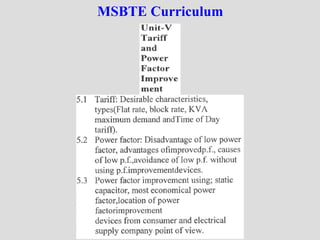
MSBTE Curriculum
5.1:Tariff :Objectives and Desirable Characteristics:
5.1.1: Electricity Tariffs:
The amount of money frame by the supplier for the supply of
electrical energy to various types of consumers in known as an electricity
tariff. In other words, the tariff is the methods of charging a consumer for
consuming electric power. The tariff covers the total cost of producing
and supplying electric energy plus a reasonable profit.
The actual tariffs that the customer pay depends on the
consumption of the electricity. The consumer bill varies according to their
requirements. The industrial consumers pay more tariffs because they use
more power for long times than the domestic consumers.
The electricity tariffs depends on the following factors-
 Type of load
 Time at which load is required.
 The power factor of the load.
 The amount of energy used.
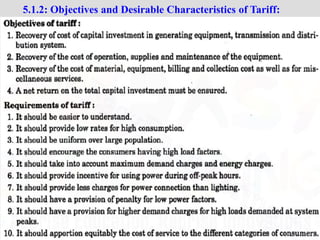
5.1.2: Objectives and Desirable Characteristics of Tariff:
5.2: Types of Electricity Tariff:
Some of the most important types of tariff are as follows;
1. Flat Demand Rate tariff
2. Block meter Rate tariff
3. Two-part tariff
4. Power factor tariff
5. Time of Day (ToD) Tariff OR Time of Use (ToU) Tariff
5.2.1: Flat Demand Rate Tariff:
The flat demand rate tariff is expressed by the equation C =
Ax. In this type of tariff, the bill of the power consumption depends only on
the maximum demand of the load. The generation of the bill is independent
of the normal energy consumption. This type of tariff is used on the street
light, sign lighting, irrigation, etc., where the working hours of the
equipment are unknown. The metering system is not used for calculating
such type of tariffs.
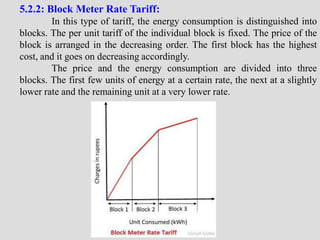
5.2.2: Block Meter Rate Tariff:
In this type of tariff, the energy consumption is distinguished into
blocks. The per unit tariff of the individual block is fixed. The price of the
block is arranged in the decreasing order. The first block has the highest
cost, and it goes on decreasing accordingly.
The price and the energy consumption are divided into three
blocks. The first few units of energy at a certain rate, the next at a slightly
lower rate and the remaining unit at a very lower rate.
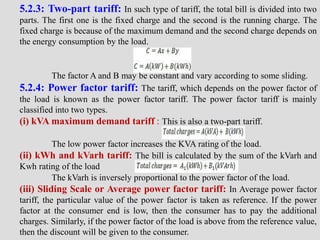
5.2.3: Two-part tariff: In such type of tariff, the total bill is divided into two
parts. The first one is the fixed charge and the second is the running charge. The
fixed charge is because of the maximum demand and the second charge depends on
the energy consumption by the load.
The factor A and B may be constant and vary according to some sliding.
5.2.4: Power factor tariff: The tariff, which depends on the power factor of
the load is known as the power factor tariff. The power factor tariff is mainly
classified into two types.
(i) kVA maximum demand tariff : This is also a two-part tariff.
The low power factor increases the KVA rating of the load.
(ii) kWh and kVarh tariff: The bill is calculated by the sum of the kVarh and
Kwh rating of the load
The kVarh is inversely proportional to the power factor of the load.
(iii) Sliding Scale or Average power factor tariff: In Average power factor
tariff, the particular value of the power factor is taken as reference. If the power
factor at the consumer end is low, then the consumer has to pay the additional
charges. Similarly, if the power factor of the load is above from the reference value,
then the discount will be given to the consumer.
5.2.5: Time of Day (ToD) Tariff OR Time of Use (ToU) Tariff:
In India, Time of Day (ToD) tariff that was used mostly for industrial
sector is now slowly being introduced for commercial sector as well. Recent
news suggest that utilities are contemplating implementing time of day tariff
for commercial customers (along with the industrial customers in State where
it has not been introduced so far). Some states have already implemented it
and others are planning. And as the demand for electricity is increasing every
day, the day is not far when the residential customers might also see the
same.
Time of Day (TOD) tariff, is recognized globally across electricity
industries, as an important Demand Side Management (DSM) measure which
is used as a means of incentivizing consumers to shift a portion of their loads
from peak times to off-peak times, thereby improving the system load factor
by reducing the demand on the system during peak period.
What is Time of Day Structure?
Time of Day (or TOD) tariff is a tariff structure in which different
rates are applicable for use of electricity at different time of the day. It means
that cost of using 1 unit of electricity will be different in mornings, noon,
evenings and nights. This means that using appliances during certain time of
the day will be cheaper than using them during other times.
Why Time of Day Structure?
Electricity grids can be compared to road or highway that can
accommodate only a certain number of vehicles at a time. During peak hours
highways are jammed, similarly during peak hours, electricity grids are
jammed.
Electricity consumption is increasing drastically and the production is
not growing up at that pace. To make sure that there is sufficient supply for the
demand, utilities have to make sure that they help their customers manage their
power consumption. It is not that they reduce their profits by helping customers
reducing consumption, but they do this to make sure that they are able to supply
electricity to all customers as per their demands. Problem that utilities face is of
peak power demand. There are certain times in the day when the demand for
electricity is at its peak. During these times, utilities have to purchase power at
very high cost, much higher than the price paid by consumers. To reduce the
peak power demands there are two options: Either they reduce the power
demand at the peak hours or overall reduction in power demand.
Time of Day tariff is implemented to reduce consumption of electricity
during peak hours. To do this, electricity is made expensive during peak hours
so that consumers use less of it. Utilities also reduce the electricity charges
during off peak hours as an incentive for people to use electricity during the off
peak hours.
Recent ToD Structures:
Dynamic tariffs like ToD are designed to lower the system costs for
utilities and bring down consumers’ bills by increasing tariffs during peak
hours and lowering them during off-peak hours. The load shape objective is
to reduce peak loads and/or shift load from peak to off-peak periods.
Various dynamic pricing tariffs have been developed, which include:
(1) Time-of-Day Tariffs (ToD): This tariff design features electricity tariffs
that vary by time period, being higher in peak periods and lower in off-peak
period. The simplest ToD tariff can be structured as a two period tariff, a
peak period and an off-peak period.
(2) Critical Peak Pricing (CPP): This tariff design features a much higher
critical peak tariff in addition to ToD tariffs. The CPP is only used on a
maximum number of days each year, the timing of which is unknown until a
day ahead or perhaps even the day of a critical pricing day.
(3) Extreme Day Pricing (EDP): This tariff design is similar to CPP,
except that the higher price is in effect for all 24 hours for a maximum
number of critical days, the timing of which is unknown until a day ahead.
(4) Extreme Day CPP (ED-CPP): This tariff design is a variation of CPP in
which the critical peak price and correspondingly lower off-peak price applies to
the critical peak hours on extreme days but there is no ToD tariff on other days.
(5) Real Time Pricing (RTP): This tariff design features electricity tariffs that
vary hourly or sub-hourly all year long, for some or a customer’s entire load.
Customers are notified of the rates on a day-ahead or hour-ahead basis.
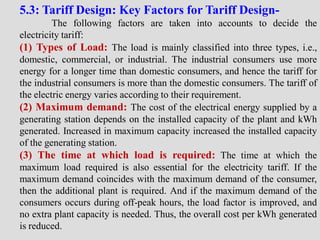
The differing dynamic pricing tariffs as discussed above exposes
consumers and utilities to the varying amounts of risk shown below:
5.3: Tariff Design: Key Factors for Tariff Design-
The following factors are taken into accounts to decide the
electricity tariff:
(1) Types of Load: The load is mainly classified into three types, i.e.,
domestic, commercial, or industrial. The industrial consumers use more
energy for a longer time than domestic consumers, and hence the tariff for
the industrial consumers is more than the domestic consumers. The tariff of
the electric energy varies according to their requirement.
(2) Maximum demand: The cost of the electrical energy supplied by a
generating station depends on the installed capacity of the plant and kWh
generated. Increased in maximum capacity increased the installed capacity
of the generating station.
(3) The time at which load is required: The time at which the
maximum load required is also essential for the electricity tariff. If the
maximum demand coincides with the maximum demand of the consumer,
then the additional plant is required. And if the maximum demand of the
consumers occurs during off-peak hours, the load factor is improved, and
no extra plant capacity is needed. Thus, the overall cost per kWh generated
is reduced.
Tariff Design: Key Factors for Tariff Design Continued:
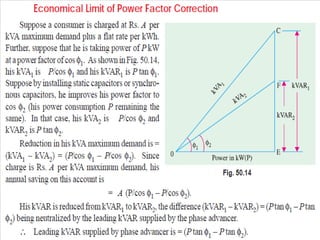
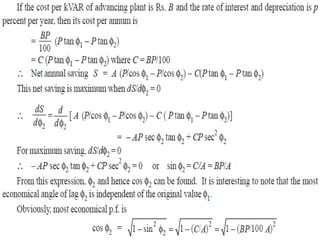
(4) The power factor of the load: The power factor plays a major role
in the plant economics. The low power factor increases the load current
which increases the losses in the system. Thus, the regulation becomes
poor. For improving the power factor, the power factor correction
equipment is installed at the generating station. Thus, the cost of the
generation increases.
(5) The amount of energy used: The cost of electrical energy is
reduced by using large amounts of energy for longer periods.
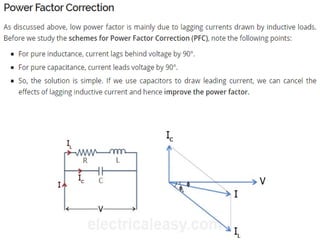
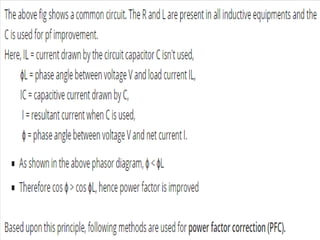
5.4: Power Factor:
we know that, irrespective of the nature of voltage and current, the
power factor may be defined as the ratio of true or active power (P)
consumed to the apparent power (S).
where φ is the phase angle (difference) between voltage (V) and
current (I).
From the above equation, it is seen that, for the given values of
voltage and current, active power will be less for low power factor and
more for high power factor. Therefore, in AC supply system, the power
factor should be high.
5.4.1: Causes of Low Power Factor:
1. Most widely used 3-Φ I.M. is having low p.f.
2. Magnetizing currents of the transformers causes low p.f.
3. The miscellaneous equipment such as arc lamps, electric discharge
lamps, and welding equipment operate at low power factor.
4. The industrial heating furnaces operate at a low lagging power factor.
5. The variation of load on the power system also causes low pf.
5.4.2: Disadvantages of Low Power Factor:
As seen from the above equation, for the given value of active
power, and voltage low power factor will result in increase in current.
Therefore, low power factor is having number of disadvantages as given
below:
1. Higher current for given capacity.
2. Larger cross-sectional area of conductors.
3. More conductor material is required.
4. More transmission and distribution voltage drops and power losses.
5. Poor voltage regulation of power system.
6. For the given capacity, higher ratings of alternators & transformers.
7. For the given capacity, higher ratings of switchgear equipments.
8. For the given capacity, more initial and running cost of system.
9. Low p.f. causes wastage of energy.
10. Low p.f. causes more heating of lines and machines.
5.4.3: Advantages of Power Factor Improvement:
Following are the advantages of power factor improvement:
1. The kW capacity of the prime movers is better utilized due to decreased
reactive power.
2. This increases the kilowatt capacity of the alternators, transformers,
and the lines.
3. The efficiency of the system is increased.
4. The cost per unit decreases.
5. Improves the voltage regulation of the lines.
6. Reduction in power losses in the system due to reduction in load
current.
7. The cost of generators, transformers, and transmission lines per kW of
load supplied decreases.
8. Reduction in kVA demand charges for large consumers.
Suggested Learning Resources As per MSBTE Curriculum

Unit_5_Tariff_&_Power_Factor_Improvement.pdf

  • 1.
    5. Tariff &Power Factor Improvement Dr. K. D. Patil EE6I – Utilization of Electrical Energy (UEE-22626)
  • 2.
  • 3.
    5.1:Tariff :Objectives andDesirable Characteristics: 5.1.1: Electricity Tariffs: The amount of money frame by the supplier for the supply of electrical energy to various types of consumers in known as an electricity tariff. In other words, the tariff is the methods of charging a consumer for consuming electric power. The tariff covers the total cost of producing and supplying electric energy plus a reasonable profit. The actual tariffs that the customer pay depends on the consumption of the electricity. The consumer bill varies according to their requirements. The industrial consumers pay more tariffs because they use more power for long times than the domestic consumers. The electricity tariffs depends on the following factors-  Type of load  Time at which load is required.  The power factor of the load.  The amount of energy used.
  • 4.
    5.1.2: Objectives andDesirable Characteristics of Tariff:
  • 5.
    5.2: Types ofElectricity Tariff: Some of the most important types of tariff are as follows; 1. Flat Demand Rate tariff 2. Block meter Rate tariff 3. Two-part tariff 4. Power factor tariff 5. Time of Day (ToD) Tariff OR Time of Use (ToU) Tariff 5.2.1: Flat Demand Rate Tariff: The flat demand rate tariff is expressed by the equation C = Ax. In this type of tariff, the bill of the power consumption depends only on the maximum demand of the load. The generation of the bill is independent of the normal energy consumption. This type of tariff is used on the street light, sign lighting, irrigation, etc., where the working hours of the equipment are unknown. The metering system is not used for calculating such type of tariffs.
  • 6.
    5.2.2: Block MeterRate Tariff: In this type of tariff, the energy consumption is distinguished into blocks. The per unit tariff of the individual block is fixed. The price of the block is arranged in the decreasing order. The first block has the highest cost, and it goes on decreasing accordingly. The price and the energy consumption are divided into three blocks. The first few units of energy at a certain rate, the next at a slightly lower rate and the remaining unit at a very lower rate.
  • 7.
    5.2.3: Two-part tariff:In such type of tariff, the total bill is divided into two parts. The first one is the fixed charge and the second is the running charge. The fixed charge is because of the maximum demand and the second charge depends on the energy consumption by the load. The factor A and B may be constant and vary according to some sliding. 5.2.4: Power factor tariff: The tariff, which depends on the power factor of the load is known as the power factor tariff. The power factor tariff is mainly classified into two types. (i) kVA maximum demand tariff : This is also a two-part tariff. The low power factor increases the KVA rating of the load. (ii) kWh and kVarh tariff: The bill is calculated by the sum of the kVarh and Kwh rating of the load The kVarh is inversely proportional to the power factor of the load. (iii) Sliding Scale or Average power factor tariff: In Average power factor tariff, the particular value of the power factor is taken as reference. If the power factor at the consumer end is low, then the consumer has to pay the additional charges. Similarly, if the power factor of the load is above from the reference value, then the discount will be given to the consumer.
  • 8.
    5.2.5: Time ofDay (ToD) Tariff OR Time of Use (ToU) Tariff: In India, Time of Day (ToD) tariff that was used mostly for industrial sector is now slowly being introduced for commercial sector as well. Recent news suggest that utilities are contemplating implementing time of day tariff for commercial customers (along with the industrial customers in State where it has not been introduced so far). Some states have already implemented it and others are planning. And as the demand for electricity is increasing every day, the day is not far when the residential customers might also see the same. Time of Day (TOD) tariff, is recognized globally across electricity industries, as an important Demand Side Management (DSM) measure which is used as a means of incentivizing consumers to shift a portion of their loads from peak times to off-peak times, thereby improving the system load factor by reducing the demand on the system during peak period. What is Time of Day Structure? Time of Day (or TOD) tariff is a tariff structure in which different rates are applicable for use of electricity at different time of the day. It means that cost of using 1 unit of electricity will be different in mornings, noon, evenings and nights. This means that using appliances during certain time of the day will be cheaper than using them during other times.
  • 9.
    Why Time ofDay Structure? Electricity grids can be compared to road or highway that can accommodate only a certain number of vehicles at a time. During peak hours highways are jammed, similarly during peak hours, electricity grids are jammed. Electricity consumption is increasing drastically and the production is not growing up at that pace. To make sure that there is sufficient supply for the demand, utilities have to make sure that they help their customers manage their power consumption. It is not that they reduce their profits by helping customers reducing consumption, but they do this to make sure that they are able to supply electricity to all customers as per their demands. Problem that utilities face is of peak power demand. There are certain times in the day when the demand for electricity is at its peak. During these times, utilities have to purchase power at very high cost, much higher than the price paid by consumers. To reduce the peak power demands there are two options: Either they reduce the power demand at the peak hours or overall reduction in power demand. Time of Day tariff is implemented to reduce consumption of electricity during peak hours. To do this, electricity is made expensive during peak hours so that consumers use less of it. Utilities also reduce the electricity charges during off peak hours as an incentive for people to use electricity during the off peak hours.
  • 10.
    Recent ToD Structures: Dynamictariffs like ToD are designed to lower the system costs for utilities and bring down consumers’ bills by increasing tariffs during peak hours and lowering them during off-peak hours. The load shape objective is to reduce peak loads and/or shift load from peak to off-peak periods. Various dynamic pricing tariffs have been developed, which include: (1) Time-of-Day Tariffs (ToD): This tariff design features electricity tariffs that vary by time period, being higher in peak periods and lower in off-peak period. The simplest ToD tariff can be structured as a two period tariff, a peak period and an off-peak period. (2) Critical Peak Pricing (CPP): This tariff design features a much higher critical peak tariff in addition to ToD tariffs. The CPP is only used on a maximum number of days each year, the timing of which is unknown until a day ahead or perhaps even the day of a critical pricing day. (3) Extreme Day Pricing (EDP): This tariff design is similar to CPP, except that the higher price is in effect for all 24 hours for a maximum number of critical days, the timing of which is unknown until a day ahead.
  • 11.
    (4) Extreme DayCPP (ED-CPP): This tariff design is a variation of CPP in which the critical peak price and correspondingly lower off-peak price applies to the critical peak hours on extreme days but there is no ToD tariff on other days. (5) Real Time Pricing (RTP): This tariff design features electricity tariffs that vary hourly or sub-hourly all year long, for some or a customer’s entire load. Customers are notified of the rates on a day-ahead or hour-ahead basis. The differing dynamic pricing tariffs as discussed above exposes consumers and utilities to the varying amounts of risk shown below:
  • 12.
    5.3: Tariff Design:Key Factors for Tariff Design- The following factors are taken into accounts to decide the electricity tariff: (1) Types of Load: The load is mainly classified into three types, i.e., domestic, commercial, or industrial. The industrial consumers use more energy for a longer time than domestic consumers, and hence the tariff for the industrial consumers is more than the domestic consumers. The tariff of the electric energy varies according to their requirement. (2) Maximum demand: The cost of the electrical energy supplied by a generating station depends on the installed capacity of the plant and kWh generated. Increased in maximum capacity increased the installed capacity of the generating station. (3) The time at which load is required: The time at which the maximum load required is also essential for the electricity tariff. If the maximum demand coincides with the maximum demand of the consumer, then the additional plant is required. And if the maximum demand of the consumers occurs during off-peak hours, the load factor is improved, and no extra plant capacity is needed. Thus, the overall cost per kWh generated is reduced.
  • 13.
    Tariff Design: KeyFactors for Tariff Design Continued: (4) The power factor of the load: The power factor plays a major role in the plant economics. The low power factor increases the load current which increases the losses in the system. Thus, the regulation becomes poor. For improving the power factor, the power factor correction equipment is installed at the generating station. Thus, the cost of the generation increases. (5) The amount of energy used: The cost of electrical energy is reduced by using large amounts of energy for longer periods.
  • 14.
    5.4: Power Factor: weknow that, irrespective of the nature of voltage and current, the power factor may be defined as the ratio of true or active power (P) consumed to the apparent power (S). where φ is the phase angle (difference) between voltage (V) and current (I). From the above equation, it is seen that, for the given values of voltage and current, active power will be less for low power factor and more for high power factor. Therefore, in AC supply system, the power factor should be high. 5.4.1: Causes of Low Power Factor: 1. Most widely used 3-Φ I.M. is having low p.f. 2. Magnetizing currents of the transformers causes low p.f. 3. The miscellaneous equipment such as arc lamps, electric discharge lamps, and welding equipment operate at low power factor. 4. The industrial heating furnaces operate at a low lagging power factor. 5. The variation of load on the power system also causes low pf.
  • 15.
    5.4.2: Disadvantages ofLow Power Factor: As seen from the above equation, for the given value of active power, and voltage low power factor will result in increase in current. Therefore, low power factor is having number of disadvantages as given below: 1. Higher current for given capacity. 2. Larger cross-sectional area of conductors. 3. More conductor material is required. 4. More transmission and distribution voltage drops and power losses. 5. Poor voltage regulation of power system. 6. For the given capacity, higher ratings of alternators & transformers. 7. For the given capacity, higher ratings of switchgear equipments. 8. For the given capacity, more initial and running cost of system. 9. Low p.f. causes wastage of energy. 10. Low p.f. causes more heating of lines and machines.
  • 16.
    5.4.3: Advantages ofPower Factor Improvement: Following are the advantages of power factor improvement: 1. The kW capacity of the prime movers is better utilized due to decreased reactive power. 2. This increases the kilowatt capacity of the alternators, transformers, and the lines. 3. The efficiency of the system is increased. 4. The cost per unit decreases. 5. Improves the voltage regulation of the lines. 6. Reduction in power losses in the system due to reduction in load current. 7. The cost of generators, transformers, and transmission lines per kW of load supplied decreases. 8. Reduction in kVA demand charges for large consumers.
  • 25.
    Suggested Learning ResourcesAs per MSBTE Curriculum