TARIFF
ELECTRICAL POWER – I
5TH
SEMESTER ELECTRICAL ENGG.
Presentation by :
Barjinder Singh
Lecturer, Electrical Engg.
Government Polytechnic College
G.T.B.GARH DISTT. MOGA
10/15/2012 Barjinder Singh
TOPICS
• Introduction
• Important terms related to economics of
Generation
• Connected load
• Maximum demand
• Demand factor
• Average load
• Load factor
10/15/2012 Barjinder Singh
TOPICS
• Diversity factor
• Tariff
• Objectives of tariff
• Main factors involved in fixing a tariff
• Types of tariff
• Simple tariff
• Flat rate tariff
• Block rate tariff
10/15/2012 Barjinder Singh
TOPICS
• Two part tariff
• Maximum demand tariff
• Power factor tariff
• Block rate tariff with minimum fixed charges
• Special features involved in fixing a tariff in India
• Off peak load hours
• Tariff enforced in India
• Summarized P.S.E.B. Tariff
• Some examples
10/15/2012 Barjinder Singh
INTRODUCTION
The electrical energy produced at the generating
station is delivered to a large number of consumers.
The rate at which energy is sold to the consumers
(called tariff) is fixed by the supplying
company .While fixing the tariff, the supply
companies are to ensure that they should not only
recover the total cost of producing the energy but
also earn some profit. However, the profit should be
minimum possible so that electrical energy can be
sold at reasonable rates and the consumers insured
to use more electricity.
10/15/2012 Barjinder Singh
IMPORTANT TERMS RELATED TO
ECONOMICS OF GENERATION
Before studying about tariff an engineer must have
the knowledge of the following important terms
Connected load : The sum of the continuous
ratings of all the equipments connected to the
power system is called connected load.
Maximum Demand : The load on the power
station is not constant, it varies from time to time
The greatest of all the demands (loads) which occur
during a given period is called maximum
demands.
10/15/2012 Barjinder Singh
DEMAND FACTOR
The ratio of maximum demand on the system
to the rated connected load to the system is
called demand factor.
Mathematically ,
Demand factor = Maximum demand
Connected load
The actual maximum demand is always less
than the rated load connected to the system ,
therefore, demand factor is always less than
unity.
10/15/2012 Barjinder Singh
AVERAGE LOAD
The average of all the loads occurring at the various
instants on the generating station is called average
load. Or
The total electrical energy (in WH or KWH) delivered
in a given period divided by the time ( in hours) is
that period , called average load.
Daily average load = kWh energy supplied in day
24
Monthly average load= kWh energy supplied in month
24x30
10/15/2012 Barjinder Singh
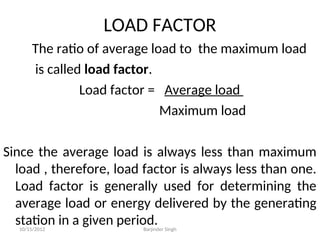
LOAD FACTOR
The ratio of average load to the maximum load
is called load factor.
Load factor = Average load
Maximum load
Since the average load is always less than maximum
load , therefore, load factor is always less than one.
Load factor is generally used for determining the
average load or energy delivered by the generating
station in a given period.
10/15/2012 Barjinder Singh
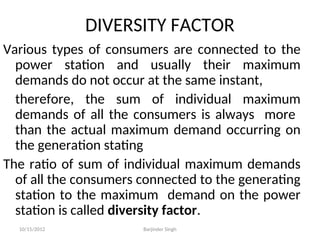
DIVERSITY FACTOR
Various types of consumers are connected to the
power station and usually their maximum
demands do not occur at the same instant,
therefore, the sum of individual maximum
demands of all the consumers is always more
than the actual maximum demand occurring on
the generation stating
The ratio of sum of individual maximum demands
of all the consumers connected to the generating
station to the maximum demand on the power
station is called diversity factor.
10/15/2012 Barjinder Singh
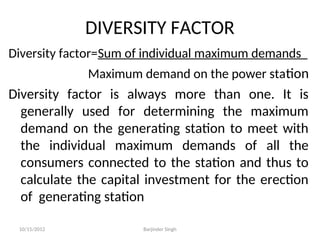
DIVERSITY FACTOR
Diversity factor=Sum of individual maximum demands
Maximum demand on the power station
Diversity factor is always more than one. It is
generally used for determining the maximum
demand on the generating station to meet with
the individual maximum demands of all the
consumers connected to the station and thus to
calculate the capital investment for the erection
of generating station
10/15/2012 Barjinder Singh
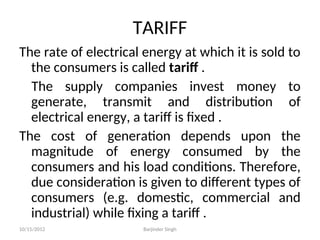
TARIFF
The rate of electrical energy at which it is sold to
the consumers is called tariff .
The supply companies invest money to
generate, transmit and distribution of
electrical energy, a tariff is fixed .
The cost of generation depends upon the
magnitude of energy consumed by the
consumers and his load conditions. Therefore,
due consideration is given to different types of
consumers (e.g. domestic, commercial and
industrial) while fixing a tariff .
10/15/2012 Barjinder Singh
OBJECTIVES OF TARIFF
The main objective of the tariff is to ensure the
recovery of the total cost of generation and
distribution .Tariff should include the following
items:
(1) Recovery of cost of electrical energy generated
at the generating system.
(2) Recovery of cost on the capital investment in
transmission and distribution system.
(3) Recovery of cost of operation, supplies and
maintenance of equipment.
10/15/2012 Barjinder Singh
OBJECTIVES OF TARIFF
(4) Recovery of cost of metering equipment,
billing and miscellaneous services .
(5) A marginal return (Profit) on the capital
investment .
10/15/2012 Barjinder Singh
MAIN FACTORS INVOLVED IN FIXING A
TARIFF
The following are the principal factor involved in
fixing a tariff:
(1)The tariff should ensure the recovery of the
total cost of generation, transmission, and
distribution etc.
(2) The tariff should be simple, cheap and
capable of easy explanation to consumers.
(3) The tariff should be attractive so that
consumers are encouraged to make more
extended use of electrical energy.
10/15/2012 Barjinder Singh
MAIN FACTORS INVOLVED IN FIXING A
TARIFF
(4) The tariff should be such that it would earn a
reasonable profit.
(5) The tariff must be fair and the consumers
should be charged according to what the
energy costs.
10/15/2012 Barjinder Singh
TYPES OF TARIFF
There are various types of consumers ( domestic,
commercial and industrial etc.) and their energy
requirements are also different. Accordingly,
several types of tariffs have been designed so far,
out of which the most commonly applied are
described below:
10/15/2012 Barjinder Singh
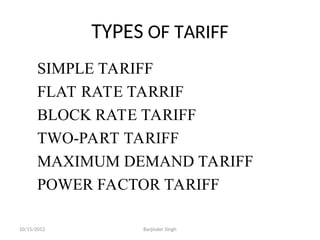
TYPES OF TARIFF
SIMPLE TARIFF
FLAT RATE TARRIF
BLOCK RATE TARIFF
TWO-PART TARIFF
MAXIMUM DEMAND TARIFF
POWER FACTOR TARIFF
10/15/2012 Barjinder Singh
SIMPLE TARIFF
Simple Tariff: The tariff in which the rate per unit
of energy is fixed, is called simple tariff.
This is a simplest possible tariff. The rate per unit of
energy consumed by the consumer is fixed
irrespective to the quantity of energy consumed
by a consumer. This energy consumed is
measured by installing an energy meter .
10/15/2012 Barjinder Singh
ADVANTAGES
The following are the advantages :
1. It is in simplest form and easily
understood by the consumers.
2. Consumer is to pay as per his
consumption.
10/15/2012 Barjinder Singh
DISADVANTAGES
1. Consumer is to pay the same rate per unit of
energy consumed irrespective of the number
of units consumed by him. Hence, consumers
are not encourage to consume more energy.
2. The cost of energy per unit delivered is high.
3. The supplier do not get any return for the
connection given to the consumer if consumer
does not consume any energy in a particular
month.
10/15/2012 Barjinder Singh
APPLICATION OF SIMPLE TARIFF
Since it is very simple form of tariff, it is
generally applied to tube wells which are
operated for irrigation purposes
10/15/2012 Barjinder Singh
FLAT RATE TARIFF
The tariff in which different types of consumers
are charged at different per unit rates is called
flat rate tariff.
This type of tariff is similar to simple tariff. Only
difference is that consumers are grouped into
different classes and each class of consumer is
charged at a different per unit rate. For example
flat rate for fan and light loads is slightly higher
than that for power loads.
10/15/2012 Barjinder Singh
ADVANTAGES
(1) It is more fair to different types of
consumers.
( 2) It is quite simple in calculations.
10/15/2012 Barjinder Singh
DISADVANTAGES
(1) Consumers are not encouraged to consume more
energy because same rate per unit of energy
consumed is charged irrespective of the quantity of
energy consumed.
(2) Separate meters are required to measured energy
consumed for light loads and power loads.
(3) The suppliers does not get any return for the
connection given to the consumer if he does not
consume any energy in a particular period or month.
10/15/2012 Barjinder Singh
APPLICATION OF FLAT RATE TARIFF
Since it is simple and easy for explanation
to consumers, therefore this tariff is
generally applied to domestic
consumers.
10/15/2012 Barjinder Singh
BLOCK RATE TARIFF
The tariff in which first block of energy is
charged at a given rate and the succeeding
blocks of energy are charged at progressively
reduced rates is called block rate tariff
10/15/2012 Barjinder Singh
BLOCK RATE TARIFF
In this type of tariff, the energy units are divided
into numbers of blocks and the rate per unit of
energy is fixed for each block. The rate per unit
of energy for the first block is the highest and
reduces progressively with the succeeding
blocks. For example, the first 100 units may be
charged at the rate of Rs. 3.00 per unit; the next
100 units may be charged at the rate of Rs.2.50
per unit and the remaining additional units may
charged at the rate of Rs. 2.00 per unit.
10/15/2012 Barjinder Singh
ADVANTAGES
(1) By giving an incentive, the consumers are
encouraged to consume more energy. This
increases the load factor of the power
system and hence reduces per unit cost of
generation.
(2) Only one energy meter is required to
measure the energy .
10/15/2012 Barjinder Singh
DISADVANTAGES
(1) The supplier does not get any return for the
connection given to the consumer if
consumer does not consume any energy in a
particular period.
10/15/2012 Barjinder Singh
APPLICATION OF BLOCK RATE
TARIFF
This type of tariff is mostly applied to
domestic and small commercial
consumers.
10/15/2012 Barjinder Singh
TWO – PART TARIFF
The tariff in which electrical energy is charged on
the basis of maximum demand of the consumer
and the units consumed by him is called two-
part tariff.
10/15/2012 Barjinder Singh
TWO- PART TARIFF
In this tariff, the total charges to be made from the
consumer are split into two components namely
fixed charges and running charges. The fixed
charges are independent of energy consumed
by the consumer but depend upon the
maximum demand, whereas the running
charges depend upon the energy consumed by
the consumer. The maximum demand of the
consumer is assessed on the basis of the kW
capacity of all the electrical devices owned by a
particular consumer or on the connected load.
10/15/2012 Barjinder Singh
TWO-PART TARIFF
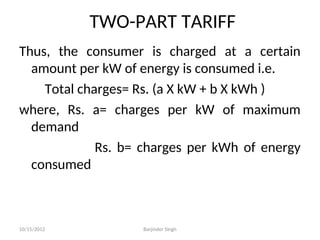
Thus, the consumer is charged at a certain
amount per kW of energy is consumed i.e.
Total charges= Rs. (a X kW + b X kWh )
where, Rs. a= charges per kW of maximum
demand
Rs. b= charges per kWh of energy
consumed
10/15/2012 Barjinder Singh
TWO- PART TARIFF
In this tariff basically, the charges made on
maximum demand recovers the fixed charges of
generation such as interest and depreciation on
the capital cost of building and equipment, taxes
and a part of operating cost which is independent
of energy generated. Whereas, the charges made
on energy consumed, recovers operating cost
which varies with variation in generated (or
supplied) energy.
10/15/2012 Barjinder Singh
ADVANTAGES
(1)It is easily understood by the consumers.
(2)The supplier gets the return in the form of
fixed charges for the connection given to the
consumer even if he does not consume any
energy in a particular period.
10/15/2012 Barjinder Singh
DISADVANTAGES
(1)If a consumer does not consume any energy
in a month even then he has to pay the fixed
charges .
(2)Since the maximum demand of consumer is
not measured, therefore, there is always
conflict between consumer and the supplier
to assess the maximum demand.
10/15/2012 Barjinder Singh
MAXIMUM DEMAND TARIFF
The tariff in which electrical energy is charged
on the basis of maximum demand of the
consumer and the units consumed by him is
called maximum demand.
This tariff is actually similar to two-part tariff
with only difference that the maximum
demand is actually measured by installing a
maximum demand indicator meter. Thus the
draw-back of two-part tariff is removed.
10/15/2012 Barjinder Singh
APPLICATION OF MAXIMUM
DEMAND TARIFF
This tariff is mostly applied to bulk supplies
and large industrial consumers.
10/15/2012 Barjinder Singh
POWER FACTOR TARIFF
The tariff in which power factor of the consumer’s
load is also taken into consideration while fixing
it, is called power factor tariff.
Power factor plays an important roll in a.c. system.
A low power factor increases the rating of power
plant equipment and gives higher losses.
Therefore, consumers are advised to operate
their loads at higher power factor.
10/15/2012 Barjinder Singh
KVA MAXIMUM DEMAND TARIFF
In this case the fixed charges are made on the
basis of maximum demand in KVA instead of
KW. Therefore, a consumer having low power
factor has to pay more fixed charges.
Thus the consumers are encouraged to operate
their loads at higher power factor.
So in these day suppliers ask consumer to use
shunt capacitors to improve power factor.
10/15/2012 Barjinder Singh
KWH & KVARH TARIFF
In this tariff, the consumers are charged for
KWH and KVARH separately. Therefore, a
consumer having low power factor shall
have to pay more charges.
10/15/2012 Barjinder Singh
SLIDING SCALE TARIFF
In this case, an average power factor , say 0.8
lagging, is taken as reference. If the power
factor of the consumer is below the
reference, an additional amount is charged
from the consumer as a penalty. On the
other hand, if the power factor is above the
reference, a discount is allowed to the
consumer as a gift.
10/15/2012 Barjinder Singh
APPLICATION OF SLIDING SCALE
TARIFF
The power factor tariff is mostly applied to
large industrial consumers.
10/15/2012 Barjinder Singh
BLOCK RATE TARIFF WITH
MINIMUM FIXED CHARGES
Tariff in which number of blocks (usually three
blocks) of energy are formed which are charged
at different rates. However if the energy
consumed by the consumer is low, he is being
charged on the basis of minimum charges made
per KW of his maximum demand.
10/15/2012 Barjinder Singh
RULES
In this tariff, the energy units are divided into
number of blocks and the rate per unit of energy
is fixed for each block. In our state, the rate per
unit of energy for the first block is minimum and
increases progressively with the succeeding
blocks.
This method is adopted to help the low income
group for the utilization of electrical energy.
10/15/2012 Barjinder Singh
ADVANTAGES
(1) It helps the consumers of low income group
to use electrical energy at low rates.
(2) The consumers uses electrical energy as per
requirement and wastage of energy causes
more bills.
(3) Only one meter is required to measure
energy.
(4) It is quite easy to understand.
10/15/2012 Barjinder Singh
DISADVANTAGES
(1)The consumers using more energy are
charged at higher rate than normal rates.
(2)The consumers are to pay the fixed charges
unnecessarily even when they do not
consume energy at all in a month.
10/15/2012 Barjinder Singh
APPLICATION OF BLOCK RATE
TARIFF
This tariff is very popular in the country
like INDIA.
10/15/2012 Barjinder Singh
FIXING A TARIFF IN INDIA
In India, supply of electrical energy is a State affair.
Therefore, the States are empowered to fix up
the tariff. Most of States impose
Education Tax
Sale Tax
Development Tax
This increases the rate of energy.
10/15/2012 Barjinder Singh
FIXING A TARIFF IN INDIA
Most of states deliver energy to the weaker
section at low rates and increase the rates
for middle and upper class consumers.
Sometimes, State like Punjab deliver
energy to a particular section free of cost
for rapid development of that section or to
fulfill some political motives.
10/15/2012 Barjinder Singh
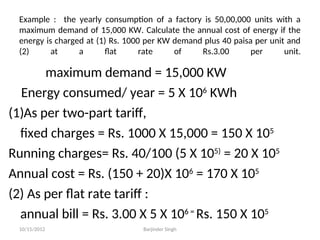
Example : the yearly consumption of a factory is 50,00,000 units with a
maximum demand of 15,000 KW. Calculate the annual cost of energy if the
energy is charged at (1) Rs. 1000 per KW demand plus 40 paisa per unit and
(2) at a flat rate of Rs.3.00 per unit.
maximum demand = 15,000 KW
Energy consumed/ year = 5 X 10⁶
KWh
(1)As per two-part tariff,
fixed charges = Rs. 1000 X 15,000 = 150 X 105
Running charges= Rs. 40/100 (5 X 10⁵)
= 20 X 105
Annual cost = Rs. (150 + 20)X 106
= 170 X 105
(2) As per flat rate tariff :
annual bill = Rs. 3.00 X 5 X 106 =
Rs. 150 X 105
10/15/2012 Barjinder Singh
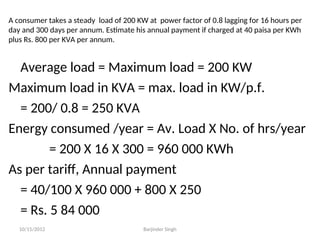
A consumer takes a steady load of 200 KW at power factor of 0.8 lagging for 16 hours per
day and 300 days per annum. Estimate his annual payment if charged at 40 paisa per KWh
plus Rs. 800 per KVA per annum.
Average load = Maximum load = 200 KW
Maximum load in KVA = max. load in KW/p.f.
= 200/ 0.8 = 250 KVA
Energy consumed /year = Av. Load X No. of hrs/year
= 200 X 16 X 300 = 960 000 KWh
As per tariff, Annual payment
= 40/100 X 960 000 + 800 X 250
= Rs. 5 84 000
10/15/2012 Barjinder Singh
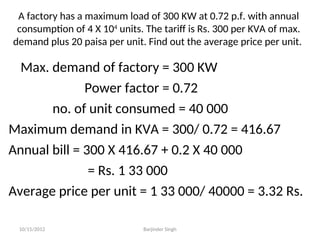
A factory has a maximum load of 300 KW at 0.72 p.f. with annual
consumption of 4 X 10⁴
units. The tariff is Rs. 300 per KVA of max.
demand plus 20 paisa per unit. Find out the average price per unit.
Max. demand of factory = 300 KW
Power factor = 0.72
no. of unit consumed = 40 000
Maximum demand in KVA = 300/ 0.72 = 416.67
Annual bill = 300 X 416.67 + 0.2 X 40 000
= Rs. 1 33 000
Average price per unit = 1 33 000/ 40000 = 3.32 Rs.
10/15/2012 Barjinder Singh
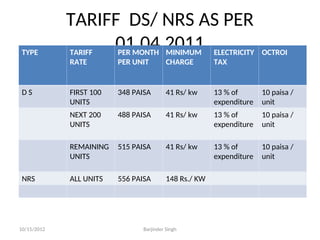
TARIFF DS/ NRS AS PER
01.04.2011
TYPE TARIFF
RATE
PER MONTH
PER UNIT
MINIMUM
CHARGE
ELECTRICITY
TAX
OCTROI
D S FIRST 100
UNITS
348 PAISA 41 Rs/ kw 13 % of
expenditure
10 paisa /
unit
NEXT 200
UNITS
488 PAISA 41 Rs/ kw 13 % of
expenditure
10 paisa /
unit
REMAINING
UNITS
515 PAISA 41 Rs/ kw 13 % of
expenditure
10 paisa /
unit
NRS ALL UNITS 556 PAISA 148 Rs./ KW
10/15/2012 Barjinder Singh
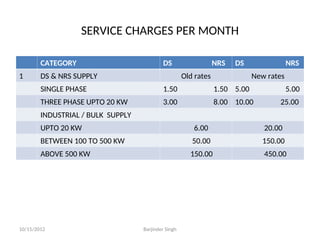
SERVICE CHARGES PER MONTH
CATEGORY DS NRS DS NRS
1 DS & NRS SUPPLY Old rates New rates
SINGLE PHASE 1.50 1.50 5.00 5.00
THREE PHASE UPTO 20 KW 3.00 8.00 10.00 25.00
INDUSTRIAL / BULK SUPPLY
UPTO 20 KW 6.00 20.00
BETWEEN 100 TO 500 KW 50.00 150.00
ABOVE 500 KW 150.00 450.00
10/15/2012 Barjinder Singh
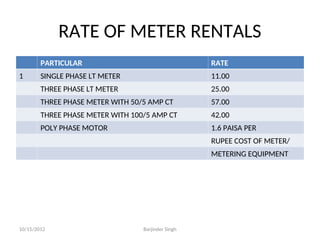
RATE OF METER RENTALS
PARTICULAR RATE
1 SINGLE PHASE LT METER 11.00
THREE PHASE LT METER 25.00
THREE PHASE METER WITH 50/5 AMP CT 57.00
THREE PHASE METER WITH 100/5 AMP CT 42.00
POLY PHASE MOTOR 1.6 PAISA PER
RUPEE COST OF METER/
METERING EQUIPMENT
10/15/2012 Barjinder Singh
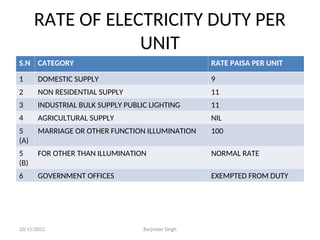
RATE OF ELECTRICITY DUTY PER
UNIT
S.N CATEGORY RATE PAISA PER UNIT
1 DOMESTIC SUPPLY 9
2 NON RESIDENTIAL SUPPLY 11
3 INDUSTRIAL BULK SUPPLY PUBLIC LIGHTING 11
4 AGRICULTURAL SUPPLY NIL
5
(A)
MARRIAGE OR OTHER FUNCTION ILLUMINATION 100
5
(B)
FOR OTHER THAN ILLUMINATION NORMAL RATE
6 GOVERNMENT OFFICES EXEMPTED FROM DUTY
10/15/2012 Barjinder Singh
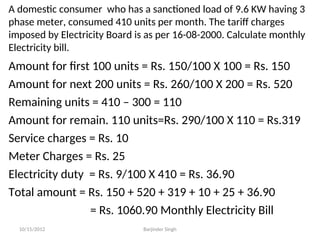
A domestic consumer who has a sanctioned load of 9.6 KW having 3
phase meter, consumed 410 units per month. The tariff charges
imposed by Electricity Board is as per 16-08-2000. Calculate monthly
Electricity bill.
Amount for first 100 units = Rs. 150/100 X 100 = Rs. 150
Amount for next 200 units = Rs. 260/100 X 200 = Rs. 520
Remaining units = 410 – 300 = 110
Amount for remain. 110 units=Rs. 290/100 X 110 = Rs.319
Service charges = Rs. 10
Meter Charges = Rs. 25
Electricity duty = Rs. 9/100 X 410 = Rs. 36.90
Total amount = Rs. 150 + 520 + 319 + 10 + 25 + 36.90
= Rs. 1060.90 Monthly Electricity Bill
10/15/2012 Barjinder Singh
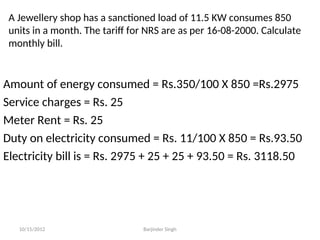
A Jewellery shop has a sanctioned load of 11.5 KW consumes 850
units in a month. The tariff for NRS are as per 16-08-2000. Calculate
monthly bill.
Amount of energy consumed = Rs.350/100 X 850 =Rs.2975
Service charges = Rs. 25
Meter Rent = Rs. 25
Duty on electricity consumed = Rs. 11/100 X 850 = Rs.93.50
Electricity bill is = Rs. 2975 + 25 + 25 + 93.50 = Rs. 3118.50
10/15/2012 Barjinder Singh
THANKS
10/15/2012 Barjinder Singh

Electrical Power Electrical Engineering1

  • 1.
    TARIFF ELECTRICAL POWER –I 5TH SEMESTER ELECTRICAL ENGG. Presentation by : Barjinder Singh Lecturer, Electrical Engg. Government Polytechnic College G.T.B.GARH DISTT. MOGA 10/15/2012 Barjinder Singh
  • 2.
    TOPICS • Introduction • Importantterms related to economics of Generation • Connected load • Maximum demand • Demand factor • Average load • Load factor 10/15/2012 Barjinder Singh
  • 3.
    TOPICS • Diversity factor •Tariff • Objectives of tariff • Main factors involved in fixing a tariff • Types of tariff • Simple tariff • Flat rate tariff • Block rate tariff 10/15/2012 Barjinder Singh
  • 4.
    TOPICS • Two parttariff • Maximum demand tariff • Power factor tariff • Block rate tariff with minimum fixed charges • Special features involved in fixing a tariff in India • Off peak load hours • Tariff enforced in India • Summarized P.S.E.B. Tariff • Some examples 10/15/2012 Barjinder Singh
  • 5.
    INTRODUCTION The electrical energyproduced at the generating station is delivered to a large number of consumers. The rate at which energy is sold to the consumers (called tariff) is fixed by the supplying company .While fixing the tariff, the supply companies are to ensure that they should not only recover the total cost of producing the energy but also earn some profit. However, the profit should be minimum possible so that electrical energy can be sold at reasonable rates and the consumers insured to use more electricity. 10/15/2012 Barjinder Singh
  • 6.
    IMPORTANT TERMS RELATEDTO ECONOMICS OF GENERATION Before studying about tariff an engineer must have the knowledge of the following important terms Connected load : The sum of the continuous ratings of all the equipments connected to the power system is called connected load. Maximum Demand : The load on the power station is not constant, it varies from time to time The greatest of all the demands (loads) which occur during a given period is called maximum demands. 10/15/2012 Barjinder Singh
  • 7.
    DEMAND FACTOR The ratioof maximum demand on the system to the rated connected load to the system is called demand factor. Mathematically , Demand factor = Maximum demand Connected load The actual maximum demand is always less than the rated load connected to the system , therefore, demand factor is always less than unity. 10/15/2012 Barjinder Singh
  • 8.
    AVERAGE LOAD The averageof all the loads occurring at the various instants on the generating station is called average load. Or The total electrical energy (in WH or KWH) delivered in a given period divided by the time ( in hours) is that period , called average load. Daily average load = kWh energy supplied in day 24 Monthly average load= kWh energy supplied in month 24x30 10/15/2012 Barjinder Singh
  • 9.
    LOAD FACTOR The ratioof average load to the maximum load is called load factor. Load factor = Average load Maximum load Since the average load is always less than maximum load , therefore, load factor is always less than one. Load factor is generally used for determining the average load or energy delivered by the generating station in a given period. 10/15/2012 Barjinder Singh
  • 10.
    DIVERSITY FACTOR Various typesof consumers are connected to the power station and usually their maximum demands do not occur at the same instant, therefore, the sum of individual maximum demands of all the consumers is always more than the actual maximum demand occurring on the generation stating The ratio of sum of individual maximum demands of all the consumers connected to the generating station to the maximum demand on the power station is called diversity factor. 10/15/2012 Barjinder Singh
  • 11.
    DIVERSITY FACTOR Diversity factor=Sumof individual maximum demands Maximum demand on the power station Diversity factor is always more than one. It is generally used for determining the maximum demand on the generating station to meet with the individual maximum demands of all the consumers connected to the station and thus to calculate the capital investment for the erection of generating station 10/15/2012 Barjinder Singh
  • 12.
    TARIFF The rate ofelectrical energy at which it is sold to the consumers is called tariff . The supply companies invest money to generate, transmit and distribution of electrical energy, a tariff is fixed . The cost of generation depends upon the magnitude of energy consumed by the consumers and his load conditions. Therefore, due consideration is given to different types of consumers (e.g. domestic, commercial and industrial) while fixing a tariff . 10/15/2012 Barjinder Singh
  • 13.
    OBJECTIVES OF TARIFF Themain objective of the tariff is to ensure the recovery of the total cost of generation and distribution .Tariff should include the following items: (1) Recovery of cost of electrical energy generated at the generating system. (2) Recovery of cost on the capital investment in transmission and distribution system. (3) Recovery of cost of operation, supplies and maintenance of equipment. 10/15/2012 Barjinder Singh
  • 14.
    OBJECTIVES OF TARIFF (4)Recovery of cost of metering equipment, billing and miscellaneous services . (5) A marginal return (Profit) on the capital investment . 10/15/2012 Barjinder Singh
  • 15.
    MAIN FACTORS INVOLVEDIN FIXING A TARIFF The following are the principal factor involved in fixing a tariff: (1)The tariff should ensure the recovery of the total cost of generation, transmission, and distribution etc. (2) The tariff should be simple, cheap and capable of easy explanation to consumers. (3) The tariff should be attractive so that consumers are encouraged to make more extended use of electrical energy. 10/15/2012 Barjinder Singh
  • 16.
    MAIN FACTORS INVOLVEDIN FIXING A TARIFF (4) The tariff should be such that it would earn a reasonable profit. (5) The tariff must be fair and the consumers should be charged according to what the energy costs. 10/15/2012 Barjinder Singh
  • 17.
    TYPES OF TARIFF Thereare various types of consumers ( domestic, commercial and industrial etc.) and their energy requirements are also different. Accordingly, several types of tariffs have been designed so far, out of which the most commonly applied are described below: 10/15/2012 Barjinder Singh
  • 18.
    TYPES OF TARIFF SIMPLETARIFF FLAT RATE TARRIF BLOCK RATE TARIFF TWO-PART TARIFF MAXIMUM DEMAND TARIFF POWER FACTOR TARIFF 10/15/2012 Barjinder Singh
  • 19.
    SIMPLE TARIFF Simple Tariff:The tariff in which the rate per unit of energy is fixed, is called simple tariff. This is a simplest possible tariff. The rate per unit of energy consumed by the consumer is fixed irrespective to the quantity of energy consumed by a consumer. This energy consumed is measured by installing an energy meter . 10/15/2012 Barjinder Singh
  • 20.
    ADVANTAGES The following arethe advantages : 1. It is in simplest form and easily understood by the consumers. 2. Consumer is to pay as per his consumption. 10/15/2012 Barjinder Singh
  • 21.
    DISADVANTAGES 1. Consumer isto pay the same rate per unit of energy consumed irrespective of the number of units consumed by him. Hence, consumers are not encourage to consume more energy. 2. The cost of energy per unit delivered is high. 3. The supplier do not get any return for the connection given to the consumer if consumer does not consume any energy in a particular month. 10/15/2012 Barjinder Singh
  • 22.
    APPLICATION OF SIMPLETARIFF Since it is very simple form of tariff, it is generally applied to tube wells which are operated for irrigation purposes 10/15/2012 Barjinder Singh
  • 23.
    FLAT RATE TARIFF Thetariff in which different types of consumers are charged at different per unit rates is called flat rate tariff. This type of tariff is similar to simple tariff. Only difference is that consumers are grouped into different classes and each class of consumer is charged at a different per unit rate. For example flat rate for fan and light loads is slightly higher than that for power loads. 10/15/2012 Barjinder Singh
  • 24.
    ADVANTAGES (1) It ismore fair to different types of consumers. ( 2) It is quite simple in calculations. 10/15/2012 Barjinder Singh
  • 25.
    DISADVANTAGES (1) Consumers arenot encouraged to consume more energy because same rate per unit of energy consumed is charged irrespective of the quantity of energy consumed. (2) Separate meters are required to measured energy consumed for light loads and power loads. (3) The suppliers does not get any return for the connection given to the consumer if he does not consume any energy in a particular period or month. 10/15/2012 Barjinder Singh
  • 26.
    APPLICATION OF FLATRATE TARIFF Since it is simple and easy for explanation to consumers, therefore this tariff is generally applied to domestic consumers. 10/15/2012 Barjinder Singh
  • 27.
    BLOCK RATE TARIFF Thetariff in which first block of energy is charged at a given rate and the succeeding blocks of energy are charged at progressively reduced rates is called block rate tariff 10/15/2012 Barjinder Singh
  • 28.
    BLOCK RATE TARIFF Inthis type of tariff, the energy units are divided into numbers of blocks and the rate per unit of energy is fixed for each block. The rate per unit of energy for the first block is the highest and reduces progressively with the succeeding blocks. For example, the first 100 units may be charged at the rate of Rs. 3.00 per unit; the next 100 units may be charged at the rate of Rs.2.50 per unit and the remaining additional units may charged at the rate of Rs. 2.00 per unit. 10/15/2012 Barjinder Singh
  • 29.
    ADVANTAGES (1) By givingan incentive, the consumers are encouraged to consume more energy. This increases the load factor of the power system and hence reduces per unit cost of generation. (2) Only one energy meter is required to measure the energy . 10/15/2012 Barjinder Singh
  • 30.
    DISADVANTAGES (1) The supplierdoes not get any return for the connection given to the consumer if consumer does not consume any energy in a particular period. 10/15/2012 Barjinder Singh
  • 31.
    APPLICATION OF BLOCKRATE TARIFF This type of tariff is mostly applied to domestic and small commercial consumers. 10/15/2012 Barjinder Singh
  • 32.
    TWO – PARTTARIFF The tariff in which electrical energy is charged on the basis of maximum demand of the consumer and the units consumed by him is called two- part tariff. 10/15/2012 Barjinder Singh
  • 33.
    TWO- PART TARIFF Inthis tariff, the total charges to be made from the consumer are split into two components namely fixed charges and running charges. The fixed charges are independent of energy consumed by the consumer but depend upon the maximum demand, whereas the running charges depend upon the energy consumed by the consumer. The maximum demand of the consumer is assessed on the basis of the kW capacity of all the electrical devices owned by a particular consumer or on the connected load. 10/15/2012 Barjinder Singh
  • 34.
    TWO-PART TARIFF Thus, theconsumer is charged at a certain amount per kW of energy is consumed i.e. Total charges= Rs. (a X kW + b X kWh ) where, Rs. a= charges per kW of maximum demand Rs. b= charges per kWh of energy consumed 10/15/2012 Barjinder Singh
  • 35.
    TWO- PART TARIFF Inthis tariff basically, the charges made on maximum demand recovers the fixed charges of generation such as interest and depreciation on the capital cost of building and equipment, taxes and a part of operating cost which is independent of energy generated. Whereas, the charges made on energy consumed, recovers operating cost which varies with variation in generated (or supplied) energy. 10/15/2012 Barjinder Singh
  • 36.
    ADVANTAGES (1)It is easilyunderstood by the consumers. (2)The supplier gets the return in the form of fixed charges for the connection given to the consumer even if he does not consume any energy in a particular period. 10/15/2012 Barjinder Singh
  • 37.
    DISADVANTAGES (1)If a consumerdoes not consume any energy in a month even then he has to pay the fixed charges . (2)Since the maximum demand of consumer is not measured, therefore, there is always conflict between consumer and the supplier to assess the maximum demand. 10/15/2012 Barjinder Singh
  • 38.
    MAXIMUM DEMAND TARIFF Thetariff in which electrical energy is charged on the basis of maximum demand of the consumer and the units consumed by him is called maximum demand. This tariff is actually similar to two-part tariff with only difference that the maximum demand is actually measured by installing a maximum demand indicator meter. Thus the draw-back of two-part tariff is removed. 10/15/2012 Barjinder Singh
  • 39.
    APPLICATION OF MAXIMUM DEMANDTARIFF This tariff is mostly applied to bulk supplies and large industrial consumers. 10/15/2012 Barjinder Singh
  • 40.
    POWER FACTOR TARIFF Thetariff in which power factor of the consumer’s load is also taken into consideration while fixing it, is called power factor tariff. Power factor plays an important roll in a.c. system. A low power factor increases the rating of power plant equipment and gives higher losses. Therefore, consumers are advised to operate their loads at higher power factor. 10/15/2012 Barjinder Singh
  • 41.
    KVA MAXIMUM DEMANDTARIFF In this case the fixed charges are made on the basis of maximum demand in KVA instead of KW. Therefore, a consumer having low power factor has to pay more fixed charges. Thus the consumers are encouraged to operate their loads at higher power factor. So in these day suppliers ask consumer to use shunt capacitors to improve power factor. 10/15/2012 Barjinder Singh
  • 42.
    KWH & KVARHTARIFF In this tariff, the consumers are charged for KWH and KVARH separately. Therefore, a consumer having low power factor shall have to pay more charges. 10/15/2012 Barjinder Singh
  • 43.
    SLIDING SCALE TARIFF Inthis case, an average power factor , say 0.8 lagging, is taken as reference. If the power factor of the consumer is below the reference, an additional amount is charged from the consumer as a penalty. On the other hand, if the power factor is above the reference, a discount is allowed to the consumer as a gift. 10/15/2012 Barjinder Singh
  • 44.
    APPLICATION OF SLIDINGSCALE TARIFF The power factor tariff is mostly applied to large industrial consumers. 10/15/2012 Barjinder Singh
  • 45.
    BLOCK RATE TARIFFWITH MINIMUM FIXED CHARGES Tariff in which number of blocks (usually three blocks) of energy are formed which are charged at different rates. However if the energy consumed by the consumer is low, he is being charged on the basis of minimum charges made per KW of his maximum demand. 10/15/2012 Barjinder Singh
  • 46.
    RULES In this tariff,the energy units are divided into number of blocks and the rate per unit of energy is fixed for each block. In our state, the rate per unit of energy for the first block is minimum and increases progressively with the succeeding blocks. This method is adopted to help the low income group for the utilization of electrical energy. 10/15/2012 Barjinder Singh
  • 47.
    ADVANTAGES (1) It helpsthe consumers of low income group to use electrical energy at low rates. (2) The consumers uses electrical energy as per requirement and wastage of energy causes more bills. (3) Only one meter is required to measure energy. (4) It is quite easy to understand. 10/15/2012 Barjinder Singh
  • 48.
    DISADVANTAGES (1)The consumers usingmore energy are charged at higher rate than normal rates. (2)The consumers are to pay the fixed charges unnecessarily even when they do not consume energy at all in a month. 10/15/2012 Barjinder Singh
  • 49.
    APPLICATION OF BLOCKRATE TARIFF This tariff is very popular in the country like INDIA. 10/15/2012 Barjinder Singh
  • 50.
    FIXING A TARIFFIN INDIA In India, supply of electrical energy is a State affair. Therefore, the States are empowered to fix up the tariff. Most of States impose Education Tax Sale Tax Development Tax This increases the rate of energy. 10/15/2012 Barjinder Singh
  • 51.
    FIXING A TARIFFIN INDIA Most of states deliver energy to the weaker section at low rates and increase the rates for middle and upper class consumers. Sometimes, State like Punjab deliver energy to a particular section free of cost for rapid development of that section or to fulfill some political motives. 10/15/2012 Barjinder Singh
  • 52.
    Example : theyearly consumption of a factory is 50,00,000 units with a maximum demand of 15,000 KW. Calculate the annual cost of energy if the energy is charged at (1) Rs. 1000 per KW demand plus 40 paisa per unit and (2) at a flat rate of Rs.3.00 per unit. maximum demand = 15,000 KW Energy consumed/ year = 5 X 10⁶ KWh (1)As per two-part tariff, fixed charges = Rs. 1000 X 15,000 = 150 X 105 Running charges= Rs. 40/100 (5 X 10⁵) = 20 X 105 Annual cost = Rs. (150 + 20)X 106 = 170 X 105 (2) As per flat rate tariff : annual bill = Rs. 3.00 X 5 X 106 = Rs. 150 X 105 10/15/2012 Barjinder Singh
  • 53.
    A consumer takesa steady load of 200 KW at power factor of 0.8 lagging for 16 hours per day and 300 days per annum. Estimate his annual payment if charged at 40 paisa per KWh plus Rs. 800 per KVA per annum. Average load = Maximum load = 200 KW Maximum load in KVA = max. load in KW/p.f. = 200/ 0.8 = 250 KVA Energy consumed /year = Av. Load X No. of hrs/year = 200 X 16 X 300 = 960 000 KWh As per tariff, Annual payment = 40/100 X 960 000 + 800 X 250 = Rs. 5 84 000 10/15/2012 Barjinder Singh
  • 54.
    A factory hasa maximum load of 300 KW at 0.72 p.f. with annual consumption of 4 X 10⁴ units. The tariff is Rs. 300 per KVA of max. demand plus 20 paisa per unit. Find out the average price per unit. Max. demand of factory = 300 KW Power factor = 0.72 no. of unit consumed = 40 000 Maximum demand in KVA = 300/ 0.72 = 416.67 Annual bill = 300 X 416.67 + 0.2 X 40 000 = Rs. 1 33 000 Average price per unit = 1 33 000/ 40000 = 3.32 Rs. 10/15/2012 Barjinder Singh
  • 55.
    TARIFF DS/ NRSAS PER 01.04.2011 TYPE TARIFF RATE PER MONTH PER UNIT MINIMUM CHARGE ELECTRICITY TAX OCTROI D S FIRST 100 UNITS 348 PAISA 41 Rs/ kw 13 % of expenditure 10 paisa / unit NEXT 200 UNITS 488 PAISA 41 Rs/ kw 13 % of expenditure 10 paisa / unit REMAINING UNITS 515 PAISA 41 Rs/ kw 13 % of expenditure 10 paisa / unit NRS ALL UNITS 556 PAISA 148 Rs./ KW 10/15/2012 Barjinder Singh
  • 56.
    SERVICE CHARGES PERMONTH CATEGORY DS NRS DS NRS 1 DS & NRS SUPPLY Old rates New rates SINGLE PHASE 1.50 1.50 5.00 5.00 THREE PHASE UPTO 20 KW 3.00 8.00 10.00 25.00 INDUSTRIAL / BULK SUPPLY UPTO 20 KW 6.00 20.00 BETWEEN 100 TO 500 KW 50.00 150.00 ABOVE 500 KW 150.00 450.00 10/15/2012 Barjinder Singh
  • 57.
    RATE OF METERRENTALS PARTICULAR RATE 1 SINGLE PHASE LT METER 11.00 THREE PHASE LT METER 25.00 THREE PHASE METER WITH 50/5 AMP CT 57.00 THREE PHASE METER WITH 100/5 AMP CT 42.00 POLY PHASE MOTOR 1.6 PAISA PER RUPEE COST OF METER/ METERING EQUIPMENT 10/15/2012 Barjinder Singh
  • 58.
    RATE OF ELECTRICITYDUTY PER UNIT S.N CATEGORY RATE PAISA PER UNIT 1 DOMESTIC SUPPLY 9 2 NON RESIDENTIAL SUPPLY 11 3 INDUSTRIAL BULK SUPPLY PUBLIC LIGHTING 11 4 AGRICULTURAL SUPPLY NIL 5 (A) MARRIAGE OR OTHER FUNCTION ILLUMINATION 100 5 (B) FOR OTHER THAN ILLUMINATION NORMAL RATE 6 GOVERNMENT OFFICES EXEMPTED FROM DUTY 10/15/2012 Barjinder Singh
  • 59.
    A domestic consumerwho has a sanctioned load of 9.6 KW having 3 phase meter, consumed 410 units per month. The tariff charges imposed by Electricity Board is as per 16-08-2000. Calculate monthly Electricity bill. Amount for first 100 units = Rs. 150/100 X 100 = Rs. 150 Amount for next 200 units = Rs. 260/100 X 200 = Rs. 520 Remaining units = 410 – 300 = 110 Amount for remain. 110 units=Rs. 290/100 X 110 = Rs.319 Service charges = Rs. 10 Meter Charges = Rs. 25 Electricity duty = Rs. 9/100 X 410 = Rs. 36.90 Total amount = Rs. 150 + 520 + 319 + 10 + 25 + 36.90 = Rs. 1060.90 Monthly Electricity Bill 10/15/2012 Barjinder Singh
  • 60.
    A Jewellery shophas a sanctioned load of 11.5 KW consumes 850 units in a month. The tariff for NRS are as per 16-08-2000. Calculate monthly bill. Amount of energy consumed = Rs.350/100 X 850 =Rs.2975 Service charges = Rs. 25 Meter Rent = Rs. 25 Duty on electricity consumed = Rs. 11/100 X 850 = Rs.93.50 Electricity bill is = Rs. 2975 + 25 + 25 + 93.50 = Rs. 3118.50 10/15/2012 Barjinder Singh
  • 61.