BTEC National Travel and Tourism Unit 21 Work-based experience within the travel and tourism industry
Summary of learning outcomes Investigate opportunities for a  work-based experience  in the travel and tourism industry; Prepare  to obtain a work-based experience; Plan, complete and present an approved  project; Undertake a  personal review  of the work-based experience and your own performance.
What can work-based experience do for me?  If approached in a logical and positive manner, your placement has the potential to: Help you get a better job when you finish studying; Develop skills that employers are looking for; Add something to your CV; Give you a chance to put academic theory into practice; Bridge the gap between college and the world of work; Make you stand out from the crowd; Get a reference from your placement employer; Build your confidence by working with others and perhaps dealing with the public; Help test out career options; Learn more about yourself as a person.
Sources of placement information and advice  College/school database Careers advisers Resource centre Tutors Colleagues Newspapers Websites HR departments
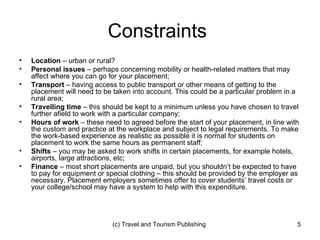
Constraints  Location  – urban or rural? Personal issues  – perhaps concerning mobility or health-related matters that may affect where you can go for your placement; Transport  – having access to public transport or other means of getting to the placement will need to be taken into account. This could be a particular problem in a rural area; Travelling time  – this should be kept to a minimum unless you have chosen to travel further afield to work with a particular company; Hours of work  – these need to agreed before the start of your placement, in line with the custom and practice at the workplace and subject to legal requirements. To make the work-based experience as realistic as possible it is normal for students on placement to work the same hours as permanent staff; Shifts  – you may be asked to work shifts in certain placements, for example hotels, airports, large attractions, etc; Finance  – most short placements are unpaid, but you shouldn’t be expected to have to pay for equipment or special clothing – this should be provided by the employer as necessary. Placement employers sometimes offer to cover students’ travel costs or your college/school may have a system to help with this expenditure.
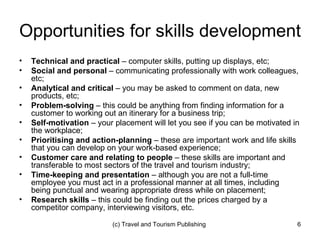
Opportunities for skills development Technical and practical  – computer skills, putting up displays, etc; Social and personal  – communicating professionally with work colleagues, etc; Analytical and critical  – you may be asked to comment on data, new products, etc; Problem-solving  – this could be anything from finding information for a customer to working out an itinerary for a business trip; Self-motivation  – your placement will let you see if you can be motivated in the workplace;  Prioritising and action-planning  – these are important work and life skills that you can develop on your work-based experience; Customer care and relating to people  – these skills are important and transferable to most sectors of the travel and tourism industry; Time-keeping and presentation  – although you are not a full-time employee you must act in a professional manner at all times, including being punctual and wearing appropriate dress while on placement; Research skills  – this could be finding out the prices charged by a competitor company, interviewing visitors, etc.
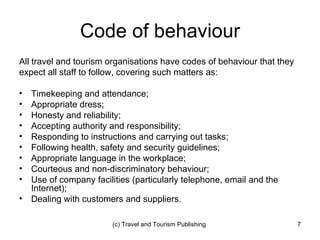
Code of behaviour All travel and tourism organisations have codes of behaviour that they expect all staff to follow, covering such matters as: Timekeeping and attendance; Appropriate dress; Honesty and reliability; Accepting authority and responsibility; Responding to instructions and carrying out tasks; Following health, safety and security guidelines; Appropriate language in the workplace; Courteous and non-discriminatory behaviour; Use of company facilities (particularly telephone, email and the Internet); Dealing with customers and suppliers.
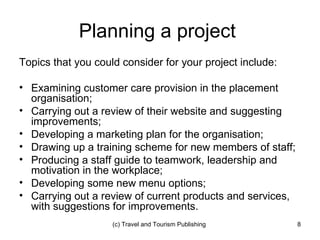
Planning a project  Topics that you could consider for your project include: Examining customer care provision in the placement organisation; Carrying out a review of their website and suggesting improvements; Developing a marketing plan for the organisation; Drawing up a training scheme for new members of staff; Producing a staff guide to teamwork, leadership and motivation in the workplace; Developing some new menu options; Carrying out a review of current products and services, with suggestions for improvements.
Presentation of your project The objectives of the project; The methods you used to achieve the objectives; Timescales involved; Resources consulted; Outcomes of the project.
Personal review Your own performance on placement Monitoring progress on placement Benefits to yourself New skills and knowledge gained Sector-specific experience New contacts made Possible new career pathways Other progression opportunities

Unit21

  • 1.
    BTEC National Traveland Tourism Unit 21 Work-based experience within the travel and tourism industry
  • 2.
    Summary of learningoutcomes Investigate opportunities for a work-based experience in the travel and tourism industry; Prepare to obtain a work-based experience; Plan, complete and present an approved project; Undertake a personal review of the work-based experience and your own performance.
  • 3.
    What can work-basedexperience do for me? If approached in a logical and positive manner, your placement has the potential to: Help you get a better job when you finish studying; Develop skills that employers are looking for; Add something to your CV; Give you a chance to put academic theory into practice; Bridge the gap between college and the world of work; Make you stand out from the crowd; Get a reference from your placement employer; Build your confidence by working with others and perhaps dealing with the public; Help test out career options; Learn more about yourself as a person.
  • 4.
    Sources of placementinformation and advice College/school database Careers advisers Resource centre Tutors Colleagues Newspapers Websites HR departments
  • 5.
    Constraints Location – urban or rural? Personal issues – perhaps concerning mobility or health-related matters that may affect where you can go for your placement; Transport – having access to public transport or other means of getting to the placement will need to be taken into account. This could be a particular problem in a rural area; Travelling time – this should be kept to a minimum unless you have chosen to travel further afield to work with a particular company; Hours of work – these need to agreed before the start of your placement, in line with the custom and practice at the workplace and subject to legal requirements. To make the work-based experience as realistic as possible it is normal for students on placement to work the same hours as permanent staff; Shifts – you may be asked to work shifts in certain placements, for example hotels, airports, large attractions, etc; Finance – most short placements are unpaid, but you shouldn’t be expected to have to pay for equipment or special clothing – this should be provided by the employer as necessary. Placement employers sometimes offer to cover students’ travel costs or your college/school may have a system to help with this expenditure.
  • 6.
    Opportunities for skillsdevelopment Technical and practical – computer skills, putting up displays, etc; Social and personal – communicating professionally with work colleagues, etc; Analytical and critical – you may be asked to comment on data, new products, etc; Problem-solving – this could be anything from finding information for a customer to working out an itinerary for a business trip; Self-motivation – your placement will let you see if you can be motivated in the workplace; Prioritising and action-planning – these are important work and life skills that you can develop on your work-based experience; Customer care and relating to people – these skills are important and transferable to most sectors of the travel and tourism industry; Time-keeping and presentation – although you are not a full-time employee you must act in a professional manner at all times, including being punctual and wearing appropriate dress while on placement; Research skills – this could be finding out the prices charged by a competitor company, interviewing visitors, etc.
  • 7.
    Code of behaviourAll travel and tourism organisations have codes of behaviour that they expect all staff to follow, covering such matters as: Timekeeping and attendance; Appropriate dress; Honesty and reliability; Accepting authority and responsibility; Responding to instructions and carrying out tasks; Following health, safety and security guidelines; Appropriate language in the workplace; Courteous and non-discriminatory behaviour; Use of company facilities (particularly telephone, email and the Internet); Dealing with customers and suppliers.
  • 8.
    Planning a project Topics that you could consider for your project include: Examining customer care provision in the placement organisation; Carrying out a review of their website and suggesting improvements; Developing a marketing plan for the organisation; Drawing up a training scheme for new members of staff; Producing a staff guide to teamwork, leadership and motivation in the workplace; Developing some new menu options; Carrying out a review of current products and services, with suggestions for improvements.
  • 9.
    Presentation of yourproject The objectives of the project; The methods you used to achieve the objectives; Timescales involved; Resources consulted; Outcomes of the project.
  • 10.
    Personal review Yourown performance on placement Monitoring progress on placement Benefits to yourself New skills and knowledge gained Sector-specific experience New contacts made Possible new career pathways Other progression opportunities