ZULKIFLI B HANAFI 
PBPI
 The PRESENT PERFECT TENSE is formed with a 
present tense form of "to have" plus the past 
participle of the verb (which can be either 
regular or irregular in form). This tense 
indicates either that an action was completed 
(finished or "perfected") at some point in the 
past or that the action extends to the 
present.
 FORM 
 [has/have + past participle] 
 Examples: 
You have seen that movie many times. 
Have you seen that movie many times? 
You have not seen that movie many times.
We use the Present Perfect to say that an 
action happened at an unspecified time 
before now. The exact time is not important. 
You CANNOT use the Present Perfect with 
specific time expressions such as: yesterday, 
one year ago, last week, when I was a child, 
when I lived in Japan, at that moment, that 
day, one day, etc. We CAN use the Present 
Perfect with unspecific expressions such as: 
ever, never, once, many times, several times, 
before, so far, already, yet, etc.
 Examples: 
 I have seen that movie twenty times. 
 I think I have met him once before. 
 There have been many earthquakes in California. 
 People have traveled to the Moon. 
 People have not traveled to Mars. 
 Have you read the book yet? 
 Nobody has ever climbed that mountain. 
 A: Has there ever been a war in the United States? 
B: Yes, there has been a war in the United States.
 Past Perfect 
 FORM 
 [had + past participle] 
 Examples: 
You had studied English before you moved to 
New York. 
Had you studied English before you moved to 
New York? 
You had not studied English before you 
moved to New York.
Completed Action Before Something in the Past 
 The Past Perfect expresses the idea that 
something occurred before another action in 
the past. It can also show that something 
happened before a specific time in the past.
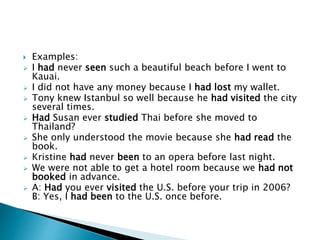
 Examples: 
 I had never seen such a beautiful beach before I went to 
Kauai. 
 I did not have any money because I had lost my wallet. 
 Tony knew Istanbul so well because he had visited the city 
several times. 
 Had Susan ever studied Thai before she moved to 
Thailand? 
 She only understood the movie because she had read the 
book. 
 Kristine had never been to an opera before last night. 
 We were not able to get a hotel room because we had not 
booked in advance. 
 A: Had you ever visited the U.S. before your trip in 2006? 
B: Yes, I had been to the U.S. once before.

Perfect tenses

  • 1.
  • 2.
     The PRESENTPERFECT TENSE is formed with a present tense form of "to have" plus the past participle of the verb (which can be either regular or irregular in form). This tense indicates either that an action was completed (finished or "perfected") at some point in the past or that the action extends to the present.
  • 3.
     FORM [has/have + past participle]  Examples: You have seen that movie many times. Have you seen that movie many times? You have not seen that movie many times.
  • 4.
    We use thePresent Perfect to say that an action happened at an unspecified time before now. The exact time is not important. You CANNOT use the Present Perfect with specific time expressions such as: yesterday, one year ago, last week, when I was a child, when I lived in Japan, at that moment, that day, one day, etc. We CAN use the Present Perfect with unspecific expressions such as: ever, never, once, many times, several times, before, so far, already, yet, etc.
  • 5.
     Examples: I have seen that movie twenty times.  I think I have met him once before.  There have been many earthquakes in California.  People have traveled to the Moon.  People have not traveled to Mars.  Have you read the book yet?  Nobody has ever climbed that mountain.  A: Has there ever been a war in the United States? B: Yes, there has been a war in the United States.
  • 6.
     Past Perfect  FORM  [had + past participle]  Examples: You had studied English before you moved to New York. Had you studied English before you moved to New York? You had not studied English before you moved to New York.
  • 7.
    Completed Action BeforeSomething in the Past  The Past Perfect expresses the idea that something occurred before another action in the past. It can also show that something happened before a specific time in the past.
  • 8.
     Examples: I had never seen such a beautiful beach before I went to Kauai.  I did not have any money because I had lost my wallet.  Tony knew Istanbul so well because he had visited the city several times.  Had Susan ever studied Thai before she moved to Thailand?  She only understood the movie because she had read the book.  Kristine had never been to an opera before last night.  We were not able to get a hotel room because we had not booked in advance.  A: Had you ever visited the U.S. before your trip in 2006? B: Yes, I had been to the U.S. once before.