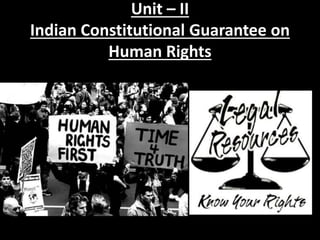
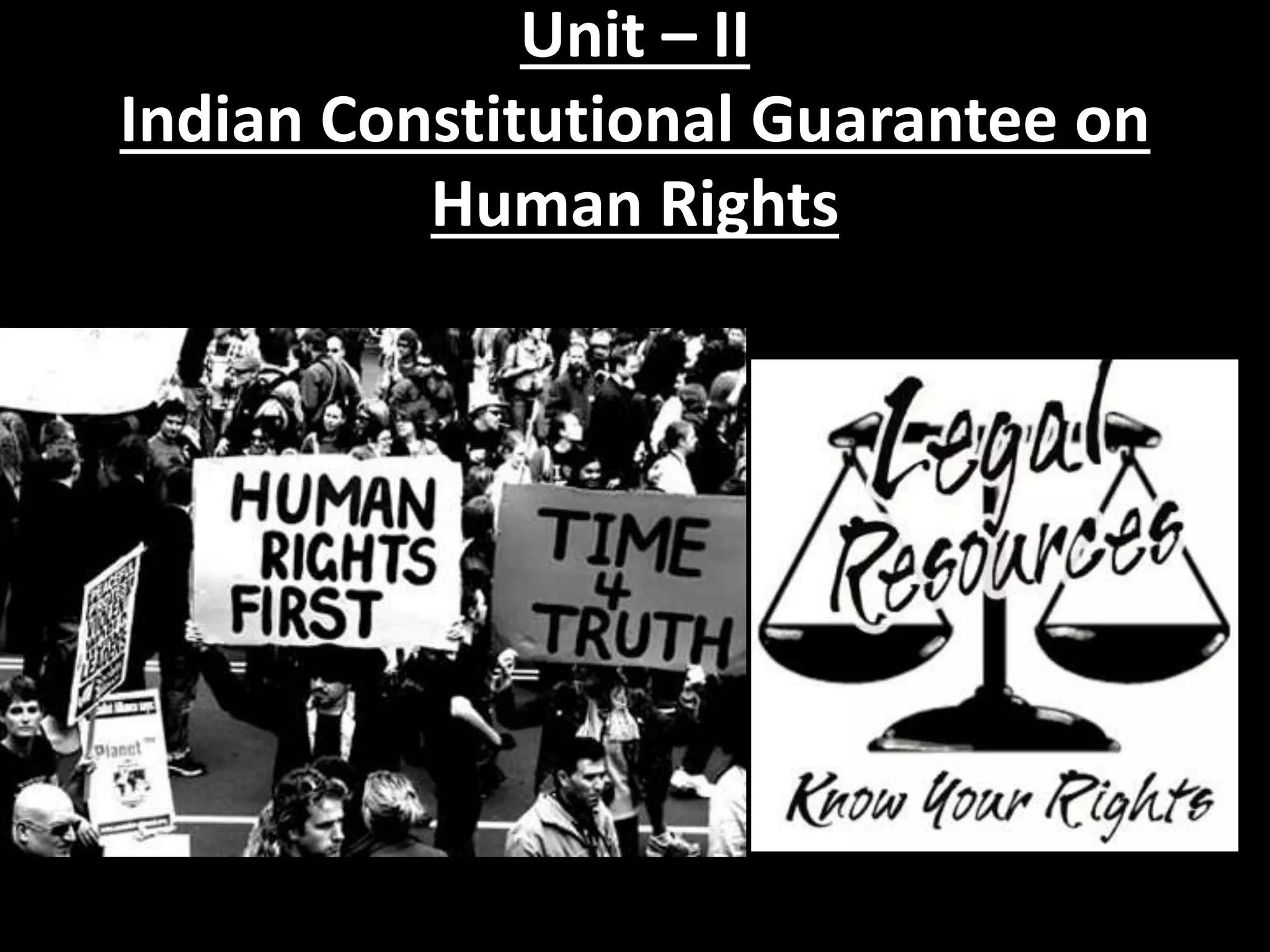
Unit – II
Indian Constitutional Guarantee on
Human Rights
Fundamental Rights
Fundamental Rights - Meaning
• Basic human freedoms which every Indian
citizen has the right to enjoy for a proper and
harmonious development of personality
Fundamental Rights –
Part III of the Indian Constitution
Fundamental Rights –
Part III of the Indian Constitution
• 'Part III - Fundamental Rights' is a ‘Charter of
Rights’
• Bill of Rights - a list of the most important
rights of the citizens of a country)
Fundamental Rights - Examples
• Equality before Law
• Freedom of Speech and Expression
• Peaceful Assembly
• Freedom to Practice Religion
• Right to Constitutional Remedies for the
Protection of Civil Rights
Violation of these rights result in
punishments as prescribed in the
Indian Penal Code, subject to
discretion of the judiciary.
Habeas Corpus
• it is a writ (legal action) which requires a
person under arrest to be brought before a
judge or into court.
• This ensures that a prisoner can be released
from unlawful detention
The Seven Fundamental Rights
Recognized By the Indian
Constitution
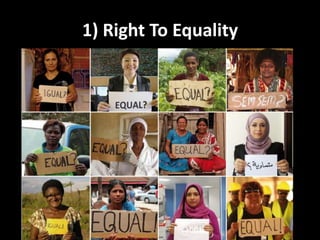
1) Right To Equality
• Equality before law,
• Prohibition of discrimination on grounds of religion,
race, caste, sex or place of birth,
• Equality of opportunity in matters of employment,
• Abolition of untouchability
• Abolition of titles.
2) Right To Freedom
2) Right To Freedom
• Speech and expression
• Assembly
• Association or union or cooperatives, movement
• Residence
• Right to practice any profession or occupation
• Right to life and liberty
• Right to education
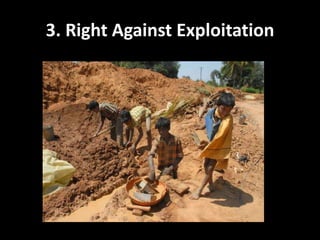
3. Right Against Exploitation
• Prohibiting all forms of forced labour,
• Child labour
• Traffic in human beings
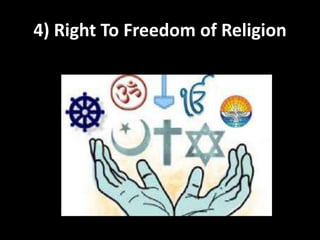
4) Right To Freedom of Religion
• Free profession practice
• Propagation of religion
• Freedom to manage religious affairs
• Freedom from certain taxes
• Freedom from religious instructions in certain
educational institutes.
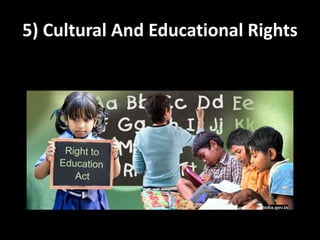
5) Cultural And Educational Rights
• Freedom to conserve their culture language or
script
• Right of minorities to establish and administer
educational institutions of their choice.
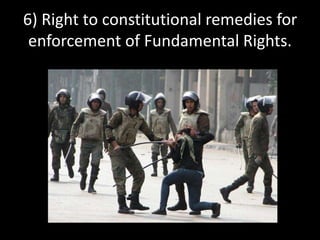
6) Right to constitutional remedies for
enforcement of Fundamental Rights.
7) Right to education which ensures
that children up to the age of 14 get
education. It can also be free of
cost.
Directive principles part IV of the
constitution
The Directive Principles of State
Policy
• Guidelines to the central and state
governments of India
• To be kept in mind while framing laws and
policies.
• They are not legally enforceable
Object of the Directive
Principles of State Policy
• 1. Welfare State
• 2. Social Revolution
• 3. Emphasizes the ideals of Preamble
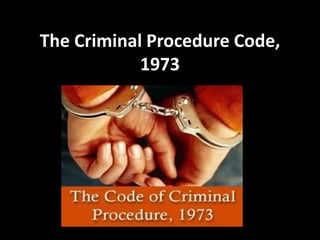
The Criminal Procedure Code,
1973
• The main legislation on procedure for administration of
substantive criminal law in India.
• approved in 1973 came into force on 1 April, 1974.
• It provides the machinery for the investigation of
crime, apprehension of suspected criminals, collection
of evidence, determination of guilt or innocence of the
accused person and the determination of punishment
of the guilty.
• The Act consists of 484 sections, 2 schedules
and 56 forms.
• The sections are divided into 38 chapters.
Classification of Offences under
the Code
1. Cognizable and Non-cognizable
Offences
• Cognizable
– Those offences for which a police officer may
arrest without court mandated warrant in
accordance with the first schedule of the code.
• Non-cognizable Offences
– Non-cognizable cases the police officer may arrest
only after being duly authorized by a warrant.
2. Summons case and warrant case
• Summons case
– A magistrate taking cognizance of an offence is to
issue summons for the attendance of the accused
if the case is a summons case.
• warrant case
– If the case appears to be a warrant case, he may
issue a warrant or a summons as he sees fit.
3. Bailable and Non-Bailable
• Bailable
– Bailable offences are offences listed under the
First Schedule
• Non-Bailable
– All other offences are non-bailable
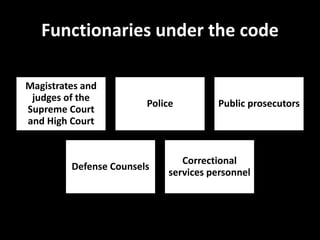
Functionaries under the code
Magistrates and
judges of the
Supreme Court
and High Court
Police Public prosecutors
Defense Counsels
Correctional
services personnel
The Protection of Civil Rights
Act, 1955
What is Civil Rights?
• Any right accumulate to a person by reason
of the abolition of ‘untouchability’ by article
17 of the constitution.
Importance of this Act
• This Act prescribes punishments for enforcing religious disabilities
on the ground of untouchability
• The Central Government has been empowered for the
implementation of the Act
• Example:
– preventing any person from entering any place of public worship
which is open to other persons professing the same religion or any
section of the religion.
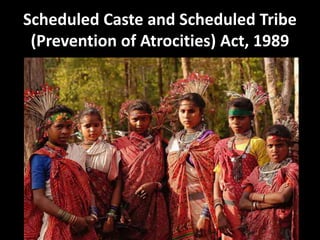
Scheduled Caste and Scheduled Tribe
(Prevention of Atrocities) Act, 1989
• Enacted by the parliament of India to prevent
atrocities against SC & ST people
• popularly known as ‘POA’, ‘the SC/ST Act’, the
‘Prevention of Atrocities Act’, or simply the
‘Atrocities Act’.
Objectives of the Act
Aims that the government to deliver
justice to SC and ST communities
Salient Features
• Divided into three different categories
 Provisions of criminal law - establishes criminal liability
for defined atrocities
 Provisions for relief and compensation
 Provisions that establish special authorities for the
implementation and monitoring of the act
International Covenant on Civil and
Political Rights (ICCPR)
• It is a multilateral treaty adopted by the
United Nations General Assembly on
December 16, 1966, and in force from March
23, 1976.
It commits its parties to respect the civil
and political rights of individuals
The ICCPR is part of the
International Bill of Human Rights,
along with the International
Covenant on Economic, Social and
Cultural Rights (ICESCR) and the
Universal Declaration of Human
Rights (UDHR).

Unit ii human rights

  • 1.
    Unit – II IndianConstitutional Guarantee on Human Rights
  • 2.
  • 3.
    Fundamental Rights -Meaning • Basic human freedoms which every Indian citizen has the right to enjoy for a proper and harmonious development of personality
  • 4.
    Fundamental Rights – PartIII of the Indian Constitution
  • 5.
    Fundamental Rights – PartIII of the Indian Constitution • 'Part III - Fundamental Rights' is a ‘Charter of Rights’ • Bill of Rights - a list of the most important rights of the citizens of a country)
  • 6.
    Fundamental Rights -Examples • Equality before Law • Freedom of Speech and Expression • Peaceful Assembly • Freedom to Practice Religion • Right to Constitutional Remedies for the Protection of Civil Rights
  • 7.
    Violation of theserights result in punishments as prescribed in the Indian Penal Code, subject to discretion of the judiciary.
  • 8.
    Habeas Corpus • itis a writ (legal action) which requires a person under arrest to be brought before a judge or into court. • This ensures that a prisoner can be released from unlawful detention
  • 9.
    The Seven FundamentalRights Recognized By the Indian Constitution
  • 10.
    1) Right ToEquality
  • 11.
    1) Right ToEquality • Equality before law, • Prohibition of discrimination on grounds of religion, race, caste, sex or place of birth, • Equality of opportunity in matters of employment, • Abolition of untouchability • Abolition of titles.
  • 12.
    2) Right ToFreedom
  • 13.
    2) Right ToFreedom • Speech and expression • Assembly • Association or union or cooperatives, movement • Residence • Right to practice any profession or occupation • Right to life and liberty • Right to education
  • 14.
    3. Right AgainstExploitation
  • 15.
    3. Right AgainstExploitation • Prohibiting all forms of forced labour, • Child labour • Traffic in human beings
  • 16.
    4) Right ToFreedom of Religion
  • 17.
    4) Right ToFreedom of Religion • Free profession practice • Propagation of religion • Freedom to manage religious affairs • Freedom from certain taxes • Freedom from religious instructions in certain educational institutes.
  • 18.
    5) Cultural AndEducational Rights
  • 19.
    5) Cultural AndEducational Rights • Freedom to conserve their culture language or script • Right of minorities to establish and administer educational institutions of their choice.
  • 20.
    6) Right toconstitutional remedies for enforcement of Fundamental Rights.
  • 21.
    7) Right toeducation which ensures that children up to the age of 14 get education. It can also be free of cost.
  • 22.
    Directive principles partIV of the constitution The Directive Principles of State Policy
  • 23.
    • Guidelines tothe central and state governments of India • To be kept in mind while framing laws and policies. • They are not legally enforceable
  • 24.
    Object of theDirective Principles of State Policy
  • 25.
    • 1. WelfareState • 2. Social Revolution • 3. Emphasizes the ideals of Preamble
  • 26.
  • 27.
    • The mainlegislation on procedure for administration of substantive criminal law in India. • approved in 1973 came into force on 1 April, 1974. • It provides the machinery for the investigation of crime, apprehension of suspected criminals, collection of evidence, determination of guilt or innocence of the accused person and the determination of punishment of the guilty.
  • 28.
    • The Actconsists of 484 sections, 2 schedules and 56 forms. • The sections are divided into 38 chapters.
  • 29.
  • 30.
    1. Cognizable andNon-cognizable Offences • Cognizable – Those offences for which a police officer may arrest without court mandated warrant in accordance with the first schedule of the code. • Non-cognizable Offences – Non-cognizable cases the police officer may arrest only after being duly authorized by a warrant.
  • 31.
    2. Summons caseand warrant case • Summons case – A magistrate taking cognizance of an offence is to issue summons for the attendance of the accused if the case is a summons case. • warrant case – If the case appears to be a warrant case, he may issue a warrant or a summons as he sees fit.
  • 32.
    3. Bailable andNon-Bailable • Bailable – Bailable offences are offences listed under the First Schedule • Non-Bailable – All other offences are non-bailable
  • 33.
    Functionaries under thecode Magistrates and judges of the Supreme Court and High Court Police Public prosecutors Defense Counsels Correctional services personnel
  • 34.
    The Protection ofCivil Rights Act, 1955
  • 35.
    What is CivilRights? • Any right accumulate to a person by reason of the abolition of ‘untouchability’ by article 17 of the constitution.
  • 36.
    Importance of thisAct • This Act prescribes punishments for enforcing religious disabilities on the ground of untouchability • The Central Government has been empowered for the implementation of the Act • Example: – preventing any person from entering any place of public worship which is open to other persons professing the same religion or any section of the religion.
  • 37.
    Scheduled Caste andScheduled Tribe (Prevention of Atrocities) Act, 1989
  • 38.
    • Enacted bythe parliament of India to prevent atrocities against SC & ST people • popularly known as ‘POA’, ‘the SC/ST Act’, the ‘Prevention of Atrocities Act’, or simply the ‘Atrocities Act’.
  • 39.
    Objectives of theAct Aims that the government to deliver justice to SC and ST communities
  • 40.
    Salient Features • Dividedinto three different categories  Provisions of criminal law - establishes criminal liability for defined atrocities  Provisions for relief and compensation  Provisions that establish special authorities for the implementation and monitoring of the act
  • 41.
    International Covenant onCivil and Political Rights (ICCPR)
  • 42.
    • It isa multilateral treaty adopted by the United Nations General Assembly on December 16, 1966, and in force from March 23, 1976.
  • 43.
    It commits itsparties to respect the civil and political rights of individuals
  • 44.
    The ICCPR ispart of the International Bill of Human Rights, along with the International Covenant on Economic, Social and Cultural Rights (ICESCR) and the Universal Declaration of Human Rights (UDHR).