



Introduction 
Rights mean those freedom which are essential for 
personal good of the community. 
The rights guaranteed under the constitution of India 
are fundamentals as they have been incorporated into 
the “fundamental law of the land” and are 
enforceable in a court of law. 
Fundamental Rights are those basic conditions of 
social life without which a citizen cannot be at his best 
self or those basic conditions which are very essential 
for the good life of a citizen.
Fundamental Rights 
Right to Equality 
Right to Freedom 
Right to get 
Education 
Right against 
Exploitation 
Right to 
Constitutional 
Remedies 
Right to Freedom 
of Religion
Right to Equality 
• Equality before Law(Article 14 ) 
• Social equality and equal access to 
public areas(Article 15) 
• Equality in matters of public 
employment (Article 16) 
• Abolition of untouchability 
(Article 17 ) 
• Abolition of Titles(Article 18 )
Right to Equality 
Right to equality is an important right provided for in Articles 14, 15, 16, 17 
and 18 of the constitution. It is the principal foundation of all other rights 
and liberties, and guarantees the following: 
(i) Equality before Law :- Article 14 of the constitution guarantees that all citizens shall be 
equally protected by the laws of the country 
(ii) Social equality and equal access to public areas:- Article 15 of the constitution states 
that no person shall be discriminated on the basis of caste, colour, language etc. Every person 
shall have equal access to public places like public parks, museums, wells, bathing ghats and 
temples etc. However, the State may make any special provision for women and children.
(iii) Equality in matters of public employment:- Article 16 of the constitution lays down that 
the State cannot discriminate against anyone in the matters of employment. All citizens can 
apply for government jobs. There are some exceptions. The Parliament may enact a law stating 
that certain jobs can only be filled by applicants who are domiciled in the area. 
(iv) Abolition of untouchability :- Article 17 of the constitution abolishes the practice of 
untouchability . Practice of untouchability is an offense and anyone doing so is punishable by 
law. 
(v) Abolition of Titles:- Article 18 of the constitution prohibits the State from conferring any 
titles. Citizens of India cannot accept titles from a foreign State.
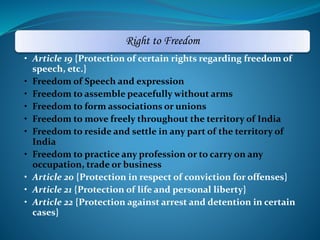
Right to Freedom 
• Article 19 {Protection of certain rights regarding freedom of 
speech, etc.} 
• Freedom of Speech and expression 
• Freedom to assemble peacefully without arms 
• Freedom to form associations or unions 
• Freedom to move freely throughout the territory of India 
• Freedom to reside and settle in any part of the territory of 
India 
• Freedom to practice any profession or to carry on any 
occupation, trade or business 
• Article 20 {Protection in respect of conviction for offenses} 
• Article 21 {Protection of life and personal liberty} 
• Article 22 {Protection against arrest and detention in certain 
cases}
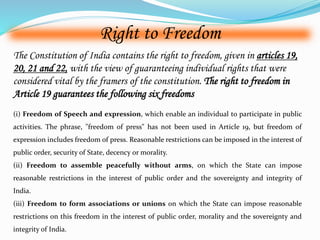
Right to Freedom 
The Constitution of India contains the right to freedom, given in articles 19, 
20, 21 and 22, with the view of guaranteeing individual rights that were 
considered vital by the framers of the constitution. The right to freedom in 
Article 19 guarantees the following six freedoms 
(i) Freedom of Speech and expression, which enable an individual to participate in public 
activities. The phrase, "freedom of press" has not been used in Article 19, but freedom of 
expression includes freedom of press. Reasonable restrictions can be imposed in the interest of 
public order, security of State, decency or morality. 
(ii) Freedom to assemble peacefully without arms, on which the State can impose 
reasonable restrictions in the interest of public order and the sovereignty and integrity of 
India. 
(iii) Freedom to form associations or unions on which the State can impose reasonable 
restrictions on this freedom in the interest of public order, morality and the sovereignty and 
integrity of India.
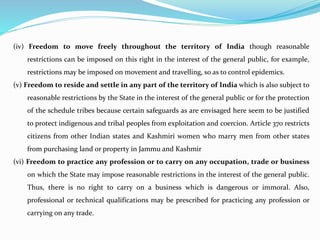
(iv) Freedom to move freely throughout the territory of India though reasonable 
restrictions can be imposed on this right in the interest of the general public, for example, 
restrictions may be imposed on movement and travelling, so as to control epidemics. 
(v) Freedom to reside and settle in any part of the territory of India which is also subject to 
reasonable restrictions by the State in the interest of the general public or for the protection 
of the schedule tribes because certain safeguards as are envisaged here seem to be justified 
to protect indigenous and tribal peoples from exploitation and coercion. Article 370 restricts 
citizens from other Indian states and Kashmiri women who marry men from other states 
from purchasing land or property in Jammu and Kashmir 
(vi) Freedom to practice any profession or to carry on any occupation, trade or business 
on which the State may impose reasonable restrictions in the interest of the general public. 
Thus, there is no right to carry on a business which is dangerous or immoral. Also, 
professional or technical qualifications may be prescribed for practicing any profession or 
carrying on any trade.
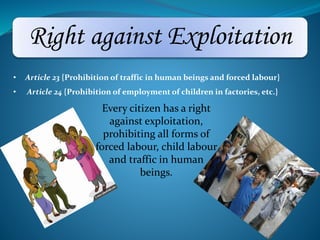
Right against Exploitation 
• Article 23 {Prohibition of traffic in human beings and forced labour} 
• Article 24 {Prohibition of employment of children in factories, etc.} 
Every citizen has a right 
against exploitation, 
prohibiting all forms of 
forced labour, child labour 
and traffic in human 
beings.
Right Against Exploitation 
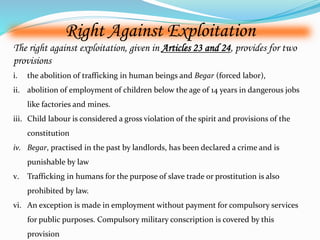
The right against exploitation, given in Articles 23 and 24, provides for two 
provisions 
i. the abolition of trafficking in human beings and Begar (forced labor), 
ii. abolition of employment of children below the age of 14 years in dangerous jobs 
like factories and mines. 
iii. Child labour is considered a gross violation of the spirit and provisions of the 
constitution 
iv. Begar, practised in the past by landlords, has been declared a crime and is 
punishable by law 
v. Trafficking in humans for the purpose of slave trade or prostitution is also 
prohibited by law. 
vi. An exception is made in employment without payment for compulsory services 
for public purposes. Compulsory military conscription is covered by this 
provision
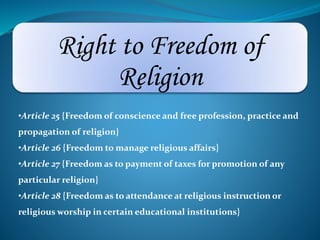
Right to Freedom of 
Religion 
•Article 25 {Freedom of conscience and free profession, practice and 
propagation of religion} 
•Article 26 {Freedom to manage religious affairs} 
•Article 27 {Freedom as to payment of taxes for promotion of any 
particular religion} 
•Article 28 {Freedom as to attendance at religious instruction or 
religious worship in certain educational institutions}
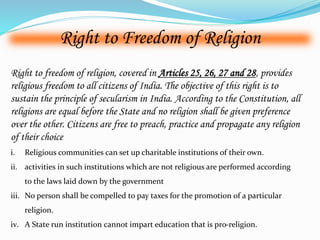
Right to Freedom of Religion 
Right to freedom of religion, covered in Articles 25, 26, 27 and 28, provides 
religious freedom to all citizens of India. The objective of this right is to 
sustain the principle of secularism in India. According to the Constitution, all 
religions are equal before the State and no religion shall be given preference 
over the other. Citizens are free to preach, practice and propagate any religion 
of their choice 
i. Religious communities can set up charitable institutions of their own. 
ii. activities in such institutions which are not religious are performed according 
to the laws laid down by the government 
iii. No person shall be compelled to pay taxes for the promotion of a particular 
religion. 
iv. A State run institution cannot impart education that is pro-religion.
Right to Get Education 
•Article 29 {Protection of interests of minorities} 
•Article 30 {Right of minorities to establish and administer 
educational institutions} 
Every 
child has a 
right to 
get basic 
education.
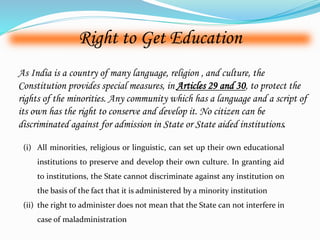
Right to Get Education 
As India is a country of many language, religion , and culture, the 
Constitution provides special measures, in Articles 29 and 30, to protect the 
rights of the minorities. Any community which has a language and a script of 
its own has the right to conserve and develop it. No citizen can be 
discriminated against for admission in State or State aided institutions. 
(i) All minorities, religious or linguistic, can set up their own educational 
institutions to preserve and develop their own culture. In granting aid 
to institutions, the State cannot discriminate against any institution on 
the basis of the fact that it is administered by a minority institution 
(ii) the right to administer does not mean that the State can not interfere in 
case of maladministration
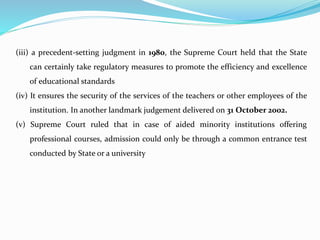
(iii) a precedent-setting judgment in 1980, the Supreme Court held that the State 
can certainly take regulatory measures to promote the efficiency and excellence 
of educational standards 
(iv) It ensures the security of the services of the teachers or other employees of the 
institution. In another landmark judgement delivered on 31 October 2002. 
(v) Supreme Court ruled that in case of aided minority institutions offering 
professional courses, admission could only be through a common entrance test 
conducted by State or a university
Right to constitutional remedies for the 
enforcement of Fundamental Rights.
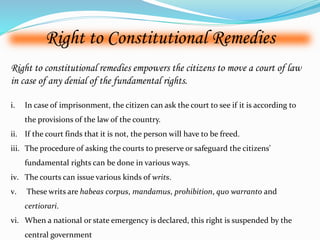
Right to Constitutional Remedies 
Right to constitutional remedies empowers the citizens to move a court of law 
in case of any denial of the fundamental rights. 
i. In case of imprisonment, the citizen can ask the court to see if it is according to 
the provisions of the law of the country. 
ii. If the court finds that it is not, the person will have to be freed. 
iii. The procedure of asking the courts to preserve or safeguard the citizens' 
fundamental rights can be done in various ways. 
iv. The courts can issue various kinds of writs. 
v. These writs are habeas corpus, mandamus, prohibition, quo warranto and 
certiorari. 
vi. When a national or state emergency is declared, this right is suspended by the 
central government
Made by : vijay mittal 
Submitted to: Gunjan mam 
{assitant professor} 
law depatment
Thank 
You!!!

Fundamentalrights & duties 130330013756-phpapp02

  • 1.
    Introduction Rights meanthose freedom which are essential for personal good of the community. The rights guaranteed under the constitution of India are fundamentals as they have been incorporated into the “fundamental law of the land” and are enforceable in a court of law. Fundamental Rights are those basic conditions of social life without which a citizen cannot be at his best self or those basic conditions which are very essential for the good life of a citizen.
  • 2.
    Fundamental Rights Rightto Equality Right to Freedom Right to get Education Right against Exploitation Right to Constitutional Remedies Right to Freedom of Religion
  • 3.
    Right to Equality • Equality before Law(Article 14 ) • Social equality and equal access to public areas(Article 15) • Equality in matters of public employment (Article 16) • Abolition of untouchability (Article 17 ) • Abolition of Titles(Article 18 )
  • 4.
    Right to Equality Right to equality is an important right provided for in Articles 14, 15, 16, 17 and 18 of the constitution. It is the principal foundation of all other rights and liberties, and guarantees the following: (i) Equality before Law :- Article 14 of the constitution guarantees that all citizens shall be equally protected by the laws of the country (ii) Social equality and equal access to public areas:- Article 15 of the constitution states that no person shall be discriminated on the basis of caste, colour, language etc. Every person shall have equal access to public places like public parks, museums, wells, bathing ghats and temples etc. However, the State may make any special provision for women and children.
  • 5.
    (iii) Equality inmatters of public employment:- Article 16 of the constitution lays down that the State cannot discriminate against anyone in the matters of employment. All citizens can apply for government jobs. There are some exceptions. The Parliament may enact a law stating that certain jobs can only be filled by applicants who are domiciled in the area. (iv) Abolition of untouchability :- Article 17 of the constitution abolishes the practice of untouchability . Practice of untouchability is an offense and anyone doing so is punishable by law. (v) Abolition of Titles:- Article 18 of the constitution prohibits the State from conferring any titles. Citizens of India cannot accept titles from a foreign State.
  • 6.
    Right to Freedom • Article 19 {Protection of certain rights regarding freedom of speech, etc.} • Freedom of Speech and expression • Freedom to assemble peacefully without arms • Freedom to form associations or unions • Freedom to move freely throughout the territory of India • Freedom to reside and settle in any part of the territory of India • Freedom to practice any profession or to carry on any occupation, trade or business • Article 20 {Protection in respect of conviction for offenses} • Article 21 {Protection of life and personal liberty} • Article 22 {Protection against arrest and detention in certain cases}
  • 7.
    Right to Freedom The Constitution of India contains the right to freedom, given in articles 19, 20, 21 and 22, with the view of guaranteeing individual rights that were considered vital by the framers of the constitution. The right to freedom in Article 19 guarantees the following six freedoms (i) Freedom of Speech and expression, which enable an individual to participate in public activities. The phrase, "freedom of press" has not been used in Article 19, but freedom of expression includes freedom of press. Reasonable restrictions can be imposed in the interest of public order, security of State, decency or morality. (ii) Freedom to assemble peacefully without arms, on which the State can impose reasonable restrictions in the interest of public order and the sovereignty and integrity of India. (iii) Freedom to form associations or unions on which the State can impose reasonable restrictions on this freedom in the interest of public order, morality and the sovereignty and integrity of India.
  • 8.
    (iv) Freedom tomove freely throughout the territory of India though reasonable restrictions can be imposed on this right in the interest of the general public, for example, restrictions may be imposed on movement and travelling, so as to control epidemics. (v) Freedom to reside and settle in any part of the territory of India which is also subject to reasonable restrictions by the State in the interest of the general public or for the protection of the schedule tribes because certain safeguards as are envisaged here seem to be justified to protect indigenous and tribal peoples from exploitation and coercion. Article 370 restricts citizens from other Indian states and Kashmiri women who marry men from other states from purchasing land or property in Jammu and Kashmir (vi) Freedom to practice any profession or to carry on any occupation, trade or business on which the State may impose reasonable restrictions in the interest of the general public. Thus, there is no right to carry on a business which is dangerous or immoral. Also, professional or technical qualifications may be prescribed for practicing any profession or carrying on any trade.
  • 9.
    Right against Exploitation • Article 23 {Prohibition of traffic in human beings and forced labour} • Article 24 {Prohibition of employment of children in factories, etc.} Every citizen has a right against exploitation, prohibiting all forms of forced labour, child labour and traffic in human beings.
  • 10.
    Right Against Exploitation The right against exploitation, given in Articles 23 and 24, provides for two provisions i. the abolition of trafficking in human beings and Begar (forced labor), ii. abolition of employment of children below the age of 14 years in dangerous jobs like factories and mines. iii. Child labour is considered a gross violation of the spirit and provisions of the constitution iv. Begar, practised in the past by landlords, has been declared a crime and is punishable by law v. Trafficking in humans for the purpose of slave trade or prostitution is also prohibited by law. vi. An exception is made in employment without payment for compulsory services for public purposes. Compulsory military conscription is covered by this provision
  • 11.
    Right to Freedomof Religion •Article 25 {Freedom of conscience and free profession, practice and propagation of religion} •Article 26 {Freedom to manage religious affairs} •Article 27 {Freedom as to payment of taxes for promotion of any particular religion} •Article 28 {Freedom as to attendance at religious instruction or religious worship in certain educational institutions}
  • 12.
    Right to Freedomof Religion Right to freedom of religion, covered in Articles 25, 26, 27 and 28, provides religious freedom to all citizens of India. The objective of this right is to sustain the principle of secularism in India. According to the Constitution, all religions are equal before the State and no religion shall be given preference over the other. Citizens are free to preach, practice and propagate any religion of their choice i. Religious communities can set up charitable institutions of their own. ii. activities in such institutions which are not religious are performed according to the laws laid down by the government iii. No person shall be compelled to pay taxes for the promotion of a particular religion. iv. A State run institution cannot impart education that is pro-religion.
  • 13.
    Right to GetEducation •Article 29 {Protection of interests of minorities} •Article 30 {Right of minorities to establish and administer educational institutions} Every child has a right to get basic education.
  • 14.
    Right to GetEducation As India is a country of many language, religion , and culture, the Constitution provides special measures, in Articles 29 and 30, to protect the rights of the minorities. Any community which has a language and a script of its own has the right to conserve and develop it. No citizen can be discriminated against for admission in State or State aided institutions. (i) All minorities, religious or linguistic, can set up their own educational institutions to preserve and develop their own culture. In granting aid to institutions, the State cannot discriminate against any institution on the basis of the fact that it is administered by a minority institution (ii) the right to administer does not mean that the State can not interfere in case of maladministration
  • 15.
    (iii) a precedent-settingjudgment in 1980, the Supreme Court held that the State can certainly take regulatory measures to promote the efficiency and excellence of educational standards (iv) It ensures the security of the services of the teachers or other employees of the institution. In another landmark judgement delivered on 31 October 2002. (v) Supreme Court ruled that in case of aided minority institutions offering professional courses, admission could only be through a common entrance test conducted by State or a university
  • 16.
    Right to constitutionalremedies for the enforcement of Fundamental Rights.
  • 17.
    Right to ConstitutionalRemedies Right to constitutional remedies empowers the citizens to move a court of law in case of any denial of the fundamental rights. i. In case of imprisonment, the citizen can ask the court to see if it is according to the provisions of the law of the country. ii. If the court finds that it is not, the person will have to be freed. iii. The procedure of asking the courts to preserve or safeguard the citizens' fundamental rights can be done in various ways. iv. The courts can issue various kinds of writs. v. These writs are habeas corpus, mandamus, prohibition, quo warranto and certiorari. vi. When a national or state emergency is declared, this right is suspended by the central government
  • 20.
    Made by :vijay mittal Submitted to: Gunjan mam {assitant professor} law depatment
  • 21.