Magazine Analysis
By Leeza Ah-Wan
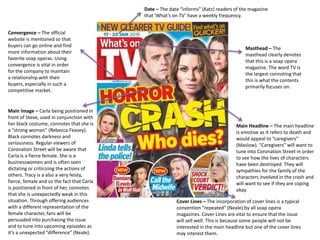
Main Headline – The main headline
is emotive as it refers to death and
would appeal to “caregivers”
(Maslow). “Caregivers” will want to
tune into Coronation Street in order
to see how the lives of characters
have been destroyed. They will
sympathies for the family of the
characters involved in the crash and
will want to see if they are coping
okay.
Main Image – Carla being positioned in
front of Steve, used in conjunction with
her black costume, connotes that she is
a “strong woman” (Rebecca Feasey).
Black connotes darkness and
seriousness. Regular viewers of
Coronation Street will be aware that
Carla is a fierce female. She is a
businesswomen and is often seen
dictating or criticizing the actions of
others. Tracy is a also a very feisty,
fierce, female and so the fact that Carla
is positioned in front of her, connotes
that she is unexpectedly weak in this
situation. Through offering audiences
with a different representation of the
female character, fans will be
persuaded into purchasing the issue
and to tune into upcoming episodes as
it’s a unexpected “difference” (Neale).
Masthead – The
masthead clearly denotes
that this is a soap opera
magazine. The word TV is
the largest connoting that
this is what the contents
primarily focuses on.
Date – The date “informs” (Katz) readers of the magazine
that ‘What’s on TV’ have a weekly frequency.
Cover Lines – The incorporation of cover lines is a typical
convention “repeated” (Neale) by all soap opera
magazines. Cover Lines are vital to ensure that the issue
will sell well. This is because some people will not be
interested in the main headline but one of the cover lines
may interest them.
Convergence – The official
website is mentioned so that
buyers can go online and find
more information about their
favorite soap operas. Using
convergence is vital in order
for the company to maintain
a relationship with their
buyers, especially in such a
competitive market.
What conventions will I “repeat”? (Neale)
The What’s on TV magazine has incorporated a range of conventions that will enable the magazine to sell well and be
successful. I will be “repeating” (Neale) multiple conventions when producing my own soap opera magazine. It is
essential that my front cover features a masthead as my magazine is not well established and as this is the first issue,
individuals will not have heard of the company before. I will ensure my masthead is catchy and memorable and links
directly to the soap opera genre. This will allow me to start the journey of building a “personal relationship” (Katz)
with potential consumers. It could be argued that well established soap opera magazines such as What’s on TV and
Inside Soap sell well, not necessarily because of an effective masthead, but due to their gripping and shocking
headlines. Therefore, another convention I will be “repeating” (Neale) is the utilization of a main headline. The main
headline uses the rhetorical question: ‘Horror Crash who dies?’. Using a rhetorical question is effective in drawing in
the interests of potential buyers. They will want to buy the issue so they can read more about the upcoming crash and
how Carla, Steve and Tracy are involved. The word ‘horror’ also connotes that there will be bloodshed and pain
involved and therefore, this isn’t a storyline fans will want to miss as it’s going to be explosive. In order to provoke
consumers to think about what’s to come, I will also be using a rhetorical question in my main headline. Furthermore, I
will not only be “repeating” (Neale) the incorporation of multiple cover lines, but I will also replicate the way each
cover line is supported by an image of the character referenced. Using multiple images on a soap opera magazine front
cover is important as a pass along audience may not be interested in reading any of the text on the cover, but when
they see a ‘star’ (Richard Dyer) who they have a “personal relationship” (Katz) with, they might pick up the issue and
choose to buy it. Using convergence through stating the official website is also important, so buyers have the option to
access news about their favorite soap operas through multiple platforms and sources.
How will my magazine offer “difference?” (Neale)
One way in which my magazine will offer “difference” (Neale) is through the representation of male and female
characters. There is only one male character on the cover of this issue and the rest are females. This is because What’s
on TV predominantly target a “female” (Hartley) audience as this is who the soap opera genre stereotypically appeals
to. I also plan to target a “female” (Hartley) demographic however, as well as using female characters, I will also try
and appeal to this demographic through providing a “female gaze” (Diana Saco). My magazine will also provide
“difference” (Neale) through the incorporation of a bar code, issue number and social networking logos.
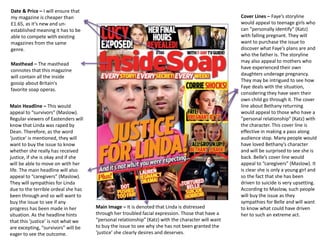
Date & Price – I will ensure that
my magazine is cheaper than
£1.65, as it’s new and un-
established meaning it has to be
able to compete with existing
magazines from the same
genre.
Main Headline – This would
appeal to “survivors” (Maslow).
Regular viewers of Eastenders will
know that Linda was raped by
Dean. Therefore, as the word
‘justice’ is mentioned, they will
want to buy the issue to know
whether she really has received
justice, if she is okay and if she
will be able to move on with her
life. The main headline will also
appeal to “caregivers” (Maslow).
They will sympathies for Linda
due to the terrible ordeal she has
been through and so will want to
buy the issue to see if any
progress has been made in her
situation. As the headline hints
that this ‘justice’ is not what we
are excepting, “survivors” will be
eager to see the outcome.
Cover Lines – Faye’s storyline
would appeal to teenage girls who
can “personally identify” (Katz)
with falling pregnant. They will
want to purchase the issue to
discover what Faye’s plans are and
who the father is. The storyline
may also appeal to mothers who
have experienced their own
daughters underage pregnancy.
They may be intrigued to see how
Faye deals with the situation,
considering they have seen their
own child go through it. The cover
line about Bethany returning
would appeal to those who have a
“personal relationship” (Katz) with
the character. This cover line is
effective in making a pass along
audience stop. Many people would
have loved Bethany’s character
and will be surprised to see she is
back. Belle’s cover line would
appeal to “caregivers” (Maslow). It
is clear she is only a young girl and
so the fact that she has been
driven to suicide is very upsetting.
According to Maslow, such people
will buy the issue as they
sympathies for Belle and will want
to know what could have driven
her to such an extreme act.
Masthead – The masthead
connotes that this magazine
will contain all the inside
gossip about Britain's
favorite soap operas.
Main Image – It is denoted that Linda is distressed
through her troubled facial expression. Those that have a
“personal relationship” (Katz) with the character will want
to buy the issue to see why she has not been granted the
‘justice’ she clearly desires and deserves.
What conventions will I “repeat”? (Neale)
This cover for Inside Soap has also utilized a range of effective and generic conventions. One aspect of the magazine
that I particularly plan to replicate is the variety of bright colors used. Both Inside Soap and What’s on TV use a
variety of vibrant colors in order to catch the eye of a pass along audience. Both the main headline and cover lines
are written in yellow and orange, making the text impossible to miss.
How will my magazine offer “difference?” (Neale)
Similarly to the What’s on TV magazine analyzed, this magazine also doesn’t have a bar code, issue number, or
utilize social networking logos. All of these conventions will be incorporated in my own production work. Inside
Soap have also not used convergence through stating the official website, which I believe is a weakness. If readers
can access news content through another platform, the chance of the company’s fan base growing is greater and
they are more likely to maintain a loyal fan base.

Unit G324: Magazine Analysis

  • 1.
  • 2.
    Main Headline –The main headline is emotive as it refers to death and would appeal to “caregivers” (Maslow). “Caregivers” will want to tune into Coronation Street in order to see how the lives of characters have been destroyed. They will sympathies for the family of the characters involved in the crash and will want to see if they are coping okay. Main Image – Carla being positioned in front of Steve, used in conjunction with her black costume, connotes that she is a “strong woman” (Rebecca Feasey). Black connotes darkness and seriousness. Regular viewers of Coronation Street will be aware that Carla is a fierce female. She is a businesswomen and is often seen dictating or criticizing the actions of others. Tracy is a also a very feisty, fierce, female and so the fact that Carla is positioned in front of her, connotes that she is unexpectedly weak in this situation. Through offering audiences with a different representation of the female character, fans will be persuaded into purchasing the issue and to tune into upcoming episodes as it’s a unexpected “difference” (Neale). Masthead – The masthead clearly denotes that this is a soap opera magazine. The word TV is the largest connoting that this is what the contents primarily focuses on. Date – The date “informs” (Katz) readers of the magazine that ‘What’s on TV’ have a weekly frequency. Cover Lines – The incorporation of cover lines is a typical convention “repeated” (Neale) by all soap opera magazines. Cover Lines are vital to ensure that the issue will sell well. This is because some people will not be interested in the main headline but one of the cover lines may interest them. Convergence – The official website is mentioned so that buyers can go online and find more information about their favorite soap operas. Using convergence is vital in order for the company to maintain a relationship with their buyers, especially in such a competitive market.
  • 3.
    What conventions willI “repeat”? (Neale) The What’s on TV magazine has incorporated a range of conventions that will enable the magazine to sell well and be successful. I will be “repeating” (Neale) multiple conventions when producing my own soap opera magazine. It is essential that my front cover features a masthead as my magazine is not well established and as this is the first issue, individuals will not have heard of the company before. I will ensure my masthead is catchy and memorable and links directly to the soap opera genre. This will allow me to start the journey of building a “personal relationship” (Katz) with potential consumers. It could be argued that well established soap opera magazines such as What’s on TV and Inside Soap sell well, not necessarily because of an effective masthead, but due to their gripping and shocking headlines. Therefore, another convention I will be “repeating” (Neale) is the utilization of a main headline. The main headline uses the rhetorical question: ‘Horror Crash who dies?’. Using a rhetorical question is effective in drawing in the interests of potential buyers. They will want to buy the issue so they can read more about the upcoming crash and how Carla, Steve and Tracy are involved. The word ‘horror’ also connotes that there will be bloodshed and pain involved and therefore, this isn’t a storyline fans will want to miss as it’s going to be explosive. In order to provoke consumers to think about what’s to come, I will also be using a rhetorical question in my main headline. Furthermore, I will not only be “repeating” (Neale) the incorporation of multiple cover lines, but I will also replicate the way each cover line is supported by an image of the character referenced. Using multiple images on a soap opera magazine front cover is important as a pass along audience may not be interested in reading any of the text on the cover, but when they see a ‘star’ (Richard Dyer) who they have a “personal relationship” (Katz) with, they might pick up the issue and choose to buy it. Using convergence through stating the official website is also important, so buyers have the option to access news about their favorite soap operas through multiple platforms and sources. How will my magazine offer “difference?” (Neale) One way in which my magazine will offer “difference” (Neale) is through the representation of male and female characters. There is only one male character on the cover of this issue and the rest are females. This is because What’s on TV predominantly target a “female” (Hartley) audience as this is who the soap opera genre stereotypically appeals to. I also plan to target a “female” (Hartley) demographic however, as well as using female characters, I will also try and appeal to this demographic through providing a “female gaze” (Diana Saco). My magazine will also provide “difference” (Neale) through the incorporation of a bar code, issue number and social networking logos.
  • 4.
    Date & Price– I will ensure that my magazine is cheaper than £1.65, as it’s new and un- established meaning it has to be able to compete with existing magazines from the same genre. Main Headline – This would appeal to “survivors” (Maslow). Regular viewers of Eastenders will know that Linda was raped by Dean. Therefore, as the word ‘justice’ is mentioned, they will want to buy the issue to know whether she really has received justice, if she is okay and if she will be able to move on with her life. The main headline will also appeal to “caregivers” (Maslow). They will sympathies for Linda due to the terrible ordeal she has been through and so will want to buy the issue to see if any progress has been made in her situation. As the headline hints that this ‘justice’ is not what we are excepting, “survivors” will be eager to see the outcome. Cover Lines – Faye’s storyline would appeal to teenage girls who can “personally identify” (Katz) with falling pregnant. They will want to purchase the issue to discover what Faye’s plans are and who the father is. The storyline may also appeal to mothers who have experienced their own daughters underage pregnancy. They may be intrigued to see how Faye deals with the situation, considering they have seen their own child go through it. The cover line about Bethany returning would appeal to those who have a “personal relationship” (Katz) with the character. This cover line is effective in making a pass along audience stop. Many people would have loved Bethany’s character and will be surprised to see she is back. Belle’s cover line would appeal to “caregivers” (Maslow). It is clear she is only a young girl and so the fact that she has been driven to suicide is very upsetting. According to Maslow, such people will buy the issue as they sympathies for Belle and will want to know what could have driven her to such an extreme act. Masthead – The masthead connotes that this magazine will contain all the inside gossip about Britain's favorite soap operas. Main Image – It is denoted that Linda is distressed through her troubled facial expression. Those that have a “personal relationship” (Katz) with the character will want to buy the issue to see why she has not been granted the ‘justice’ she clearly desires and deserves.
  • 5.
    What conventions willI “repeat”? (Neale) This cover for Inside Soap has also utilized a range of effective and generic conventions. One aspect of the magazine that I particularly plan to replicate is the variety of bright colors used. Both Inside Soap and What’s on TV use a variety of vibrant colors in order to catch the eye of a pass along audience. Both the main headline and cover lines are written in yellow and orange, making the text impossible to miss. How will my magazine offer “difference?” (Neale) Similarly to the What’s on TV magazine analyzed, this magazine also doesn’t have a bar code, issue number, or utilize social networking logos. All of these conventions will be incorporated in my own production work. Inside Soap have also not used convergence through stating the official website, which I believe is a weakness. If readers can access news content through another platform, the chance of the company’s fan base growing is greater and they are more likely to maintain a loyal fan base.