UNIT 7.- GRAPHIC EXPRESSION AND COMMUNICATION 
Subject: TECHNOLOGY Teacher: MERCEDES RUBIO 
ORTEGA 
Title of the Unit : TECHNIQUES FOR GRAPHIC REPRESENTATION Course / 
Level: 1st ESO 
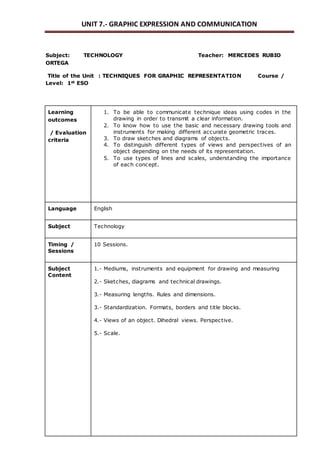
Learning 
outcomes 
/ Evaluation 
criteria 
1. To be able to communicate technique ideas using codes in the 
drawing in order to transmit a clear information. 
2. To know how to use the basic and necessary drawing tools and 
instruments for making different accurate geometric traces. 
3. To draw sketches and diagrams of objects. 
4. To distinguish different types of views and perspectives of an 
object depending on the needs of its representation. 
5. To use types of lines and scales, understanding the importance 
of each concept. 
Language English 
Subject Technology 
Timing / 
Sessions 
10 Sessions. 
Subject 
Content 
1.- Mediums, instruments and equipment for drawing and measuring 
2.- Sketches, diagrams and technical drawings. 
3.- Measuring lengths. Rules and dimensions. 
3.- Standardization. Formats, borders and title blocks. 
4.- Views of an object. Dihedral views. Perspective. 
5.- Scale.
UNIT 7.- GRAPHIC EXPRESSION AND COMMUNICATION 
LANGUAGE CONTENT / COMMUNICATION 
Vocabulary 
Section 
Nouns 
Verbs 
Adjectives 
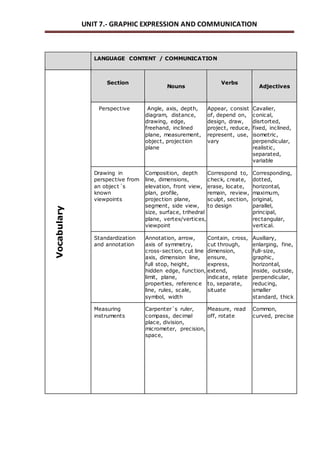
Perspective Angle, axis, depth, 
diagram, distance, 
drawing, edge, 
freehand, inclined 
plane, measurement, 
object, projection 
plane 
Appear, consist 
of, depend on, 
design, draw, 
project, reduce, 
represent, use, 
vary 
Cavalier, 
conical, 
disrtorted, 
fixed, inclined, 
isometric, 
perpendicular, 
realistic, 
separated, 
variable 
Drawing in 
perspective from 
an object´s 
known 
viewpoints 
Composition, depth 
line, dimensions, 
elevation, front view, 
plan, profile, 
projection plane, 
segment, side view, 
size, surface, trihedral 
plane, vertex/vertices, 
viewpoint 
Correspond to, 
check, create, 
erase, locate, 
remain, review, 
sculpt, section, 
to design 
Corresponding, 
dotted, 
horizontal, 
maximum, 
original, 
parallel, 
principal, 
rectangular, 
vertical. 
Standardization 
and annotation 
Annotation, arrow, 
axis of symmetry, 
cross-section, cut line 
axis, dimension line, 
full stop, height, 
hidden edge, function, 
limit, plane, 
properties, reference 
line, rules, scale, 
symbol, width 
Contain, cross, 
cut through, 
dimension, 
ensure, 
express, 
extend, 
indicate, relate 
to, separate, 
situate 
Auxiliary, 
enlarging, fine, 
full-size, 
graphic, 
horizontal, 
inside, outside, 
perpendicular, 
reducing, 
smaller 
standard, thick 
Measuring 
instruments 
Carpenter´s ruler, 
compass, decimal 
place, division, 
micrometer, precision, 
space, 
Measure, read 
off, rotate 
Common, 
curved, precise
UNIT 7.- GRAPHIC EXPRESSION AND COMMUNICATION 
Structures 
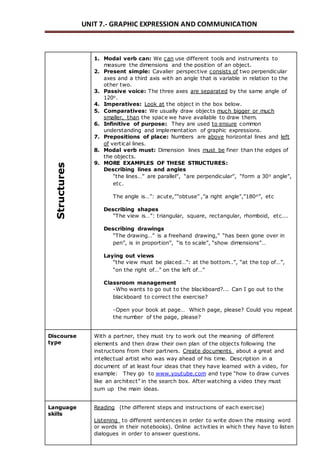
1. Modal verb can: We can use different tools and instruments to 
measure the dimensions and the position of an object. 
2. Present simple: Cavalier perspective consists of two perpendicular 
axes and a third axis with an angle that is variable in relation to the 
other two. 
3. Passive voice: The three axes are separated by the same angle of 
120o. 
4. Imperatives: Look at the object in the box below. 
5. Comparatives: We usually draw objects much bigger or much 
smaller, than the space we have available to draw them. 
6. Infinitive of purpose: They are used to ensure common 
understanding and implementation of graphic expressions. 
7. Prepositions of place: Numbers are above horizontal lines and left 
of vertical lines. 
8. Modal verb must: Dimension lines must be finer than the edges of 
the objects. 
9. MORE EXAMPLES OF THESE STRUCTURES: 
Describing lines and angles 
“the lines…” are parallel”, “are perpendic ular”, “form a 30o angle”, 
etc. 
The angle is…”: ac ute,””obtuse” ,”a right angle”,”180o”, etc 
Describing shapes 
“The view is…”: triangular, square, rec tangular, rhomboid, etc ... 
Describing drawings 
“The drawing…” is a freehand drawing,” “has been gone over in 
pen”, is in proportion”, “is to sc ale”, “show dimensions”… 
Laying out views 
“the view must be plac ed…”: at the bottom..”, “at the top of…”, 
“on the right of…” on the left of…” 
Classroom management 
-Who wants to go out to the blackboard?... Can I go out to the 
blackboard to correct the exercise? 
-Open your book at page… Whic h page, please? Could you repeat 
the number of the page, please? 
Discourse 
type 
With a partner, they must try to work out the meaning of different 
elements and then draw their own plan of the objects following the 
instructions from their partners. Create documents about a great and 
intellectual artist who was way ahead of his time. Description in a 
document of at least four ideas that they have learned with a video, for 
example: They go to www.youtube.com and type “how to draw c urves 
like an arc hitec t” in the searc h box. After watc hing a video they must 
sum up the main ideas. 
Language 
skills 
Reading (the different steps and instructions of each exercise) 
Listening to different sentences in order to write down the missing word 
or words in their notebooks). Online activities in which they have to listen 
dialogues in order to answer questions.
UNIT 7.- GRAPHIC EXPRESSION AND COMMUNICATION 
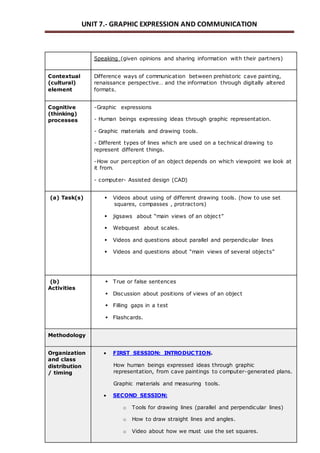
Speaking (given opinions and sharing information with their partners) 
Contextual 
(cultural) 
element 
Difference ways of communication between prehistoric cave painting, 
renaissanc e perspec tive… and the information through digitally altered 
formats. 
Cognitive 
(thinking) 
processes 
-Graphic expressions 
- Human beings expressing ideas through graphic representation. 
- Graphic materials and drawing tools. 
- Different types of lines which are used on a technical drawing to 
represent different things. 
-How our perception of an object depends on which viewpoint we look at 
it from. 
- computer- Assisted design (CAD) 
(a) Task(s)  Videos about using of different drawing tools. (how to use set 
squares, compasses , protractors) 
 jigsaws about “main views of an objec t” 
 Webquest about scales. 
 Videos and questions about parallel and perpendicular lines 
 Videos and questions about “main views of several objec ts” 
(b) 
Activities 
 True or false sentences 
 Discussion about positions of views of an object 
 Filling gaps in a test 
 Flashcards. 
Methodology 
Organization 
and class 
distribution 
/ timing 
 FIRST SESSION: INTRODUCTION. 
How human beings expressed ideas through graphic 
representation, from cave paintings to computer-generated plans. 
Graphic materials and measuring tools. 
 SECOND SESSION: 
o Tools for drawing lines (parallel and perpendicular lines) 
o How to draw straight lines and angles. 
o Video about how we must use the set squares.
UNIT 7.- GRAPHIC EXPRESSION AND COMMUNICATION 
 THIRD SESSION: PRACTISING THE NEW VOCABULARY 
o Show a set of flashcards and ask them to write the ones 
they remember. 
o Matching between definitions and images 
o Fill in a chart about the new vocabulary and doing 
exercises. 
o Check in what they know. 
 FOURTH SESSION: SKETCHES, DIAGRAMS AND TECHNICAL 
DRAWINGS 
o Look at a video about the difference between these types 
of drawing. Decide what type of drawing is the best one for 
each situation. 
o Listen to the teacher describing a sketch, diagram or 
technical drawing and discuss with the other students the 
type of them. 
o Types of lines. 
o Dimensions. Making measurements of length and 
converting the units. 
 FIFTH SESSION: VIEWS OF AN OBJECT and DIHEDRAL SYSTEM 
o Look at presentations, videos in order to learn the main 
views of an object. 
o Show the main views using a common object (for example 
an eraser or the blackboard eraser) and draw the main 
views of it. 
 SIXTH SESSION: VIEWS OF AN OBJECT II 
o Jigsaw about objects and main views. 
o TEST about main views of an object. 
 SEVENTH SESSION: SCALES 
o Definition. Types of scales. 
o Exercises about scales. Making sentences to explain the 
solution of each problem. 
o Test about scales.
UNIT 7.- GRAPHIC EXPRESSION AND COMMUNICATION 
 EIGHTH SESSION: MAKING A SIMPLE MODEL 
o Build a three dimensional model and a trihedral plane 
o Practice the main views and draw them. 
o Work in pairs to ask questions (about the new vocabulary 
and expressions) given by the teacher. Change roles and 
repeat the questions in a different order. 
 NINENTH SESSION: DOUBTS AND CHECK THE 
UNDERSTANDING OF EACH CONTENTS. 
Resources / 
Materials 
Internet resources: videos, webquests, crosswords. 
Key 
Competences 
Evaluation 
(criteria and 
instruments) 
ASSESMENT WORKSHEET ABOUT TECHNICAL DRAWING 
EXAM ABOUT ALL THE KWOLEDGES LEARNED IN THIS UNIT.
UNIT 7.- GRAPHIC EXPRESSION AND COMMUNICATION 
Feel free to use this template. Thanks for attributing the source. 
A first sample of this template has been published at: 
Pérez Torres, I. 2009. "Apuntes sobre los principios y características de la metodología 
AICLE" en V. Pavón, J. Ávila (eds.), Aplicaciones didácticas para la enseñanza integrada de 
lengua y contenidos. Sevilla: Consejería de Educación de la Junta de Andalucía- 
Universidad de Córdoba.171-180. 
It is mainly based on the hands-on experience at designing units and on conversations 
with experts and peers. The theory of the 4Cs by Do Coyle has also been taken into 
account. This theory has been shown in various publications, such as: Coyle, D., Hood, P. 
and Marsh, D., 2010. Content and Language Integrated Learning. Cambridge University 
Press.
UNIT 7.- GRAPHIC EXPRESSION AND COMMUNICATION 
FIRST SESSION: INTRODUCTION TO GRAPHIC EXPRESSION AND COMMUNICATION 
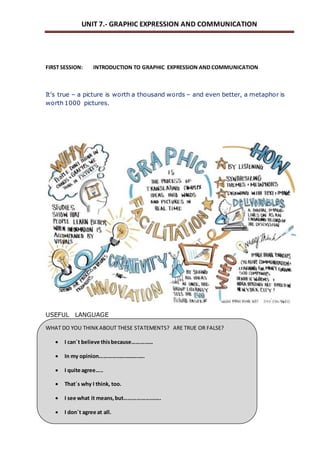
It’s true – a picture is worth a thousand words – and even better, a metaphor is 
worth 1000 pictures. 
USEFUL LANGUAGE 
WHAT DO YOU THINK ABOUT THESE STATEMENTS? ARE TRUE OR FALSE? 
 I can´t believe this because…………… 
 In my opinion………………………….. 
 I quite agree….. 
 That´s why I think, too. 
 I see what it means, but…………………….. 
 I don´t agree at all.
UNIT 7.- GRAPHIC EXPRESSION AND COMMUNICATION 
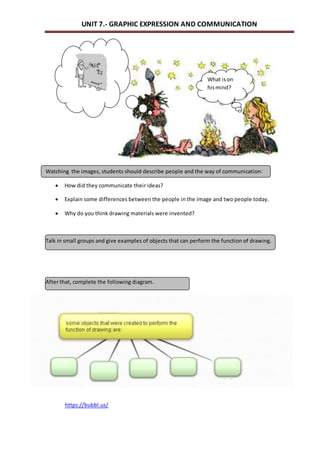
Watching the images, students should describe people and the way of communication: 
 How did they communicate their ideas? 
 Explain some differences between the people in the image and two people today. 
 Why do you think drawing materials were invented? 
Talk in small groups and give examples of objects that can perform the function of drawing. 
After that, complete the following diagram. 
https://bubbl.us/ 
What is on 
his mind?
UNIT 7.- GRAPHIC EXPRESSION AND COMMUNICATION 
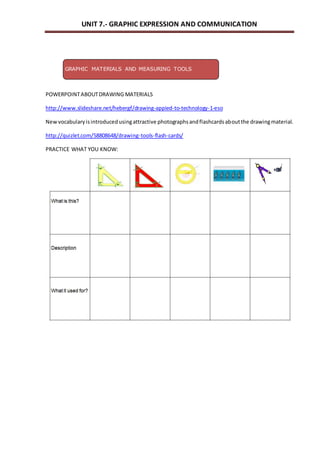
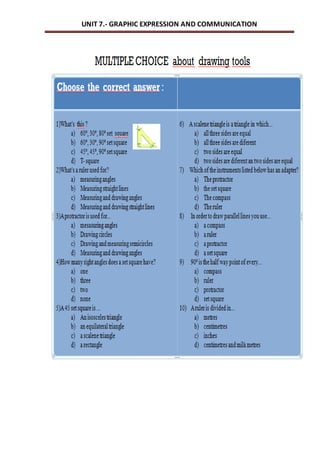
GRAPHIC MATERIALS AND MEASURING TOOLS 
POWERPOINT ABOUT DRAWING MATERIALS 
http://www.slideshare.net/hebergf/drawing-appied-to-technology-1-eso 
New vocabulary is introduced using attractive photographs and flashcards about the drawing material. 
http://quizlet.com/58808648/drawing-tools-flash-cards/ 
PRACTICE WHAT YOU KNOW:
UNIT 7.- GRAPHIC EXPRESSION AND COMMUNICATION
UNIT 7.- GRAPHIC EXPRESSION AND COMMUNICATION 
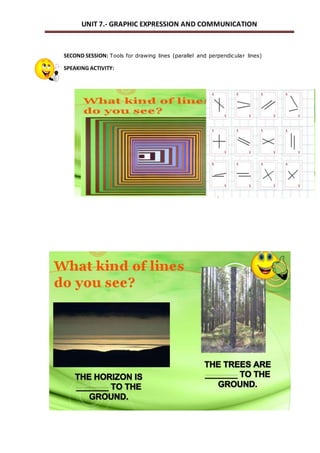
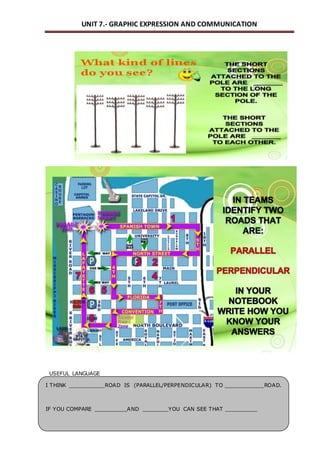
SECOND SESSION: Tools for drawing lines (parallel and perpendicular lines) 
SPEAKING ACTIVITY:
UNIT 7.- GRAPHIC EXPRESSION AND COMMUNICATION 
USEFUL LANGUAGE 
I THINK ___________ROAD IS (PARALLEL/PERPENDICULAR) TO ____________ROAD. 
IF YOU COMPARE __________AND ________YOU CAN SEE THAT __________
UNIT 7.- GRAPHIC EXPRESSION AND COMMUNICATION 
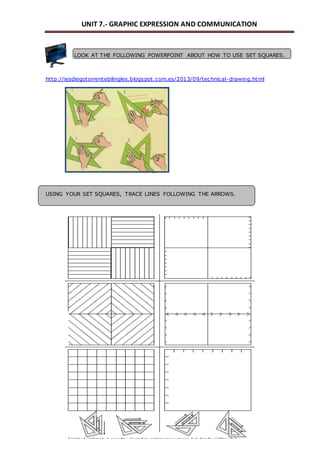
LOOK AT THE FOLLOWING POWERPOINT ABOUT HOW TO USE SET SQUARES. 
http://iesdiegotorrentebilingles.blogspot.com.es/2013/09/technical-drawing.html 
USING YOUR SET SQUARES, TRACE LINES FOLLOWING THE ARROWS.
UNIT 7.- GRAPHIC EXPRESSION AND COMMUNICATION 
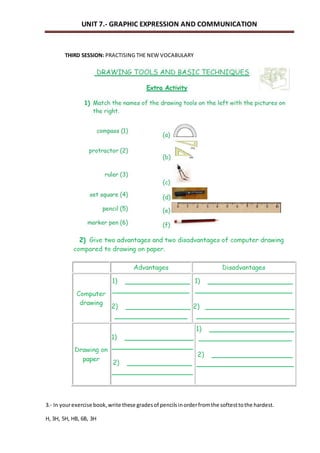
THIRD SESSION: PRACTISING THE NEW VOCABULARY 
3.- In your exercise book, write these grades of pencils in order from the softest to the hardest. 
H, 3H, 5H, HB, 6B, 3H
UNIT 7.- GRAPHIC EXPRESSION AND COMMUNICATION 
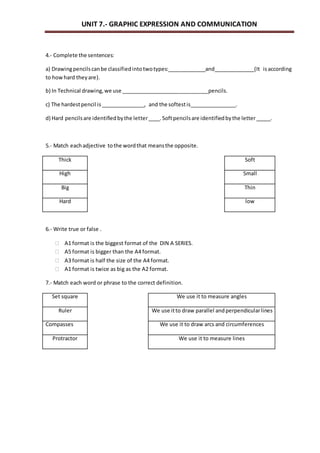
4.- Complete the sentences: 
a) Drawing pencils can be classified into two types:_____________and______________(It is according 
to how hard they are). 
b) In Technical drawing, we use ______________________________pencils. 
c) The hardest pencil is _______________, and the softest is________________. 
d) Hard pencils are identified by the letter ____. Soft pencils are identified by the letter _____. 
5.- Match each adjective to the word that means the opposite. 
Thick Soft 
High Small 
Big Thin 
Hard low 
6.- Write true or false . 
 A1 format is the biggest format of the DIN A SERIES. 
 A5 format is bigger than the A4 format. 
 A3 format is half the size of the A4 format. 
 A1 format is twice as big as the A2 format. 
7.- Match each word or phrase to the correct definition. 
Set square We use it to measure angles 
Ruler We use it to draw parallel and perpendicular lines 
Compasses We use it to draw arcs and circumferences 
Protractor We use it to measure lines
UNIT 7.- GRAPHIC EXPRESSION AND COMMUNICATION 
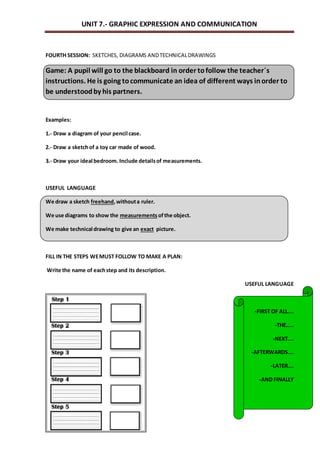
FOURTH SESSION: SKETCHES, DIAGRAMS AND TECHNICAL DRAWINGS 
Game: A pupil will go to the blackboard in order to follow the teacher´s 
instructions. He is going to communicate an idea of different ways in order to 
be understood by his partners. 
Examples: 
1.- Draw a diagram of your pencil case. 
2.- Draw a sketch of a toy car made of wood. 
3.- Draw your ideal bedroom. Include details of measurements. 
USEFUL LANGUAGE 
We draw a sketch freehand, without a ruler. 
We use diagrams to show the measurements of the object. 
We make technical drawing to give an exact picture. 
FILL IN THE STEPS WE MUST FOLLOW TO MAKE A PLAN: 
Write the name of each step and its description. 
USEFUL LANGUAGE 
-FIRST OF ALL…. 
-THE….. 
-NEXT…. 
-AFTERWARDS…. 
-LATER…. 
-AND FINALLY
UNIT 7.- GRAPHIC EXPRESSION AND COMMUNICATION 
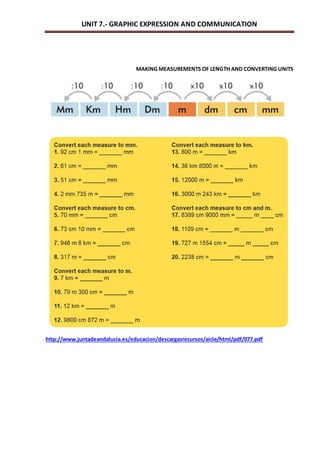
MAKING MEASUREMENTS OF LENGTH AND CONVERTING UNITS 
http://www.juntadeandalucia.es/educacion/descargasrecursos/aicle/html/pdf/077.pdf
UNIT 7.- GRAPHIC EXPRESSION AND COMMUNICATION 
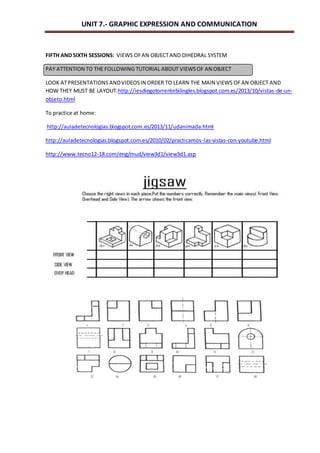
FIFTH AND SIXTH SESSIONS: VIEWS OF AN OBJECT AND DIHEDRAL SYSTEM 
PAY ATTENTION TO THE FOLLOWING TUTORIAL ABOUT VIEWS OF AN OBJECT 
LOOK AT PRESENTATIONS AND VIDEOS IN ORDER TO LEARN THE MAIN VIEWS OF AN OBJECT AND 
HOW THEY MUST BE LAYOUT.http://iesdiegotorrentebilingles.blogspot.com.es/2013/10/vistas-de-un-objeto. 
html 
To practice at home: 
http://auladetecnologias.blogspot.com.es/2013/11/udanimada.html 
http://auladetecnologias.blogspot.com.es/2010/02/practicamos-las-vistas-con-youtube.html 
http://www.tecno12-18.com/eng/mud/view3d1/view3d1.asp
UNIT 7.- GRAPHIC EXPRESSION AND COMMUNICATION 
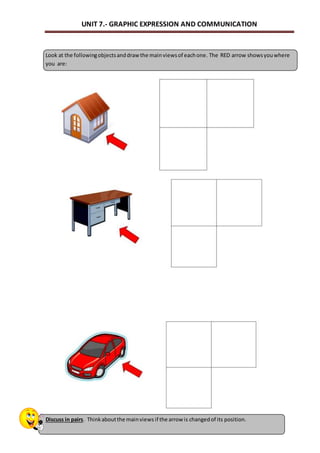
Look at the following objects and draw the main views of each one. The RED arrow shows you where 
you are: 
Discuss in pairs. Think about the main views if the arrow is changed of its position.
UNIT 7.- GRAPHIC EXPRESSION AND COMMUNICATION 
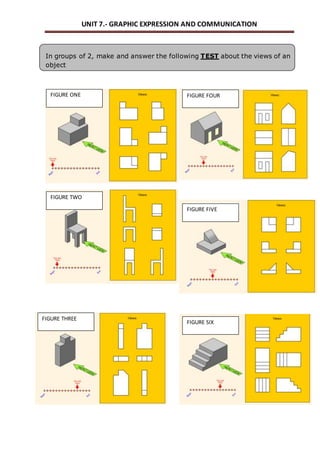
In groups of 2, make and answer the following TEST about the views of an 
object 
FIGURE ONE 
FIGURE TWO 
FIGURE FOUR 
FIGURE FIVE 
FIGURE THREE 
FIGURE SIX
UNIT 7.- GRAPHIC EXPRESSION AND COMMUNICATION 
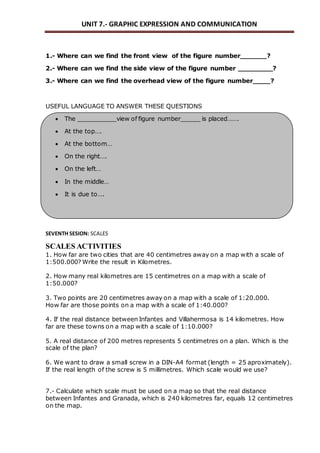
1.- Where can we find the front view of the figure number______? 
2.- Where can we find the side view of the figure number ________? 
3.- Where can we find the overhead view of the figure number____? 
USEFUL LANGUAGE TO ANSWER THESE QUESTIONS 
 The __________view of figure number_____ is placed……. 
 At the top…. 
 At the bottom… 
 On the right…. 
 On the left… 
 In the middle… 
 It is due to…. 
SEVENTH SESION: SCALES 
SCALES ACTIVITIES 
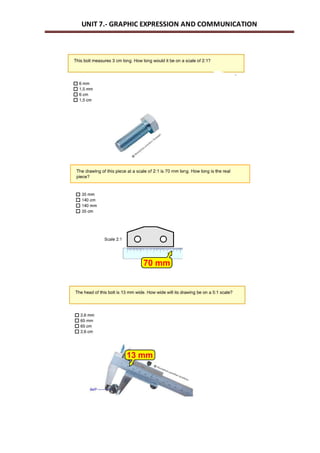
1. How far are two cities that are 40 centimetres away on a map with a scale of 
1:500.000? Write the result in Kilometres. 
2. How many real kilometres are 15 centimetres on a map with a scale of 
1:50.000? 
3. Two points are 20 centimetres away on a map with a scale of 1:20.000. 
How far are those points on a map with a scale of 1:40.000? 
4. If the real distance between Infantes and Villahermosa is 14 kilometres. How 
far are these towns on a map with a scale of 1:10.000? 
5. A real distance of 200 metres represents 5 centimetres on a plan. Which is the 
scale of the plan? 
6. We want to draw a small screw in a DIN-A4 format (length = 25 aproximately). 
If the real length of the screw is 5 millimetres. Which scale would we use? 
7.- Calculate which scale must be used on a map so that the real distance 
between Infantes and Granada, which is 240 kilometres far, equals 12 centimetres 
on the map.
UNIT 7.- GRAPHIC EXPRESSION AND COMMUNICATION 
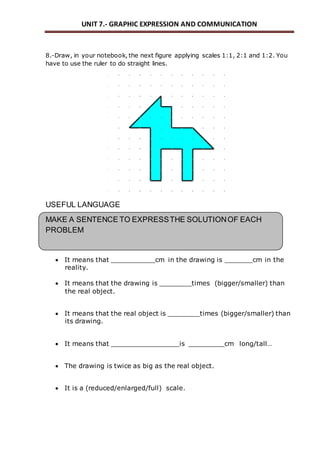
8.-Draw, in your notebook, the next figure applying scales 1:1, 2:1 and 1:2. You 
have to use the ruler to do straight lines. 
USEFUL LANGUAGE 
MAKE A SENTENCE TO EXPRESS THE SOLUTION OF EACH 
PROBLEM 
 It means that ___________cm in the drawing is _______cm in the 
reality. 
 It means that the drawing is ________times (bigger/smaller) than 
the real object. 
 It means that the real object is ________times (bigger/smaller) than 
its drawing. 
 It means that _________________is _________cm long/tall… 
 The drawing is twice as big as the real object. 
 It is a (reduced/enlarged/full) scale.
UNIT 7.- GRAPHIC EXPRESSION AND COMMUNICATION 
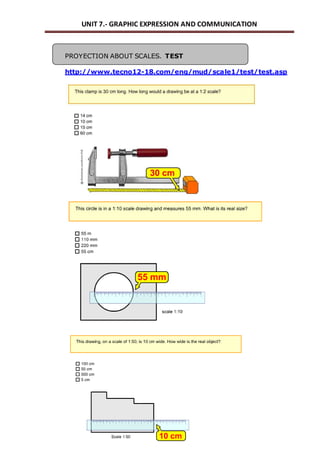
PROYECTION ABOUT SCALES. TEST 
http://www.tecno12-18.com/eng/mud/scale1/test/test.asp
UNIT 7.- GRAPHIC EXPRESSION AND COMMUNICATION
UNIT 7.- GRAPHIC EXPRESSION AND COMMUNICATION 
EIGTHTH SESSION: MAKING A SIMPLE MODEL 
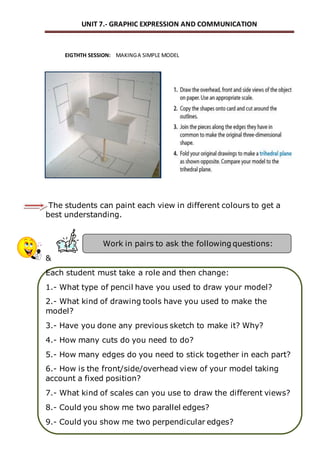
The students can paint each view in different colours to get a 
best understanding. 
Work in pairs to ask the following questions: 
& 
Each student must take a role and then change: 
1.- What type of pencil have you used to draw your model? 
2.- What kind of drawing tools have you used to make the 
model? 
3.- Have you done any previous sketch to make it? Why? 
4.- How many cuts do you need to do? 
5.- How many edges do you need to stick together in each part? 
6.- How is the front/side/overhead view of your model taking 
account a fixed position? 
7.- What kind of scales can you use to draw the different views? 
8.- Could you show me two parallel edges? 
9.- Could you show me two perpendicular edges?
UNIT 7.- GRAPHIC EXPRESSION AND COMMUNICATION 
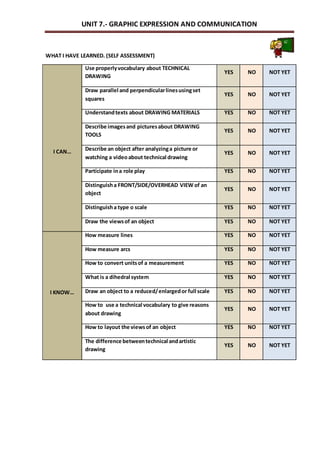
WHAT I HAVE LEARNED. (SELF ASSESSMENT) 
I CAN… 
Use properly vocabulary about TECHNICAL 
DRAWING 
YES NO NOT YET 
Draw parallel and perpendicular lines using set 
squares 
YES NO NOT YET 
Understand texts about DRAWING MATERIALS YES NO NOT YET 
Describe images and pictures about DRAWING 
TOOLS 
YES NO NOT YET 
Describe an object after analyzing a picture or 
watching a video about technical drawing 
YES NO NOT YET 
Participate in a role play YES NO NOT YET 
Distinguish a FRONT/SIDE/OVERHEAD VIEW of an 
object 
YES NO NOT YET 
Distinguish a type o scale YES NO NOT YET 
Draw the views of an object YES NO NOT YET 
I KNOW… 
How measure lines YES NO NOT YET 
How measure arcs YES NO NOT YET 
How to convert units of a measurement YES NO NOT YET 
What is a dihedral system YES NO NOT YET 
Draw an object to a reduced/ enlarged or full scale YES NO NOT YET 
How to use a technical vocabulary to give reasons 
about drawing 
YES NO NOT YET 
How to layout the views of an object YES NO NOT YET 
The difference between technical and artistic 
drawing 
YES NO NOT YET

Unit 7 techniques for graphic representation

  • 1.
    UNIT 7.- GRAPHICEXPRESSION AND COMMUNICATION Subject: TECHNOLOGY Teacher: MERCEDES RUBIO ORTEGA Title of the Unit : TECHNIQUES FOR GRAPHIC REPRESENTATION Course / Level: 1st ESO Learning outcomes / Evaluation criteria 1. To be able to communicate technique ideas using codes in the drawing in order to transmit a clear information. 2. To know how to use the basic and necessary drawing tools and instruments for making different accurate geometric traces. 3. To draw sketches and diagrams of objects. 4. To distinguish different types of views and perspectives of an object depending on the needs of its representation. 5. To use types of lines and scales, understanding the importance of each concept. Language English Subject Technology Timing / Sessions 10 Sessions. Subject Content 1.- Mediums, instruments and equipment for drawing and measuring 2.- Sketches, diagrams and technical drawings. 3.- Measuring lengths. Rules and dimensions. 3.- Standardization. Formats, borders and title blocks. 4.- Views of an object. Dihedral views. Perspective. 5.- Scale.
  • 2.
    UNIT 7.- GRAPHICEXPRESSION AND COMMUNICATION LANGUAGE CONTENT / COMMUNICATION Vocabulary Section Nouns Verbs Adjectives Perspective Angle, axis, depth, diagram, distance, drawing, edge, freehand, inclined plane, measurement, object, projection plane Appear, consist of, depend on, design, draw, project, reduce, represent, use, vary Cavalier, conical, disrtorted, fixed, inclined, isometric, perpendicular, realistic, separated, variable Drawing in perspective from an object´s known viewpoints Composition, depth line, dimensions, elevation, front view, plan, profile, projection plane, segment, side view, size, surface, trihedral plane, vertex/vertices, viewpoint Correspond to, check, create, erase, locate, remain, review, sculpt, section, to design Corresponding, dotted, horizontal, maximum, original, parallel, principal, rectangular, vertical. Standardization and annotation Annotation, arrow, axis of symmetry, cross-section, cut line axis, dimension line, full stop, height, hidden edge, function, limit, plane, properties, reference line, rules, scale, symbol, width Contain, cross, cut through, dimension, ensure, express, extend, indicate, relate to, separate, situate Auxiliary, enlarging, fine, full-size, graphic, horizontal, inside, outside, perpendicular, reducing, smaller standard, thick Measuring instruments Carpenter´s ruler, compass, decimal place, division, micrometer, precision, space, Measure, read off, rotate Common, curved, precise
  • 3.
    UNIT 7.- GRAPHICEXPRESSION AND COMMUNICATION Structures 1. Modal verb can: We can use different tools and instruments to measure the dimensions and the position of an object. 2. Present simple: Cavalier perspective consists of two perpendicular axes and a third axis with an angle that is variable in relation to the other two. 3. Passive voice: The three axes are separated by the same angle of 120o. 4. Imperatives: Look at the object in the box below. 5. Comparatives: We usually draw objects much bigger or much smaller, than the space we have available to draw them. 6. Infinitive of purpose: They are used to ensure common understanding and implementation of graphic expressions. 7. Prepositions of place: Numbers are above horizontal lines and left of vertical lines. 8. Modal verb must: Dimension lines must be finer than the edges of the objects. 9. MORE EXAMPLES OF THESE STRUCTURES: Describing lines and angles “the lines…” are parallel”, “are perpendic ular”, “form a 30o angle”, etc. The angle is…”: ac ute,””obtuse” ,”a right angle”,”180o”, etc Describing shapes “The view is…”: triangular, square, rec tangular, rhomboid, etc ... Describing drawings “The drawing…” is a freehand drawing,” “has been gone over in pen”, is in proportion”, “is to sc ale”, “show dimensions”… Laying out views “the view must be plac ed…”: at the bottom..”, “at the top of…”, “on the right of…” on the left of…” Classroom management -Who wants to go out to the blackboard?... Can I go out to the blackboard to correct the exercise? -Open your book at page… Whic h page, please? Could you repeat the number of the page, please? Discourse type With a partner, they must try to work out the meaning of different elements and then draw their own plan of the objects following the instructions from their partners. Create documents about a great and intellectual artist who was way ahead of his time. Description in a document of at least four ideas that they have learned with a video, for example: They go to www.youtube.com and type “how to draw c urves like an arc hitec t” in the searc h box. After watc hing a video they must sum up the main ideas. Language skills Reading (the different steps and instructions of each exercise) Listening to different sentences in order to write down the missing word or words in their notebooks). Online activities in which they have to listen dialogues in order to answer questions.
  • 4.
    UNIT 7.- GRAPHICEXPRESSION AND COMMUNICATION Speaking (given opinions and sharing information with their partners) Contextual (cultural) element Difference ways of communication between prehistoric cave painting, renaissanc e perspec tive… and the information through digitally altered formats. Cognitive (thinking) processes -Graphic expressions - Human beings expressing ideas through graphic representation. - Graphic materials and drawing tools. - Different types of lines which are used on a technical drawing to represent different things. -How our perception of an object depends on which viewpoint we look at it from. - computer- Assisted design (CAD) (a) Task(s)  Videos about using of different drawing tools. (how to use set squares, compasses , protractors)  jigsaws about “main views of an objec t”  Webquest about scales.  Videos and questions about parallel and perpendicular lines  Videos and questions about “main views of several objec ts” (b) Activities  True or false sentences  Discussion about positions of views of an object  Filling gaps in a test  Flashcards. Methodology Organization and class distribution / timing  FIRST SESSION: INTRODUCTION. How human beings expressed ideas through graphic representation, from cave paintings to computer-generated plans. Graphic materials and measuring tools.  SECOND SESSION: o Tools for drawing lines (parallel and perpendicular lines) o How to draw straight lines and angles. o Video about how we must use the set squares.
  • 5.
    UNIT 7.- GRAPHICEXPRESSION AND COMMUNICATION  THIRD SESSION: PRACTISING THE NEW VOCABULARY o Show a set of flashcards and ask them to write the ones they remember. o Matching between definitions and images o Fill in a chart about the new vocabulary and doing exercises. o Check in what they know.  FOURTH SESSION: SKETCHES, DIAGRAMS AND TECHNICAL DRAWINGS o Look at a video about the difference between these types of drawing. Decide what type of drawing is the best one for each situation. o Listen to the teacher describing a sketch, diagram or technical drawing and discuss with the other students the type of them. o Types of lines. o Dimensions. Making measurements of length and converting the units.  FIFTH SESSION: VIEWS OF AN OBJECT and DIHEDRAL SYSTEM o Look at presentations, videos in order to learn the main views of an object. o Show the main views using a common object (for example an eraser or the blackboard eraser) and draw the main views of it.  SIXTH SESSION: VIEWS OF AN OBJECT II o Jigsaw about objects and main views. o TEST about main views of an object.  SEVENTH SESSION: SCALES o Definition. Types of scales. o Exercises about scales. Making sentences to explain the solution of each problem. o Test about scales.
  • 6.
    UNIT 7.- GRAPHICEXPRESSION AND COMMUNICATION  EIGHTH SESSION: MAKING A SIMPLE MODEL o Build a three dimensional model and a trihedral plane o Practice the main views and draw them. o Work in pairs to ask questions (about the new vocabulary and expressions) given by the teacher. Change roles and repeat the questions in a different order.  NINENTH SESSION: DOUBTS AND CHECK THE UNDERSTANDING OF EACH CONTENTS. Resources / Materials Internet resources: videos, webquests, crosswords. Key Competences Evaluation (criteria and instruments) ASSESMENT WORKSHEET ABOUT TECHNICAL DRAWING EXAM ABOUT ALL THE KWOLEDGES LEARNED IN THIS UNIT.
  • 7.
    UNIT 7.- GRAPHICEXPRESSION AND COMMUNICATION Feel free to use this template. Thanks for attributing the source. A first sample of this template has been published at: Pérez Torres, I. 2009. "Apuntes sobre los principios y características de la metodología AICLE" en V. Pavón, J. Ávila (eds.), Aplicaciones didácticas para la enseñanza integrada de lengua y contenidos. Sevilla: Consejería de Educación de la Junta de Andalucía- Universidad de Córdoba.171-180. It is mainly based on the hands-on experience at designing units and on conversations with experts and peers. The theory of the 4Cs by Do Coyle has also been taken into account. This theory has been shown in various publications, such as: Coyle, D., Hood, P. and Marsh, D., 2010. Content and Language Integrated Learning. Cambridge University Press.
  • 8.
    UNIT 7.- GRAPHICEXPRESSION AND COMMUNICATION FIRST SESSION: INTRODUCTION TO GRAPHIC EXPRESSION AND COMMUNICATION It’s true – a picture is worth a thousand words – and even better, a metaphor is worth 1000 pictures. USEFUL LANGUAGE WHAT DO YOU THINK ABOUT THESE STATEMENTS? ARE TRUE OR FALSE?  I can´t believe this because……………  In my opinion…………………………..  I quite agree…..  That´s why I think, too.  I see what it means, but……………………..  I don´t agree at all.
  • 9.
    UNIT 7.- GRAPHICEXPRESSION AND COMMUNICATION Watching the images, students should describe people and the way of communication:  How did they communicate their ideas?  Explain some differences between the people in the image and two people today.  Why do you think drawing materials were invented? Talk in small groups and give examples of objects that can perform the function of drawing. After that, complete the following diagram. https://bubbl.us/ What is on his mind?
  • 10.
    UNIT 7.- GRAPHICEXPRESSION AND COMMUNICATION GRAPHIC MATERIALS AND MEASURING TOOLS POWERPOINT ABOUT DRAWING MATERIALS http://www.slideshare.net/hebergf/drawing-appied-to-technology-1-eso New vocabulary is introduced using attractive photographs and flashcards about the drawing material. http://quizlet.com/58808648/drawing-tools-flash-cards/ PRACTICE WHAT YOU KNOW:
  • 11.
    UNIT 7.- GRAPHICEXPRESSION AND COMMUNICATION
  • 12.
    UNIT 7.- GRAPHICEXPRESSION AND COMMUNICATION SECOND SESSION: Tools for drawing lines (parallel and perpendicular lines) SPEAKING ACTIVITY:
  • 13.
    UNIT 7.- GRAPHICEXPRESSION AND COMMUNICATION USEFUL LANGUAGE I THINK ___________ROAD IS (PARALLEL/PERPENDICULAR) TO ____________ROAD. IF YOU COMPARE __________AND ________YOU CAN SEE THAT __________
  • 14.
    UNIT 7.- GRAPHICEXPRESSION AND COMMUNICATION LOOK AT THE FOLLOWING POWERPOINT ABOUT HOW TO USE SET SQUARES. http://iesdiegotorrentebilingles.blogspot.com.es/2013/09/technical-drawing.html USING YOUR SET SQUARES, TRACE LINES FOLLOWING THE ARROWS.
  • 15.
    UNIT 7.- GRAPHICEXPRESSION AND COMMUNICATION THIRD SESSION: PRACTISING THE NEW VOCABULARY 3.- In your exercise book, write these grades of pencils in order from the softest to the hardest. H, 3H, 5H, HB, 6B, 3H
  • 16.
    UNIT 7.- GRAPHICEXPRESSION AND COMMUNICATION 4.- Complete the sentences: a) Drawing pencils can be classified into two types:_____________and______________(It is according to how hard they are). b) In Technical drawing, we use ______________________________pencils. c) The hardest pencil is _______________, and the softest is________________. d) Hard pencils are identified by the letter ____. Soft pencils are identified by the letter _____. 5.- Match each adjective to the word that means the opposite. Thick Soft High Small Big Thin Hard low 6.- Write true or false .  A1 format is the biggest format of the DIN A SERIES.  A5 format is bigger than the A4 format.  A3 format is half the size of the A4 format.  A1 format is twice as big as the A2 format. 7.- Match each word or phrase to the correct definition. Set square We use it to measure angles Ruler We use it to draw parallel and perpendicular lines Compasses We use it to draw arcs and circumferences Protractor We use it to measure lines
  • 17.
    UNIT 7.- GRAPHICEXPRESSION AND COMMUNICATION FOURTH SESSION: SKETCHES, DIAGRAMS AND TECHNICAL DRAWINGS Game: A pupil will go to the blackboard in order to follow the teacher´s instructions. He is going to communicate an idea of different ways in order to be understood by his partners. Examples: 1.- Draw a diagram of your pencil case. 2.- Draw a sketch of a toy car made of wood. 3.- Draw your ideal bedroom. Include details of measurements. USEFUL LANGUAGE We draw a sketch freehand, without a ruler. We use diagrams to show the measurements of the object. We make technical drawing to give an exact picture. FILL IN THE STEPS WE MUST FOLLOW TO MAKE A PLAN: Write the name of each step and its description. USEFUL LANGUAGE -FIRST OF ALL…. -THE….. -NEXT…. -AFTERWARDS…. -LATER…. -AND FINALLY
  • 18.
    UNIT 7.- GRAPHICEXPRESSION AND COMMUNICATION MAKING MEASUREMENTS OF LENGTH AND CONVERTING UNITS http://www.juntadeandalucia.es/educacion/descargasrecursos/aicle/html/pdf/077.pdf
  • 19.
    UNIT 7.- GRAPHICEXPRESSION AND COMMUNICATION FIFTH AND SIXTH SESSIONS: VIEWS OF AN OBJECT AND DIHEDRAL SYSTEM PAY ATTENTION TO THE FOLLOWING TUTORIAL ABOUT VIEWS OF AN OBJECT LOOK AT PRESENTATIONS AND VIDEOS IN ORDER TO LEARN THE MAIN VIEWS OF AN OBJECT AND HOW THEY MUST BE LAYOUT.http://iesdiegotorrentebilingles.blogspot.com.es/2013/10/vistas-de-un-objeto. html To practice at home: http://auladetecnologias.blogspot.com.es/2013/11/udanimada.html http://auladetecnologias.blogspot.com.es/2010/02/practicamos-las-vistas-con-youtube.html http://www.tecno12-18.com/eng/mud/view3d1/view3d1.asp
  • 20.
    UNIT 7.- GRAPHICEXPRESSION AND COMMUNICATION Look at the following objects and draw the main views of each one. The RED arrow shows you where you are: Discuss in pairs. Think about the main views if the arrow is changed of its position.
  • 21.
    UNIT 7.- GRAPHICEXPRESSION AND COMMUNICATION In groups of 2, make and answer the following TEST about the views of an object FIGURE ONE FIGURE TWO FIGURE FOUR FIGURE FIVE FIGURE THREE FIGURE SIX
  • 22.
    UNIT 7.- GRAPHICEXPRESSION AND COMMUNICATION 1.- Where can we find the front view of the figure number______? 2.- Where can we find the side view of the figure number ________? 3.- Where can we find the overhead view of the figure number____? USEFUL LANGUAGE TO ANSWER THESE QUESTIONS  The __________view of figure number_____ is placed…….  At the top….  At the bottom…  On the right….  On the left…  In the middle…  It is due to…. SEVENTH SESION: SCALES SCALES ACTIVITIES 1. How far are two cities that are 40 centimetres away on a map with a scale of 1:500.000? Write the result in Kilometres. 2. How many real kilometres are 15 centimetres on a map with a scale of 1:50.000? 3. Two points are 20 centimetres away on a map with a scale of 1:20.000. How far are those points on a map with a scale of 1:40.000? 4. If the real distance between Infantes and Villahermosa is 14 kilometres. How far are these towns on a map with a scale of 1:10.000? 5. A real distance of 200 metres represents 5 centimetres on a plan. Which is the scale of the plan? 6. We want to draw a small screw in a DIN-A4 format (length = 25 aproximately). If the real length of the screw is 5 millimetres. Which scale would we use? 7.- Calculate which scale must be used on a map so that the real distance between Infantes and Granada, which is 240 kilometres far, equals 12 centimetres on the map.
  • 23.
    UNIT 7.- GRAPHICEXPRESSION AND COMMUNICATION 8.-Draw, in your notebook, the next figure applying scales 1:1, 2:1 and 1:2. You have to use the ruler to do straight lines. USEFUL LANGUAGE MAKE A SENTENCE TO EXPRESS THE SOLUTION OF EACH PROBLEM  It means that ___________cm in the drawing is _______cm in the reality.  It means that the drawing is ________times (bigger/smaller) than the real object.  It means that the real object is ________times (bigger/smaller) than its drawing.  It means that _________________is _________cm long/tall…  The drawing is twice as big as the real object.  It is a (reduced/enlarged/full) scale.
  • 24.
    UNIT 7.- GRAPHICEXPRESSION AND COMMUNICATION PROYECTION ABOUT SCALES. TEST http://www.tecno12-18.com/eng/mud/scale1/test/test.asp
  • 25.
    UNIT 7.- GRAPHICEXPRESSION AND COMMUNICATION
  • 26.
    UNIT 7.- GRAPHICEXPRESSION AND COMMUNICATION EIGTHTH SESSION: MAKING A SIMPLE MODEL The students can paint each view in different colours to get a best understanding. Work in pairs to ask the following questions: & Each student must take a role and then change: 1.- What type of pencil have you used to draw your model? 2.- What kind of drawing tools have you used to make the model? 3.- Have you done any previous sketch to make it? Why? 4.- How many cuts do you need to do? 5.- How many edges do you need to stick together in each part? 6.- How is the front/side/overhead view of your model taking account a fixed position? 7.- What kind of scales can you use to draw the different views? 8.- Could you show me two parallel edges? 9.- Could you show me two perpendicular edges?
  • 27.
    UNIT 7.- GRAPHICEXPRESSION AND COMMUNICATION WHAT I HAVE LEARNED. (SELF ASSESSMENT) I CAN… Use properly vocabulary about TECHNICAL DRAWING YES NO NOT YET Draw parallel and perpendicular lines using set squares YES NO NOT YET Understand texts about DRAWING MATERIALS YES NO NOT YET Describe images and pictures about DRAWING TOOLS YES NO NOT YET Describe an object after analyzing a picture or watching a video about technical drawing YES NO NOT YET Participate in a role play YES NO NOT YET Distinguish a FRONT/SIDE/OVERHEAD VIEW of an object YES NO NOT YET Distinguish a type o scale YES NO NOT YET Draw the views of an object YES NO NOT YET I KNOW… How measure lines YES NO NOT YET How measure arcs YES NO NOT YET How to convert units of a measurement YES NO NOT YET What is a dihedral system YES NO NOT YET Draw an object to a reduced/ enlarged or full scale YES NO NOT YET How to use a technical vocabulary to give reasons about drawing YES NO NOT YET How to layout the views of an object YES NO NOT YET The difference between technical and artistic drawing YES NO NOT YET