Unit 7 –
Rational Explorations: Numbers and
their Opposites
MCC6.NS.5
MCC6.NS.6
MCC6.NS.7
MCC6.NS.8
Math Vocabulary
Rational Number – numbers that can be written as a
fraction.
Integer – a whole number that can be either greater
or less than zero.
Positive Integers – Integers greater than zero.
Negative Integers – Integers less than zero.
Number Line – Integers ordered from smallest to
largest (left to right).
Zero – the exact middle of all numbers. Has no value.
Opposite – numbers that are equal distance from
zero.
Rational Numbers (3.1 – 3.3)
Rational Numbers are numbers that can be written as
a fraction. Rational Numbers include: whole
numbers, zero, positive & negative integers, positive
& negative fractions, positive & negative decimals
(non-repeating decimals) Example: 3 , -5
Negative Rational Numbers are numbers that can be
written as a fraction that have a value less than zero.
Examples: -5, -8, -999, - ½ , - 7/10 , etc.
Integer is a whole number that can be either greater
or less than zero. Examples: {…, -4, -3, -2, -1, 0, 1, 2, 3, 4, …}
Rational Numbers (3.1 – 3.3)
Integers greater than zero are called positive integers. Positive integers
represent changes that result in an INCREASE or greater number. In
standard form a positive integer is given a + sign or no sign at all.
For example: imagine you decide to deposit $50 into your savings
account. The $50 would be considered “positive” or +50 because it
would increase your savings account balance.
Integers less than zero are called negative integers. Negative integers
also represent changes that result in a DECREASE or smaller number. In
standard form, negative integers are written with a - sign in front of
them. For example, twenty degrees below zero is written - 20°
Zero is neither positive nor negative.
Rational Numbers (3.1 – 3.3)
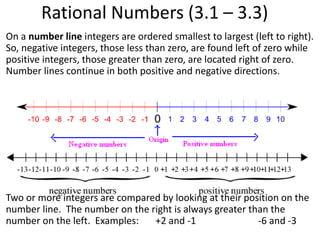
On a number line integers are ordered smallest to largest (left to right).
So, negative integers, those less than zero, are found left of zero while
positive integers, those greater than zero, are located right of zero.
Number lines continue in both positive and negative directions.
Two or more integers are compared by looking at their position on the
number line. The number on the right is always greater than the
number on the left. Examples: +2 and -1 -6 and -3
Opposites & Word Problems(3.4 – 3.5)
Zero is the exact middle of all numbers. Zero has no value. All
negative numbers are to the left of zero and all positive numbers are
to the right of zero. Numbers that are equal distance from zero are
opposites. For example, +3 and -3 are opposites because they both
name spaces three units from zero.
Integers are used to describe opposite relationships also, like +/-,
up/down, increase/decrease, gain/loss, spend/save,
deposit/withdrawal.
Example 2:
Andrew
Month Balance
Jan 1 $25
Feb 1 $30
Mar 1 $35
April 1 $40
Jason
Month Balance
Jan 1 $25
Feb 1 $20
Mar 1 $15
April 1 $10
Math Vocabulary
Rational Number – numbers that can be written as a
fraction.
Integer – a whole number that can be either greater
or less than zero.
Positive Integers – Integers greater than zero.
Negative Integers – Integers less than zero.
Number Line – Integers ordered from smallest to
largest (left to right).
Zero – the exact middle of all numbers. Has no value.
Opposite – numbers that are equal distance from
zero.
Vocabulary Quiz
1.) The exact middle of all numbers. Has no value.
2.) Integers less than zero.
3.) A whole number that can be either greater or less
than zero.
4.) Numbers that are equal distance from zero.
5.) Integers ordered from smallest to largest (left to
right).
6.) Integers greater than zero.
7.) Numbers that can be written as a fraction.
Graphing on a Number Line (4.1 – 4.2)
Number Lines allow you to graph values of positive and negative real
numbers as well as zero. Number lines can be horizontal or vertical.
Example 1: What number does point A represent on the number line ?
Example 2: What number does point B represent on the number line ?
0 1 2 3
A
-3 -2 -1 0
B
Improper Fractions and Decimals on a
Number Line (4.3)
Improper fractions and decimal values can also be plotted on a
number line.
Example 3 : Where would 4/3 fall on the number line below?
Example 4: Plot the value of - 1.75 on the number line below.
Plotting Points on a Vertical Number Line
Number lines can also be
drawn up and down (vertical)
instead of across the page
(horizontal). You plot points on
a vertical number line the same
way as you do on a horizontal
number line.
H
G
F
E
D
C
B
A
Absolute Value (4.6 – 4.7)
The absolute vale of a number is the distance the number is from zero
on the number line.
The absolute value of 6 is written |6|. |6| = 6
The absolute value of – 6 is written |- 6|. |- 6| = 6
The absolute value of - |- 6| or - |6| is - 6, because the negative sign
is on the outside of the absolute value sign.
Both 6 and - 6 are the same distance, 6 spaces, from zero so their
absolute value is the same: 6.
Examples: |- 4| = _____ |9| - |8| = _________
- |- 4| = _______ |6| - |- 6| = ________
|- 9| + 5 = _______ |- 5| + |- 2| =
MONDAY , APRIL 1 , 2013
-COME IN QUIETLY AND SIT IN YOUR
ASSIGNED SEAT.
-FILL OUT YOUR AGENDA AND HAVE IT OUT FOR ME TO SIGN.
-COMPLETE THE FOLLOWING WARM-UP IN YOUR
COMPOSITION BOOK:
Classwork: Computer Lab – Unit 7
(Numbers & Their Opposites)
Homework: CRCT PRACTICE - ALGEBRA
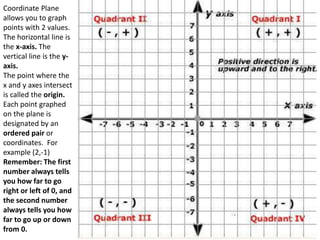
Coordinate Plane
allows you to graph
points with 2 values.
The horizontal line is
the x-axis. The
vertical line is the y-
axis.
The point where the
x and y axes intersect
is called the origin.
Each point graphed
on the plane is
designated by an
ordered pair or
coordinates. For
example (2,-1)
Remember: The first
number always tells
you how far to go
right or left of 0, and
the second number
always tells you how
far to go up or down
from 0.
A
B
C
D
Point A: Left (negative)
two and up (positive)
three = (-2,3) in Quad II
Point B: Right (positive)
one and up (positive)
one = (1,1) in Quad I
Point C: Left (negative)
three and down
(negative) one = (-3,-1)
in Quad III
Point D: Right (positive)
one and down (negative)
three = (1,-3) in Quad IV
III
III IV
S M
PA
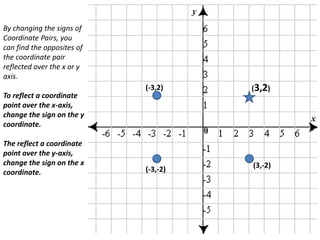
(-3,2) (3,2)
(-3,-2) (3,-2)
By changing the signs of
Coordinate Pairs, you
can find the opposites of
the coordinate pair
reflected over the x or y
axis.
To reflect a coordinate
point over the x-axis,
change the sign on the y
coordinate.
The reflect a coordinate
point over the y-axis,
change the sign on the x
coordinate.
J
F
C
D
III
III IV
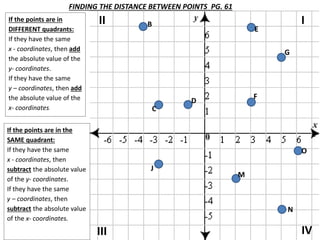
If the points are in
DIFFERENT quadrants:
If they have the same
x - coordinates, then add
the absolute value of the
y- coordinates.
If they have the same
y – coordinates, then add
the absolute value of the
x- coordinates.
If the points are in the
SAME quadrant:
If they have the same
x - coordinates, then
subtract the absolute value
of the y- coordinates.
If they have the same
y – coordinates, then
subtract the absolute value
of the x- coordinates.
FINDING THE DISTANCE BETWEEN POINTS PG. 61
G
M
O
N
E
B

Unit 7

  • 1.
    Unit 7 – RationalExplorations: Numbers and their Opposites MCC6.NS.5 MCC6.NS.6 MCC6.NS.7 MCC6.NS.8
  • 2.
    Math Vocabulary Rational Number– numbers that can be written as a fraction. Integer – a whole number that can be either greater or less than zero. Positive Integers – Integers greater than zero. Negative Integers – Integers less than zero. Number Line – Integers ordered from smallest to largest (left to right). Zero – the exact middle of all numbers. Has no value. Opposite – numbers that are equal distance from zero.
  • 3.
    Rational Numbers (3.1– 3.3) Rational Numbers are numbers that can be written as a fraction. Rational Numbers include: whole numbers, zero, positive & negative integers, positive & negative fractions, positive & negative decimals (non-repeating decimals) Example: 3 , -5 Negative Rational Numbers are numbers that can be written as a fraction that have a value less than zero. Examples: -5, -8, -999, - ½ , - 7/10 , etc. Integer is a whole number that can be either greater or less than zero. Examples: {…, -4, -3, -2, -1, 0, 1, 2, 3, 4, …}
  • 4.
    Rational Numbers (3.1– 3.3) Integers greater than zero are called positive integers. Positive integers represent changes that result in an INCREASE or greater number. In standard form a positive integer is given a + sign or no sign at all. For example: imagine you decide to deposit $50 into your savings account. The $50 would be considered “positive” or +50 because it would increase your savings account balance. Integers less than zero are called negative integers. Negative integers also represent changes that result in a DECREASE or smaller number. In standard form, negative integers are written with a - sign in front of them. For example, twenty degrees below zero is written - 20° Zero is neither positive nor negative.
  • 5.
    Rational Numbers (3.1– 3.3) On a number line integers are ordered smallest to largest (left to right). So, negative integers, those less than zero, are found left of zero while positive integers, those greater than zero, are located right of zero. Number lines continue in both positive and negative directions. Two or more integers are compared by looking at their position on the number line. The number on the right is always greater than the number on the left. Examples: +2 and -1 -6 and -3
  • 6.
    Opposites & WordProblems(3.4 – 3.5) Zero is the exact middle of all numbers. Zero has no value. All negative numbers are to the left of zero and all positive numbers are to the right of zero. Numbers that are equal distance from zero are opposites. For example, +3 and -3 are opposites because they both name spaces three units from zero. Integers are used to describe opposite relationships also, like +/-, up/down, increase/decrease, gain/loss, spend/save, deposit/withdrawal. Example 2: Andrew Month Balance Jan 1 $25 Feb 1 $30 Mar 1 $35 April 1 $40 Jason Month Balance Jan 1 $25 Feb 1 $20 Mar 1 $15 April 1 $10
  • 7.
    Math Vocabulary Rational Number– numbers that can be written as a fraction. Integer – a whole number that can be either greater or less than zero. Positive Integers – Integers greater than zero. Negative Integers – Integers less than zero. Number Line – Integers ordered from smallest to largest (left to right). Zero – the exact middle of all numbers. Has no value. Opposite – numbers that are equal distance from zero.
  • 8.
    Vocabulary Quiz 1.) Theexact middle of all numbers. Has no value. 2.) Integers less than zero. 3.) A whole number that can be either greater or less than zero. 4.) Numbers that are equal distance from zero. 5.) Integers ordered from smallest to largest (left to right). 6.) Integers greater than zero. 7.) Numbers that can be written as a fraction.
  • 9.
    Graphing on aNumber Line (4.1 – 4.2) Number Lines allow you to graph values of positive and negative real numbers as well as zero. Number lines can be horizontal or vertical. Example 1: What number does point A represent on the number line ? Example 2: What number does point B represent on the number line ? 0 1 2 3 A -3 -2 -1 0 B
  • 10.
    Improper Fractions andDecimals on a Number Line (4.3) Improper fractions and decimal values can also be plotted on a number line. Example 3 : Where would 4/3 fall on the number line below? Example 4: Plot the value of - 1.75 on the number line below.
  • 11.
    Plotting Points ona Vertical Number Line Number lines can also be drawn up and down (vertical) instead of across the page (horizontal). You plot points on a vertical number line the same way as you do on a horizontal number line. H G F E D C B A
  • 12.
    Absolute Value (4.6– 4.7) The absolute vale of a number is the distance the number is from zero on the number line. The absolute value of 6 is written |6|. |6| = 6 The absolute value of – 6 is written |- 6|. |- 6| = 6 The absolute value of - |- 6| or - |6| is - 6, because the negative sign is on the outside of the absolute value sign. Both 6 and - 6 are the same distance, 6 spaces, from zero so their absolute value is the same: 6. Examples: |- 4| = _____ |9| - |8| = _________ - |- 4| = _______ |6| - |- 6| = ________ |- 9| + 5 = _______ |- 5| + |- 2| =
  • 13.
    MONDAY , APRIL1 , 2013 -COME IN QUIETLY AND SIT IN YOUR ASSIGNED SEAT. -FILL OUT YOUR AGENDA AND HAVE IT OUT FOR ME TO SIGN. -COMPLETE THE FOLLOWING WARM-UP IN YOUR COMPOSITION BOOK: Classwork: Computer Lab – Unit 7 (Numbers & Their Opposites) Homework: CRCT PRACTICE - ALGEBRA
  • 14.
    Coordinate Plane allows youto graph points with 2 values. The horizontal line is the x-axis. The vertical line is the y- axis. The point where the x and y axes intersect is called the origin. Each point graphed on the plane is designated by an ordered pair or coordinates. For example (2,-1) Remember: The first number always tells you how far to go right or left of 0, and the second number always tells you how far to go up or down from 0.
  • 16.
    A B C D Point A: Left(negative) two and up (positive) three = (-2,3) in Quad II Point B: Right (positive) one and up (positive) one = (1,1) in Quad I Point C: Left (negative) three and down (negative) one = (-3,-1) in Quad III Point D: Right (positive) one and down (negative) three = (1,-3) in Quad IV III III IV
  • 17.
  • 18.
    (-3,2) (3,2) (-3,-2) (3,-2) Bychanging the signs of Coordinate Pairs, you can find the opposites of the coordinate pair reflected over the x or y axis. To reflect a coordinate point over the x-axis, change the sign on the y coordinate. The reflect a coordinate point over the y-axis, change the sign on the x coordinate.
  • 20.
    J F C D III III IV If thepoints are in DIFFERENT quadrants: If they have the same x - coordinates, then add the absolute value of the y- coordinates. If they have the same y – coordinates, then add the absolute value of the x- coordinates. If the points are in the SAME quadrant: If they have the same x - coordinates, then subtract the absolute value of the y- coordinates. If they have the same y – coordinates, then subtract the absolute value of the x- coordinates. FINDING THE DISTANCE BETWEEN POINTS PG. 61 G M O N E B