Public Policymaking An Introduction 5th Edition James E. Anderson
Public Policymaking An Introduction 5th Edition James E. Anderson
Public Policymaking An Introduction 5th Edition James E. Anderson
Public Policymaking An Introduction 5th Edition James E. Anderson
Public Policymaking An Introduction 5th Edition James E. Anderson
1.
Public Policymaking AnIntroduction 5th Edition
James E. Anderson download
https://ebookgate.com/product/public-policymaking-an-
introduction-5th-edition-james-e-anderson/
Get Instant Ebook Downloads – Browse at https://ebookgate.com
2.
Get Your DigitalFiles Instantly: PDF, ePub, MOBI and More
Quick Digital Downloads: PDF, ePub, MOBI and Other Formats
Statistics An Introduction 5th. Edition Roger E. Kirk
https://ebookgate.com/product/statistics-an-introduction-5th-
edition-roger-e-kirk/
An Introduction to Dynamic Meteorology 5th Edition
James R. Holton
https://ebookgate.com/product/an-introduction-to-dynamic-
meteorology-5th-edition-james-r-holton/
JAVA Illuminated An Active Learning Approach 5th
Edition Julie Anderson
https://ebookgate.com/product/java-illuminated-an-active-
learning-approach-5th-edition-julie-anderson/
Talking Nets An Oral History of Neural Networks James
A. Anderson
https://ebookgate.com/product/talking-nets-an-oral-history-of-
neural-networks-james-a-anderson/
3.
American Civilization AnIntroduction 5th Edition David
Mauk
https://ebookgate.com/product/american-civilization-an-
introduction-5th-edition-david-mauk/
Political Ideologies An Introduction 5th Edition Andrew
Heywood
https://ebookgate.com/product/political-ideologies-an-
introduction-5th-edition-andrew-heywood/
Human Evolution An Illustrated Introduction 5th Edition
Roger Lewin
https://ebookgate.com/product/human-evolution-an-illustrated-
introduction-5th-edition-roger-lewin/
Lipid Biochemistry An Introduction 5th Edition Michael
I. Gurr
https://ebookgate.com/product/lipid-biochemistry-an-
introduction-5th-edition-michael-i-gurr/
An Introduction to Parapsychology 5th Edition Harvey J.
Irwin
https://ebookgate.com/product/an-introduction-to-
parapsychology-5th-edition-harvey-j-irwin/
Contents
Preface ix
CHAPTER 1The Study of Public Policy
What Is Public Policy? 2
Categories of Public Policies 5
Approaches to Policy Study 13
Methodological Difficulties in Studying Public Policy 24
The Plan of This Book 26
For Further Exploration 31
Suggested Readings 31
CHAPTER 2 The Policy-Makers and Their
Environment
The Policy Environment 38
The Official Policy-Makers 46
Nongovernmental Participants 56
Levels of Politics 67
CASE STUDY The Endangered Snail Darter 72
For Further Exploration 73
Suggested Readings 74
CHAPTER 3 Policy Formation: Problems, Agendas,
1
35
and Formulation 79
Policy Problems 81
The Policy Agenda 85
The Agenda-Setting Process 88
Nondecisions 94
The Loss of Agenda Status 95
Two Cases in Agenda Setting 97
CASE STUDY Coal-mine Safety 97
CASE STUDY Environmental Pollution Control 99
v
9.
vi IContents
The Formulationof Policy Proposals 101
Policy Formulation as a Technical Process 107
CASE STUDY Formulating Policy: The Family and Medical Leave Act 109
A Concluding Comment 113
For Further Exploration 114
Suggested Readings 114
CHAPTER 4 Policy Adoption
Theories of Decision-Making 120
Decision Criteria 125
The Public Interest 134
Styles of Decision-Making 136
Presidential Decision-Making 144
CASE STUDY Policy Adoption: Consumer Bankruptcy 148
For Further Exploration 153
Suggested Readings 153
CHAPTER 5 Budgeting and Public Policy
The Budget and Public Policy 159
The National Budgetary Process 163
CASE STUDY The Struggle to Balance the Budget 180
For Further Exploration 189
Suggested Readings 190
CHAPTER 6 Policy Implementation
Who Implements Policy? 196
Administrative Organization 202
Administrative Politics 205
Administratjve Policymaking 211
CASE STUDY National Park Service Fire Policy 218
CASE STUDY The Elementary and Secondary Education Act 219
Techniques of Control 220
CASE STUDY The Clean Air Act's Emissions-Trading System 229
Compliance 230
For Further Exploration 239
Suggested Readings 239
119
157
193
10.
Contents I vii
CHAPTER1 Policy Impact, Evaluation, and Change 245
Policy Impact 248
Policy Evaluation Processes 253
CASE STUDY The GAO and Food Safety 256
Problems in Policy Evaluation 260
Policy Evaluation: The Use and Misuse of Cost-Benefit Analysis 264
CASE STUDY The Politics of Evaluation: Head Start 269
Policy Termination 273
CASE STUDY The Policy Cycle: Airline Regulation and Deregulation 276
For Further Exploration 284
Suggested Readings 284
CHAPTER s Concluding Comments
Glossary 301
Index 309
291
11.
Preface
Public Policymaking: AnIntroduction, Fifth Edition, views the policymaking
process as a policy cycle-a sequence of functional activities, beginning
with problem identification and agenda formation, and concluding with the
evaluation and termination, modification, or continuation of policy. This policy
cycle is a workable approach to the study and analysis of public policymaking.
In addition, the text surveys some other approaches to the study of policy for-
mation; describes and analyzes the current political environment of policymak-
ing in the United States; makes comparisons with other countries; and looks at
some of the logistical aspects of policymaking, such as majority-building and
cost-benefit analysis.
As the subtitle indicates, Public Policymaking: An Introduction, serves as a
jumping-off point for the study of public policymaking and touches upon all
stages or phases of the policymaking process. The suggested reading list at the
end of each chapter will assist readers who want to explore the stages of the pol-
icy process in greater depth.
I have made a variety of changes and additions in this revision according to
new developments in policymaking, especially at the national level in the United
States, and recent additions to the body of policy formation scholarship. Spe-
cific changes include the following: The chapter "The Study of Public Policy"
now features an expanded commentary on the approaches to policy study; 'The
Policy-Makers and Their Environment" has incorporated a discussion of tech-
nology as an influence on socioeconomic conditions; a new case study on con-
sumer bankruptcy legislation appears in the "Policy Adoption" chapter; an
updated discussion of budgeting, addressing recent developments in the bal-
anced budget struggle, appears in "Budgeting and Public Policy"; and in the
chapter "Policy Impact, Evaluation, and Change," the discussion of the Gov-
ernment Performance and Results Act has been expanded and the examination
of cost-benefit analysis has been tightened and updated. Additionally, at least
one case study example now appears in most of the chapters. The b asic frame-
work of the hook remains the same
Many references are made to changes in government and the policy process
that flowed from the Republican takeover in 1994 of both Houses of Congress.
Although some important changes occurred, as in the House subcommittee sys-
tem, the rejection of seniority in selecting some House committee chairs, and
more attention (at least for a time) to balancing the budget, these changes did
not produce a "revolution" either in government structure or the policymaking
process. The American system demonstrated its resilience and capacity totem-
per and mitigate change, and the general outline of the policymaking process
ix
12.
X IPreface
remains asbefore. Whether the concern with terrorism generated by the Sep-
tember 11, 2001, assault on the World Trade Center and the Pentagon will fun-
damentally alter the system is still unknown.
I have tried to be evenhanded and impartial in my handling of the many top-
ics covered in the book. In writing this book I have been guided and I think
with substantial success,__by the principle of "intended neutrality." Analysis
rather than advocacy, and teaching rather than preaching, have been my goals
throughout.
I want to express my gratitude to those who assisted in the preparation of
this edition. Several reviewers, at the request of Houghton Mifflin, provided
prerevision reviews. Collectively, they presented me with many thoughtful,
challenging, useful, and positive comments and recommendations for improv-
ing and updating the book. I did not always agree with them, as one would ex-
pect, nor was it always possible to implement their suggestions. Clearly though,
the reviewers did their part to help make this a better book. They include
Matthew Cahn, California State University-Northridge; Joseph J. Karlesky,
Franklin & Marshall College; Martin A. Nie, University of Minnesota, Duluth; J.
P. Piskulich, Oakland University; and James L. True, Lamar University.
Various colleagues at Texas A & M University responded to my requests for
information and advice. Dan Wood continued to be a source of support, and my
graduate assistant, Rob Ruhland, was always ready to help. Carrie Kilpatrick
promptly and cheerfully converted my handwritten copy into good typescript.
I would also like to acknowledge the longtime influence of Professor Charles
Jones on my study of politics and policymaking. At Houghton Mifflin, Kather-
ine Meisenheimer, Jean Woy, Tanya Lobato, Lindsay Frost, Aileen Mason, and
Jennifer Meyer Dare worked to keep me moving and steer the project to com-
pletion. Alberta (Mrs. Anderson) once again helped evaluate my ideas, listened
to my complaints, offered some sympathy, and provided encouragement. Rocky
and Stoney, our Boston terriers, continued in their unhelpful and diversionary
ways, including fleeing from thunder.
I reluctantly accept responsibility for any shortcomings in the book. I would
like to hear from users on such matters.
1
The Study
of PublicPolicy
In the course of their daily lives people are affected, directly and indirectly,
obviously and subtly, by an extensive array of public policies. Take, for exam-
ple, automobile owners. If an automobile was purchased on time, the Truth in
Lending Act required provision of accurate information by the lender on the
cost of credit. The vehicle features safety equipment, such as a padded dash and
seat belts, required by the National Highway Traffic Safety Administration and
a catalytic converter to reduce tailpipe emissions necessitated by Environmen-
tal Protection Agency rules. Out on the highway, financed jointly by the state
and national governments, our driver needs to be aware of state and local traf-
fic regulations, or risk direct contact with law enforcement officials. State pol-
icy requires that the automobile be insured and that both it and the driver be
licensed. The price of the gasoline it consumes is indirectly affected by national
energy policies and directly increased by national and state excise taxes. The ve-
hicle's gas mileage must meet the national corporate average fuel economy
(CAFE) standard.
Public policies in a modern, complex society are indeed ubiquitous. They
confer advantages and disadvantages, cause pleasure, irritation, and pain, and
collectively have important consequences for our well-being and happiness.
They constitute a significant portion of our environment. This being so, we
should know something about public policies, including how they are formed,
budgeted, implemented, and evaluated. There are also scientific, professional,
and political reasons for studying public policies and policymaking.
Scientifically the systematic and rigorous study of the origins, development,
and implementation of public policies will enhance our knowledge of political
behavior and governance, as well as of public policy per se. How is policymak-
ing affected by federalism and the separation of powers? Were pressure groups
or public opinion or the media influential in the adoption of a policy? Why did
government cease to be concerned with a problem? Concern with questions of
this sort are designated as policy study.
Professionally, a person may pursue a career as a policy analyst or evalua-
tor. Practitioners of policy analysis, which draws heavily upon economic theory
and statistical and mathematical analytical techniques, have been growing in
number in recent decades. 1
Policy analysis has an applied orientation and seeks
to identify the most efficient alternative (i.e., the one that will yield the largest
1
15.
2 The StudyofPublic Policy
net social benefit) for dealing with a current problem, such as the control of air
pollution or the disposal of household garbage. A variant of policy analysis is
evaluation research, which assesses how well policies attain their goals and the
other societal effects that they may have.
Politically, many people want to engage in policy advocacy, using knowledge
of public policy to formulate and promote "good" public policies that will have
the "right" goals, that is, goals which serve their purposes. They may think of
themselves as liberals, conservatives, libertarians, communitarians, or social-
ists and disagree greatly in their notions of what is good or just. The research
efforts of policy advocates are frequently skewed by their wish to generate data
and analysis in line with their preferences. In contrast, policy study is motivated
by the intent to be impartial.
This book draws on the scientific policy studies approach to develop a basic
understanding of the policymaking process, which is here viewed as an inher-
ently political process involving conflict and struggle among people (public offi-
cials and private citizens) with conflicting interests, values, and desires on policy
issues. In describing and analyzing the policymaking process, the scientific pol-
icy studies approach has three basic aims.2
First, its primary goal is to explain
the adoption of a policy rather than to identify or prescribe "good" or proper pol-
icy. Analysis, rather than advocacy, is its style. Second, it rigorously searches for
the causes and consequences of public policies by applying social-scientific
methodology, which is not restricted to the use of quantitative data and method-
ology. At a minimum, it does require that one should strive to be rational, em-
pirical, and objective. Third, this approach aims to develop reliable theories and
explanations about public policies and their politics. Thus policy studies can be
both theoretical and somewhat relevant to the more practical aspects of policy-
making. It has been said that nothing is as practical as a good theory.
What Is Public Policy?
In general usage, the term policy designates the behavior of
some actor or set of actors, such as an official, a govern-
mental agency, or a legislature, in an area of activity such
as public transportation or consumer protection. Public
policy also may be viewed as whatever governments choose to do or not to do.
Such definitions may be adequate for ordinary discourse, but because we set
out in this book to do a systematic analysis of public policy, a more precise def-
inition or concept is needed to structure our thinking and to facilitate effective
communication with one another.
In this book a policy is defined as a relatively stable, purposive course ofac-
tion followed by an actor or set ofactors in dealing with a problem or matter of
concern. This definition focuses on what is actually done instead of what is only
proposed or intended; differentiates a policy from a decision, which is essen-
tially a specific choice among alternatives; and views policy as something that
unfolds over time.
16.
What Is PublicPolicy? I 3
Public policies are those developed by govemmental bodies and officials.
(Nongovernmental actors and factors may of course influence public-policy de-
velopment.) The special characteristics of public policies stem from their being
formulated by what political scientist David Easton has called the "authorities"
in a political system, namely, "elders, paramount chiefs, executives, legislators,
judges, administrators, councilors, monarchs, and the like." These are, he says,
the persons who "engage in the daily affairs of a political system," are "recog-
nized by most members of the system as having responsibility for these mat-
ters," and take actions that are "accepted as binding most of the time by most
of the members so long as they act within the limits of their roles.''3
In short,
public policies are those produced by government officials and agencies. They
also usually affect substantial numbers of people.
There are several implications of this concept of public policy as a relatively
stable, purposive course of action followed by govemment in dealing with some
problem or matter of concern. First, the definition links policy to purposive or
goal-oriented action rather than to random behavior or chance occurrences.
Public policies in modem political systems do not, by and large, just happen.
They are instead designed to accomplish specified goals or produce definite re-
sults, although these are not always achieved. Proposed policies may be usefully
thought of as hypotheses suggesting that specific actions be taken to achieve
particular goals. Thus, to increase farm income, the national government uti-
lizes income subsidies and production controls. These programs have indeed
enhanced the incomes of many farmers, but by no means all.
The goals of a policy may be somewhat loosely stated and cloudy in content,
thus providing general direction rather than precise targets for its implementa-
tion. Those who want action on a problem may differ both as to what should be
done and how it should be done. Ambiguity in language then can become a
means for reducing conflict, at least for the moment. Compromise to secure
agreement and build support may consequently yield general phrasing and lack
of clarity in the statement of policy goals.
Second, policies consist of courses or pattems of action taken over time by
govemmental officials rather than their separate, discrete decisions. It is diffi-
cult to think of such actions as a presidential decision to honor a movie actor or
a Social Security Administration decision to award disability benefits to Joe
Doaks as public policies. A policy includes not only the decision to adopt a law
or make a rule on some topic but also the subsequent decisions that are intended
to enforce or implement the law or rule. Industrial health and safety policy, for
example, is shaped not only by the Occupational Safety and Health Act of 1970
but also by a stream of administrative rules and judicial decisions interpreting,
elaborating, and applying (or not applying) the act to particular situations.
Third, public policies emerge in response to policy demands, or those claims
for action or inaction on some public issue made by other actors-private citizens,
group representatives, or legislators and other public officials-upon govemment
officials and agencies. Such demands may range from general insistence that a
municipal govemment "do something" about traffic congestion to a specific call
17.
4 The StudyofPublic Policy
for the national government to prohibit theft of pet dogs and cats for sale to med-
ical and scientific research organizations. In short, some demands simply call for
action; others also specify the action desired.
In response to policy demands, public officials make decisions that give con-
tent and direction to public policy. These decisions may enact statutes, issue ex-
ecutive orders or edicts, promulgate administrative rules, or make judicial
interpretations of laws. Thus the decision by Congress to enact the Sherman An-
titrust Act in 1890 was a policy decision; another was the 1911 Supreme Court
ruling that the act prohibited only unreasonable restraints of trade rather than
all restraints of trade. Each was of major importance in shaping that course of
action called antitrust policy. (The Sherman Act also prohibits monopolization
and attempts to monopolize.) Such decisions may be contrasted with the innu-
merable relatively routine decisions that officials make in the day-to-day appli-
cation of public policy. The Department of Veterans Affairs, for example, makes
hundreds of thousands of decisions every year on veterans' benefits; most, how-
ever, fall within the bounds of settled policy and can be categorized as routine
decisions.
Policy statements in turn usually are formal expressions or articulations of
public policy. Among these are legislative statutes, executive orders and decrees,
administrative rules and regulations, and court opinions, as well as statements
and speeches by public officials indicating the government's intentions and
goals and what will be done to realize them. Policy statements are sometimes
notably ambiguous. Witness the conflicts that arise over the meaning of statu-
tory provisions or judicial holdings, or the time and effort expended analyzing
and trying to divine the meaning of policy statements by national political lead-
ers, such as the president of the United States or the chair of the Federal Re-
serve Board. Different levels, branches, or units of government may also issue
conflicting policy statements, as on such matters as environmental pollution or
liability for consumer products.
Fourth, policy involves what governments actually do, not just what they in-
tend to do or what officials say they are going to do. If a legislature enacts a law
requiring employers to pay no less than a stated minimum wage but nothing is
done to enforce the law, and subsequently little change occurs in economic be-
havior, it seems reasonable to contend that public policy actually takes the form
of nonregulation of wages.
Relevant here is the concept ofpolicy output, or the action actually taken in
pursuance of policy decisions and statements. This concept focuses our atten-
tion on such matters as amounts of taxes collected, miles of highway built, wel-
fare benefits paid, restraints of trade eliminated, traffic fines collected, and
foreign-aid projects undertaken. These can usually be enumerated with little
difficulty. Examining policy outputs, we may find that a policy differs some-
what or even greatly from what policy statements indicate it should be. Policy
outputs should be distinguished from policy outcomes, which focus on a policy's
societal consequences. For example, do longer prison terms reduce crime rates?
Do air pollution control programs improve public health? Outputs can be
counted; outcomes are often difficult or impossible to measure.
18.
Categories of PublicPolicies I 5
Fifth, a public policy may be either positive or negative. Some form of overt
governmental action may deal with a problem on which action is demanded
(positive), or governmental officials may decide to do nothing on some matter
on which government involvement was sought (negative). In other words, gov-
ernments can follow a policy of laissez faire, or hands off, either generally or on
some aspects of economic activity. Such inaction may have major consequences
for a society or some groups, as in the late 1970s, when the national government
decided to cease regulating commercial airline rates and routes.
Inaction becomes a public policy when officials decline to act on a problem-
that is, when they decide an issue negatively. This choice differs from nonaction
on a matter that has not become a public issue, has not been brought to official
attention, and has not been considered or debated. A slightly ludicrous example
is the lack of governmental action on the taking of earthworms-the activity has
no seasons and no bag limits. Is this a public policy? The answer is no, because
it is not an issue and no decisions have been made.
Finally, public policy, at least in its positive form, is based on law and is au-
thoritative. Members of a society usually accept as legitimate the facts that taxes
must be paid, import controls must be obeyed, and highway speed limits must
be complied with, unless one wants to run the risk of fines, jail sentences, or
other legally imposed sanctions or disabilities. Thus public policy has an au-
thoritative, legally coercive quality that the policies of private organizations do
not have. Indeed, a major characteristic distinguishing government from pri-
vate organizations is its monopoly over the legitimate use of coercion. Govern-
ments can legally incarcerate people; private organizations cannot.
Some public policies may be widely violated even though they are authori-
tative, such as national prohibition in the 1920s and many highway speed lim-
its. Moreover, enforcement may be limited, piecemeal, or sporadic. Are these
still public policies? The answer is yes, because they were on the statute books
and enforcement was provided for. Whether such policies are effective or wise
is another matter. Authoritativeness is a necessary but not a sufficient condition
for effective public policy.
Categories of Public Policies
Governments at all levels in the United States-national,
state, and local-have been increasingly active in developing
public policies. Every year a large volume of laws and ordi-
nances flows from the nation's national, state, and local leg-
islative bodies. That volume of laws in turn is greatly exceeded by the quantity of
rules and regulations produced by administrative agencies acting on the basis of
legislative authorizations. This proliferation of public policies has occurred in
such traditional areas of governmental action as foreign policy, transportation,
education, welfare, law enforcement, business and labor regulation, and interna-
tional trade. Much activity has also come in areas that received little attention un-
til the last two or three decades: economic stability, environmental protection,
equality of opportunity, medical care, nuclear energy, and consumer protection.
19.
6 The StudyofPublic Policy
During a typical two-year term of Congress 300 to 400 public laws will be
enacted. Though the legislative process was disrupted by bitter partisan conflict
over the possible impeachment of President Bill Clinton, Congress still man-
aged in 1998 to adopt several important pieces of legislation. These dealt with
such matters as an overhaul of public housing, higher education, vocational ed-
ucation, charter schools, Head Start, Internal Revenue Service reform, surface
transportation, veterans' benefits, chemical weapons, and International Mone-
tary Fund financing. Involving mostly changes or additions to current policies,
all of the laws incorporate biases that benefit some groups and disadvantage
other groups, which is indeed an intrinsic feature of public policies. Rarely does
a public policy make everyone better off.
Given the large number and complexity of public policies in the United
States, the task of trying to make sense of them is enormous. This section will
summarize a number of general typologies that political scientists and oth-
ers have developed for categorizing public policies. These typologies will
prove much more useful in distinguishing among and generalizing about
policies than some of the more traditional and widely used categorization
schemes, such as by issue area (labor, welfare, civil rights, and foreign af-
fairs), institution (legislative policies, judicial policies, and departmental
policies), and time (New Deal era, post-World War II, and late nineteenth
century). Although these categories are convenient for designating various
sets of policies and organizing discussions about them, they are not helpful
in developing generalizations, because they do not reflect the basic charac-
teristics and content of policies. The discussion of typologies will also pro-
vide the reader with a notion of the scope, diversity, and different purposes
of public policies.
Substantive
and Procedural
Polides
First, policies may be classified as either substantive orpro-
cedural. Substantive policies involve what government is
going to do, such as constructing highways, paying welfare
benefits, acquiring bombers, or prohibiting the retail sale
of liquor. Substantive policies directly allocate advantages
and disadvantages, benefits and costs, to people. Procedural policies, in con-
trast, pertain to how something is going to be done or who is going to take ac-
tion. So defined, procedural policies include laws providing for the creation of
administrative agencies, determining the matters over which they have juris-
diction, specifying the processes and techniques that they can use in carrying
out their programs, and providing for presidential, judicial, and other controls
over their operations.
A procedural policy of great importance is the federal Administrative Pro-
cedure Act (APA) of 1946. This statute, a response to the growth of administra-
tive agency discretion in the twentieth century, prescribes procedures to be used
by agencies in notice and comment or informal rule-making. For example, APA
requires notice of the proposed rule-making, opportunity for interested persons
to participate in the proceeding through oral or written submissions, publica-
20.
Categories ofPublic PoliciesI 7
tion of a proposed rule at least thirty days before it becomes effective, and op-
portunity for interested persons to petition for issuance, amendment, or repeal
of a rule. The act's requirements for adjudication are much more detailed, but
in both instances it is intended to ensure openness and fairness in agency decision-
making. Another example of a procedural policy is the requirement that an en-
vironmental impact statement be prepared by agencies proposing major
actions affecting the environment by the National Environmental Policy Act
(NEPA). Its purpose is to cause agencies to give consideration to environmen-
tal effects before making their decisions. In itself NEPA adds nothing to the sub-
stance of policy; it neither prohibits nor requires particular agency actions
toward the environment.
Procedural policies may have important substantive consequences. That
is, how something is done or who takes the action may help determine what
is actually done. Frequently, efforts are made to use procedural issues to de-
lay or prevent adoption of substantive decisions and policies. An agency's ac-
tion may be challenged on the ground that improper procedures were
followed, as under APA, when it is really the substance of the action that is be-
ing resisted. Some Washington lawyers have become highly skilled in manip-
ulating procedural rules to delay agency action. Thus, because of procedural
delays and complications (most of them produced by the maneuverings of the
defendant company), it took the Federal Trade Commission thirteen years to
complete a case compelling the manufacturer to remove the word "liver" from
a product named "Carter's Little Liver Pills." (The product has no effect on
one's liver.)
Distributive,
Regulatory, Self-
Regulatory, and
Redistributive
Polides
This typology differentiates policies by their effect on soci-
ety and the relationships among those involved in policy
formation.4
Distributive policies involve allocation of services or ben-
efits to particular segments of the population-individuals,
groups, corporations, and communities. Some distributive
policies may provide benefits to one or a few beneficiaries,
as in the Chrysler loan guarantee of the late 1970s, which kept the company from
bankruptcy, and the subsidies for the operation of American merchant ships. Oth-
ers may provide benefits for vast numbers of persons, as is true for agricultural
income-support programs, tax deductions for home mortgage interest payments,
free public school education, and job-training programs.
Distributive policies typically involve using public funds to assist particular
groups, communities, or industries. Those who seek benefits usually do not
compete directly with one another, although in some instances they do, as in the
selection of the site for the Superconducting Super Collider, where there could
be only one winner. The SSC was a costly scientific venture, later cancelled,
which was supposed to help determine the nature of matter. Nor do their ben-
efits represent a direct cost to any specific group; rather, the costs are assessed
to the public treasury, which is to say all taxpayers. Thus, distributive policies
21.
8 The StudyofPublic Policy
appear to create only winners and no specific losers, although obviously some-
one does pay their financial cost.
The standard example of distributive policy has been rivers and harbors im-
provement and flood control legislation (water projects), carried out by the
Army Corps of Engineers. In recent years it has been surpassed as an example
of pork-barrel legislation (or simply, "pork") by transportation legislation. The
1998 surface transportation law, entitled the Transportation Equity Act for the
21st Century, provides for $218 billion in spending over a six-year period. In ad-
dition to its general provisions the act contains authorization for many hun-
dreds of special highway, mass transit, and bus projects requested by members
of Congress from both parties. The cost of these pork projects was estimated to
be more than $20 billion. Most states and congressional districts shared in the
bacon.
These projects are scattered all around the country and have little connec-
tion with one another, which supports Professor Theodore J. Lowi's contention
that distributive policies "are virtually not policies at all but are highly individ-
ualized decisions that only by accumulation can be called a policy."5
Each lo-
cality and its supporters seek authorization and funding for their own project
without challenging the right of others to do likewise. Most projects conse-
quently have some friends and no enemies in Congress, and presidents usually
leave them alone. President Jimmy Carter upset the apple cart in 1977, when he
successfully eliminated some water projects on the grounds that they were
wasteful and unnecessary. Many members of Congress were antagonized by
this action, either because they favored the targeted projects or resented presi-
dential intervention in an area long under congressional domination. A few of
the projects later were restored.
Regulatory policies impose restrictions or limitations on the behavior of in-
dividuals and groups. That is, they reduce the freedom or discretion to act of
those regulated, whether bankers, utility companies, meat-packers, or saloon-
keepers. In this sense they clearly differ from distributive policies, which in-
crease the freedom or discretion of the persons or groups affected.
When we think of regulatory policies we usually focus on business regula-
tory policies, such as those pertaining to control of pollution or regulation of
transportation industries. Among others, these sorts of policies were the focus
of the movement for deregulation. The most extensive variety of regulatory poli-
cies, however, is that which deals with criminal behavior against persons and
property. What are called social regulatory policies deal with such topics as af-
firmative action, school prayer, gun control, pomography, and abortion, and in-
volve the regulation of personal behavior.6
The formation of regulatory policy usually features conflict between two
groups or coalitions of groups, with one side seeking to impose some sort of
control on the other side, which customarily resists, arguing either that control
is unnecessary or that the wrong kind of control is being proposed. Amid this
opposition, regulatory decisions involve clear winners and losers, although the
winners usually get less than they initially sought. (When the winners are pub-
lic interest groups, they may not gain direct material benefits from policies
22.
Categories ofPublic PoliciesI 9
which, like the Clean Air Act, provide broad social benefits.) It is often difficult,
however, to identify all the purposes and consequences of regulatory policies.
Regulatory policies take several forms.
Some regulatory policies set forth general rules of behavior, directing that
actions be taken or commanding that others not be taken. The Sherman Act in
effect tells businesses, "Thou shalt not monopolize or attempt to monopolize or
act to restrain trade." These prohibitions are enforced by actions brought in the
federal courts against violators. In contrast, public-utility regulation by state
govemments involved detailed control of entry into the business, standards of
service, financial practices, and rates charged by electric, telephone, and other
utility companies. Comparatively, antitrust regulation entails much less restric-
tion of business discretion than does public-utility regulation.
Consumer-protection policies illustrate other variations in regulatory poli-
cies. Some statutes, such as the Pure Food and Drug Act of 1906 and the Drug
Amendments of 1962, set standards for quality that drug manufacturers must
comply with. Thus, before new drugs can be put on the market, they must be
shown to meet the standards for safety in use and efficacy for the purposes in-
tended. Other consumer legislation, such as the Consumer Credit Protection
Act, requires creditors to provide borrowers with accurate information on in-
terest and other financing costs for credit purchases. The first sort of policy is
intended to prevent products that do not meet designated standards from en-
tering the marketplace; the second type is meant to provide consumers with
enough information to make informed decisions.
Some regulatory policies, such as those which restrict entry into a business
such as television broadcasting or electric power distribution, are implemented
by decisions that confer benefits on some and deny them to others. Of the sev-
eral applicants for a television broadcast license for a city that may be before
the Federal Communications Commission, only one can be propitiated. These
can be called competitive regulatory policies because they limit the number of
providers of specific goods and services. They also may regulate the quality of
services that can be provided to consumers.7
Self-regulatory policies are similar to competitive regulatory policies in that
they involve restricting or controlling some matter or group. Unlike competitive
regulatory policies, however, self-regulatory policies are usually more controlled
by the regulated group as a means of protecting or promoting the interests of its
members. Several hundred professions and occupations, ranging from tree sur-
geons and auctioneers to lawyers and physicians, are licensed in one or more
states; about sixty are licensed in a majority of states. Commonly licensed health
professionals include chiropractors, dentists, dental hygienists, emergency med-
ical technicians, optometrists, pharmacists, physicians, podiatrists, practical
and registered nurses, psychologists, sanitarians, and social workers.8
The usual policymaking pattem here is for a professional or occupational
group acting on its own to seek licensing legislation from the state legislature.
Outside the ranks of the interested group, interest in the matter usually is slight.
The result is enactment of a licensing law, whose implementation is delegated
to a board dominated by members from the licensed group. In time, entry into
23.
10 The StudyofPublic Policy
the licensed occupation or profession may be restricted and the prices charged
for its specialized services may increase. It is unclear to what extent licensing
improves the quality of services available to the public.9
Supervised self-regulation may also occur. Under the Agricultural Market-
ing Agreement Act of 1937, the producers and handlers of fruits, vegetables, and
specialty crops such as almonds sold on the fresh market collectively act to ob-
tain marketing orders from the Agricultural Marketing Service (AMS). Put into
effect with the approval of two-thirds of the producers of a commodity, these
orders are binding on all producers and may authorize research and promo-
tional programs, set standards for quality, and control movement of such prod-
ucts as oranges and grapefruit to market so as to ensure "orderly marketing."
Marketing orders, which are managed by producer-dominated administrative
committees and are subject to AMS supervision, are intended to improve the
economic situation of producers.10
Redistributive policies involve deliberate efforts by the govemment to shift
the allocation of wealth, income, property, or rights among broad classes or
groups of the population, such as haves and have-nots, proletariat and bour-
geoisie. "The aim involved is not use of property but property itself, not equal
treatment but equal possession, not behavior but being.''11
In American society
redistributive policies ultimately involve disagreements between liberals (pro)
and conservatives (con) and tend to be highly productive of conflict.
The usual pattem in redistributive policy shifts resources from haves to
have-nots. It is possible, however, for the flow to reverse. Farm subsidy pay-
ments under the agricultural income-support programs go mostly to large com-
mercial farmers; small-scale farmers derive few benefits, yet everyone who pays
taxes contributes to financing of the programs. Typically, however, such in-
stances are not debated as redistributive,12
perhaps because of reluctance to ac-
knowledge that sometimes the haves benefit at the expense of the have-nots.
Redistributive policies are difficult to enact because they involve the reallo-
cation of money, rights, or power. Those who possess money or power rarely
yield them willingly, regardless of how strenuously some may discourse upon
the "burdens" and heavy responsibility attending their possession. Because
money and power are good coinage in the political realm, those who possess
them have ample means to resist their diminution.
Policies that have (or have had) some redistributive influence include the
graduated income tax, Medicare and Medicaid, the War on Poverty, the Voting
Rights Act, and legislative reapportionment. The Johnson administration's War
on Poverty represented an effort to shift wealth and other resources to blacks
and poor people. Encountering much resistance from conservatives and lack-
ing strong presidential support, it was gradually dispersed and dismantled. Al-
though most of the individual antipoverty programs (such as Head Start and the
community action or service programs) still function, they have lost much of
their redistributive quality. The Voting Rights Act, which on the whole has been
enforced with considerable strength by the Justice Department, has helped to
produce a substantial increase in black voter registration, voting, and state and
local officeholding in the South.
24.
Categories ofPublic PoliciesI 11
The graduated income tax, which is based on the principle of ability to pay
(those who have more income can fairly be expected to pay at progressively
higher rates) has now lost much of its redistributive potential. The top marginal
rate once was as high as 91 percent. In the early 1980s the rates ranged from 14
to 50 percent over a dozen income brackets, which still held out the possibility
of considerable redistribution. The Tax Reform Act of 1986, enacted by Con-
gress with strong support from President Reagan, who believed that high mar-
ginal tax rates both infringed on individual liberty and discouraged economic
growth, provided for only two tax brackets at 15 and 28 percentY Brackets of
31, 36, and 39.6 percent were added in the 1990s, however. These marginal tax
rates will be reduced over the next several years by tax reduction legislation en-
acted in 2001 at the urging of the George W. Bush administration.
Redistributive policies are not only difficult to obtain, they are also hard to
retain, as the discussion of the income tax indicates. Equality of result or con-
dition (that is, equality in income or standard of living) is not overly appealing
to most Americans, whatever they think about equality of opportunity.
Material and
Symbolic Polides
Public policies may also be described as either material or
symbolic, depending upon the kind of benefits they allo-
cate. 14
Material policies actually either provide tangible re-
sources or substantive power to their beneficiaries, or
impose real disadvantages on those who are adversely affected. Legislation re-
quiring employers to pay a prescribed minimum wage, appropriating money
for a public-housing program, or providing income-support payments to farm-
ers is material in content and effect.
Symbolic policies, in contrast, have little real material impact on people. They
do not deliver what they appear to deliver; they allocate no tangible advantages
and disadvantages. Rather, they appeal to people's cherished values, such as
peace, patriotism, and social justice. A prime example of a symbolic policy is the
Kellogg-Briand Pact of 1928, by which the United States and fourteen other coun-
tries agreed to outlaw war. Comment on its impact seems unnecessary.
Burning of the United States flag as a symbolic form of political protest has
agitated members of Congress for several years. In 1989 the Flag Protection Act
provided criminal penalties for any person who "knowingly mutilates, defaces,
physically defiles, burns, maintains on the floor or ground, or tramples upon
any flag of the United States." Quickly challenged, the act was declared uncon-
stitutional by the U.S. Supreme Court as an infringement on the freedom of ex-
pression protected by the first amendment. The Court's ruling touched off a
public and political furor. An effort in the early 1990s to amend the Constitu-
tion to prohibit desecration of the flag failed. However, in 1995, the House,
stimulated by the new Republican majority, approved (312 to 120) an amend-
ment authorizing the national and state governments to ban "physical desecra-
tion of the flag of the United States."15
It failed to win approval in the Senate.
There is much symbolism at stake in this struggle.
Occasionally a policy that appears to be mostly symbolic may turn out to
have important consequences. The Endangered Species Act of 1973, which is
25.
12 The StudyofPublic Policy
intended to help ensure the survival of rare animals and plants, initially appeared
to be a statement of good intentions with few costs. Little opposition attended its
enactment. As implemented, however, the act has had important effects, some-
times being used to block construction projects, timber cutting, and other activ-
ities that would threaten or destroy the habitats of endangered species, such as
spotted owls, California gnatcatchers, and the red-cockaded woodpecker.16
Most policies are neither entirely symbolic nor wholly material. The sym-
bolic and material categories should instead be viewed as the poles of a contin-
uum, with most policies being ranged along the continuum depending upon how
symbolic or material they are in practice. The Sherman Act, as an instrument for
"trust busting," for breaking up large monopolistic companies, has long been
symbolic. With the exception of AT&T, no trusts have been broken up since the
Progressive Era. On the other hand, beginning with the Carter administration
and continuing on into the Clinton administration, the Sherman Act has been
applied with some vigor against collusive behavior such as price fixing, bid rig-
ging, and market allocation. Here it has had substantial material impact.
Policies that are ostensibly material as labeled by legislative language may be
rendered essentially symbolic by administrative action or by the legislature's fail-
ure to provide adequate funds for their implementation. The public-housing goals
of the Housing Act of 1949 and later laws were made substantially symbolic by the
subsequent failure of Congress to provide the authorized level of funding for hous-
ing construction.17
On the other hand, policies may move from the more symbolic
to the more material category. Professor Bruce I. Oppenheimer argues that policy
for controlling oil pollution was largely symbolic during the years 1947 to 1966.18
Legislation was on the books but little was done to enforce it. After 1966, the con-
trol of oil pollution became much more effective as a consequence of growing pub-
lic concern about pollution, increased enforcement activity, and additional
congressional legislation, such as the 1986 Oil Pollution Act.
The material-symbolic typology is especially useful to keep in mind when an-
alyzing effects of policy because it directs attention beyond formal policy state-
ments. It also alerts us to the important role of symbols in political behavior.
Polides Involving
Collective Goods
or Private Goods
Public policies may also involve the provision of either col-
lective (indivisible) goods or private (divisible) goods.19
The nature of collective goods is such that if they are pro-
vided for one person, they must be provided for all. More-
over, one person's consumption of a collective good does
not deny it to others. A standard example is national defense: there is no effec-
tive way to provide it for some citizens and exclude others from its benefit, en-
joyment, or other consequences, nor to calculate that some citizens benefit
more from it than others. Thus an economically rational person would never
voluntarily pay for national defense, choosing rather to be a free rider and let
others stand the costs. Hence defense must be provided, if we want it, by gov-
ernment and financed by taxation. Other examples of collective goods are clean
air, public safety, traffic control, and mosquito abatement.
26.
Approaches to PolicyStudy I 13
Private goods, in contrast, may be broken into units and purchased or charged
by the individual user or beneficiary, and are available in the marketplace. Others
may be excluded from their use. Various social goods provided by government
(garbage collection, postal service, medical care, museums, public housing, and
national parks) have some characteristics of private goods. Charges and fees are
sometimes, but not always, levied on users. Whether such goods, which conceiv-
ably could be provided by the market economy, will be provided by the govern-
ment is a function of political decisions influenced by tradition (parks), notions of
the proper functions of government (the post office), the desire of users or benefi-
ciaries to shift some of their costs to others (federal crop insurance), and the like.
Some argue that only collective goods should be the subject of public policy.
The tendency, however, has been more and more to convert private goods into so-
cial goods by government action. Many consider ill health, unemployment, envi-
ronmental pollution, industrial accidents and disease, and misrepresentation in
the marketplace to be collective rather than individual problems-matters affect-
ing the entire population, hence involving public goods for which the entire soci-
ety should pay. Generally, the more something is thought to have the qualities of a
public good, the more likely people are to accept its provision by government. If it
seems clear that some benefit more directly than others, there may also be a de-
sire to levy charges, fees, or taxes on the direct beneficiaries to cover part of the
cost. Thus we encounter user fees at national parks, tuition at public colleges, rent
in public-housing projects, and tolls for some bridges and highways.
The privatization movement, encouraged in the 1980s by the Reagan adminis-
tration, represented a counterforce to the long-run tendency to expand the scope of
social goods. Based on free-market economic theory, privatization supports trans-
ferring many government assets or programs to the private sector and contracting
with private companies to handle many public services, whether the collection of
garbage or the operation of prisons. "The private sector, it is argued, will perform
these functions more efficiently and economically than the public sector."20
The results of the privatization movement at the national level are mixed. A
successful example is the sale of Conrail, which operated several railroads in the
Northeast and Midwest, to a private corporation. Nothing, however, came out
of proposals by the Reagan administration and others to sell public lands in the
western states to private buyers.21
Even western ranchers and other supporters
of the "sagebrush rebellion," which promoted transferring ownership of public
lands to state and local governments, lost interest in privatization. Their access
to public grazing lands with low lease rates would have been jeopardized by pri-
vatization. Congress was also quite skeptical about the sale of public lands.
Approaches to Policy Study
Political and social scientists have developed many models,
theories, approaches, concepts, and schemes for analyzing
policymaking and its related component, decision-making.
Indeed, political scientists have often displayed more facility
27.
14 The StudyofPublic Policy
and zeal for theorizing about public policymaking than for actually studying pol-
icy and the policymaking process. Nonetheless, theories and concepts are needed
to guide the study ofpublic policy, to facilitate communication, and to suggest pos-
sible explanations for policy actions. Those who aspire to systematically study the
policymaking process need some guidelines and criteria of relevance to focus their
effort and to prevent aimless meandering through the fields of political data. What
we find when we engage in research depends partly upon what we are looking for;
policy concepts, models, and theories give direction and structure to our inquiry.
This section will survey several theoretical approaches to the study of pub-
lic policy. But first we must distinguish between policymaking and decision-
making, a distinction students of public policy do not always make with clarity,
if at all. Decision-making, which will be treated in the chapter titled "Policy
Adoption," involves making a discrete choice from among two or more alterna-
tives, such as whether or not to read further in this book. Theories of decision-
making deal with the criteria and processes used in making such choices. A
policy, as defined earlier, is "a relatively stable, purposive course of action fol-
lowed by an actor or set of actors in dealing with a problem or matter of con-
cern." Policymaking thus typically encompasses a flow and pattern of action
that extends over time and includes many decisions, some routine and some not
so routine. Rarely will a policy be synonymous with a single decision. Here is a
mundane illustration: it would not be accurate for a person to state that it was
his policy to bathe on Saturday nights, if in fact he did so infrequently, however
elegant and thoughtful the decision-making process that led to his doing so on
a rare Saturday. It is the course of action, the pattern or regularity, that defines
policy, not an isolated event. In the example, the policy is best thought of as go-
ing dirty.
The theoretical approaches discussed here include political systems theory,
group theory, elite theory, institutionalism, and rational-choice theory. Al-
though most of these approaches were not developed specifically for analyzing
policy formation, they can readily be bent to that purpose. They are useful to
the extent that they direct our attention to important political phenomena, help
clarify and organize our thinking, and suggest explanations for political activ-
ity or, in our case, public policies. Limitations and criticisms are mentioned as
the discussion proceeds.
Political Systems
Theory
Public policy may be viewed as a political system's response
to demands arising from its environment. The political sys-
tem, as Easton defines it, comprises those identifiable and
interrelated institutions and activities (what we usually
think of as governmental institutions and political processes) in a society that
make authoritative allocations of values (decisions) that are binding on society.
The environment consists of all phenomena-the social system, the economic
system, the biological setting-that are external to the boundaries of the politi-
cal system. Thus at least analytically one can separate the political system from
all the other components of a society.22
28.
Approaches to PolicyStudy I 15
Inputs into the political system from the environment consist of demands
and supports. Demands are the claims for action that individuals and groups
make to satisfy their interests and values. Support is rendered when groups and
individuals abide by election results, pay taxes, obey laws, and otherwise accept
the decisions and actions undertaken by the political system in response to de-
mands. The amount of support for a political system indicates the extent to
which it is regarded as legitimate, or as authoritative and binding on its citizens.
Outputs of the political system include laws, rules, judicial decisions, and
the like. Regarded as the authoritative allocations of values, they constitute
public policy. The concept of feedback indicates that public policies (or outputs)
made at a given time may subsequently alter the environment and the demands
arising therefrom, as well as the character of the political system itself. Policy
outputs may produce new demands, which lead to further outputs, and so on
in a never-ending flow of public policy (see Figure 1.1).
The usefulness of systems theory in studying public policy is limited by its
highly general and abstract nature. It does not, moreover, say much about the
procedures and processes by which decisions are made and policy is devel-
oped within the "black box" called the political system. Indeed, systems the-
ory depicts government as simply responding to demands made upon it, and
its results are sometimes characterized as "input-output studies." (For an il-
lustration, see the discussion in the section headed Socioeconomic Condi-
tions.) Nonetheless, this approach can be helpful in organizing inquiry into
policy formation. It also alerts us to some important facets of the political
process, such as these: How do inputs from the environment affect the con-
tent of public policy and the operation of the political system? How in turn
does public policy affect the environment and subsequent demands for policy
action? How well is the political system able to convert demands into public
policy and preserve itself over time?
FIGURE 1.1
A Model of the Political System
Th E
e nv1ronment
Inputs Outputs
Demands ~ ~ Laws
Political -
.. System
Support ~ ~ Decisions
Feedback
29.
16 The StudyofPublic Policy
Group Theory According to the group theory of politics, public policy is
the product of the group struggle. One writer states, "What
may be called public policy is the equilibrium reached in
this [group] struggle at any given moment, and it represents a balance which
the contending factions or groups constantly strive to weight in their favor.'123
Many public policies do reflect the activities of groups. Examples include the
AFL-CIO and minimum-wage legislation, farm groups and agricultural subsi-
dies, the National Rifle Association and gun-control policies, and the National
Education Association and federal aid to public schools.
Group theory rests on the contention that interaction and struggle among
groups are the central facts of political life. A group is a collection of individu-
als that may, on the basis of shared attitudes or interests, make claims upon
other groups in society. It becomes a political interest group "when it makes a
claim through or upon any of the institutions of government."24
And many
groups do just that. The individual is significant in politics only as a participant
in or a representative of groups. It is through groups that individuals seek to se-
cure their political preferences.
A central concept in group theory is that of access. To have influence and to
be able to help shape governmental decisions, a group must have access, or the
opportunity to express its viewpoints to decision-makers.25
Obviously, if a
group is unable to communicate with decision-makers, if no one in govemment
will listen, its chances of affecting policymaking are slim. Access may result
from the group's being organized, from its having status, good leadership, or re-
sources such as money for campaign contributions. Social lobbying-the win-
ing, dining, and entertaining of legislators and other public officials-can be
understood as an effort to create access by engendering a feeling of obligation
to the groups involved. Then, when a group wishes to discuss policy matters
with an official, it will have an opportunity to present its case or have its tele-
phone calls retumed. Contributions to legislators by political action commit-
tees (PACs) are also often justified as a way of acquiring or maintaining access.
In the nature of things, some groups will have more access than others.
Public policy at any given time will reflect the interests of those who are dom-
inant. As groups gain and lose power and influence, public policy will be al-
tered in favor of the interests of those gaining influence against the interests of
those losing it.
The role of govemment ("official groups") in policy formation is described
by one proponent of group theory:
The legislature referees the group struggle, ratifies the victories of the
successful coalitions, and records the terms of the surrenders, compromises,
and conquests in the form of statutes. Every statute tends to represent
compromises because the process of accommodating conflicts of group
interests is one of deliberation and consent. The legislative vote on any issue
tends to represent the composition of strength, i.e., the balance of power,
among the contending groups at the moment of voting.... Administrative
agencies of the regulatory kind are established to carry out the terms of the
30.
Approaches to PolicyStudy I
treaties that the legislators have negotiated and ratified.... The judiciary,
like the civilian bureaucracy, is one of the instrumentalities for the
administration of the agreed rules.26
17
Group theory focuses on one of the major dynamic elements in policy for-
mation, especially in pluralist societies such as the United States, but it seems
both to overstate the importance of groups and to understate the independent
and creative role that public officials can play in the policy process. Indeed,
many groups have been generated by public policies. The American Farm Bu-
reau Federation, which developed around the agricultural extension program,
is a notable example, as is the National Welfare Rights Organization. Public of-
ficials also may acquire a stake in particular programs and act as an interest
group supporting their continuance. In the United States some welfare-agency
employees, including social workers, prefer current programs, with their em-
phasis on supervision and services (as well as benefits), to a guaranteed annual
income, which would probably eliminate some of their jobs.
Another shortcoming of group theory is that in actuality many people (e.g.,
the poor and disadvantaged) and interests (such diffuse interests as natural
beauty and social justice) are either not represented or only poorly represented
in the group struggle. As Professor E. E. Schattschneider remarks about the un-
derorganization of the poor, "The flaw in the pluralist heaven is that the heav-
enly chorus sings with a strong upper-class accent."27
Those who are not
represented will have little voice in policymaking and thus their interests are
likely to be slighted therein.
Finally, from a methodological perspective, it is misleading and inefficient to
try to explain politics and policymaking solely in terms of interests and the group
struggle. This bias leads to neglect of many other factors, such as ideas and in-
stitutions, which abound and which independently affect the development of
policy. The reductionism or unicausal explanation that results when all political
phenomena are crammed into the group concept should therefore be avoided.28
Elite Theory Approached from the perspective of elite theory, public pol-
icy can be regarded as reflecting the values and preferences
of a goveming elite. The essential argument of elite theory
is that public policy is not determined by the demands and actions of the peo-
ple or the "masses" but rather by a ruling elite whose preferences are carried
into effect by public officials and agencies.
Professors Thomas Dye and Harmon Zeigler provide a summary of elite
theory:
1. Society is divided into the few who have power and the many who do not.
[Only a small number of persons allocate values for society; the masses do
not decide public policy.]
2. The few who govern are not typical of the masses who are governed.
Elites are drawn disproportionately from the upper socioeconomic strata
of society.
31.
18 The StudyofPublic Policy
3. The movement of non-elites to elite positions must be slow and
continuous to maintain stability and avoid revolution. Only non-elites
who have accepted the basic elite consensus can be admitted to governing
circles.
4. Elites share a consensus on the basic values of the social system and the
preservation of the system. [In the United States, the elite consensus
includes private enterprise, private property, limited government, and
individual liberty.]
5. Public policy does not reflect demands of the masses but rather the
prevailing values of the elite. Changes in public policy will be incremental
rather than revolutionary. [Incremental changes permit responses to
events that threaten a social system with a minimum of alteration or
dislocation of the system.]
6. Elites may act out of narrow self-serving motives and risk undermining
mass support, or they may initiate reforms, curb abuse, and undertake
public-regarding programs to preserve the system and their place in it.
7. Active elites are subject to relatively little direct influence from apathetic
masses. Elites influence masses more than masses influence elites.29
So stated, elite theory is a challenging theory of policy formation. Policy is the
product of elites, reflecting their values and serving their ends, one of which
may be a desire to provide in some way for the welfare of the masses. Dye ar-
gues that development of civil-rights policies in the United States during the
1960s can be suitably explained by elite theory. These policies were "a response
of a national elite to conditions affecting a small minority of Americans rather
than a response of national leaders to majority sentiments." Thus, for example,
the "elimination of legal discrimination and the guarantee of equality of op-
portunity in the Civil Rights Act of 1964 was achieved largely through the dra-
matic appeals of middle-class black leaders to the conscience of white elites."30
This interpretation presents a narrow perspective on both who is affected by
or interested in civil-rights policies and the explanation for adoption of the Civil
Rights Act of 1964. Certainly leadership in Congress and the executive branch
was very important, but so too were civil-rights protests and marches, public
opinion, and support from an array of nonblack organizations. The civil-rights
movement of the 1960s was far more than an effort by black leaders to appeal
to the conscience of white elites.
Elite theory focuses our attention on the role of leadership in policy forma-
tion and on the reality that, in any political system, a few govern the many.
Whether elites rule and determine policy, with little influence from the masses,
is a difficult proposition to handle. It cannot be proved merely by assertions that
the "establishment runs things," which has been a familiar plaint in recent
years. Political scientist Robert Dahl argues that to defend the proposition suc-
cessfully one must identify "a controlling group, less than a majority in size,
that is not a pure artifact of democratic rules ... a minority of individuals whose
preferences regularly prevail in cases of differences of preferences on key polit-
ical issues."31
It may be that elite theory has more utility for analysis and ex-
32.
Approaches to PolicyStudy I 19
planation of policy formation in some political systems, such as developing or
Eastern European countries, than in others, such as the pluralist democracies
of the United States and Canada. Sociologist William Domhoff has long argued,
however, that there is an American upper class, based on the ownership and
control of large corporations, which is in fact a governing class.32
Institutionalism The study of government institutions (or organizations) is
one of the oldest concerns of political science. This is not
surprising, since political life generally revolves around
governmental institutions such as legislatures, executives, courts, and political
parties; public policy, moreover, is authoritatively determined and implemented
by these institutions.
Traditionally, the institutional approach concentrated on describing the more
formal and legal aspects of governmental institutions: their formal structure, le-
gal powers, procedural rules, and functions or activities. Formal relationships
with other institutions might also be considered, such as legislative-executive re-
lations. Usually little was done to explain how institutions actually operated as
opposed to how they were supposed to operate, to analyze public policies pro-
duced by the institutions, or to discover the relationships between institutional
structure and public policies.
Subsequently, political scientists turned their attention in teaching and re-
search to the political processes within governmental or political institutions;
concentrating on the behavior of participants in the process and on political re-
alities rather than formalism. In the study of the legislatures, interest shifted
from simply describing the legislature as an institution to analyzing and ex-
plaining its operation over time, from its static to its dynamic aspects. Thus in
the academic curriculum the course on the legislature often came to be about
the legislative process.
Institutionalism, with its emphasis on the formal or structural aspects of in-
stitutions, can nonetheless be usefully employed in policy analysis. An institu-
tion is, in part, a set of regularized patterns of human behavior that persist over
time and perform some significant social function or activity. It is their differ-
ing patterns of behavior that really distinguish courts from legislatures, from
administrative agencies, and so on. These regularized patterns of behavior,
which we often call rules or structures, can affect decision-making and the con-
tent of public policy. Rules and structural arrangements are usually not neutral
in their effects; rather, they tend to favor some interests in society over others
and some policy results over others. It is contended that some of the Senate
rules (and traditions, which often have the effect of rules), such as those relat-
ing to unlimited debate and action by unanimous consent, favor the interests of
legislative minorities over majorities. Many actions in the Senate, such as bring-
ing bills up for consideration and closing off debate on them, are done by unan-
imous consent. Thus one senator, so inclined, can block action by the Senate.
In the American federal system, which allocates governmental power
among the national and state governments, several arenas of action are created.
Some groups may have more influence if policy is made at the national level,
33.
20 The StudyofPublic Policy
whereas others may benefit more from state policymaking. Civil-rights groups,
for example, have received a better response in Washington, D.C., than in the
capitals of the southern states. Groups advocating adoption of English as the
nation's official language, however, have fared better at the state level. Between
1983 and 1997, twenty states adopted such laws, but the Congress has been un-
sympathetic. Indeed, the Voting Rights Act provides that in some states ballots
must be printed in foreign languages as well as English.
In summary, institutional structures, arrangements, and procedures often
have important consequences for the adoption and content of public policies.
They provide part of the context for policymaking, which must be considered
along with the more dynamic aspects of politics, such as political parties,
groups, and public opinion, in policy study. By itself, however, institutional the-
ory can provide only partial explanations of policy. It has little to say about what
drives the policy process.
Rational-Choice
Theory
The rational-choice theory, which is sometimes called social-
choice, public-choice, or formal theory, originated with
economists and involves applying the principles of micro-
economic theory to the analysis and explanation of politi-
cal behavior (or nonmarket decision-making). It has now gained many
adherents among political scientists.
Perhaps the earliest use of rational-choice theory to study the political
process is Anthony Downs's Economic Theory ofDemocracy. 33
In this influential
book, Downs assumes that voters and political parties act as rational decision-
makers who seek to maximize attainment of their preferences. Parties formu-
lated whatever policies would win them most votes, and voters sought to
maximize the portion of their preferences that could be realized through gov-
ernment action. In attempting to win elections, political parties moved toward
the center of the ideological spectrum to appeal to the greatest number of vot-
ers and maximize their voting support. Thus, rather than providing voters with
"meaningful alternatives," parties will become as much alike as possible,
thereby providing an "echo rather than a choice."
Let us now look more closely at the major components of rational-choice
theory. One of its basic axioms is that political actors, like economic actors, act
rationally in pursuing their own self-interest. Thus economist James Buchanan,
a leading proponent of rational-choice theory, contends that politicians are
guided by their self-interest rather than an altruistic commitment to such goals
as statesmanship or the national interest. "This should be no surprise," says
Buchanan, "because governments are made up of individuals, and individuals
operate from self-interest when they are engaged in a system of exchange,
whether this is in the market economy or in politics."34
Individuals who are en-
gaged in decision-making exchanges or transactions, such as voting, also have
preferences that vary from person to person. Being rational, individuals are
able to comprehend and rank their preferences from most to least desired. In
making decisions (whether economic or political), they are guided by these
preferences and will seek to maximize the benefits they gain. In short, people
34.
Approaches to PolicyStudy I 21
are self-interested utility maximizers, not the uninformed, confused, or irra-
tional choice-makers often depicted in analyses of political behavior.
A second basic axiom of rational-choice theory involves methodological in-
dividualism. The individual decision-maker is the primary unit of analysis and
theory. The individual's preferences or values are assumed to be more important
than other values-collective, organizational, or social. Conversely, rational-
choice theorists argue that the actions of organizations and groups can be satis-
factorily explained in terms of the behavior of a model individual. Nothing
substantial will be lost by so doing in explaining the behavior of all persons.
For example, a rational-choice explanation of why Congress delegates dis-
cretionary power to administrative agencies begins with the assumption that
the preference of members of Congress is to get reelected.35
To this end, legis-
lators delegate power to agencies, knowing that in exercising that power the
agencies will create problems for their constituents. Legislators will then be
called on by their constituents to assist them with their bureaucratic problems
and, in retum for assistance, the grateful constituents will vote to reelect the leg-
islators. The pursuit of self-interest by the members of Congress thus explains
the delegation of power and the growth of bureaucracy.
Some rational-choice theorists have explored the effects of incomplete or im-
perfect information and uncertainty on policymaking.36
Political decision-makers
are said to be possessed of differing amounts of information (a condition called
infonnation asymmetry) and are uncertain about the outcomes or consequences
of laws and policies when they are implemented. In Congress, legislative com-
mittee members, as policy specialists and the basic developers of legislation, are
best informed about the relationship between a proposed policy and its likely
consequences. In comparison, the rank-and-file members of Congress, who make
the final decisions on the enactment of legislation, have only limited knowledge
of the policy-consequences relationships. Conceivably this information asym-
metry would permit committee members to act strategically and secure the en-
actment of policies of benefit primarily to themselves (and their constituents).
Various rules and practices in Congress, however, help ensure that legisla-
tors will have incentives both to specialize in analyzing public problems and
crafting policies and to make information generally available to the members
of Congress. The problem is to identify the institutional arrangements that help
reduce uncertainty. This "information-theories" variant of rational choice con-
tinues to assume that legislators are utility maximizers with differing interests.
Their utility, however, is determined by policy outcomes rather than by policies
per se. About outcomes, as we have seen, there is uncertainty.
Rational-choice studies of political behavior are often characterized by rigid
and narrow assumptions, mathematical equations, abstractions, and remoteness
from reality. Even William C. Mitchell, an early enlistee in the rational-choice
movement, remarks that as it appears in textbooks, rational-choice theory
"hardly involves government, politicians, bureaucrats, and interest groups. Little
of the exposition ... has anything to do with the fiscal or regulatory lives of the
community or state."37
A more positive view holds that "in its pure form it is one,
but only one, useful, partial explanation of politics."38
35.
22 The StudyofPublic Policy
Rational-choice theory both alerts us to the importance ofself-interest as a mo-
tivating force in politics and policymaking, and provides a better understanding
of decision-making processes. Many contend, however, that politics is not nearly
as devoid of altruism and concern for the public interest as the rational-choice the-
orists assume. The adoption of "good public policy," for example, is frequently a
goal of members of Congress.39
And public-interest groups, such as the National
Wildlife Federation, are motivated by more than immediate self-interest.40
Commentary Because individual political scientists often manifest
strong preference for one or another of these theoretical
approaches (or others, such as incrementalism, which is
presented as a decision-making theory in the chapter titled "Policy Adop-
tion"), there is no consensus on which is the "best" or the most satisfactory.
Each approach focuses attention on different aspects of policymaking and
politics and thus seems more useful for understanding some situations or
events than others.
Group theory and elite theory are mutually exclusive explanations of how
the policy process operates and, most important, of who controls or dominates
and benefits from it. Or, succinctly: Who rules? Sharp intellectual struggles
have been waged between group (or pluralist) theorists and elite theorists about
who controls decision-making on public policy in American communities.
Much heat if not light was generated by this controversy, which has quieted
down without the issue having been fully resolved.41
Systems theory and institutionalism both focus on the process of policy-
making, albeit in different ways, and are not incompatible. Institutionalism
can be used to help explain what goes on within the "black box" (the political
system), which is neglected by systems theory. Because neither theory directly
confronts the question of who rules, either group or elite theory could be com-
bined with them to some degree. Rational-choice theory, because of its narrow
focus, must stand pretty much by itself. Institutions appear as the individual
writ large; little attention is given to the policy environment, how issues are
brought to the attention of government, or how policy preferences are devel-
oped. Like institutionalism, however, rational-choice theory does show much
interest in how rules and structures help determine the outcomes of decision-
making. Rational-choice scholars often occupy themselves with demonstrating
how the manipulation of rules could produce preferred decisions.
On the question of who rules, rational-choice theory asserts that democrat-
ically elected officials will promote their own interest rather than the people's.
This conviction frequently leads to the normative (and conservative) conclusion
that less government is better government. Group theorists feel that the inter-
ests of dominant groups (however determined) prevail, and for elite theorists
the few (a ruling class) govern in their own interest, perhaps with some concern
for the condition of the masses.
The various theories thus raise some controversial questions about politics
and the policymaking process. They also tend to skew research findings. Not
36.
Approaches to PolicyStudy I 23
surprisingly, pluralists find groups in control, elite theorists detect dominance
by an elite, and rational-choice theorists find that self-interest dominates. These
theories are therefore not merely neutral alternatives for guiding analysis. What
one finds in policy research depends in important part on what one is looking
for, just as those who go about town "looking for trouble" are more apt to find
it than are more peaceful citizens.
The differing concerns of these theoretical approaches can be further clarified
by briefly observing how their proponents might look at political campaign finance
reform. A major goal of reformers has been to ban "soft money"-funds that can
be raised in unlimited amounts from corporations, labor unions, and wealthy per-
sons and spent for party-building activities, such as voter registration and get out
the vote campaigns. Soft money can also be expended on generic or issue adver-
tising to promote generally a political party or to influence the election prospects
of particular candidates, so long as this is done without specifically endorsing their
defeat or election. The Democratic and Republican parties together raised more
than half a billion dollars in soft money during the 1999-2000 election cycle.
Agroup theorist would view the struggle to enact a campaign finance reform
law as a contest for advantage among various business, labor, and public-interest
groups and their supporters, as well as the political parties. Lobbying and other
group tactics would be scrutinized. An institutionalist, in comparison, would
focus on the problems presented by congressional structure and procedure in
securing the enactment of legislation. These could include getting the bill to the
House floor for debate, overcoming filibusters in the Senate, resolving differ-
ences in House and Senate versions of the bill, and avoiding a presidential veto.
Much attention would be given to how a bill becomes law.
A rational-choice proponent would see members of Congress calculating
how the content of reform legislation would affect the ability to raise campaign
money and to get reelected. Another of his concerns would be strategic behav-
ior, as when opponents propose amendments which, if adopted, would make
the bill unacceptable to some of its supporters (a "poison pill"), or when re-
formers craft amendments to help gain or retain supporters. Self-interest would
be seen as informing legislative behavior.
An elite theorist would see the legislative struggle here as one of interest pri-
marily to top-level legislative and political leaders. Both proponents and oppo-
nents of reform would contend that what they were trying to do was best for the
public. The elitist would hold that the mass public was neither interested or in-
formed, especially on the details of legislation.
Finally, a systems theorist would likely rivet on how government action was
influenced by inputs (demands, pressures, information) from its political, so-
cial, and economic environment. Limited attention at best would be devoted to
the details of how a bill becomes law. In time the systems theorist would be at-
tentive to how the government's decisions on campaign finance reform affected
its operation and future demands on it.
To conclude, a person should avoid becoming too dogmatically or rigidly
bound to one model or approach As a rule it is desirable to be eclectic and
37.
24 The StudyofPublic Policy
flexible, using those theories and concepts that seem most useful for the sat-
isfactory and fair-minded description and explanation of political inquiry. The
goal should be the objective explanation of political behavior rather than the
validation of a preferred theoretical approach. Each of the theories that have
been discussed, if drawn upon skillfully and selectively, can contribute to a
fuller understanding of policymaking.
Methodological Difficulties
in Studying Public Policy
Methodological problems afflict all research, although so-
cial scientists appear both more self-conscious about their
methodology and more intellectually inclined to batter
themselves for methodological infirmities than do natural and physical scien-
tists. Policy research, especially given the complexity of its subject matter, has
its full share of methodological problems. Such problems may impede or limit
policy research, and may make it more than a little frustrating at times, but they
neither prevent it nor negate the need for it. An awareness of some of these
problems, however, may help prevent wasted efforts, needless errors, unsound
conclusions, and insomnia.
Solid, conclusive evidence, facts, or data, as one prefers, on the motives, val-
ues, and behavior of policy-makers, the nature and scope of public problems,
the impact of policies, and other facets of the policy process are often difficult
to acquire or simply not available. The urge to convert assumptions or specula-
tions about what happened into facts is something to be resisted, along with the
uncritical acceptance of the often self-serving statements or incomplete expla-
nations emanating from public officials and other participants in the policy
process. Sometimes numerical measures of political phenomena such as policy
impacts are used without sufficient care in determining their validity. Is the
number of infant deaths (in their first year) per 1,000 live births a good indica-
tor of the general level of health care in a society that has much income in-
equality? Do salary levels and similar data really measure the professionalism
of civil servants? The acquisition of hard facts about who did what, why, and
with what effect should be the goal of research. We need to be able to say with
some certainty why members of Congress respond to constituency interests on
some issues and not others, or what role the media play in setting agendas.
In explaining behavior in the policy process, one needs empirical data that
will permit the demonstration or sound inference of cause-and-effect relation-
ships. Once a person gets involved in quantitative data-based analysis, it is im-
portant to resist the notion that collecting empirical data is of prime
importance and that the more data one has, the more one can explain. One can
drown in a sea of data as well as thirst for lack thereof. To account for or ex-
plain behavior, theory is needed that will guide analysis in potentially fruitful
directions, as well as good judgment in the selection of policy measures. As
much as possible, hypotheses about cause-and-effect relationships need to be
developed and tested on the basis of the best available evidence.
38.
Methodological Difficulties inStudying Public Policy I 25
The notion that policy analysis is worthwhile only when it involves the
analysis of quantitative data with statistical techniques-the higher powered
the better-should also be resisted. There is no reason to assume that if some-
thing cannot be counted, it does not count. Some policy areas and problems
have not been very amenable to rigorous quantitative measurement and analy-
sis, although this may not always continue to be the case. Many aspects of so-
cial welfare and economic regulatory policies currently fit into this category.
How does one measure the comparative influence of pressure groups, agency
values, and economic analysis on rulemaking by EPA or OSHA? The prosecu-
tion of insider traders by the Securities and Exchange Commission? The total
benefits of a public-housing program? And how does one appraise the power of
ideas, as distinct from interests, in developing programs for the handicapped?
Such questions present real puzzles.
Yet it should be stressed that explicit theory, quantitative data, and careful,
rigorous analysis have not been as frequently utilized in studying policy as
would be possible or desirable. Thus political scientist Marver H. Bemstein's
hoary contention that regulatory agencies pass through a four-stage life cycle
(gestation and birth, youth, maturity, and old age), frequently culminating in
their "capture" (which is not well-specified) by the regulated groups, is often
cited as though it were a clearly supported phenomenon.42
Bemstein provides
impressionistic support but by no means strong proof for his life-cycle theory.
(He does not follow a single commission through all of the stages of the cycle.)
It still lacks systematic empirical support. Conventional wisdom of this sort fre-
quently rests on a rather frail intellectual foundation. Another example, also in
the regulatory area, is economist George Stigler's theory of economic regula-
tion. It holds that, as a rule, regulation is sought by the affected industry and
operated for its benefit.43
This theory will not do much to explain a raft of con-
sumer protection, industrial health and safety, and environmental programs, or
the deregulation legislation of the late 1970s and early 1980s.
Many perceptive and informative studies ofpolicy formation employ little or no
statistical analysis. Examples are Charles 0. Jones's Clean Air; Alan Stone's Eco-
nomic Regulation and the Public Interest; Barbara J. Nelson's Making an Issue of
Child Abuse; and I. M. Destler's American Trade Politics.44
The quality of intellectual
analysis and careful use of sound data (or information) are more important than
whether and to what extent quantitative analysis is employed when it comes to de-
termining the worth of a study. To be rigorous, analysis does not have to be quan-
titative, and not all quantitative analysis is rigorous. Those who use quantitative
techniques have been known to quarrel with enthusiasm and even some rancor
over the reliability or appropriateness of their techniques and the validity of their
findings. (In the chapter titled "The Policy-Makers and Their Environment" there
is a discussion on whether socioeconomic or political variables better explain pol-
icy.) Also, to be fair-minded, one should avoid developing a phobia for quantitative
or statistical analysis, as some did in reaction to the behavioral movement in polit-
ical science. Much can be leamed through quantitative analysis.
Data gained by interviews and questionnaires administered to public offi-
cials and other players in the policy process are often invaluable and may not
39.
26 The StudyofPublic Policy
otherwise be available to researchers. Care is required, however, in using both
such techniques and the data acquired. Questions must be properly framed to
elicit the needed information. Questions which are "loaded" and therefore bias
responses, or which are so general as to create strong doubt about their intent,
need to be avoided. Officials and others may not always respond fully or can-
didly to questions, their memories may be hazy, and they may overstate their
own role in events. Data gained from these sources obviously should not be
viewed as gospel. Rather, they should be checked against other sources, used
with care, and regarded as representing particular viewpoints on some event.
Good judgment is called for.
Many studies of policymaking take the form of case studies; that is, they fo-
cus on particular programs, statutes, or areas of public policy. Case studies have
been the butt of much criticism because, being narrowly based, they do not
permit sound generalization. "What is a case study a case of?" is a common
gibe. Preferred studies are those dealing with all the cases in a universe, such as
all regulatory commissions or sunset laws, or a meaningful sample thereof,
such as Supreme Court decisions on the rights of the accused or the benefit de-
cisions made by a welfare agency. These afford a better basis for generaliza-
tions. Case studies, however, do have a variety of uses.45
They can be used to test
theories, to develop new theories, to provide detailed, contextual analysis of
events, to analyze deviant cases that contradict our generalizations, and to help
provide an "intuitive feel" for the subtleties and nuances of the policy process
and the practice of politics. There is plenty of room in the study of policy for
both case studies and more general and comparative studies. To draw on a Re-
publican analogy, policy study should be viewed as a "big tent."
The Plan of This Book
The central concern of this book is the policy process,
which is a shorthand way of designating the various
processes and practices by which public policies are
formed. There is not, however, a single process by which
policies are made. They do not come off of an assembly line as do automobiles
or television sets. Rather, variations in the subjects of policies will produce vari-
ations in the style and techniques of policymaking. Foreign policy, taxation,
railroad regulation, health-care financing, professional licensing, and reform of
local government each are characterized by a distinguishable policy process-
different participants, procedures, techniques, decision rules, and the like. Pol-
icymaking may also vary depending upon whether its primary organizational
location is the legislature, the executive, the judiciary, or administrative agen-
cies. Policymaking within administrative agencies is more likely to be charac-
terized by hierarchy, secrecy (or low visibility), and the involvement of experts
or professionals than is legislative policymaking.46
And certainly one will dis-
cover differences in the formation of tax policy in the United States, Great
Britain, and Mexico.
40.
The Plan ofThisBook I 27
This variability does not mean, however, that there are no common func-
tions or elements, and that it is impossible to formulate generalizations on pol-
icy formation. Given the diversity and complexity in policymaking processes,
the development of some sort of "general theory" that has broad explanatory
power is an unrealistic aspiration.47
But we can achieve a useful start toward
what political scientists call "theory building" by striving to develop sound gen-
eralizations about such topics as who is involved in policy formation, on what
sorts of issues, under what conditions, in what ways, and to what effect. Nor
should we neglect to ask about how policy problems develop or obtain a place
on governmental agendas. Such questions are not as simple as they may first
appear.
To provide a conceptual framework to guide the examination of the policy
process in the ensuing chapters, I view it as a sequential pattern of activities
or functions that can readily be distinguished analytically although they may
be empirically more difficult to pull apart. The following categories or stages
are employed (see their portrayal in Table 1.1 ). Some illustrative questions are
included.
1. Problem identification and agenda setting. The focus here is on how the
problems that may become the targets of public policies are identified
and specified. Why only some problems, out of all that exist, receive
consideration by policy-makers requires an examination of agenda
setting; that is, how governmental bodies decide what problems to
address. What is a public problem? Why does some condition or matter
become a public problem? How does a problem get on a governmental
agenda? Why do some problems not achieve agenda status?
2. Formulation. This encompasses the creation, identification, or borrowing
of proposed courses of action, often called alternatives or options, for
resolving or ameliorating public problems. Who participates in policy
formulation? How are alternatives for dealing with a problem developed?
Are there difficulties and biases in formulating policy proposals?
3. Adoption. This involves deciding which proposed alternative, including
taking no action, will be used to handle a problem. In American
legislatures this function is performed by majorities. How is a policy
alternative adopted or enacted? What requirements must be met? Who
are the adopters? What is the content of the adopted policy?
4. Implementation. (A synonym is administration.) Here attention is on what
is done to carry into effect or apply adopted policies. Often further
development or elaboration of policies will occur in the course of their
administration. Who is involved? What, if anything, is done to enforce or
apply a policy? How does implementation help shape or determine the
content of policy?
5. Evaluation. This entails activities intended to determine what a policy is
accomplishing, whether it is achieving its goals, and whether it has other
consequences. Who is involved? Who is advantaged and disadvantaged by
The Plan ofThisBook I
a policy? What are the consequences of policy evaluation? Are there
demands for changes in or repeal of the policy? Are new problems
identified? Is the policy process restarted because of evaluation?
29
Within this simplified framework, the formation and implementation of
policies are seen as political in that they involve conflict and struggle among in-
dividuals and groups, officials and agencies, with conflicting ideas, interests,
values, and information on public-policy issues. Policymaking is "political"; it
involves "politics." That is, its features include conflict, negotiation, the exercise
of power, bargaining, and compromise-and sometimes such nefarious prac-
tices as deception and bribery. There is no good reason to resist or disparage
this conclusion, or to imitate those who derogate policies that they do not like
with such statements as, "It's nothing but politics." Although it is sometimes
implied or even asserted that if enough analysis were done, if enough facts and
data were gathered, all "right-thinking" people would agree on the appropriate
course of action to handle a problem, this is not the way the world works. Quite
reasonable people can disagree on policy issues because they have differing in-
terests, values, and affiliations. Politics is the way a democratic society resolves
such differences.
The policy-process (sometimes it is called the policy cycle) approach to pol-
icy study has several advantages. First, and most important, the policy-process
approach centers attention on the officials and institutions who make policy de-
cisions and the factors that influence and condition their actions. We need to be
concerned about more than the complexity of public problems, the goals of the
polity, the general forms policy responses can take, and similar matters. Knowl-
edge of these is clearly of value; but we also want to know who makes policy de-
cisions and how they do it. Consequently, answers are needed for such
questions as: What is the legislature's role in policymaking? How does its struc-
ture affect decision-making? What sorts of factors or considerations influence
the legislator's decisions? T.be policy-process approach not only helps us learn
about policymaking and policy, it also causes us to take a :more holistic view of
bow government works.
Second, policymaking usually incorporates the stages or categories of activ-
ity that I have described. Its sequential nature thus helps one capture and com-
prehend the flow of action in the actual policy process. However, in actuality the
formulation and adoption stages may blend together, as when proposed legis-
lation on welfare reform is modified during consideration in committees and
on the House and Senate floors in order to win votes needed for its enactment.
Administrative agencies issue rules elaborating policy, as in the case of public-
lands policy, while implementing it (see the chapter titled "Policy Implementa-
tion"). The adoption of a policy, such as restrictions on abortion, solves a
problem for some people while it creates a problem for others, who then restart
the policy process in an effort to modify or repeal the disliked policy. Even in
such instances, the policy-process approach can be used to analytically distin-
guish the various activities involved.
43.
30 The StudyofPublic Policy
Third, the policy-process approach is flexible and open to change andre-
finement.48 Additional stages can be introduced if experience indicates that
they would strengthen description and analysis. Perhaps budgeting should be
recognized as a separate stage of the process. Various forms of data collec-
tion and analysis, whether quantitative (statistical), historical, legal, or nor-
mative (value-oriented), are compatible with it. It can be used to study a
single policy (e.g., the Americans with Disabilities Act) or to compare the en-
actment and implementation of several civil-rights laws. Group, institu-
tional, and other approaches to policy study can be fitted into it. The group
approach may help explain policy adoption; institutionalism can cast light on
its implementation. Systems theory may help alert us to some of its societal
consequences.
Fourth, the policy-process approach helps present a dynamic and develop-
mental, rather than static and cross-sectional, view of the policy process. It is
concerned with the evolution of policy and requires that one think about what
moves action on policy from one stage of the process to another. Moreover, it
helps emphasize relationships, or interactions, among the participants in poli-
cymaking. Political parties, interest groups, legislative procedures, presidential
commitments, public opinion, and other matters can be tied together as they
drive and help explain the formation of a policy. Further, one can seek to dis-
cover how action at one stage of the process affects action at later stages. For
example, how does the design and content of legislation ease or complicate its
implementation? How does implementation affect its impact?
Fifth, the policy-process approach is not "culture bound." It can readily be
used to study policymaking in foreign political systems. It also lends itself to
manageable comparisons, such as how problems reach governmental agendas,
or how policies are adopted in various countries. A few such comparisons are
included in this book.49
The structure of the remainder of the book looks like this: the chapter titled
''The Policy-Makers and Their Environment" surveys the environment or con-
text of policymaking and the official and unofficial participants in the policy
process. "Policy Formation: Problems, Agendas, and Formulation" examines
the nature of policy problems and agendas, agenda-setting processes, and the
formulation of policy proposals. The chapter "Policy Adoption" is concerned
with decision-making and the adoption of public policies. The "Budgeting and
Public Policy" chapter takes up the budgetary process because of its important
effects on the implementation of public policies. The struggle to balance the
budget is also considered. "Policy Implementation" discusses several aspects of
policy implementation and explores why people comply with politics. The chap-
ter titled "Policy Impact, Evaluation, and Change" deals with policy impacts,
the evaluation of policies, and policy termination, which occasionally may fol-
low evaluation. A case study on airline regulation and deregulation examines
the rise, elaboration, and termination of an important public policy over several
decades. In "Concluding Comments," some conclusions and comments on the
American policy process are presented.
44.
Suggested Readings I31
For Further Exploration
I http:/jwww.movingideas.org
The Policy Action Network site provides numerous links to liberal think
tanks and foundations devoted to a variety of public policy issues such
as economic, health, education, and media policies.
I http:/jwww.policy.comj
This site provides information related to public policy issues at the
federal, state and local levels. Included in this web site are daily policy
briefings, as well as a policy "issue of the week."
I http:/jwww.ncpa.org
Although it is conservative in nature, the homepage of The National
Center for Policy Analysis (NCPA) provides a wealth of descriptive
material on specific domestic and foreign policy issues.
I http:/jwww.pbs.orgjnewshourj
The Online NewsHour provides a site titled "Forum," where several
current policy issues are debated each month. This site also contains
transcripts of the various policy discussions and roundtable issues that
were broadcast on The NewsHour with Jim Lehrer.
Suggested Readings
Kenneth Bickers and John T. Williams, Public Policy Analysis (Boston: Houghton
Mifflin, 2001). This readable examination of the policy process introduces the
reader to rational choice theory.
Frank R. Baumgartner and Beth L. Leech, Basic Interests: The Importance of
Groups in Politics and Political Science (Princeton: Princeton University Press,
1998). No one interested in groups and politics should ignore this outstanding
analysis of group theory and the literature on groups.
Charles L. Cochran and Eloise F. Malone, Public Policy: Perspectives & Choices,
2nd ed. (New York: McGraw-Hill, 1999). This book, which draws broadly on
the social sciences, combines a general treatment of policymaking with a
discussion of several substantive policy areas.
Thomas R. Dye, Top Down Policymaking (New York: Chatham House, 2001). This
controversial examination of the policymaking process in the United States
argues that it is dominated by a national elite.
Carl E. Van Horn, Donald C. Baumer, and William T. Gormley, Jr., Politics and
Public Policy, 2nd ed. (Washington, D.C.: CQ Press, 1992). Six policy
domains-boardroom, bureaucratic, cloakroom, chief executive, courtroom,
and livingroom politics-are utilized in a wide-ranging examination of the
policy process.
45.
32 The StudyofPublic Policy
Paul A. Sabatier, ed., Theories ofthe Policy Process (Boulder, Colo.: Westview Press,
2001). The challenging essays in this anthology present a variety of theoretical
lenses for studying the policy process.
Notes
1. On policy analysis see Robert D. Behn, "Policy Analysis and Politics," Policy
Analysis, VII (Spring 1981). pp. 199-226; and Peter J. May, "Politics and Policy
Analysis," Political Science Quarterly, Vol. 101 (Spring 1986), pp. 109-125.
2. Thomas R. Dye, Understanding Public Policy, 7th ed. (Englewood Cliffs, N.J.:
Prentice-Hall, 1992), p. 7.
3. David Easton, A Systems Analysis ofPolitical Life (New York: Wiley, 1965),
p. 212.
4. The basic typology is from Theodore J. Lowi, "American Business, Public
Policy Case Studies, and Political Theory," World Politics, XVI (July 1964),
pp. 677-715. The self-regulatory category is from Robert Salisbury, "The
Analysis of Public Policy" in Austin Ranney, ed. Political Science and Public
Policy (Chicago: Markham, 1968), pp. 151-175.
5. Lowi, op. cit., p. 690.
6. Raymond Tatalovich and Byron W. Daynes, eds., Moral Controversies in
American Politics: Cases in Social Regulatory Politics (Armonk, N.Y.: M. E.
Sharpe, 1998).
7. Randall B. Ripley and Grace A. Franklin, Congress, the Bureaucracy, and
Public Policy (Pacific Grove, Calif.: Brooks/Cole, 1991), pp. 20-21.
8. Kenneth J. Meier and E. Thomas Garman, Regulation and Consumer
Protection, 3rd ed. (Houston: Dome Publications, 1998), pp. 41-42.
9. For a discussion of licensing, see ibid., chap. 3.
10. James E. Anderson, "Agricultural Marketing Orders and the Process and
Politics of Self-Regulation," Policy Studies Review, II (August 1982),
pp. 97-111.
11. Lowi, op. cit., p. 691. On redistributive policies, see Ripley and Franklin,
Congress, the Bureaucracy, and Public Policy, op. cit., chap. 6.
12. Randall B. Ripley, Policy Analysis in Political Science (Chicago: Nelson Hall,
1985), pp. 68-69.
13. Paul E. Peterson and Mark Rom, "Lower Taxes, More Spending, and Budget
Deficits," in Charles 0. Jones, ed., The Reagan Legacy: Promise and
Performance (Chatham, N.J.: Chatham House, 1988), pp. 218-221.
14. On the symbolic aspects of policies, see Murray Edelmann, The Symbolic Uses of
Politics (Urbana: University of Illinois Press, 1964), chap. 2; and Charles D. Elder
and Roger W. Cobb, The Political Uses ofSymbols (New York: Longman, 1983).
15. Congressional Quarterly Weekly Report, Vol. 53 (July 1, 1995), p. 1933.
16. Brian Czech and Paul R. Krausman, The Endangered Species Act (Baltimore:
Johns Hopkins University Press, 2001).
17. Richard 0. Davis, Housing Reform During the Truman Administration
(Columbia: University of Missouri Press, 1966), chap. 10.
18. Bruce I. Oppenheimer, Oil and the Congressional Process (Lexington, Mass.:
Heath, 1974), pp. 130-145.
46.
Notes I
19. Cf.L. L. Wade and R. L. Cuny, Jr., A Logic ofPublic Policy (Belmont, Calif.:
Wadsworth, 1970), chap. 5; and Charles L. Cochran and Eloise F. Malone,
Public Policy (New York: McGraw-Hill, 1995), pp. 17-19.
33
20. Ronald C. Moe, "Exploring the Limits of Privatization," Public Administration
Review, XLVII (November-December 1987), p. 453.
21. R. McGregor Cawley, Federal Land, Western Anger (Lawrence: University Press
of Kansas, 1993).
22. David Easton, "An Approach to the Analysis of Political Systems," World
Politics, IX (April 1957), pp. 383-400; and Easton, A Systems Analysis of
Political Life (New York: Wiley, 1965).
23. Earl Latham, The Group Basis ofPolitics (New York: Octagon Books, 1965),
p. 36.
24. David Truman, The Governmental Process (New York: Knopf, 1951), p. 37.
25. Alan C. Isaak, Scope and Methods ofPolitical Science (Chicago: Dorsey Press,
1988), pp. 269-270.
26. Latham, op. cit., pp. 35-36, 38-39.
27. E. E. Schattschneider, The Semisovereign People (New York: Holt, Rinehart
and Winston, 1960), p. 35.
28. See generally, Frank R. Baumgartner and Beth L. Leech, Basic Interest: The
Importance ofGroups in Politics and Political Science (Princeton, N.J.:
Princeton University Press, 1998).
29. Thomas R. Dye and L. Harmon Zeigler, The Irony ofDemocracy, lOth ed.
(Belmont, Calif.: Wadsworth, 1996), pp. 4-5. See also Thomas R. Dye, Top
Down Policymaking (New York: Chatham House, 2001).
30. Dye, op. cit., pp. 59-63.
31. Robert A. Dahl, "A Critique of the Ruling Elite Model," American Political
Science Review, LII (June 1958), p. 464.
32. G. William Domhoff, Who Rules America? (Englewood Cliffs, N.J.: Prentice-
Hall, 1967); G. William Domhoff, The Power Elite and the State: How Policy Is
Made in America (New York: Walter deGruyter, 1990).
33. Anthony Downs, An Economic Theory ofDemocracy (New York: Harper &
Row, 1957).
34. Roger Lewin, "Self-Interest in Politics Earns a Nobel Prize," Science,
CCXXXIV (November 21, 1986), p. 941.
35. Morris P. Fiorina, Congress: Keystone ofthe Washington Establishment, 2nd ed.
(New Haven: Yale University Press, 1989).
36. This discussion leans heavily upon Keith Krehbiel, Information and Legislative
Organization (Ann Arbor: University of Michigan Press, 1992); and Thomas W.
Gilligan and Keith Krehbiel, "Asymmetric Information and Legislative Rules
with a Heterogeneous Committee," American Journal ofPolitical Science,
XXXIII (May 1989), pp. 459-490.
37. William C. Mitchell, "Textbook Public Choice: A Review Essay," Public Choice,
XXVIII (1982), p. 99.
38. Louis F. Weschler, "Methodological Individualism in Politics," Public
Administration Review, XLIII (May-June 1982), p. 294.
39. See Richard J. Fenno, Jr., Congressmen in Committees (Boston: Little, Brown,
1973). Fenno indicates that members of Congress are variously influenced by
the desires to be reelected, to help enact good public policy, and to acquire in-
fluence in the House.
47.
34 The StudyofPublic Policy
40. Those wishing to explore rational choice theory further can begin with
Kenneth A. Shepsle and Mark S. Bonchek, Analyzing Politics: Rationality,
Behavior, and Institutions (New York: Norton, 1997). For a critique see Donald
P. Green and Ian Shapiro, Pathologies ofRational Choice Theory (New Haven:
Yale University Press, 1994).
41. See Philip J. Trounstine and Terry Christensen, Movers and Shakers: The Study
ofCommunity Power (New York: St. Martin's, 1982).
42. Marver H. Bernstein, Regulating Business by Independent Commission
(Princeton: Princeton University Press, 1955), pp. 74-95.
43. George Stigler, "The Theory of Economic Regulation," Bell Journal of
Economic and Management Science (Spring 1971), pp. 3-21.
44. Charles 0. Jones, Clean Air (Pittsburgh, Pa.: University of Pittsburgh Press,
1975); Alan Stone, Economic Regulation and the Public Interest (Ithaca, N.Y.:
Cornell University Press, 1977); Barbara J. Nelson, Making an Issue ofChild
Abuse (Chicago: University of Chicago Press, 1984); and I. M. Destler,
American Trade Politics, 2nd ed. (Washington, D.C.: Institute of International
Economics, 1992). All are political scientists.
45. See Harry Eckstein, "Case Study and Theory in Political Science," in Fred I.
Greenstein and Nelson W. Polsby, eds., The Handbook ofPolitical Science, Vol.
7, Strategies ofInquiry (Reading, Mass.: Addison-Wesley, 1975), pp. 79-137.
46. Francis E. Rourke, Bureaucracy, Politics, and Public Policy, 3rd ed. (Boston:
Little, Brown, 1984), pp. 145-158.
47. See David Easton, The Political System (New York: Knopf, 1953), chap. 2.
48. See, generally, Richard Rose, "Concepts for Comparison," Policy Studies
Journal, I (Spring 1973), pp. 122-127.
49. For criticisms of the sequential process approach, see Charles E. Lindblom
and Edward J. Woodhouse, The Policy Making Process, 3rd ed. (Englewood
Cliffs, N.J.: Prentice Hall, 1993), pp. 10-12; and Policy Change and Learning:
An Advocacy Coalition Approach, Paul A. Sabatier and Hank Jenkins-Smith,
eds. (Boulder, Colo.: Westview, 1993), chap. 1.
48.
2
The Policy-Makers
and TheirEnvironment
In the American political system, political power is fragmented and dis-
persed by constitutional prescription and political practice. Many points of of-
ficial decision-making exist, and a multitude of officials share in the exercise of
political power and the formation of public policy. At the national level the
Framers of the Constitution provided for the separation of power, distributing
it among the legislative, executive, and judicial branches of the national gov-
ernment. Thus, Article I provides that "all legislative Powers herein granted
shall be vested in a Congress of the United States. . .." Article II states that "the
executive Power shall be vested in a President of the United States of America."
In turn, Article III declares that "the judicial Power of the United States, shall
be vested in one supreme court and such inferior Courts as the Congress may
from time to time ordain and establish." This separation was reinforced by the
provision of different selection processes for officials in each branch. Thus, the
House of Representatives was to be chosen by the voters, the Senate by the state
legislatures (changed to the voters by the Sixteenth Amendment), the president
by the Electoral College, and the judges by the president with the consent of the
Senate. The Constitution also prohibits anyone from being a member of more
than one branch at the same time.
The separation of powers was not rigidly imposed, however. By the corollary
principle of checks and balances, the Framers gave each branch some means
for interfering with-checking-the exercise of power by the other two
branches. As James Madison stated in Federalist no. 51: "Ambition must be
made to counteract ambition." Thus Congress is given primary responsibility
for the enactment of legislation, but the president is authorized to recommend
matters for its attention and to veto laws, although the veto can be overcome by
a two-thirds vote in both houses. Many presidential appointments, including
those to the federal courts, require Senate approval. The Supreme Court can de-
clare actions by the other branches unconstitutional, but Congress can regulate
the jurisdiction of the courts and the kinds of cases they may hear. What the
Framers really created was a set of separate institutions sharing power. Profes-
sor Charles Jones puts it somewhat differently when he states that "these sepa-
rated institutions often compete for shared powers!" 1
The Framers' intent was to use the principles of separation of powers and
checks and balances to prevent the abuse of power and the intrusion by gov-
ernment on individual liberty. Whatever their influence in these respects, these
35
The statues werecarried away from Athens by Xerxês, and restored to the
Athenians by Alexander after his conquest of Persia (Arrian, Ex. Al. iii, 14, 16;
Pliny, H. N. xxxiv, 4-8).
51.
[222] One ofthese stories may be seen in Justin, ii, 9,—who gives the name
of Dioklês to Hipparchus,—“Diocles, alter ex filiis, per vim stupratâ virgine, a
fratre puellæ interficitur.”
[223] Ἡ γὰρ δειλία φονικώτατόν ἐστιν ἐν ταῖς τυραννίσιν—observes Plutarch,
(Artaxerxês, c. 25).
[224] Pausan. i, 23, 2: Plutarch, De Garrulitate, p. 897; Polyæn. viii, 45;
Athenæus, xiii. p. 596.
[225] We can hardly be mistaken in putting this interpretation on the words
of Thucydidês—Ἀθηναῖος ὢν, Λαμψακηνῷ ἔδωκε (vi, 59).
Some financial tricks and frauds are ascribed to Hippias by the author of the
Pseudo-Aristotelian second book of the Œconomica (ii, 4). I place little reliance on
the statements in this treatise respecting persons of early date, such as Kypselus
or Hippias; in respect to facts of the subsequent period of Greece, between 450-
300 B. C., the author’s means of information will doubtless render him a better
witness.
[226] Herodot. vi, 36-37.
[227] Thus the Scythians broke into the Chersonese even during the
government of Miltiadês son of Kimôn, nephew of Miltiadês the œkist, about forty
years after the wall had been erected (Herodot. vi, 40). Again, Periklês
reëstablished the cross-wall, on sending to the Chersonese a fresh band of one
thousand Athenian settlers (Plutarch, Periklês, c. 19): lastly, Derkyllidas the
Lacedæmonian built it anew, in consequence of loud complaints raised by the
inhabitants of their defenceless condition,—about 397 B. C. (Xenophon. Hellen. iii,
2, 8-10). So imperfect, however, did the protection prove, that about half a
century afterwards, during the first years of the conquests of Philip of Macedon,
an idea was entertained of digging through the isthmus, and converting the
peninsula into an island (Demosthenês, Philippic ii, 6, p. 92, and De Haloneso, c.
10, p. 86); an idea, however, never carried into effect.
[228] Herodot. vi, 38, 39.
[229] Herodot. v, 94. I have already said that I conceive this as a different
war from that in which the poet Alkæus was engaged.
[230] Herodot. iii, 39.
52.
[231] Herodot. vi,104, 139, 140.
[232] Herodot. vi, 39-103. Cornelius Nepos, in his Life of Miltiadês,
confounds in one biography the adventures of two persons,—Miltiadês son of
Kypselus, the œkist,—and Miltiadês son of Kimôn, the victor of Marathon,—the
uncle and the nephew.
[233] There is nothing that I know to mark the date except that it was earlier
than the death of Hipparchus in 514 B. C., and also earlier than the expedition of
Darius against the Scythians, about 516 B. C., in which expedition Miltiadês was
engaged: see Mr. Clinton’s Fasti Hellenici, and J. M. Schultz, Beitrag zu genaueren
Zeitbestimmungen der Hellen. Geschichten von der 63sten bis zur 72sten
Olympiade, p. 165, in the Kieler Philologische Studien 1841.
[234] Herodot. v, 62. The unfortunate struggle at Leipsydrion became
afterwards the theme of a popular song (Athenæus, xv, p. 695): see Hesychius, v.
Λειψύδριον, and Aristotle, Fragm. Ἀθηναίων Πολιτεία, 37, ed. Neumann.
If it be true that Alkibiadês, grandfather of the celebrated Alkibiadês, took part
with Kleisthenês and the Alkmæonid exiles in this struggle (see Isokratês, De
Bigis, Or. xvi, p. 351), he must have been a mere youth.
[235] Pausan. x, 5, 5.
[236] Herodot. i, 50, ii, 180. I have taken the three hundred talents of
Herodotus as being Æginæan talents, which are to Attic talents in the ratio of
5 : 3. The Inscriptions prove that the accounts of the temple were kept by the
Amphiktyons on the Æginæan scale of money: see Corpus Inscrip. Boeckh, No.
1688, and Boeckh, Metrologie, vii, 4.
[237] Herodot. vi, 62. The words of the historian would seem to imply that
they only began to think of this scheme of building the temple after the defeat of
Leipsydrion, and a year or two before the expulsion of Hippias; a supposition
quite inadmissible, since the temple must have taken some years in building.
The loose and prejudiced statement in Philochorus, affirming that the
Peisistratids caused the Delphian temple to be burnt, and also that they were at
last deposed by the victorious arm of the Alkmæônids (Philochori Fragment. 70,
ed. Didot) makes us feel the value of Herodotus and Thucydidês as authorities.
[238] Herodot. vi, 128; Cicero, De Legg. ii, 16. The deposit here mentioned
by Cicero, which may very probably have been recorded in an inscription in the
temple, must have been made before the time of the Persian conquest of Samos,
—indeed, before the death of Polykratês in 522 B. C., after which period the island
fell at once into a precarious situation, and very soon afterwards into the greatest
calamities.
53.
[239] Herodot. v,62, 63.
[240] Herodot. v, 64, 65.
[241] Thucyd. vi, 56, 57.
[242] Thucyd. vi, 55. ὡς ὅ τε βωμὸς σημαίνει, καὶ ἡ στήλη περὶ τῆς τῶν
τυράννων ἀδικίας, ἡ ἐν τῇ Ἀθηναίων ἀκροπόλει σταθεῖσα.
Dr. Thirlwall, after mentioning the departure of Hippias, proceeds as follows:
“After his departure many severe measures were taken against his adherents,
who appear to have been for a long time afterwards a formidable party. They
were punished or repressed, some by death, others by exile or by the loss of their
political privileges. The family of the tyrants was condemned to perpetual
banishment, and appears to have been excepted from the most comprehensive
decrees of amnesty passed in later times.” (Hist. of Gr. ch. xi, vol. ii, p. 81.)
I cannot but think that Dr. Thirlwall has here been misled by insufficient
authority. He refers to the oration of Andokidês de Mysteriis, sects. 106 and 78
(sect. 106 coincides in part with ch. 18, in the ed. of Dobree). An attentive
reading of it will show that it is utterly unworthy of credit in regard to matters
anterior to the speaker by one generation or more. The orators often permit
themselves great license in speaking of past facts, but Andokidês in this chapter
passes the bounds even of rhetorical license. First, he states something not
bearing the least analogy to the narrative of Herodotus as to the circumstances
preceding the expulsion of the Peisistratids, and indeed tacitly setting aside that
narrative; next, he actually jumbles together the two capital and distinct exploits
of Athens,—the battle of Marathon and the repulse of Xerxês ten years after it. I
state this latter charge in the words of Sluiter and Valckenaer, before I consider
the former charge: “Verissime ad hæc verba notat Valckenaerius—Confundere
videtur Andocidês diversissima; Persica sub Miltiade et Dario et victoriam
Marathoniam (v, 14)—quæque evenere sub Themistocle, Xerxis gesta. Hic urbem
incendio delevit, non ille (v, 20). Nihil magis manifestum est, quam diversa ab
oratore confundi.” (Sluiter, Lection. Andocideæ, p. 147.)
The criticism of these commentators is perfectly borne out by the words of the
orator, which are too long to find a place here. But immediately prior to those
words he expresses himself as follows, and this is the passage which serves as Dr.
Thirlwall’s authority: Οἱ γὰρ πατέρες οἱ ὑμέτεροι, γενομένων τῇ πόλει κακῶν
μεγάλων, ὅτε οἱ τύραννοι εἶχον τὴν πόλιν, ὁ δὲ δῆμος ἔφυγε, νικήσαντες
μαχόμενοι τοὺς τυράννους ἐπὶ Παλληνίῳ, στρατηγοῦντος Λεωγόρου τοῦ
προπάππου τοῦ ἐμοῦ, καὶ Χαρίου οὗ ἐκεῖνος τὴν θυγατέρα εἶχεν ἐξ ἧς ὁ ἡμέτερος
ἦν πάππος, κατελθόντες εἰς τὴν πατρίδα τοὺς μὲν ἀπέκτειναν, τῶν δὲ φυγὴν
κατέγνωσαν, τοὺς δὲ μένειν ἐν τῇ πόλει ἐάσαντες ἠτίμωσαν.
Both Sluiter (Lect. And. p. 8) and Dr. Thirlwall (Hist. p. 80) refer this alleged
victory of Leogoras and the Athenian demus to the action described by Herodotus
54.
(v, 64) ashaving been fought by Kleomenês of Sparta against the Thessalian
cavalry. But the two events have not a single circumstance in common, except
that each is a victory over the Peisistratidæ or their allies: nor could they well be
the same event, described in different terms, seeing that Kleomenês, marching
from Sparta to Athens, could not have fought the Thessalians at Pallênê, which
lay on the road from Marathon to Athens. Pallênê was the place where
Peisistratus, advancing from Marathon to Athens, on occasion of his second
restoration, gained his complete victory over the opposing party, and marched on
afterwards to Athens without farther resistance (Herodot. i, 63).
If, then, we compare the statement given by Andokidês of the preceding
circumstances, whereby the dynasty of the Peisistratids was put down, with that
given by Herodotus, we shall see that the two are radically different; we cannot
blend them together, but must make our election between them. Not less
different are the representations of the two as to the circumstances which
immediately ensued on the fall of Hippias: they would scarcely appear to relate to
the same event. That “the adherents of the Peisistratidæ were punished or
repressed, some by death, others by exile, or by the loss of their political
privileges,” which is the assertion of Andokidês and Dr. Thirlwall, is not only not
stated by Herodotus, but is highly improbable, if we accept the facts which he
does state; for he tells us that Hippias capitulated and agreed to retire while
possessing ample means of resistance,—simply from regard to the safety of his
children. It is not to be supposed that he would leave his intimate partisans
exposed to danger; such of them as felt themselves obnoxious would naturally
retire along with him; and if this be what is meant by “many persons condemned
to exile,” here is no reason to call it in question. But there is little probability that
any one was put to death, and still less probability that any were punished by the
loss of their political privileges. Within a year afterwards came the comprehensive
constitution of Kleisthenês, to be described in the following chapter, and I
consider it eminently unlikely that there were a considerable class of residents in
Attica left out of this constitution, under the category of partisans of Peisistratus:
indeed, the fact cannot be so, if it be true that the very first person banished
under the Kleisthenean ostracism was a person named Hipparchus, a kinsman of
Peisistratus (Androtion, Fr. 5, ed. Didot; Harpokration, v. Ἵππαρχος); and this
latter circumstance depends upon evidence better than that of Andokidês. That
there were a party in Attica attached to the Peisistratids, I do not doubt; but that
they were “a powerful party,” (as Dr. Thirlwall imagines,) I see nothing to show;
and the extraordinary vigor and unanimity of the Athenian people under the
Kleisthenean constitution will go far to prove that such could not have been the
case.
I will add another reason to evince how completely Andokidês misconceives
the history of Athens between 510-480 B. C. He says that when the Peisistratids
were put down, many of their partisans were banished, many others allowed to
stay at home with the loss of their political privileges; but that afterwards, when
55.
the overwhelming dangersof the Persian invasion supervened, the people passed
a vote to restore the exiles and to remove the existing disfranchisements at
home. He would thus have us believe that the exiled partisans of the Peisistratids
were all restored, and the disfranchised partisans of the Peisistratids all
enfranchised, just at the moment of the Persian invasion, and with the view of
enabling Athens better to repel that grave danger. This is nothing less than a
glaring mistake; for the first Persian invasion was undertaken with the express
view of restoring Hippias, and with the presence of Hippias himself at Marathon;
while the second Persian invasion was also brought on in part by the instigation
of his family. Persons who had remained in exile or in a state of disfranchisement
down to that time, in consequence of their attachment to the Peisistratids, could
not in common prudence be called into action at the moment of peril, to help in
repelling Hippias himself. It is very true that the exiles and the disfranchised were
readmitted, shortly before the invasion of Xerxês, and under the then pressing
calamities of the state. But these persons were not philo-Peisistratids; they were
a number gradually accumulated from the sentences of exile and (atimy or)
disfranchisement every year passed at Athens,—for these were punishments
applied by the Athenian law to various crimes and public omissions,—the persons
so sentenced were not politically disaffected, and their aid would then be of use
in defending the state against a foreign enemy.
In regard to “the exception of the family of Peisistratus from the most
comprehensive decrees of amnesty passed in later times,” I will also remark that,
in the decree of amnesty, there is no mention of them by name, nor any special
exception made against them: among a list of various categories excepted, those
are named “who have been condemned to death or exile either as murderers or
as despots,” (ἢ σφαγεῦσιν ἢ τυράννοις, Andokid. c. 13.) It is by no means certain
that the descendants of Peisistratus would be comprised in this exception, which
mentions only the person himself condemned; but even if this were otherwise,
the exception is a mere continuance of similar words of exception in the old
Solonian law, anterior to Peisistratus; and, therefore, affords no indication of
particular feeling against the Peisistratids.
Andokidês is a useful authority for the politics of Athens in his own time
(between 420-390 B. C.), but in regard to the previous history of Athens between
510-480 B. C., his assertions are so loose, confused, and unscrupulous, that he is
a witness of no value. The mere circumstance noted by Valckenaer, that he has
confounded together Marathon and Salamis, would be sufficient to show this; but
when we add to such genuine ignorance his mention of his two great-
grandfathers in prominent and victorious leadership, which it is hardly credible
that they could ever have occupied,—when we recollect that the facts which he
alleges to have preceded and accompanied the expulsion of the Peisistratids are
not only at variance with those stated by Herodotus, but so contrived as to found
a factitious analogy for the cause which he is himself pleading,—we shall hardly
be able to acquit him of something worse than ignorance in his deposition.
56.
[243] Herodot. v,66-69 ἑσσούμενος δὲ ὁ Κλεισθένης τὸν δῆμον
προσεταιρίζεται—ὡς γὰρ δὴ τὸν Ἀθηναίων δῆμον, πρότερον ἀπωσμένον πάντων,
τότε πρὸς τὴν ἑωϋτοῦ μοίρην προσεθήκατο, etc.
[244] Aristot. Polit. iii, 1, 10; vi, 2, 11. Κλεισθένης,—πολλοῖς ἐφυλέτευσε
ξένους καὶ δούλους μετοίκους.
Several able critics, and Dr. Thirlwall among the number, consider this passage
as affording no sense, and assume some conjectural emendation to be
indispensable; though there is no particular emendation which suggests itself as
preëminently plausible. Under these circumstances, I rather prefer to make the
best of the words as they stand; which, though unusual, seem to me not
absolutely inadmissible. The expression ξένος μέτοικος (which is a perfectly good
one, as we find in Aristoph. Equit. 347,—εἴπου δικιδίον εἶπας εὖ κατὰ ξένου
μετοίκου) may be considered as the correlative to δούλους μετοίκους,—the last
word being construed both with δούλους and with ξένους. I apprehend that there
always must have been in Attica a certain number of intelligent slaves living apart
from their masters (χωρὶς οἰκοῦντες), in a state between slavery and freedom,
working partly on condition of a fixed payment to him, partly for themselves, and
perhaps continuing to pass nominally as slaves after they had bought their liberty
by instalments. Such men would be δοῦλοι μέτοικοι: indeed, there are cases in
which δοῦλοι signifies freedmen (Meier, De Gentilitate Atticâ, p. 6): they must
have been industrious and pushing men, valuable partisans to a political
revolution. See K. F. Hermann, Lehrbuch der Griech. Staats Alterth. ch. 111, not.
15.
[245] Herodot. v, 69. Κλεισθένης,—ὑπεριδὼν Ἴωνας, ἵνα μὴ σφισι αἱ αὐταὶ
ἔωσι φυλαὶ καὶ Ἴωσι.
[246] Such a disposition seems evident in Herodot. i, 143.
[247] In illustration of what is here stated, see the account of the
modifications of the constitution of Zurich, in Blüntschli, Staats und Rechts
Geschichte der Stadt Zurich, book iii. ch. 2, p. 322; also, Kortüm, Entstehungs
Geschichte der Freistädtischen Bünde im Mittelalter, ch. 5, pp. 74-75.
[248] Respecting these Eponymous Heroes of the Ten Tribes, and the
legends connected with them, see chapter viii of the Ἐπιτάφιος Λόγος,
erroneously ascribed to Demosthenês.
[249] Herodot. v, 69. δέκα δὲ καὶ τοὺς δήμους κατένεμε ἐς τὰς φυλάς.
Schömann contends that Kleisthenês established exactly one hundred demes
to the ten tribes (De Comitiis Atheniensium, Præf. p. xv and p. 363, and
Antiquitat. Jur. Pub. Græc. ch. xxii, p. 260), and K. F. Hermann (Lehrbuch der
57.
Griech. Staats Alt.ch. 111) thinks that this is what Herodotus meant to affirm,
though he does not believe the fact to have really stood so.
I incline, as the least difficulty in the case, to construe δέκα with φυλὰς and
not with δήμους, as Wachsmuth (i, 1, p. 271) and Dieterich (De Clisthene, a
treatise cited by K. F. Hermann, but which I have not seen) construe it.
[250] The deme Melitê belonged to the tribe Kekropis; Kollytus, to the tribe
Ægêis; Kydathenæon, to the tribe Pandionis; Kerameis or Kerameikus, to the
Akamantis; Skambônidæ, to the Leontis.
All these five were demes within the city of Athens, and all belonged to
different tribes.
Peiræus belonged to the Hippothoöntis; Phalêrum, to the Æantis; Xypetê, to
the Kekropis; Thymætadæ, to the Hippothoöntis. These four demes, adjoining to
each other, formed a sort of quadruple local union, for festivals and other
purposes, among themselves; though three of them belonged to different tribes.
See the list of the Attic demes, with a careful statement of their localities in so
far as ascertained, in Professor Ross, Die Demen von Attika. Halle, 1846. The
distribution of the city-demes, and of Peiræus and Phalêrum, among different
tribes, appears to me a clear proof of the intention of the original distributors. It
shows that they wished from the beginning to make the demes constituting each
tribe discontinuous, and that they desired to prevent both the growth of separate
tribe-interests and ascendency of one tribe over the rest. It contradicts the belief
of those who suppose that the tribe was at first composed of continuous demes,
and that the breach of continuity arose from subsequent changes.
Of course there were many cases in which adjoining demes belonged to the
same tribe; but not one of the ten tribes was made up altogether of adjoining
demes.
[251] See Boeckh, Corp. Inscriptt. Nos. 85, 128, 213, etc.: compare
Demosthen. cont. Theokrin. c. 4. p. 1326 R.
[252] We may remark that this register was called by a special name, the
Lexiarchic register; while the primitive register of phrators and gentiles always
retained, even in the time of the orators, its original name of the common register
—Harpokration, v. Κοινὸν γραμματεῖον καὶ ληξιαρχικόν.
[253] See Schömann, Antiq. Jur. P. Græc. ch. xxiv. The oration of
Demosthenês against Eubulidês is instructive about these proceedings of the
assembled demots: compare Harpokration, v. Διαψήφισις, and Meier, De Bonis
Damnatorum, ch. xii, p. 78, etc.
[254] Aristot. Fragment. de Republ., ed. Neumann.—Ἀθην. πολιτ. Fr. 40, p.
88; Schol. ad Aristophan. Ran. 37; Harpokration, v. Δήμαρχος—Ναυκραρικά;
Photius, v. Ναυκραρία.
58.
[255] Herodot. vi,109-111.
[256] Harpokration, v. Ἀποδέκται.
[257] See the valuable treatise of Schömann, De Comitiis, passim; also his
Antiq. Jur. Publ. Gr. ch. xxxi; Harpokration, v. Κυρία Ἐκκλησία; Pollux, viii, 95.
[258] See in particular on this subject the treatise of Schömann, De
Sortitione Judicum (Gripswald, 1820), and the work of the same author, Antiq.
Jur. Publ. Græc. ch. 49-55, p. 264, seqq.; also Heffter, Die Athenäische
Gerichtsverfassung, part ii, ch. 2, p. 51, seqq.; Meier and Schömann, Der Attische
Prozess, pp. 127-135.
The views of Schömann respecting the sortition of the Athenian jurors have
been bitterly attacked, but in no way refuted, by F. V. Fritzsche (De Sortitione
Judicum apud Athenienses Conmentatio, Leipsic, 1835).
Two or three of these dikastic tickets, marking the name and the deme of the
citizen, and the letter of the decury to which during that particular year he
belonged, have been recently dug up near Athens:—
Δ.Διόδωρος Ε.Δεινίας
Φρεάῤῥιος Ἀλαιεύς.
(Boeckh, Corp. Inscrip. Nos. 207-208.)
Fritzsche (p. 73) considers these to be tickets of senators, not of dikasts,
contrary to all probability.
For the Heliastic oath, and its remarkable particulars, see Demosthen. cont.
Timokrat. p. 746. See also Aristophanês, Plutus, 277 (with the valuable Scholia,
though from different hands and not all of equal correctness) and 972;
Ekklesiazusæ, 678, seqq.
[259] Plutarch, Arist. 7; Herodot. vi, 109-111.
[260] Aristotle puts these two together; election of magistrates by the mass
of the citizens, but only out of persons possessing a high pecuniary qualification;
this he ranks as the least democratical democracy, if one may use the phrase
(Politic. iii, 6-11), or a mean between democracy and oligarchy,—an ἀριστοκρατία,
or πολιτεῖα, in his sense of the word (iv, 7, 3). He puts the employment of the lot
as a symptom of decisive and extreme democracy, such as would never tolerate a
pecuniary qualification of eligibility.
So again Plato (Legg. iii, p. 692), after remarking that the legislator of Sparta
first provided the senate, next the ephors, as a bridle upon the kings, says of the
ephors that they were “something nearly approaching to an authority emanating
from the lot,”—οἷον ψάλιον ἐνέβαλεν αὐτῇ τὴν τῶν ἐφόρων δύναμιν, ἐγγὺς τῆς
κληρωτῆς ἀγαγὼν δυνάμεως.
59.
Upon which passagethere are some good remarks in Schömann’s edition of
Plutarch’s Lives of Agis and Kleomenês (Comment. ad Ag. c. 8, p. 119). It is to be
recollected that the actual mode in which the Spartan ephors were chosen, as I
have already stated in my first volume, cannot be clearly made out, and has been
much debated by critics:—
“Mihi hæc verba, quum illud quidem manifestum faciant, quod etiam aliunde
constat, sorte captos ephoros non esse, tum hoc alterum, quod Hermannus
statuit, creationem sortitioni non absimilem fuisse, nequaquam demonstrare
videntur. Nimirum nihil aliud nisi prope accedere ephororum magistratus ad cos
dicitur, qui sortito capiantur. Sortitis autem magistratibus hoc maxime proprium
est, ut promiscue—non ex genere, censu, dignitate—a quolibet capi possint:
quamobrem quum ephori quoque fere promiscue fierent ex omni multitudine
civium, poterat haud dubie magistratus eorum ἐγγὺς τῆς κληρωτῆς δυνάμεως
esse dici, etiamsi αἱρετοὶ essent—h. e. suffragiis creati. Et video Lachmannum
quoque, p. 165, not. 1, de Platonis loco similiter judicare.”
The employment of the lot, as Schömann remarks, implies universal
admissibility of all citizens to office: though the converse does not hold good,—
the latter does not of necessity imply the former. Now, as we know that universal
admissibility did not become the law of Athens until after the battle of Platæa, so
we may conclude that the employment of the lot had no place before that epoch,
—i. e. had no place under the constitution of Kleisthenês.
[261] Plutarch, Periklês, c. 9-16.
[262] See a passage about such characters in Plato, Republic, v, p. 475 B.
[263] Plutarch, Arist. 22.
[264] So at least the supporters of the constitution of Kleisthenês were called
by the contemporaries of Periklês.
[265] Plutarch, Arist. ut sup. γράφει ψήφισμα, κοινὴν εἶναι τὴν πολιτείαν, καὶ
τοὺς ἄρχοντας ἐξ Ἀθηναίων πάντων αἱρεῖσθαι.
[266] So in the Italian republics of the twelfth and thirteenth century, the
nobles long continued to possess the exclusive right of being elected to the
consulate and the great offices of state, even after those offices had come to be
elected by the people: the habitual misrule and oppression of the nobles
gradually put an end to this right, and even created in many towns a resolution
positively to exclude them. At Milan, towards the end of the twelfth century, the
twelve consuls, with the Podestat, possessed all the powers of government: these
consuls were nominated by one hundred electors chosen by and among the
people. Sismondi observes: “Cependant le peuple imposa lui-même a ces
électeurs, la règle fondamentale de choisir tous les magistrats dans le corps de la
60.
noblesse. Ce n’étoitpoint encore la possession des magistratures que l’on
contestoit aux gentilshommes: on demandoit seulement qu’ils fussent les
mandataires immédiats de la nation. Mais plus d’une fois, en dépit du droit
incontestable des citoyens, les consuls regnant s’attribuèrent l’élection de leurs
successeurs.” (Sismondi, Histoire des Républiques Italiennes, chap. xii, vol. ii, p.
240.)
[267] Plutarch, Kimon, c. 15. τὴν ἐπὶ Κλεισθένους ἐγείρειν ἀριστοκρατίαν
πειρωμένου: compare Plutarch, Aristeidês, c. 2, and Isokratês, Areopagiticus, Or.
vii, p. 143, p. 192, ed. Bek.
[268] Herodotus speaks of Kallimachus the Polemarch, at Marathon, as ὁ τῷ
κυάμῳ λαχὼν Πολέμαρχος (vi, 110).
I cannot but think that in this case he transfers to the year 490 B. C. the
practice of his own time. The polemarch, at the time of the battle of Marathon,
was in a certain sense the first stratêgus; and the stratêgi were never taken by
lot, but always chosen by show of hands, even to the end of the democracy. It
seems impossible to believe that the stratêgi were elected, and that the
polemarch, at the time when his functions were the same as theirs, was chosen
by lot.
Herodotus seems to have conceived the choice of magistrates by lot as being
of the essence of a democracy (Herodot. iii, 80).
Plutarch also (Periklês, c. 9) seems to have conceived the choice of archons by
lot as a very ancient institution of Athens: nevertheless, it results from the first
chapter of his life of Aristeidês,—an obscure chapter, in which conflicting
authorities are mentioned without being well discriminated,—that Aristeidês was
chosen archon by the people,—not drawn by lot: an additional reason for
believing this is, that he was archon in the year following the battle of Marathon,
at which, he had been one of the ten generals. Idomeneus distinctly affirmed this
to be the fact.—οὐ κυαμευτὸν, ἀλλ᾽ ἑλομένων Ἀθηναίων (Plutarch, Arist. c. 1).
Isokratês also (Areopagit. Or. vii, p. 144, p. 195, ed. Bekker) conceived the
constitution of Kleisthenês as including all the three points noticed in the text: 1.
A high pecuniary qualification of eligibility for individual offices. 2. Election to
these offices by all the citizens, and accountability to the same after office. 3. No
employment of the lot.—He even contends that this election is more truly
democratical than sortition; since the latter process might admit men attached to
oligarchy, which would not happen under the former,—ἔπειτα καὶ δημοτικωτέραν
ἐνόμιζον ταύτην τὴν κατάστασιν ἢ τὴν διὰ τοῦ λαγχάνειν γιγνομένην· ἐν μὲν γὰρ
τῇ κληρώσει τὴν τύχην βραβεύσειν, καὶ πολλάκις λήψεσθαι τὰς ἀρχὰς τοὺς τῆς
ὀλιγαρχίας ἐπιθυμοῦντας, etc. This would be a good argument if there were no
pecuniary qualification for eligibility,—such pecuniary qualification is a provision
which he lays down, but which he does not find it convenient to insist upon
emphatically.
61.
I do nothere advert to the γραφὴ παρανόμων, the νομοφύλακες, and the
sworn νομόθεται,—all of them institutions belonging to the time of Periklês at the
earliest; not to that of Kleisthenês.
[269] See above, chap. xi. vol. iii. p. 145.
[270] Aristeidês Rhetor. Orat. xlvi. vol ii. p. 317, ed. Dindorf.
[271] Plutarch (Nikias, c. 11; Alkibiad. c. 13; Aristeid. c. 7): Thucyd. viii, 73.
Plato Comicus said, respecting Hyperbolus—
Οὐ γὰρ τοιούτων οὕνεκ᾽ ὄστραχ᾽ ηὑρέθη.
Theophrastus had stated that Phæax, and not Nikias, was the rival of
Alkibiadês on this occasion, when Hyperbolus was ostracized; but most authors,
says Plutarch, represent Nikias as the person. It is curious that there should be
any difference of statement about a fact so notorious, and in the best-known time
of Athenian history.
Taylor thinks that the oration which now passes as that of Andokidês against
Alkibiadês, is really by Phæax, and was read by Plutarch as the oration of Phæax
in an actual contest of ostracism between Phæax, Nikias, and Alkibiadês. He is
opposed by Ruhnken and Valckenaer (see Sluiter’s preface to that oration, c. 1,
and Ruhnken, Hist. Critic. Oratt. Græcor. p. 135). I cannot agree with either: I
cannot think with him, that it is a real oration of Phæax; nor with them, that it is
a real oration in any genuine cause of ostracism whatever. It appears to me to
have been composed after the ostracism had fallen into desuetude, and when the
Athenians had not only become somewhat ashamed of it, but had lost the familiar
conception of what it really was. For how otherwise can we explain the fact, that
the author of that oration complains that he is about to be ostracized without any
secret voting, in which the very essence of the ostracism consisted, and from
which its name was borrowed (οὔτε διαψηφισαμένων κρυβδὴν, c. 2)? His oration
is framed as if the audience whom he was addressing were about to ostracize one
out of the three, by show of hands. But the process of ostracizing included no
meeting and haranguing,—nothing but simple deposit of the shells in a cask; as
may be seen by the description of the special railing-in of the agora, and by the
story (true or false) of the unlettered country-citizen coming into the city to give
his vote, and asking Aristeidês, without even knowing his person, to write the
name for him on the shell (Plutarch, Aristeid. c. 7). There was, indeed, previous
discussion in the senate as well as in the ekklesia, whether a vote of ostracism
should be entered upon at all; but the author of the oration to which I allude
does not address himself to that question; he assumes that the vote is actually
about to be taken, and that one of the three—himself, Nikias, or Alkibiadês—must
be ostracized (c. 1). Now, doubtless, in practice, the decision commonly lay
between two formidable rivals; but it was not publicly or formally put so before
62.
the people: everycitizen might write upon the shell such name as he chose.
Farther, the open denunciation of the injustice of ostracism as a system (c. 2),
proves an age later than the banishment of Hyperbolus. Moreover, the author
having begun by remarking that he stands in contest with Nikias as well as with
Alkibiadês, says nothing more about Nikias to the end of the speech.
[272] See the discussion of the ostracism in Aristot. Politic. iii, 8, where he
recognizes the problem as one common to all governments.
Compare, also, a good Dissertation—J. A. Paradys, De Ostracismo
Atheniensium, Lugduni Batavor. 1793; K. F. Hermann, Lehrbuch der Griechischen
Staatsalterthümer, ch. 130; and Schömann, Antiq. Jur. Pub. Græc. ch. xxxv, p.
233.
[273] Plutarch, Aristeid. c. 3.
[274] The barathrum was a deep pit, said to have had iron spikes at the
bottom, into which criminals condemned to death were sometimes cast. Though
probably an ancient Athenian punishment, it seems to have become at the very
least extremely rare, if not entirely disused, during the times of Athens historically
known to us; but the phrase continued in speech after the practice had become
obsolete. The iron spikes depend on the evidence of the Schol. Aristophan.
Plutus, 431,—a very doubtful authority, when we read the legend which he blends
with his statement.
[275] Thucyd. iii, 70, 81, 82.
[276] Andokidês, De Mysteriis, p. 12, c. 13. Μηδὲ νόμον ἐπ᾽ ἀνδρὶ ἐξεῖναι
θεῖναι, ἐὰν μὴ τὸν αὐτὸν ἐπὶ πᾶσιν Ἀθηναίοις· ἐὰν μὴ ἑξακισχιλίοις δόξῃ, κρυβδὴν
ψηφιζομένοις. According to the usual looseness in dealing with the name of
Solon, this has been called a law of Solon (see Petit. Leg. Att. p. 188), though it
certainly cannot be older than Kleisthenês.
“Privilegia ne irroganto,” said the law of the Twelve Tables at Rome (Cicero,
Legg. iii, 4-19).
[277] Aristotle and Philochorus, ap. Photium, App. p. 672 and 675, ed.
Porson.
It would rather appear by that passage that the ostracism was never formally
abrogated; and that even in the later times, to which the description of Aristotle
refers, the form was still preserved of putting the question whether the public
safety called for an ostracizing vote, long after it had passed both out of use and
out of mind.
[278] Philochorus, ut supra; Plutarch, Aristeid. c. 7; Schol. ad Aristophan.
Equit. 851; Pollux, viii, 19.
63.
There is adifference of opinion among the authorities, as well as among the
expositors, whether the minimum of six thousand applies to the votes given in all,
or to the votes given against any one name. I embrace the latter opinion, which
is supported by Philochorus, Pollux, and the Schol. on Aristophanês, though
Plutarch countenances the former. Boeckh, in his Public Economy of Athens, and
Wachsmuth, (i, 1, p. 272) are in favor of Plutarch and the former opinion; Paradys
(Dissertat. De Ostr. p. 25), Platner, and Hermann (see K. F. Hermann, Lehrbuch
der Gr. Staatsalt. ch. 130, not. 6) support the other, which appears to me the
right one.
For the purpose, so unequivocally pronounced, of the general law determining
the absolute minimum necessary for a privilegium, would by no means be
obtained, if the simple majority of votes, among six thousand voters in all, had
been allowed to take effect. A person might then be ostracized with a very small
number of votes against him, and without creating any reasonable presumption
that he was dangerous to the constitution; which was by no means either the
purpose of Kleisthenês, or the well-understood operation of the ostracism, so long
as it continued to be a reality.
[279] The practical working of the ostracism presents it as a struggle
between two contending leaders, accompanied with chance of banishment to
both—Periklês πρὸς τὸν Θουκυδίδην εἰς ἀγῶνα περὶ τοῦ ὀστράκου καταστὰς, καὶ
διακινδυνεύσας, ἐκεῖνον μὲν ἐξέβαλε, κατέλυσε δὲ τὴν ἀντιτεταγμένην ἑταιρείαν
(Plutarch, Periklês, c. 14; compare Plutarch, Nikias, c. 11).
[280] It is not necessary in this remark to take notice, either of the oligarchy
of Four Hundred, or that of Thirty, called the Thirty Tyrants, established during
the closing years of the Peloponnesian war, and after the ostracism had been
discontinued. Neither of these changes were brought about by the excessive
ascendency of any one or few men: both of them grew out of the
embarrassments and dangers of Athens in the latter period of her great foreign
war.
[281] Aristotle (Polit. iii, 8, 6) seems to recognize the political necessity of the
ostracism, as applied even to obvious superiority of wealth, connection, etc.
(which he distinguishes pointedly from superiority of merit and character), and
upon principles of symmetry only, even apart from dangerous designs on the part
of the superior mind. No painter, he observes, will permit a foot, in his picture of
a man, to be of disproportionate size with the entire body, though separately
taken it may be finely painted; nor will the chorus-master allow any one voice,
however beautiful, to predominate beyond a certain proportion over the rest.
His final conclusion is, however, that the legislator ought, if possible, so to
construct his constitution, as to have no need of such exceptional remedy; but, if
64.
this cannot bedone, then the second-best step is to apply the ostracism.
Compare also v, 2, 5.
The last century of the free Athenian democracy realized the first of these
alternatives.
[282] Plutarch, Nikias, c. 11: Harpokration. v. Ἵππαρχος.
[283] Lysias cont. Alkibiad. A. c. 11, p. 143: Harpokration. v. Ἀλκιβιάδης;
Andokidês cont. Alkibiad. c. 11-12, pp. 129, 130: this last oration may afford
evidence as to the facts mentioned in it, though I cannot imagine it to be either
genuine, or belonging to the time to which it professes to refer, as has been
observed in a previous note.
[284] Plutarch, Periklês. c. 4; Plutarch. Aristeid. c. 1.
[285] Ælian, V. H. xiii, 24; Herakleidês, περὶ Πολιτειῶν, c. 1, ed. Köhler.
[286] Plutarch, Themistoklês, 22; Plutarch, Aristeidês, 7, παραμυθία φθόνου
καὶ κουφισμός. See the same opinions repeated by Wachsmuth, Hellenische
Alterthumskunde, ch. 48, vol. i, p. 272, and by Platner, Prozess and Klagen bey
den Attikern, vol. i, p. 386.
[287] Thucyd. viii, 73, διὰ δυνάμεως καὶ ἀξιώματος φόβον.
[288] Kratinus ap. Plutarch, Periklês, 13.
Ὁ σχινοκέφαλος Ζεὺς ὁδὶ προσέρχεται
Περικλέης, τᾠδεῖον ἐπὶ τοῦ κρανíου
Ἔχων, ἐπειδὴ τοὔστρακον παροίχεται.
For the attacks of the comic writers upon Damôn, see Plutarch, Periklês, c. 4.
[289] Aristot. Polit. iii, 8, 4; v, 2, 5.
[290] Diodor. xi, 55-87. This author describes very imperfectly the Athenian
ostracism, transferring to it apparently the circumstances of the Syracusan
Petalism.
[291] Herodot. v, 70-72; compare Schol. ad Aristophan. Lysistr. 274.
[292] Herodot. v, 73.
[293] See vol. ii, p. 295, part ii, ch. 3.
[294] Thucyd. iii, 61.
65.
[295] Herodot. vi,108. ἐᾷν Θηβαίους Βοιωτῶν τοὺς μὴ βουλομένους ἐς
Βοιωτοὺς τελέειν. This is an important circumstance in regard to Grecian political
feeling: I shall advert to it hereafter.
[296] Herodot. vi, 108. Thucydidês (iii, 58), when recounting the capture of
Platæa by the Lacedæmonians in the third year of the Peloponnesian war, states
that the alliance between Platæa and Athens was then in its 93rd year of date;
according to which reckoning it would begin in the year 519 B. C., where Mr.
Clinton and other chronologers place it.
I venture to think that the immediate circumstances, as recounted in the text
from Herodotus (whether Thucydidês conceived them in the same way, cannot be
determined), which brought about the junction of Platæa with Athens, cannot
have taken place in 519 B. C., but must have happened after the expulsion of
Hippias from Athens in 510 B. C.,—for the following reasons:—
1. No mention is made of Hippias, who yet, if the event had happened in 519
B. C., must have been the person to determine whether the Athenians should
assist Platæa or not. The Platæan envoys present themselves at a public sacrifice
in the attitude of suppliants, so as to touch the feelings of the Athenian citizens
generally: had Hippias been then despot, he would have been the person to be
propitiated and to determine for or against assistance.
2. We know no cause which should have brought Kleomenês with a
Lacedæmonian force near to Platæa in the year 519 B. C.: we know from the
statement of Herodotus (v, 76) that no Lacedæmonian expedition against Attica
took place at that time. But in the year to which I have referred the event,
Kleomenês is on his march near the spot upon a known and assignable object.
From the very tenor of the narrative, it is plain that Kleomenês and his army were
not designedly in Bœotia, nor meddling with Bœotian affairs, at the time when
the Platæans solicited his aid; he declines to interpose in the matter, pleading the
great distance between Sparta and Platæa as a reason.
3. Again, Kleomenês, in advising the Platæans to solicit Athens, does not give
the advice through good-will towards them, but through a desire to harass and
perplex the Athenians, by entangling them in a quarrel with the Bœotians. At the
point of time to which I have referred the incident, this was a very natural desire:
he was angry, and perhaps alarmed, at the recent events which had brought
about his expulsion from Athens. But what was there to make him conceive such
a feeling against Athens during the reign of Hippias? That despot was on terms of
the closest intimacy with Sparta: the Peisistratids were (ξείνους—ξεινίους
ταμάλιστα—Herod. v, 63, 90, 91) “the particular guests” of the Spartans, who
were only induced to take part against Hippias from a reluctant obedience to the
oracles procured, one after another, by Kleisthenês. The motive, therefore,
assigned by Herodotus, for the advice given by Kleomenês to the Platæans, can
have no application to the time when Hippias was still despot.
66.
4. That Herodotusdid not conceive the victory gained by the Athenians over
Thebes as having taken place before the expulsion of Hippias, is evident from his
emphatic contrast between their warlike spirit and success when liberated from
the despots, and their timidity or backwardness while under Hippias (Ἀθηναῖοι
τυραννευόμενοι μὲν, οὐδαμῶν τῶν σφέας περιοικεόντων ἔσαν τὰ πολέμια
ἀμείνους, ἀπαλλαχθέντες δὲ τυράννων, μακρῷ πρῶτοι ἐγένοντο· δηλοῖ ὦν ταῦτα,
ὅτι κατεχόμενοι μὲν, ἐθελοκάκεον, etc. v, 78). The man who wrote thus cannot
have believed that, in the year 519 B. C., while Hippias was in full sway, the
Athenians gained an important victory over the Thebans, cut off a considerable
portion of the Theban territory for the purpose of joining it to that of the
Platæans, and showed from that time forward their constant superiority over
Thebes by protecting her inferior neighbor against her.
These different reasons, taking them altogether, appear to me to show that
the first alliance between Athens and Platæa, as Herodotus conceives and
describes it, cannot have taken place before the expulsion of Hippias, in 510 B. C.;
and induce me to believe, either that Thucydidês was mistaken in the date of that
event, or that Herodotus has not correctly described the facts. Not seeing any
reason to suspect the description given by the latter, I have departed, though
unwillingly, from the date of Thucydidês.
The application of the Platæans to Kleomenês, and his advice grounded
thereupon, may be connected more suitably with his first expedition to Athens,
after the expulsion of Hippias, than with his second.
[297] Herodot. v, 75.
[298] Compare Kortüm, Zur Geschichte Hellenischer Staats-Verfassungen, p.
35 (Heidelberg, 1821).
I doubt, however, his interpretation of the words in Herodotus (v, 63)—εἴτε
ἰδίῳ στόλῳ, εἴτε δημοσίῳ χρησόμενοι.
[299] Herodot. v, 77; Ælian, V. H. vi, 1; Pausan. i, 28, 2.
[300] Herodot. v, 80.
[301] In the expression of Herodotus, the Æakid heroes are really sent from
Ægina, and really sent back by the Thebans (v, 80-81)—Οἱ δέ σφι αἰτέουσι
ἐπικουρίην τοὺς Αἰακίδας συμπέμπειν ἔφασαν, αὖτις οἱ Θηβαῖοι πέμψαντες, τ ο ὺ ς
μ ὲ ν Α ἰ α κ ί δ α ς σ φ ι ἀ π ε δ ί δ ο σ α ν , τ ῶ ν δ ὲ ἀ ν δ ρ ῶ ν ἐ δ έ ο ν τ ο. Compare
again v, 75; viii, 64; and Polyb. vii, 9, 2. θεῶν τῶν συστρατευομένων.
Justin gives a narrative of an analogous application from the Epizephyrian
Lokrians to Sparta (xx, 3): “Territi Locrenses ad Spartanos decurrunt: auxilium
supplices deprecantur: illi longinquâ militiâ gravati, auxilium a Castore et Polluce
petere eos jubent. Neque legati responsum sociæ urbis spreverunt; profectique in
proximum templum, facto sacrificio, auxilium deorum implorant. Litatis hostiis,
67.
obtentoque, ut rebantur,quod petebant—haud secus læti quam si deos ipsos
secum avecturi essent—pulvinaria iis in navi componunt, faustisque profecti
ominibus, solatia suis pro auxiliis deportant.” In comparing the expressions of
Herodotus with those of Justin, we see that the former believes the direct literal
presence and action of the Æakid heroes (“the Thebans sent back the heroes,
and asked for men”), while the latter explains away the divine intervention into a
mere fancy and feeling on the part of those to whom it is supposed to be
accorded. This was the tone of those later authors whom Justin followed:
compare also Pausan. iii, 19, 2.
[302] Herodot. v, 81-82.
[303] Herodot. v, 83-88.
[304] Herodot. v, 81-89. μεγάλως Ἀθηναίους ἐσινέοντο.
[305] Herodot. v, 90.
[306] Herodot. v, 90, 91.
[307] Herodot. v, 92. ... τυραννίδας ἐς τὰς πόλις κατάγειν παρασκευάζεσθε,
τοῦ οὔτε ἀδικώτερον ἐστὶ οὐδὲν κατ᾽ ἀνθρώπους οὔτε μιαιφονώτερον.
[308] Herodot. v, 93. μὴ ποιέειν μηδὲν νεώτερον περὶ πόλιν Ἑλλάδα.
[309] Herodot. v, 93-94.
[310] Thucydid. i, 68-71, 120-124.
[311] Herodot. v, 78-91. Ἀθηναῖοι μέν νυν ηὔξηντο· δηλοῖ δὲ οὐ κατ᾽ ἓν
μόνον ἀλλὰ πανταχῇ, ἡ ἰσηγορίη ὡς ἔστι χρῆμα σπουδαῖον, εἰ καὶ Ἀθηναῖοι
τυραννευόμενοι μὲν, οὐδαμῶν τῶν σφέας περιοικεόντων ἔσαν τὰ πολέμια
ἀμείνους, ἀπαλλαχθέντες δὲ τυράννων, μακρῷ πρῶτοι ἐγένοντο· δηλοῖ ὦν ταῦτα,
ὅτι κατεχόμενοι μὲν, ἐθελοκάκεον, ὡς δεσπότῃ ἐργαζόμενοι, ἐλευθερωθέντων δὲ,
αὐτὸς ἕκαστος ἑωϋτῷ προθυμέετο κατεργάζεσθαι.
(c. 91.) Οἱ Λακεδαιμόνιοι—νόῳ λαβόντες, ὡς ἐλεύθερον μὲν ἐὸν τὸ γένος τὸ
Ἀττικὸν, ἰσόῤῥοπον τῷ ἑωϋτῶν ἂν γένοιτο, κατεχόμενον δὲ ὑπό του τυραννίδι,
ἀσθενὲς καὶ πειθαρχέεσθαι ἐτοῖμον.
[312] Herodot. iii, 80. Πλῆθος δὲ ἄρχον, π ρ ῶ τ α μ ὲ ν , ο ὔ ν ο μ α π ά ν τ ω ν
κ ά λ λ ι σ τ ο ν ἔ χ ε ι , ἰ σ ο ν ο μ ί η ν· δεύτερα δὲ, τούτων τῶν ὁ μόναρχος, ποιέει
οὐδέν· πάλῳ μὲν ἀρχὰς ἄρχει, ὑπεύθυνον δὲ ἀρχὴν ἔχει, βουλεύματα δὲ πάντα ἐς
τὸ κοινὸν ἀναφέρει.
The democratical speaker at Syracuse, Athenagoras, also puts this name and
promise in the first rank of advantages—(Thucyd. vi, 39)—ἐγὼ δέ φημι, π ρ ῶ τ α
68.
μ ὲ ν,δῆμον ξύμπαν ὠνόμασθαι, ὀλιγαρχίαν δὲ, μέρος, etc.
[313] See the preceding chapter xi, of this History, vol. iii, p. 145, respecting
the Solonian declaration here adverted to.
[314] See the two speeches of Periklês in Thucyd. ii, 35-46, and ii, 60-64.
Compare the reflections of Thucydidês upon the two democracies of Athens and
Syracuse, vi, 69 and vii, 21-55.
[315] Thucyd. vii, 69. Πατρίδος τε τῆς ἐλευθερωτάτης ὑπομιμνήσκων καὶ τῆς
ἐν αὐτῇ ἀνεπιτακτοῦ πᾶσιν ἐς τὴν δίαιταν ἐξουσίας, etc.
[316] Compare the remarkable speech of the Corinthian envoys at Sparta
(Thucyd. i, 68-71), with the φιλοπραγμοσύνη which Demosthenês so emphatically
notices in Philip (Olynthiac. i, 6, p. 13): also Philippic. i, 2, and the Philippics and
Olynthiacs generally.
[317] Among the lost productions of Antisthenês the contemporary of
Xenophon and Plato, and emanating like them from the tuition of Sokratês, was
one Κῦρος, ἢ περὶ Βασιλείας (Diogenes Laërt. vi, 15).
[318] That this was the real story—a close parallel of Romulus and Remus—
we may see by Herodotus, i, 122. Some rationalizing Greeks or Persians
transformed it into a more plausible tale,—that the herdsman’s wife who suckled
the boy Cyrus was named Κυνώ (Κυών is a dog, male or female); contending that
this latter was the real basis of fact, and that the intervention of the bitch was an
exaggeration built upon the name of the woman, in order that the divine
protection shown to Cyrus might be still more manifest,—οἱ δὲ τοκέες
παραλαβόντες τὸ οὔνομα τοῦτ (ἵ ν α θ ε ι ο τ έ ρ ω ς δ ο κ έ ῃ τ ο ῖ σ ι Π έ ρ σ ῃ σ ι
π ε ρ ι ε ῖ ν α ί σ φ ι ὁ π α ῖ ς), κατέβαλον φάτιν ὡς ἐκκείμενον Κῦρον κύων
ἐξέθρεψε· ἐνθεῦτεν μὲν ἡ φάτις αὐτὴ κεχωρήκεε.
In the first volume of this History, I have noticed various transformations
operated by Palæphatus and others upon the Greek mythes,—the ram which
carried Phryxus and Hellê across the Hellespont is represented to us as having
been in reality a man named Krius, who aided their flight,—the winged horse
which carried Bellerophon was a ship named Pegasus, etc.
This same operation has here been performed upon the story of the suckling
of Cyrus; for we shall run little risk in affirming that the miraculous story is the
older of the two. The feelings which welcome a miraculous story are early and
primitive; those which break down the miracle into a common-place fact are of
subsequent growth.
[319] Herodot. i, 95. Ὡς ὦν Περσέων μ ε τ ε ξ έ τ ε ρ ο ι λέγουσιν, οἱ μ ὴ
β ο υ λ ό μ ε ν ο ι σ ε μ ν ο ῦ ν τὰ περὶ Κῦρον, ἀλλὰ τὸν ἐόντα λέγειν λόγον, κατὰ
69.
ταῦτα γράψω· ἐπιστάμενοςπερὶ Κύρου καὶ τ ρ ι φ α σ ί α ς ἄ λ λ α ς λόγων ὁδοὺς
φῆναι. His informants were thus select persons, who differed from the Persians
generally.
The long narrative respecting the infancy and growth of Cyrus is contained in
Herodot. i, 107-129.
[320] See the Extracts from the lost Persian History of Ktêsias, in Photius
Cod. lxxii, also appended to Schweighaüser’s edition of Herodotus, vol. iv, p. 345.
Φησὶ δὲ (Ktêsias) αὐτὸν τῶν πλειόνων ἃ ἱστορεῖ αὐτόπτην γενόμενον, ἢ παρ᾽
αὐτῶν Περσῶν (ἔνθα τὸ ὁρᾷν μὴ ἐνεχώρει) αὐτήκοον καταστάντα, οὕτως τὴν
ἱστορίαν συγγράψαι.
To the discrepancies between Xenophon, Herodotus, and Ktêsias, on the
subject of Cyrus, is to be added the statement of Æschylus (Persæ, 747), the
oldest authority of them all, and that of the Armenian historians: see Bähr ad
Ktesiam, p. 85: comp. Bähr’s comments on the discrepancies, p. 87.
[321] Xenophon, Anabas. i, 8, 26.
[322] Herodot. i, 71-153; Arrian, v, 4; Strabo, xv, p. 727; Plato, Legg. iii, p.
695.
[323] Xenophon, Anabas. iii, 3, 6; iii, 4, 7-12. Strabo had read accounts
which represented the last battle between Astyagês and Cyrus to have been
fought near Pasargadæ (xv, p. 730).
It has been rendered probable by Ritter, however, that the ruined city which
Xenophon called Mespila was the ancient Assyrian Nineveh, and the other
deserted city which Xenophon calls Larissa, situated as it was on the Tigris, must
have been originally Assyrian, and not Median. See about Nineveh, above,—the
Chapter on the Babylonians, vol. iii, ch. xix, p. 305, note.
The land east of the Tigris, in which Nineveh and Arbêla were situated, seems
to have been called Aturia,—a dialectic variation of Assyria (Strabo, xvi, p. 737;
Dio Cass. lxviii, 28).
[324] Xenophanês, Fragm. p. 39, ap. Schneidewin, Delectus Poett. Elegiac.
Græc.—
Πήλικος ἦσθ᾽ ὅθ᾽ ὁ Μῆδος ἀφίκετο;
compare Theognis, v, 775, and Herodot. i, 163.
[325] Strabo, xv, p. 724. ὁμόγλωττοι παρὰ μικρόν. See Heeren, Ueber den
Verkehr der Alten Welt, part i, book i, pp. 320-340, and Ritter, Erdkunde, West-
Asien, b. iii, Abtheil. ii, sects. 1 and 2, pp. 17-84.
70.
Welcome to OurBookstore - The Ultimate Destination for Book Lovers
Are you passionate about books and eager to explore new worlds of
knowledge? At our website, we offer a vast collection of books that
cater to every interest and age group. From classic literature to
specialized publications, self-help books, and children’s stories, we
have it all! Each book is a gateway to new adventures, helping you
expand your knowledge and nourish your soul
Experience Convenient and Enjoyable Book Shopping Our website is more
than just an online bookstore—it’s a bridge connecting readers to the
timeless values of culture and wisdom. With a sleek and user-friendly
interface and a smart search system, you can find your favorite books
quickly and easily. Enjoy special promotions, fast home delivery, and
a seamless shopping experience that saves you time and enhances your
love for reading.
Let us accompany you on the journey of exploring knowledge and
personal growth!
ebookgate.com




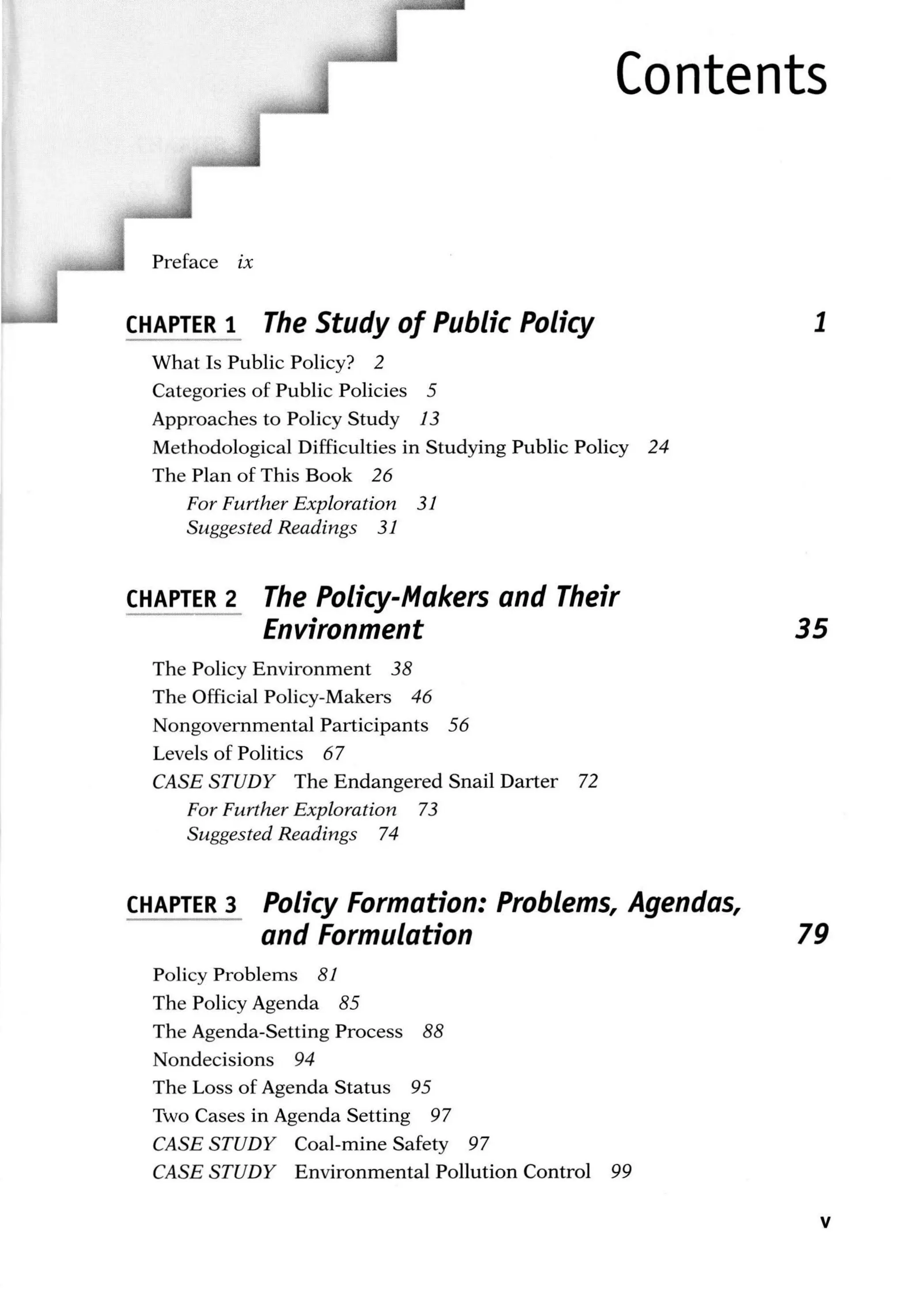

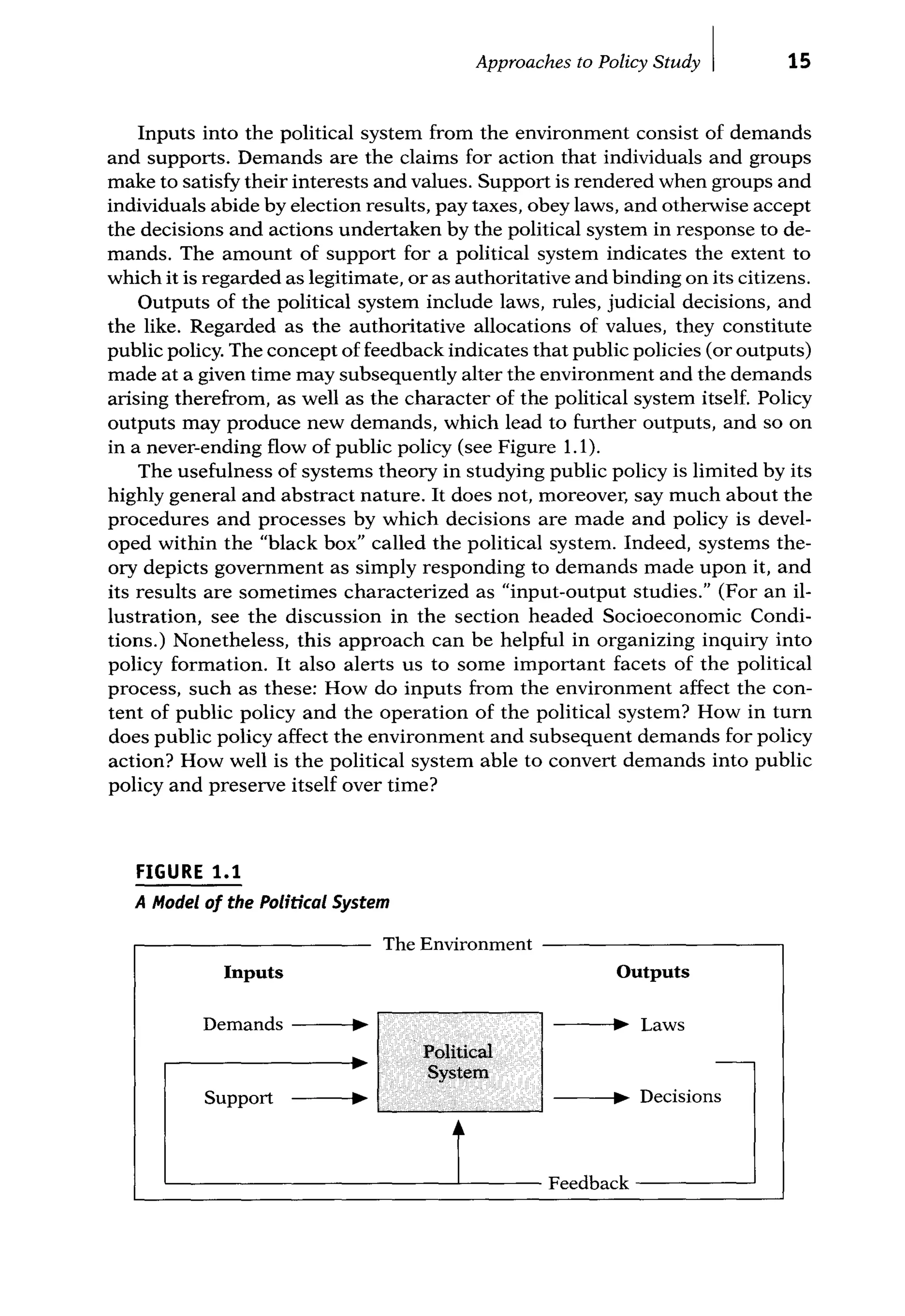
![16 The Study ofPublic Policy
Group Theory According to the group theory of politics, public policy is
the product of the group struggle. One writer states, "What
may be called public policy is the equilibrium reached in
this [group] struggle at any given moment, and it represents a balance which
the contending factions or groups constantly strive to weight in their favor.'123
Many public policies do reflect the activities of groups. Examples include the
AFL-CIO and minimum-wage legislation, farm groups and agricultural subsi-
dies, the National Rifle Association and gun-control policies, and the National
Education Association and federal aid to public schools.
Group theory rests on the contention that interaction and struggle among
groups are the central facts of political life. A group is a collection of individu-
als that may, on the basis of shared attitudes or interests, make claims upon
other groups in society. It becomes a political interest group "when it makes a
claim through or upon any of the institutions of government."24
And many
groups do just that. The individual is significant in politics only as a participant
in or a representative of groups. It is through groups that individuals seek to se-
cure their political preferences.
A central concept in group theory is that of access. To have influence and to
be able to help shape governmental decisions, a group must have access, or the
opportunity to express its viewpoints to decision-makers.25
Obviously, if a
group is unable to communicate with decision-makers, if no one in govemment
will listen, its chances of affecting policymaking are slim. Access may result
from the group's being organized, from its having status, good leadership, or re-
sources such as money for campaign contributions. Social lobbying-the win-
ing, dining, and entertaining of legislators and other public officials-can be
understood as an effort to create access by engendering a feeling of obligation
to the groups involved. Then, when a group wishes to discuss policy matters
with an official, it will have an opportunity to present its case or have its tele-
phone calls retumed. Contributions to legislators by political action commit-
tees (PACs) are also often justified as a way of acquiring or maintaining access.
In the nature of things, some groups will have more access than others.
Public policy at any given time will reflect the interests of those who are dom-
inant. As groups gain and lose power and influence, public policy will be al-
tered in favor of the interests of those gaining influence against the interests of
those losing it.
The role of govemment ("official groups") in policy formation is described
by one proponent of group theory:
The legislature referees the group struggle, ratifies the victories of the
successful coalitions, and records the terms of the surrenders, compromises,
and conquests in the form of statutes. Every statute tends to represent
compromises because the process of accommodating conflicts of group
interests is one of deliberation and consent. The legislative vote on any issue
tends to represent the composition of strength, i.e., the balance of power,
among the contending groups at the moment of voting.... Administrative
agencies of the regulatory kind are established to carry out the terms of the](https://image.slidesharecdn.com/35126-250510111843-2800b7b4/75/Public-Policymaking-An-Introduction-5th-Edition-James-E-Anderson-29-2048.jpg)
![Approaches to Policy Study I
treaties that the legislators have negotiated and ratified.... The judiciary,
like the civilian bureaucracy, is one of the instrumentalities for the
administration of the agreed rules.26
17
Group theory focuses on one of the major dynamic elements in policy for-
mation, especially in pluralist societies such as the United States, but it seems
both to overstate the importance of groups and to understate the independent
and creative role that public officials can play in the policy process. Indeed,
many groups have been generated by public policies. The American Farm Bu-
reau Federation, which developed around the agricultural extension program,
is a notable example, as is the National Welfare Rights Organization. Public of-
ficials also may acquire a stake in particular programs and act as an interest
group supporting their continuance. In the United States some welfare-agency
employees, including social workers, prefer current programs, with their em-
phasis on supervision and services (as well as benefits), to a guaranteed annual
income, which would probably eliminate some of their jobs.
Another shortcoming of group theory is that in actuality many people (e.g.,
the poor and disadvantaged) and interests (such diffuse interests as natural
beauty and social justice) are either not represented or only poorly represented
in the group struggle. As Professor E. E. Schattschneider remarks about the un-
derorganization of the poor, "The flaw in the pluralist heaven is that the heav-
enly chorus sings with a strong upper-class accent."27
Those who are not
represented will have little voice in policymaking and thus their interests are
likely to be slighted therein.
Finally, from a methodological perspective, it is misleading and inefficient to
try to explain politics and policymaking solely in terms of interests and the group
struggle. This bias leads to neglect of many other factors, such as ideas and in-
stitutions, which abound and which independently affect the development of
policy. The reductionism or unicausal explanation that results when all political
phenomena are crammed into the group concept should therefore be avoided.28
Elite Theory Approached from the perspective of elite theory, public pol-
icy can be regarded as reflecting the values and preferences
of a goveming elite. The essential argument of elite theory
is that public policy is not determined by the demands and actions of the peo-
ple or the "masses" but rather by a ruling elite whose preferences are carried
into effect by public officials and agencies.
Professors Thomas Dye and Harmon Zeigler provide a summary of elite
theory:
1. Society is divided into the few who have power and the many who do not.
[Only a small number of persons allocate values for society; the masses do
not decide public policy.]
2. The few who govern are not typical of the masses who are governed.
Elites are drawn disproportionately from the upper socioeconomic strata
of society.](https://image.slidesharecdn.com/35126-250510111843-2800b7b4/75/Public-Policymaking-An-Introduction-5th-Edition-James-E-Anderson-30-2048.jpg)
![18 The Study ofPublic Policy
3. The movement of non-elites to elite positions must be slow and
continuous to maintain stability and avoid revolution. Only non-elites
who have accepted the basic elite consensus can be admitted to governing
circles.
4. Elites share a consensus on the basic values of the social system and the
preservation of the system. [In the United States, the elite consensus
includes private enterprise, private property, limited government, and
individual liberty.]
5. Public policy does not reflect demands of the masses but rather the
prevailing values of the elite. Changes in public policy will be incremental
rather than revolutionary. [Incremental changes permit responses to
events that threaten a social system with a minimum of alteration or
dislocation of the system.]
6. Elites may act out of narrow self-serving motives and risk undermining
mass support, or they may initiate reforms, curb abuse, and undertake
public-regarding programs to preserve the system and their place in it.
7. Active elites are subject to relatively little direct influence from apathetic
masses. Elites influence masses more than masses influence elites.29
So stated, elite theory is a challenging theory of policy formation. Policy is the
product of elites, reflecting their values and serving their ends, one of which
may be a desire to provide in some way for the welfare of the masses. Dye ar-
gues that development of civil-rights policies in the United States during the
1960s can be suitably explained by elite theory. These policies were "a response
of a national elite to conditions affecting a small minority of Americans rather
than a response of national leaders to majority sentiments." Thus, for example,
the "elimination of legal discrimination and the guarantee of equality of op-
portunity in the Civil Rights Act of 1964 was achieved largely through the dra-
matic appeals of middle-class black leaders to the conscience of white elites."30
This interpretation presents a narrow perspective on both who is affected by
or interested in civil-rights policies and the explanation for adoption of the Civil
Rights Act of 1964. Certainly leadership in Congress and the executive branch
was very important, but so too were civil-rights protests and marches, public
opinion, and support from an array of nonblack organizations. The civil-rights
movement of the 1960s was far more than an effort by black leaders to appeal
to the conscience of white elites.
Elite theory focuses our attention on the role of leadership in policy forma-
tion and on the reality that, in any political system, a few govern the many.
Whether elites rule and determine policy, with little influence from the masses,
is a difficult proposition to handle. It cannot be proved merely by assertions that
the "establishment runs things," which has been a familiar plaint in recent
years. Political scientist Robert Dahl argues that to defend the proposition suc-
cessfully one must identify "a controlling group, less than a majority in size,
that is not a pure artifact of democratic rules ... a minority of individuals whose
preferences regularly prevail in cases of differences of preferences on key polit-
ical issues."31
It may be that elite theory has more utility for analysis and ex-](https://image.slidesharecdn.com/35126-250510111843-2800b7b4/75/Public-Policymaking-An-Introduction-5th-Edition-James-E-Anderson-31-2048.jpg)
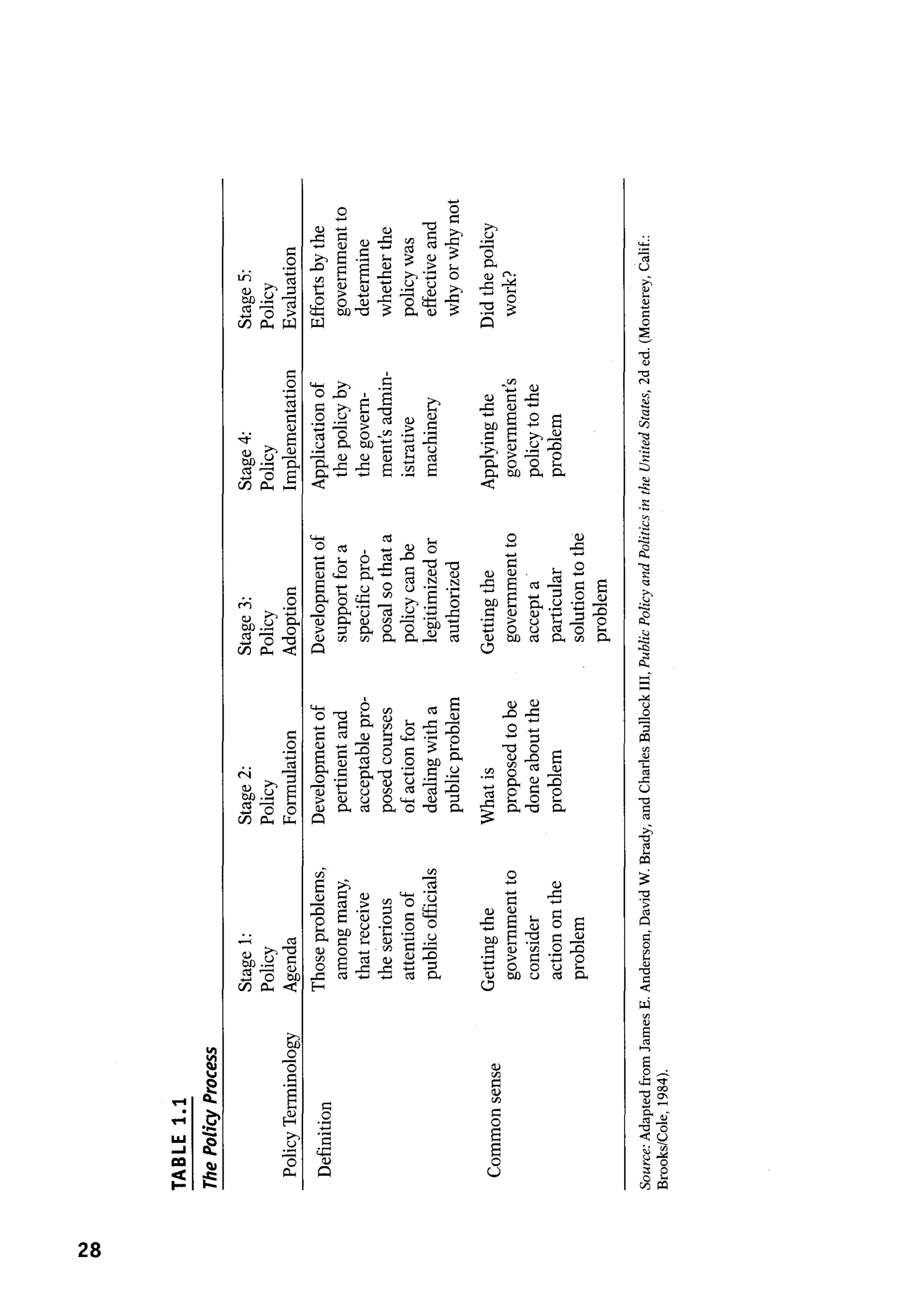

![[222] One of these stories may be seen in Justin, ii, 9,—who gives the name
of Dioklês to Hipparchus,—“Diocles, alter ex filiis, per vim stupratâ virgine, a
fratre puellæ interficitur.”
[223] Ἡ γὰρ δειλία φονικώτατόν ἐστιν ἐν ταῖς τυραννίσιν—observes Plutarch,
(Artaxerxês, c. 25).
[224] Pausan. i, 23, 2: Plutarch, De Garrulitate, p. 897; Polyæn. viii, 45;
Athenæus, xiii. p. 596.
[225] We can hardly be mistaken in putting this interpretation on the words
of Thucydidês—Ἀθηναῖος ὢν, Λαμψακηνῷ ἔδωκε (vi, 59).
Some financial tricks and frauds are ascribed to Hippias by the author of the
Pseudo-Aristotelian second book of the Œconomica (ii, 4). I place little reliance on
the statements in this treatise respecting persons of early date, such as Kypselus
or Hippias; in respect to facts of the subsequent period of Greece, between 450-
300 B. C., the author’s means of information will doubtless render him a better
witness.
[226] Herodot. vi, 36-37.
[227] Thus the Scythians broke into the Chersonese even during the
government of Miltiadês son of Kimôn, nephew of Miltiadês the œkist, about forty
years after the wall had been erected (Herodot. vi, 40). Again, Periklês
reëstablished the cross-wall, on sending to the Chersonese a fresh band of one
thousand Athenian settlers (Plutarch, Periklês, c. 19): lastly, Derkyllidas the
Lacedæmonian built it anew, in consequence of loud complaints raised by the
inhabitants of their defenceless condition,—about 397 B. C. (Xenophon. Hellen. iii,
2, 8-10). So imperfect, however, did the protection prove, that about half a
century afterwards, during the first years of the conquests of Philip of Macedon,
an idea was entertained of digging through the isthmus, and converting the
peninsula into an island (Demosthenês, Philippic ii, 6, p. 92, and De Haloneso, c.
10, p. 86); an idea, however, never carried into effect.
[228] Herodot. vi, 38, 39.
[229] Herodot. v, 94. I have already said that I conceive this as a different
war from that in which the poet Alkæus was engaged.
[230] Herodot. iii, 39.](https://image.slidesharecdn.com/35126-250510111843-2800b7b4/75/Public-Policymaking-An-Introduction-5th-Edition-James-E-Anderson-51-2048.jpg)
![[231] Herodot. vi, 104, 139, 140.
[232] Herodot. vi, 39-103. Cornelius Nepos, in his Life of Miltiadês,
confounds in one biography the adventures of two persons,—Miltiadês son of
Kypselus, the œkist,—and Miltiadês son of Kimôn, the victor of Marathon,—the
uncle and the nephew.
[233] There is nothing that I know to mark the date except that it was earlier
than the death of Hipparchus in 514 B. C., and also earlier than the expedition of
Darius against the Scythians, about 516 B. C., in which expedition Miltiadês was
engaged: see Mr. Clinton’s Fasti Hellenici, and J. M. Schultz, Beitrag zu genaueren
Zeitbestimmungen der Hellen. Geschichten von der 63sten bis zur 72sten
Olympiade, p. 165, in the Kieler Philologische Studien 1841.
[234] Herodot. v, 62. The unfortunate struggle at Leipsydrion became
afterwards the theme of a popular song (Athenæus, xv, p. 695): see Hesychius, v.
Λειψύδριον, and Aristotle, Fragm. Ἀθηναίων Πολιτεία, 37, ed. Neumann.
If it be true that Alkibiadês, grandfather of the celebrated Alkibiadês, took part
with Kleisthenês and the Alkmæonid exiles in this struggle (see Isokratês, De
Bigis, Or. xvi, p. 351), he must have been a mere youth.
[235] Pausan. x, 5, 5.
[236] Herodot. i, 50, ii, 180. I have taken the three hundred talents of
Herodotus as being Æginæan talents, which are to Attic talents in the ratio of
5 : 3. The Inscriptions prove that the accounts of the temple were kept by the
Amphiktyons on the Æginæan scale of money: see Corpus Inscrip. Boeckh, No.
1688, and Boeckh, Metrologie, vii, 4.
[237] Herodot. vi, 62. The words of the historian would seem to imply that
they only began to think of this scheme of building the temple after the defeat of
Leipsydrion, and a year or two before the expulsion of Hippias; a supposition
quite inadmissible, since the temple must have taken some years in building.
The loose and prejudiced statement in Philochorus, affirming that the
Peisistratids caused the Delphian temple to be burnt, and also that they were at
last deposed by the victorious arm of the Alkmæônids (Philochori Fragment. 70,
ed. Didot) makes us feel the value of Herodotus and Thucydidês as authorities.
[238] Herodot. vi, 128; Cicero, De Legg. ii, 16. The deposit here mentioned
by Cicero, which may very probably have been recorded in an inscription in the
temple, must have been made before the time of the Persian conquest of Samos,
—indeed, before the death of Polykratês in 522 B. C., after which period the island
fell at once into a precarious situation, and very soon afterwards into the greatest
calamities.](https://image.slidesharecdn.com/35126-250510111843-2800b7b4/75/Public-Policymaking-An-Introduction-5th-Edition-James-E-Anderson-52-2048.jpg)
![[239] Herodot. v, 62, 63.
[240] Herodot. v, 64, 65.
[241] Thucyd. vi, 56, 57.
[242] Thucyd. vi, 55. ὡς ὅ τε βωμὸς σημαίνει, καὶ ἡ στήλη περὶ τῆς τῶν
τυράννων ἀδικίας, ἡ ἐν τῇ Ἀθηναίων ἀκροπόλει σταθεῖσα.
Dr. Thirlwall, after mentioning the departure of Hippias, proceeds as follows:
“After his departure many severe measures were taken against his adherents,
who appear to have been for a long time afterwards a formidable party. They
were punished or repressed, some by death, others by exile or by the loss of their
political privileges. The family of the tyrants was condemned to perpetual
banishment, and appears to have been excepted from the most comprehensive
decrees of amnesty passed in later times.” (Hist. of Gr. ch. xi, vol. ii, p. 81.)
I cannot but think that Dr. Thirlwall has here been misled by insufficient
authority. He refers to the oration of Andokidês de Mysteriis, sects. 106 and 78
(sect. 106 coincides in part with ch. 18, in the ed. of Dobree). An attentive
reading of it will show that it is utterly unworthy of credit in regard to matters
anterior to the speaker by one generation or more. The orators often permit
themselves great license in speaking of past facts, but Andokidês in this chapter
passes the bounds even of rhetorical license. First, he states something not
bearing the least analogy to the narrative of Herodotus as to the circumstances
preceding the expulsion of the Peisistratids, and indeed tacitly setting aside that
narrative; next, he actually jumbles together the two capital and distinct exploits
of Athens,—the battle of Marathon and the repulse of Xerxês ten years after it. I
state this latter charge in the words of Sluiter and Valckenaer, before I consider
the former charge: “Verissime ad hæc verba notat Valckenaerius—Confundere
videtur Andocidês diversissima; Persica sub Miltiade et Dario et victoriam
Marathoniam (v, 14)—quæque evenere sub Themistocle, Xerxis gesta. Hic urbem
incendio delevit, non ille (v, 20). Nihil magis manifestum est, quam diversa ab
oratore confundi.” (Sluiter, Lection. Andocideæ, p. 147.)
The criticism of these commentators is perfectly borne out by the words of the
orator, which are too long to find a place here. But immediately prior to those
words he expresses himself as follows, and this is the passage which serves as Dr.
Thirlwall’s authority: Οἱ γὰρ πατέρες οἱ ὑμέτεροι, γενομένων τῇ πόλει κακῶν
μεγάλων, ὅτε οἱ τύραννοι εἶχον τὴν πόλιν, ὁ δὲ δῆμος ἔφυγε, νικήσαντες
μαχόμενοι τοὺς τυράννους ἐπὶ Παλληνίῳ, στρατηγοῦντος Λεωγόρου τοῦ
προπάππου τοῦ ἐμοῦ, καὶ Χαρίου οὗ ἐκεῖνος τὴν θυγατέρα εἶχεν ἐξ ἧς ὁ ἡμέτερος
ἦν πάππος, κατελθόντες εἰς τὴν πατρίδα τοὺς μὲν ἀπέκτειναν, τῶν δὲ φυγὴν
κατέγνωσαν, τοὺς δὲ μένειν ἐν τῇ πόλει ἐάσαντες ἠτίμωσαν.
Both Sluiter (Lect. And. p. 8) and Dr. Thirlwall (Hist. p. 80) refer this alleged
victory of Leogoras and the Athenian demus to the action described by Herodotus](https://image.slidesharecdn.com/35126-250510111843-2800b7b4/75/Public-Policymaking-An-Introduction-5th-Edition-James-E-Anderson-53-2048.jpg)
![[243] Herodot. v, 66-69 ἑσσούμενος δὲ ὁ Κλεισθένης τὸν δῆμον
προσεταιρίζεται—ὡς γὰρ δὴ τὸν Ἀθηναίων δῆμον, πρότερον ἀπωσμένον πάντων,
τότε πρὸς τὴν ἑωϋτοῦ μοίρην προσεθήκατο, etc.
[244] Aristot. Polit. iii, 1, 10; vi, 2, 11. Κλεισθένης,—πολλοῖς ἐφυλέτευσε
ξένους καὶ δούλους μετοίκους.
Several able critics, and Dr. Thirlwall among the number, consider this passage
as affording no sense, and assume some conjectural emendation to be
indispensable; though there is no particular emendation which suggests itself as
preëminently plausible. Under these circumstances, I rather prefer to make the
best of the words as they stand; which, though unusual, seem to me not
absolutely inadmissible. The expression ξένος μέτοικος (which is a perfectly good
one, as we find in Aristoph. Equit. 347,—εἴπου δικιδίον εἶπας εὖ κατὰ ξένου
μετοίκου) may be considered as the correlative to δούλους μετοίκους,—the last
word being construed both with δούλους and with ξένους. I apprehend that there
always must have been in Attica a certain number of intelligent slaves living apart
from their masters (χωρὶς οἰκοῦντες), in a state between slavery and freedom,
working partly on condition of a fixed payment to him, partly for themselves, and
perhaps continuing to pass nominally as slaves after they had bought their liberty
by instalments. Such men would be δοῦλοι μέτοικοι: indeed, there are cases in
which δοῦλοι signifies freedmen (Meier, De Gentilitate Atticâ, p. 6): they must
have been industrious and pushing men, valuable partisans to a political
revolution. See K. F. Hermann, Lehrbuch der Griech. Staats Alterth. ch. 111, not.
15.
[245] Herodot. v, 69. Κλεισθένης,—ὑπεριδὼν Ἴωνας, ἵνα μὴ σφισι αἱ αὐταὶ
ἔωσι φυλαὶ καὶ Ἴωσι.
[246] Such a disposition seems evident in Herodot. i, 143.
[247] In illustration of what is here stated, see the account of the
modifications of the constitution of Zurich, in Blüntschli, Staats und Rechts
Geschichte der Stadt Zurich, book iii. ch. 2, p. 322; also, Kortüm, Entstehungs
Geschichte der Freistädtischen Bünde im Mittelalter, ch. 5, pp. 74-75.
[248] Respecting these Eponymous Heroes of the Ten Tribes, and the
legends connected with them, see chapter viii of the Ἐπιτάφιος Λόγος,
erroneously ascribed to Demosthenês.
[249] Herodot. v, 69. δέκα δὲ καὶ τοὺς δήμους κατένεμε ἐς τὰς φυλάς.
Schömann contends that Kleisthenês established exactly one hundred demes
to the ten tribes (De Comitiis Atheniensium, Præf. p. xv and p. 363, and
Antiquitat. Jur. Pub. Græc. ch. xxii, p. 260), and K. F. Hermann (Lehrbuch der](https://image.slidesharecdn.com/35126-250510111843-2800b7b4/75/Public-Policymaking-An-Introduction-5th-Edition-James-E-Anderson-56-2048.jpg)
![Griech. Staats Alt. ch. 111) thinks that this is what Herodotus meant to affirm,
though he does not believe the fact to have really stood so.
I incline, as the least difficulty in the case, to construe δέκα with φυλὰς and
not with δήμους, as Wachsmuth (i, 1, p. 271) and Dieterich (De Clisthene, a
treatise cited by K. F. Hermann, but which I have not seen) construe it.
[250] The deme Melitê belonged to the tribe Kekropis; Kollytus, to the tribe
Ægêis; Kydathenæon, to the tribe Pandionis; Kerameis or Kerameikus, to the
Akamantis; Skambônidæ, to the Leontis.
All these five were demes within the city of Athens, and all belonged to
different tribes.
Peiræus belonged to the Hippothoöntis; Phalêrum, to the Æantis; Xypetê, to
the Kekropis; Thymætadæ, to the Hippothoöntis. These four demes, adjoining to
each other, formed a sort of quadruple local union, for festivals and other
purposes, among themselves; though three of them belonged to different tribes.
See the list of the Attic demes, with a careful statement of their localities in so
far as ascertained, in Professor Ross, Die Demen von Attika. Halle, 1846. The
distribution of the city-demes, and of Peiræus and Phalêrum, among different
tribes, appears to me a clear proof of the intention of the original distributors. It
shows that they wished from the beginning to make the demes constituting each
tribe discontinuous, and that they desired to prevent both the growth of separate
tribe-interests and ascendency of one tribe over the rest. It contradicts the belief
of those who suppose that the tribe was at first composed of continuous demes,
and that the breach of continuity arose from subsequent changes.
Of course there were many cases in which adjoining demes belonged to the
same tribe; but not one of the ten tribes was made up altogether of adjoining
demes.
[251] See Boeckh, Corp. Inscriptt. Nos. 85, 128, 213, etc.: compare
Demosthen. cont. Theokrin. c. 4. p. 1326 R.
[252] We may remark that this register was called by a special name, the
Lexiarchic register; while the primitive register of phrators and gentiles always
retained, even in the time of the orators, its original name of the common register
—Harpokration, v. Κοινὸν γραμματεῖον καὶ ληξιαρχικόν.
[253] See Schömann, Antiq. Jur. P. Græc. ch. xxiv. The oration of
Demosthenês against Eubulidês is instructive about these proceedings of the
assembled demots: compare Harpokration, v. Διαψήφισις, and Meier, De Bonis
Damnatorum, ch. xii, p. 78, etc.
[254] Aristot. Fragment. de Republ., ed. Neumann.—Ἀθην. πολιτ. Fr. 40, p.
88; Schol. ad Aristophan. Ran. 37; Harpokration, v. Δήμαρχος—Ναυκραρικά;
Photius, v. Ναυκραρία.](https://image.slidesharecdn.com/35126-250510111843-2800b7b4/75/Public-Policymaking-An-Introduction-5th-Edition-James-E-Anderson-57-2048.jpg)
![[255] Herodot. vi, 109-111.
[256] Harpokration, v. Ἀποδέκται.
[257] See the valuable treatise of Schömann, De Comitiis, passim; also his
Antiq. Jur. Publ. Gr. ch. xxxi; Harpokration, v. Κυρία Ἐκκλησία; Pollux, viii, 95.
[258] See in particular on this subject the treatise of Schömann, De
Sortitione Judicum (Gripswald, 1820), and the work of the same author, Antiq.
Jur. Publ. Græc. ch. 49-55, p. 264, seqq.; also Heffter, Die Athenäische
Gerichtsverfassung, part ii, ch. 2, p. 51, seqq.; Meier and Schömann, Der Attische
Prozess, pp. 127-135.
The views of Schömann respecting the sortition of the Athenian jurors have
been bitterly attacked, but in no way refuted, by F. V. Fritzsche (De Sortitione
Judicum apud Athenienses Conmentatio, Leipsic, 1835).
Two or three of these dikastic tickets, marking the name and the deme of the
citizen, and the letter of the decury to which during that particular year he
belonged, have been recently dug up near Athens:—
Δ.Διόδωρος Ε.Δεινίας
Φρεάῤῥιος Ἀλαιεύς.
(Boeckh, Corp. Inscrip. Nos. 207-208.)
Fritzsche (p. 73) considers these to be tickets of senators, not of dikasts,
contrary to all probability.
For the Heliastic oath, and its remarkable particulars, see Demosthen. cont.
Timokrat. p. 746. See also Aristophanês, Plutus, 277 (with the valuable Scholia,
though from different hands and not all of equal correctness) and 972;
Ekklesiazusæ, 678, seqq.
[259] Plutarch, Arist. 7; Herodot. vi, 109-111.
[260] Aristotle puts these two together; election of magistrates by the mass
of the citizens, but only out of persons possessing a high pecuniary qualification;
this he ranks as the least democratical democracy, if one may use the phrase
(Politic. iii, 6-11), or a mean between democracy and oligarchy,—an ἀριστοκρατία,
or πολιτεῖα, in his sense of the word (iv, 7, 3). He puts the employment of the lot
as a symptom of decisive and extreme democracy, such as would never tolerate a
pecuniary qualification of eligibility.
So again Plato (Legg. iii, p. 692), after remarking that the legislator of Sparta
first provided the senate, next the ephors, as a bridle upon the kings, says of the
ephors that they were “something nearly approaching to an authority emanating
from the lot,”—οἷον ψάλιον ἐνέβαλεν αὐτῇ τὴν τῶν ἐφόρων δύναμιν, ἐγγὺς τῆς
κληρωτῆς ἀγαγὼν δυνάμεως.](https://image.slidesharecdn.com/35126-250510111843-2800b7b4/75/Public-Policymaking-An-Introduction-5th-Edition-James-E-Anderson-58-2048.jpg)
![Upon which passage there are some good remarks in Schömann’s edition of
Plutarch’s Lives of Agis and Kleomenês (Comment. ad Ag. c. 8, p. 119). It is to be
recollected that the actual mode in which the Spartan ephors were chosen, as I
have already stated in my first volume, cannot be clearly made out, and has been
much debated by critics:—
“Mihi hæc verba, quum illud quidem manifestum faciant, quod etiam aliunde
constat, sorte captos ephoros non esse, tum hoc alterum, quod Hermannus
statuit, creationem sortitioni non absimilem fuisse, nequaquam demonstrare
videntur. Nimirum nihil aliud nisi prope accedere ephororum magistratus ad cos
dicitur, qui sortito capiantur. Sortitis autem magistratibus hoc maxime proprium
est, ut promiscue—non ex genere, censu, dignitate—a quolibet capi possint:
quamobrem quum ephori quoque fere promiscue fierent ex omni multitudine
civium, poterat haud dubie magistratus eorum ἐγγὺς τῆς κληρωτῆς δυνάμεως
esse dici, etiamsi αἱρετοὶ essent—h. e. suffragiis creati. Et video Lachmannum
quoque, p. 165, not. 1, de Platonis loco similiter judicare.”
The employment of the lot, as Schömann remarks, implies universal
admissibility of all citizens to office: though the converse does not hold good,—
the latter does not of necessity imply the former. Now, as we know that universal
admissibility did not become the law of Athens until after the battle of Platæa, so
we may conclude that the employment of the lot had no place before that epoch,
—i. e. had no place under the constitution of Kleisthenês.
[261] Plutarch, Periklês, c. 9-16.
[262] See a passage about such characters in Plato, Republic, v, p. 475 B.
[263] Plutarch, Arist. 22.
[264] So at least the supporters of the constitution of Kleisthenês were called
by the contemporaries of Periklês.
[265] Plutarch, Arist. ut sup. γράφει ψήφισμα, κοινὴν εἶναι τὴν πολιτείαν, καὶ
τοὺς ἄρχοντας ἐξ Ἀθηναίων πάντων αἱρεῖσθαι.
[266] So in the Italian republics of the twelfth and thirteenth century, the
nobles long continued to possess the exclusive right of being elected to the
consulate and the great offices of state, even after those offices had come to be
elected by the people: the habitual misrule and oppression of the nobles
gradually put an end to this right, and even created in many towns a resolution
positively to exclude them. At Milan, towards the end of the twelfth century, the
twelve consuls, with the Podestat, possessed all the powers of government: these
consuls were nominated by one hundred electors chosen by and among the
people. Sismondi observes: “Cependant le peuple imposa lui-même a ces
électeurs, la règle fondamentale de choisir tous les magistrats dans le corps de la](https://image.slidesharecdn.com/35126-250510111843-2800b7b4/75/Public-Policymaking-An-Introduction-5th-Edition-James-E-Anderson-59-2048.jpg)
![noblesse. Ce n’étoit point encore la possession des magistratures que l’on
contestoit aux gentilshommes: on demandoit seulement qu’ils fussent les
mandataires immédiats de la nation. Mais plus d’une fois, en dépit du droit
incontestable des citoyens, les consuls regnant s’attribuèrent l’élection de leurs
successeurs.” (Sismondi, Histoire des Républiques Italiennes, chap. xii, vol. ii, p.
240.)
[267] Plutarch, Kimon, c. 15. τὴν ἐπὶ Κλεισθένους ἐγείρειν ἀριστοκρατίαν
πειρωμένου: compare Plutarch, Aristeidês, c. 2, and Isokratês, Areopagiticus, Or.
vii, p. 143, p. 192, ed. Bek.
[268] Herodotus speaks of Kallimachus the Polemarch, at Marathon, as ὁ τῷ
κυάμῳ λαχὼν Πολέμαρχος (vi, 110).
I cannot but think that in this case he transfers to the year 490 B. C. the
practice of his own time. The polemarch, at the time of the battle of Marathon,
was in a certain sense the first stratêgus; and the stratêgi were never taken by
lot, but always chosen by show of hands, even to the end of the democracy. It
seems impossible to believe that the stratêgi were elected, and that the
polemarch, at the time when his functions were the same as theirs, was chosen
by lot.
Herodotus seems to have conceived the choice of magistrates by lot as being
of the essence of a democracy (Herodot. iii, 80).
Plutarch also (Periklês, c. 9) seems to have conceived the choice of archons by
lot as a very ancient institution of Athens: nevertheless, it results from the first
chapter of his life of Aristeidês,—an obscure chapter, in which conflicting
authorities are mentioned without being well discriminated,—that Aristeidês was
chosen archon by the people,—not drawn by lot: an additional reason for
believing this is, that he was archon in the year following the battle of Marathon,
at which, he had been one of the ten generals. Idomeneus distinctly affirmed this
to be the fact.—οὐ κυαμευτὸν, ἀλλ᾽ ἑλομένων Ἀθηναίων (Plutarch, Arist. c. 1).
Isokratês also (Areopagit. Or. vii, p. 144, p. 195, ed. Bekker) conceived the
constitution of Kleisthenês as including all the three points noticed in the text: 1.
A high pecuniary qualification of eligibility for individual offices. 2. Election to
these offices by all the citizens, and accountability to the same after office. 3. No
employment of the lot.—He even contends that this election is more truly
democratical than sortition; since the latter process might admit men attached to
oligarchy, which would not happen under the former,—ἔπειτα καὶ δημοτικωτέραν
ἐνόμιζον ταύτην τὴν κατάστασιν ἢ τὴν διὰ τοῦ λαγχάνειν γιγνομένην· ἐν μὲν γὰρ
τῇ κληρώσει τὴν τύχην βραβεύσειν, καὶ πολλάκις λήψεσθαι τὰς ἀρχὰς τοὺς τῆς
ὀλιγαρχίας ἐπιθυμοῦντας, etc. This would be a good argument if there were no
pecuniary qualification for eligibility,—such pecuniary qualification is a provision
which he lays down, but which he does not find it convenient to insist upon
emphatically.](https://image.slidesharecdn.com/35126-250510111843-2800b7b4/75/Public-Policymaking-An-Introduction-5th-Edition-James-E-Anderson-60-2048.jpg)
![I do not here advert to the γραφὴ παρανόμων, the νομοφύλακες, and the
sworn νομόθεται,—all of them institutions belonging to the time of Periklês at the
earliest; not to that of Kleisthenês.
[269] See above, chap. xi. vol. iii. p. 145.
[270] Aristeidês Rhetor. Orat. xlvi. vol ii. p. 317, ed. Dindorf.
[271] Plutarch (Nikias, c. 11; Alkibiad. c. 13; Aristeid. c. 7): Thucyd. viii, 73.
Plato Comicus said, respecting Hyperbolus—
Οὐ γὰρ τοιούτων οὕνεκ᾽ ὄστραχ᾽ ηὑρέθη.
Theophrastus had stated that Phæax, and not Nikias, was the rival of
Alkibiadês on this occasion, when Hyperbolus was ostracized; but most authors,
says Plutarch, represent Nikias as the person. It is curious that there should be
any difference of statement about a fact so notorious, and in the best-known time
of Athenian history.
Taylor thinks that the oration which now passes as that of Andokidês against
Alkibiadês, is really by Phæax, and was read by Plutarch as the oration of Phæax
in an actual contest of ostracism between Phæax, Nikias, and Alkibiadês. He is
opposed by Ruhnken and Valckenaer (see Sluiter’s preface to that oration, c. 1,
and Ruhnken, Hist. Critic. Oratt. Græcor. p. 135). I cannot agree with either: I
cannot think with him, that it is a real oration of Phæax; nor with them, that it is
a real oration in any genuine cause of ostracism whatever. It appears to me to
have been composed after the ostracism had fallen into desuetude, and when the
Athenians had not only become somewhat ashamed of it, but had lost the familiar
conception of what it really was. For how otherwise can we explain the fact, that
the author of that oration complains that he is about to be ostracized without any
secret voting, in which the very essence of the ostracism consisted, and from
which its name was borrowed (οὔτε διαψηφισαμένων κρυβδὴν, c. 2)? His oration
is framed as if the audience whom he was addressing were about to ostracize one
out of the three, by show of hands. But the process of ostracizing included no
meeting and haranguing,—nothing but simple deposit of the shells in a cask; as
may be seen by the description of the special railing-in of the agora, and by the
story (true or false) of the unlettered country-citizen coming into the city to give
his vote, and asking Aristeidês, without even knowing his person, to write the
name for him on the shell (Plutarch, Aristeid. c. 7). There was, indeed, previous
discussion in the senate as well as in the ekklesia, whether a vote of ostracism
should be entered upon at all; but the author of the oration to which I allude
does not address himself to that question; he assumes that the vote is actually
about to be taken, and that one of the three—himself, Nikias, or Alkibiadês—must
be ostracized (c. 1). Now, doubtless, in practice, the decision commonly lay
between two formidable rivals; but it was not publicly or formally put so before](https://image.slidesharecdn.com/35126-250510111843-2800b7b4/75/Public-Policymaking-An-Introduction-5th-Edition-James-E-Anderson-61-2048.jpg)
![the people: every citizen might write upon the shell such name as he chose.
Farther, the open denunciation of the injustice of ostracism as a system (c. 2),
proves an age later than the banishment of Hyperbolus. Moreover, the author
having begun by remarking that he stands in contest with Nikias as well as with
Alkibiadês, says nothing more about Nikias to the end of the speech.
[272] See the discussion of the ostracism in Aristot. Politic. iii, 8, where he
recognizes the problem as one common to all governments.
Compare, also, a good Dissertation—J. A. Paradys, De Ostracismo
Atheniensium, Lugduni Batavor. 1793; K. F. Hermann, Lehrbuch der Griechischen
Staatsalterthümer, ch. 130; and Schömann, Antiq. Jur. Pub. Græc. ch. xxxv, p.
233.
[273] Plutarch, Aristeid. c. 3.
[274] The barathrum was a deep pit, said to have had iron spikes at the
bottom, into which criminals condemned to death were sometimes cast. Though
probably an ancient Athenian punishment, it seems to have become at the very
least extremely rare, if not entirely disused, during the times of Athens historically
known to us; but the phrase continued in speech after the practice had become
obsolete. The iron spikes depend on the evidence of the Schol. Aristophan.
Plutus, 431,—a very doubtful authority, when we read the legend which he blends
with his statement.
[275] Thucyd. iii, 70, 81, 82.
[276] Andokidês, De Mysteriis, p. 12, c. 13. Μηδὲ νόμον ἐπ᾽ ἀνδρὶ ἐξεῖναι
θεῖναι, ἐὰν μὴ τὸν αὐτὸν ἐπὶ πᾶσιν Ἀθηναίοις· ἐὰν μὴ ἑξακισχιλίοις δόξῃ, κρυβδὴν
ψηφιζομένοις. According to the usual looseness in dealing with the name of
Solon, this has been called a law of Solon (see Petit. Leg. Att. p. 188), though it
certainly cannot be older than Kleisthenês.
“Privilegia ne irroganto,” said the law of the Twelve Tables at Rome (Cicero,
Legg. iii, 4-19).
[277] Aristotle and Philochorus, ap. Photium, App. p. 672 and 675, ed.
Porson.
It would rather appear by that passage that the ostracism was never formally
abrogated; and that even in the later times, to which the description of Aristotle
refers, the form was still preserved of putting the question whether the public
safety called for an ostracizing vote, long after it had passed both out of use and
out of mind.
[278] Philochorus, ut supra; Plutarch, Aristeid. c. 7; Schol. ad Aristophan.
Equit. 851; Pollux, viii, 19.](https://image.slidesharecdn.com/35126-250510111843-2800b7b4/75/Public-Policymaking-An-Introduction-5th-Edition-James-E-Anderson-62-2048.jpg)
![There is a difference of opinion among the authorities, as well as among the
expositors, whether the minimum of six thousand applies to the votes given in all,
or to the votes given against any one name. I embrace the latter opinion, which
is supported by Philochorus, Pollux, and the Schol. on Aristophanês, though
Plutarch countenances the former. Boeckh, in his Public Economy of Athens, and
Wachsmuth, (i, 1, p. 272) are in favor of Plutarch and the former opinion; Paradys
(Dissertat. De Ostr. p. 25), Platner, and Hermann (see K. F. Hermann, Lehrbuch
der Gr. Staatsalt. ch. 130, not. 6) support the other, which appears to me the
right one.
For the purpose, so unequivocally pronounced, of the general law determining
the absolute minimum necessary for a privilegium, would by no means be
obtained, if the simple majority of votes, among six thousand voters in all, had
been allowed to take effect. A person might then be ostracized with a very small
number of votes against him, and without creating any reasonable presumption
that he was dangerous to the constitution; which was by no means either the
purpose of Kleisthenês, or the well-understood operation of the ostracism, so long
as it continued to be a reality.
[279] The practical working of the ostracism presents it as a struggle
between two contending leaders, accompanied with chance of banishment to
both—Periklês πρὸς τὸν Θουκυδίδην εἰς ἀγῶνα περὶ τοῦ ὀστράκου καταστὰς, καὶ
διακινδυνεύσας, ἐκεῖνον μὲν ἐξέβαλε, κατέλυσε δὲ τὴν ἀντιτεταγμένην ἑταιρείαν
(Plutarch, Periklês, c. 14; compare Plutarch, Nikias, c. 11).
[280] It is not necessary in this remark to take notice, either of the oligarchy
of Four Hundred, or that of Thirty, called the Thirty Tyrants, established during
the closing years of the Peloponnesian war, and after the ostracism had been
discontinued. Neither of these changes were brought about by the excessive
ascendency of any one or few men: both of them grew out of the
embarrassments and dangers of Athens in the latter period of her great foreign
war.
[281] Aristotle (Polit. iii, 8, 6) seems to recognize the political necessity of the
ostracism, as applied even to obvious superiority of wealth, connection, etc.
(which he distinguishes pointedly from superiority of merit and character), and
upon principles of symmetry only, even apart from dangerous designs on the part
of the superior mind. No painter, he observes, will permit a foot, in his picture of
a man, to be of disproportionate size with the entire body, though separately
taken it may be finely painted; nor will the chorus-master allow any one voice,
however beautiful, to predominate beyond a certain proportion over the rest.
His final conclusion is, however, that the legislator ought, if possible, so to
construct his constitution, as to have no need of such exceptional remedy; but, if](https://image.slidesharecdn.com/35126-250510111843-2800b7b4/75/Public-Policymaking-An-Introduction-5th-Edition-James-E-Anderson-63-2048.jpg)
![this cannot be done, then the second-best step is to apply the ostracism.
Compare also v, 2, 5.
The last century of the free Athenian democracy realized the first of these
alternatives.
[282] Plutarch, Nikias, c. 11: Harpokration. v. Ἵππαρχος.
[283] Lysias cont. Alkibiad. A. c. 11, p. 143: Harpokration. v. Ἀλκιβιάδης;
Andokidês cont. Alkibiad. c. 11-12, pp. 129, 130: this last oration may afford
evidence as to the facts mentioned in it, though I cannot imagine it to be either
genuine, or belonging to the time to which it professes to refer, as has been
observed in a previous note.
[284] Plutarch, Periklês. c. 4; Plutarch. Aristeid. c. 1.
[285] Ælian, V. H. xiii, 24; Herakleidês, περὶ Πολιτειῶν, c. 1, ed. Köhler.
[286] Plutarch, Themistoklês, 22; Plutarch, Aristeidês, 7, παραμυθία φθόνου
καὶ κουφισμός. See the same opinions repeated by Wachsmuth, Hellenische
Alterthumskunde, ch. 48, vol. i, p. 272, and by Platner, Prozess and Klagen bey
den Attikern, vol. i, p. 386.
[287] Thucyd. viii, 73, διὰ δυνάμεως καὶ ἀξιώματος φόβον.
[288] Kratinus ap. Plutarch, Periklês, 13.
Ὁ σχινοκέφαλος Ζεὺς ὁδὶ προσέρχεται
Περικλέης, τᾠδεῖον ἐπὶ τοῦ κρανíου
Ἔχων, ἐπειδὴ τοὔστρακον παροίχεται.
For the attacks of the comic writers upon Damôn, see Plutarch, Periklês, c. 4.
[289] Aristot. Polit. iii, 8, 4; v, 2, 5.
[290] Diodor. xi, 55-87. This author describes very imperfectly the Athenian
ostracism, transferring to it apparently the circumstances of the Syracusan
Petalism.
[291] Herodot. v, 70-72; compare Schol. ad Aristophan. Lysistr. 274.
[292] Herodot. v, 73.
[293] See vol. ii, p. 295, part ii, ch. 3.
[294] Thucyd. iii, 61.](https://image.slidesharecdn.com/35126-250510111843-2800b7b4/75/Public-Policymaking-An-Introduction-5th-Edition-James-E-Anderson-64-2048.jpg)
![[295] Herodot. vi, 108. ἐᾷν Θηβαίους Βοιωτῶν τοὺς μὴ βουλομένους ἐς
Βοιωτοὺς τελέειν. This is an important circumstance in regard to Grecian political
feeling: I shall advert to it hereafter.
[296] Herodot. vi, 108. Thucydidês (iii, 58), when recounting the capture of
Platæa by the Lacedæmonians in the third year of the Peloponnesian war, states
that the alliance between Platæa and Athens was then in its 93rd year of date;
according to which reckoning it would begin in the year 519 B. C., where Mr.
Clinton and other chronologers place it.
I venture to think that the immediate circumstances, as recounted in the text
from Herodotus (whether Thucydidês conceived them in the same way, cannot be
determined), which brought about the junction of Platæa with Athens, cannot
have taken place in 519 B. C., but must have happened after the expulsion of
Hippias from Athens in 510 B. C.,—for the following reasons:—
1. No mention is made of Hippias, who yet, if the event had happened in 519
B. C., must have been the person to determine whether the Athenians should
assist Platæa or not. The Platæan envoys present themselves at a public sacrifice
in the attitude of suppliants, so as to touch the feelings of the Athenian citizens
generally: had Hippias been then despot, he would have been the person to be
propitiated and to determine for or against assistance.
2. We know no cause which should have brought Kleomenês with a
Lacedæmonian force near to Platæa in the year 519 B. C.: we know from the
statement of Herodotus (v, 76) that no Lacedæmonian expedition against Attica
took place at that time. But in the year to which I have referred the event,
Kleomenês is on his march near the spot upon a known and assignable object.
From the very tenor of the narrative, it is plain that Kleomenês and his army were
not designedly in Bœotia, nor meddling with Bœotian affairs, at the time when
the Platæans solicited his aid; he declines to interpose in the matter, pleading the
great distance between Sparta and Platæa as a reason.
3. Again, Kleomenês, in advising the Platæans to solicit Athens, does not give
the advice through good-will towards them, but through a desire to harass and
perplex the Athenians, by entangling them in a quarrel with the Bœotians. At the
point of time to which I have referred the incident, this was a very natural desire:
he was angry, and perhaps alarmed, at the recent events which had brought
about his expulsion from Athens. But what was there to make him conceive such
a feeling against Athens during the reign of Hippias? That despot was on terms of
the closest intimacy with Sparta: the Peisistratids were (ξείνους—ξεινίους
ταμάλιστα—Herod. v, 63, 90, 91) “the particular guests” of the Spartans, who
were only induced to take part against Hippias from a reluctant obedience to the
oracles procured, one after another, by Kleisthenês. The motive, therefore,
assigned by Herodotus, for the advice given by Kleomenês to the Platæans, can
have no application to the time when Hippias was still despot.](https://image.slidesharecdn.com/35126-250510111843-2800b7b4/75/Public-Policymaking-An-Introduction-5th-Edition-James-E-Anderson-65-2048.jpg)
![4. That Herodotus did not conceive the victory gained by the Athenians over
Thebes as having taken place before the expulsion of Hippias, is evident from his
emphatic contrast between their warlike spirit and success when liberated from
the despots, and their timidity or backwardness while under Hippias (Ἀθηναῖοι
τυραννευόμενοι μὲν, οὐδαμῶν τῶν σφέας περιοικεόντων ἔσαν τὰ πολέμια
ἀμείνους, ἀπαλλαχθέντες δὲ τυράννων, μακρῷ πρῶτοι ἐγένοντο· δηλοῖ ὦν ταῦτα,
ὅτι κατεχόμενοι μὲν, ἐθελοκάκεον, etc. v, 78). The man who wrote thus cannot
have believed that, in the year 519 B. C., while Hippias was in full sway, the
Athenians gained an important victory over the Thebans, cut off a considerable
portion of the Theban territory for the purpose of joining it to that of the
Platæans, and showed from that time forward their constant superiority over
Thebes by protecting her inferior neighbor against her.
These different reasons, taking them altogether, appear to me to show that
the first alliance between Athens and Platæa, as Herodotus conceives and
describes it, cannot have taken place before the expulsion of Hippias, in 510 B. C.;
and induce me to believe, either that Thucydidês was mistaken in the date of that
event, or that Herodotus has not correctly described the facts. Not seeing any
reason to suspect the description given by the latter, I have departed, though
unwillingly, from the date of Thucydidês.
The application of the Platæans to Kleomenês, and his advice grounded
thereupon, may be connected more suitably with his first expedition to Athens,
after the expulsion of Hippias, than with his second.
[297] Herodot. v, 75.
[298] Compare Kortüm, Zur Geschichte Hellenischer Staats-Verfassungen, p.
35 (Heidelberg, 1821).
I doubt, however, his interpretation of the words in Herodotus (v, 63)—εἴτε
ἰδίῳ στόλῳ, εἴτε δημοσίῳ χρησόμενοι.
[299] Herodot. v, 77; Ælian, V. H. vi, 1; Pausan. i, 28, 2.
[300] Herodot. v, 80.
[301] In the expression of Herodotus, the Æakid heroes are really sent from
Ægina, and really sent back by the Thebans (v, 80-81)—Οἱ δέ σφι αἰτέουσι
ἐπικουρίην τοὺς Αἰακίδας συμπέμπειν ἔφασαν, αὖτις οἱ Θηβαῖοι πέμψαντες, τ ο ὺ ς
μ ὲ ν Α ἰ α κ ί δ α ς σ φ ι ἀ π ε δ ί δ ο σ α ν , τ ῶ ν δ ὲ ἀ ν δ ρ ῶ ν ἐ δ έ ο ν τ ο. Compare
again v, 75; viii, 64; and Polyb. vii, 9, 2. θεῶν τῶν συστρατευομένων.
Justin gives a narrative of an analogous application from the Epizephyrian
Lokrians to Sparta (xx, 3): “Territi Locrenses ad Spartanos decurrunt: auxilium
supplices deprecantur: illi longinquâ militiâ gravati, auxilium a Castore et Polluce
petere eos jubent. Neque legati responsum sociæ urbis spreverunt; profectique in
proximum templum, facto sacrificio, auxilium deorum implorant. Litatis hostiis,](https://image.slidesharecdn.com/35126-250510111843-2800b7b4/75/Public-Policymaking-An-Introduction-5th-Edition-James-E-Anderson-66-2048.jpg)
![obtentoque, ut rebantur, quod petebant—haud secus læti quam si deos ipsos
secum avecturi essent—pulvinaria iis in navi componunt, faustisque profecti
ominibus, solatia suis pro auxiliis deportant.” In comparing the expressions of
Herodotus with those of Justin, we see that the former believes the direct literal
presence and action of the Æakid heroes (“the Thebans sent back the heroes,
and asked for men”), while the latter explains away the divine intervention into a
mere fancy and feeling on the part of those to whom it is supposed to be
accorded. This was the tone of those later authors whom Justin followed:
compare also Pausan. iii, 19, 2.
[302] Herodot. v, 81-82.
[303] Herodot. v, 83-88.
[304] Herodot. v, 81-89. μεγάλως Ἀθηναίους ἐσινέοντο.
[305] Herodot. v, 90.
[306] Herodot. v, 90, 91.
[307] Herodot. v, 92. ... τυραννίδας ἐς τὰς πόλις κατάγειν παρασκευάζεσθε,
τοῦ οὔτε ἀδικώτερον ἐστὶ οὐδὲν κατ᾽ ἀνθρώπους οὔτε μιαιφονώτερον.
[308] Herodot. v, 93. μὴ ποιέειν μηδὲν νεώτερον περὶ πόλιν Ἑλλάδα.
[309] Herodot. v, 93-94.
[310] Thucydid. i, 68-71, 120-124.
[311] Herodot. v, 78-91. Ἀθηναῖοι μέν νυν ηὔξηντο· δηλοῖ δὲ οὐ κατ᾽ ἓν
μόνον ἀλλὰ πανταχῇ, ἡ ἰσηγορίη ὡς ἔστι χρῆμα σπουδαῖον, εἰ καὶ Ἀθηναῖοι
τυραννευόμενοι μὲν, οὐδαμῶν τῶν σφέας περιοικεόντων ἔσαν τὰ πολέμια
ἀμείνους, ἀπαλλαχθέντες δὲ τυράννων, μακρῷ πρῶτοι ἐγένοντο· δηλοῖ ὦν ταῦτα,
ὅτι κατεχόμενοι μὲν, ἐθελοκάκεον, ὡς δεσπότῃ ἐργαζόμενοι, ἐλευθερωθέντων δὲ,
αὐτὸς ἕκαστος ἑωϋτῷ προθυμέετο κατεργάζεσθαι.
(c. 91.) Οἱ Λακεδαιμόνιοι—νόῳ λαβόντες, ὡς ἐλεύθερον μὲν ἐὸν τὸ γένος τὸ
Ἀττικὸν, ἰσόῤῥοπον τῷ ἑωϋτῶν ἂν γένοιτο, κατεχόμενον δὲ ὑπό του τυραννίδι,
ἀσθενὲς καὶ πειθαρχέεσθαι ἐτοῖμον.
[312] Herodot. iii, 80. Πλῆθος δὲ ἄρχον, π ρ ῶ τ α μ ὲ ν , ο ὔ ν ο μ α π ά ν τ ω ν
κ ά λ λ ι σ τ ο ν ἔ χ ε ι , ἰ σ ο ν ο μ ί η ν· δεύτερα δὲ, τούτων τῶν ὁ μόναρχος, ποιέει
οὐδέν· πάλῳ μὲν ἀρχὰς ἄρχει, ὑπεύθυνον δὲ ἀρχὴν ἔχει, βουλεύματα δὲ πάντα ἐς
τὸ κοινὸν ἀναφέρει.
The democratical speaker at Syracuse, Athenagoras, also puts this name and
promise in the first rank of advantages—(Thucyd. vi, 39)—ἐγὼ δέ φημι, π ρ ῶ τ α](https://image.slidesharecdn.com/35126-250510111843-2800b7b4/75/Public-Policymaking-An-Introduction-5th-Edition-James-E-Anderson-67-2048.jpg)
![μ ὲ ν, δῆμον ξύμπαν ὠνόμασθαι, ὀλιγαρχίαν δὲ, μέρος, etc.
[313] See the preceding chapter xi, of this History, vol. iii, p. 145, respecting
the Solonian declaration here adverted to.
[314] See the two speeches of Periklês in Thucyd. ii, 35-46, and ii, 60-64.
Compare the reflections of Thucydidês upon the two democracies of Athens and
Syracuse, vi, 69 and vii, 21-55.
[315] Thucyd. vii, 69. Πατρίδος τε τῆς ἐλευθερωτάτης ὑπομιμνήσκων καὶ τῆς
ἐν αὐτῇ ἀνεπιτακτοῦ πᾶσιν ἐς τὴν δίαιταν ἐξουσίας, etc.
[316] Compare the remarkable speech of the Corinthian envoys at Sparta
(Thucyd. i, 68-71), with the φιλοπραγμοσύνη which Demosthenês so emphatically
notices in Philip (Olynthiac. i, 6, p. 13): also Philippic. i, 2, and the Philippics and
Olynthiacs generally.
[317] Among the lost productions of Antisthenês the contemporary of
Xenophon and Plato, and emanating like them from the tuition of Sokratês, was
one Κῦρος, ἢ περὶ Βασιλείας (Diogenes Laërt. vi, 15).
[318] That this was the real story—a close parallel of Romulus and Remus—
we may see by Herodotus, i, 122. Some rationalizing Greeks or Persians
transformed it into a more plausible tale,—that the herdsman’s wife who suckled
the boy Cyrus was named Κυνώ (Κυών is a dog, male or female); contending that
this latter was the real basis of fact, and that the intervention of the bitch was an
exaggeration built upon the name of the woman, in order that the divine
protection shown to Cyrus might be still more manifest,—οἱ δὲ τοκέες
παραλαβόντες τὸ οὔνομα τοῦτ (ἵ ν α θ ε ι ο τ έ ρ ω ς δ ο κ έ ῃ τ ο ῖ σ ι Π έ ρ σ ῃ σ ι
π ε ρ ι ε ῖ ν α ί σ φ ι ὁ π α ῖ ς), κατέβαλον φάτιν ὡς ἐκκείμενον Κῦρον κύων
ἐξέθρεψε· ἐνθεῦτεν μὲν ἡ φάτις αὐτὴ κεχωρήκεε.
In the first volume of this History, I have noticed various transformations
operated by Palæphatus and others upon the Greek mythes,—the ram which
carried Phryxus and Hellê across the Hellespont is represented to us as having
been in reality a man named Krius, who aided their flight,—the winged horse
which carried Bellerophon was a ship named Pegasus, etc.
This same operation has here been performed upon the story of the suckling
of Cyrus; for we shall run little risk in affirming that the miraculous story is the
older of the two. The feelings which welcome a miraculous story are early and
primitive; those which break down the miracle into a common-place fact are of
subsequent growth.
[319] Herodot. i, 95. Ὡς ὦν Περσέων μ ε τ ε ξ έ τ ε ρ ο ι λέγουσιν, οἱ μ ὴ
β ο υ λ ό μ ε ν ο ι σ ε μ ν ο ῦ ν τὰ περὶ Κῦρον, ἀλλὰ τὸν ἐόντα λέγειν λόγον, κατὰ](https://image.slidesharecdn.com/35126-250510111843-2800b7b4/75/Public-Policymaking-An-Introduction-5th-Edition-James-E-Anderson-68-2048.jpg)
![ταῦτα γράψω· ἐπιστάμενος περὶ Κύρου καὶ τ ρ ι φ α σ ί α ς ἄ λ λ α ς λόγων ὁδοὺς
φῆναι. His informants were thus select persons, who differed from the Persians
generally.
The long narrative respecting the infancy and growth of Cyrus is contained in
Herodot. i, 107-129.
[320] See the Extracts from the lost Persian History of Ktêsias, in Photius
Cod. lxxii, also appended to Schweighaüser’s edition of Herodotus, vol. iv, p. 345.
Φησὶ δὲ (Ktêsias) αὐτὸν τῶν πλειόνων ἃ ἱστορεῖ αὐτόπτην γενόμενον, ἢ παρ᾽
αὐτῶν Περσῶν (ἔνθα τὸ ὁρᾷν μὴ ἐνεχώρει) αὐτήκοον καταστάντα, οὕτως τὴν
ἱστορίαν συγγράψαι.
To the discrepancies between Xenophon, Herodotus, and Ktêsias, on the
subject of Cyrus, is to be added the statement of Æschylus (Persæ, 747), the
oldest authority of them all, and that of the Armenian historians: see Bähr ad
Ktesiam, p. 85: comp. Bähr’s comments on the discrepancies, p. 87.
[321] Xenophon, Anabas. i, 8, 26.
[322] Herodot. i, 71-153; Arrian, v, 4; Strabo, xv, p. 727; Plato, Legg. iii, p.
695.
[323] Xenophon, Anabas. iii, 3, 6; iii, 4, 7-12. Strabo had read accounts
which represented the last battle between Astyagês and Cyrus to have been
fought near Pasargadæ (xv, p. 730).
It has been rendered probable by Ritter, however, that the ruined city which
Xenophon called Mespila was the ancient Assyrian Nineveh, and the other
deserted city which Xenophon calls Larissa, situated as it was on the Tigris, must
have been originally Assyrian, and not Median. See about Nineveh, above,—the
Chapter on the Babylonians, vol. iii, ch. xix, p. 305, note.
The land east of the Tigris, in which Nineveh and Arbêla were situated, seems
to have been called Aturia,—a dialectic variation of Assyria (Strabo, xvi, p. 737;
Dio Cass. lxviii, 28).
[324] Xenophanês, Fragm. p. 39, ap. Schneidewin, Delectus Poett. Elegiac.
Græc.—
Πήλικος ἦσθ᾽ ὅθ᾽ ὁ Μῆδος ἀφίκετο;
compare Theognis, v, 775, and Herodot. i, 163.
[325] Strabo, xv, p. 724. ὁμόγλωττοι παρὰ μικρόν. See Heeren, Ueber den
Verkehr der Alten Welt, part i, book i, pp. 320-340, and Ritter, Erdkunde, West-
Asien, b. iii, Abtheil. ii, sects. 1 and 2, pp. 17-84.](https://image.slidesharecdn.com/35126-250510111843-2800b7b4/75/Public-Policymaking-An-Introduction-5th-Edition-James-E-Anderson-69-2048.jpg)