


Overview of exam and revision Lesson Aims: 1. To identify crucial elements of the upcoming examination. 2. To prepare effectively for examinations. Key words: Preparation Study techniques Do now: Write down three ways in which  you  prepare for exams.
Complications? Complete the following calculation: X Divide the answer above by how many main subjects you have. Divide that answer by 30 (the amount of weeks you’ve been taught examinable material) What do you have left? days till exams average time available for study per day
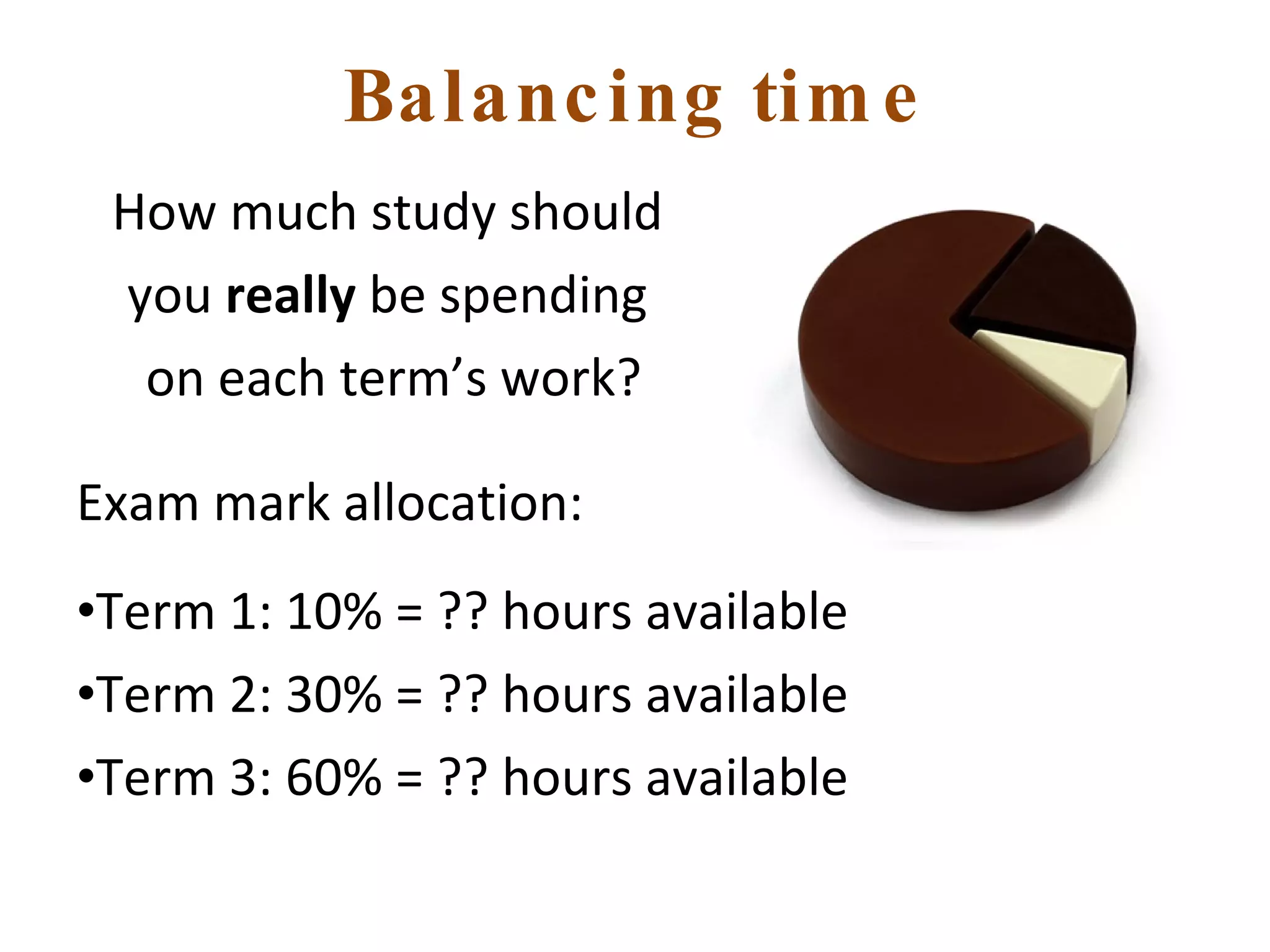
Balancing time How much study should  you  really  be spending  on each term’s work? Exam mark allocation: Term 1: 10% = ?? hours available Term 2: 30% = ?? hours available Term 3: 60% = ?? hours available
Study Guide Your teacher will now hand you your study guide for the exam. Read through it carefully.  Before we continue, give yourself a confidence grade out of 5 next to each point. 0 = I’ve never seen this  before in my life! 5 = I know this part  through and through!
Setting  realistic goals What grades have you been getting this year?  What grade do you believe you are capable of getting in the upcoming exam? What is going to help you achieve that goal?
How are you going to achieve them?
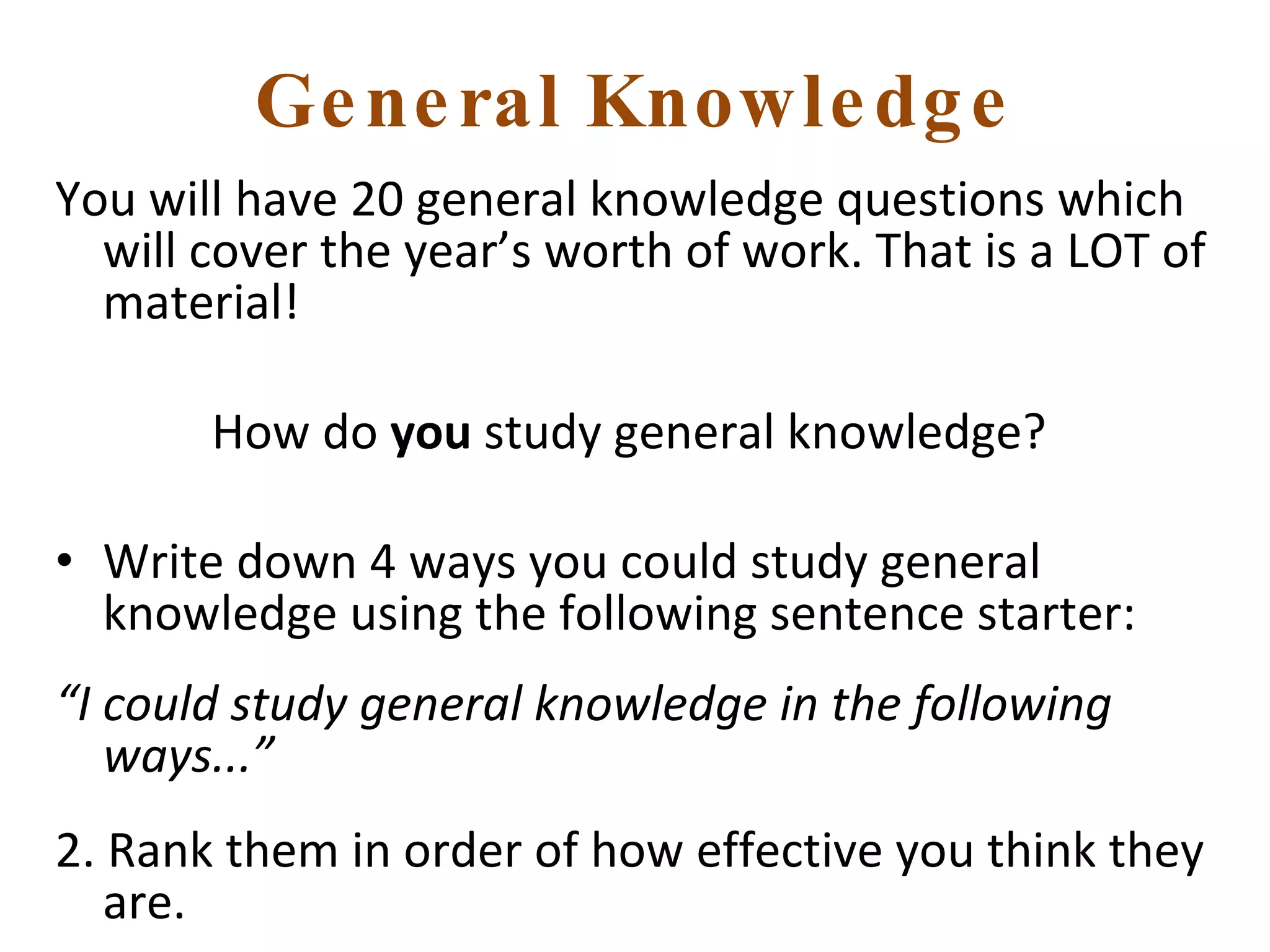
General Knowledge You will have 20 general knowledge questions which will cover the year’s worth of work. That is a LOT of material! How do  you  study general knowledge?  Write down 4 ways you could study general knowledge using the following sentence starter: “ I could study general knowledge in the following ways...” 2. Rank them in order of how effective you think they are.
Glossary Terms These are  very  important.  You will need to make sure you have a solid grasp of the key terms of the course.
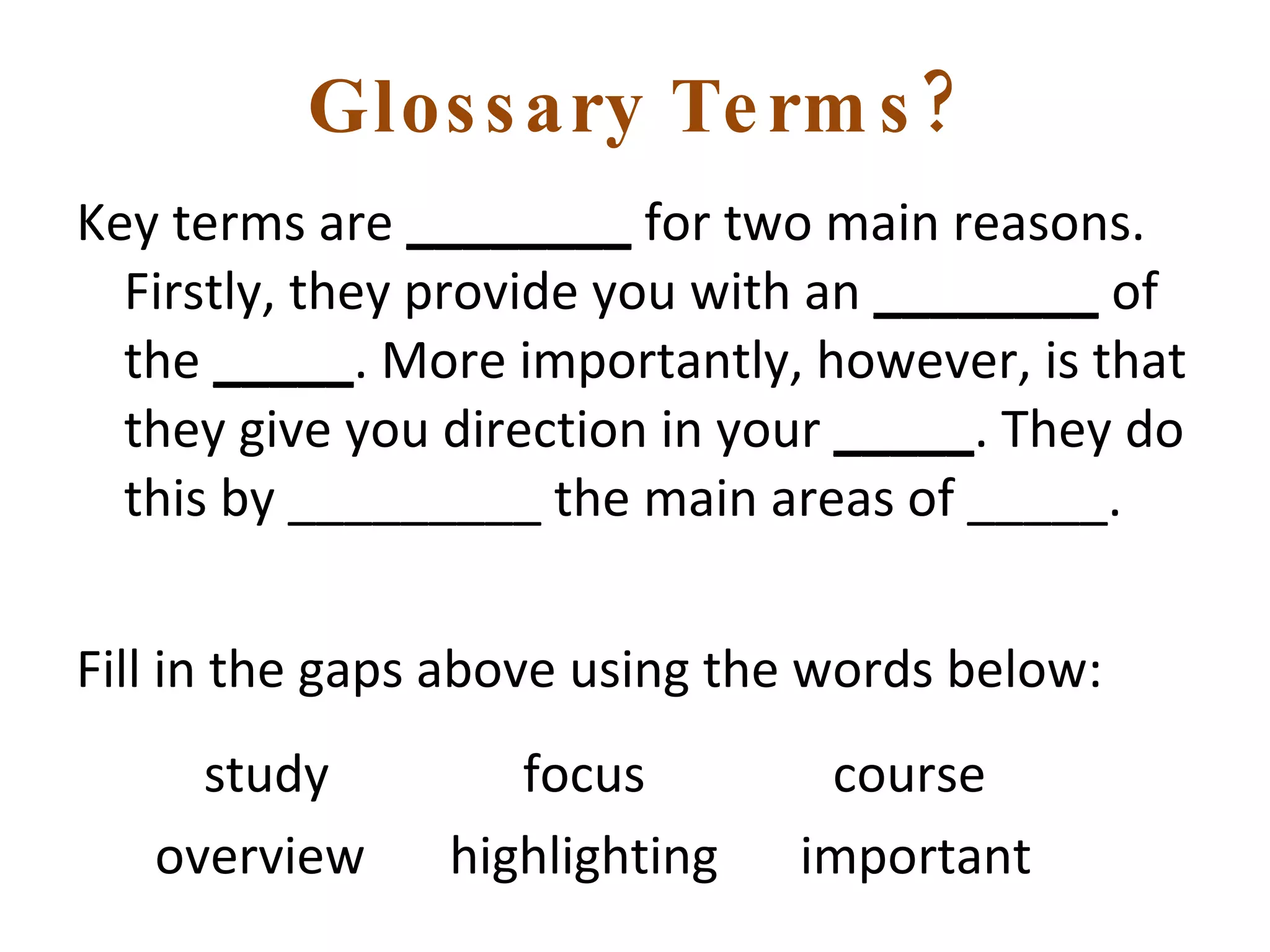
Glossary Terms? Key terms are  ________  for two main reasons. Firstly, they provide you with an  ________  of the  _____ . More importantly, however, is that they give you direction in your  _____ . They do this by _________ the main areas of _____. Fill in the gaps above using the words below:   study   focus  course overview  highlighting  important
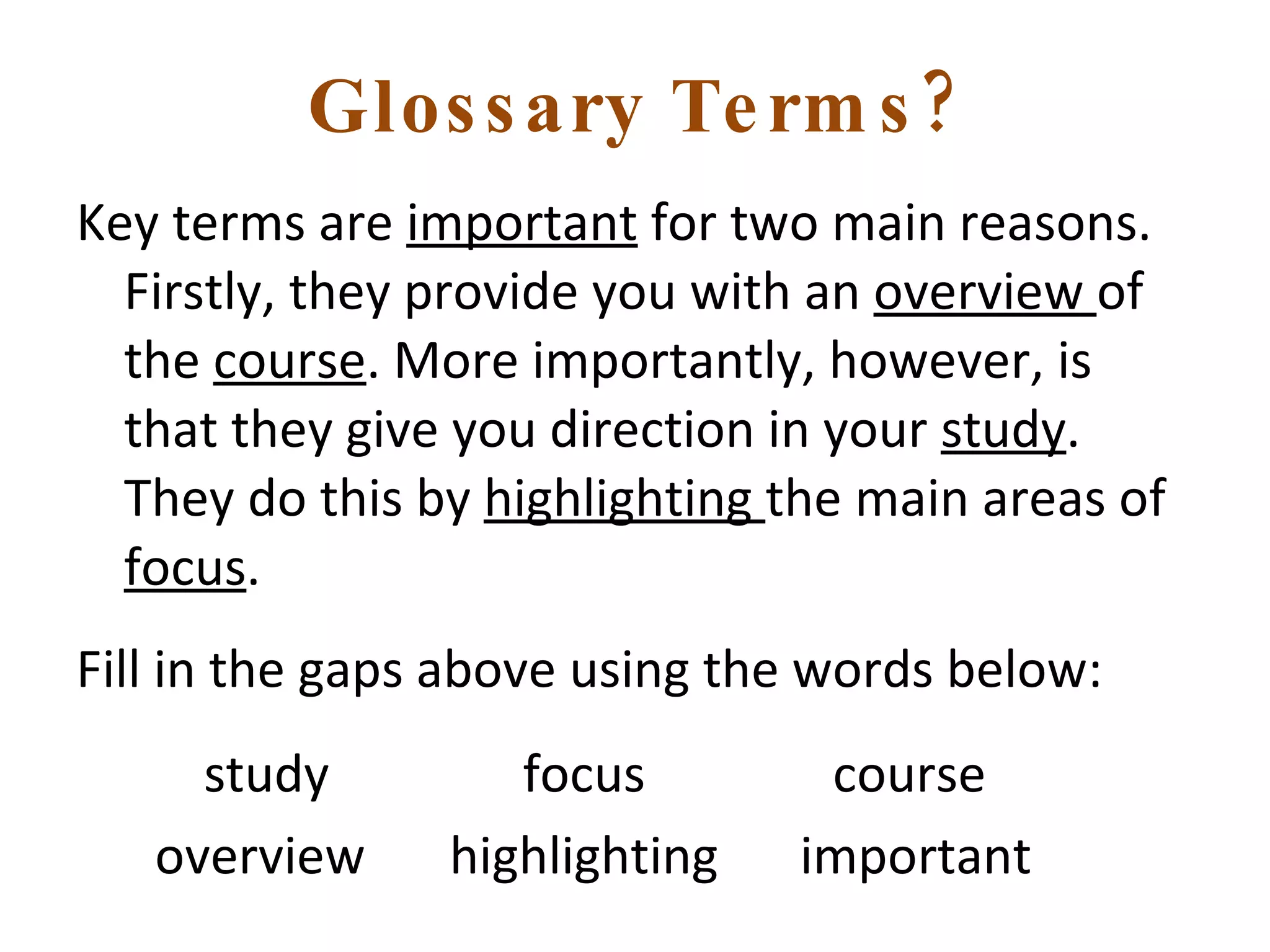
Glossary Terms? Key terms are  important  for two main reasons. Firstly, they provide you with an  overview  of the  course . More importantly, however, is that they give you direction in your  study . They do this by  highlighting  the main areas of  focus . Fill in the gaps above using the words below:   study   focus  course overview  highlighting  important
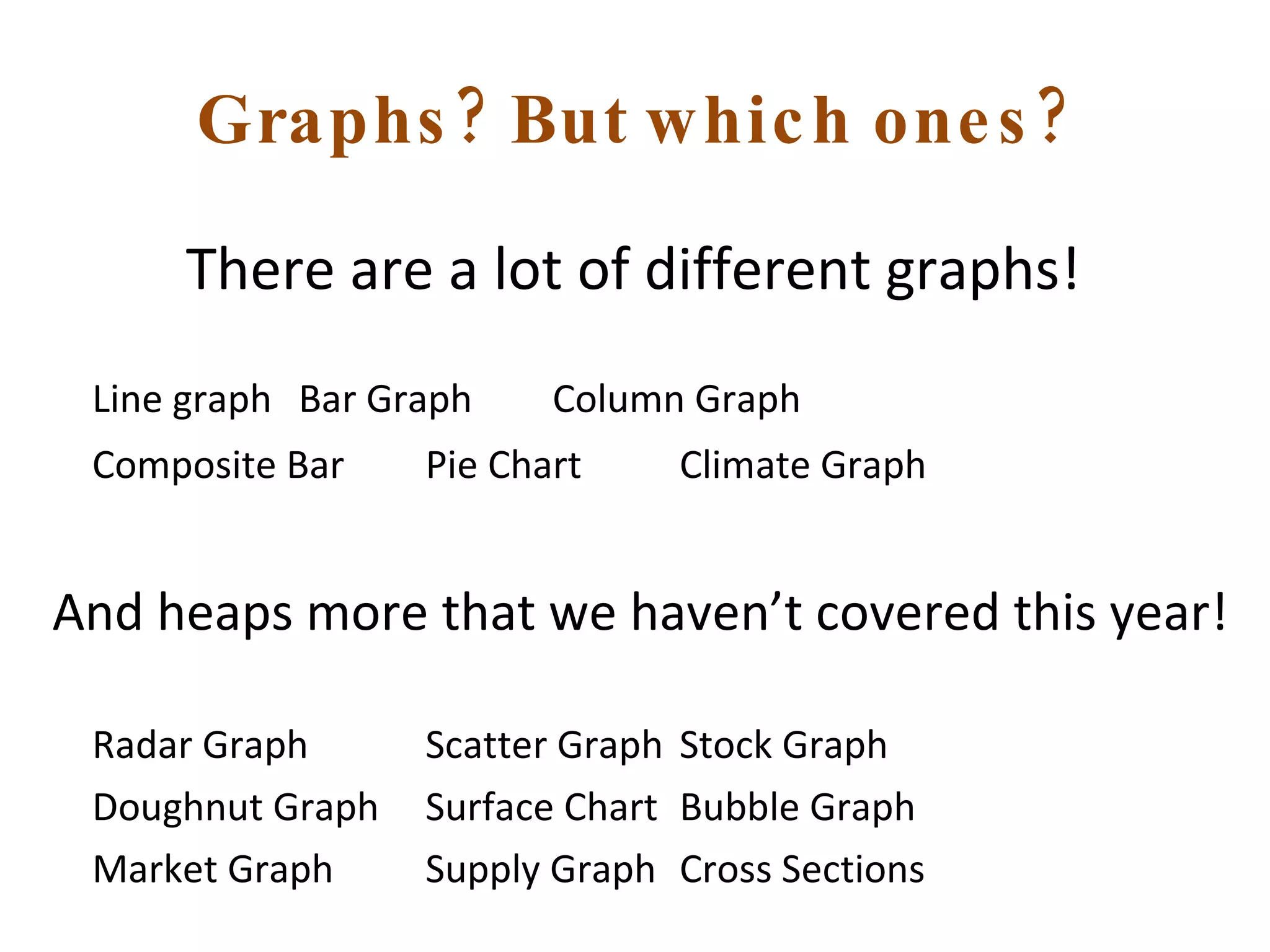
Graphs? But which ones? There are a lot of different graphs!  Line graph Bar Graph Column Graph Composite Bar Pie Chart Climate Graph And heaps more that we haven’t covered this year! Radar Graph Scatter Graph Stock Graph Doughnut Graph Surface Chart Bubble Graph Market Graph Supply Graph Cross Sections
How to practice graphing Pie Graphs Bar Graphs Column Graphs Line Graphs Climate Graphs Etc! How do you study graphs? Is there a better way?
FAME   F ind  A cronyms   for  M arking  E xcellence Come up with acronyms for the following marking schemes below: (A) 1. Axes  2. Lines  3. Title  4. Labels (B) 1. Title 2. Key 3. L to S 4. Accuracy How else could  you remember this?
Deeper Level Thinking Remember though, that it’s not just about how to complete the graphs but how to interpret them!  What do they  mean ?
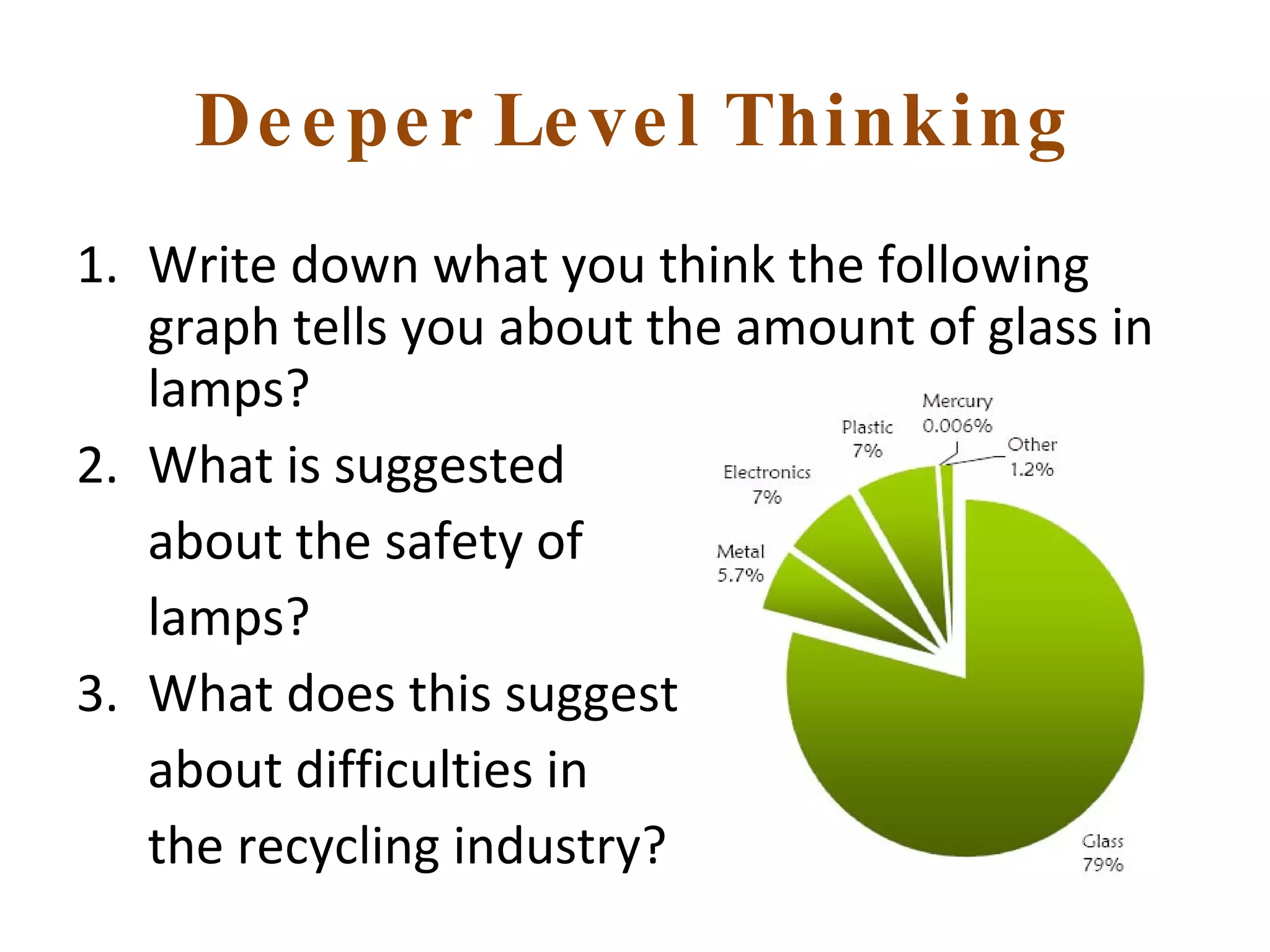
Deeper Level Thinking Write down what you think the following graph tells you about the amount of glass in lamps? What is suggested  about the safety of  lamps?  3.  What does this suggest  about difficulties in  the recycling industry?
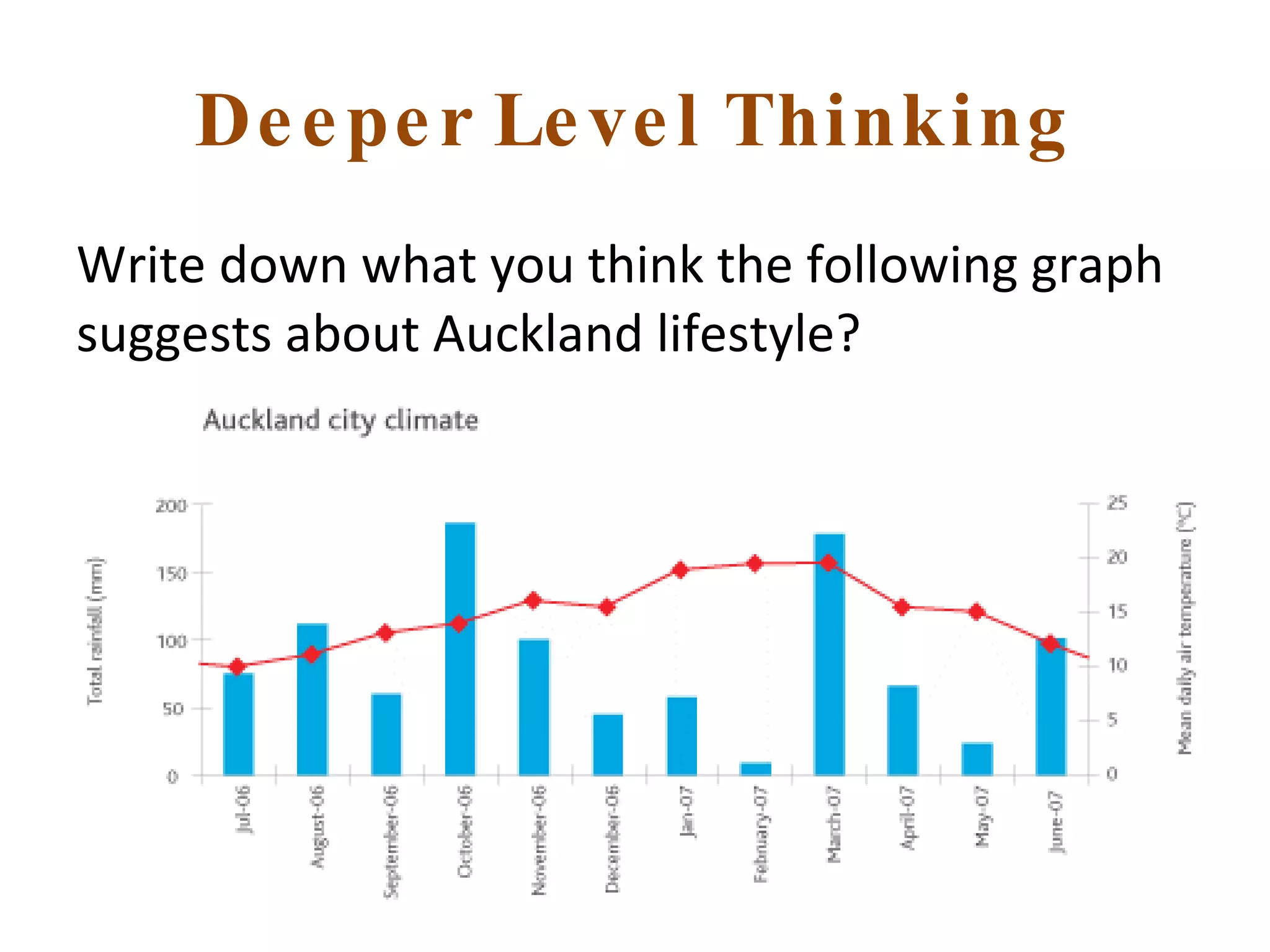
Deeper Level Thinking Write down what you think the following graph suggests about Auckland lifestyle?
Mapping Skills What do you do to remember  the places on Maps? On a fresh sheet of paper,  try to sketch the outline  of a map you need to know. 2.  Can you remember any of the bordering countries? 3.  Can you remember any geographical features?
Timelines A timeline is a useful tool to work out the relationship between events. This is not simply to put them in date order but to discover how the events may have influenced each other. How might the following events have influenced each other: 1. Monday – new school rule that all students must wear a hat. 2. Thursday – a student gets told off by his parents for breaking a school rule.
Timelines A timeline is a useful tool to work out the relationship between events. This is not simply to put them in date order but to discover how the events may have influenced each other. How might the following events have influenced each other: 1. 2009 – income tax is lowered by the government. 2. 2010 – your parents buy a new business.
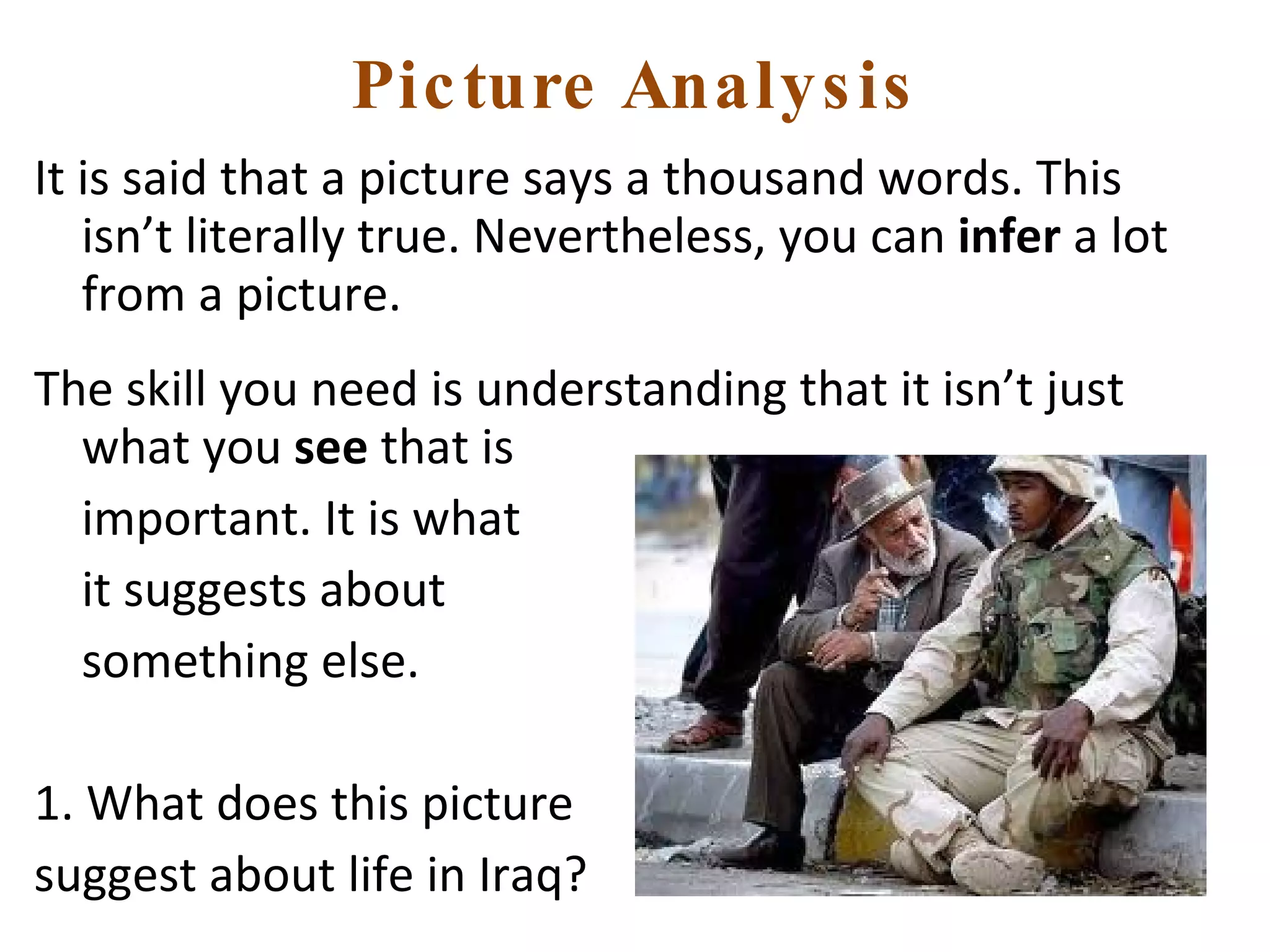
Picture Analysis It is said that a picture says a thousand words. This isn’t literally true. Nevertheless, you can  infer  a lot from a picture. The skill you need is understanding that it isn’t just what you  see  that is  important. It is what  it suggests about  something else. 1. What does this picture  suggest about life in Iraq?
Paragraph and Essay Structure How to study for this one?  Unfortunately this is not as simple as memorising an acronym (although PEE will help you out a lot!) Chose a topic you want to argue about (such as a preference): Is Playstation better than Xbox 360? Is Humanities really that important for life? Then start practicing your paragraphing using the acronym you memorised.  Remember: you don’t get your marks for the structure. The structure helps you focus on the  argument  rather than just  giving your opinion.
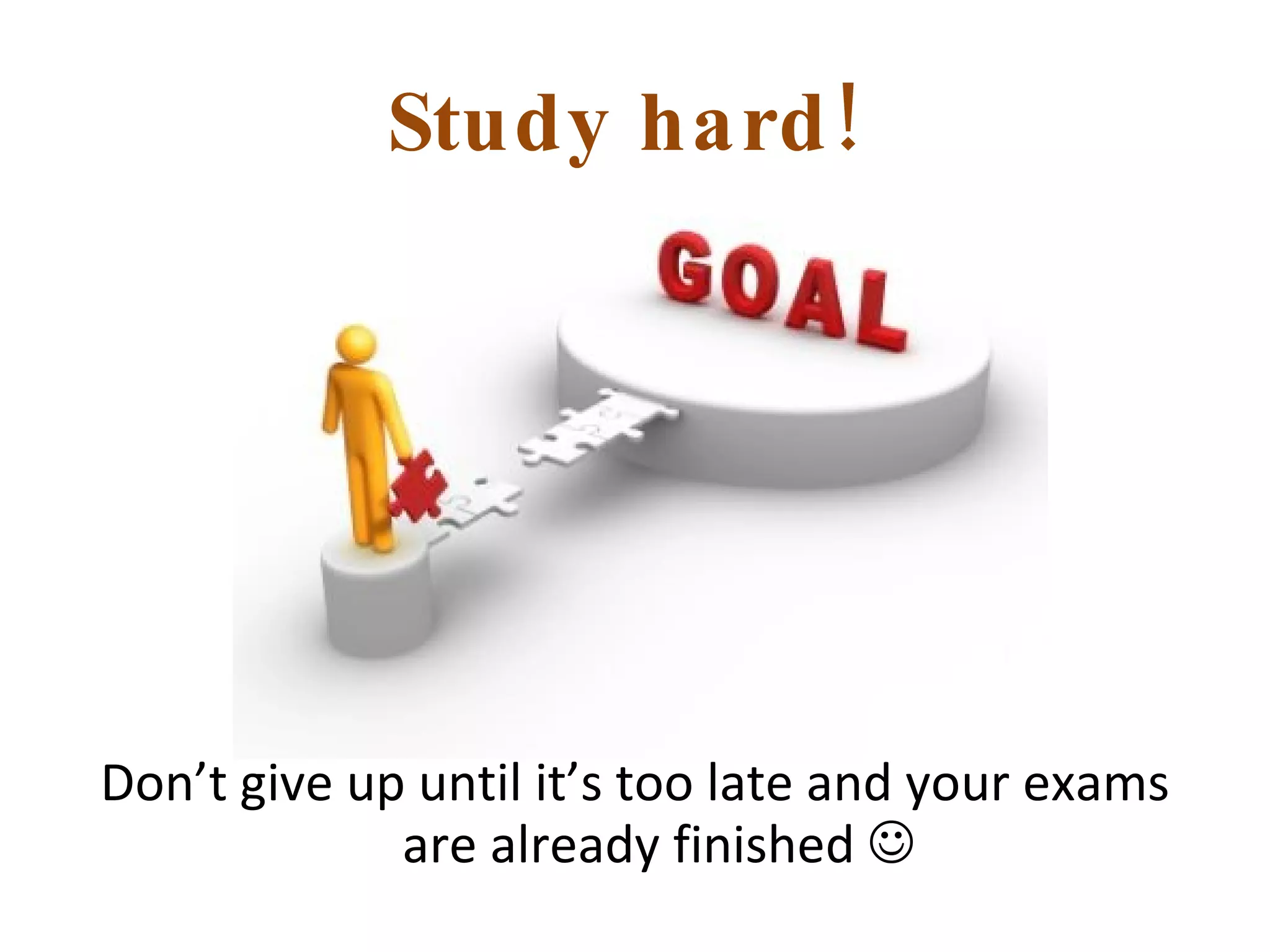
Study hard!  Don’t give up until it’s too late and your exams are already finished  

Preparation for Exams

  • 1.
    Overview of examand revision Lesson Aims: 1. To identify crucial elements of the upcoming examination. 2. To prepare effectively for examinations. Key words: Preparation Study techniques Do now: Write down three ways in which you prepare for exams.
  • 2.
    Complications? Complete thefollowing calculation: X Divide the answer above by how many main subjects you have. Divide that answer by 30 (the amount of weeks you’ve been taught examinable material) What do you have left? days till exams average time available for study per day
  • 3.
    Balancing time Howmuch study should you really be spending on each term’s work? Exam mark allocation: Term 1: 10% = ?? hours available Term 2: 30% = ?? hours available Term 3: 60% = ?? hours available
  • 4.
    Study Guide Yourteacher will now hand you your study guide for the exam. Read through it carefully. Before we continue, give yourself a confidence grade out of 5 next to each point. 0 = I’ve never seen this before in my life! 5 = I know this part through and through!
  • 5.
    Setting realisticgoals What grades have you been getting this year? What grade do you believe you are capable of getting in the upcoming exam? What is going to help you achieve that goal?
  • 6.
    How are yougoing to achieve them?
  • 7.
    General Knowledge Youwill have 20 general knowledge questions which will cover the year’s worth of work. That is a LOT of material! How do you study general knowledge? Write down 4 ways you could study general knowledge using the following sentence starter: “ I could study general knowledge in the following ways...” 2. Rank them in order of how effective you think they are.
  • 8.
    Glossary Terms Theseare very important. You will need to make sure you have a solid grasp of the key terms of the course.
  • 9.
    Glossary Terms? Keyterms are ________ for two main reasons. Firstly, they provide you with an ________ of the _____ . More importantly, however, is that they give you direction in your _____ . They do this by _________ the main areas of _____. Fill in the gaps above using the words below: study focus course overview highlighting important
  • 10.
    Glossary Terms? Keyterms are important for two main reasons. Firstly, they provide you with an overview of the course . More importantly, however, is that they give you direction in your study . They do this by highlighting the main areas of focus . Fill in the gaps above using the words below: study focus course overview highlighting important
  • 11.
    Graphs? But whichones? There are a lot of different graphs! Line graph Bar Graph Column Graph Composite Bar Pie Chart Climate Graph And heaps more that we haven’t covered this year! Radar Graph Scatter Graph Stock Graph Doughnut Graph Surface Chart Bubble Graph Market Graph Supply Graph Cross Sections
  • 12.
    How to practicegraphing Pie Graphs Bar Graphs Column Graphs Line Graphs Climate Graphs Etc! How do you study graphs? Is there a better way?
  • 13.
    FAME F ind A cronyms for M arking E xcellence Come up with acronyms for the following marking schemes below: (A) 1. Axes 2. Lines 3. Title 4. Labels (B) 1. Title 2. Key 3. L to S 4. Accuracy How else could you remember this?
  • 14.
    Deeper Level ThinkingRemember though, that it’s not just about how to complete the graphs but how to interpret them! What do they mean ?
  • 15.
    Deeper Level ThinkingWrite down what you think the following graph tells you about the amount of glass in lamps? What is suggested about the safety of lamps? 3. What does this suggest about difficulties in the recycling industry?
  • 16.
    Deeper Level ThinkingWrite down what you think the following graph suggests about Auckland lifestyle?
  • 17.
    Mapping Skills Whatdo you do to remember the places on Maps? On a fresh sheet of paper, try to sketch the outline of a map you need to know. 2. Can you remember any of the bordering countries? 3. Can you remember any geographical features?
  • 18.
    Timelines A timelineis a useful tool to work out the relationship between events. This is not simply to put them in date order but to discover how the events may have influenced each other. How might the following events have influenced each other: 1. Monday – new school rule that all students must wear a hat. 2. Thursday – a student gets told off by his parents for breaking a school rule.
  • 19.
    Timelines A timelineis a useful tool to work out the relationship between events. This is not simply to put them in date order but to discover how the events may have influenced each other. How might the following events have influenced each other: 1. 2009 – income tax is lowered by the government. 2. 2010 – your parents buy a new business.
  • 20.
    Picture Analysis Itis said that a picture says a thousand words. This isn’t literally true. Nevertheless, you can infer a lot from a picture. The skill you need is understanding that it isn’t just what you see that is important. It is what it suggests about something else. 1. What does this picture suggest about life in Iraq?
  • 21.
    Paragraph and EssayStructure How to study for this one? Unfortunately this is not as simple as memorising an acronym (although PEE will help you out a lot!) Chose a topic you want to argue about (such as a preference): Is Playstation better than Xbox 360? Is Humanities really that important for life? Then start practicing your paragraphing using the acronym you memorised. Remember: you don’t get your marks for the structure. The structure helps you focus on the argument rather than just giving your opinion.
  • 22.
    Study hard! Don’t give up until it’s too late and your exams are already finished 