ECB2212-Digital Electronics
Numbering Systems
Ms.K.Indra Gandhi
Asst Prof (Sr.Gr) /ECE
Digital System Design
Multiplexers and Demultiplexers,
and
Encoders and Decoders
3
Multiplexers
4
Multiplexers

A multiplexer has
 N control inputs
 2N
data inputs
 1 output

A multiplexer routes (or connects) the selected
data input to the output.
 The value of the control inputs determines the
data input that is selected.
5
Multiplexers
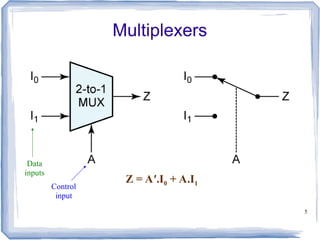
Z = A′.I0 + A.I1
Data
inputs
Control
input
6
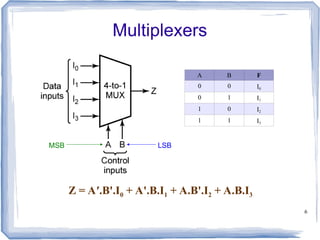
Multiplexers
Z = A′.B'.I0 + A'.B.I1 + A.B'.I2 + A.B.I3
A B F
0 0 I0
0 1 I1
1 0 I2
1 1 I3
MSB LSB
7
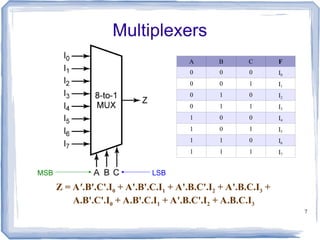
Multiplexers
Z = A′.B'.C'.I0 + A'.B'.C.I1 + A'.B.C'.I2 + A'.B.C.I3 +
A.B'.C'.I0 + A.B'.C.I1 + A'.B.C'.I2 + A.B.C.I3
MSB LSB
A B C F
0 0 0 I0
0 0 1 I1
0 1 0 I2
0 1 1 I3
1 0 0 I4
1 0 1 I5
1 1 0 I6
1 1 1 I7
Fall 2010 ECE 331 - Digital System Design 8
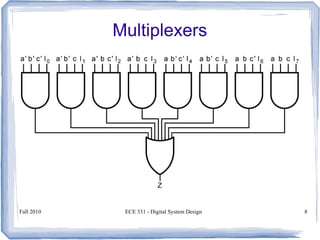
Multiplexers
9
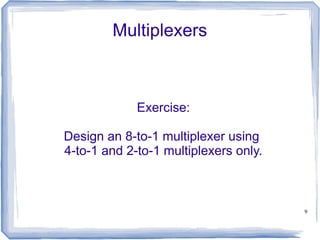
Multiplexers
Exercise:
Design an 8-to-1 multiplexer using
4-to-1 and 2-to-1 multiplexers only.
10
Multiplexers
Exercise:
Design a 16-to-1 multiplexer using
4-to-1 multiplexers only.
Fall 2010 ECE 331 - Digital System Design 11
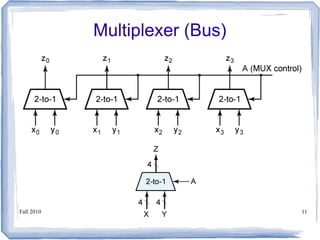
Multiplexer (Bus)
12
Demultiplexers
13
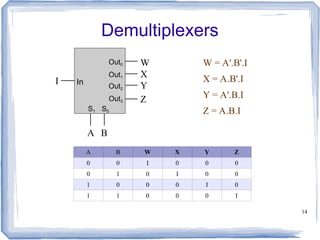
Demultiplexers

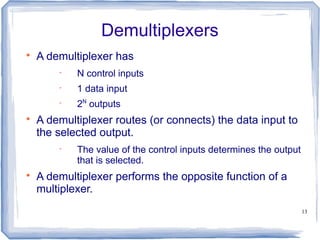
A demultiplexer has
 N control inputs
 1 data input
 2N
outputs

A demultiplexer routes (or connects) the data input to
the selected output.
 The value of the control inputs determines the output
that is selected.

A demultiplexer performs the opposite function of a
multiplexer.
14
Demultiplexers
A B W X Y Z
0 0 I 0 0 0
0 1 0 I 0 0
1 0 0 0 I 0
1 1 0 0 0 I
W = A'.B'.I
X = A.B'.I
Y = A'.B.I
Z = A.B.I
Out0
In
S1 S0
I
W
X
Y
Z
A B
Out1
Out2
Out3
15
Decoders
16
Decoders

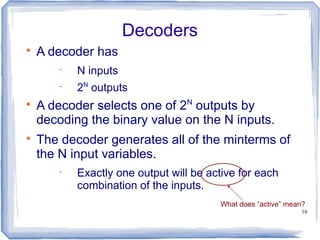
A decoder has
 N inputs
 2N
outputs

A decoder selects one of 2N
outputs by
decoding the binary value on the N inputs.

The decoder generates all of the minterms of
the N input variables.
 Exactly one output will be active for each
combination of the inputs.
What does “active” mean?
17
Decoders
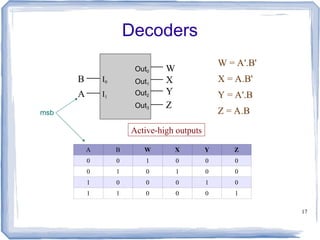
A B W X Y Z
0 0 1 0 0 0
0 1 0 1 0 0
1 0 0 0 1 0
1 1 0 0 0 1
Active-high outputs
B
W
X
Y
Z
I0
I1
A
Out0
Out1
Out2
Out3
W = A'.B'
X = A.B'
Y = A'.B
Z = A.B
msb
Fall 2010 ECE 331 - Digital System Design 18
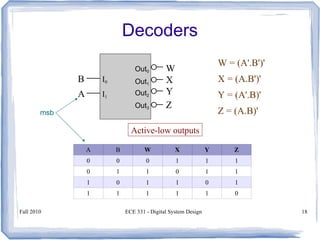
Decoders
A B W X Y Z
0 0 0 1 1 1
0 1 1 0 1 1
1 0 1 1 0 1
1 1 1 1 1 0
Active-low outputs
W = (A'.B')'
X = (A.B')'
Y = (A'.B)'
Z = (A.B)'
msb
B
W
X
Y
Z
I0
I1
A
Out0
Out1
Out2
Out3
19
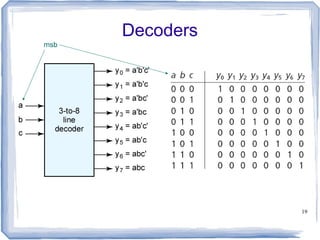
Decoders
msb
20
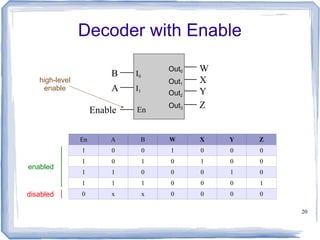
Decoder with Enable
En A B W X Y Z
1 0 0 1 0 0 0
1 0 1 0 1 0 0
1 1 0 0 0 1 0
1 1 1 0 0 0 1
0 x x 0 0 0 0
enabled
disabled
high-level
enable
Enable
B
W
X
Y
Z
I0
I1
A
Out0
Out1
Out2
Out3
En
21
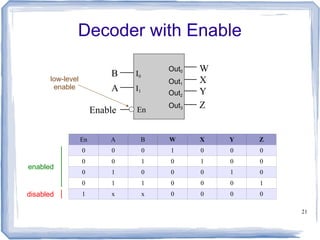
Decoder with Enable
En A B W X Y Z
0 0 0 1 0 0 0
0 0 1 0 1 0 0
0 1 0 0 0 1 0
0 1 1 0 0 0 1
1 x x 0 0 0 0
enabled
disabled
Enable
B
W
X
Y
Z
I0
I1
A
Out0
Out1
Out2
Out3
En
low-level
enable
22
Decoders
Exercise:
Design a 4-to-16 decoder using
2-to-4 decoders only.
23
Encoders
24
Encoders

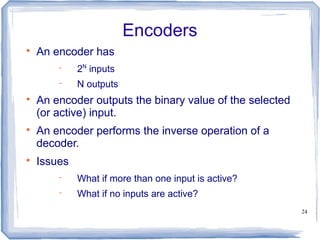
An encoder has
 2N
inputs
 N outputs

An encoder outputs the binary value of the selected
(or active) input.

An encoder performs the inverse operation of a
decoder.

Issues
 What if more than one input is active?
 What if no inputs are active?
25
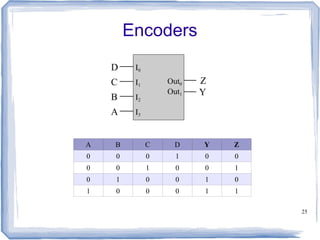
Encoders
A B C D Y Z
0 0 0 1 0 0
0 0 1 0 0 1
0 1 0 0 1 0
1 0 0 0 1 1
D
Z
Y
I0
I1
C
B I2
I3
A
Out0
Out1
26
Priority Encoders

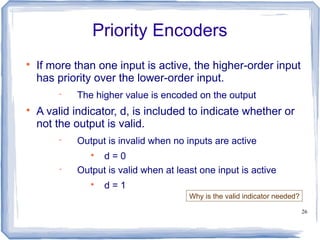
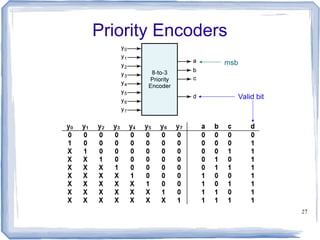
If more than one input is active, the higher-order input
has priority over the lower-order input.
 The higher value is encoded on the output

A valid indicator, d, is included to indicate whether or
not the output is valid.
 Output is invalid when no inputs are active

d = 0
 Output is valid when at least one input is active

d = 1
Why is the valid indicator needed?
27
Priority Encoders
Valid bit
msb
28
Designing logic circuits using multiplexers
29
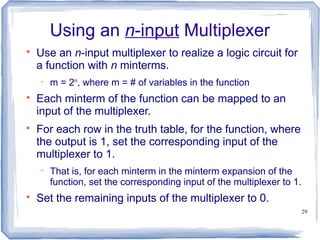
Using an n-input Multiplexer

Use an n-input multiplexer to realize a logic circuit for
a function with n minterms.
 m = 2n
, where m = # of variables in the function

Each minterm of the function can be mapped to an
input of the multiplexer.

For each row in the truth table, for the function, where
the output is 1, set the corresponding input of the
multiplexer to 1.
 That is, for each minterm in the minterm expansion of the
function, set the corresponding input of the multiplexer to 1.

Set the remaining inputs of the multiplexer to 0.
30
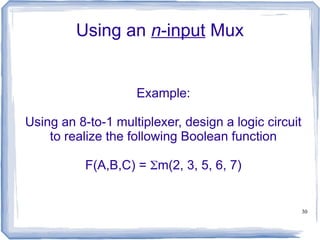
Using an n-input Mux
Example:
Using an 8-to-1 multiplexer, design a logic circuit
to realize the following Boolean function
F(A,B,C) = m(2, 3, 5, 6, 7)
31
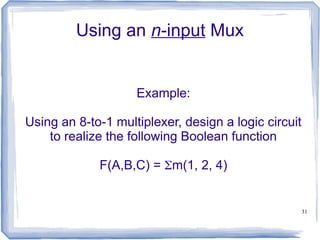
Using an n-input Mux
Example:
Using an 8-to-1 multiplexer, design a logic circuit
to realize the following Boolean function
F(A,B,C) = m(1, 2, 4)
32
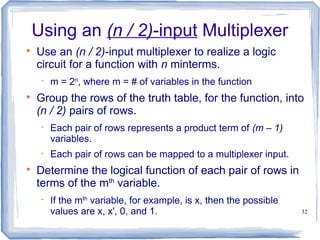
Using an (n / 2)-input Multiplexer

Use an (n / 2)-input multiplexer to realize a logic
circuit for a function with n minterms.
 m = 2n
, where m = # of variables in the function

Group the rows of the truth table, for the function, into
(n / 2) pairs of rows.
 Each pair of rows represents a product term of (m – 1)
variables.
 Each pair of rows can be mapped to a multiplexer input.

Determine the logical function of each pair of rows in
terms of the mth
variable.
 If the mth
variable, for example, is x, then the possible
values are x, x', 0, and 1.
33
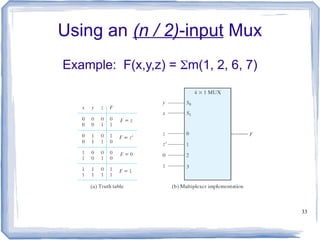
Using an (n / 2)-input Mux
Example: F(x,y,z) = m(1, 2, 6, 7)
34
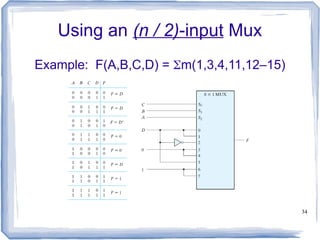
Using an (n / 2)-input Mux
Example: F(A,B,C,D) = m(1,3,4,11,12–15)
35
Using an (n / 4)-input Mux
The design of a logic circuit using an (n / 2)-input
multiplexer can be easily extended to the use of
an (n / 4)-input multiplexer.
36
Designing logic circuits using decoders
37
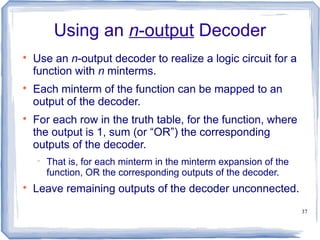
Using an n-output Decoder

Use an n-output decoder to realize a logic circuit for a
function with n minterms.

Each minterm of the function can be mapped to an
output of the decoder.

For each row in the truth table, for the function, where
the output is 1, sum (or “OR”) the corresponding
outputs of the decoder.
 That is, for each minterm in the minterm expansion of the
function, OR the corresponding outputs of the decoder.

Leave remaining outputs of the decoder unconnected.
38
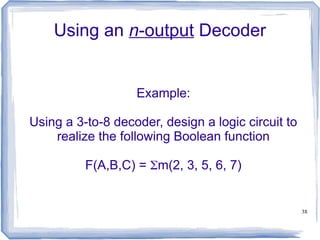
Using an n-output Decoder
Example:
Using a 3-to-8 decoder, design a logic circuit to
realize the following Boolean function
F(A,B,C) = m(2, 3, 5, 6, 7)
39
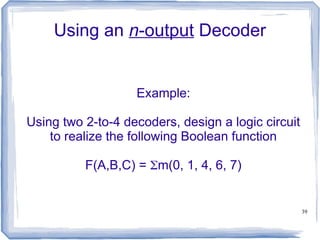
Using an n-output Decoder
Example:
Using two 2-to-4 decoders, design a logic circuit
to realize the following Boolean function
F(A,B,C) = m(0, 1, 4, 6, 7)
40
Questions?

Encoder-Decoder-Multiplexers-and-Demultiplexers.ppt

  • 1.
  • 2.
    Digital System Design Multiplexersand Demultiplexers, and Encoders and Decoders
  • 3.
  • 4.
    4 Multiplexers  A multiplexer has N control inputs  2N data inputs  1 output  A multiplexer routes (or connects) the selected data input to the output.  The value of the control inputs determines the data input that is selected.
  • 5.
    5 Multiplexers Z = A′.I0+ A.I1 Data inputs Control input
  • 6.
    6 Multiplexers Z = A′.B'.I0+ A'.B.I1 + A.B'.I2 + A.B.I3 A B F 0 0 I0 0 1 I1 1 0 I2 1 1 I3 MSB LSB
  • 7.
    7 Multiplexers Z = A′.B'.C'.I0+ A'.B'.C.I1 + A'.B.C'.I2 + A'.B.C.I3 + A.B'.C'.I0 + A.B'.C.I1 + A'.B.C'.I2 + A.B.C.I3 MSB LSB A B C F 0 0 0 I0 0 0 1 I1 0 1 0 I2 0 1 1 I3 1 0 0 I4 1 0 1 I5 1 1 0 I6 1 1 1 I7
  • 8.
    Fall 2010 ECE331 - Digital System Design 8 Multiplexers
  • 9.
    9 Multiplexers Exercise: Design an 8-to-1multiplexer using 4-to-1 and 2-to-1 multiplexers only.
  • 10.
    10 Multiplexers Exercise: Design a 16-to-1multiplexer using 4-to-1 multiplexers only.
  • 11.
    Fall 2010 ECE331 - Digital System Design 11 Multiplexer (Bus)
  • 12.
  • 13.
    13 Demultiplexers  A demultiplexer has N control inputs  1 data input  2N outputs  A demultiplexer routes (or connects) the data input to the selected output.  The value of the control inputs determines the output that is selected.  A demultiplexer performs the opposite function of a multiplexer.
  • 14.
    14 Demultiplexers A B WX Y Z 0 0 I 0 0 0 0 1 0 I 0 0 1 0 0 0 I 0 1 1 0 0 0 I W = A'.B'.I X = A.B'.I Y = A'.B.I Z = A.B.I Out0 In S1 S0 I W X Y Z A B Out1 Out2 Out3
  • 15.
  • 16.
    16 Decoders  A decoder has N inputs  2N outputs  A decoder selects one of 2N outputs by decoding the binary value on the N inputs.  The decoder generates all of the minterms of the N input variables.  Exactly one output will be active for each combination of the inputs. What does “active” mean?
  • 17.
    17 Decoders A B WX Y Z 0 0 1 0 0 0 0 1 0 1 0 0 1 0 0 0 1 0 1 1 0 0 0 1 Active-high outputs B W X Y Z I0 I1 A Out0 Out1 Out2 Out3 W = A'.B' X = A.B' Y = A'.B Z = A.B msb
  • 18.
    Fall 2010 ECE331 - Digital System Design 18 Decoders A B W X Y Z 0 0 0 1 1 1 0 1 1 0 1 1 1 0 1 1 0 1 1 1 1 1 1 0 Active-low outputs W = (A'.B')' X = (A.B')' Y = (A'.B)' Z = (A.B)' msb B W X Y Z I0 I1 A Out0 Out1 Out2 Out3
  • 19.
  • 20.
    20 Decoder with Enable EnA B W X Y Z 1 0 0 1 0 0 0 1 0 1 0 1 0 0 1 1 0 0 0 1 0 1 1 1 0 0 0 1 0 x x 0 0 0 0 enabled disabled high-level enable Enable B W X Y Z I0 I1 A Out0 Out1 Out2 Out3 En
  • 21.
    21 Decoder with Enable EnA B W X Y Z 0 0 0 1 0 0 0 0 0 1 0 1 0 0 0 1 0 0 0 1 0 0 1 1 0 0 0 1 1 x x 0 0 0 0 enabled disabled Enable B W X Y Z I0 I1 A Out0 Out1 Out2 Out3 En low-level enable
  • 22.
    22 Decoders Exercise: Design a 4-to-16decoder using 2-to-4 decoders only.
  • 23.
  • 24.
    24 Encoders  An encoder has 2N inputs  N outputs  An encoder outputs the binary value of the selected (or active) input.  An encoder performs the inverse operation of a decoder.  Issues  What if more than one input is active?  What if no inputs are active?
  • 25.
    25 Encoders A B CD Y Z 0 0 0 1 0 0 0 0 1 0 0 1 0 1 0 0 1 0 1 0 0 0 1 1 D Z Y I0 I1 C B I2 I3 A Out0 Out1
  • 26.
    26 Priority Encoders  If morethan one input is active, the higher-order input has priority over the lower-order input.  The higher value is encoded on the output  A valid indicator, d, is included to indicate whether or not the output is valid.  Output is invalid when no inputs are active  d = 0  Output is valid when at least one input is active  d = 1 Why is the valid indicator needed?
  • 27.
  • 28.
    28 Designing logic circuitsusing multiplexers
  • 29.
    29 Using an n-inputMultiplexer  Use an n-input multiplexer to realize a logic circuit for a function with n minterms.  m = 2n , where m = # of variables in the function  Each minterm of the function can be mapped to an input of the multiplexer.  For each row in the truth table, for the function, where the output is 1, set the corresponding input of the multiplexer to 1.  That is, for each minterm in the minterm expansion of the function, set the corresponding input of the multiplexer to 1.  Set the remaining inputs of the multiplexer to 0.
  • 30.
    30 Using an n-inputMux Example: Using an 8-to-1 multiplexer, design a logic circuit to realize the following Boolean function F(A,B,C) = m(2, 3, 5, 6, 7)
  • 31.
    31 Using an n-inputMux Example: Using an 8-to-1 multiplexer, design a logic circuit to realize the following Boolean function F(A,B,C) = m(1, 2, 4)
  • 32.
    32 Using an (n/ 2)-input Multiplexer  Use an (n / 2)-input multiplexer to realize a logic circuit for a function with n minterms.  m = 2n , where m = # of variables in the function  Group the rows of the truth table, for the function, into (n / 2) pairs of rows.  Each pair of rows represents a product term of (m – 1) variables.  Each pair of rows can be mapped to a multiplexer input.  Determine the logical function of each pair of rows in terms of the mth variable.  If the mth variable, for example, is x, then the possible values are x, x', 0, and 1.
  • 33.
    33 Using an (n/ 2)-input Mux Example: F(x,y,z) = m(1, 2, 6, 7)
  • 34.
    34 Using an (n/ 2)-input Mux Example: F(A,B,C,D) = m(1,3,4,11,12–15)
  • 35.
    35 Using an (n/ 4)-input Mux The design of a logic circuit using an (n / 2)-input multiplexer can be easily extended to the use of an (n / 4)-input multiplexer.
  • 36.
  • 37.
    37 Using an n-outputDecoder  Use an n-output decoder to realize a logic circuit for a function with n minterms.  Each minterm of the function can be mapped to an output of the decoder.  For each row in the truth table, for the function, where the output is 1, sum (or “OR”) the corresponding outputs of the decoder.  That is, for each minterm in the minterm expansion of the function, OR the corresponding outputs of the decoder.  Leave remaining outputs of the decoder unconnected.
  • 38.
    38 Using an n-outputDecoder Example: Using a 3-to-8 decoder, design a logic circuit to realize the following Boolean function F(A,B,C) = m(2, 3, 5, 6, 7)
  • 39.
    39 Using an n-outputDecoder Example: Using two 2-to-4 decoders, design a logic circuit to realize the following Boolean function F(A,B,C) = m(0, 1, 4, 6, 7)
  • 40.