Lecture by
Dr. Jaya Goyal
Department of Mechanical Engineering
Pimpri Chinchwad College of Engineering
Unit 3
Introduction to Sensors
Fundamentals of Electromechanical Systems
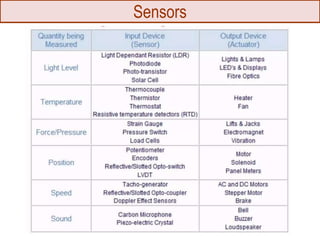
Sensors
Classification of Sensors
Based on the physical properties used in Sensing
• Position
Sensors
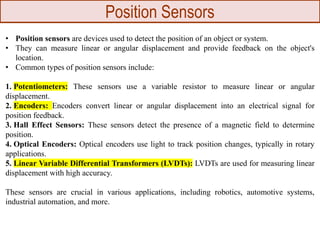
Position Sensors
• Position sensors are devices used to detect the position of an object or system.
• They can measure linear or angular displacement and provide feedback on the object's
location.
• Common types of position sensors include:
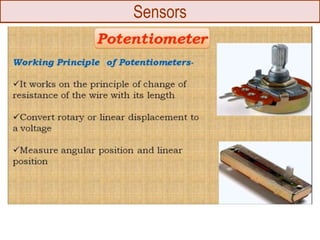
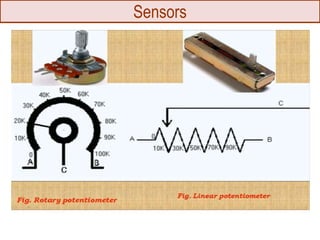
1. Potentiometers: These sensors use a variable resistor to measure linear or angular
displacement.
2. Encoders: Encoders convert linear or angular displacement into an electrical signal for
position feedback.
3. Hall Effect Sensors: These sensors detect the presence of a magnetic field to determine
position.
4. Optical Encoders: Optical encoders use light to track position changes, typically in rotary
applications.
5. Linear Variable Differential Transformers (LVDTs): LVDTs are used for measuring linear
displacement with high accuracy.
These sensors are crucial in various applications, including robotics, automotive systems,
industrial automation, and more.
Sensors
Sensors
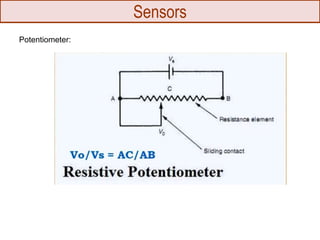
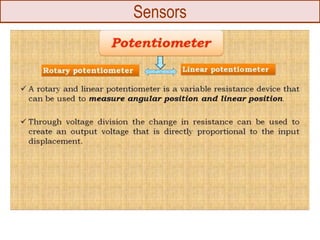
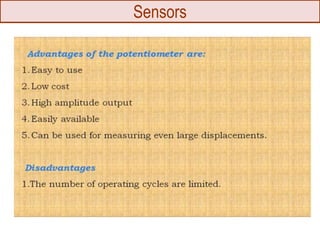
Potentiometer:
Sensors
Sensors
Sensors
LINEARV
ARIABLE DIFFERENTIAL TRANSDUCER (LVDT)
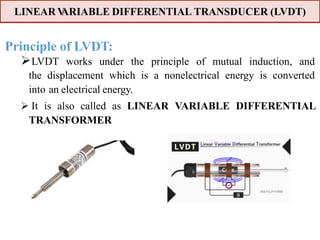
Principle of LVDT:
LVDT works under the principle of mutual induction, and
the displacement which is a nonelectrical energy is converted
into an electrical energy.
 It is also called as LINEAR VARIABLE DIFFERENTIAL
TRANSFORMER
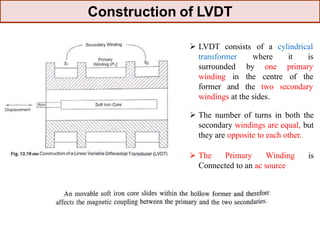
 LVDT consists of a cylindrical
transformer where it is
surrounded
winding
former
by one primary
in the centre of the
and the two secondary
windings at the sides.
 The number of turns in both the
secondary windings are equal, but
they are opposite to each other.
 The Primary Winding is
Connected to an ac source
Construction of LVDT
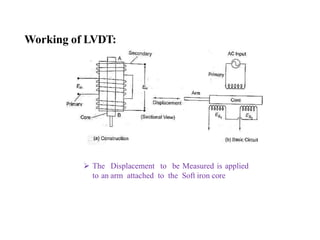
Working of LVDT:
 The Displacement to be Measured is applied
to an arm attached to the Soft iron core
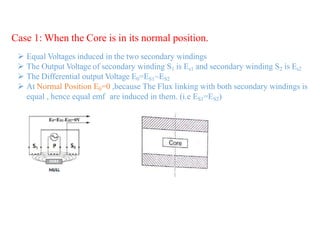
Case 1: When the Core is in its normal position.
 Equal Voltages induced in the two secondary windings
 The Output Voltage of secondary winding S1 is Es1 and secondary winding S2 is Es2
 The Differential output Voltage E0=ES1~ES2
 At Normal Position E0=0 ,because The Flux linking with both secondary windings is
equal , hence equal emf are induced in them. (i.e ES1=ES2)
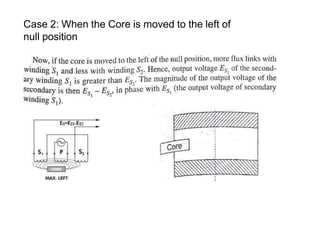
Case 2: When the Core is moved to the left of
null position
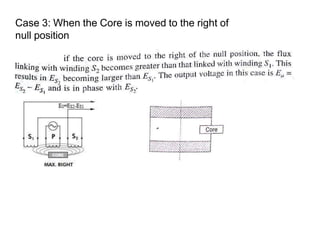
Case 3: When the Core is moved to the right of
null position
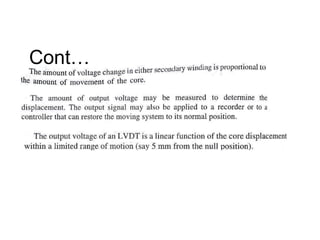
Cont…
Cont…
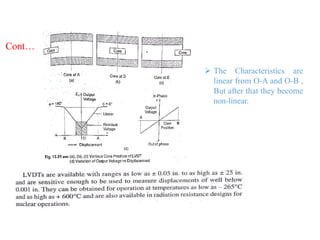
 The Characteristics are
linear from O-A and O-B ,
But after that they become
non-linear.
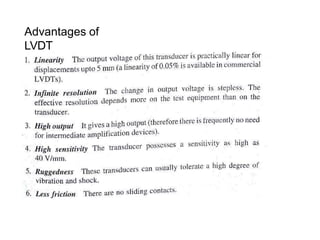
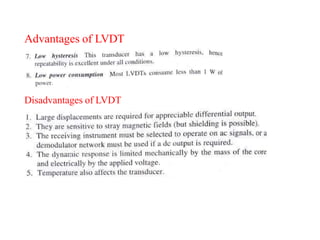
Advantages of
LVDT
Advantages of LVDT
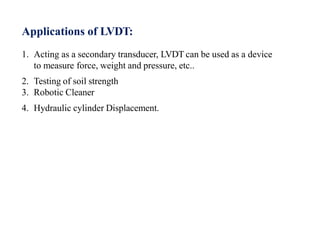
Disadvantages of LVDT
Applications of LVDT:
1. Acting as a secondary transducer, LVDT can be used as a device
to measure force, weight and pressure, etc..
2. Testing of soil strength
3. Robotic Cleaner
4. Hydraulic cylinder Displacement.
Sensors
Sensors
Sensors
Sensors
Sensors
Sensors
Sensors
Sensors
Sensors
Sensors
Sensors

Unit 3 _Sensors and applications un.pptx

  • 1.
    Lecture by Dr. JayaGoyal Department of Mechanical Engineering Pimpri Chinchwad College of Engineering Unit 3 Introduction to Sensors Fundamentals of Electromechanical Systems
  • 2.
  • 3.
    Classification of Sensors Basedon the physical properties used in Sensing • Position
  • 4.
  • 5.
    Position Sensors • Positionsensors are devices used to detect the position of an object or system. • They can measure linear or angular displacement and provide feedback on the object's location. • Common types of position sensors include: 1. Potentiometers: These sensors use a variable resistor to measure linear or angular displacement. 2. Encoders: Encoders convert linear or angular displacement into an electrical signal for position feedback. 3. Hall Effect Sensors: These sensors detect the presence of a magnetic field to determine position. 4. Optical Encoders: Optical encoders use light to track position changes, typically in rotary applications. 5. Linear Variable Differential Transformers (LVDTs): LVDTs are used for measuring linear displacement with high accuracy. These sensors are crucial in various applications, including robotics, automotive systems, industrial automation, and more.
  • 6.
  • 7.
  • 8.
  • 9.
  • 10.
  • 11.
    LINEARV ARIABLE DIFFERENTIAL TRANSDUCER(LVDT) Principle of LVDT: LVDT works under the principle of mutual induction, and the displacement which is a nonelectrical energy is converted into an electrical energy.  It is also called as LINEAR VARIABLE DIFFERENTIAL TRANSFORMER
  • 12.
     LVDT consistsof a cylindrical transformer where it is surrounded winding former by one primary in the centre of the and the two secondary windings at the sides.  The number of turns in both the secondary windings are equal, but they are opposite to each other.  The Primary Winding is Connected to an ac source Construction of LVDT
  • 13.
    Working of LVDT: The Displacement to be Measured is applied to an arm attached to the Soft iron core
  • 14.
    Case 1: Whenthe Core is in its normal position.  Equal Voltages induced in the two secondary windings  The Output Voltage of secondary winding S1 is Es1 and secondary winding S2 is Es2  The Differential output Voltage E0=ES1~ES2  At Normal Position E0=0 ,because The Flux linking with both secondary windings is equal , hence equal emf are induced in them. (i.e ES1=ES2)
  • 15.
    Case 2: Whenthe Core is moved to the left of null position
  • 16.
    Case 3: Whenthe Core is moved to the right of null position
  • 17.
  • 18.
    Cont…  The Characteristicsare linear from O-A and O-B , But after that they become non-linear.
  • 19.
  • 20.
  • 21.
    Applications of LVDT: 1.Acting as a secondary transducer, LVDT can be used as a device to measure force, weight and pressure, etc.. 2. Testing of soil strength 3. Robotic Cleaner 4. Hydraulic cylinder Displacement.
  • 22.
  • 23.
  • 24.
  • 25.
  • 26.
  • 27.
  • 28.
  • 29.
  • 30.
  • 31.
  • 32.