Download to read offline

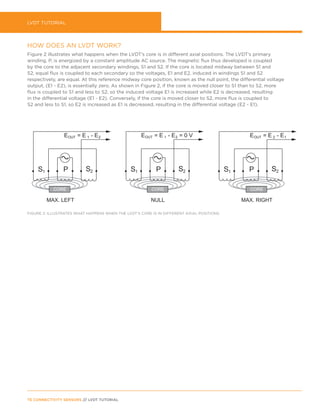

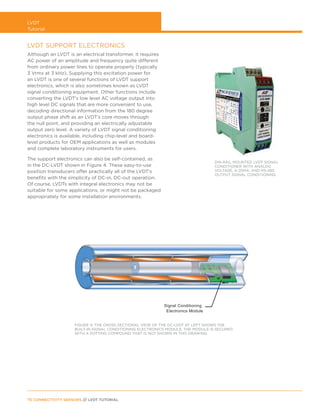


The document provides an overview of linear variable differential transformers (LVDTs), including what they are, how they work, their components, and why they are used. Specifically: - An LVDT is an electromechanical transducer that converts rectilinear motion into a corresponding electrical signal using a primary winding centered between two secondary windings on a coil. - It works by inducing different voltages in the secondary windings depending on the position of a movable magnetically permeable core, providing a differential output signal. - LVDTs offer frictionless, highly repeatable position measurement suitable for applications like subsea sensors due to their robustness, infinite resolution, unlimited mechanical life, and ability to withstand overtravel


