Unit 3 : Introduction to Consumer Behaviour
In Unit 1, you studied about the marketing concept that emphasized the importance of the cus-
tomer. Customer needs and wants should form the beginning of all product design and mar-
keting activities. For this it is essential for marketers to understand consumer behaviour. Ses-
sion I of this Unit highlights the importance of studying consumer behaviour and describes the
stages in the typical consumer decision making process. Session II describes the different types
of buyer behaviour and the participants in the purchase decision.
Session I
Meaning and Defining Consumer Behavior and its Scope
Meaning
Consumer behavior refers to all the processes related to why, how, when, from whom con-
sumers purchase and pay for a product and how they consume and dispose of it in order to
meet their needs.
Definition
“The process whereby individuals decide whether, what, when, where, how and from whom to
purchase goods and services.” …as defined by Professors Walter and Paul.
Scope
The scope of consumer behaviour is very broad. It starts from the point where a consumer ex-
periences a need which can be fulfilled by a product.
It includes the decisions and activities involved in the purchase of a specific product alternative.
It encompasses all the factors that influence the process of consumer need recognition, choice
of alternative and product consumption. These factors include cultural factors (e.g. food and
dress habits, customs and rituals),
social factors (e.g. family and friends),
personal factors (e.g. consumer age and occupation),
psychological factors (e.g. consumer personality, motives, attitudes etc.) and marketing activi-
ties.
It ends only after the consumer has used and disposed of the product.
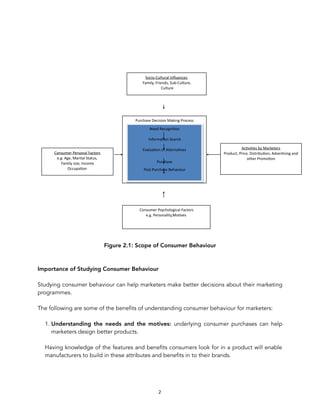
Figure 2.1 depicts an overview of the factors that influence consumer behaviour.
1
Figure 2.1: Scope of Consumer Behaviour
Importance of Studying Consumer Behaviour
Studying consumer behaviour can help marketers make better decisions about their marketing
programmes.
The following are some of the benefits of understanding consumer behaviour for marketers:
1. Understanding the needs and the motives: underlying consumer purchases can help
marketers design better products.
Having knowledge of the features and benefits consumers look for in a product will enable
manufacturers to build in these attributes and benefits in to their brands.
2
Socio-Cultural	Influences	
Family,	Friends,	Sub-Culture,	
	Culture
Purchase	Decision	Making	Process
Consumer	Personal	Factors	
e.g.	Age,	Marital	Status,	
Family	size,	Income	
OccupaFon
AcFviFes	by	Marketers	
Product,	Price,	DistribuFon,	AdverFsing	and	
other	PromoFon
Consumer	Psychological	Factors	
e.g.	Personality,MoFves
Need	RecogniFon	
InformaFon	Search	
EvaluaFon	of	AlternaFves	
Purchase	
Post	Purchase	Behaviour
For example for consumers who want a bathing soap that fights germs, manufacturers offer
brands such as Lifebuoy soap and Dettol soap. For consumers who are looking for a soap
which is gentle on the skin, manufacturers offer soaps such as Dove and Pears . Similarly for
the cost conscious car-owner there is the Maruti 800, Alto and other hatchback car models
such as the Hyundai Santro and Maruti Swift. On the other hand for customers looking for
luxury cars with more powerful engines, there are car models such as Toyota Corolla and
Honda Volkswagen Vento.
Product packaging is also influenced by the knowledge of consumer behaviour.
Several brands of shampoo have been able to add greatly to their sales by launching the Rs.
1 or Rs. 2 shampoo sachet after they realized that many cost conscious consumers want to
use quality products but are unwilling to spend a large amount at one time on shampoo
bottles.
2. Knowing when and where consumers buy products: enables marketers to make the prod-
uct available at the right place and time.
The key to the survival and success of many fast-moving consumer goods such as cold drinks,
bread, salt and soap is wide availability because marketers have understood that if a particular
brand is not available then consumers will easily take a substitute rather than go searching for a
specific brand.
On the other hand, for high-end luxury products limited distribution is possible and in fact adds
to the exclusive image of the brand. With the increase in internet penetration in India and
greater consumer confidence about purchasing online, many marketers are ensuring that their
products can be purchased through the online mode.
3. An understanding of the role that different individuals play in the purchase process : can
help design better promotional programmes such as advertisement and personal selling and
aim them at the right people.
For example the manufacturers of milk additives (such as Bournvita, Maltova and Horlicks) ad-
dress their advertising and sales promotion campaigns to both mothers and children, since the
former are the buyers of the product category and the latter are the users.
The yes pls attempt is to persuade the mothers by highlighting the nutritional value of the
product. while attracting children to the brand through good taste and associations with car-
toon characters and celebrities.
4. A knowledge of the sources of information that various consumers are exposed to or
use to know about the product: can help marketers ensure that information about the prod-
uct is available to their target consumer in the appropriate media.
3
Thus products for which the decision makers are women will be advertised in women’s maga-
zines or TV programmes watched by women. Expensive luxury watches will be advertised in
glossy magazines read by business executives.
5. Pricing decisions also need to be based on an understanding of consumer behaviour:
Pricing cannot be a mechanical process based only on cost of the product and desired profit
margin.
Pricing is a complex task and must also take in to account the value that consumers place on
the product as well as competitors offerings.
Mobile phone manufacturers such as Nokia, Samsung and Micromax have phones available at
various price points in India. These manufacturers want to cater to the customers who would
like a low-priced phone with the minimum features as well as the customers who want the lat-
est features and are willing to pay for them.
6. The study of consumer behavior takes us to the roots of “why a consumer has positive or
negative predisposition?”
7. Comprehending consumer needs, expectations and aspirations coupled with problems is a
must to exploit marketing opportunities and meeting the challenges beset along with the op-
portunities.
Summary : Thus, consumer behavior is the case of micro behavior as well as macro behavior.
CB encompasses all the efforts, explain all the acts of choice either at a given time or over a
period of time.
Major questions involved in CB :
What are the products they buy? >> Why they buy them ?
How they buy them ? >> When they buy them ?
Where they buy them ? >> How often they buy them ?
Who is important in the buying decisions?
Success Story : Procter and Gamble states : “ Our business is based on understanding the
consumer and providing the kind of products that the consumer wants. We place enormous
emphasis on our product development area and our marketing area, and on our people know-
ing the consumer.”
Why to study CB :
1) Buyer’s reactions to a firm’s marketing strategy have great impact on the firm’s success.
4
2) The proof of establishing consumer orientation in the marketing concept of the firm
depends on how marketing mix is developed to include positive answers to the ques-
tions listed above.
3) By gaining a better understanding of the factors that affect buyer behavior, marketers
are in a better position to predict how consumers will respond to marketing strategies.
4) CB helps in selection and segmentation of the target markets.
5) Devising an appropriate marketing strategy most relevant to the target market seg-
ment.
6) Evaluation of marketing programmes, strategies and tactics.
7) Assessing the trends of change and preparing marketing plans to suit future changes.
8) Finally, a consumer is the principal – a priori of business.
Major contributors to the field of CB :
1) Howard-Sheth 2) Englel-Kollat-Blackwell and 3) Nicosia.
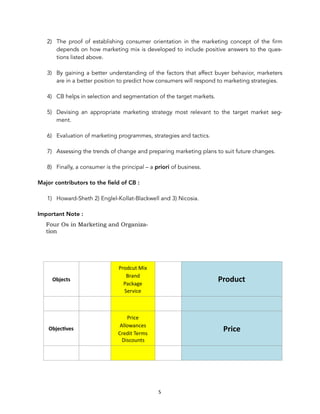
Important Note :
Four Os in Marketing and Organiza-
tion
Objects
Prodcut	Mix

Brand

Package

Service
Product
	 	 	 	
Objec.ves
Price

Allowances

Credit	Terms

Discounts
Price
	 	 	 	
5
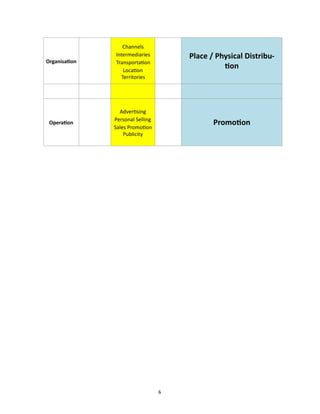
Organisa.on
Channels

Intermediaries

TransportaFon

LocaFon

Territories
Place	/	Physical	Distribu-
.on
	 	 	 	
Opera.on
AdverFsing

Personal	Selling

Sales	PromoFon

Publicity
Promo.on
6

Unit 3 consumer behaviour (for sa1 ) - Class 11 - CBSE - 2016/17

  • 1.
    Unit 3 :Introduction to Consumer Behaviour In Unit 1, you studied about the marketing concept that emphasized the importance of the cus- tomer. Customer needs and wants should form the beginning of all product design and mar- keting activities. For this it is essential for marketers to understand consumer behaviour. Ses- sion I of this Unit highlights the importance of studying consumer behaviour and describes the stages in the typical consumer decision making process. Session II describes the different types of buyer behaviour and the participants in the purchase decision. Session I Meaning and Defining Consumer Behavior and its Scope Meaning Consumer behavior refers to all the processes related to why, how, when, from whom con- sumers purchase and pay for a product and how they consume and dispose of it in order to meet their needs. Definition “The process whereby individuals decide whether, what, when, where, how and from whom to purchase goods and services.” …as defined by Professors Walter and Paul. Scope The scope of consumer behaviour is very broad. It starts from the point where a consumer ex- periences a need which can be fulfilled by a product. It includes the decisions and activities involved in the purchase of a specific product alternative. It encompasses all the factors that influence the process of consumer need recognition, choice of alternative and product consumption. These factors include cultural factors (e.g. food and dress habits, customs and rituals), social factors (e.g. family and friends), personal factors (e.g. consumer age and occupation), psychological factors (e.g. consumer personality, motives, attitudes etc.) and marketing activi- ties. It ends only after the consumer has used and disposed of the product. Figure 2.1 depicts an overview of the factors that influence consumer behaviour. 1
  • 2.
    Figure 2.1: Scopeof Consumer Behaviour Importance of Studying Consumer Behaviour Studying consumer behaviour can help marketers make better decisions about their marketing programmes. The following are some of the benefits of understanding consumer behaviour for marketers: 1. Understanding the needs and the motives: underlying consumer purchases can help marketers design better products. Having knowledge of the features and benefits consumers look for in a product will enable manufacturers to build in these attributes and benefits in to their brands. 2 Socio-Cultural Influences Family, Friends, Sub-Culture, Culture Purchase Decision Making Process Consumer Personal Factors e.g. Age, Marital Status, Family size, Income OccupaFon AcFviFes by Marketers Product, Price, DistribuFon, AdverFsing and other PromoFon Consumer Psychological Factors e.g. Personality,MoFves Need RecogniFon InformaFon Search EvaluaFon of AlternaFves Purchase Post Purchase Behaviour
  • 3.
    For example forconsumers who want a bathing soap that fights germs, manufacturers offer brands such as Lifebuoy soap and Dettol soap. For consumers who are looking for a soap which is gentle on the skin, manufacturers offer soaps such as Dove and Pears . Similarly for the cost conscious car-owner there is the Maruti 800, Alto and other hatchback car models such as the Hyundai Santro and Maruti Swift. On the other hand for customers looking for luxury cars with more powerful engines, there are car models such as Toyota Corolla and Honda Volkswagen Vento. Product packaging is also influenced by the knowledge of consumer behaviour. Several brands of shampoo have been able to add greatly to their sales by launching the Rs. 1 or Rs. 2 shampoo sachet after they realized that many cost conscious consumers want to use quality products but are unwilling to spend a large amount at one time on shampoo bottles. 2. Knowing when and where consumers buy products: enables marketers to make the prod- uct available at the right place and time. The key to the survival and success of many fast-moving consumer goods such as cold drinks, bread, salt and soap is wide availability because marketers have understood that if a particular brand is not available then consumers will easily take a substitute rather than go searching for a specific brand. On the other hand, for high-end luxury products limited distribution is possible and in fact adds to the exclusive image of the brand. With the increase in internet penetration in India and greater consumer confidence about purchasing online, many marketers are ensuring that their products can be purchased through the online mode. 3. An understanding of the role that different individuals play in the purchase process : can help design better promotional programmes such as advertisement and personal selling and aim them at the right people. For example the manufacturers of milk additives (such as Bournvita, Maltova and Horlicks) ad- dress their advertising and sales promotion campaigns to both mothers and children, since the former are the buyers of the product category and the latter are the users. The yes pls attempt is to persuade the mothers by highlighting the nutritional value of the product. while attracting children to the brand through good taste and associations with car- toon characters and celebrities. 4. A knowledge of the sources of information that various consumers are exposed to or use to know about the product: can help marketers ensure that information about the prod- uct is available to their target consumer in the appropriate media. 3
  • 4.
    Thus products forwhich the decision makers are women will be advertised in women’s maga- zines or TV programmes watched by women. Expensive luxury watches will be advertised in glossy magazines read by business executives. 5. Pricing decisions also need to be based on an understanding of consumer behaviour: Pricing cannot be a mechanical process based only on cost of the product and desired profit margin. Pricing is a complex task and must also take in to account the value that consumers place on the product as well as competitors offerings. Mobile phone manufacturers such as Nokia, Samsung and Micromax have phones available at various price points in India. These manufacturers want to cater to the customers who would like a low-priced phone with the minimum features as well as the customers who want the lat- est features and are willing to pay for them. 6. The study of consumer behavior takes us to the roots of “why a consumer has positive or negative predisposition?” 7. Comprehending consumer needs, expectations and aspirations coupled with problems is a must to exploit marketing opportunities and meeting the challenges beset along with the op- portunities. Summary : Thus, consumer behavior is the case of micro behavior as well as macro behavior. CB encompasses all the efforts, explain all the acts of choice either at a given time or over a period of time. Major questions involved in CB : What are the products they buy? >> Why they buy them ? How they buy them ? >> When they buy them ? Where they buy them ? >> How often they buy them ? Who is important in the buying decisions? Success Story : Procter and Gamble states : “ Our business is based on understanding the consumer and providing the kind of products that the consumer wants. We place enormous emphasis on our product development area and our marketing area, and on our people know- ing the consumer.” Why to study CB : 1) Buyer’s reactions to a firm’s marketing strategy have great impact on the firm’s success. 4
  • 5.
    2) The proofof establishing consumer orientation in the marketing concept of the firm depends on how marketing mix is developed to include positive answers to the ques- tions listed above. 3) By gaining a better understanding of the factors that affect buyer behavior, marketers are in a better position to predict how consumers will respond to marketing strategies. 4) CB helps in selection and segmentation of the target markets. 5) Devising an appropriate marketing strategy most relevant to the target market seg- ment. 6) Evaluation of marketing programmes, strategies and tactics. 7) Assessing the trends of change and preparing marketing plans to suit future changes. 8) Finally, a consumer is the principal – a priori of business. Major contributors to the field of CB : 1) Howard-Sheth 2) Englel-Kollat-Blackwell and 3) Nicosia. Important Note : Four Os in Marketing and Organiza- tion Objects Prodcut Mix
 Brand
 Package
 Service Product Objec.ves Price
 Allowances
 Credit Terms
 Discounts Price 5
  • 6.
    Organisa.on Channels
 Intermediaries
 TransportaFon
 LocaFon
 Territories Place / Physical Distribu- .on Opera.on AdverFsing
 Personal Selling
 Sales PromoFon
 Publicity Promo.on 6