UNIT 3UNIT 3
ANIMAL KINGDOMANIMAL KINGDOM
VERTEBRATEVERTEBRATE
SS
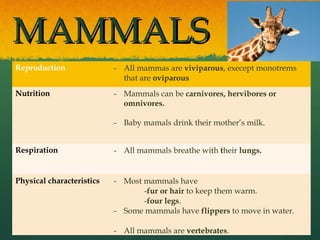
MAMMALSMAMMALS
Reproduction - All mammas are viviparous, execept monotrems
that are oviparous
Nutrition - Mammals can be carnivores, hervibores or
omnivores.
- Baby mamals drink their mother’s milk.
Respiration - All mammals breathe with their lungs.
Physical characteristics - Most mammals have
-fur or hair to keep them warm.
-four legs.
- Some mammals have flippers to move in water.
- All mammals are vertebrates.
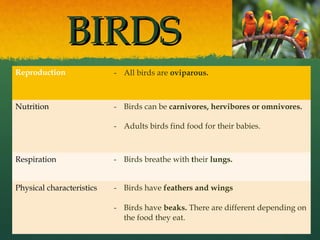
BIRDSBIRDS
Reproduction - All birds are oviparous.
Nutrition - Birds can be carnivores, hervibores or omnivores.
- Adults birds find food for their babies.
Respiration - Birds breathe with their lungs.
Physical characteristics - Birds have feathers and wings
- Birds have beaks. There are different depending on
the food they eat.
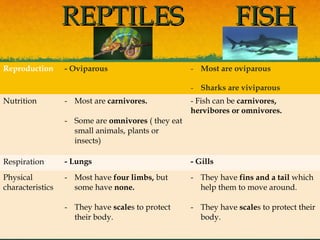
REPTILESREPTILES FISHFISH
Reproduction - Oviparous - Most are oviparous
- Sharks are viviparous
Nutrition - Most are carnivores.
- Some are omnivores ( they eat
small animals, plants or
insects)
- Fish can be carnivores,
hervibores or omnivores.
Respiration - Lungs - Gills
Physical
characteristics
- Most have four limbs, but
some have none.
- They have scales to protect
their body.
- They have fins and a tail which
help them to move around.
- They have scales to protect their
body.
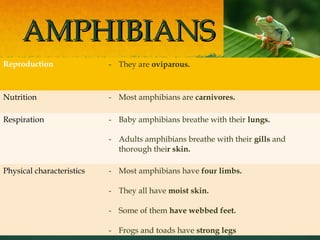
AMPHIBIANSAMPHIBIANS
Reproduction - They are oviparous.
Nutrition - Most amphibians are carnivores.
Respiration - Baby amphibians breathe with their lungs.
- Adults amphibians breathe with their gills and
thorough their skin.
Physical characteristics - Most amphibians have four limbs.
- They all have moist skin.
- Some of them have webbed feet.
- Frogs and toads have strong legs
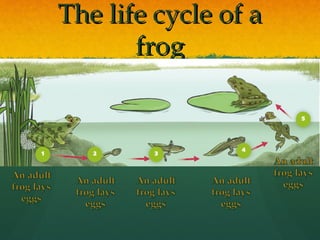
The life cycle of aThe life cycle of a
frogfrog
INVERTEBRATESINVERTEBRATES
ARTHROPODSARTHROPODS
 They are the biggest group of invertebrates. ThisThey are the biggest group of invertebrates. This
group includes four subgroups:group includes four subgroups:
1.1. InsectsInsects
2.2. ArachnidsArachnids
3.3. MyriapodsMyriapods
4.4. CrustaceansCrustaceans
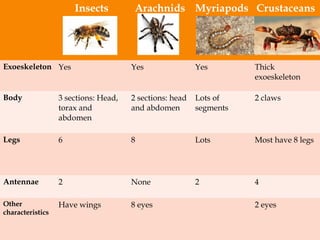
Insects Arachnids Myriapods Crustaceans
Exoeskeleton Yes Yes Yes Thick
exoeskeleton
Body 3 sections: Head,
torax and
abdomen
2 sections: head
and abdomen
Lots of
segments
2 claws
Legs 6 8 Lots Most have 8 legs
Antennae 2 None 2 4
Other
characteristics
Have wings 8 eyes 2 eyes
MOLLUSCSMOLLUSCS
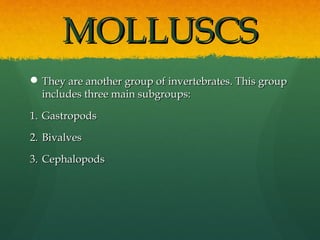
 They are another group of invertebrates. This groupThey are another group of invertebrates. This group
includes three main subgroups:includes three main subgroups:
1.1. GastropodsGastropods
2.2. BivalvesBivalves
3.3. CephalopodsCephalopods
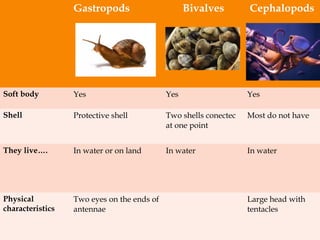
Gastropods Bivalves Cephalopods
Soft body Yes Yes Yes
Shell Protective shell Two shells conectec
at one point
Most do not have
They live…. In water or on land In water In water
Physical
characteristics
Two eyes on the ends of
antennae
Large head with
tentacles

Unit 3 animal kindgdom

  • 1.
    UNIT 3UNIT 3 ANIMALKINGDOMANIMAL KINGDOM
  • 2.
  • 3.
    MAMMALSMAMMALS Reproduction - Allmammas are viviparous, execept monotrems that are oviparous Nutrition - Mammals can be carnivores, hervibores or omnivores. - Baby mamals drink their mother’s milk. Respiration - All mammals breathe with their lungs. Physical characteristics - Most mammals have -fur or hair to keep them warm. -four legs. - Some mammals have flippers to move in water. - All mammals are vertebrates.
  • 4.
    BIRDSBIRDS Reproduction - Allbirds are oviparous. Nutrition - Birds can be carnivores, hervibores or omnivores. - Adults birds find food for their babies. Respiration - Birds breathe with their lungs. Physical characteristics - Birds have feathers and wings - Birds have beaks. There are different depending on the food they eat.
  • 5.
    REPTILESREPTILES FISHFISH Reproduction -Oviparous - Most are oviparous - Sharks are viviparous Nutrition - Most are carnivores. - Some are omnivores ( they eat small animals, plants or insects) - Fish can be carnivores, hervibores or omnivores. Respiration - Lungs - Gills Physical characteristics - Most have four limbs, but some have none. - They have scales to protect their body. - They have fins and a tail which help them to move around. - They have scales to protect their body.
  • 6.
    AMPHIBIANSAMPHIBIANS Reproduction - Theyare oviparous. Nutrition - Most amphibians are carnivores. Respiration - Baby amphibians breathe with their lungs. - Adults amphibians breathe with their gills and thorough their skin. Physical characteristics - Most amphibians have four limbs. - They all have moist skin. - Some of them have webbed feet. - Frogs and toads have strong legs
  • 7.
    The life cycleof aThe life cycle of a frogfrog
  • 8.
  • 9.
    ARTHROPODSARTHROPODS  They arethe biggest group of invertebrates. ThisThey are the biggest group of invertebrates. This group includes four subgroups:group includes four subgroups: 1.1. InsectsInsects 2.2. ArachnidsArachnids 3.3. MyriapodsMyriapods 4.4. CrustaceansCrustaceans
  • 10.
    Insects Arachnids MyriapodsCrustaceans Exoeskeleton Yes Yes Yes Thick exoeskeleton Body 3 sections: Head, torax and abdomen 2 sections: head and abdomen Lots of segments 2 claws Legs 6 8 Lots Most have 8 legs Antennae 2 None 2 4 Other characteristics Have wings 8 eyes 2 eyes
  • 11.
    MOLLUSCSMOLLUSCS  They areanother group of invertebrates. This groupThey are another group of invertebrates. This group includes three main subgroups:includes three main subgroups: 1.1. GastropodsGastropods 2.2. BivalvesBivalves 3.3. CephalopodsCephalopods
  • 12.
    Gastropods Bivalves Cephalopods Softbody Yes Yes Yes Shell Protective shell Two shells conectec at one point Most do not have They live…. In water or on land In water In water Physical characteristics Two eyes on the ends of antennae Large head with tentacles