Unit 2 Vocab
  By: Nic Medina
Magna Carta

• The Magna Carta was written for
• The magna Carta was written on the year
  1215.
• It made them lose a lot of power when
  King James was forced to sign it.
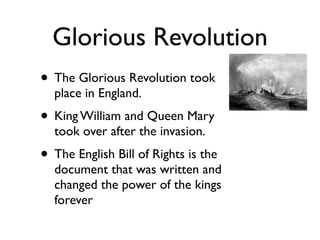
Glorious Revolution
• The Glorious Revolution took
  place in England.
• King William and Queen Mary
  took over after the invasion.
• The English Bill of Rights is the
  document that was written and
  changed the power of the kings
  forever
The Bill of Rights

• The Bill of Rights was written the year of
  1689
• The Bill of Rights was written to those
  rights against infringement. It was written
  so that they could have constitutional
  amendments.
The Enlightenment
• The purpose to reform society using
  reason and advance knowledge through
  science. It promoted science and
  intellectual interchange and opposed
  superstition intolerance and some abuses
  by church and state.
• It took place in Europe and the American
  Colonies.
• It started schools.
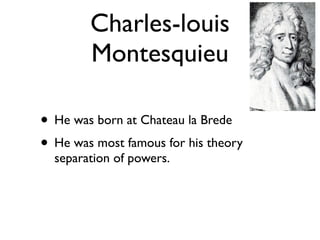
Charles-louis
        Montesquieu

• He was born at Chateau la Brede
• He was most famous for his theory
  separation of powers.
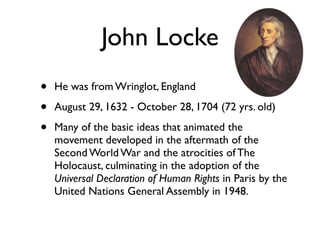
John Locke
•   He was from Wringlot, England

•   August 29, 1632 - October 28, 1704 (72 yrs. old)

•   Many of the basic ideas that animated the
    movement developed in the aftermath of the
    Second World War and the atrocities of The
    Holocaust, culminating in the adoption of the
    Universal Declaration of Human Rights in Paris by the
    United Nations General Assembly in 1948.
Jean-Jacques Rousseau
• He was born in Geneva
•   Addresses the questions of the origin of society
    and the legitimacy of the authority of the state
    over the individual. Social contract arguments
    typically posit that individuals have consented,
    either explicitly or tacitly, to surrender some of
    their freedoms and submit to the authority of the
    ruler or magistrate.

•   June 28,1712-July 2,1778 (age 66)
Thomas Jefferson

• From Shadwell, Goochland County,Virginia
• He was most known for writing the
    Declaration of Independence.
•

Unit 2 vocab

  • 1.
    Unit 2 Vocab By: Nic Medina
  • 2.
    Magna Carta • TheMagna Carta was written for • The magna Carta was written on the year 1215. • It made them lose a lot of power when King James was forced to sign it.
  • 3.
    Glorious Revolution • TheGlorious Revolution took place in England. • King William and Queen Mary took over after the invasion. • The English Bill of Rights is the document that was written and changed the power of the kings forever
  • 4.
    The Bill ofRights • The Bill of Rights was written the year of 1689 • The Bill of Rights was written to those rights against infringement. It was written so that they could have constitutional amendments.
  • 5.
    The Enlightenment • Thepurpose to reform society using reason and advance knowledge through science. It promoted science and intellectual interchange and opposed superstition intolerance and some abuses by church and state. • It took place in Europe and the American Colonies. • It started schools.
  • 6.
    Charles-louis Montesquieu • He was born at Chateau la Brede • He was most famous for his theory separation of powers.
  • 7.
    John Locke • He was from Wringlot, England • August 29, 1632 - October 28, 1704 (72 yrs. old) • Many of the basic ideas that animated the movement developed in the aftermath of the Second World War and the atrocities of The Holocaust, culminating in the adoption of the Universal Declaration of Human Rights in Paris by the United Nations General Assembly in 1948.
  • 8.
    Jean-Jacques Rousseau • Hewas born in Geneva • Addresses the questions of the origin of society and the legitimacy of the authority of the state over the individual. Social contract arguments typically posit that individuals have consented, either explicitly or tacitly, to surrender some of their freedoms and submit to the authority of the ruler or magistrate. • June 28,1712-July 2,1778 (age 66)
  • 9.
    Thomas Jefferson • FromShadwell, Goochland County,Virginia • He was most known for writing the Declaration of Independence. •

Editor's Notes