Test Vocabulary   The Key To Raising Scores by Teresa Betts, Streetsboro City Schools [email_address]
Science Social Studies Math Writing Reading Each of the icons below represents the testing area under which the vocabulary word may fall.  Note:  All  clip are is subject to copyright laws and may not be duplicated.  Note to All Users: I have tried to make a user-friendly vocabulary unit that incorporates selective test vocabulary words.  In no way is the unit inclusive.  All work has been checked and double-checked but errors may be present. Feel free to adapt the material here for your own use but please do not represent the work as your own. Sincerely, Teresa Betts
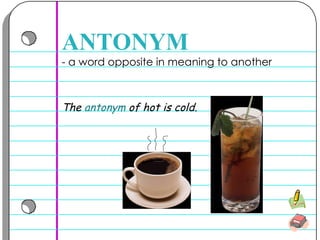
- a word opposite in meaning to another   ANTONYM The  antonym  of hot is cold.
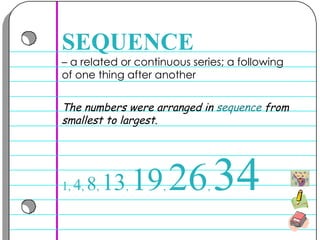
–  a related or continuous series; a following of one thing after another  SEQUENCE The numbers were arranged in  sequence  from smallest to largest. 1 ,  4 ,  8 ,  13 ,  19 ,  26 ,  34
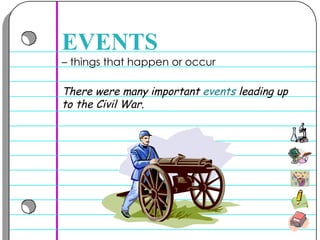
–  things that happen or occur  EVENTS There were many important  events  leading up to the Civil War.
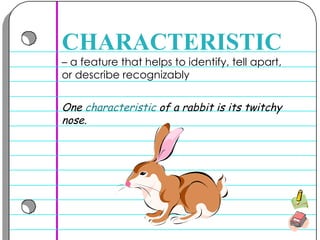
–  a feature that helps to identify, tell apart, or describe recognizably  CHARACTERISTIC One  characteristic  of a rabbit is its twitchy nose.
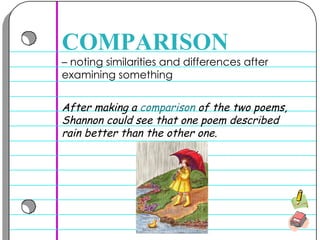
–  noting similarities and differences after examining something  COMPARISON After making a  comparison  of the two poems, Shannon could see that one poem described rain better than the other one.
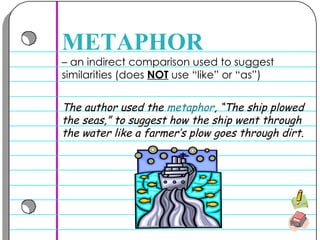
–  an indirect comparison used to suggest similarities (does  NOT  use “like” or “as”) METAPHOR The author used the  metaphor , “The ship plowed the seas,” to suggest how the ship went through the water like a farmer’s plow goes through dirt.
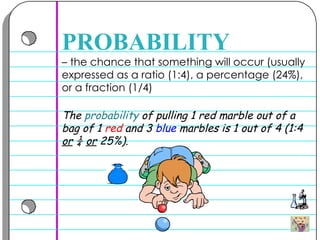
–  the chance that something will occur (usually expressed as a ratio (1:4), a percentage (24%), or a fraction (1/4) PROBABILITY The  probability  of pulling 1  red  marble out of a bag of 1  red  and 3  blue  marbles is 1 out of 4 (1:4  or  ¼  or  25%).
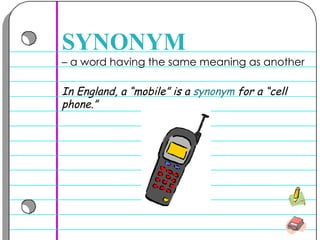
–  a word having the same meaning as another SYNONYM In England, a “mobile” is a  synonym  for a “cell phone.”
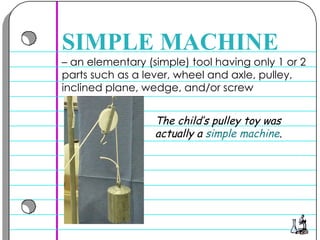
–  an elementary (simple) tool having only 1 or 2 parts such as a lever, wheel and axle, pulley, inclined plane, wedge, and/or screw  SIMPLE MACHINE The child’s pulley toy was actually a  simple machine .
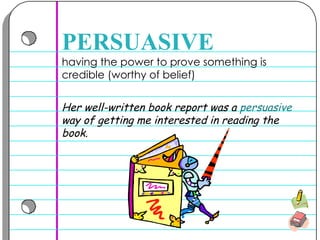
having the power to prove something is credible (worthy of belief) PERSUASIVE Her well-written book report was a  persuasive  way of getting me interested in reading the book.
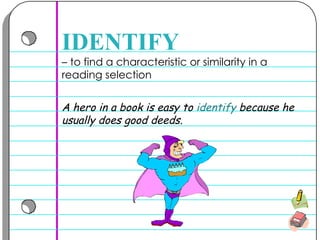
–  to find a characteristic or similarity in a reading selection  IDENTIFY A hero in a book is easy to  identify  because he usually does good deeds.
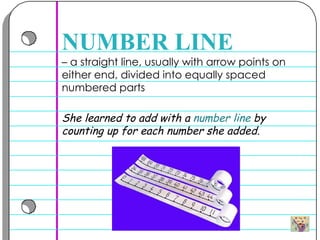
–  a straight line, usually with arrow points on either end, divided into equally spaced numbered parts  NUMBER LINE She learned to add with a  number line  by counting up for each number she added.
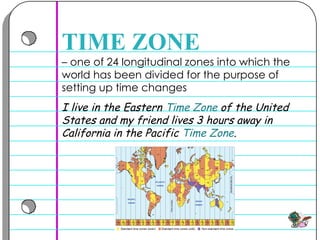
–  one of 24 longitudinal zones into which the world has been divided for the purpose of setting up time changes  TIME ZONE I live in the Eastern  Time Zone  of the United States and my friend lives 3 hours away in California in the Pacific  Time Zone .
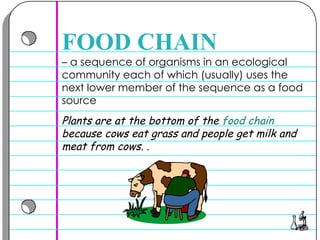
–  a sequence of organisms in an ecological community each of which (usually) uses the next lower member of the sequence as a food source  FOOD CHAIN Plants are at the bottom of the  food chain  because cows eat grass and people get milk and meat from cows. .
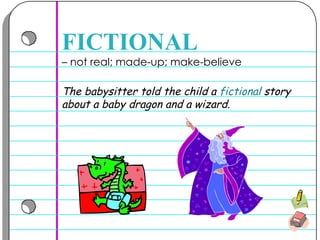
–  not real; made-up; make-believe  FICTIONAL The babysitter told the child a  fictional  story about a baby dragon and a wizard.
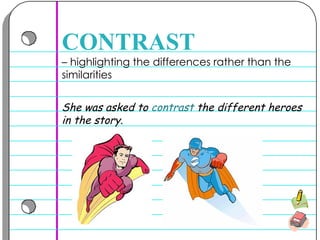
–  highlighting the differences rather than the similarities  CONTRAST She was asked to  contrast  the different heroes in the story.
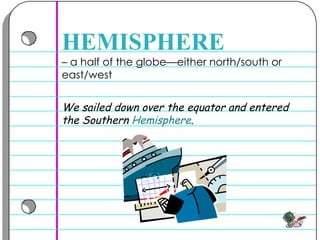
–  a half of the globe—either north/south or east/west  HEMISPHERE We sailed down over the equator and entered the Southern  Hemisphere .
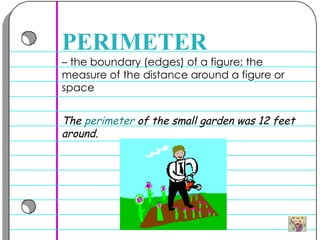
–  the boundary (edges) of a figure; the measure of the distance around a figure or space PERIMETER The  perimeter  of the small garden was 12 feet around.
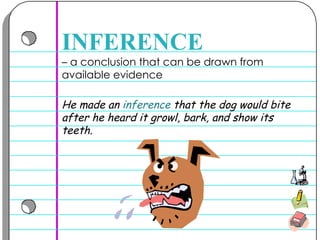
–  a conclusion that can be drawn from available evidence  INFERENCE He made an  inference  that the dog would bite after he heard it growl, bark, and show its teeth.
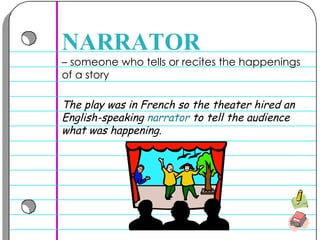
–  someone who tells or recites the happenings of a story  NARRATOR The play was in French so the theater hired an English-speaking  narrator  to tell the audience what was happening.
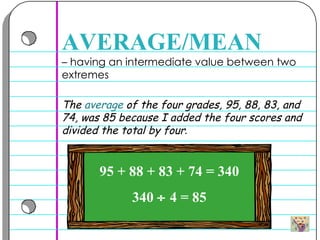
–  having an intermediate value between two extremes  AVERAGE/MEAN The  average  of the four grades, 95, 88, 83, and 74, was 85 because I added the four scores and divided the total by four .   95 + 88 + 83 + 74 = 340 340    4 = 85
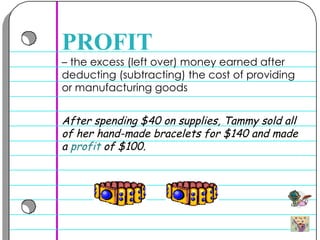
–  the excess (left over) money earned after deducting (subtracting) the cost of providing or manufacturing goods  PROFIT After spending $40 on supplies, Tammy sold all of her hand-made bracelets for $140 and made a  profit  of $100.
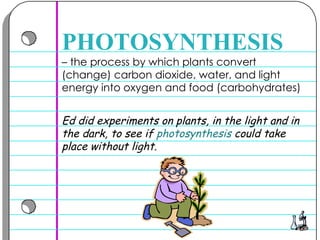
–  the process by which plants convert (change) carbon dioxide, water, and light energy into oxygen and food (carbohydrates)  PHOTOSYNTHESIS Ed did experiments on plants, in the light and in the dark, to see if  photosynthesis   could take place without light.
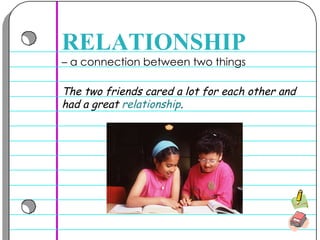
–  a connection between two things  RELATIONSHIP The two friends cared a lot for each other and had a great  relationship .
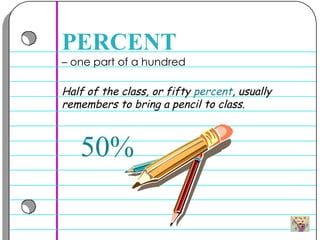
–  one part of a hundred  PERCENT Half of the class, or fifty  percent , usually remembers to bring a pencil to class.  50%
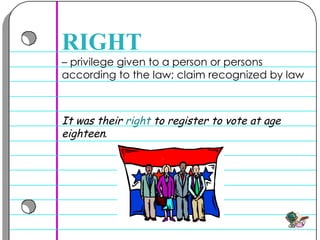
–  privilege given to a person or persons according to the law; claim recognized by law  RIGHT It was their  right  to register to vote at age eighteen .
–  a proposal that is assumed in order to prove or disprove it through scientific investigation  HYPOTHESIS Ed’s   experiments proved his  hypothesis  that plants cannot live without water .
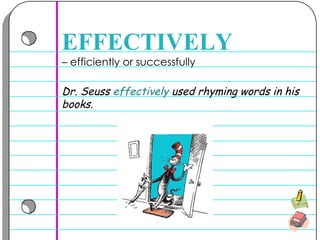
–  efficiently or successfully EFFECTIVELY Dr. Seuss  effectively   used rhyming words in his books.
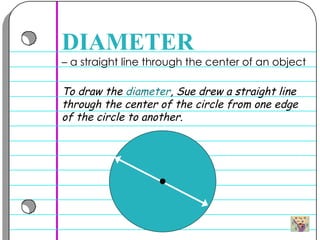
–  a straight line through the center of an object  DIAMETER To draw the  diameter , Sue drew a straight line through the center of the circle from one edge of the circle to another.
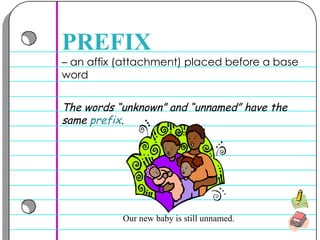
–  an affix (attachment) placed before a base word  PREFIX The words “unknown” and “unnamed” have the same  prefix .  Our new baby is still unnamed.
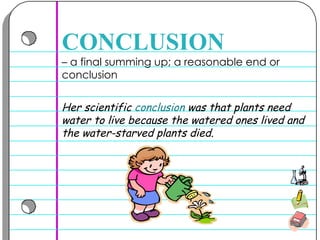
–  a final summing up; a reasonable end or conclusion  CONCLUSION Her scientific  conclusion  was that plants need water to live because the watered ones lived and the water-starved plants died.
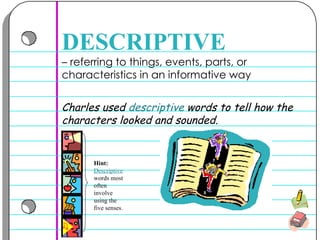
–  referring to things, events, parts, or characteristics in an informative way DESCRIPTIVE Charles used  descriptive  words to tell how the characters looked and sounded.  Hint:   Descriptive  words most often involve using the five senses.
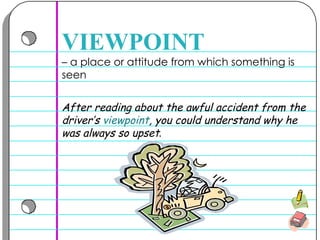
–  a place or attitude from which something is seen  VIEWPOINT After reading about the awful accident from the driver’s  viewpoint , you could understand why he was always so upset .
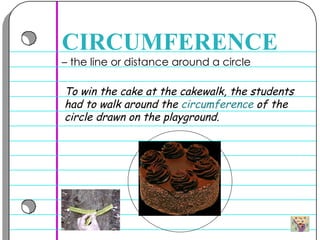
–  the line or distance around a circle  CIRCUMFERENCE To win the cake at the cakewalk, the students had to walk around the  circumference  of the circle drawn on the playground.
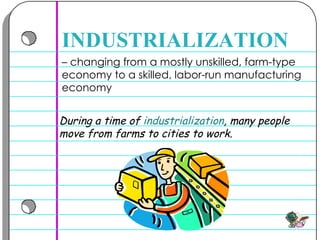
–  changing from a mostly unskilled, farm-type economy to a skilled, labor-run manufacturing economy  INDUSTRIALIZATION During a time of  industrialization , many people move from farms to cities to work.
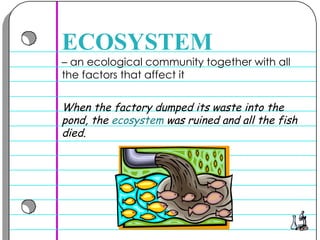
–  an ecological community together with all the factors that affect it  ECOSYSTEM When the factory dumped its waste into the pond, the  ecosystem  was ruined and all the fish died.
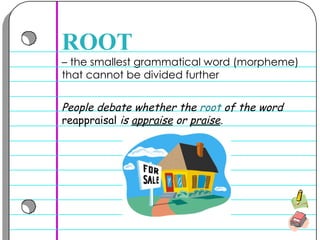
–  the smallest grammatical word (morpheme) that cannot be divided further  ROOT People debate whether the  root  of the word  reappraisal  is  appraise  or  praise .
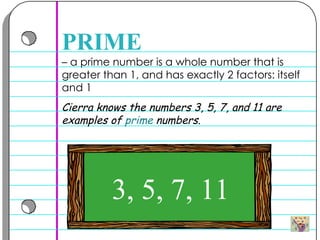
–  a prime number is a whole number that is greater than 1, and has exactly 2 factors: itself and 1  PRIME Cierra knows the numbers 3, 5, 7, and 11 are examples of  prime  numbers.  3, 5, 7, 11
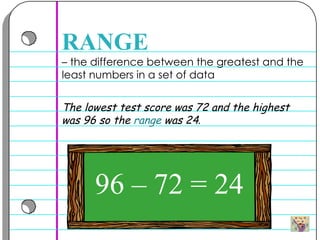
–  the difference between the greatest and the least numbers in a set of data  RANGE The lowest test score was 72 and the highest was 96 so the  range  was 24 .   96 – 72 = 24
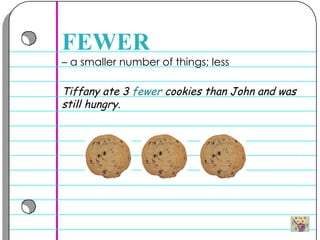
–  a smaller number of things; less  FEWER Tiffany ate 3  fewer  cookies than John and was still hungry.
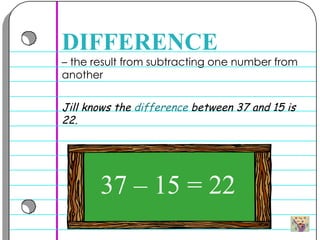
–  the result from subtracting one number from another  DIFFERENCE Jill knows the  difference  between 37 and 15 is 22.  37 – 15 = 22
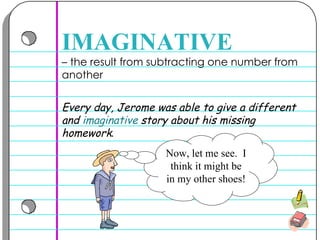
–  the result from subtracting one number from another  IMAGINATIVE Every day, Jerome was able to give a different and  imaginative  story about his missing homework .   Now, let me see.  I think it might be in my other shoes!
–  to make clear; to make known in detail  EXPLAIN Mike was able to  explain  his answer by including many descriptive details.
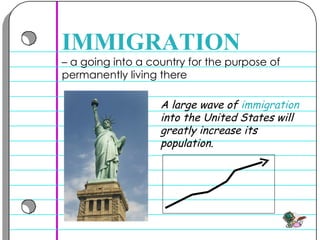
–  a going into a country for the purpose of permanently living there  IMMIGRATION A large wave of  immigration  into the United States will greatly increase its population.
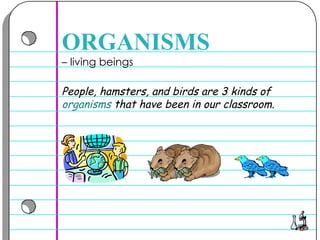
–  living beings  ORGANISMS People, hamsters, and birds are 3 kinds of  organisms  that have been in our classroom.
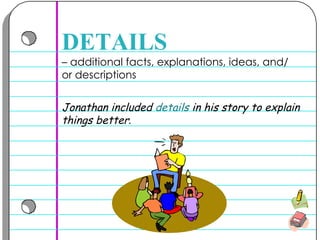
–  additional facts, explanations, ideas, and/or descriptions  DETAILS Jonathan included  details  in his story to explain things better .
–  decided or settled  RESOLVED The problem was  resolved  when Shana apologized for being mean.
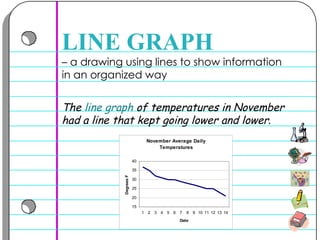
–  a drawing using lines to show information in an organized way  LINE GRAPH The  line graph  of temperatures in November had a line that kept going lower and lower .
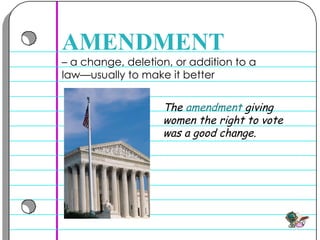
–  a change, deletion, or addition to a law—usually to make it better  AMENDMENT The  amendment  giving women the right to vote was a good change.
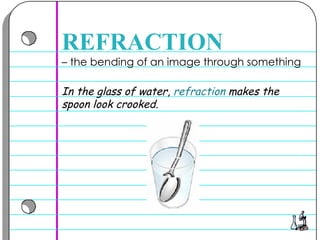
–  the bending of an image through something  REFRACTION In the glass of water,  refraction  makes the spoon look crooked.
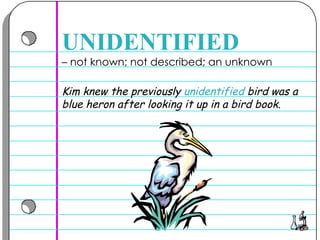
–  not known; not described; an unknown  UNIDENTIFIED Kim knew the previously  unidentified  bird was a blue heron after looking it up in a bird book.
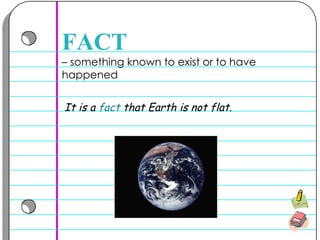
–  something known to exist or to have happened  FACT It is a  fact  that Earth is not flat.
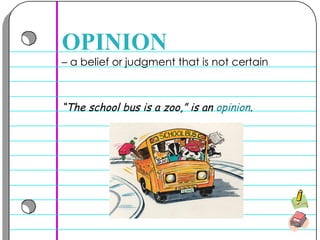
–  a belief or judgment that is not certain  OPINION “ The school bus is a zoo,” is an  opinion .
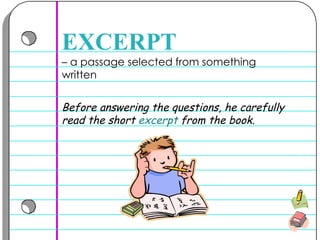
–  a passage selected from something written  EXCERPT Before answering the questions, he carefully read the short  excerpt  from the book.
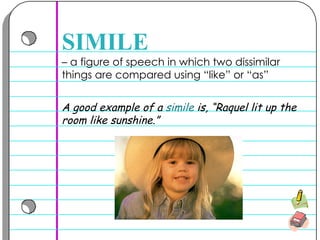
–  a figure of speech in which two dissimilar things are compared using “like” or “as”  SIMILE A good example of a  simile  is, “Raquel lit up the room like sunshine.”
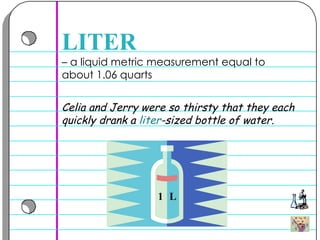
–  a liquid metric measurement equal to about 1.06 quarts  LITER Celia and Jerry were so thirsty that they each quickly drank a  liter -sized bottle of water.  1  L
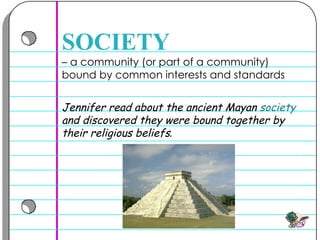
–  a community (or part of a community) bound by common interests and standards  SOCIETY Jennifer read about the ancient Mayan  society  and discovered they were bound together by their religious beliefs .
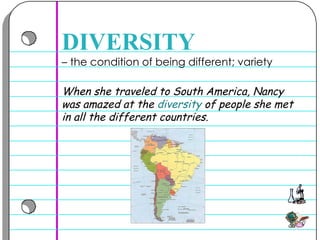
–  the condition of being different; variety  DIVERSITY When she traveled to South America, Nancy was amazed at the  diversity  of people she met in all the different countries.
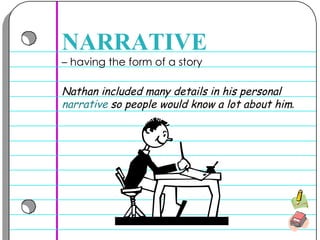
–  having the form of a story  NARRATIVE Nathan included many details in his personal  narrative  so people would know a lot about him .
–  a reaction or answer to written material  RESPONSE Jarrod wrote a long  response  to the test question because he had many things to say.
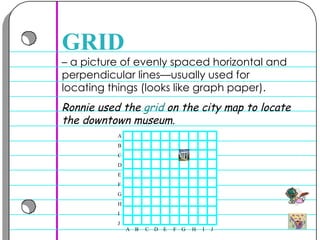
–  a picture of evenly spaced horizontal and perpendicular lines—usually used for locating things (looks like graph paper).   GRID Ronnie used the  grid  on the city map to locate the downtown museum.  A B C D E F G H I J A  B  C  D  E  F  G  H  I  J
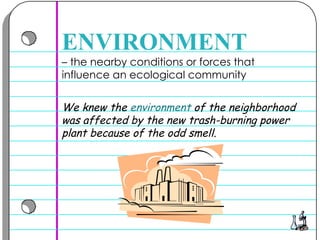
–  the nearby conditions or forces that influence an ecological community  ENVIRONMENT We knew the  environment  of the neighborhood was affected by the new trash-burning power plant because of the odd smell.
–  a detailed examination; study; research  INVESTIGATION Jessica’s  investigation  into her family’s history uncovered a famous Underground Railroad conductor.
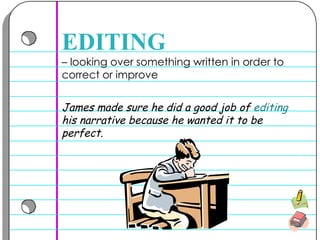
–  looking over something written in order to correct or improve  EDITING James made sure he did a good job of  editing  his narrative because he wanted it to be perfect.
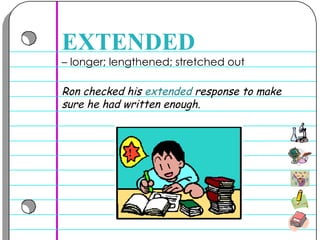
–  longer; lengthened; stretched out  EXTENDED Ron checked his  extended  response to make sure he had written enough.  !
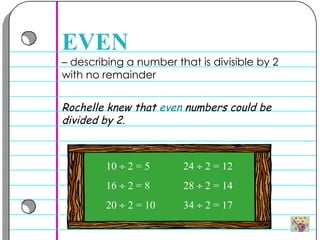
–  describing a number that is divisible by 2 with no remainder  EVEN Rochelle knew that  even  numbers could be divided by 2.  10    2 = 5   24    2 = 12 16    2 = 8   28    2 = 14 20    2 = 10   34    2 = 17
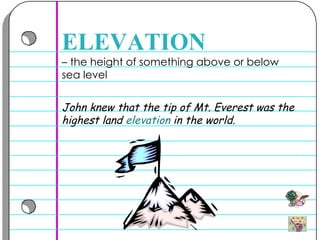
–  the height of something above or below sea level  ELEVATION John knew that the tip of Mt. Everest was the highest land  elevation  in the world.
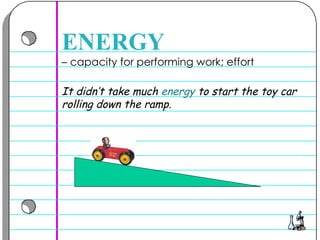
–  capacity for performing work; effort  ENERGY It didn’t take much  energy  to start the toy car rolling down the ramp.
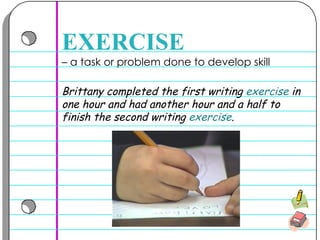
–  a task or problem done to develop skill  EXERCISE Brittany completed the first writing  exercise  in one hour and had another hour and a half to finish the second writing  exercise .
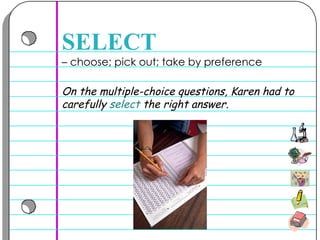
–  choose; pick out; take by preference  SELECT On the multiple-choice questions, Karen had to carefully  select  the right answer.
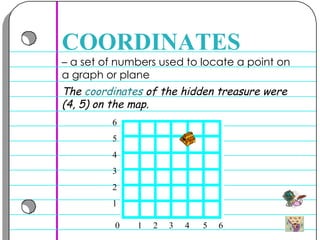
  –  a set of numbers used to locate a point on a graph or plane  COORDINATES The  coordinates  of the hidden treasure were (4, 5) on the map.  6 5 4 3 2 1 0  1  2  3  4  5  6                                 
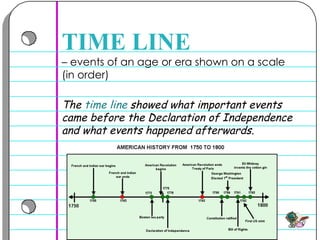
–  events of an age or era shown on a scale (in order) TIME LINE The  time line  showed what important events came before the Declaration of Independence and what events happened afterwards.
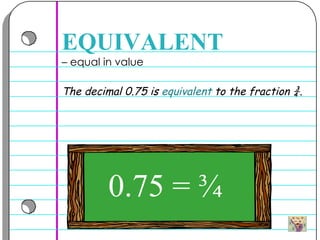
–  equal in value  EQUIVALENT The decimal 0.75 is  equivalent  to the fraction ¾.  0.75 = ¾
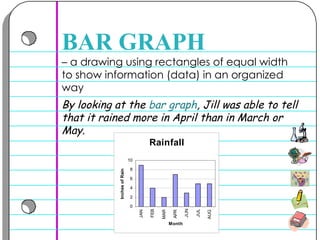
–  a drawing using rectangles of equal width to show information (data) in an organized way  BAR GRAPH By looking at the  bar graph , Jill was able to tell that it rained more in April than in March or May.
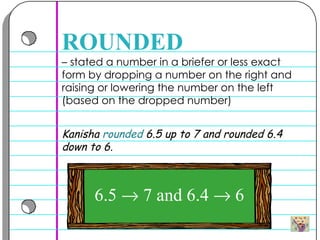
–  stated a number in a briefer or less exact form by dropping a number on the right and raising or lowering the number on the left (based on the dropped number) ROUNDED Kanisha  rounded  6.5 up to 7 and rounded 6.4 down to 6.  6.5    7 and 6.4    6
–  to leave out; to fail to include  OMIT Gayle checked over her narrative to make sure she didn’t  omit  any details that were asked for in the directions.
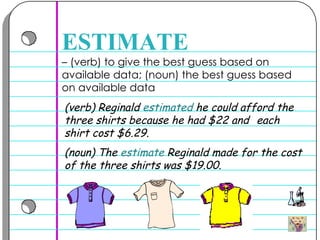
–  (verb) to give the best guess based on available data; (noun) the best guess based on available data  ESTIMATE (verb) Reginald  estimated  he could afford the three shirts because he had $22 and  each shirt cost $6.29.  (noun) The  estimate  Reginald made for the cost of the three shirts was $19.00.
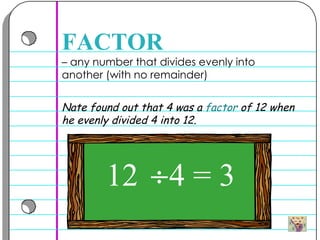
–  any number that divides evenly into another (with no remainder) FACTOR Nate found out that 4 was a  factor  of 12 when he evenly divided 4 into 12.  12      4 = 3
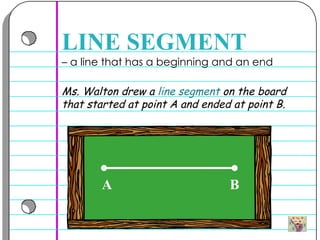
–  a line that has a beginning and an end  LINE SEGMENT Ms. Walton drew a  line segment  on the board that started at point A and ended at point B.  A B
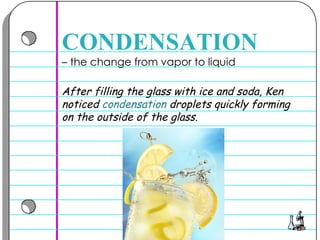
–  the change from vapor to liquid  CONDENSATION After filling the glass with ice and soda, Ken noticed  condensation  droplets quickly forming on the outside of the glass.
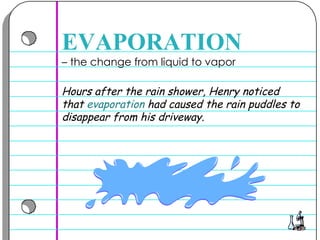
–  the change from liquid to vapor  EVAPORATION Hours after the rain shower, Henry noticed that  evaporation  had caused the rain puddles to disappear from his driveway.
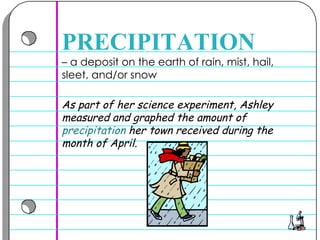
–  a deposit on the earth of rain, mist, hail, sleet, and/or snow  PRECIPITATION As part of her science experiment, Ashley measured and graphed the amount of  precipitation  her town received during the month of April.
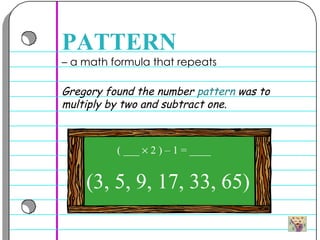
–  a math formula that repeats  PATTERN Gregory found the number  pattern  was to multiply by two and subtract one.  (3, 5, 9, 17, 33, 65) ( ___    2 ) – 1 = ____
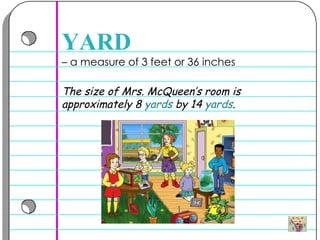
–  a measure of 3 feet or 36 inches  YARD The size of Mrs. McQueen’s room is approximately 8  yards  by 14  yards .
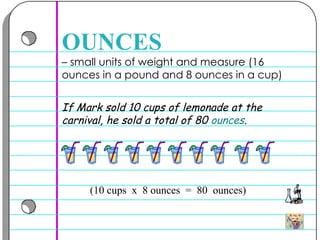
–  small units of weight and measure (16 ounces in a pound and 8 ounces in a cup)  OUNCES If Mark sold 10 cups of lemonade at the carnival, he sold a total of 80  ounces .  (10 cups  x  8 ounces  =  80  ounces)
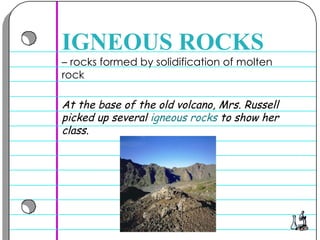
–  rocks formed by solidification of molten rock  IGNEOUS ROCKS At the base of the old volcano, Mrs. Russell picked up several  igneous rocks  to show her class.
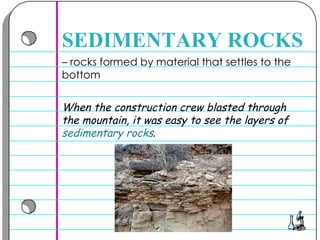
–  rocks formed by material that settles to the bottom  SEDIMENTARY ROCKS When the construction crew blasted through the mountain, it was easy to see the layers of  sedimentary rocks .
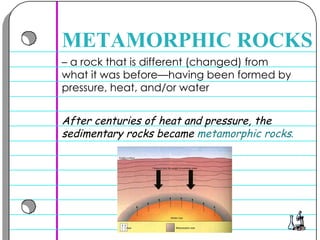
–  a rock that is different (changed) from what it was before—having been formed by pressure, heat, and/or water  METAMORPHIC ROCKS After centuries of heat and pressure, the sedimentary rocks became  metamorphic rocks .
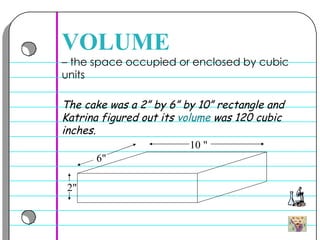
–  the space occupied or enclosed by cubic units  VOLUME The cake was a 2” by 6” by 10” rectangle and Katrina figured out its  volume  was 120 cubic inches.  10  " 2 " 6 "
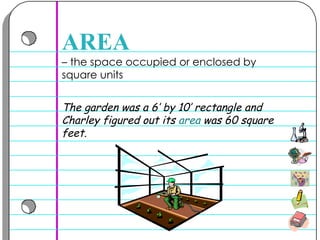
–  the space occupied or enclosed by square units  AREA The garden was a 6’ by 10’ rectangle and Charley figured out its  area  was 60 square feet.
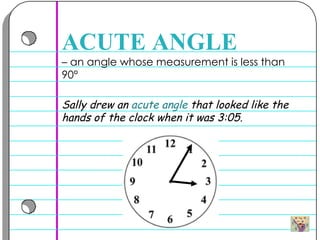
–  an angle whose measurement is less than 90° ACUTE ANGLE Sally drew an  acute angle  that looked like the hands of the clock when it was 3:05.
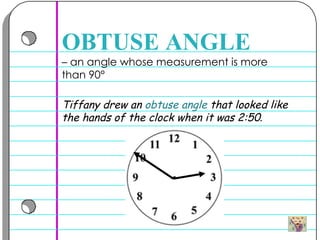
–  an angle whose measurement is more than 90° OBTUSE ANGLE Tiffany drew an  obtuse angle  that looked like the hands of the clock when it was 2:50 .
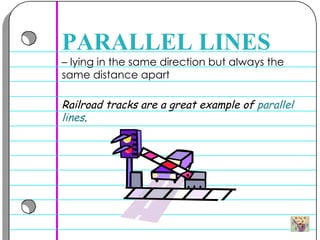
–  lying in the same direction but always the same distance apart  PARALLEL LINES Railroad tracks are a great example of  parallel   lines .
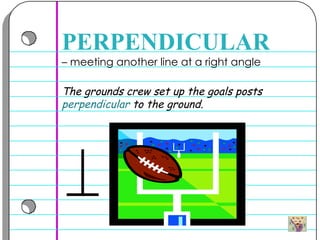
–  meeting another line at a right angle  PERPENDICULAR The grounds crew set up the goals posts  perpendicular  to the ground.
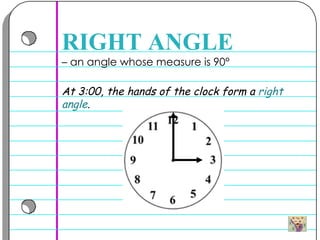
–  an angle whose measure is 90° RIGHT ANGLE At 3:00, the hands of the clock form a  right angle .
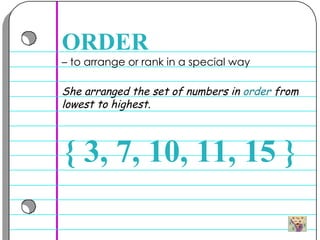
–  to arrange or rank in a special way  ORDER She arranged the set of numbers in  order  from lowest to highest.  { 3, 7, 10, 11, 15 }
–  to state or express in a brief, concise form  SUMMARIZE After reading the entire, long passage, Jackie was able to summarize it into just two sentences.
–  knowledge communicated; facts INFORMATION Dave checked all the  information  provided before attempting to answer the question.
–  a portion or section of a written work  PASSAGE Read the entire  passage  carefully and look for clues.
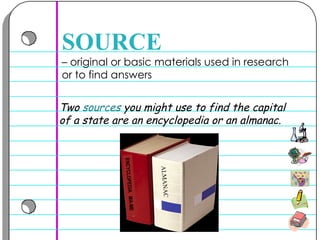
–  original or basic materials used in research or to find answers  SOURCE Two  sources  you might use to find the capital of a state are an encyclopedia or an almanac. ENCYCLOPEDIA  MA-ME ALMANAC
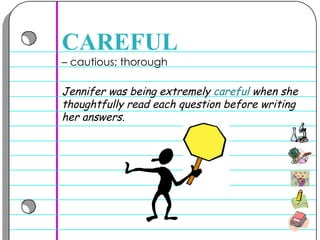
–  cautious; thorough  CAREFUL Jennifer was being extremely  careful  when she thoughtfully read each question before writing her answers.
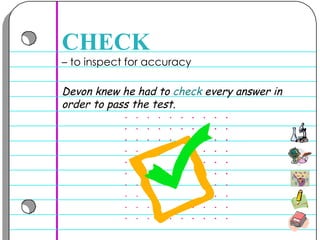
–  to inspect for accuracy  CHECK Devon knew he had to  check  every answer in order to pass the test.

Vocabulary Power Point

  • 1.
    Test Vocabulary The Key To Raising Scores by Teresa Betts, Streetsboro City Schools [email_address]
  • 2.
    Science Social StudiesMath Writing Reading Each of the icons below represents the testing area under which the vocabulary word may fall. Note: All clip are is subject to copyright laws and may not be duplicated. Note to All Users: I have tried to make a user-friendly vocabulary unit that incorporates selective test vocabulary words. In no way is the unit inclusive. All work has been checked and double-checked but errors may be present. Feel free to adapt the material here for your own use but please do not represent the work as your own. Sincerely, Teresa Betts
  • 3.
    - a wordopposite in meaning to another ANTONYM The antonym of hot is cold.
  • 4.
    – arelated or continuous series; a following of one thing after another SEQUENCE The numbers were arranged in sequence from smallest to largest. 1 , 4 , 8 , 13 , 19 , 26 , 34
  • 5.
    – thingsthat happen or occur EVENTS There were many important events leading up to the Civil War.
  • 6.
    – afeature that helps to identify, tell apart, or describe recognizably CHARACTERISTIC One characteristic of a rabbit is its twitchy nose.
  • 7.
    – notingsimilarities and differences after examining something COMPARISON After making a comparison of the two poems, Shannon could see that one poem described rain better than the other one.
  • 8.
    – anindirect comparison used to suggest similarities (does NOT use “like” or “as”) METAPHOR The author used the metaphor , “The ship plowed the seas,” to suggest how the ship went through the water like a farmer’s plow goes through dirt.
  • 9.
    – thechance that something will occur (usually expressed as a ratio (1:4), a percentage (24%), or a fraction (1/4) PROBABILITY The probability of pulling 1 red marble out of a bag of 1 red and 3 blue marbles is 1 out of 4 (1:4 or ¼ or 25%).
  • 10.
    – aword having the same meaning as another SYNONYM In England, a “mobile” is a synonym for a “cell phone.”
  • 11.
    – anelementary (simple) tool having only 1 or 2 parts such as a lever, wheel and axle, pulley, inclined plane, wedge, and/or screw SIMPLE MACHINE The child’s pulley toy was actually a simple machine .
  • 12.
    having the powerto prove something is credible (worthy of belief) PERSUASIVE Her well-written book report was a persuasive way of getting me interested in reading the book.
  • 13.
    – tofind a characteristic or similarity in a reading selection IDENTIFY A hero in a book is easy to identify because he usually does good deeds.
  • 14.
    – astraight line, usually with arrow points on either end, divided into equally spaced numbered parts NUMBER LINE She learned to add with a number line by counting up for each number she added.
  • 15.
    – oneof 24 longitudinal zones into which the world has been divided for the purpose of setting up time changes TIME ZONE I live in the Eastern Time Zone of the United States and my friend lives 3 hours away in California in the Pacific Time Zone .
  • 16.
    – asequence of organisms in an ecological community each of which (usually) uses the next lower member of the sequence as a food source FOOD CHAIN Plants are at the bottom of the food chain because cows eat grass and people get milk and meat from cows. .
  • 17.
    – notreal; made-up; make-believe FICTIONAL The babysitter told the child a fictional story about a baby dragon and a wizard.
  • 18.
    – highlightingthe differences rather than the similarities CONTRAST She was asked to contrast the different heroes in the story.
  • 19.
    – ahalf of the globe—either north/south or east/west HEMISPHERE We sailed down over the equator and entered the Southern Hemisphere .
  • 20.
    – theboundary (edges) of a figure; the measure of the distance around a figure or space PERIMETER The perimeter of the small garden was 12 feet around.
  • 21.
    – aconclusion that can be drawn from available evidence INFERENCE He made an inference that the dog would bite after he heard it growl, bark, and show its teeth.
  • 22.
    – someonewho tells or recites the happenings of a story NARRATOR The play was in French so the theater hired an English-speaking narrator to tell the audience what was happening.
  • 23.
    – havingan intermediate value between two extremes AVERAGE/MEAN The average of the four grades, 95, 88, 83, and 74, was 85 because I added the four scores and divided the total by four . 95 + 88 + 83 + 74 = 340 340  4 = 85
  • 24.
    – theexcess (left over) money earned after deducting (subtracting) the cost of providing or manufacturing goods PROFIT After spending $40 on supplies, Tammy sold all of her hand-made bracelets for $140 and made a profit of $100.
  • 25.
    – theprocess by which plants convert (change) carbon dioxide, water, and light energy into oxygen and food (carbohydrates) PHOTOSYNTHESIS Ed did experiments on plants, in the light and in the dark, to see if photosynthesis could take place without light.
  • 26.
    – aconnection between two things RELATIONSHIP The two friends cared a lot for each other and had a great relationship .
  • 27.
    – onepart of a hundred PERCENT Half of the class, or fifty percent , usually remembers to bring a pencil to class. 50%
  • 28.
    – privilegegiven to a person or persons according to the law; claim recognized by law RIGHT It was their right to register to vote at age eighteen .
  • 29.
    – aproposal that is assumed in order to prove or disprove it through scientific investigation HYPOTHESIS Ed’s experiments proved his hypothesis that plants cannot live without water .
  • 30.
    – efficientlyor successfully EFFECTIVELY Dr. Seuss effectively used rhyming words in his books.
  • 31.
    – astraight line through the center of an object DIAMETER To draw the diameter , Sue drew a straight line through the center of the circle from one edge of the circle to another.
  • 32.
    – anaffix (attachment) placed before a base word PREFIX The words “unknown” and “unnamed” have the same prefix . Our new baby is still unnamed.
  • 33.
    – afinal summing up; a reasonable end or conclusion CONCLUSION Her scientific conclusion was that plants need water to live because the watered ones lived and the water-starved plants died.
  • 34.
    – referringto things, events, parts, or characteristics in an informative way DESCRIPTIVE Charles used descriptive words to tell how the characters looked and sounded. Hint: Descriptive words most often involve using the five senses.
  • 35.
    – aplace or attitude from which something is seen VIEWPOINT After reading about the awful accident from the driver’s viewpoint , you could understand why he was always so upset .
  • 36.
    – theline or distance around a circle CIRCUMFERENCE To win the cake at the cakewalk, the students had to walk around the circumference of the circle drawn on the playground.
  • 37.
    – changingfrom a mostly unskilled, farm-type economy to a skilled, labor-run manufacturing economy INDUSTRIALIZATION During a time of industrialization , many people move from farms to cities to work.
  • 38.
    – anecological community together with all the factors that affect it ECOSYSTEM When the factory dumped its waste into the pond, the ecosystem was ruined and all the fish died.
  • 39.
    – thesmallest grammatical word (morpheme) that cannot be divided further ROOT People debate whether the root of the word reappraisal is appraise or praise .
  • 40.
    – aprime number is a whole number that is greater than 1, and has exactly 2 factors: itself and 1 PRIME Cierra knows the numbers 3, 5, 7, and 11 are examples of prime numbers. 3, 5, 7, 11
  • 41.
    – thedifference between the greatest and the least numbers in a set of data RANGE The lowest test score was 72 and the highest was 96 so the range was 24 . 96 – 72 = 24
  • 42.
    – asmaller number of things; less FEWER Tiffany ate 3 fewer cookies than John and was still hungry.
  • 43.
    – theresult from subtracting one number from another DIFFERENCE Jill knows the difference between 37 and 15 is 22. 37 – 15 = 22
  • 44.
    – theresult from subtracting one number from another IMAGINATIVE Every day, Jerome was able to give a different and imaginative story about his missing homework . Now, let me see. I think it might be in my other shoes!
  • 45.
    – tomake clear; to make known in detail EXPLAIN Mike was able to explain his answer by including many descriptive details.
  • 46.
    – agoing into a country for the purpose of permanently living there IMMIGRATION A large wave of immigration into the United States will greatly increase its population.
  • 47.
    – livingbeings ORGANISMS People, hamsters, and birds are 3 kinds of organisms that have been in our classroom.
  • 48.
    – additionalfacts, explanations, ideas, and/or descriptions DETAILS Jonathan included details in his story to explain things better .
  • 49.
    – decidedor settled RESOLVED The problem was resolved when Shana apologized for being mean.
  • 50.
    – adrawing using lines to show information in an organized way LINE GRAPH The line graph of temperatures in November had a line that kept going lower and lower .
  • 51.
    – achange, deletion, or addition to a law—usually to make it better AMENDMENT The amendment giving women the right to vote was a good change.
  • 52.
    – thebending of an image through something REFRACTION In the glass of water, refraction makes the spoon look crooked.
  • 53.
    – notknown; not described; an unknown UNIDENTIFIED Kim knew the previously unidentified bird was a blue heron after looking it up in a bird book.
  • 54.
    – somethingknown to exist or to have happened FACT It is a fact that Earth is not flat.
  • 55.
    – abelief or judgment that is not certain OPINION “ The school bus is a zoo,” is an opinion .
  • 56.
    – apassage selected from something written EXCERPT Before answering the questions, he carefully read the short excerpt from the book.
  • 57.
    – afigure of speech in which two dissimilar things are compared using “like” or “as” SIMILE A good example of a simile is, “Raquel lit up the room like sunshine.”
  • 58.
    – aliquid metric measurement equal to about 1.06 quarts LITER Celia and Jerry were so thirsty that they each quickly drank a liter -sized bottle of water. 1 L
  • 59.
    – acommunity (or part of a community) bound by common interests and standards SOCIETY Jennifer read about the ancient Mayan society and discovered they were bound together by their religious beliefs .
  • 60.
    – thecondition of being different; variety DIVERSITY When she traveled to South America, Nancy was amazed at the diversity of people she met in all the different countries.
  • 61.
    – havingthe form of a story NARRATIVE Nathan included many details in his personal narrative so people would know a lot about him .
  • 62.
    – areaction or answer to written material RESPONSE Jarrod wrote a long response to the test question because he had many things to say.
  • 63.
    – apicture of evenly spaced horizontal and perpendicular lines—usually used for locating things (looks like graph paper). GRID Ronnie used the grid on the city map to locate the downtown museum. A B C D E F G H I J A B C D E F G H I J
  • 64.
    – thenearby conditions or forces that influence an ecological community ENVIRONMENT We knew the environment of the neighborhood was affected by the new trash-burning power plant because of the odd smell.
  • 65.
    – adetailed examination; study; research INVESTIGATION Jessica’s investigation into her family’s history uncovered a famous Underground Railroad conductor.
  • 66.
    – lookingover something written in order to correct or improve EDITING James made sure he did a good job of editing his narrative because he wanted it to be perfect.
  • 67.
    – longer;lengthened; stretched out EXTENDED Ron checked his extended response to make sure he had written enough. !
  • 68.
    – describinga number that is divisible by 2 with no remainder EVEN Rochelle knew that even numbers could be divided by 2. 10  2 = 5 24  2 = 12 16  2 = 8 28  2 = 14 20  2 = 10 34  2 = 17
  • 69.
    – theheight of something above or below sea level ELEVATION John knew that the tip of Mt. Everest was the highest land elevation in the world.
  • 70.
    – capacityfor performing work; effort ENERGY It didn’t take much energy to start the toy car rolling down the ramp.
  • 71.
    – atask or problem done to develop skill EXERCISE Brittany completed the first writing exercise in one hour and had another hour and a half to finish the second writing exercise .
  • 72.
    – choose;pick out; take by preference SELECT On the multiple-choice questions, Karen had to carefully select the right answer.
  • 73.
      – a set of numbers used to locate a point on a graph or plane COORDINATES The coordinates of the hidden treasure were (4, 5) on the map. 6 5 4 3 2 1 0 1 2 3 4 5 6                                 
  • 74.
    – eventsof an age or era shown on a scale (in order) TIME LINE The time line showed what important events came before the Declaration of Independence and what events happened afterwards.
  • 75.
    – equalin value EQUIVALENT The decimal 0.75 is equivalent to the fraction ¾. 0.75 = ¾
  • 76.
    – adrawing using rectangles of equal width to show information (data) in an organized way BAR GRAPH By looking at the bar graph , Jill was able to tell that it rained more in April than in March or May.
  • 77.
    – stateda number in a briefer or less exact form by dropping a number on the right and raising or lowering the number on the left (based on the dropped number) ROUNDED Kanisha rounded 6.5 up to 7 and rounded 6.4 down to 6. 6.5  7 and 6.4  6
  • 78.
    – toleave out; to fail to include OMIT Gayle checked over her narrative to make sure she didn’t omit any details that were asked for in the directions.
  • 79.
    – (verb)to give the best guess based on available data; (noun) the best guess based on available data ESTIMATE (verb) Reginald estimated he could afford the three shirts because he had $22 and each shirt cost $6.29. (noun) The estimate Reginald made for the cost of the three shirts was $19.00.
  • 80.
    – anynumber that divides evenly into another (with no remainder) FACTOR Nate found out that 4 was a factor of 12 when he evenly divided 4 into 12. 12  4 = 3
  • 81.
    – aline that has a beginning and an end LINE SEGMENT Ms. Walton drew a line segment on the board that started at point A and ended at point B. A B
  • 82.
    – thechange from vapor to liquid CONDENSATION After filling the glass with ice and soda, Ken noticed condensation droplets quickly forming on the outside of the glass.
  • 83.
    – thechange from liquid to vapor EVAPORATION Hours after the rain shower, Henry noticed that evaporation had caused the rain puddles to disappear from his driveway.
  • 84.
    – adeposit on the earth of rain, mist, hail, sleet, and/or snow PRECIPITATION As part of her science experiment, Ashley measured and graphed the amount of precipitation her town received during the month of April.
  • 85.
    – amath formula that repeats PATTERN Gregory found the number pattern was to multiply by two and subtract one. (3, 5, 9, 17, 33, 65) ( ___  2 ) – 1 = ____
  • 86.
    – ameasure of 3 feet or 36 inches YARD The size of Mrs. McQueen’s room is approximately 8 yards by 14 yards .
  • 87.
    – smallunits of weight and measure (16 ounces in a pound and 8 ounces in a cup) OUNCES If Mark sold 10 cups of lemonade at the carnival, he sold a total of 80 ounces . (10 cups x 8 ounces = 80 ounces)
  • 88.
    – rocksformed by solidification of molten rock IGNEOUS ROCKS At the base of the old volcano, Mrs. Russell picked up several igneous rocks to show her class.
  • 89.
    – rocksformed by material that settles to the bottom SEDIMENTARY ROCKS When the construction crew blasted through the mountain, it was easy to see the layers of sedimentary rocks .
  • 90.
    – arock that is different (changed) from what it was before—having been formed by pressure, heat, and/or water METAMORPHIC ROCKS After centuries of heat and pressure, the sedimentary rocks became metamorphic rocks .
  • 91.
    – thespace occupied or enclosed by cubic units VOLUME The cake was a 2” by 6” by 10” rectangle and Katrina figured out its volume was 120 cubic inches. 10 " 2 " 6 "
  • 92.
    – thespace occupied or enclosed by square units AREA The garden was a 6’ by 10’ rectangle and Charley figured out its area was 60 square feet.
  • 93.
    – anangle whose measurement is less than 90° ACUTE ANGLE Sally drew an acute angle that looked like the hands of the clock when it was 3:05.
  • 94.
    – anangle whose measurement is more than 90° OBTUSE ANGLE Tiffany drew an obtuse angle that looked like the hands of the clock when it was 2:50 .
  • 95.
    – lyingin the same direction but always the same distance apart PARALLEL LINES Railroad tracks are a great example of parallel lines .
  • 96.
    – meetinganother line at a right angle PERPENDICULAR The grounds crew set up the goals posts perpendicular to the ground.
  • 97.
    – anangle whose measure is 90° RIGHT ANGLE At 3:00, the hands of the clock form a right angle .
  • 98.
    – toarrange or rank in a special way ORDER She arranged the set of numbers in order from lowest to highest. { 3, 7, 10, 11, 15 }
  • 99.
    – tostate or express in a brief, concise form SUMMARIZE After reading the entire, long passage, Jackie was able to summarize it into just two sentences.
  • 100.
    – knowledgecommunicated; facts INFORMATION Dave checked all the information provided before attempting to answer the question.
  • 101.
    – aportion or section of a written work PASSAGE Read the entire passage carefully and look for clues.
  • 102.
    – originalor basic materials used in research or to find answers SOURCE Two sources you might use to find the capital of a state are an encyclopedia or an almanac. ENCYCLOPEDIA MA-ME ALMANAC
  • 103.
    – cautious;thorough CAREFUL Jennifer was being extremely careful when she thoughtfully read each question before writing her answers.
  • 104.
    – toinspect for accuracy CHECK Devon knew he had to check every answer in order to pass the test.