Reporting statements
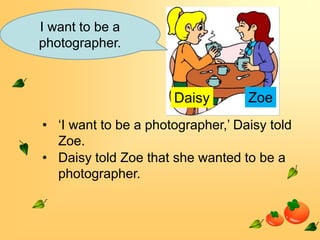
I want to be a
photographer.


                      Daisy        Zoe
• ‘I want to be a photographer,’ Daisy told
  Zoe.
• Daisy told Zoe that she wanted to be a
  photographer.
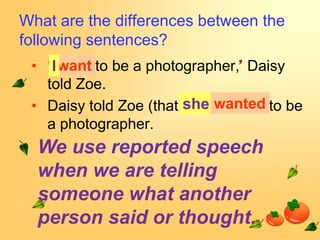
What are the differences between the
following sentences?
 • ‘ I want to be a photographer,’ Daisy
   ‘I want                       ’
   told Zoe.
 • Daisy told Zoe (that)she wanted to be
                          she wanted
   a photographer.
  We use reported speech
  when we are telling
  someone what another
  person said or thought.
When we report statements in simple
present tense, follow these rules:
1. We DO NOT use quotation marks.

‘I want to be a photographer,’ Daisy told
 Zoe.

Daisy told Zoe that she wanted to be a
 photographer.
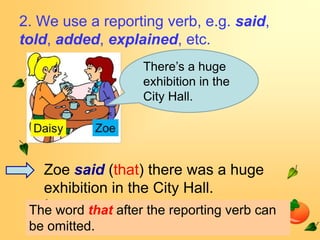
2. We use a reporting verb, e.g. said,
told, added, explained, etc.
                    There’s a huge
                    exhibition in the
                    City Hall.


   Zoe said (that) there was a huge
   exhibition in the City Hall.
 The word that after the reporting verb can
 be omitted.
Your turn….
• ‘I like watching films,’ Rachel said.
• Rachel said (that) she liked watching
  films.

• ‘I love ballet,’ said Bella. ‘I want to be a
  ballet dancer,’ she added.
• Bella said (that) she loved ballet. She
    added (that) she wanted to be a ballet
  dancer.
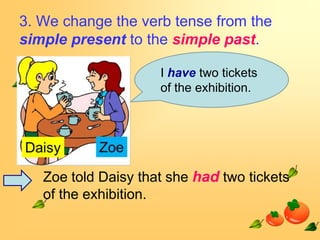
3. We change the verb tense from the
simple present to the simple past.

                     I have two tickets
                     of the exhibition.


   Zoe told Daisy that she had two tickets
   of the exhibition.
Your turn….
• ‘You have my ticket,’ said Jenny.
• Jenny said that I   had       her ticket.

• ‘I plan to take you to a painting exhibition
  next week,’ our Art teacher told us.
• Our Art teacher told us that she planned
  to take us to a painting exhibition.
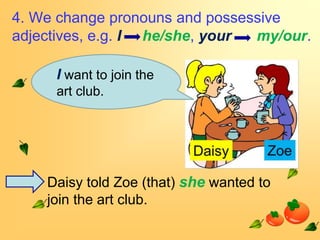
4. We change pronouns and possessive
adjectives, e.g. I he/she, your my/our.

     I want to join the
     art club.


    Daisy told Zoe (that) she wanted to
    join the art club.
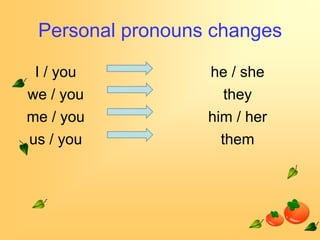
Personal pronouns changes

 I / you          he / she
we / you             they
me / you          him / her
us / you            them
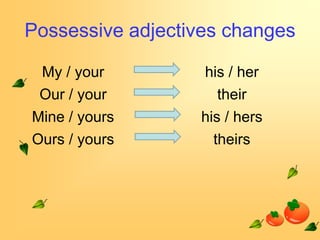
Possessive adjectives changes

 My / your        his / her
 Our / your          their
Mine / yours      his / hers
Ours / yours        theirs
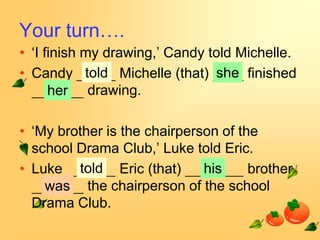
Your turn….
• ‘I finish my drawing,’ Candy told Michelle.
• Candy told Michelle (that) she finished
      her drawing.

• ‘My brother is the chairperson of the
  school Drama Club,’ Luke told Eric.
• Luke told Eric (that)       his     brother
    was the chairperson of the school
  Drama Club.
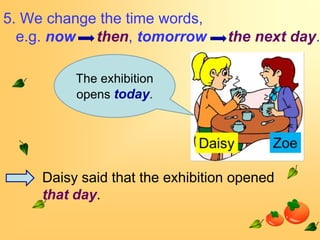
5. We change the time words,
  e.g. now then, tomorrow         the next day.

          The exhibition
          opens today.


     Daisy said that the exhibition opened
     that day.
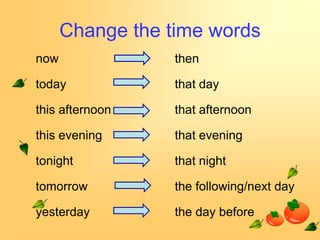
Change the time words
now               then

today             that day

this afternoon    that afternoon

this evening      that evening

tonight           that night

tomorrow          the following/next day

yesterday         the day before
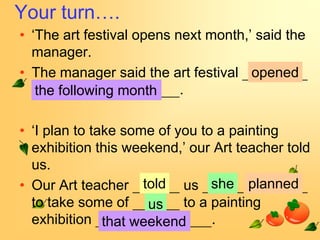
Your turn….
• ‘The art festival opens next month,’ said the
  manager.
• The manager said the art festival opened
   the following month     .

• ‘I plan to take some of you to a painting
  exhibition this weekend,’ our Art teacher told
  us.
• Our Art teacher told us she planned
  to take some of us to a painting
  exhibition that weekend       .
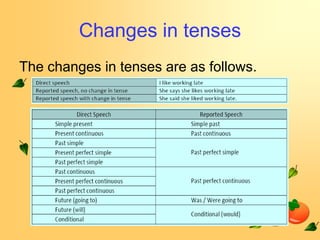
Changes in tenses
The changes in tenses are as follows.

Unit 1-reporting-speech

  • 1.
  • 2.
    I want tobe a photographer. Daisy Zoe • ‘I want to be a photographer,’ Daisy told Zoe. • Daisy told Zoe that she wanted to be a photographer.
  • 3.
    What are thedifferences between the following sentences? • ‘ I want to be a photographer,’ Daisy ‘I want ’ told Zoe. • Daisy told Zoe (that)she wanted to be she wanted a photographer. We use reported speech when we are telling someone what another person said or thought.
  • 4.
    When we reportstatements in simple present tense, follow these rules: 1. We DO NOT use quotation marks. ‘I want to be a photographer,’ Daisy told Zoe. Daisy told Zoe that she wanted to be a photographer.
  • 5.
    2. We usea reporting verb, e.g. said, told, added, explained, etc. There’s a huge exhibition in the City Hall. Zoe said (that) there was a huge exhibition in the City Hall. The word that after the reporting verb can be omitted.
  • 6.
    Your turn…. • ‘Ilike watching films,’ Rachel said. • Rachel said (that) she liked watching films. • ‘I love ballet,’ said Bella. ‘I want to be a ballet dancer,’ she added. • Bella said (that) she loved ballet. She added (that) she wanted to be a ballet dancer.
  • 7.
    3. We changethe verb tense from the simple present to the simple past. I have two tickets of the exhibition. Zoe told Daisy that she had two tickets of the exhibition.
  • 8.
    Your turn…. • ‘Youhave my ticket,’ said Jenny. • Jenny said that I had her ticket. • ‘I plan to take you to a painting exhibition next week,’ our Art teacher told us. • Our Art teacher told us that she planned to take us to a painting exhibition.
  • 9.
    4. We changepronouns and possessive adjectives, e.g. I he/she, your my/our. I want to join the art club. Daisy told Zoe (that) she wanted to join the art club.
  • 10.
    Personal pronouns changes I / you he / she we / you they me / you him / her us / you them
  • 11.
    Possessive adjectives changes My / your his / her Our / your their Mine / yours his / hers Ours / yours theirs
  • 12.
    Your turn…. • ‘Ifinish my drawing,’ Candy told Michelle. • Candy told Michelle (that) she finished her drawing. • ‘My brother is the chairperson of the school Drama Club,’ Luke told Eric. • Luke told Eric (that) his brother was the chairperson of the school Drama Club.
  • 13.
    5. We changethe time words, e.g. now then, tomorrow the next day. The exhibition opens today. Daisy said that the exhibition opened that day.
  • 14.
    Change the timewords now then today that day this afternoon that afternoon this evening that evening tonight that night tomorrow the following/next day yesterday the day before
  • 15.
    Your turn…. • ‘Theart festival opens next month,’ said the manager. • The manager said the art festival opened the following month . • ‘I plan to take some of you to a painting exhibition this weekend,’ our Art teacher told us. • Our Art teacher told us she planned to take some of us to a painting exhibition that weekend .
  • 16.
    Changes in tenses Thechanges in tenses are as follows.