This document provides an introduction to control accounts in financial accounting. It defines key terms like ledgers, explains the main purposes of control accounts to verify subsidiary ledger balances and locate errors. It also discusses how control accounts relate to the double entry system and provides examples of common control account types like the sales ledger control account and purchases ledger control account. Sample control account transactions and solutions to practice questions are presented to illustrate the application of control account principles.
Objectives
By the endof this unit, you should be able to:
Define key terms such as ledger, sales ledger, purchases ledger
and control account
Explain the main purposes of a control account
Explain how control accounts relate to the double entry system
Accurately prepare sales and purchases ledger control accounts
Apply control accounts principles to general ledger accounts
3.
What is aledger?
A ledger records financial transactions from journals as
debits and credits
It holds account information that is needed to prepare
financial statements
Three main types of ledgers:
Sales ledger
Purchases ledger
General ledger
4.
Types of ledgers(cont’d)
Sales Ledger
A subsidiary ledger in which the personal accounts of
credit customers (debtors) are kept
The balance of a customer’s account shows the amount
that the customer owes the business
Therefore, the total of balances in the sales ledger is the
total owed by credit customers (accounts receivable)
5.
Types of ledgers(cont’d)
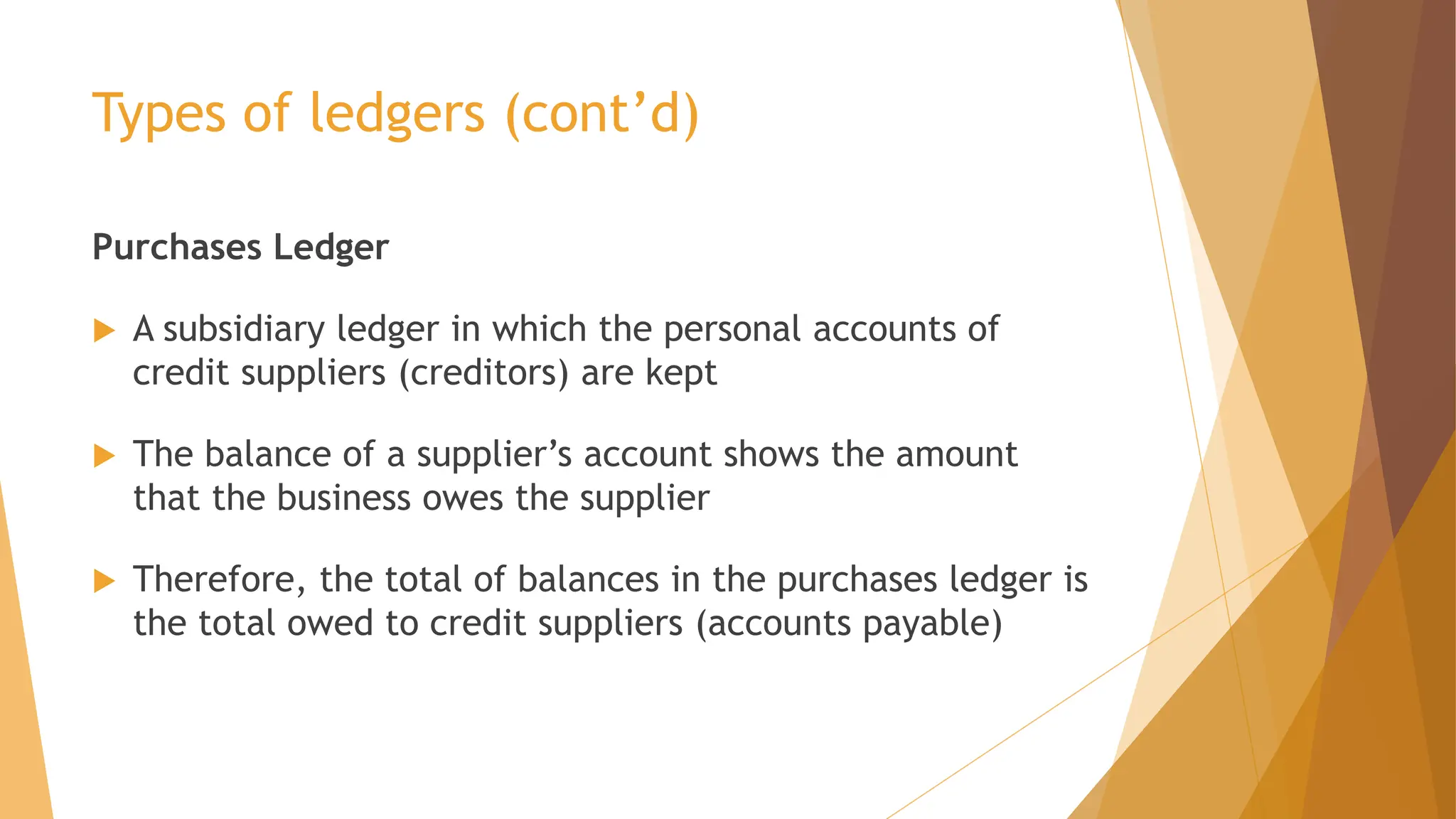
Purchases Ledger
A subsidiary ledger in which the personal accounts of
credit suppliers (creditors) are kept
The balance of a supplier’s account shows the amount
that the business owes the supplier
Therefore, the total of balances in the purchases ledger is
the total owed to credit suppliers (accounts payable)
6.
Types of ledgers(cont’d)
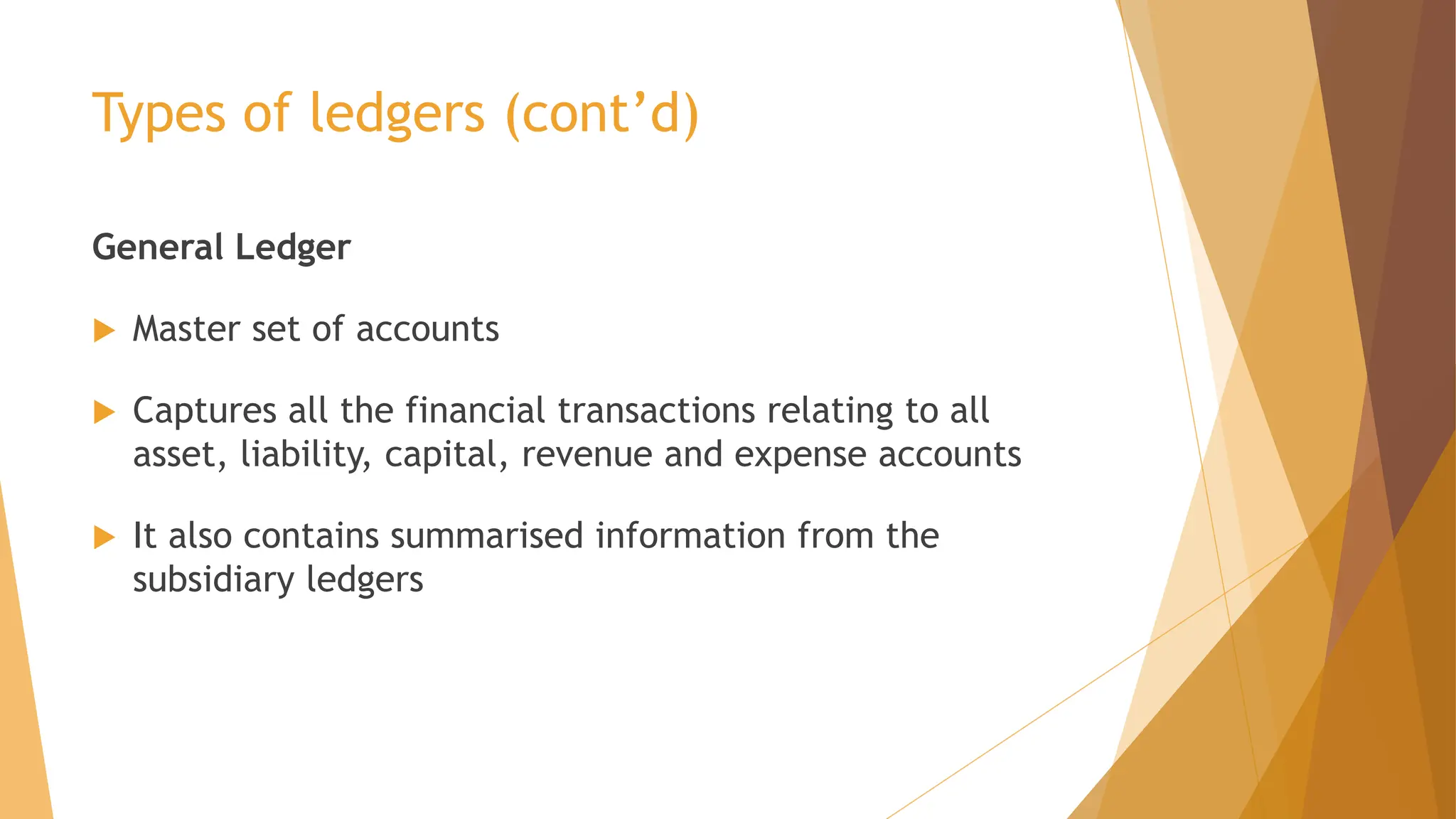
General Ledger
Master set of accounts
Captures all the financial transactions relating to all
asset, liability, capital, revenue and expense accounts
It also contains summarised information from the
subsidiary ledgers
7.
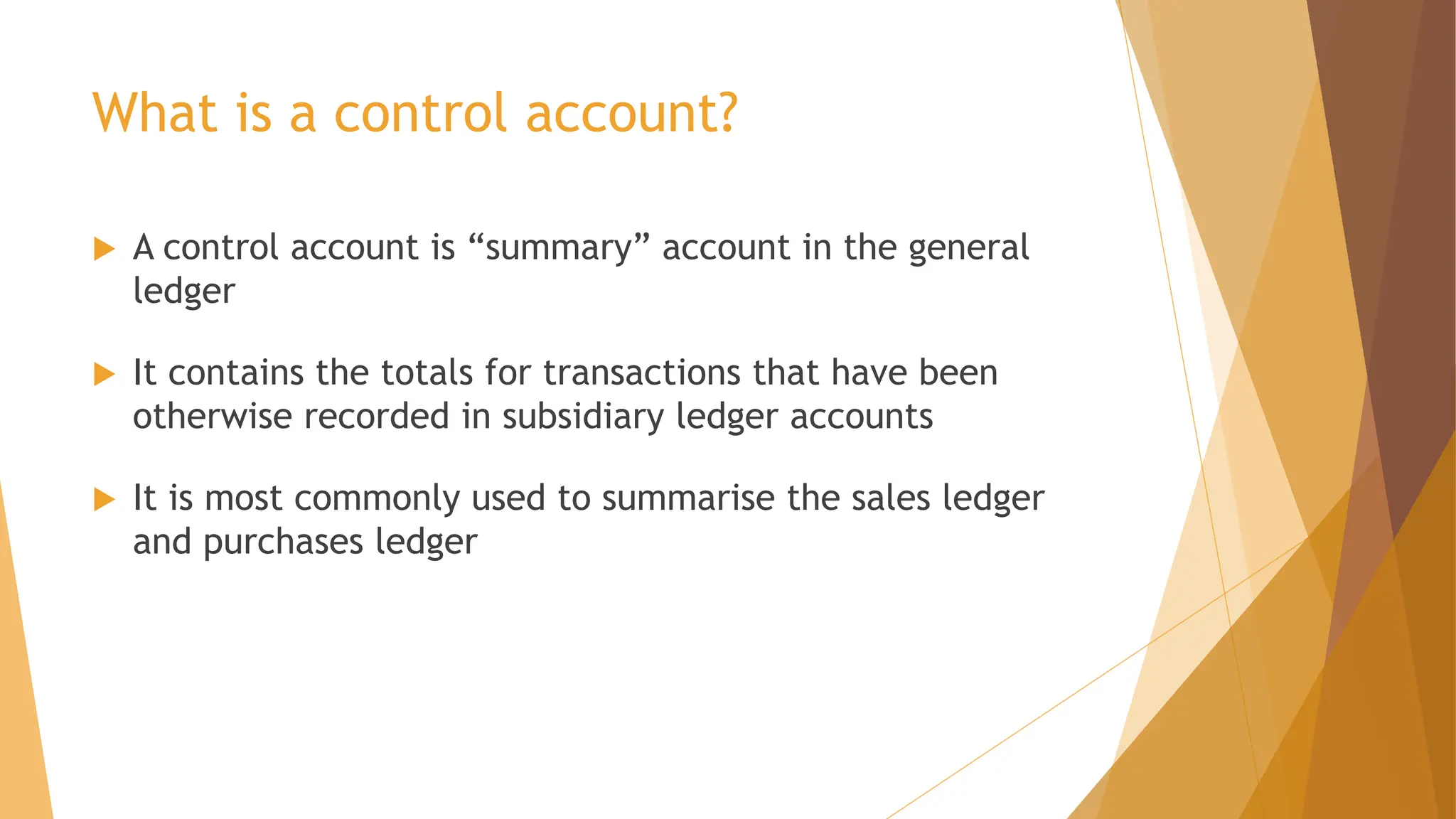
What is acontrol account?
A control account is “summary” account in the general
ledger
It contains the totals for transactions that have been
otherwise recorded in subsidiary ledger accounts
It is most commonly used to summarise the sales ledger
and purchases ledger
8.
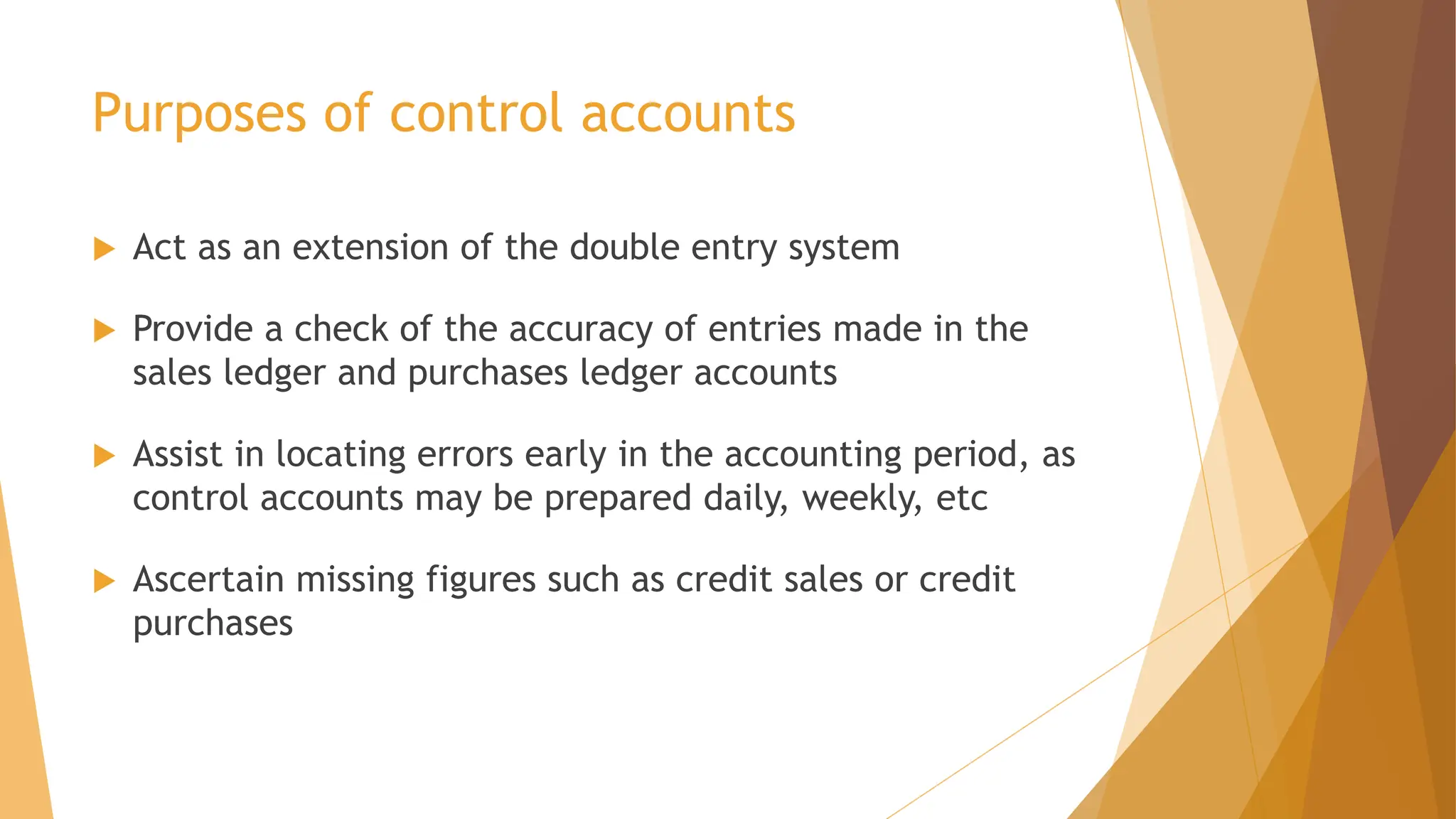
Purposes of controlaccounts
Act as an extension of the double entry system
Provide a check of the accuracy of entries made in the
sales ledger and purchases ledger accounts
Assist in locating errors early in the accounting period, as
control accounts may be prepared daily, weekly, etc
Ascertain missing figures such as credit sales or credit
purchases
9.
Common types ofcontrol accounts
The two most commonly used control accounts:
Sales ledger control account
Purchases ledger control account
10.
Sales ledger controlaccount
The sales ledger control account (SLCA) is used to verify
the balance in the sales ledger accounts
It is also called the total debtors control account
11.
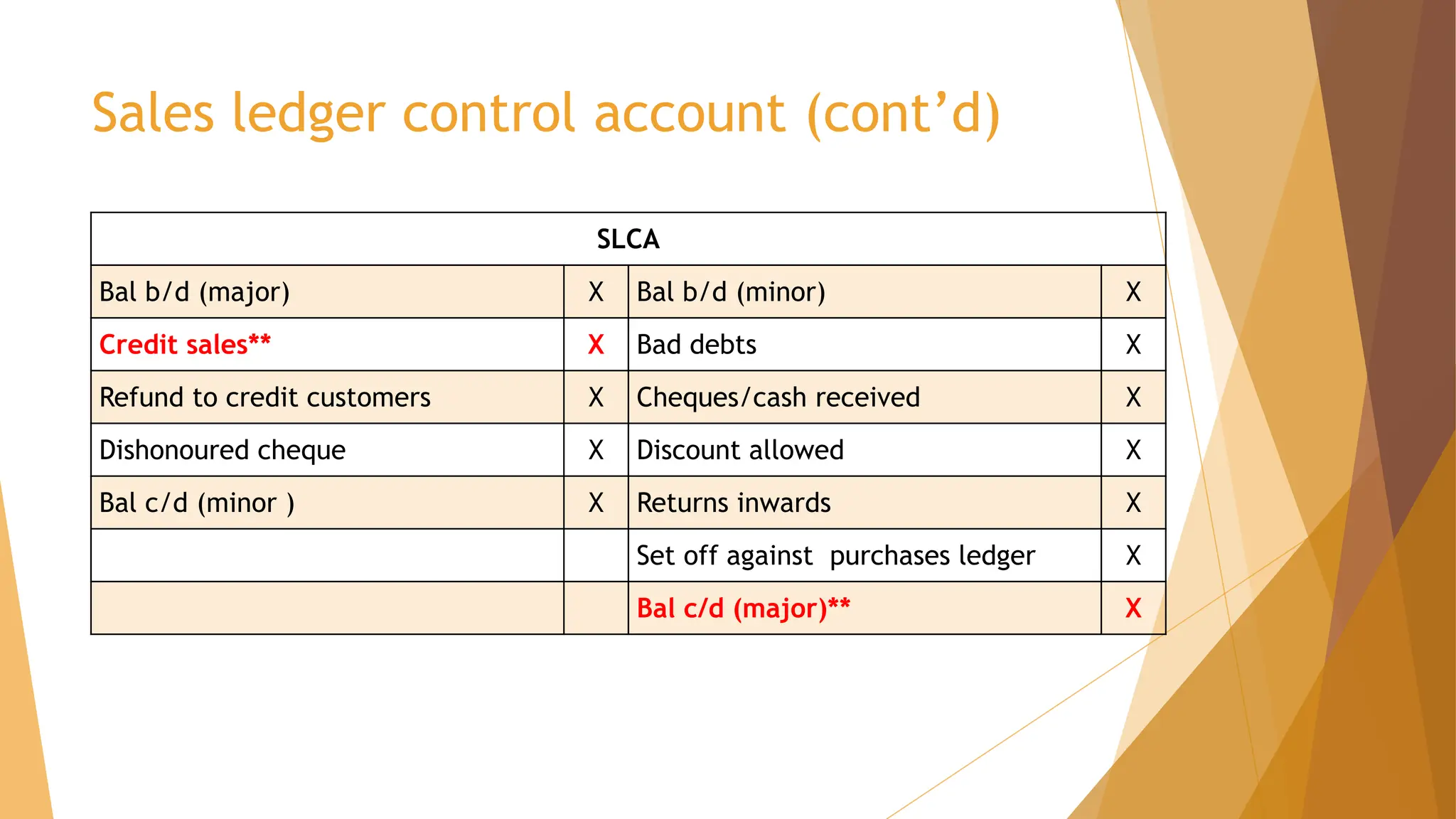
Sales ledger controlaccount (cont’d)
SLCA
Bal b/d (major) X Bal b/d (minor) X
Credit sales** X Bad debts X
Refund to credit customers X Cheques/cash received X
Dishonoured cheque X Discount allowed X
Bal c/d (minor ) X Returns inwards X
Set off against purchases ledger X
Bal c/d (major)** X
12.
Purchases ledger controlaccount
The purchases ledger control account (PLCA) is used to
verify the balance in the purchases ledger accounts
It is also called the total creditors control account
13.
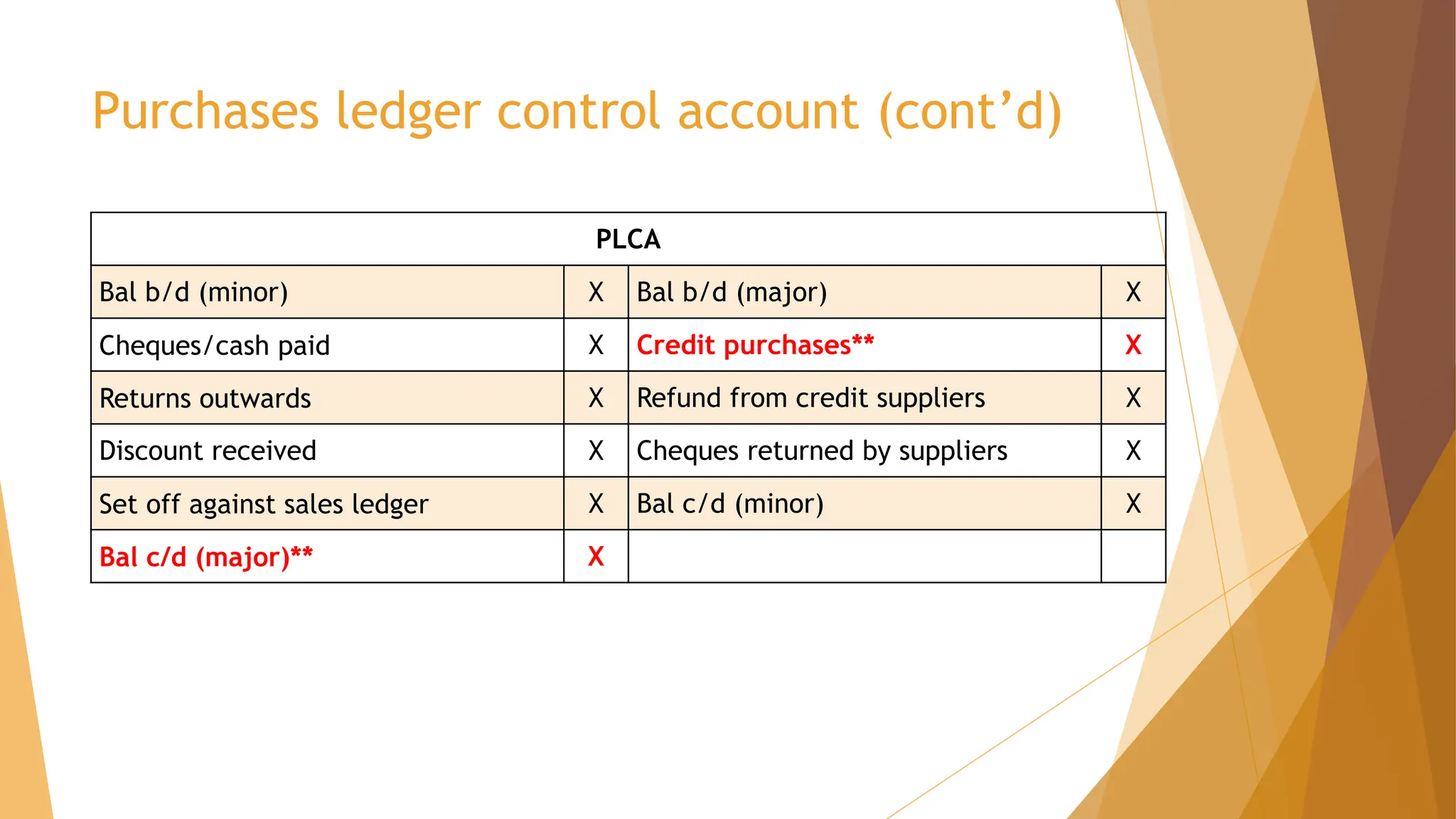
Purchases ledger controlaccount (cont’d)
PLCA
Bal b/d (minor) X Bal b/d (major) X
Cheques/cash paid X Credit purchases** X
Returns outwards X Refund from credit suppliers X
Discount received X Cheques returned by suppliers X
Set off against sales ledger X Bal c/d (minor) X
Bal c/d (major)** X
14.
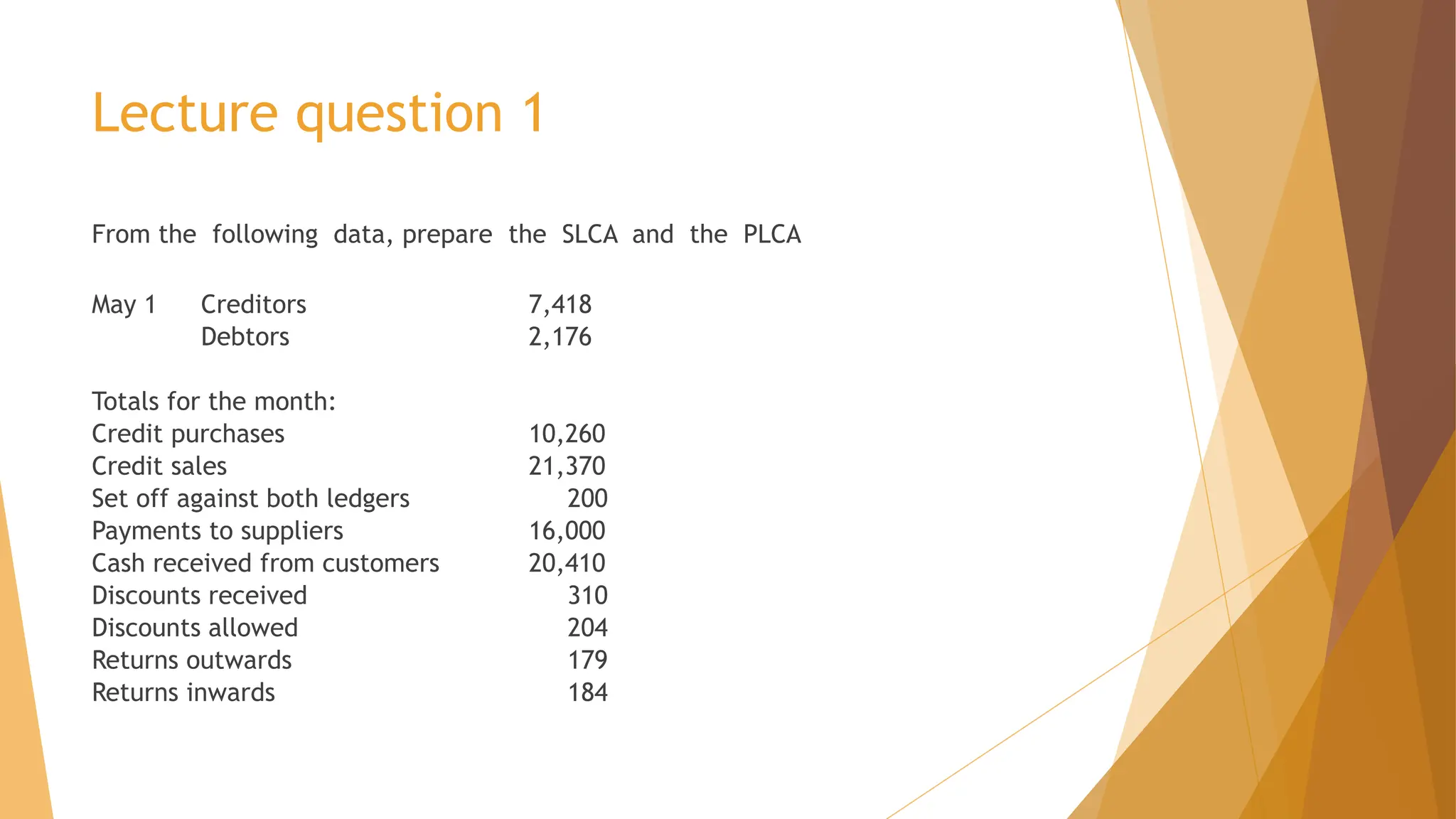
Lecture question 1
Fromthe following data, prepare the SLCA and the PLCA
May 1 Creditors 7,418
Debtors 2,176
Totals for the month:
Credit purchases 10,260
Credit sales 21,370
Set off against both ledgers 200
Payments to suppliers 16,000
Cash received from customers 20,410
Discounts received 310
Discounts allowed 204
Returns outwards 179
Returns inwards 184
15.
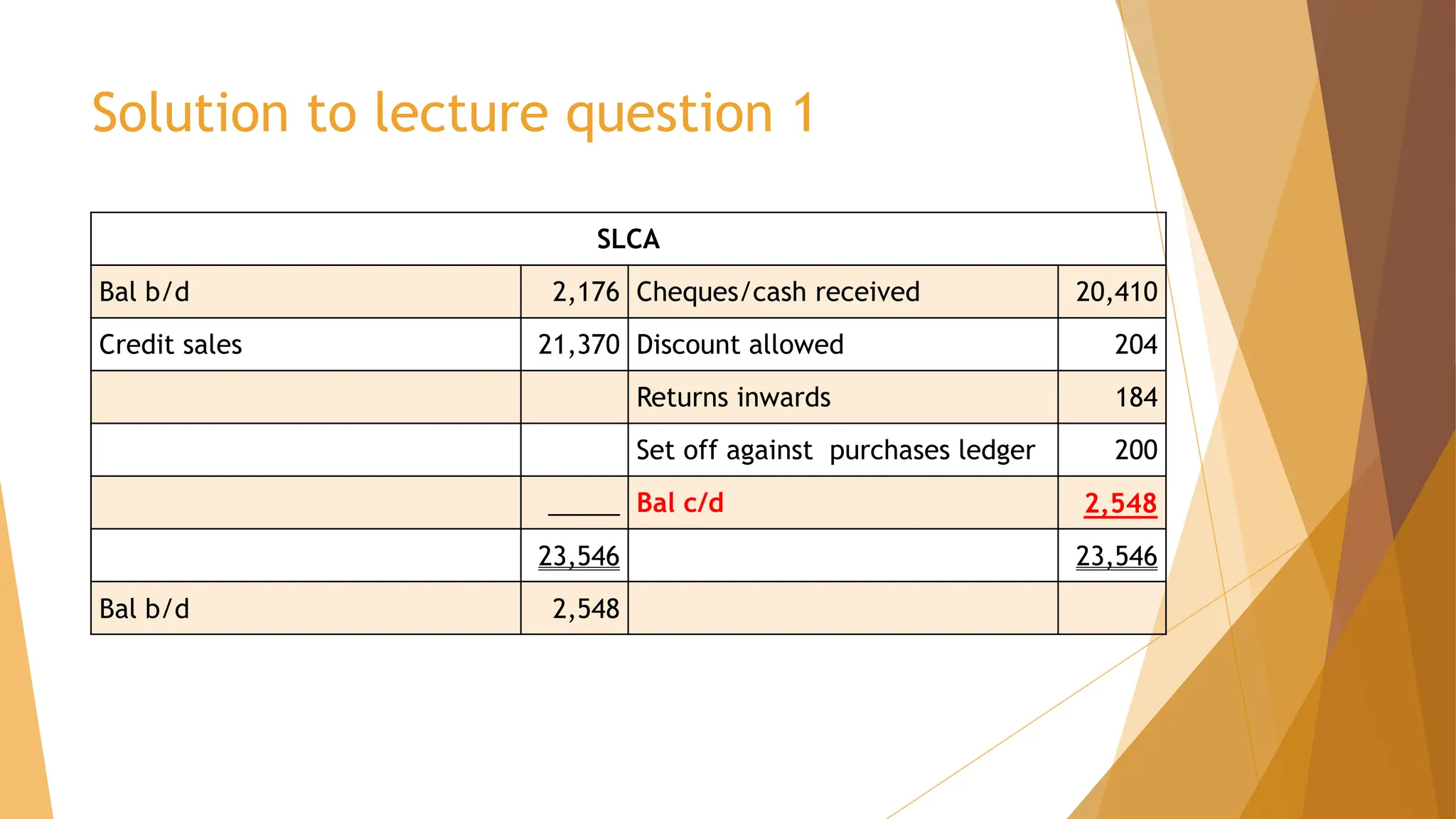
Solution to lecturequestion 1
SLCA
Bal b/d 2,176 Cheques/cash received 20,410
Credit sales 21,370 Discount allowed 204
Returns inwards 184
Set off against purchases ledger 200
_____ Bal c/d 2,548
23,546 23,546
Bal b/d 2,548
16.
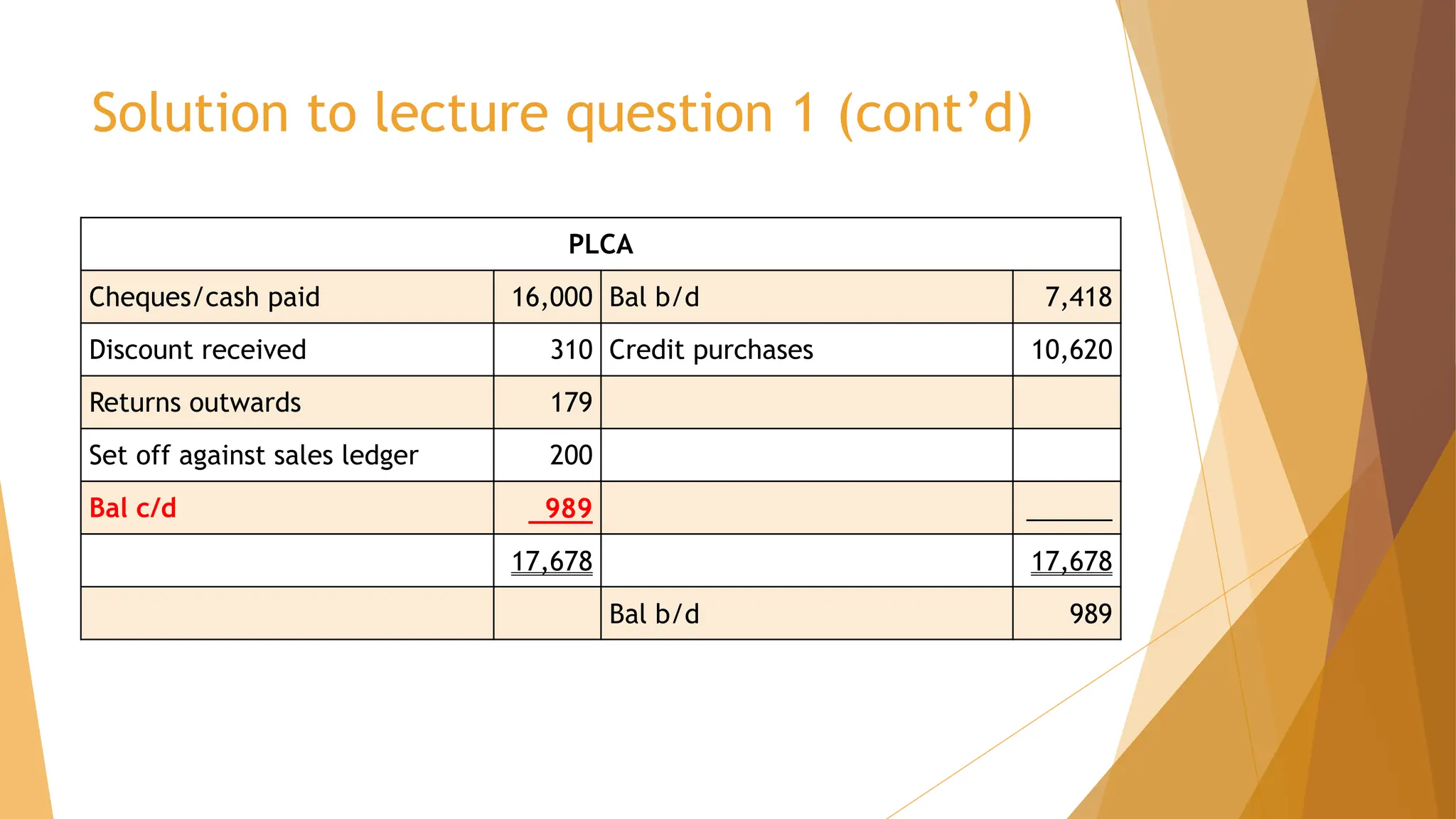
Solution to lecturequestion 1 (cont’d)
PLCA
Cheques/cash paid 16,000 Bal b/d 7,418
Discount received 310 Credit purchases 10,620
Returns outwards 179
Set off against sales ledger 200
Bal c/d 989 ______
17,678 17,678
Bal b/d 989
17.
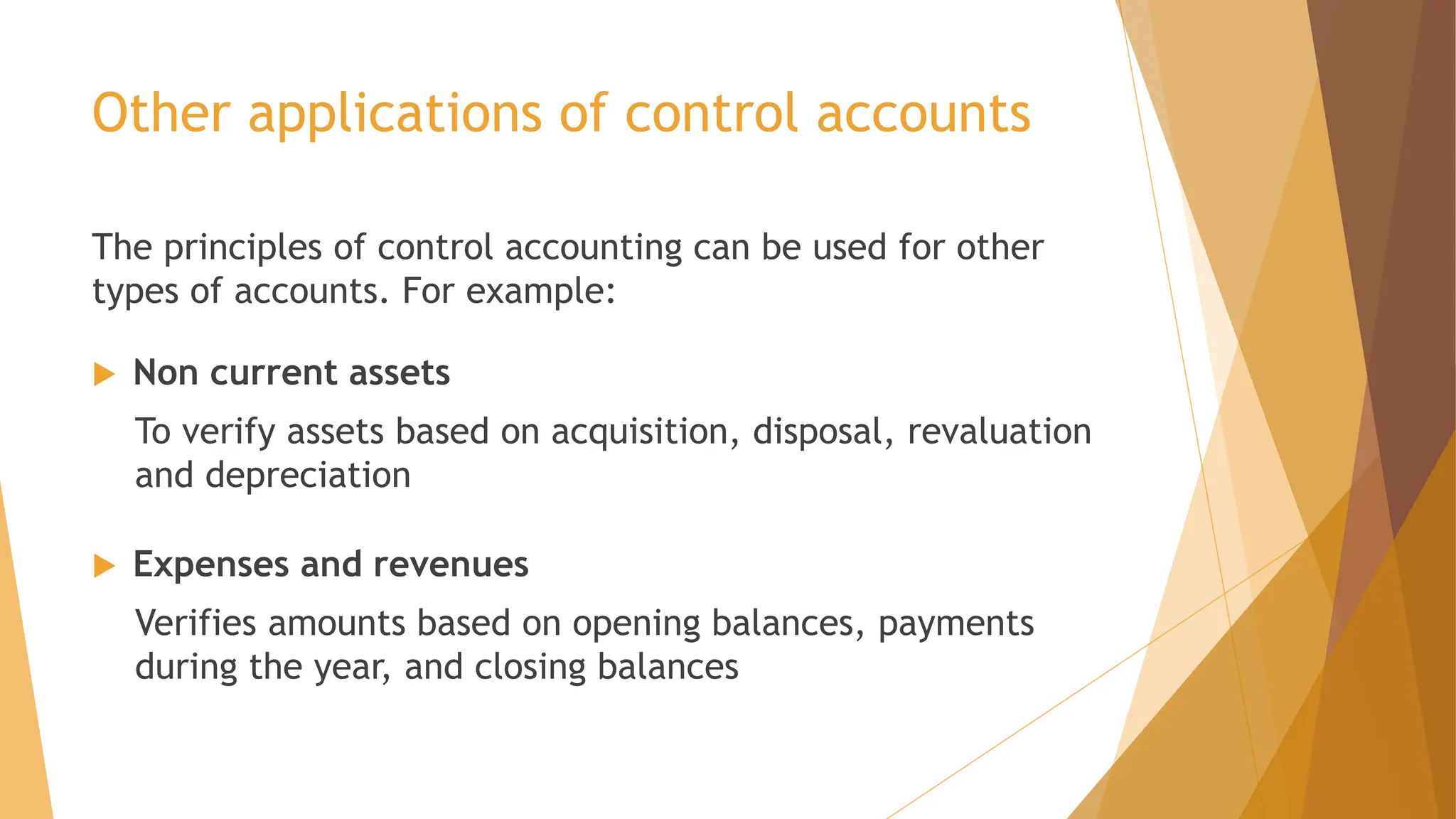
Other applications ofcontrol accounts
The principles of control accounting can be used for other
types of accounts. For example:
Non current assets
To verify assets based on acquisition, disposal, revaluation
and depreciation
Expenses and revenues
Verifies amounts based on opening balances, payments
during the year, and closing balances
18.
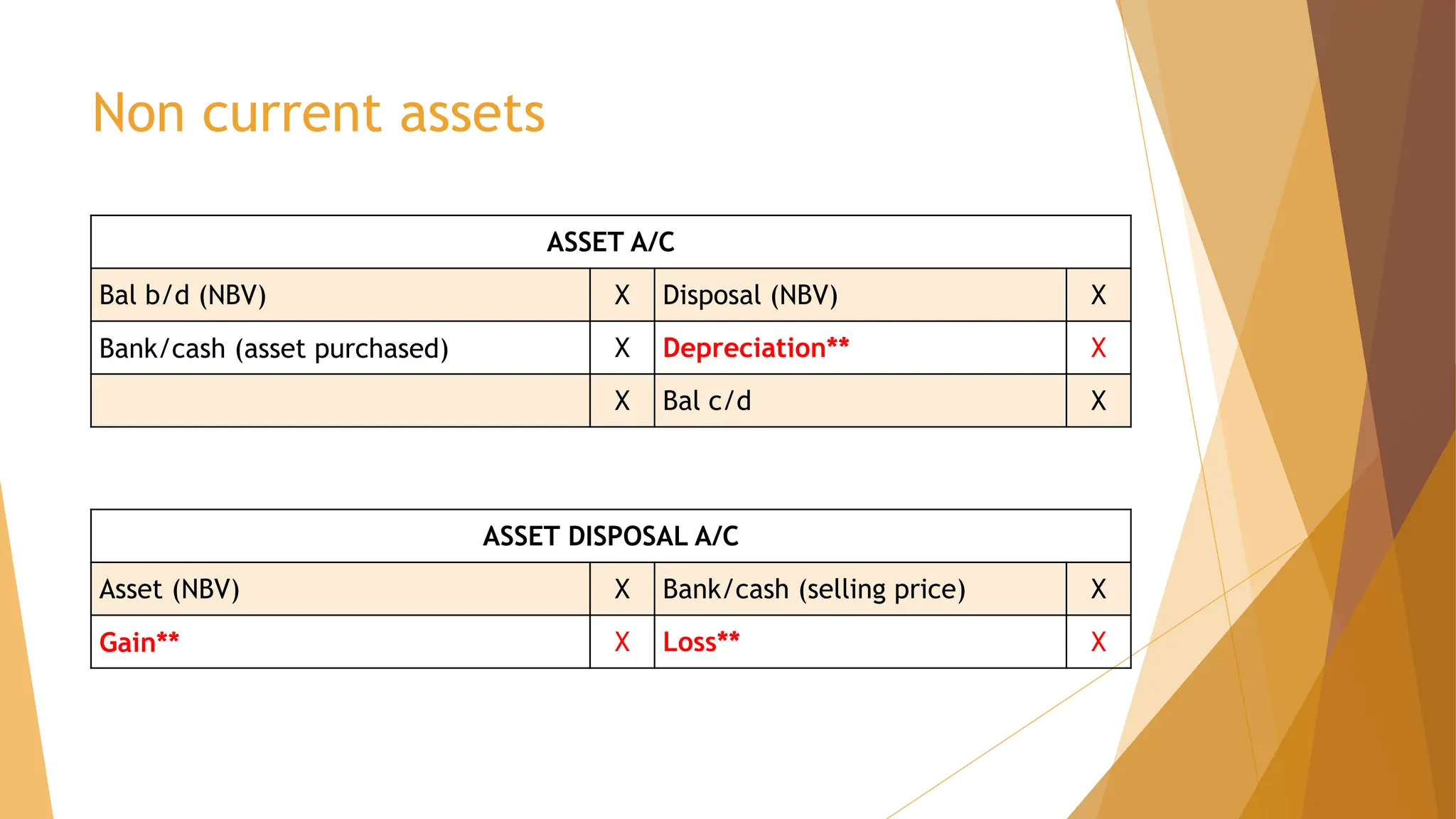
Non current assets
ASSETA/C
Bal b/d (NBV) X Disposal (NBV) X
Bank/cash (asset purchased) X Depreciation** X
X Bal c/d X
ASSET DISPOSAL A/C
Asset (NBV) X Bank/cash (selling price) X
Gain** X Loss** X
19.
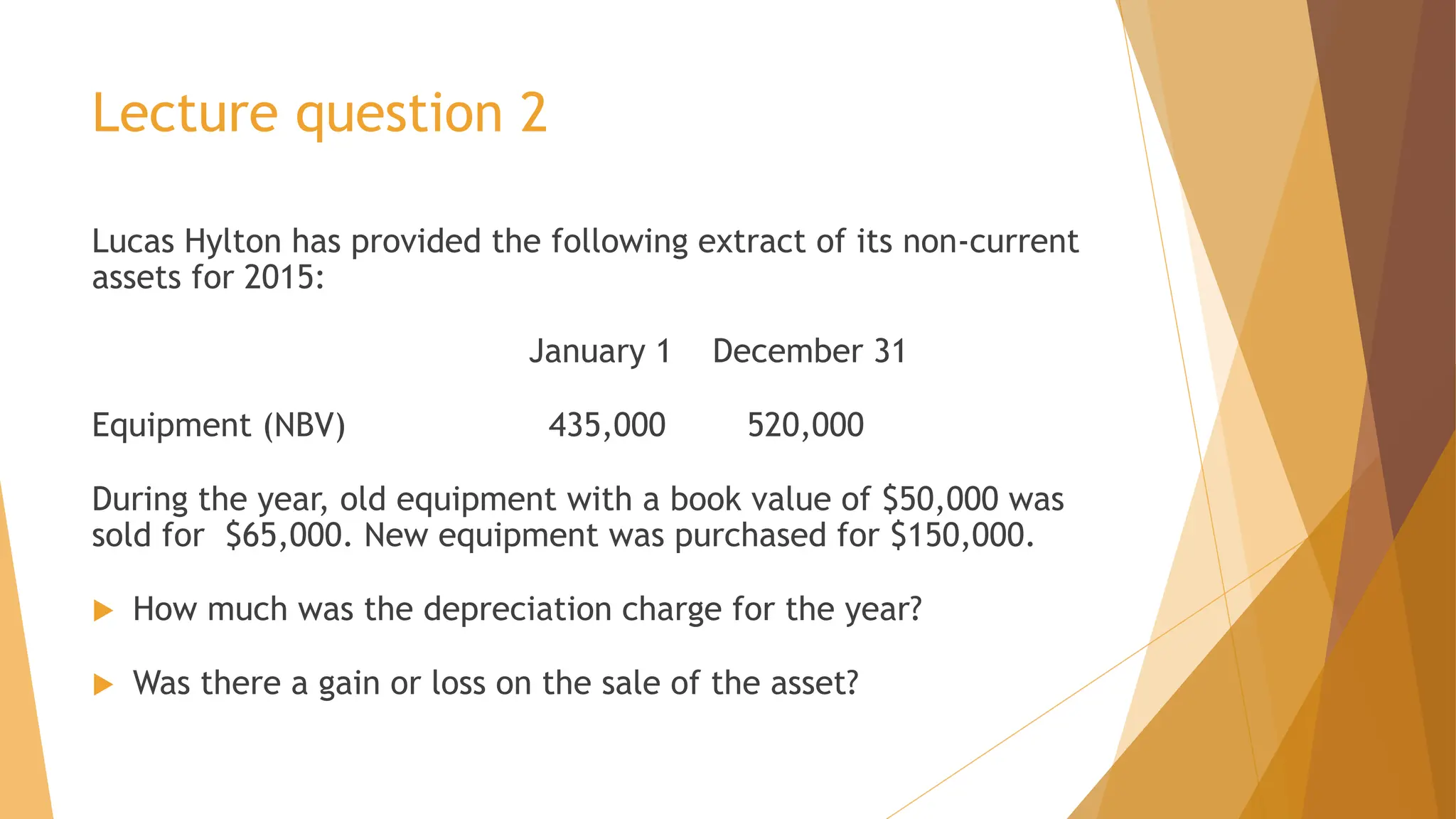
Lecture question 2
LucasHylton has provided the following extract of its non-current
assets for 2015:
January 1 December 31
Equipment (NBV) 435,000 520,000
During the year, old equipment with a book value of $50,000 was
sold for $65,000. New equipment was purchased for $150,000.
How much was the depreciation charge for the year?
Was there a gain or loss on the sale of the asset?
20.
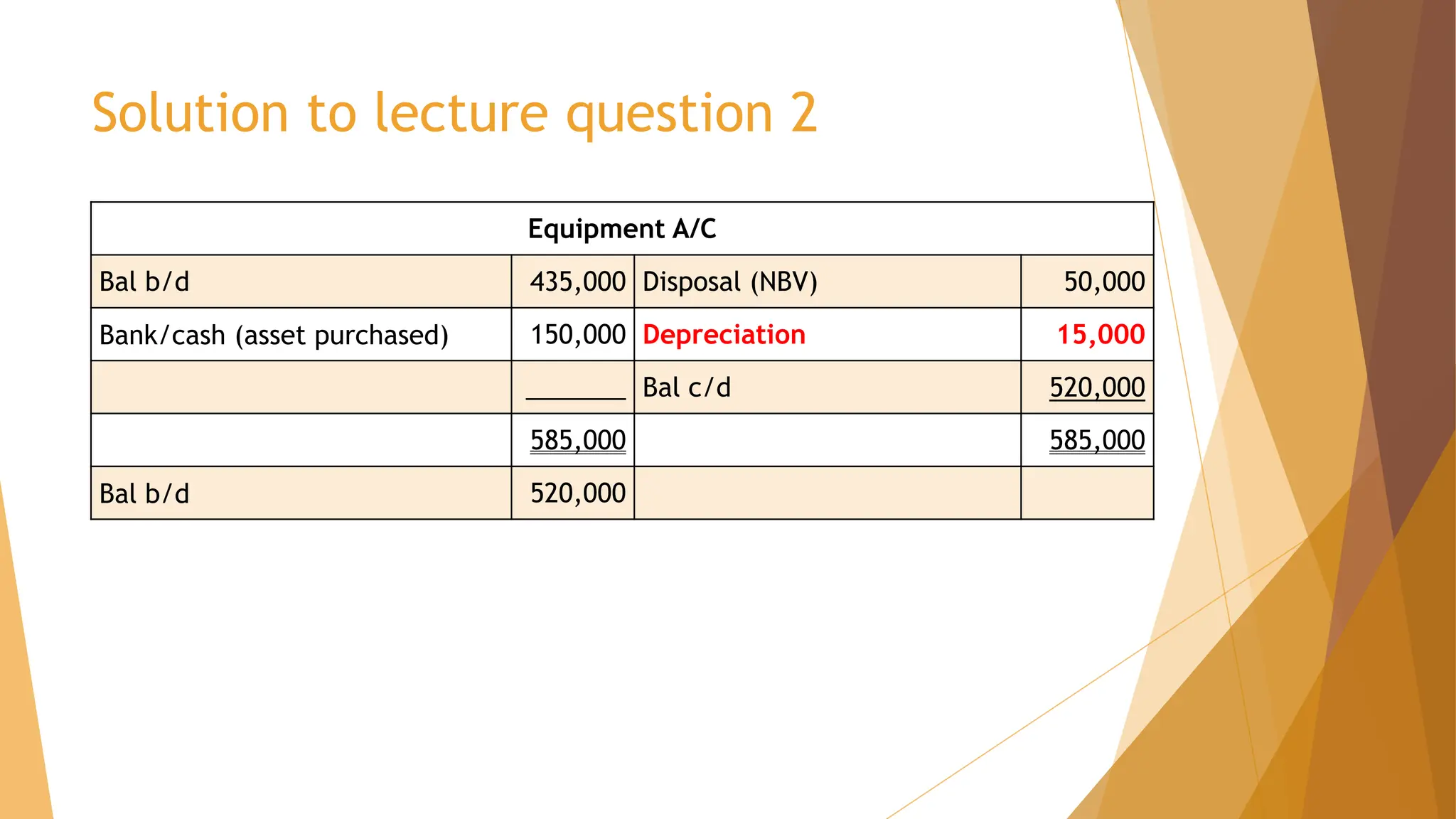
Solution to lecturequestion 2
Equipment A/C
Bal b/d 435,000 Disposal (NBV) 50,000
Bank/cash (asset purchased) 150,000 Depreciation 15,000
_______ Bal c/d 520,000
585,000 585,000
Bal b/d 520,000
21.
Solution to lecturequestion 2 (cont’d)
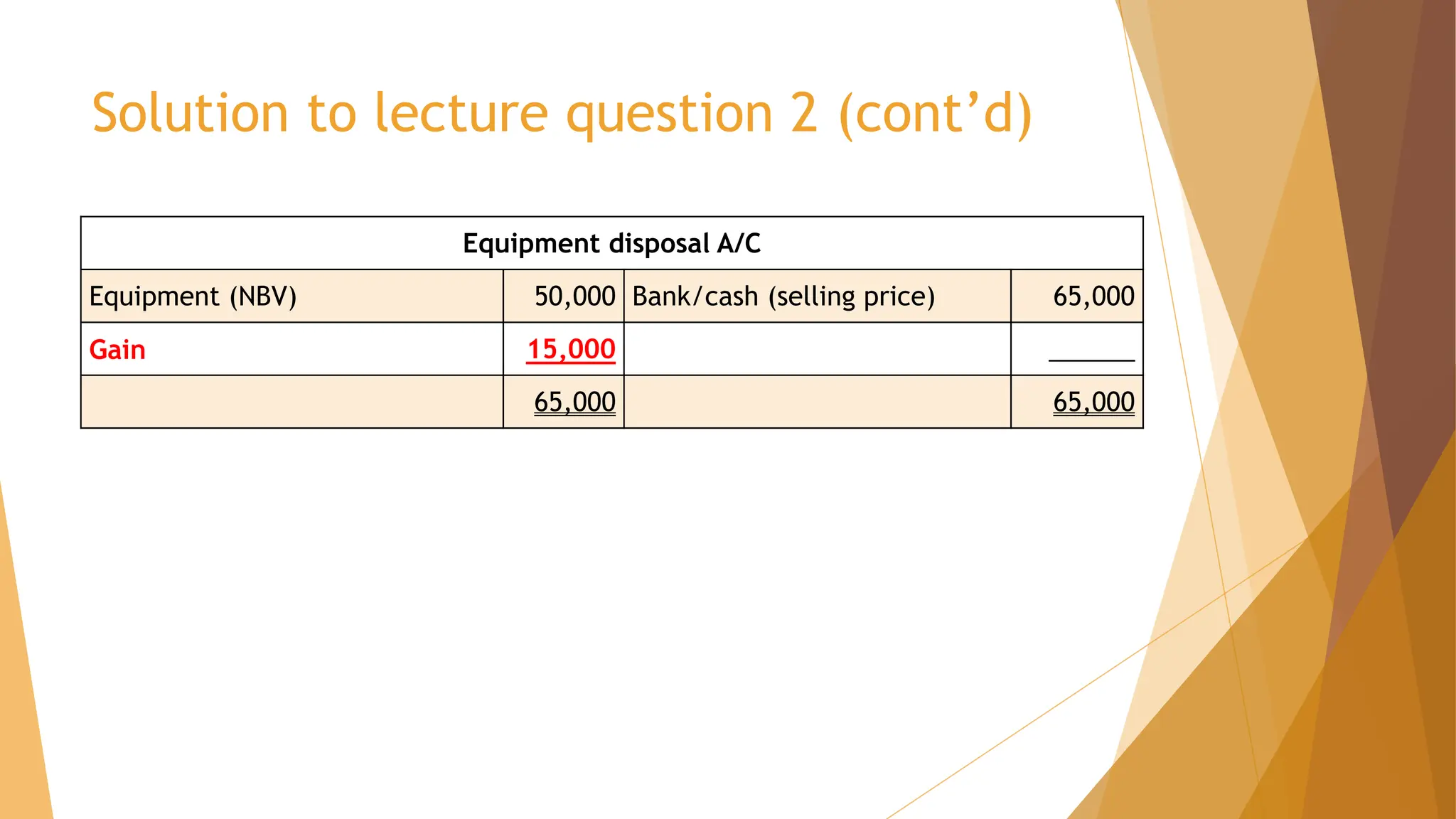
Equipment disposal A/C
Equipment (NBV) 50,000 Bank/cash (selling price) 65,000
Gain 15,000 ______
65,000 65,000
22.
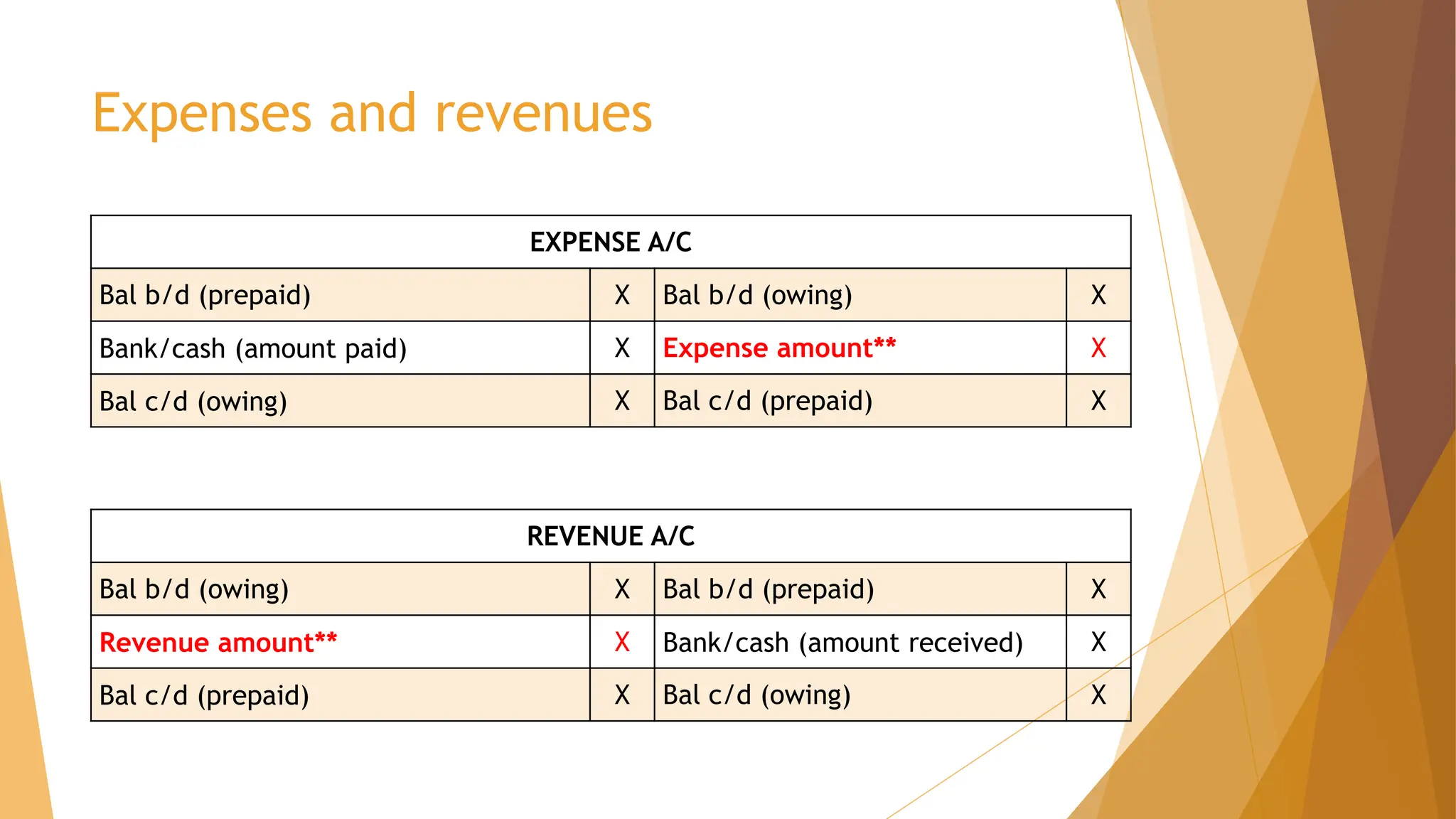
Expenses and revenues
EXPENSEA/C
Bal b/d (prepaid) X Bal b/d (owing) X
Bank/cash (amount paid) X Expense amount** X
Bal c/d (owing) X Bal c/d (prepaid) X
REVENUE A/C
Bal b/d (owing) X Bal b/d (prepaid) X
Revenue amount** X Bank/cash (amount received) X
Bal c/d (prepaid) X Bal c/d (owing) X
23.
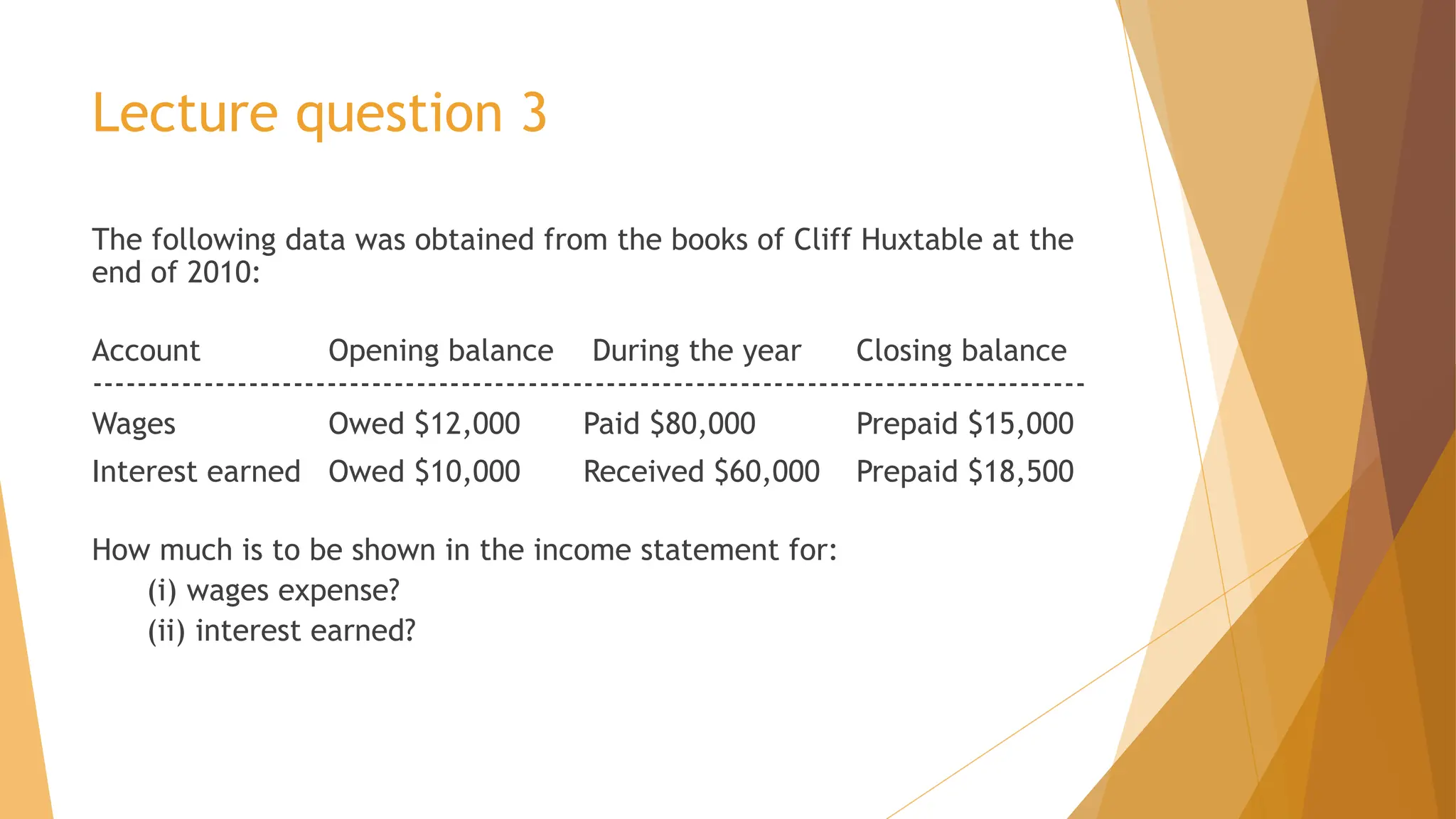
Lecture question 3
Thefollowing data was obtained from the books of Cliff Huxtable at the
end of 2010:
Account Opening balance During the year Closing balance
-----------------------------------------------------------------------------------------
Wages Owed $12,000 Paid $80,000 Prepaid $15,000
Interest earned Owed $10,000 Received $60,000 Prepaid $18,500
How much is to be shown in the income statement for:
(i) wages expense?
(ii) interest earned?
24.
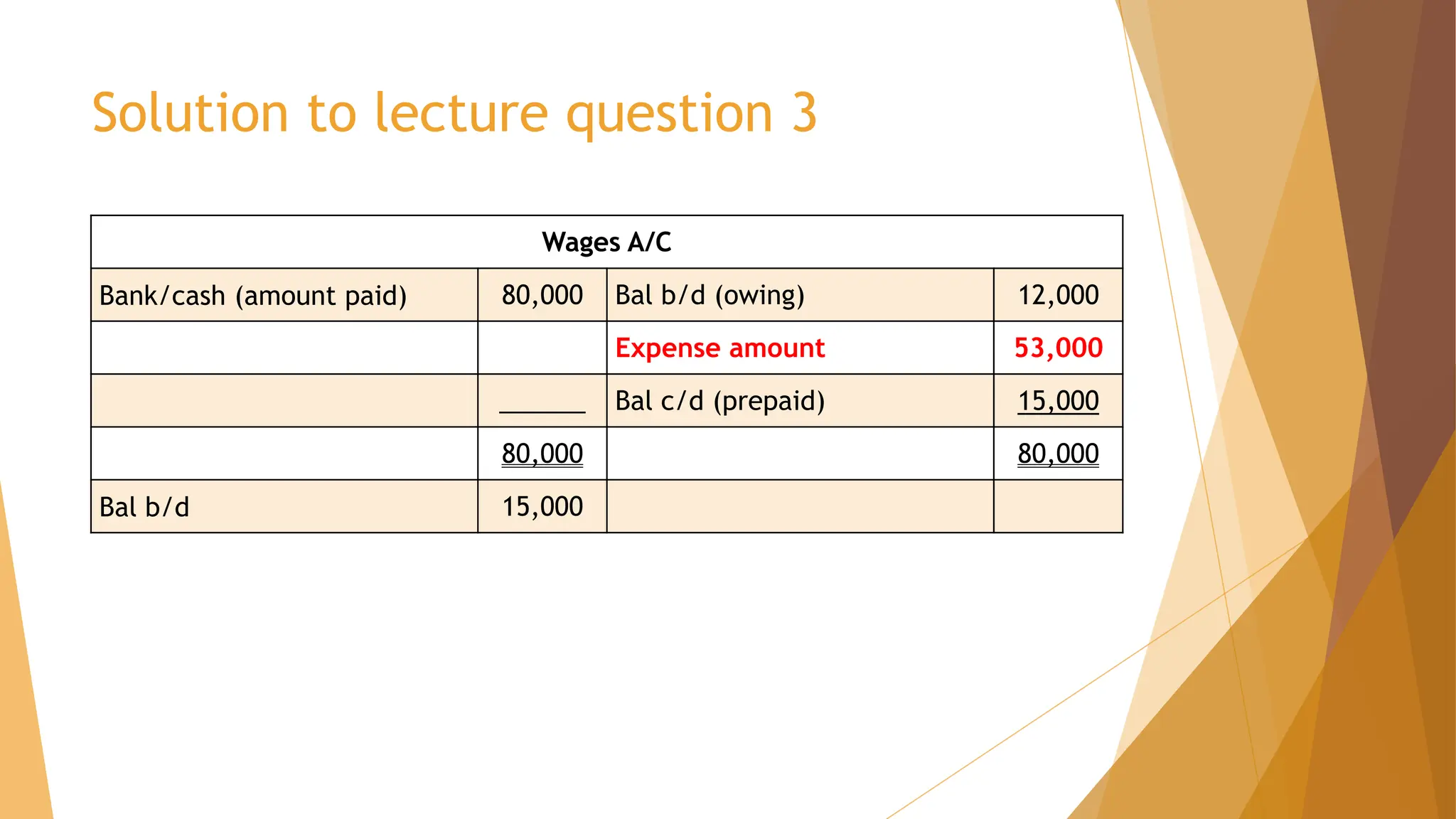
Solution to lecturequestion 3
Wages A/C
Bank/cash (amount paid) 80,000 Bal b/d (owing) 12,000
Expense amount 53,000
______ Bal c/d (prepaid) 15,000
80,000 80,000
Bal b/d 15,000
25.
Solution to lecturequestion 3 (cont’d)
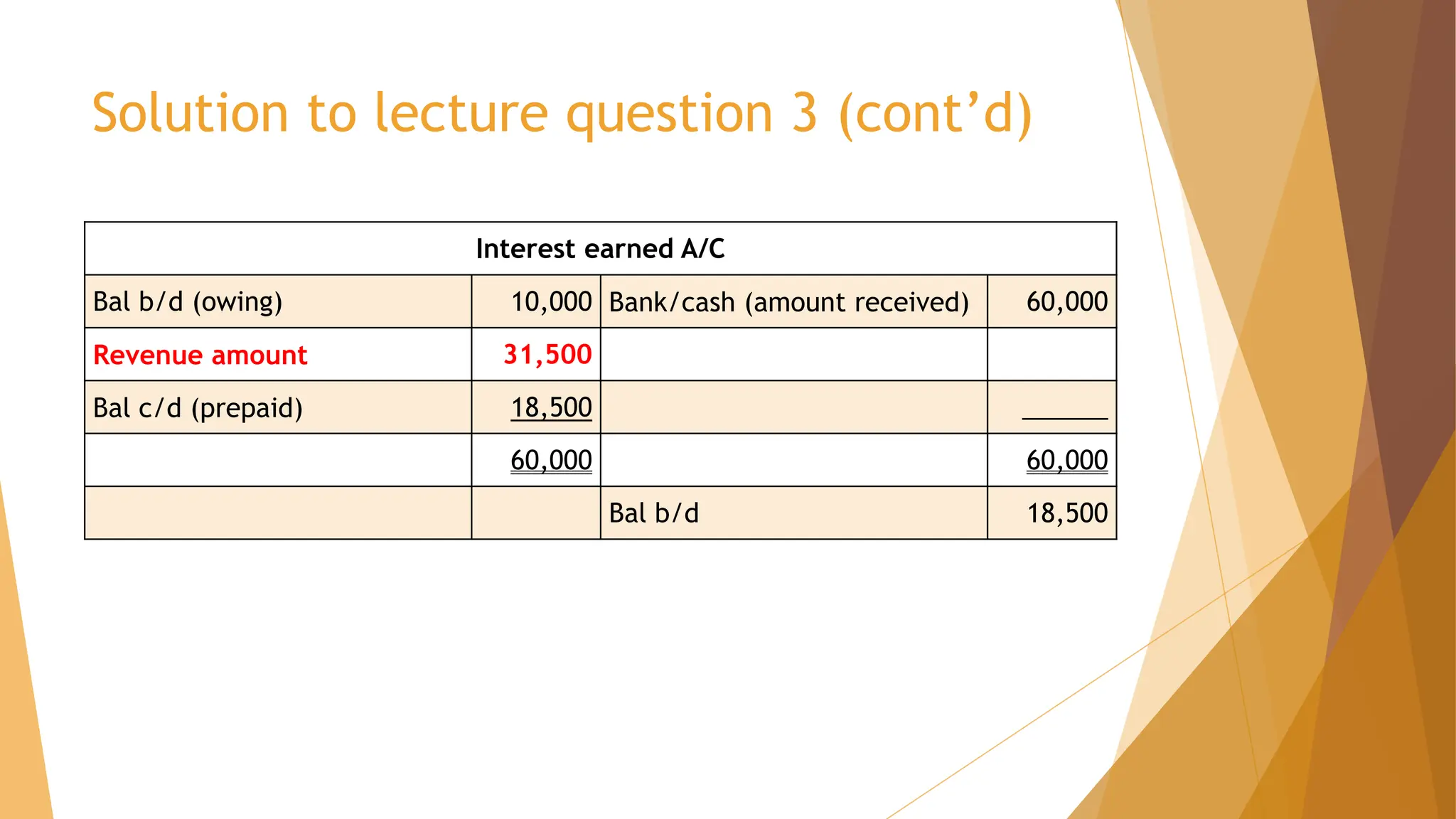
Interest earned A/C
Bal b/d (owing) 10,000 Bank/cash (amount received) 60,000
Revenue amount 31,500
Bal c/d (prepaid) 18,500 ______
60,000 60,000
Bal b/d 18,500