Unit 1.2 Why Do Businesses Exist?
The purpose of business To provide a service To make a profit For charitable purposes To develop a good idea
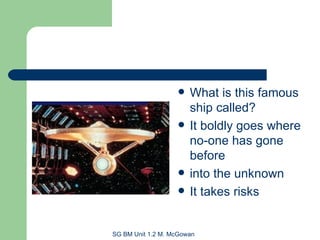
What is this famous ship called? It boldly goes where no-one has gone before into the unknown It takes risks
What is Enterprise? Enterprise is the art of bringing together land, labour and capital  –   the factors of production The person who is responsible for bringing together the factors of production is called an  entrepreneur
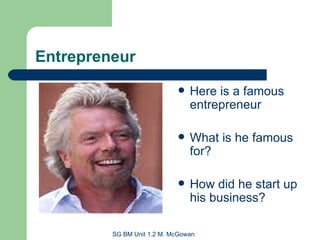
Entrepreneur Here is a famous entrepreneur What is he famous for? How did he start up his business?
Risk Taking Starting a new businesses involves risk. Why?  Because it is a venture into the unknown Entrepreneurs take risks: To make bigger profits To increase market share To survive To grow
Aims of the business Different organisations have different aims and objectives. Remember the three business sectors? Private Public Voluntary
Private Sector Aims The Private sector aims are all  Profit-related To survive To break-even To maximise profits To increase shareholder returns To expand and grow
Public Sector Aims The Public sector aims are  Service-related To improve quality of service To cut costs/break-even To raise revenue
Voluntary Sector Aims Voluntary sector aims are all  aid-related To help people To maximise cash collection To offer more community services To recruit more helpers To open more branches/shops
Having an Interest in a Business Southsiders  is a new TV soap being made. It is expected to attract 15 million viewers. Who would benefit from this? They have a  stake  in the future success of the business!
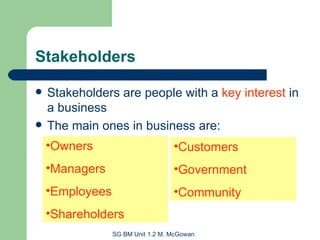
Stakeholders Stakeholders are people with a  key interest  in a business The main ones in business are: Customers Government Community Owners Managers Employees Shareholders
But…..! Some groups can be both internal and external stakeholders Such as staff or shareholders who are also local residents Can you think of any others?
Owners and Shareholders The number of owners and the roles they carry out differ according to the size of the firm In small businesses there may be only one owner (sole trader) or perhaps a small number of partners (partnership) In large firms there are often thousands of shareholders, who each own a small part of the business
organise make decisions plan control are accountable to the owner(s) Managers
Employees A business needs staff or employees to carry out its activities Employees agree to work a certain  number of hours  in return for a wage or salary Pay levels vary with skills, qualifications, age, location, types of work and industry and other factors
Customers Customers buy the goods or services produced by firms They may be individuals or other businesses Firms must understand and meet the needs of their customers, otherwise they will fail to make a profit or, indeed, survive
Firms get the  resources  they need to produce goods and services from suppliers Businesses should have  effective relationships  with their suppliers in order to get quality resources at reasonable prices This is a two-way process, as suppliers depend on the firms they supply Suppliers
Firms and the communities they exist in are also in a  two-way relationship The local community may often provide many of the firm’s staff and customers The business often supplies goods and services vital to the local area But at times the community can feel aggrieved by some aspects of what a firm does Community
Economic policies  affect firms’ costs (through taxation and interest rates) Legislation  regulates what business can do in areas such as the environment and occupational safety and health Successful firms are good for governments as they create wealth and employment Government
Economic Systems What is the Economy? A system which tries to solve the Basic Economic Problem What is The Basic Economic Problem? How scarce resources with different uses are allocated to satisfy wants
Types of Economic System Centrally Planned System Free Market System Mixed System
Centrally Planned System All economic decisions made by government All firms & resources owned by Govt. Decisions taken by Govt. in interest of people Communist countries like former Soviet Union and the Eastern European nations used this. China and Cuba still do.
Free Market System Free market decisions about what is to be produced is made by the consumers and producers. The government does not intervene. This is what Adam Smith called ‘Laissez-faire’. Companies have to listen to customers in order to survive. If they don’t, they go bust! The United States is a free market system.
Mixed System A mixed economy combines elements of both systems. Some decisions are made by producers and consumers, while the government still make some decisions. The UK is a mixed economy. We have a large private sector and a large public sector too.
Infrastructure Infrastructure  – road, rail, air links, sewage, telephone systems and utilities which provide a network that benefits both businesses and the community Building such systems require lots of  capital , but can be seen as a good future investment
Balancing Costs and Benefits A new airport is to be built near Eaglesham.  East Ren International Airport! Do you think the people who live in Eaglesham, Busby, Mearns would be happy? Think of some  good points  and  bad points  about this development
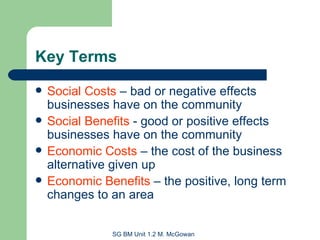
Key Terms Social Costs  – bad or negative effects businesses have on the community Social Benefits  - good or positive effects businesses have on the community Economic Costs  – the cost of the business alternative given up Economic Benefits  – the positive, long term changes to an area
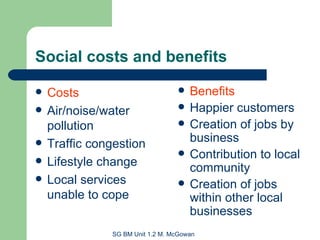
Social costs and benefits Costs Air/noise/water pollution Traffic congestion Lifestyle change Local services unable to cope Benefits Happier customers Creation of jobs by business Contribution to local community Creation of jobs within other local businesses
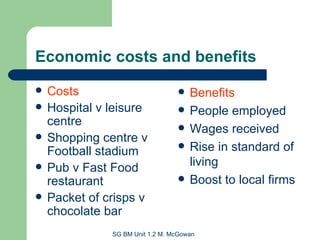
Economic costs and benefits Costs Hospital v leisure centre Shopping centre v Football stadium Pub v Fast Food restaurant Packet of crisps v chocolate bar Benefits People employed Wages received Rise in standard of living Boost to local firms

Unit 1.2 Slides

  • 1.
    Unit 1.2 WhyDo Businesses Exist?
  • 2.
    The purpose ofbusiness To provide a service To make a profit For charitable purposes To develop a good idea
  • 3.
    What is thisfamous ship called? It boldly goes where no-one has gone before into the unknown It takes risks
  • 4.
    What is Enterprise?Enterprise is the art of bringing together land, labour and capital – the factors of production The person who is responsible for bringing together the factors of production is called an entrepreneur
  • 5.
    Entrepreneur Here isa famous entrepreneur What is he famous for? How did he start up his business?
  • 6.
    Risk Taking Startinga new businesses involves risk. Why? Because it is a venture into the unknown Entrepreneurs take risks: To make bigger profits To increase market share To survive To grow
  • 7.
    Aims of thebusiness Different organisations have different aims and objectives. Remember the three business sectors? Private Public Voluntary
  • 8.
    Private Sector AimsThe Private sector aims are all Profit-related To survive To break-even To maximise profits To increase shareholder returns To expand and grow
  • 9.
    Public Sector AimsThe Public sector aims are Service-related To improve quality of service To cut costs/break-even To raise revenue
  • 10.
    Voluntary Sector AimsVoluntary sector aims are all aid-related To help people To maximise cash collection To offer more community services To recruit more helpers To open more branches/shops
  • 11.
    Having an Interestin a Business Southsiders is a new TV soap being made. It is expected to attract 15 million viewers. Who would benefit from this? They have a stake in the future success of the business!
  • 12.
    Stakeholders Stakeholders arepeople with a key interest in a business The main ones in business are: Customers Government Community Owners Managers Employees Shareholders
  • 13.
    But…..! Some groupscan be both internal and external stakeholders Such as staff or shareholders who are also local residents Can you think of any others?
  • 14.
    Owners and ShareholdersThe number of owners and the roles they carry out differ according to the size of the firm In small businesses there may be only one owner (sole trader) or perhaps a small number of partners (partnership) In large firms there are often thousands of shareholders, who each own a small part of the business
  • 15.
    organise make decisionsplan control are accountable to the owner(s) Managers
  • 16.
    Employees A businessneeds staff or employees to carry out its activities Employees agree to work a certain number of hours in return for a wage or salary Pay levels vary with skills, qualifications, age, location, types of work and industry and other factors
  • 17.
    Customers Customers buythe goods or services produced by firms They may be individuals or other businesses Firms must understand and meet the needs of their customers, otherwise they will fail to make a profit or, indeed, survive
  • 18.
    Firms get the resources they need to produce goods and services from suppliers Businesses should have effective relationships with their suppliers in order to get quality resources at reasonable prices This is a two-way process, as suppliers depend on the firms they supply Suppliers
  • 19.
    Firms and thecommunities they exist in are also in a two-way relationship The local community may often provide many of the firm’s staff and customers The business often supplies goods and services vital to the local area But at times the community can feel aggrieved by some aspects of what a firm does Community
  • 20.
    Economic policies affect firms’ costs (through taxation and interest rates) Legislation regulates what business can do in areas such as the environment and occupational safety and health Successful firms are good for governments as they create wealth and employment Government
  • 21.
    Economic Systems Whatis the Economy? A system which tries to solve the Basic Economic Problem What is The Basic Economic Problem? How scarce resources with different uses are allocated to satisfy wants
  • 22.
    Types of EconomicSystem Centrally Planned System Free Market System Mixed System
  • 23.
    Centrally Planned SystemAll economic decisions made by government All firms & resources owned by Govt. Decisions taken by Govt. in interest of people Communist countries like former Soviet Union and the Eastern European nations used this. China and Cuba still do.
  • 24.
    Free Market SystemFree market decisions about what is to be produced is made by the consumers and producers. The government does not intervene. This is what Adam Smith called ‘Laissez-faire’. Companies have to listen to customers in order to survive. If they don’t, they go bust! The United States is a free market system.
  • 25.
    Mixed System Amixed economy combines elements of both systems. Some decisions are made by producers and consumers, while the government still make some decisions. The UK is a mixed economy. We have a large private sector and a large public sector too.
  • 26.
    Infrastructure Infrastructure – road, rail, air links, sewage, telephone systems and utilities which provide a network that benefits both businesses and the community Building such systems require lots of capital , but can be seen as a good future investment
  • 27.
    Balancing Costs andBenefits A new airport is to be built near Eaglesham. East Ren International Airport! Do you think the people who live in Eaglesham, Busby, Mearns would be happy? Think of some good points and bad points about this development
  • 28.
    Key Terms SocialCosts – bad or negative effects businesses have on the community Social Benefits - good or positive effects businesses have on the community Economic Costs – the cost of the business alternative given up Economic Benefits – the positive, long term changes to an area
  • 29.
    Social costs andbenefits Costs Air/noise/water pollution Traffic congestion Lifestyle change Local services unable to cope Benefits Happier customers Creation of jobs by business Contribution to local community Creation of jobs within other local businesses
  • 30.
    Economic costs andbenefits Costs Hospital v leisure centre Shopping centre v Football stadium Pub v Fast Food restaurant Packet of crisps v chocolate bar Benefits People employed Wages received Rise in standard of living Boost to local firms