UNIT-1.2
COMMUNALISM
Communalism as a phenomenon needs to be interpreted again and
again in the light of fast changing global affairs.
Communalism has been a topic of detailed study for the past several years
and many research works are done in this field.
The most important threat the globe facing is the rising communalism.
The rising trend of communalism and the violence followed is the major
threat posed towards the integrity of nation.
So, efficient measures are to be adopted against communalism and its spread
in order to check cracks on the social harmony and bondage.
The Meaning of Communalism
Generally understood, communalism is rivalry kept and practiced by one
community or religion towards another or each other.
Bothering only about the well being of one’s own religion and viewing the
welfare of another community as a threat is a common characteristic of
communalism.
The primary feature of communalism is that one community is being viewed
doubtfully in every social development.
“Communalism can be considered an ideology which states that society is
divided into religious communities whose interests differ and are at times
even opposed to each other.
The antagonism practiced by members of one community against the
people of other community and religion can be termed communalism.
According to Bipan Chandra “communalism is the belief that because a
group of people follow a particular religion, they have as a result, common
social political and economic interests.”
“Some authors have defined communalism as a form of indifference.
Condescension, hatred or aggressive attitude to all the members of a
religious community other than one’s own, based on a real or imaginary
threat from an individual or a group of that community or an actual
damage done to one’s personal interest or way of life or to those of one’s
religious community.”
Prabha Dixit in her book, ‘Communalism, a Struggle for Political Power’
states that: “Communalism in India is neither the reaction to anti communalism
nor an outgrowth of religious and cultural differences but it is a triangular
power struggle of the elite.
Communal persons are those who practice politics using religion.
To win some personal or political ends, the communal minded persons deliberately
connect religion to that particular issue.
For example, if the member of a community, who is in competition with his business
rivalry belonging to another community and the rival business men is supposed to start a
new venture in a specific area, problems may arise from the part of the former. The
former will intentionally try to block the way of the latter through arousing communal
feelings among the public. This can be done in two ways:
(1) By spreading the rumour that the proposed spot which the rival business man
intending to open a business or factory is a holy place belonging to a particular religion.
Plea will be made that a temple or a mosque or a church should be built there on the basis
of some assumed historical importance.
(2) By creating a sense of fear in the minds of the members of the community that the
advent of this business or industry will weaken the economic condition of the community
and result to the economic domination of other community leading to the deterioration of
‘ours’.
T.S. Lokhandwala, considers that before independence, communalism was
considered as an ideology, affecting social, political and economic units.
It is a shifting and changing phenomenon.
The modern communalism is different, than it had been during early years of
independence, which led to the creation of Pakistan.
The recent conflict between communities may have economic or some other
background, but now it is considered, a conflict of religious differences.
Numerous factors play significant role in present day communalism, closely
related to each other.
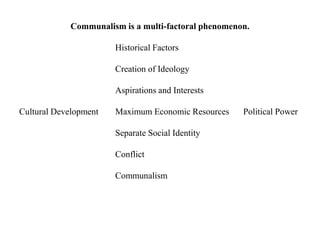
Communalism is a multi-factoral phenomenon.
Historical Factors
Creation of Ideology
Aspirations and Interests
Cultural Development Maximum Economic Resources Political Power
Separate Social Identity
Conflict
Communalism
The Causes of Communal Conflicts and Violence
Communalism is a very complex phenomenon.
If the menace of communalism is not bridled at the right time it will spread
like poisonous gas and take the lives of thousands.
Serious efforts have been made in the past to prevent and to control
communal conflicts.
The attempted interpretations are commonly focused on solving the problem
in the top level, bringing the situation under the control of law.
The history of communal conflicts in India is generally the history of Hindu-
Muslim rivalry.
In order to resolve the age long difference and hostility between the two
communities is not an easy task.
Resolutions made previously by means of enforcing laws and suppression
has proved futile in the background of frequent recurrence of conflict
between the two communities.
Peaceful methods could only bring about lasting peace and harmony. To find
a remedy for the mounting communal violence and its destructive after
effects, a scientific approach is needed.
There is no legal solution to these issues because the legal solution touches
only the externals and cannot reach the heart of the problem.”48A lot of
factors constitute the existence of communal conflict.
If the problem is to be solved and communal harmony is to be ensured, the
causes of communal problems should be dealt in depth.
Although it appears that the reason behind a communal trouble is religious in
nature, the detailed analyzing of incidents uncovers other reasons and causes.
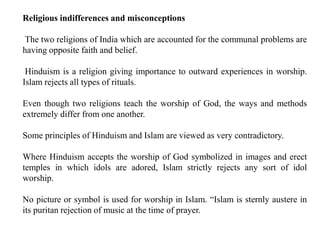
Religious indifferences and misconceptions
The two religions of India which are accounted for the communal problems are
having opposite faith and belief.
Hinduism is a religion giving importance to outward experiences in worship.
Islam rejects all types of rituals.
Even though two religions teach the worship of God, the ways and methods
extremely differ from one another.
Some principles of Hinduism and Islam are viewed as very contradictory.
Where Hinduism accepts the worship of God symbolized in images and erect
temples in which idols are adored, Islam strictly rejects any sort of idol
worship.
No picture or symbol is used for worship in Islam. “Islam is sternly austere in
its puritan rejection of music at the time of prayer.
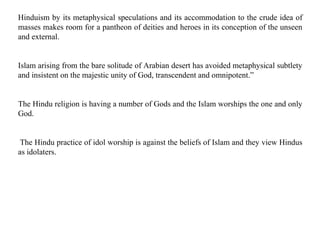
Hinduism by its metaphysical speculations and its accommodation to the crude idea of
masses makes room for a pantheon of deities and heroes in its conception of the unseen
and external.
Islam arising from the bare solitude of Arabian desert has avoided metaphysical subtlety
and insistent on the majestic unity of God, transcendent and omnipotent.”
The Hindu religion is having a number of Gods and the Islam worships the one and only
God.
The Hindu practice of idol worship is against the beliefs of Islam and they view Hindus
as idolaters.

UNIT 1.2 Communalism PPT.pptx

  • 1.
  • 2.
    Communalism as aphenomenon needs to be interpreted again and again in the light of fast changing global affairs. Communalism has been a topic of detailed study for the past several years and many research works are done in this field. The most important threat the globe facing is the rising communalism. The rising trend of communalism and the violence followed is the major threat posed towards the integrity of nation. So, efficient measures are to be adopted against communalism and its spread in order to check cracks on the social harmony and bondage.
  • 3.
    The Meaning ofCommunalism Generally understood, communalism is rivalry kept and practiced by one community or religion towards another or each other. Bothering only about the well being of one’s own religion and viewing the welfare of another community as a threat is a common characteristic of communalism. The primary feature of communalism is that one community is being viewed doubtfully in every social development. “Communalism can be considered an ideology which states that society is divided into religious communities whose interests differ and are at times even opposed to each other. The antagonism practiced by members of one community against the people of other community and religion can be termed communalism.
  • 4.
    According to BipanChandra “communalism is the belief that because a group of people follow a particular religion, they have as a result, common social political and economic interests.” “Some authors have defined communalism as a form of indifference. Condescension, hatred or aggressive attitude to all the members of a religious community other than one’s own, based on a real or imaginary threat from an individual or a group of that community or an actual damage done to one’s personal interest or way of life or to those of one’s religious community.” Prabha Dixit in her book, ‘Communalism, a Struggle for Political Power’ states that: “Communalism in India is neither the reaction to anti communalism nor an outgrowth of religious and cultural differences but it is a triangular power struggle of the elite.
  • 5.
    Communal persons arethose who practice politics using religion. To win some personal or political ends, the communal minded persons deliberately connect religion to that particular issue. For example, if the member of a community, who is in competition with his business rivalry belonging to another community and the rival business men is supposed to start a new venture in a specific area, problems may arise from the part of the former. The former will intentionally try to block the way of the latter through arousing communal feelings among the public. This can be done in two ways: (1) By spreading the rumour that the proposed spot which the rival business man intending to open a business or factory is a holy place belonging to a particular religion. Plea will be made that a temple or a mosque or a church should be built there on the basis of some assumed historical importance. (2) By creating a sense of fear in the minds of the members of the community that the advent of this business or industry will weaken the economic condition of the community and result to the economic domination of other community leading to the deterioration of ‘ours’.
  • 6.
    T.S. Lokhandwala, considersthat before independence, communalism was considered as an ideology, affecting social, political and economic units. It is a shifting and changing phenomenon. The modern communalism is different, than it had been during early years of independence, which led to the creation of Pakistan. The recent conflict between communities may have economic or some other background, but now it is considered, a conflict of religious differences. Numerous factors play significant role in present day communalism, closely related to each other.
  • 7.
    Communalism is amulti-factoral phenomenon. Historical Factors Creation of Ideology Aspirations and Interests Cultural Development Maximum Economic Resources Political Power Separate Social Identity Conflict Communalism
  • 8.
    The Causes ofCommunal Conflicts and Violence Communalism is a very complex phenomenon. If the menace of communalism is not bridled at the right time it will spread like poisonous gas and take the lives of thousands. Serious efforts have been made in the past to prevent and to control communal conflicts. The attempted interpretations are commonly focused on solving the problem in the top level, bringing the situation under the control of law. The history of communal conflicts in India is generally the history of Hindu- Muslim rivalry. In order to resolve the age long difference and hostility between the two communities is not an easy task.
  • 9.
    Resolutions made previouslyby means of enforcing laws and suppression has proved futile in the background of frequent recurrence of conflict between the two communities. Peaceful methods could only bring about lasting peace and harmony. To find a remedy for the mounting communal violence and its destructive after effects, a scientific approach is needed. There is no legal solution to these issues because the legal solution touches only the externals and cannot reach the heart of the problem.”48A lot of factors constitute the existence of communal conflict. If the problem is to be solved and communal harmony is to be ensured, the causes of communal problems should be dealt in depth. Although it appears that the reason behind a communal trouble is religious in nature, the detailed analyzing of incidents uncovers other reasons and causes.
  • 10.
    Religious indifferences andmisconceptions The two religions of India which are accounted for the communal problems are having opposite faith and belief. Hinduism is a religion giving importance to outward experiences in worship. Islam rejects all types of rituals. Even though two religions teach the worship of God, the ways and methods extremely differ from one another. Some principles of Hinduism and Islam are viewed as very contradictory. Where Hinduism accepts the worship of God symbolized in images and erect temples in which idols are adored, Islam strictly rejects any sort of idol worship. No picture or symbol is used for worship in Islam. “Islam is sternly austere in its puritan rejection of music at the time of prayer.
  • 11.
    Hinduism by itsmetaphysical speculations and its accommodation to the crude idea of masses makes room for a pantheon of deities and heroes in its conception of the unseen and external. Islam arising from the bare solitude of Arabian desert has avoided metaphysical subtlety and insistent on the majestic unity of God, transcendent and omnipotent.” The Hindu religion is having a number of Gods and the Islam worships the one and only God. The Hindu practice of idol worship is against the beliefs of Islam and they view Hindus as idolaters.