By:
Muhammad Baqar
RN, P.B.CHN, BScN, MSPH
Concept of Elimination
College of Nursing Sukkur
2024
Elimination
 The act of dischargingor excreting waste products from the
body.
 Eliminationis a basic human function of excreting
waste through the bowel and urinary system.
Elimination Pattern
 Eliminationpatterns describe the regulationcontrol, and
removalof by-productsand wastesin the body.
The term usually refers to the movementof fecesor urine
from the body.
Urinary Elimination
Urinary Eliminationis the removalof waste products from the
body through the urinary system
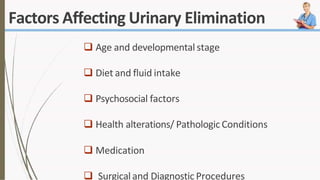
Factors Affecting Urinary Elimination
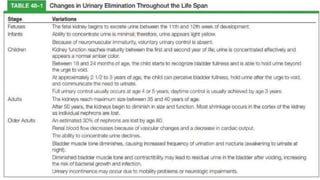
 Age and developmental stage
 Diet and fluid intake
 Psychosocial factors
 Health alterations/ Pathologic Conditions
 Medication
 Surgicaland Diagnostic Procedures
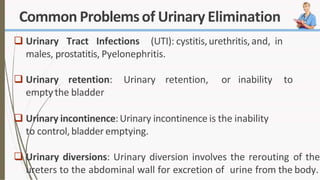
Common Problemsof Urinary Elimination
 Urinary Tract Infections (UTI): cystitis,urethritis,and, in
males, prostatitis, Pyelonephritis.
 Urinary retention: Urinary retention, or inability to
empty the bladder
 Urinary incontinence:Urinary incontinence is the inability
to control,bladder emptying.
 Urinary diversions: Urinary diversion involves the rerouting of the
ureters to the abdominal wall for excretion of urine from the body.
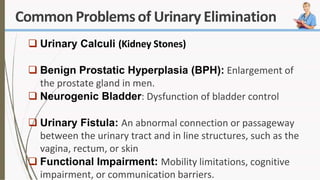
CommonProblemsof Urinary Elimination
 Urinary Calculi (Kidney Stones)
 Benign Prostatic Hyperplasia (BPH): Enlargement of
the prostate gland in men.
 Neurogenic Bladder: Dysfunction of bladder control
 Urinary Fistula: An abnormal connection or passageway
between the urinary tract and in line structures, such as the
vagina, rectum, or skin
 Functional Impairment: Mobility limitations, cognitive
impairment, or communication barriers.
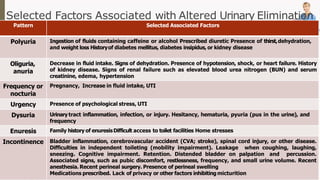
Selected Factors Associated with Altered Urinary Elimination
Pattern Selected Associated Factors
Polyuria Ingestion of fluids containing caffeine or alcohol Prescribed diuretic Presence of thirst,dehydration,
and weight loss Historyof diabetes mellitus, diabetes insipidus, or kidney disease
Oliguria,
anuria
Decrease in fluid intake. Signs of dehydration. Presence of hypotension, shock, or heart failure. History
of kidney disease. Signs of renal failure such as elevated blood urea nitrogen (BUN) and serum
creatinine, edema, hypertension
Frequency or
nocturia
Pregnancy, Increase in fluid intake, UTI
Urgency Presence of psychological stress, UTI
Dysuria Urinary tract inflammation, infection, or injury. Hesitancy, hematuria, pyuria (pus in the urine), and
frequency
Enuresis Family history of enuresisDifficult access to toilet facilities Home stresses
Incontinence Bladder inflammation, cerebrovascular accident (CVA; stroke), spinal cord injury, or other disease.
Difficulties in independent toileting (mobility impairment). Leakage when coughing, laughing,
sneezing. Cognitive impairment. Retention. Distended bladder on palpation and percussion.
Associated signs, such as pubic discomfort, restlessness, frequency, and small urine volume. Recent
anesthesia. Recent perineal surgery. Presence of perineal swelling
Medications prescribed. Lack of privacy or other factors inhibiting micturition
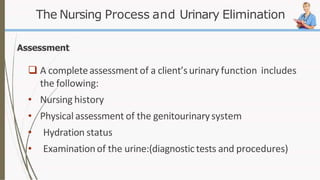
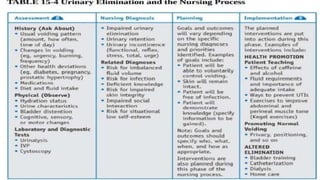
The Nursing Process and Urinary Elimination
Assessment
 A completeassessment of a client’surinary function includes
the following:
• Nursing history
• Physical assessment of the genitourinarysystem
• Hydration status
• Examinationof the urine:(diagnostictests and procedures)
The Nursing Processand UrinaryElimination
Diagnosis
 NANDA International (2009) includes two general
diagnostic labels for urinary elimination:
• Impaired Urinary Elimination: dysfunction in urine
elimination
• Readiness for Enhanced Urinary Elimination: A pattern
sufficient for meeting
of urinary functions that is
elimination needs and can be
strengthened’
The Nursing Processand Urinary Elimination
Diagnosis
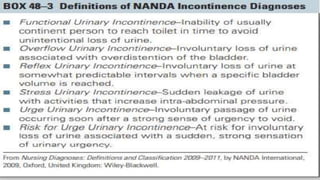
 Others also includes:
• Functional Urinary Incontinence
• Overflow Urinary Incontinence
• Reflex Urinary Incontinence
• Stress Urinary Incontinence
• Urge Urinary Incontinence
• Risk for Urge Urinary Incontinence
• Urinary Retention
The Nursing Processand UrinaryElimination
Planning
 The goals established will vary according to the diagnosis and
defining characteristics focus on urinary elimination problems.
 Appropriate preventive and corrective nursing
Interventions that relate tothese must be identified.
 Specific nursing activities associated with each of these
interventions can be selected to meet the client’s individual
needs.
The NursingProcessand Urinary Elimination
Nursing interventions
 Maintainingnormal urinary elimination
• Promoting Fluid Intake
• Maintaining Normal Voiding Habits
• Assisting with Toileting
The Nursing Processand Urinary Elimination
Nursing interventions
 Preventing urinary tract infections
• UTI is greaterin women than men
• Drink at least 8 to 10 eight-ounceglasses of waterper day
• Always wipe from front to back after urinationor
defecation
• Wear cotton underwear
• Urinate after having intercourse
• On time report any symptomsof UTI
The NursingProcessand Urinary Elimination
Nursing interventions
 Managing urinary incontinence (Bladder) Training
• UI is not a normal part of aging and often is treatable.
• Bladder retraining
• Habit training
The Nursing Processand UrinaryElimination
Nursing interventions
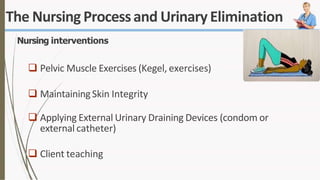
 Pelvic Muscle Exercises (Kegel, exercises)
 MaintainingSkin Integrity
 Applying External Urinary Draining Devices (condom or
external catheter)
 Client teaching
Bowel Elimination(Defecation)
Bowel elimination is the excretionof wastesfrom the
gastrointestinal (GI) system
Bowel Elimination(Defecation) is a natural process by which
the soiled waste products of digestion (fecesor stool) are
eliminatedfrom the bowel.
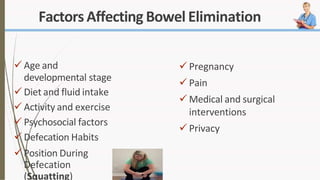
FactorsAffecting Bowel Elimination
 Age and
developmental stage
 Diet and fluid intake
 Activity and exercise
 Psychosocial factors
 Defecation Habits
Position During
Defecation
(Squatting)
 Pregnancy
 Pain
 Medical and surgical
interventions
 Privacy
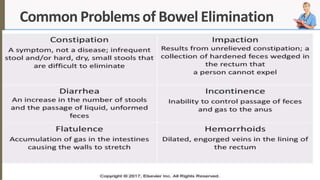
Common Problemsof Bowel Elimination
BOWELELIMINATION
flatulence (or gas accumulation):
Constipation:
Impaction
Diarrhea
Fecal incontinence
Bowel diversions
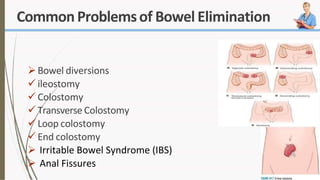
CommonProblemsof Bowel Elimination
Bowel diversions
 ileostomy
 Colostomy
 Transverse Colostomy
 Loop colostomy
 End colostomy
 Irritable Bowel Syndrome (IBS)
 Anal Fissures
The Nursing Processand BowelElimination
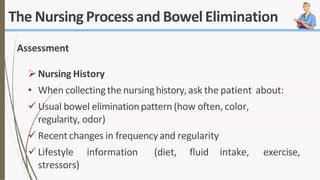
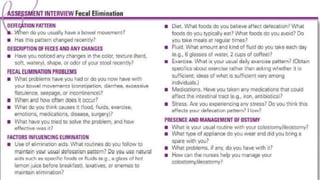
Assessment
Nursing History
• When collectingthe nursinghistory,ask the patient about:
 Usual bowel eliminationpattern (how often, color,
regularity, odor)
 Recent changes in frequencyand regularity
 Lifestyle information (diet, fluid intake, exercise,
stressors)
The Nursing Processand Bowel Elimination
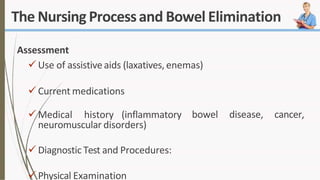
Assessment
 Use of assistiveaids (laxatives, enemas)
 Current medications
bowel disease, cancer,
 Medical history (inflammatory
neuromuscular disorders)
 Diagnostic Test and Procedures:
 Physical Examination
The Nursing Processand Bowel Elimination
Nursing diagnoses
 Bowelincontinence
 Constipation
 Riskforconstipation,
 Perceived
constipation
 Diarrhea Riskfor
impaired skin integrity
Risk for deficientfluid
volume
 Deficient knowledge
 Disturbed body image
 Impaired social
interaction
The Nursing Processand BowelElimination
Planning
 Identifyinggoals and expected outcomes
It isimportanttodevelop goalsandoutcomesthat arerealisticfor
the clientandhisor herunique situation. Themajorgoalsfocuson
following
• Maintainor restorenormalbowelelimination pattern.
The Nursing Processand Bowel Elimination
Planning
• Maintainor regain normal stoolregularity.
• Preventassociatedriskssuch asfluidandelectrolyte imbalance,
skin breakdown,abdominaldistention, andpain
• Settingpriorities, and planninginterventions
The Nursing Processand BowelElimination
Nursinginterventions
 Assessboweleliminationpatternsandcontributing factors
 Increase physical activity
 Increase intakeof dietaryfiberand fluids
 Schedule or encourage toiletingat timeswhen the
person’s defecationurge is strongest.
 Positiontheperson tofacilitateease of elimination.
The Nursing Processand Bowel Elimination
Nursing interventions
 Provide privacy for elimination.
 Administer stool softeners or bulk-forminglaxatives or
antidiarrheal agents may be given for diarrhea as
prescribed by the physician.
I. Enema:Used for temporary relief of constipation
II. Digitalremovalofstools:Usedwhenapatienthasan
impaction
III. Rectaltube:Usedtorelievegas.
IV. Nasogastricintubation:Usedtorelievepressurecaused
bytheaccumulationoffluidsandair.
Conclusion
 Elimination patternsdescribetheregulation control, andremovalof by-productsandwastesinthe body
 Theurinarysystemplaysanimportant roleinmaintaining fluid,electrolyte, andacid–basebalance.
 Many variables influence urinary elimination, including diet, fluid intake, activity level, age and
developmental stage, psychosocial factors,healthdeviations, andmedicalandsurgicalinterventions.
 Urinary retention, urinary incontinence, and UTIs are the three most common urinary elimination
alterations.
 Bowelelimination patterns varywidelyfromindividual toindividual.
 Age, diet, fluid intake,levelof activity, healthstatus,and emotionalstateall influencean individual’sbowel
elimination pattern.
 Alterations in bowel elimination include constipation, diarrhea, flatulence, fecal incontinence, and bowel
diversions
 Nursesprovidecareforpatients withcommonly occurringelimination alterations, including
• Urinarytractinfections , Urinaryincontinence, Urinaryretention,
Constipation, Diarrhea& Bowelincontinence.
Concept Elimination /Elimination pattern

Concept Elimination /Elimination pattern

  • 2.
    By: Muhammad Baqar RN, P.B.CHN,BScN, MSPH Concept of Elimination College of Nursing Sukkur 2024
  • 3.
    Elimination  The actof dischargingor excreting waste products from the body.  Eliminationis a basic human function of excreting waste through the bowel and urinary system.
  • 4.
    Elimination Pattern  Eliminationpatternsdescribe the regulationcontrol, and removalof by-productsand wastesin the body. The term usually refers to the movementof fecesor urine from the body.
  • 5.
    Urinary Elimination Urinary Eliminationisthe removalof waste products from the body through the urinary system
  • 6.
    Factors Affecting UrinaryElimination  Age and developmental stage  Diet and fluid intake  Psychosocial factors  Health alterations/ Pathologic Conditions  Medication  Surgicaland Diagnostic Procedures
  • 8.
    Common Problemsof UrinaryElimination  Urinary Tract Infections (UTI): cystitis,urethritis,and, in males, prostatitis, Pyelonephritis.  Urinary retention: Urinary retention, or inability to empty the bladder  Urinary incontinence:Urinary incontinence is the inability to control,bladder emptying.  Urinary diversions: Urinary diversion involves the rerouting of the ureters to the abdominal wall for excretion of urine from the body.
  • 9.
    CommonProblemsof Urinary Elimination Urinary Calculi (Kidney Stones)  Benign Prostatic Hyperplasia (BPH): Enlargement of the prostate gland in men.  Neurogenic Bladder: Dysfunction of bladder control  Urinary Fistula: An abnormal connection or passageway between the urinary tract and in line structures, such as the vagina, rectum, or skin  Functional Impairment: Mobility limitations, cognitive impairment, or communication barriers.
  • 11.
    Selected Factors Associatedwith Altered Urinary Elimination Pattern Selected Associated Factors Polyuria Ingestion of fluids containing caffeine or alcohol Prescribed diuretic Presence of thirst,dehydration, and weight loss Historyof diabetes mellitus, diabetes insipidus, or kidney disease Oliguria, anuria Decrease in fluid intake. Signs of dehydration. Presence of hypotension, shock, or heart failure. History of kidney disease. Signs of renal failure such as elevated blood urea nitrogen (BUN) and serum creatinine, edema, hypertension Frequency or nocturia Pregnancy, Increase in fluid intake, UTI Urgency Presence of psychological stress, UTI Dysuria Urinary tract inflammation, infection, or injury. Hesitancy, hematuria, pyuria (pus in the urine), and frequency Enuresis Family history of enuresisDifficult access to toilet facilities Home stresses Incontinence Bladder inflammation, cerebrovascular accident (CVA; stroke), spinal cord injury, or other disease. Difficulties in independent toileting (mobility impairment). Leakage when coughing, laughing, sneezing. Cognitive impairment. Retention. Distended bladder on palpation and percussion. Associated signs, such as pubic discomfort, restlessness, frequency, and small urine volume. Recent anesthesia. Recent perineal surgery. Presence of perineal swelling Medications prescribed. Lack of privacy or other factors inhibiting micturition
  • 13.
    The Nursing Processand Urinary Elimination Assessment  A completeassessment of a client’surinary function includes the following: • Nursing history • Physical assessment of the genitourinarysystem • Hydration status • Examinationof the urine:(diagnostictests and procedures)
  • 17.
    The Nursing ProcessandUrinaryElimination Diagnosis  NANDA International (2009) includes two general diagnostic labels for urinary elimination: • Impaired Urinary Elimination: dysfunction in urine elimination • Readiness for Enhanced Urinary Elimination: A pattern sufficient for meeting of urinary functions that is elimination needs and can be strengthened’
  • 18.
    The Nursing ProcessandUrinary Elimination Diagnosis  Others also includes: • Functional Urinary Incontinence • Overflow Urinary Incontinence • Reflex Urinary Incontinence • Stress Urinary Incontinence • Urge Urinary Incontinence • Risk for Urge Urinary Incontinence • Urinary Retention
  • 20.
    The Nursing ProcessandUrinaryElimination Planning  The goals established will vary according to the diagnosis and defining characteristics focus on urinary elimination problems.  Appropriate preventive and corrective nursing Interventions that relate tothese must be identified.  Specific nursing activities associated with each of these interventions can be selected to meet the client’s individual needs.
  • 21.
    The NursingProcessand UrinaryElimination Nursing interventions  Maintainingnormal urinary elimination • Promoting Fluid Intake • Maintaining Normal Voiding Habits • Assisting with Toileting
  • 22.
    The Nursing ProcessandUrinary Elimination Nursing interventions  Preventing urinary tract infections • UTI is greaterin women than men • Drink at least 8 to 10 eight-ounceglasses of waterper day • Always wipe from front to back after urinationor defecation • Wear cotton underwear • Urinate after having intercourse • On time report any symptomsof UTI
  • 23.
    The NursingProcessand UrinaryElimination Nursing interventions  Managing urinary incontinence (Bladder) Training • UI is not a normal part of aging and often is treatable. • Bladder retraining • Habit training
  • 24.
    The Nursing ProcessandUrinaryElimination Nursing interventions  Pelvic Muscle Exercises (Kegel, exercises)  MaintainingSkin Integrity  Applying External Urinary Draining Devices (condom or external catheter)  Client teaching
  • 26.
    Bowel Elimination(Defecation) Bowel eliminationis the excretionof wastesfrom the gastrointestinal (GI) system Bowel Elimination(Defecation) is a natural process by which the soiled waste products of digestion (fecesor stool) are eliminatedfrom the bowel.
  • 27.
    FactorsAffecting Bowel Elimination Age and developmental stage  Diet and fluid intake  Activity and exercise  Psychosocial factors  Defecation Habits Position During Defecation (Squatting)  Pregnancy  Pain  Medical and surgical interventions  Privacy
  • 28.
    Common Problemsof BowelElimination BOWELELIMINATION flatulence (or gas accumulation): Constipation: Impaction Diarrhea Fecal incontinence Bowel diversions
  • 29.
    CommonProblemsof Bowel Elimination Boweldiversions  ileostomy  Colostomy  Transverse Colostomy  Loop colostomy  End colostomy  Irritable Bowel Syndrome (IBS)  Anal Fissures
  • 30.
    The Nursing ProcessandBowelElimination Assessment Nursing History • When collectingthe nursinghistory,ask the patient about:  Usual bowel eliminationpattern (how often, color, regularity, odor)  Recent changes in frequencyand regularity  Lifestyle information (diet, fluid intake, exercise, stressors)
  • 31.
    The Nursing ProcessandBowel Elimination Assessment  Use of assistiveaids (laxatives, enemas)  Current medications bowel disease, cancer,  Medical history (inflammatory neuromuscular disorders)  Diagnostic Test and Procedures:  Physical Examination
  • 35.
    The Nursing ProcessandBowel Elimination Nursing diagnoses  Bowelincontinence  Constipation  Riskforconstipation,  Perceived constipation  Diarrhea Riskfor impaired skin integrity Risk for deficientfluid volume  Deficient knowledge  Disturbed body image  Impaired social interaction
  • 36.
    The Nursing ProcessandBowelElimination Planning  Identifyinggoals and expected outcomes It isimportanttodevelop goalsandoutcomesthat arerealisticfor the clientandhisor herunique situation. Themajorgoalsfocuson following • Maintainor restorenormalbowelelimination pattern.
  • 37.
    The Nursing ProcessandBowel Elimination Planning • Maintainor regain normal stoolregularity. • Preventassociatedriskssuch asfluidandelectrolyte imbalance, skin breakdown,abdominaldistention, andpain • Settingpriorities, and planninginterventions
  • 38.
    The Nursing ProcessandBowelElimination Nursinginterventions  Assessboweleliminationpatternsandcontributing factors  Increase physical activity  Increase intakeof dietaryfiberand fluids  Schedule or encourage toiletingat timeswhen the person’s defecationurge is strongest.  Positiontheperson tofacilitateease of elimination.
  • 39.
    The Nursing ProcessandBowel Elimination Nursing interventions  Provide privacy for elimination.  Administer stool softeners or bulk-forminglaxatives or antidiarrheal agents may be given for diarrhea as prescribed by the physician. I. Enema:Used for temporary relief of constipation II. Digitalremovalofstools:Usedwhenapatienthasan impaction III. Rectaltube:Usedtorelievegas. IV. Nasogastricintubation:Usedtorelievepressurecaused bytheaccumulationoffluidsandair.
  • 40.
    Conclusion  Elimination patternsdescribetheregulationcontrol, andremovalof by-productsandwastesinthe body  Theurinarysystemplaysanimportant roleinmaintaining fluid,electrolyte, andacid–basebalance.  Many variables influence urinary elimination, including diet, fluid intake, activity level, age and developmental stage, psychosocial factors,healthdeviations, andmedicalandsurgicalinterventions.  Urinary retention, urinary incontinence, and UTIs are the three most common urinary elimination alterations.  Bowelelimination patterns varywidelyfromindividual toindividual.  Age, diet, fluid intake,levelof activity, healthstatus,and emotionalstateall influencean individual’sbowel elimination pattern.  Alterations in bowel elimination include constipation, diarrhea, flatulence, fecal incontinence, and bowel diversions  Nursesprovidecareforpatients withcommonly occurringelimination alterations, including • Urinarytractinfections , Urinaryincontinence, Urinaryretention, Constipation, Diarrhea& Bowelincontinence.