ETHICAL PRINCIPLES AND
THEORIES
By: Muhammad Baqar
RN,P.B.CHN,BScN,MSPH
OUTLINE
Discuss ethical principles in health care in the
light of ethical theories.
Discuss the ethical dilemmas face by nurses and
client.
 Discuss the strategies to resolve ethical dilemma
in daily nursing practice.
List steps of ethical decision-making
ETHICAL THEORIES AND MODELS
Ethical theories and models are the group
of related concepts that propose values
and moral actions.
They act as a guide and provide the
framework to develop ethical principles
and values that evaluate and classify
actions into right and wrong.
ETHICAL THEORIES AND PRINCIPLES`
Ethical theories and principles are the foundations
of ethical analysis
They are the viewpoints from which guidance can
be obtained along the pathway to a decision
Each theory emphasizes different points such as
predicting the outcome and following one's duties
to others in order to reach an ethically correct
decision.
ETHICAL THEORIES AND PRINCIPLES
An ethical theory to be useful, the theory must be
directed towards a common set of goals.
Ethical principles are the common goals that each
theory tries to achieve in order to be successful.
These goals include beneficence, least harm,
respect for autonomy and justice
GOALS OR OBJECTIVES OF ETHICAL
THEORIES
 The goals or objectives of ethical theories include the
following:
1. Beneficence
2. Least harm / Nonmaleficence
3. Respect for autonomy
4. Justice
BENEFICENCE
This is the ethical principle that guides the
ethical theory to do what is good.
 An example of “doing good” is found in
the practice of medicine in which the
health of an individual is bettered by
treatment from a physician and care from
Nurse.
LEAST HARM/ Nonmaleficence
 This principle tells about choosing an option to avoid
harm or an option to do the least harm possible or do
harm to the fewest people.
 It helps the doctors and Nurses to choose the treatment
& care that causes less injury and is safer.
 Therefore, the theories framed should suggest a principle
of least harm towards patient care.
RESPECT FOR AUTONOMY
 This principle states that an ethical theory should provide
opportunity to the patients or their family to make
decisions that apply to their lives.
 This means that people should have control over their
lives because they are the ones who completely
understand their chosen type of lifestyle.
 An ethical theory should be framed in such way that it
aims for provision of respect for each person.
JUSTICE
 Justice means being fair and not being disinterested.
 Ethical theories should support justice to all.
 For example, while providing nursing care, all patients
should be treated equal, irrespective of their caste,
belief, religion, socioeconomic status, and age.
 These principles should be an important component in
all the ethical theories framed for nursing.
ETHICAL PRINCIPLES
Principles-based ethics is the most widely known
approach to health care ethics.
This approach was first described in Beauchamp
and Childress’s Principles of Biomedical Ethics
(2009).
Their idea was that when health care providers
encountered an ethical problem, they would
examine the situation, decide which ethical
principles applied, and use them to make a
decision.
ETHICAL PRINCIPLES
 Are principles that direct or govern actions.
 They are widely accepted and generally are based on
the humane aspects of society.
 Ethical decisions are principled; that is, they reflect what
is best for the client and society.
 By applying ethical principles, nurses become more
systematic in solving ethical conflicts
 Ethical principles can be used as guidelines in analyzing
dilemmas
 Remember that these principles are not absolute; there
can be exceptions to each principle in any given
situation.
ETHICAL PRINCIPLES
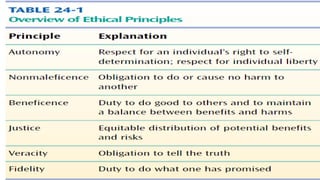
 The original principles of bioethics were
 Autonomy,
 Beneficence (doing good)
 Nonmaleficence (avoiding harm to others) , and
 Justice
 Later, principles of
 Fidelity and
 Veracity
 were added, and autonomy was expanded to respect
for persons.
ETHICAL DILEMMAS
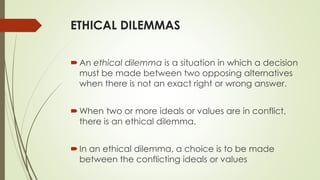
An ethical dilemma is a situation in which a decision
must be made between two opposing alternatives
when there is not an exact right or wrong answer.
When two or more ideals or values are in conflict,
there is an ethical dilemma.
In an ethical dilemma, a choice is to be made
between the conflicting ideals or values
SPECIFIC ETHICAL ISSUES
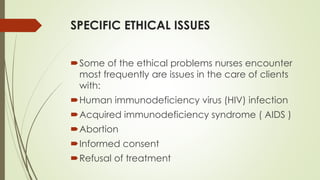
Some of the ethical problems nurses encounter
most frequently are issues in the care of clients
with:
Human immunodeficiency virus (HIV) infection
Acquired immunodeficiency syndrome ( AIDS )
Abortion
Informed consent
Refusal of treatment
SPECIFIC ETHICAL ISSUES
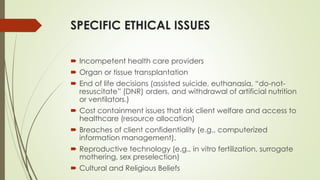
 Incompetent health care providers
 Organ or tissue transplantation
 End of life decisions (assisted suicide, euthanasia, “do-not-
resuscitate” (DNR) orders, and withdrawal of artificial nutrition
or ventilators.)
 Cost containment issues that risk client welfare and access to
healthcare (resource allocation)
 Breaches of client confidentiality (e.g., computerized
information management).
 Reproductive technology (e.g., in vitro fertilization, surrogate
mothering, sex preselection)
 Cultural and Religious Beliefs
STRATEGIES TO RESOLVE ETHICAL
DILEMMAS IN DAILY NURSING PRACTICE
Several strategies can help nurses address and resolve dilemmas effectively.
1. Ethical Decision-Making Frameworks
2. Ethics Committees and Consultations
3. Ethical Reflection and Self-awareness
4. Communication and Advocacy
5. Education and Training
6. Clear Communication and Documentation
7. Patient and Family Involvement
8. Use of Ethical Principles
9. Use of Ethical Principles
10. Seek Support and Advocacy
Implementing these strategies involves integrating ethical considerations into daily
practice
ETHICAL DECISION MAKING
Ethical questions (dilemmas) are not easy to answer.
Ethical reasoning is the process of examining the
issue in a methodical manner.
 Ethical decisions should not be made based on
emotions.
 Is used in situations in which the right decision is not
clear or in which there are conflicts of rights and
duties.
FRAMEWORK FOR ETHICAL DECISION
MAKING
 Once an ethical dilemma is identified, the nurse must
determine the relevant parts of the conflict in order to
resolve it.
 When making an ethical decision, the nurse must
consider the following relevant parts:
• Which theories are involved?
• Which principles are involved?
• Who will be affected?
• What will be the consequences of the alternatives
(ethical options)?
 To resolve ethical dilemmas, the nurse must be able to
make decisions in a systematic way.
Frameworks for Solving Ethical
Dilemmas
 Systematically working through an ethical dilemma is key
to identifying a solution.
 Many frameworks exist for solving an ethical dilemma,
including:
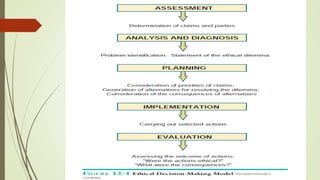
1. Ethical Decision-Making Model
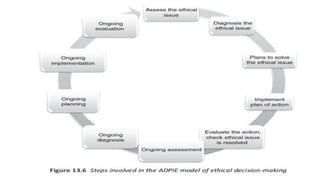
2. Nursing Process Model (ADPIE)
3. Moral Model
4. Ethics (mnemonic) Model
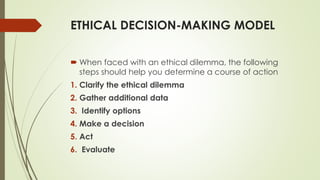
ETHICAL DECISION-MAKING MODEL
 When faced with an ethical dilemma, the following
steps should help you determine a course of action
1. Clarify the ethical dilemma
2. Gather additional data
3. Identify options
4. Make a decision
5. Act
6. Evaluate
CLARIFY THE ETHICAL DILEMMA
Whose problem is it, and who should
make the decision?
Who is affected by the decision
 What ethical principles are related to the
problem
GATHER ADDITIONAL DATA
 It's important to have as much information about the
situations possible
 Be sure you're up to date on any legal cases related to
the ethical question.
IDENTIFY OPTIONS
Brain storm with others to identify as many
alternatives as you can.
The more options you identify, the more
likely you are to find an acceptable
solution.
MAKE A DECISION
Think through the options you've
identified.
Some will be more feasible than others.
Determine which option is most
acceptable.
ACT
Carry out the decision.
It's usually necessary to collaborate with
others to implement the decision as well
as to identify options.
EVALUATE
After acting on a decision, evaluate its
impact.
 In retrospect, did you choose the best
course of action, or
would an alternative have been better?
Why ?
What went right and what went wrong?
Why?
MORAL MODEL
 M: Massage the dilemma
 Collect data by identifying the interests and perceptions of those involved,
defining the dilemma, and describing conflicts. Establish a goal.
 O: Outline options
 Generate several effective alternatives to reach the goal
 R: Review criteria and resolve
 Identify moral criteria and select the course of action
 A: Affirm position and act
 Implement action based on knowledge from the previous steps (M-O-R).
 L: Look back
 Evaluate each step and the decision made
CONCLUSION
Ethical theories and principles can help us make
decisions in the healthcare field. By using the
theory of utilitarianism, we can make difficult
decisions that do not seem to have a right or
wrong answer. Through using the principles of
justice and autonomy, we can ensure that our
patients are getting the best care possible and
that we are also respecting their wishes, beliefs
and values
Ethical Principles and Theories.........

Ethical Principles and Theories.........

  • 2.
    ETHICAL PRINCIPLES AND THEORIES By:Muhammad Baqar RN,P.B.CHN,BScN,MSPH
  • 3.
    OUTLINE Discuss ethical principlesin health care in the light of ethical theories. Discuss the ethical dilemmas face by nurses and client.  Discuss the strategies to resolve ethical dilemma in daily nursing practice. List steps of ethical decision-making
  • 4.
    ETHICAL THEORIES ANDMODELS Ethical theories and models are the group of related concepts that propose values and moral actions. They act as a guide and provide the framework to develop ethical principles and values that evaluate and classify actions into right and wrong.
  • 5.
    ETHICAL THEORIES ANDPRINCIPLES` Ethical theories and principles are the foundations of ethical analysis They are the viewpoints from which guidance can be obtained along the pathway to a decision Each theory emphasizes different points such as predicting the outcome and following one's duties to others in order to reach an ethically correct decision.
  • 6.
    ETHICAL THEORIES ANDPRINCIPLES An ethical theory to be useful, the theory must be directed towards a common set of goals. Ethical principles are the common goals that each theory tries to achieve in order to be successful. These goals include beneficence, least harm, respect for autonomy and justice
  • 7.
    GOALS OR OBJECTIVESOF ETHICAL THEORIES  The goals or objectives of ethical theories include the following: 1. Beneficence 2. Least harm / Nonmaleficence 3. Respect for autonomy 4. Justice
  • 8.
    BENEFICENCE This is theethical principle that guides the ethical theory to do what is good.  An example of “doing good” is found in the practice of medicine in which the health of an individual is bettered by treatment from a physician and care from Nurse.
  • 9.
    LEAST HARM/ Nonmaleficence This principle tells about choosing an option to avoid harm or an option to do the least harm possible or do harm to the fewest people.  It helps the doctors and Nurses to choose the treatment & care that causes less injury and is safer.  Therefore, the theories framed should suggest a principle of least harm towards patient care.
  • 10.
    RESPECT FOR AUTONOMY This principle states that an ethical theory should provide opportunity to the patients or their family to make decisions that apply to their lives.  This means that people should have control over their lives because they are the ones who completely understand their chosen type of lifestyle.  An ethical theory should be framed in such way that it aims for provision of respect for each person.
  • 11.
    JUSTICE  Justice meansbeing fair and not being disinterested.  Ethical theories should support justice to all.  For example, while providing nursing care, all patients should be treated equal, irrespective of their caste, belief, religion, socioeconomic status, and age.  These principles should be an important component in all the ethical theories framed for nursing.
  • 12.
    ETHICAL PRINCIPLES Principles-based ethicsis the most widely known approach to health care ethics. This approach was first described in Beauchamp and Childress’s Principles of Biomedical Ethics (2009). Their idea was that when health care providers encountered an ethical problem, they would examine the situation, decide which ethical principles applied, and use them to make a decision.
  • 13.
    ETHICAL PRINCIPLES  Areprinciples that direct or govern actions.  They are widely accepted and generally are based on the humane aspects of society.  Ethical decisions are principled; that is, they reflect what is best for the client and society.  By applying ethical principles, nurses become more systematic in solving ethical conflicts  Ethical principles can be used as guidelines in analyzing dilemmas  Remember that these principles are not absolute; there can be exceptions to each principle in any given situation.
  • 14.
    ETHICAL PRINCIPLES  Theoriginal principles of bioethics were  Autonomy,  Beneficence (doing good)  Nonmaleficence (avoiding harm to others) , and  Justice  Later, principles of  Fidelity and  Veracity  were added, and autonomy was expanded to respect for persons.
  • 16.
    ETHICAL DILEMMAS An ethicaldilemma is a situation in which a decision must be made between two opposing alternatives when there is not an exact right or wrong answer. When two or more ideals or values are in conflict, there is an ethical dilemma. In an ethical dilemma, a choice is to be made between the conflicting ideals or values
  • 17.
    SPECIFIC ETHICAL ISSUES Someof the ethical problems nurses encounter most frequently are issues in the care of clients with: Human immunodeficiency virus (HIV) infection Acquired immunodeficiency syndrome ( AIDS ) Abortion Informed consent Refusal of treatment
  • 18.
    SPECIFIC ETHICAL ISSUES Incompetent health care providers  Organ or tissue transplantation  End of life decisions (assisted suicide, euthanasia, “do-not- resuscitate” (DNR) orders, and withdrawal of artificial nutrition or ventilators.)  Cost containment issues that risk client welfare and access to healthcare (resource allocation)  Breaches of client confidentiality (e.g., computerized information management).  Reproductive technology (e.g., in vitro fertilization, surrogate mothering, sex preselection)  Cultural and Religious Beliefs
  • 19.
    STRATEGIES TO RESOLVEETHICAL DILEMMAS IN DAILY NURSING PRACTICE Several strategies can help nurses address and resolve dilemmas effectively. 1. Ethical Decision-Making Frameworks 2. Ethics Committees and Consultations 3. Ethical Reflection and Self-awareness 4. Communication and Advocacy 5. Education and Training 6. Clear Communication and Documentation 7. Patient and Family Involvement 8. Use of Ethical Principles 9. Use of Ethical Principles 10. Seek Support and Advocacy Implementing these strategies involves integrating ethical considerations into daily practice
  • 20.
    ETHICAL DECISION MAKING Ethicalquestions (dilemmas) are not easy to answer. Ethical reasoning is the process of examining the issue in a methodical manner.  Ethical decisions should not be made based on emotions.  Is used in situations in which the right decision is not clear or in which there are conflicts of rights and duties.
  • 21.
    FRAMEWORK FOR ETHICALDECISION MAKING  Once an ethical dilemma is identified, the nurse must determine the relevant parts of the conflict in order to resolve it.  When making an ethical decision, the nurse must consider the following relevant parts: • Which theories are involved? • Which principles are involved? • Who will be affected? • What will be the consequences of the alternatives (ethical options)?  To resolve ethical dilemmas, the nurse must be able to make decisions in a systematic way.
  • 22.
    Frameworks for SolvingEthical Dilemmas  Systematically working through an ethical dilemma is key to identifying a solution.  Many frameworks exist for solving an ethical dilemma, including: 1. Ethical Decision-Making Model 2. Nursing Process Model (ADPIE) 3. Moral Model 4. Ethics (mnemonic) Model
  • 23.
    ETHICAL DECISION-MAKING MODEL When faced with an ethical dilemma, the following steps should help you determine a course of action 1. Clarify the ethical dilemma 2. Gather additional data 3. Identify options 4. Make a decision 5. Act 6. Evaluate
  • 24.
    CLARIFY THE ETHICALDILEMMA Whose problem is it, and who should make the decision? Who is affected by the decision  What ethical principles are related to the problem
  • 25.
    GATHER ADDITIONAL DATA It's important to have as much information about the situations possible  Be sure you're up to date on any legal cases related to the ethical question.
  • 26.
    IDENTIFY OPTIONS Brain stormwith others to identify as many alternatives as you can. The more options you identify, the more likely you are to find an acceptable solution.
  • 27.
    MAKE A DECISION Thinkthrough the options you've identified. Some will be more feasible than others. Determine which option is most acceptable.
  • 28.
    ACT Carry out thedecision. It's usually necessary to collaborate with others to implement the decision as well as to identify options.
  • 29.
    EVALUATE After acting ona decision, evaluate its impact.  In retrospect, did you choose the best course of action, or would an alternative have been better? Why ? What went right and what went wrong? Why?
  • 32.
    MORAL MODEL  M:Massage the dilemma  Collect data by identifying the interests and perceptions of those involved, defining the dilemma, and describing conflicts. Establish a goal.  O: Outline options  Generate several effective alternatives to reach the goal  R: Review criteria and resolve  Identify moral criteria and select the course of action  A: Affirm position and act  Implement action based on knowledge from the previous steps (M-O-R).  L: Look back  Evaluate each step and the decision made
  • 34.
    CONCLUSION Ethical theories andprinciples can help us make decisions in the healthcare field. By using the theory of utilitarianism, we can make difficult decisions that do not seem to have a right or wrong answer. Through using the principles of justice and autonomy, we can ensure that our patients are getting the best care possible and that we are also respecting their wishes, beliefs and values