Module 1
Wireless Wide
Area Networks
Learning objectives
– To understand Wireless Wide Area Networks
(WWANs)
– To study the WWAN standards
– To know the architectures of WWANs
– To study the protocols used in WWANS
– To illustrate the applications of WWANs
Wireless wide area networks
technologies such as Global System for Mobile
Communications (GSM), General Packet Radio
Service (GPRS), Universal Mobile
Telecommunications System (UMTS), Code
Division Multiple Access (CDMA), etc., to transfer
data.
•WWAN can also use Local Multipoint
Distribution Service (LMDS) and Wi-Fi to connect to
the Internet.
•WWAN connectivity allows a user with a laptop and a
WWAN card to surf the web, check email, or connect to
a Virtual Private Network (VPN) from anywhere
within the regional boundaries of cellular service.
• WWAN is a form of wireless network which uses
mobile telecommunication cellular network
Cellular networks
• A cellular network uses a large number of low-power wireless
transmitters to create cells - the basic geographic service area
of a wireless communications system.
• Mobile users travel from cell to cell, their conversations
are handed of between cells to maintain seamless service.
• Channels (frequencies) used in one cell can
be reused in
another cell some distance away.
• Cells can be added to accommodate growth, creating new cells
in unserved areas or overlaying cells in existing areas.
• Examples of this type of networks are GSM, PCS
(Personal communication systems) and UMTS/IMT 2000
(Universal Mobile Telecommunications System
/International Mobile Telecommunications).
Principles of cellular networks
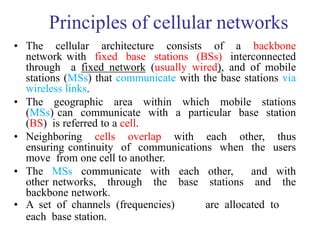
• The cellular architecture consists of a backbone
network with fixed base stations (BSs) interconnected
through a fixed network (usually wired), and of mobile
stations (MSs) that communicate with the base stations via
wireless links.
• The geographic area within which mobile stations
(MSs) can communicate with a particular base station
(BS) is referred to a cell.
• Neighboring cells overlap with each other, thus
ensuring continuity of communications when the users
move from one cell to another.
• The MSs communicate with each other, and with
other networks, through the base stations and the
backbone network.
• A set of channels (frequencies) are allocated to
each base station.
Principles of cellular networks
(Contd..)
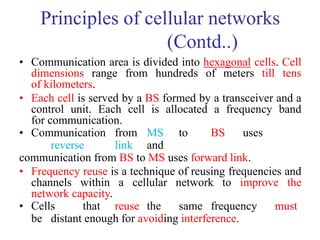
• Communication area is divided into hexagonal cells. Cell
dimensions range from hundreds of meters till tens
of kilometers.
• Each cell is served by a BS formed by a transceiver and a
control unit. Each cell is allocated a frequency band
for communication.
• Communication from MS to BS uses
reverse link and
communication from BS to MS uses forward link.
• Frequency reuse is a technique of reusing frequencies and
channels within a cellular network to improve the
network capacity.
• Cells that reuse the same frequency must
be distant enough for avoiding interference.
Principles of cellular networks
(Contd..)
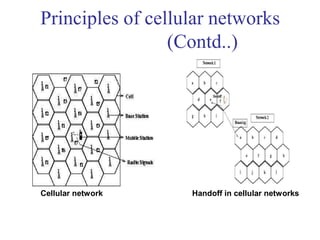
Cellular network Handoff in cellular networks
Handoff
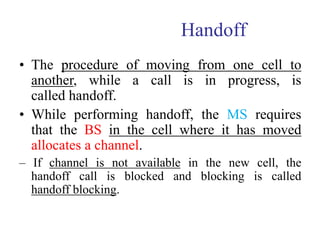
• The procedure of moving from one cell to
another, while a call is in progress, is
called handoff.
• While performing handoff, the MS requires
that the BS in the cell where it has moved
allocates a channel.
– If channel is not available in the new cell, the
handoff call is blocked and blocking is called
handoff blocking.
Handoff (Contd..)
• The QoS (Quality of Service) of a cellular network is
determined by new call and handoff blocking
probabilities.
• Blocking probabilities can be reduced by increasing
the capacity of the cellular networks.
• Capacity of Cellular networks can be increased
– by applying efficient power control algorithms or
– by reducing the size of the cells or
– by increasing the number of channels in each cell.
• High cost solution
– Reduced cells size
– Adding supplementary channels
Other methods to increase capacity
in cellular networks
• Frequency borrowing: congested cells use
frequencies taken from adjacent cells where less
traffic is observed.
• Cell sectoring: cells are divided into sectors and each
sector is allocated its own set of frequencies. BSs use
directional antennas to cover sectors.
• Microcells and picocells: a microcell covers a range
of about 500 m and a picocell covers a range of about
10 m.
Example
A cellular network has a total bandwidth 56 MHz. If two 35 KHz
simplex channels are used to provide full duplex voice and control
channels, compute the number of channels available per cell if
a system uses (a) 4-cell reuse, (b) 7-cell reuse, (c) 12-cell reuse.
Solution:
•Given that the total available bandwidth is 56 MHz = 56,000 KHz.
•Channel bandwidth = 35 KHz x 2 simplex channels = 70 KHz/duplex
channels.
•Total available channels = 56,000/70 = 800 channels.
•let N denotes cell reuse.
•(a) For N = 4, Total number of channels available per cell = 800/4 =
200 channels.
•(b) For N = 7, Total number of channels available per cell = 800/7 =
115 channels.
•(c) For N = 12, Total number of channels available per cell =
800/12 = 67 channels.
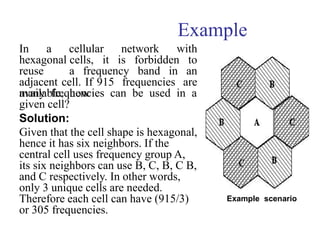
Example
In a cellular network with
hexagonal cells, it is forbidden to
reuse a frequency band in an
adjacent cell. If 915 frequencies are
available, how
many frequencies can be used in a
given cell?
Solution:
Given that the cell shape is hexagonal,
hence it has six neighbors. If the
central cell uses frequency group A,
its six neighbors can use B, C, B, C B,
and C respectively. In other words,
only 3 unique cells are needed.
Therefore each cell can have (915/3)
or 305 frequencies.
Example scenario
Example
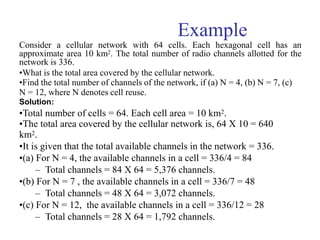
Consider a cellular network with 64 cells. Each hexagonal cell has an
approximate area 10 km2. The total number of radio channels allotted for the
network is 336.
•What is the total area covered by the cellular network.
•Find the total number of channels of the network, if (a) N = 4, (b) N = 7, (c)
N = 12, where N denotes cell reuse.
Solution:
•Total number of cells = 64. Each cell area = 10 km2.
•The total area covered by the cellular network is, 64 X 10 = 640
km2.
•It is given that the total available channels in the network = 336.
•(a) For N = 4, the available channels in a cell = 336/4 = 84
– Total channels = 84 X 64 = 5,376 channels.
•(b) For N = 7 , the available channels in a cell = 336/7 = 48
– Total channels = 48 X 64 = 3,072 channels.
•(c) For N = 12, the available channels in a cell = 336/12 = 28
– Total channels = 28 X 64 = 1,792 channels.
GSM
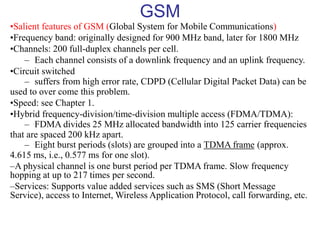
•Salient features of GSM (Global System for Mobile Communications)
•Frequency band: originally designed for 900 MHz band, later for 1800 MHz
•Channels: 200 full-duplex channels per cell.
– Each channel consists of a downlink frequency and an uplink frequency.
•Circuit switched
– suffers from high error rate, CDPD (Cellular Digital Packet Data) can be
used to over come this problem.
•Speed: see Chapter 1.
•Hybrid frequency-division/time-division multiple access (FDMA/TDMA):
– FDMA divides 25 MHz allocated bandwidth into 125 carrier frequencies
that are spaced 200 kHz apart.
– Eight burst periods (slots) are grouped into a TDMA frame (approx.
4.615 ms, i.e., 0.577 ms for one slot).
–A physical channel is one burst period per TDMA frame. Slow frequency
hopping at up to 217 times per second.
–Services: Supports value added services such as SMS (Short Message
Service), access to Internet, Wireless Application Protocol, call forwarding, etc.
GSM Architecture
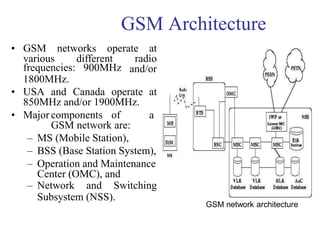
• GSM networks operate at
various different radio
and/or
frequencies: 900MHz
1800MHz.
• USA and Canada operate at
850MHz and/or 1900MHz.
• Major components of a
GSM network are:
– MS (Mobile Station),
– BSS (Base Station System),
– Operation and Maintenance
Center (OMC), and
– Network and Switching
Subsystem (NSS).
GSM network architecture
GSM Architecture (Contd..)
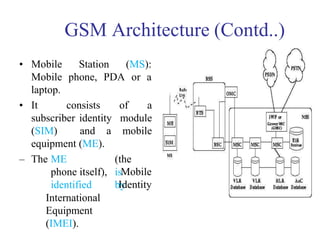
Station (MS):
phone, PDA or a
• Mobile
Mobile
laptop.
• It consists of a
subscriber identity module
(SIM) and a mobile
equipment (ME).
– The ME (the
phone itself), is
identified by
Mobile
Identity
International
Equipment
(IMEI).
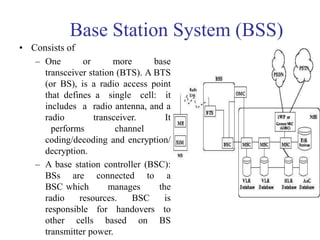
Base Station System (BSS)
• Consists of
– One or more base
transceiver station (BTS). A BTS
(or BS), is a radio access point
that defines a single cell: it
includes a radio antenna, and a
radio transceiver. It
performs channel
coding/decoding and encryption/
decryption.
– A base station controller (BSC):
BSs are connected to a
BSC which manages the
radio resources. BSC is
responsible for handovers to
other cells based on BS
transmitter power.
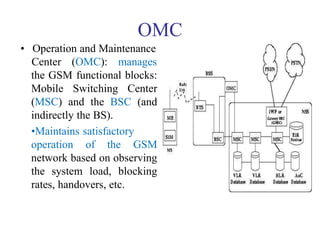
OMC
• Operation and Maintenance
Center (OMC): manages
the GSM functional blocks:
Mobile Switching Center
(MSC) and the BSC (and
indirectly the BS).
•Maintains satisfactory
operation of the GSM
network based on observing
the system load, blocking
rates, handovers, etc.
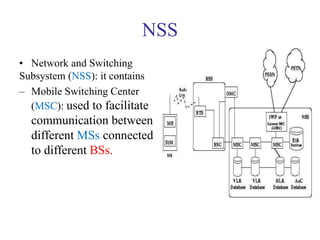
NSS
• Network and Switching
Subsystem (NSS): it contains
– Mobile Switching Center
(MSC): used to facilitate
communication between
different MSs connected
to different BSs.
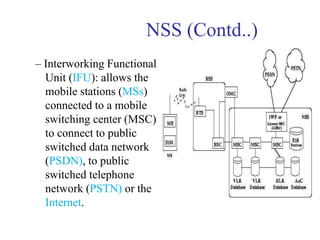
NSS (Contd..)
– Interworking Functional
Unit (IFU): allows the
mobile stations (MSs)
connected to a mobile
switching center (MSC)
to connect to public
switched data network
(PSDN), to public
switched telephone
network (PSTN) or the
Internet.
NSS (Contd..)
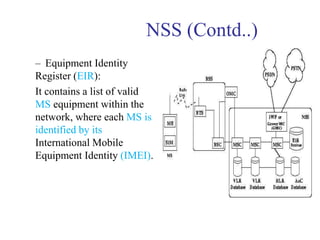
– Equipment Identity
Register (EIR):
It contains a list of valid
MS equipment within the
network, where each MS is
identified by its
International Mobile
Equipment Identity (IMEI).
NSS (Contd..)
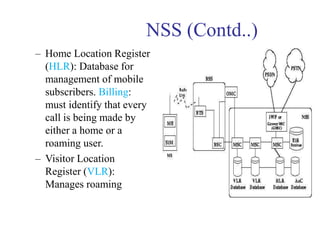
– Home Location Register
(HLR): Database for
management of mobile
subscribers. Billing:
must identify that every
call is being made by
either a home or a
roaming user.
– Visitor Location
Register (VLR):
Manages roaming
NSS (Contd..)
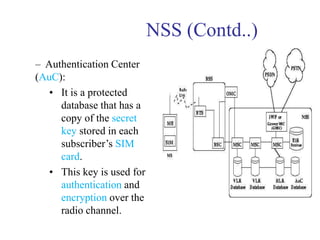
– Authentication Center
(AuC):
• It is a protected
database that has a
copy of the secret
key stored in each
subscriber’s SIM
card.
• This key is used for
authentication and
encryption over the
radio channel.
GSM as a cellular network standard
• GSM was the European standard for voice services; later
data services were introduced.
• Some of the standards developed for WWANs are IS-41,
IS-54, IS-88, IS-91, IS-93, IS-95, IS-124, IS-637, IS-756,
and IS-2000.
• IS stands for Inter-Systems operation
• Four different cell sizes in a GSM network
– macro, micro, pico and umbrella cells.
• macro cells: cells where the BS antenna is installed in a mast
or a building above average roof top level.
• micro cells: Antenna height is under average roof top level;
they are typically used in urban areas.
• picocells: they are mainly used indoors.
• umbrella cells : To cover shadowed regions of smaller cells
and fill gaps in coverage between those cells.
GPRS
• General Packet Radio Service (GPRS) is a non-voice
value-added service that allows information to be sent
and received across a mobile telephone network.
• It supplements today’s circuit-switched data
and SMS.
• GPRS is not related to the global positioning
system (GPS), a similar acronym that is often used
in mobile contexts.
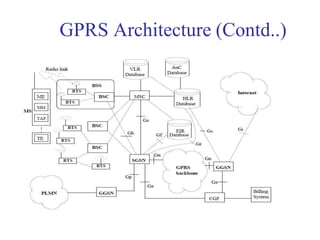
GPRS Architecture
• General Packet Radio Service (GPRS) is an
enhancement over the GSM and adds some
nodes in the network to provide the packet
switched services.
• These network nodes are called GPRS support
nodes (GSNs) and are responsible for the
routing and delivery of the data packets to and
from the MS and external packet data network
(PDN)
GPRS Architecture (Contd..)
GPRS mobile station (MS)
• GPRS mobile station (MS) includes two components:
MT (Mobile Terminal) and TE (Terminal
Equipment).
– MT is typically a handset used to access the radio interface.
It consists of
• ME,
• SIM, and
• Terminal Adaptation Function (TAF)
– TAF helps GPRS TE merely to use the radio
system at hotspots.
– TE is typically a laptop or a
Personal Digital Assistant (PDA).
GPRS mobile station (Contd..)
• Three different classes of MS have been
defined:
– Class-A: supports simultaneous monitoring and operation
of both GPRS (packet-switched) and GSM (circuit-
switched) services.
– Class-B: supports simultaneous monitoring but not
simultaneous operation of GSM (circuit-switched) and
GPRS (packet-switched) services.
– Class-C: supports either GSM (circuit-switched) or GPRS
(packet-switched) monitoring and operation at a given time.
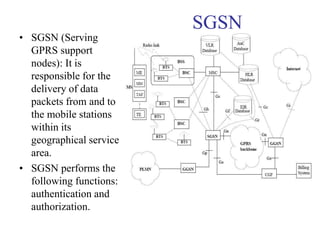
SGSN
• SGSN (Serving
GPRS support
nodes): It is
responsible for the
delivery of data
packets from and to
the mobile stations
within its
geographical service
area.
• SGSN performs the
following functions:
authentication and
authorization.
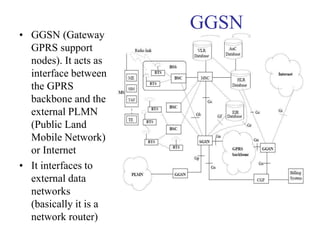
GGSN
• GGSN (Gateway
GPRS support
nodes). It acts as
interface between
the GPRS
backbone and the
external PLMN
(Public Land
Mobile Network)
or Internet
• It interfaces to
external data
networks
(basically it is a
network router)
CGF (The Charging Gateway Function)
• It provides the mechanism of transfer of charging
information from the GPRS Support Nodes
(GSNs) the billing system
• The CGF can be a separate centralized element or it
can be distributed among GPRS Support Nodes
• GPRS networks derive charging information for each
user transaction into Call Detail Records (CDRs)
from SGSNs and GGSNs.
• Billing is typically based on the amount of data
transferred
Functioning of GPRS
• GPRS is a packet-switched protocol for
applications such as World Wide Web (WWW).
• SGSN receives and
transmits packets
between
the MSs and their counterparts in the PSDN
• GGSN interworks with
the PSDN using
connectionless network protocols
• SGSN and GGSN interact with the GSM location
databases
Functioning of GPRS (Contd..)
• The GPRS data units are routed to the destination
MSs based on location information.
• Both SGSN and GGSN may be equipped with cache
memories containing location information to speed up
the routing procedure.
• GPRS air interface requires a new radio link protocol
to guarantee fast call setup procedure and low bit
error rate for data transfer between the MSs and the
BSs.
CDMA
• Code division multiple access (CDMA) is a channel
access method utilized by various
radio communication technologies.
• CDMA consistently provides better capacity for voice
and data communications than other
commercial mobile technologies.
CDMA (Contd..)
• When implemented in a cellular telephone system,
CDMA technology offers following benefits:
– Capacity increases of 8 to 10 times that of an AMPS analog
system and 4 to 5 times that of a GSM system.
– Improved call quality
– Simplified system planning through
the use of the same
frequency in every sector of every cell.
– Improved coverage characteristics
CDMA (Contd..)
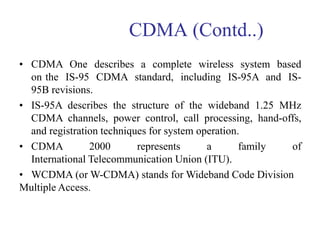
• CDMA One describes a complete wireless system based
on the IS-95 CDMA standard, including IS-95A and IS-
95B revisions.
• IS-95A describes the structure of the wideband 1.25 MHz
CDMA channels, power control, call processing, hand-offs,
and registration techniques for system operation.
• CDMA 2000 represents a family of
International Telecommunication Union (ITU).
• WCDMA (or W-CDMA) stands for Wideband Code Division
Multiple Access.
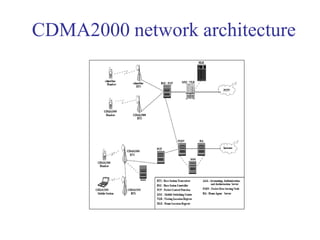
CDMA2000 network architecture
The Mobile Station (MS)
• In a CDMA2000 1X network, the mobile station-the
subscriber's handset-functions as a mobile-IP client.
• Upon power-up, the mobile station
automatically registers with the HLR in order to
– Authenticate the mobile for the environment
of the accessed network
– Provide the HLR with the mobile's current location
– Provide the Serving MobileSwitching
Centre (MSC-S)
with the mobile's permitted feature set
Base Station Transceiver
Subsystem (BTS)
• BTS controls the activities of the air link and acts as
the interface between the network and the mobile.
• RF resources such as frequency assignments,
sector separation and transmit power control are
managed at the BTS.
• In addition, the BTS manages the back-haul from the
cell site to the Base Station Controller (BSC) to
minimize any delays between these two elements.
Base Station Controller (BSC)
• BSC routes voice- and circuit-switched data messages
between the cell sites and the MSC.
• It also bears responsibility for mobility management :
it controls and directs handoffs from one cell site to
another as needed.
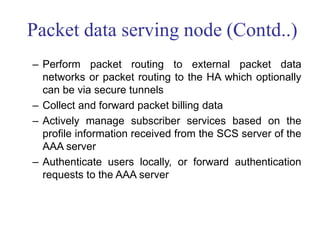
Packet data serving node
• The PDSN does the following activities:
– Manage the radio-packet interface between the
BSS (Base Station Subsystem = BTS + BSC) and
the IP network by establishing, maintaining
and terminating link layer to the mobile client
– Terminate the Point-to-Point Protocol
(PPP) session initiated by the subscriber
– Provide an IP address for the subscriber (either
from an internal pool or through a DHCP server or
through an AAA server)
Packet data serving node (Contd..)
– Perform packet routing to external packet data
networks or packet routing to the HA which optionally
can be via secure tunnels
– Collect and forward packet billing data
– Actively manage subscriber services based on the
profile information received from the SCS server of the
AAA server
– Authenticate users locally, or forward authentication
requests to the AAA server
Packet data serving node (Contd..)
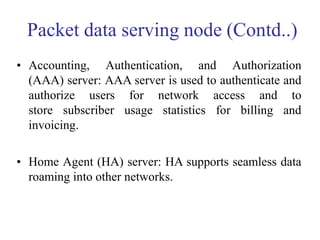
• Accounting, Authentication, and Authorization
(AAA) server: AAA server is used to authenticate and
authorize users for network access and to
store subscriber usage statistics for billing and
invoicing.
• Home Agent (HA) server: HA supports seamless data
roaming into other networks.
Call set-up scenario in CDMA2000
(Contd..)
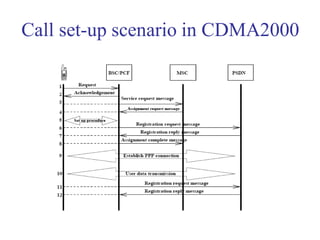
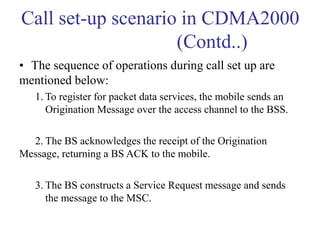
• The sequence of operations during call set up are
mentioned below:
1. To register for packet data services, the mobile sends an
Origination Message over the access channel to the BSS.
2. The BS acknowledges the receipt of the Origination
Message, returning a BS ACK to the mobile.
3. The BS constructs a Service Request message and sends
the message to the MSC.
Call set-up scenario in CDMA2000
(Contd..)
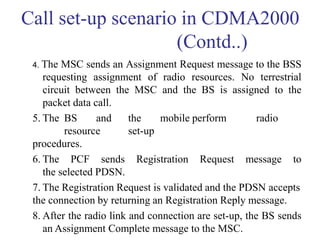
4. The MSC sends an Assignment Request message to the BSS
requesting assignment of radio resources. No terrestrial
circuit between the MSC and the BS is assigned to the
packet data call.
5. The BS and the mobile perform radio
resource set-up
procedures.
6. The PCF sends Registration Request message to
the selected PDSN.
7. The Registration Request is validated and the PDSN accepts
the connection by returning an Registration Reply message.
8. After the radio link and connection are set-up, the BS sends
an Assignment Complete message to the MSC.
Call set-up scenario in CDMA2000
(Contd..)
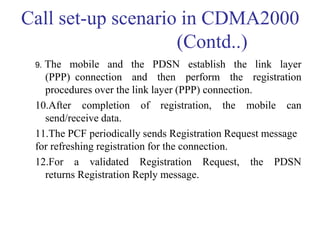
9. The mobile and the PDSN establish the link layer
(PPP) connection and then perform the registration
procedures over the link layer (PPP) connection.
10.After completion of registration, the mobile can
send/receive data.
11.The PCF periodically sends Registration Request message
for refreshing registration for the connection.
12.For a validated Registration Request, the PDSN
returns Registration Reply message.
GSM Vs. CDMA
Handover in cellular networks
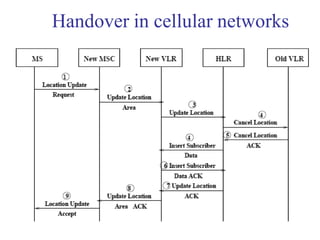
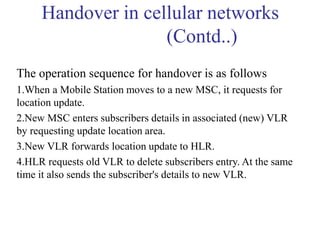
The operation sequence for handover is as follows
1.When a Mobile Station moves to a new MSC, it requests for
location update.
2.New MSC enters subscribers details in associated (new) VLR
by requesting update location area.
3.New VLR forwards location update to HLR.
4.HLR requests old VLR to delete subscribers entry. At the same
time it also sends the subscriber's details to new VLR.
Handover in cellular networks
(Contd..)
These slides are based on the slides formatted by Dr Sunilkumar S. manvi and Dr Mahabaleshwar S. Kakkasageri, the
authors of the textbook: Wireless and Mobile Networks, concepts and protocols. See slide number one.
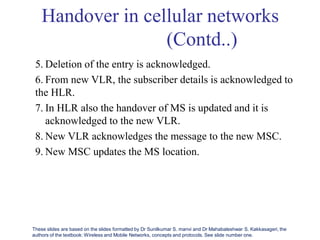
5. Deletion of the entry is acknowledged.
6. From new VLR, the subscriber details is acknowledged to
the HLR.
7. In HLR also the handover of MS is updated and it is
acknowledged to the new VLR.
8. New VLR acknowledges the message to the new MSC.
9. New MSC updates the MS location.
Handover in cellular networks
(Contd..)
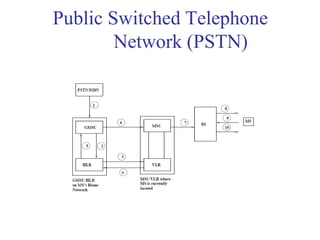
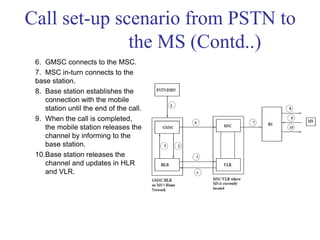
Public Switched Telephone
Network (PSTN)
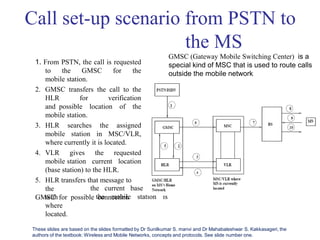
Call set-up scenario from PSTN to
the MS
1. From PSTN, the call is requested
to the GMSC for the
mobile station.
2. GMSC transfers the call to the
HLR for verification
and possible location of the
mobile station.
3. HLR searches the assigned
mobile station in MSC/VLR,
where currently it is located.
4. VLR gives the requested
mobile station current location
(base station) to the HLR.
5. HLR transfers that message to
the
GMSC for possible connection
with
where
the current base station
the mobile station is
located.
GMSC (Gateway Mobile Switching Center) is a
special kind of MSC that is used to route calls
outside the mobile network
These slides are based on the slides formatted by Dr Sunilkumar S. manvi and Dr Mahabaleshwar S. Kakkasageri, the
authors of the textbook: Wireless and Mobile Networks, concepts and protocols. See slide number one.
Call set-up scenario from PSTN to
the MS (Contd..)
6. GMSC connects to the MSC.
7. MSC in-turn connects to the
base station.
8. Base station establishes the
connection with the mobile
station until the end of the call.
9. When the call is completed,
the mobile station releases the
channel by informing to the
base station.
10.Base station releases the
channel and updates in HLR
and VLR.
Satellite networks
• A satellite is an object that orbits or revolves around
another object.
• Satellite communication systems differ
from terrestrial systems in that the transmitter is not
based on the ground but in the sky.
• A satellite system consisting of one or more satellites
and the cooperating earth stations is referred as a
satellite network.
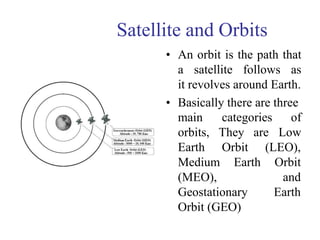
Satellite and Orbits
• An orbit is the path that
a satellite follows as
it revolves around Earth.
• Basically there are three
categories of
Low
main
orbits,
Earth
They are
Orbit (LEO),
Orbit
and
Earth
Medium Earth
(MEO),
Geostationary
Orbit (GEO)
Salient features
• A satellite network communicates using earth stations and
satellites
• Communication from earth station to satellite is called uplink
channel whereas communication from earth station to satellite
is called downlink channel.
• Some of the features of satellite networks are as follows
– Coverage
– Speed
– Security
– Service types
– Usage
– Repeater
– Packet switched
– Frequency band
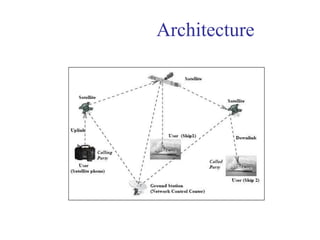
Architecture
Architecture (Contd..)
• Satellite
– A satellite is a type of satellite network component that orbits the earth
in space as a wireless receiver/transmitter.
• Ground stations
– Many satellites are moving in their respective orbits over the earth, thus
it is idealistic that we can freely communicate with a satellite by a radio
frequency whenever we want to monitor its status or send a command.
• Users
– A satellite network user may be a satellite telephone (sat phone), or a
communication unit in the ship is a type of mobile phone that connects
to orbiting satellites instead of terrestrial cell sites.
WLAN Vs. WWAN
• Coverage
– Wireless local area networks by definition operate over
a
small, local coverage area, normally about 100 m in range.
– Wireless wide area networks cover a much wider area, such
as wherever the cellular network provider has wireless
coverage.
• Speed
– Wireless WAN speeds differ depending on the technology
used
• GPRS networks offer a maximum user data rate of over 115 kbps if
all eight timeslots in a cell are allocated for data transmission.
• Data speeds on CDMA networks were initially available at speeds
of 14.4 kbps, but have increased to a maximum throughput of 153
kbps as carriers have implemented CDMA2000 1X
(1xRTT) networks
WLAN Vs. WWAN (Contd..)
• Data Security
– In contrast to the security weaknesses in 802.11 networks,
cellular wireless WAN networks are extremely secure.
– These networks incorporate military
technology and sophisticated encryption and
authentication methods.
– Hotspots are wireless LANs available
to the public in a
location like an airport, coffee shop, or city neighborhood.
WLAN Vs. WWAN (Contd..)
• Cost
– Since wireless LANs operate in the unlicensed
frequency range, there is no service cost for using a private
wireless LAN.
– The main cost involved is the cost of purchasing and
installing the wireless LAN equipment and devices, and the
cost of maintaining the network and the users.
WLAN Vs. WWAN (Contd..)
Interworking of WLAN and
WWAN
• Although WLANs and WWANs may appear to
be competing technologies, they are far more
useful as complementary technologies.
• These are used together, a user would have the best of
both technologies, offering high-speed
wireless access in a campus area, and access to all
their data and applications with high-speed cellular
access from anywhere with wireless WAN network
coverage.
WWAN applications
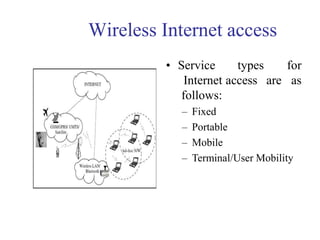
• Wireless Internet
– Internet can be accessed through the following:
IEEE 802.11, 802.11a,
• Global Satellite Networks.
• Cellular Networks: GSM, CDPD, GPRS.
• WCDMA/cdma2000 Wireless LANs:
802.11b.
• PersonalArea Networks: IEEE 802.15, Bluetooth.
Wireless Internet access
– Fixed
– Portable
– Mobile
– Terminal/User Mobility
• Service types for
Internet access are as
follows:
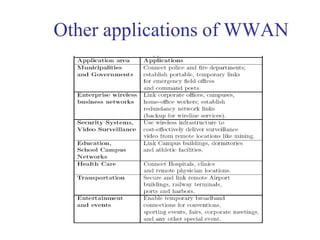
Other applications of WWAN

UNIT 1 wireless wide area network for wireless network

  • 1.
  • 2.
    Learning objectives – Tounderstand Wireless Wide Area Networks (WWANs) – To study the WWAN standards – To know the architectures of WWANs – To study the protocols used in WWANS – To illustrate the applications of WWANs
  • 3.
    Wireless wide areanetworks technologies such as Global System for Mobile Communications (GSM), General Packet Radio Service (GPRS), Universal Mobile Telecommunications System (UMTS), Code Division Multiple Access (CDMA), etc., to transfer data. •WWAN can also use Local Multipoint Distribution Service (LMDS) and Wi-Fi to connect to the Internet. •WWAN connectivity allows a user with a laptop and a WWAN card to surf the web, check email, or connect to a Virtual Private Network (VPN) from anywhere within the regional boundaries of cellular service. • WWAN is a form of wireless network which uses mobile telecommunication cellular network
  • 4.
    Cellular networks • Acellular network uses a large number of low-power wireless transmitters to create cells - the basic geographic service area of a wireless communications system. • Mobile users travel from cell to cell, their conversations are handed of between cells to maintain seamless service. • Channels (frequencies) used in one cell can be reused in another cell some distance away. • Cells can be added to accommodate growth, creating new cells in unserved areas or overlaying cells in existing areas. • Examples of this type of networks are GSM, PCS (Personal communication systems) and UMTS/IMT 2000 (Universal Mobile Telecommunications System /International Mobile Telecommunications).
  • 5.
    Principles of cellularnetworks • The cellular architecture consists of a backbone network with fixed base stations (BSs) interconnected through a fixed network (usually wired), and of mobile stations (MSs) that communicate with the base stations via wireless links. • The geographic area within which mobile stations (MSs) can communicate with a particular base station (BS) is referred to a cell. • Neighboring cells overlap with each other, thus ensuring continuity of communications when the users move from one cell to another. • The MSs communicate with each other, and with other networks, through the base stations and the backbone network. • A set of channels (frequencies) are allocated to each base station.
  • 6.
    Principles of cellularnetworks (Contd..) • Communication area is divided into hexagonal cells. Cell dimensions range from hundreds of meters till tens of kilometers. • Each cell is served by a BS formed by a transceiver and a control unit. Each cell is allocated a frequency band for communication. • Communication from MS to BS uses reverse link and communication from BS to MS uses forward link. • Frequency reuse is a technique of reusing frequencies and channels within a cellular network to improve the network capacity. • Cells that reuse the same frequency must be distant enough for avoiding interference.
  • 7.
    Principles of cellularnetworks (Contd..) Cellular network Handoff in cellular networks
  • 8.
    Handoff • The procedureof moving from one cell to another, while a call is in progress, is called handoff. • While performing handoff, the MS requires that the BS in the cell where it has moved allocates a channel. – If channel is not available in the new cell, the handoff call is blocked and blocking is called handoff blocking.
  • 9.
    Handoff (Contd..) • TheQoS (Quality of Service) of a cellular network is determined by new call and handoff blocking probabilities. • Blocking probabilities can be reduced by increasing the capacity of the cellular networks. • Capacity of Cellular networks can be increased – by applying efficient power control algorithms or – by reducing the size of the cells or – by increasing the number of channels in each cell. • High cost solution – Reduced cells size – Adding supplementary channels
  • 10.
    Other methods toincrease capacity in cellular networks • Frequency borrowing: congested cells use frequencies taken from adjacent cells where less traffic is observed. • Cell sectoring: cells are divided into sectors and each sector is allocated its own set of frequencies. BSs use directional antennas to cover sectors. • Microcells and picocells: a microcell covers a range of about 500 m and a picocell covers a range of about 10 m.
  • 11.
    Example A cellular networkhas a total bandwidth 56 MHz. If two 35 KHz simplex channels are used to provide full duplex voice and control channels, compute the number of channels available per cell if a system uses (a) 4-cell reuse, (b) 7-cell reuse, (c) 12-cell reuse. Solution: •Given that the total available bandwidth is 56 MHz = 56,000 KHz. •Channel bandwidth = 35 KHz x 2 simplex channels = 70 KHz/duplex channels. •Total available channels = 56,000/70 = 800 channels. •let N denotes cell reuse. •(a) For N = 4, Total number of channels available per cell = 800/4 = 200 channels. •(b) For N = 7, Total number of channels available per cell = 800/7 = 115 channels. •(c) For N = 12, Total number of channels available per cell = 800/12 = 67 channels.
  • 12.
    Example In a cellularnetwork with hexagonal cells, it is forbidden to reuse a frequency band in an adjacent cell. If 915 frequencies are available, how many frequencies can be used in a given cell? Solution: Given that the cell shape is hexagonal, hence it has six neighbors. If the central cell uses frequency group A, its six neighbors can use B, C, B, C B, and C respectively. In other words, only 3 unique cells are needed. Therefore each cell can have (915/3) or 305 frequencies. Example scenario
  • 13.
    Example Consider a cellularnetwork with 64 cells. Each hexagonal cell has an approximate area 10 km2. The total number of radio channels allotted for the network is 336. •What is the total area covered by the cellular network. •Find the total number of channels of the network, if (a) N = 4, (b) N = 7, (c) N = 12, where N denotes cell reuse. Solution: •Total number of cells = 64. Each cell area = 10 km2. •The total area covered by the cellular network is, 64 X 10 = 640 km2. •It is given that the total available channels in the network = 336. •(a) For N = 4, the available channels in a cell = 336/4 = 84 – Total channels = 84 X 64 = 5,376 channels. •(b) For N = 7 , the available channels in a cell = 336/7 = 48 – Total channels = 48 X 64 = 3,072 channels. •(c) For N = 12, the available channels in a cell = 336/12 = 28 – Total channels = 28 X 64 = 1,792 channels.
  • 14.
    GSM •Salient features ofGSM (Global System for Mobile Communications) •Frequency band: originally designed for 900 MHz band, later for 1800 MHz •Channels: 200 full-duplex channels per cell. – Each channel consists of a downlink frequency and an uplink frequency. •Circuit switched – suffers from high error rate, CDPD (Cellular Digital Packet Data) can be used to over come this problem. •Speed: see Chapter 1. •Hybrid frequency-division/time-division multiple access (FDMA/TDMA): – FDMA divides 25 MHz allocated bandwidth into 125 carrier frequencies that are spaced 200 kHz apart. – Eight burst periods (slots) are grouped into a TDMA frame (approx. 4.615 ms, i.e., 0.577 ms for one slot). –A physical channel is one burst period per TDMA frame. Slow frequency hopping at up to 217 times per second. –Services: Supports value added services such as SMS (Short Message Service), access to Internet, Wireless Application Protocol, call forwarding, etc.
  • 15.
    GSM Architecture • GSMnetworks operate at various different radio and/or frequencies: 900MHz 1800MHz. • USA and Canada operate at 850MHz and/or 1900MHz. • Major components of a GSM network are: – MS (Mobile Station), – BSS (Base Station System), – Operation and Maintenance Center (OMC), and – Network and Switching Subsystem (NSS). GSM network architecture
  • 16.
    GSM Architecture (Contd..) Station(MS): phone, PDA or a • Mobile Mobile laptop. • It consists of a subscriber identity module (SIM) and a mobile equipment (ME). – The ME (the phone itself), is identified by Mobile Identity International Equipment (IMEI).
  • 17.
    Base Station System(BSS) • Consists of – One or more base transceiver station (BTS). A BTS (or BS), is a radio access point that defines a single cell: it includes a radio antenna, and a radio transceiver. It performs channel coding/decoding and encryption/ decryption. – A base station controller (BSC): BSs are connected to a BSC which manages the radio resources. BSC is responsible for handovers to other cells based on BS transmitter power.
  • 18.
    OMC • Operation andMaintenance Center (OMC): manages the GSM functional blocks: Mobile Switching Center (MSC) and the BSC (and indirectly the BS). •Maintains satisfactory operation of the GSM network based on observing the system load, blocking rates, handovers, etc.
  • 19.
    NSS • Network andSwitching Subsystem (NSS): it contains – Mobile Switching Center (MSC): used to facilitate communication between different MSs connected to different BSs.
  • 20.
    NSS (Contd..) – InterworkingFunctional Unit (IFU): allows the mobile stations (MSs) connected to a mobile switching center (MSC) to connect to public switched data network (PSDN), to public switched telephone network (PSTN) or the Internet.
  • 21.
    NSS (Contd..) – EquipmentIdentity Register (EIR): It contains a list of valid MS equipment within the network, where each MS is identified by its International Mobile Equipment Identity (IMEI).
  • 22.
    NSS (Contd..) – HomeLocation Register (HLR): Database for management of mobile subscribers. Billing: must identify that every call is being made by either a home or a roaming user. – Visitor Location Register (VLR): Manages roaming
  • 23.
    NSS (Contd..) – AuthenticationCenter (AuC): • It is a protected database that has a copy of the secret key stored in each subscriber’s SIM card. • This key is used for authentication and encryption over the radio channel.
  • 24.
    GSM as acellular network standard • GSM was the European standard for voice services; later data services were introduced. • Some of the standards developed for WWANs are IS-41, IS-54, IS-88, IS-91, IS-93, IS-95, IS-124, IS-637, IS-756, and IS-2000. • IS stands for Inter-Systems operation • Four different cell sizes in a GSM network – macro, micro, pico and umbrella cells. • macro cells: cells where the BS antenna is installed in a mast or a building above average roof top level. • micro cells: Antenna height is under average roof top level; they are typically used in urban areas. • picocells: they are mainly used indoors. • umbrella cells : To cover shadowed regions of smaller cells and fill gaps in coverage between those cells.
  • 25.
    GPRS • General PacketRadio Service (GPRS) is a non-voice value-added service that allows information to be sent and received across a mobile telephone network. • It supplements today’s circuit-switched data and SMS. • GPRS is not related to the global positioning system (GPS), a similar acronym that is often used in mobile contexts.
  • 26.
    GPRS Architecture • GeneralPacket Radio Service (GPRS) is an enhancement over the GSM and adds some nodes in the network to provide the packet switched services. • These network nodes are called GPRS support nodes (GSNs) and are responsible for the routing and delivery of the data packets to and from the MS and external packet data network (PDN)
  • 27.
  • 28.
    GPRS mobile station(MS) • GPRS mobile station (MS) includes two components: MT (Mobile Terminal) and TE (Terminal Equipment). – MT is typically a handset used to access the radio interface. It consists of • ME, • SIM, and • Terminal Adaptation Function (TAF) – TAF helps GPRS TE merely to use the radio system at hotspots. – TE is typically a laptop or a Personal Digital Assistant (PDA).
  • 29.
    GPRS mobile station(Contd..) • Three different classes of MS have been defined: – Class-A: supports simultaneous monitoring and operation of both GPRS (packet-switched) and GSM (circuit- switched) services. – Class-B: supports simultaneous monitoring but not simultaneous operation of GSM (circuit-switched) and GPRS (packet-switched) services. – Class-C: supports either GSM (circuit-switched) or GPRS (packet-switched) monitoring and operation at a given time.
  • 30.
    SGSN • SGSN (Serving GPRSsupport nodes): It is responsible for the delivery of data packets from and to the mobile stations within its geographical service area. • SGSN performs the following functions: authentication and authorization.
  • 31.
    GGSN • GGSN (Gateway GPRSsupport nodes). It acts as interface between the GPRS backbone and the external PLMN (Public Land Mobile Network) or Internet • It interfaces to external data networks (basically it is a network router)
  • 32.
    CGF (The ChargingGateway Function) • It provides the mechanism of transfer of charging information from the GPRS Support Nodes (GSNs) the billing system • The CGF can be a separate centralized element or it can be distributed among GPRS Support Nodes • GPRS networks derive charging information for each user transaction into Call Detail Records (CDRs) from SGSNs and GGSNs. • Billing is typically based on the amount of data transferred
  • 33.
    Functioning of GPRS •GPRS is a packet-switched protocol for applications such as World Wide Web (WWW). • SGSN receives and transmits packets between the MSs and their counterparts in the PSDN • GGSN interworks with the PSDN using connectionless network protocols • SGSN and GGSN interact with the GSM location databases
  • 34.
    Functioning of GPRS(Contd..) • The GPRS data units are routed to the destination MSs based on location information. • Both SGSN and GGSN may be equipped with cache memories containing location information to speed up the routing procedure. • GPRS air interface requires a new radio link protocol to guarantee fast call setup procedure and low bit error rate for data transfer between the MSs and the BSs.
  • 35.
    CDMA • Code divisionmultiple access (CDMA) is a channel access method utilized by various radio communication technologies. • CDMA consistently provides better capacity for voice and data communications than other commercial mobile technologies.
  • 36.
    CDMA (Contd..) • Whenimplemented in a cellular telephone system, CDMA technology offers following benefits: – Capacity increases of 8 to 10 times that of an AMPS analog system and 4 to 5 times that of a GSM system. – Improved call quality – Simplified system planning through the use of the same frequency in every sector of every cell. – Improved coverage characteristics
  • 37.
    CDMA (Contd..) • CDMAOne describes a complete wireless system based on the IS-95 CDMA standard, including IS-95A and IS- 95B revisions. • IS-95A describes the structure of the wideband 1.25 MHz CDMA channels, power control, call processing, hand-offs, and registration techniques for system operation. • CDMA 2000 represents a family of International Telecommunication Union (ITU). • WCDMA (or W-CDMA) stands for Wideband Code Division Multiple Access.
  • 38.
  • 39.
    The Mobile Station(MS) • In a CDMA2000 1X network, the mobile station-the subscriber's handset-functions as a mobile-IP client. • Upon power-up, the mobile station automatically registers with the HLR in order to – Authenticate the mobile for the environment of the accessed network – Provide the HLR with the mobile's current location – Provide the Serving MobileSwitching Centre (MSC-S) with the mobile's permitted feature set
  • 40.
    Base Station Transceiver Subsystem(BTS) • BTS controls the activities of the air link and acts as the interface between the network and the mobile. • RF resources such as frequency assignments, sector separation and transmit power control are managed at the BTS. • In addition, the BTS manages the back-haul from the cell site to the Base Station Controller (BSC) to minimize any delays between these two elements.
  • 41.
    Base Station Controller(BSC) • BSC routes voice- and circuit-switched data messages between the cell sites and the MSC. • It also bears responsibility for mobility management : it controls and directs handoffs from one cell site to another as needed.
  • 42.
    Packet data servingnode • The PDSN does the following activities: – Manage the radio-packet interface between the BSS (Base Station Subsystem = BTS + BSC) and the IP network by establishing, maintaining and terminating link layer to the mobile client – Terminate the Point-to-Point Protocol (PPP) session initiated by the subscriber – Provide an IP address for the subscriber (either from an internal pool or through a DHCP server or through an AAA server)
  • 43.
    Packet data servingnode (Contd..) – Perform packet routing to external packet data networks or packet routing to the HA which optionally can be via secure tunnels – Collect and forward packet billing data – Actively manage subscriber services based on the profile information received from the SCS server of the AAA server – Authenticate users locally, or forward authentication requests to the AAA server
  • 44.
    Packet data servingnode (Contd..) • Accounting, Authentication, and Authorization (AAA) server: AAA server is used to authenticate and authorize users for network access and to store subscriber usage statistics for billing and invoicing. • Home Agent (HA) server: HA supports seamless data roaming into other networks.
  • 45.
  • 46.
    Call set-up scenarioin CDMA2000 (Contd..) • The sequence of operations during call set up are mentioned below: 1. To register for packet data services, the mobile sends an Origination Message over the access channel to the BSS. 2. The BS acknowledges the receipt of the Origination Message, returning a BS ACK to the mobile. 3. The BS constructs a Service Request message and sends the message to the MSC.
  • 47.
    Call set-up scenarioin CDMA2000 (Contd..) 4. The MSC sends an Assignment Request message to the BSS requesting assignment of radio resources. No terrestrial circuit between the MSC and the BS is assigned to the packet data call. 5. The BS and the mobile perform radio resource set-up procedures. 6. The PCF sends Registration Request message to the selected PDSN. 7. The Registration Request is validated and the PDSN accepts the connection by returning an Registration Reply message. 8. After the radio link and connection are set-up, the BS sends an Assignment Complete message to the MSC.
  • 48.
    Call set-up scenarioin CDMA2000 (Contd..) 9. The mobile and the PDSN establish the link layer (PPP) connection and then perform the registration procedures over the link layer (PPP) connection. 10.After completion of registration, the mobile can send/receive data. 11.The PCF periodically sends Registration Request message for refreshing registration for the connection. 12.For a validated Registration Request, the PDSN returns Registration Reply message.
  • 49.
  • 50.
  • 51.
    The operation sequencefor handover is as follows 1.When a Mobile Station moves to a new MSC, it requests for location update. 2.New MSC enters subscribers details in associated (new) VLR by requesting update location area. 3.New VLR forwards location update to HLR. 4.HLR requests old VLR to delete subscribers entry. At the same time it also sends the subscriber's details to new VLR. Handover in cellular networks (Contd..)
  • 52.
    These slides arebased on the slides formatted by Dr Sunilkumar S. manvi and Dr Mahabaleshwar S. Kakkasageri, the authors of the textbook: Wireless and Mobile Networks, concepts and protocols. See slide number one. 5. Deletion of the entry is acknowledged. 6. From new VLR, the subscriber details is acknowledged to the HLR. 7. In HLR also the handover of MS is updated and it is acknowledged to the new VLR. 8. New VLR acknowledges the message to the new MSC. 9. New MSC updates the MS location. Handover in cellular networks (Contd..)
  • 53.
  • 54.
    Call set-up scenariofrom PSTN to the MS 1. From PSTN, the call is requested to the GMSC for the mobile station. 2. GMSC transfers the call to the HLR for verification and possible location of the mobile station. 3. HLR searches the assigned mobile station in MSC/VLR, where currently it is located. 4. VLR gives the requested mobile station current location (base station) to the HLR. 5. HLR transfers that message to the GMSC for possible connection with where the current base station the mobile station is located. GMSC (Gateway Mobile Switching Center) is a special kind of MSC that is used to route calls outside the mobile network These slides are based on the slides formatted by Dr Sunilkumar S. manvi and Dr Mahabaleshwar S. Kakkasageri, the authors of the textbook: Wireless and Mobile Networks, concepts and protocols. See slide number one.
  • 55.
    Call set-up scenariofrom PSTN to the MS (Contd..) 6. GMSC connects to the MSC. 7. MSC in-turn connects to the base station. 8. Base station establishes the connection with the mobile station until the end of the call. 9. When the call is completed, the mobile station releases the channel by informing to the base station. 10.Base station releases the channel and updates in HLR and VLR.
  • 56.
    Satellite networks • Asatellite is an object that orbits or revolves around another object. • Satellite communication systems differ from terrestrial systems in that the transmitter is not based on the ground but in the sky. • A satellite system consisting of one or more satellites and the cooperating earth stations is referred as a satellite network.
  • 57.
    Satellite and Orbits •An orbit is the path that a satellite follows as it revolves around Earth. • Basically there are three categories of Low main orbits, Earth They are Orbit (LEO), Orbit and Earth Medium Earth (MEO), Geostationary Orbit (GEO)
  • 58.
    Salient features • Asatellite network communicates using earth stations and satellites • Communication from earth station to satellite is called uplink channel whereas communication from earth station to satellite is called downlink channel. • Some of the features of satellite networks are as follows – Coverage – Speed – Security – Service types – Usage – Repeater – Packet switched – Frequency band
  • 59.
  • 60.
    Architecture (Contd..) • Satellite –A satellite is a type of satellite network component that orbits the earth in space as a wireless receiver/transmitter. • Ground stations – Many satellites are moving in their respective orbits over the earth, thus it is idealistic that we can freely communicate with a satellite by a radio frequency whenever we want to monitor its status or send a command. • Users – A satellite network user may be a satellite telephone (sat phone), or a communication unit in the ship is a type of mobile phone that connects to orbiting satellites instead of terrestrial cell sites.
  • 61.
    WLAN Vs. WWAN •Coverage – Wireless local area networks by definition operate over a small, local coverage area, normally about 100 m in range. – Wireless wide area networks cover a much wider area, such as wherever the cellular network provider has wireless coverage.
  • 62.
    • Speed – WirelessWAN speeds differ depending on the technology used • GPRS networks offer a maximum user data rate of over 115 kbps if all eight timeslots in a cell are allocated for data transmission. • Data speeds on CDMA networks were initially available at speeds of 14.4 kbps, but have increased to a maximum throughput of 153 kbps as carriers have implemented CDMA2000 1X (1xRTT) networks WLAN Vs. WWAN (Contd..)
  • 63.
    • Data Security –In contrast to the security weaknesses in 802.11 networks, cellular wireless WAN networks are extremely secure. – These networks incorporate military technology and sophisticated encryption and authentication methods. – Hotspots are wireless LANs available to the public in a location like an airport, coffee shop, or city neighborhood. WLAN Vs. WWAN (Contd..)
  • 64.
    • Cost – Sincewireless LANs operate in the unlicensed frequency range, there is no service cost for using a private wireless LAN. – The main cost involved is the cost of purchasing and installing the wireless LAN equipment and devices, and the cost of maintaining the network and the users. WLAN Vs. WWAN (Contd..)
  • 65.
    Interworking of WLANand WWAN • Although WLANs and WWANs may appear to be competing technologies, they are far more useful as complementary technologies. • These are used together, a user would have the best of both technologies, offering high-speed wireless access in a campus area, and access to all their data and applications with high-speed cellular access from anywhere with wireless WAN network coverage.
  • 66.
    WWAN applications • WirelessInternet – Internet can be accessed through the following: IEEE 802.11, 802.11a, • Global Satellite Networks. • Cellular Networks: GSM, CDPD, GPRS. • WCDMA/cdma2000 Wireless LANs: 802.11b. • PersonalArea Networks: IEEE 802.15, Bluetooth.
  • 67.
    Wireless Internet access –Fixed – Portable – Mobile – Terminal/User Mobility • Service types for Internet access are as follows:
  • 68.