1
1
© 2005 Luciano Bononi Sistemi e Reti Wireless
IEEE 802.15 (WPAN)
(Bluetooth)
Luciano Bononi (bononi@cs.unibo.it)
Figure Credits: some figures have been taken form slides found on the web by the following authors (in
alfabethical order):
Pravin Bhagwat (acm.org), Chatschik Bisdikian (ibm.com), Tom Siep (ti)
2
© 2005 Luciano Bononi Sistemi e Reti Wireless
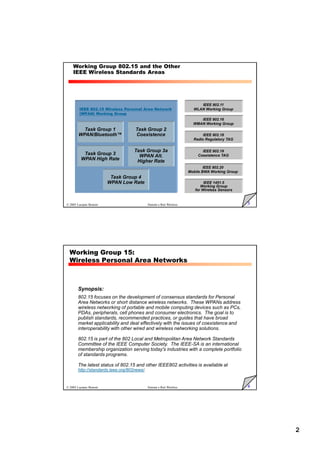
IEEE 802.xy Wireless Standards
Data Rate (Mbps)
Range
ZigBee
802.15.4
802.15.3
802.15.3a
802.15.3c
WPAN
WLAN
WMAN
WWAN
WiFi
802.11
0.01 0.1 1 10 100 1000
Bluetooth
802.15.1
IEEE 802.22
WiMax
IEEE 802.16
IEEE 802.20
2
3
© 2005 Luciano Bononi Sistemi e Reti Wireless
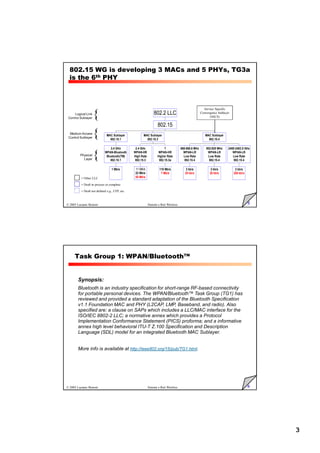
IEEE 802.15 Wireless Personal Area Network
(WPAN) Working Group
Task Group 1
WPAN/Bluetooth™
Task Group 2
Coexistence
Task Group 3
WPAN High Rate
Task Group 3a
WPAN Alt.
Higher Rate
Task Group 4
WPAN Low Rate
IEEE 802.11
WLAN Working Group
IEEE 802.16
WMAN Working Group
IEEE 802.20
Mobile BWA Working Group
Working Group 802.15 and the Other
IEEE Wireless Standards Areas
IEEE 802.18
Radio Regulatory TAG
IEEE 802.19
Coexistence TAG
IEEE 1451.5
Working Group
for Wireless Sensors
4
© 2005 Luciano Bononi Sistemi e Reti Wireless
Working Group 15:
Wireless Personal Area Networks
Synopsis:
802.15 focuses on the development of consensus standards for Personal
Area Networks or short distance wireless networks. These WPANs address
wireless networking of portable and mobile computing devices such as PCs,
PDAs, peripherals, cell phones and consumer electronics. The goal is to
publish standards, recommended practices, or guides that have broad
market applicability and deal effectively with the issues of coexistence and
interoperability with other wired and wireless networking solutions.
802.15 is part of the 802 Local and Metropolitan Area Network Standards
Committee of the IEEE Computer Society. The IEEE-SA is an international
membership organization serving today's industries with a complete portfolio
of standards programs.
The latest status of 802.15 and other IEEE802 activities is available at
http://standards.ieee.org/802news/.
3
5
© 2005 Luciano Bononi Sistemi e Reti Wireless
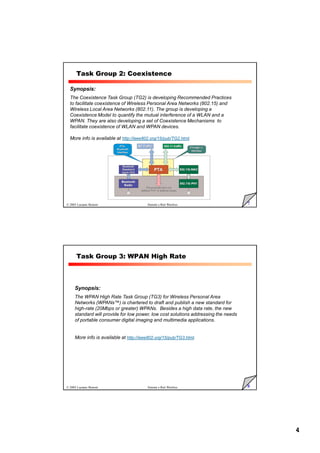
802.15 WG is developing 3 MACs and 5 PHYs, TG3a
is the 6th PHY
= Draft in process or complete
= Draft not defined e.g., CFP, etc.
1 Mb/s
2.4 GHz
WPAN-Bluetooth
Bluetooth(TM)
802.15.1
MAC Sublayer
802.15.1
11 Mb/s
22 Mb/s
55 Mb/s
2.4 GHz
WPAN-HR
High Rate
802.15.3
110 Mb/s
? Mb/s
?
WPAN-HR
Higher Rate
802.15.3a
MAC Sublayer
802.15.3
2 kb/s
20 kb/s
868-868.6 MHz
WPAN-LR
Low Rate
802.15.4
2 kb/s
20 kb/s
902-928 MHz
WPAN-LR
Low Rate
802.15.4
2 kb/s
250 kb/s
2400-2483.5 GHz
WPAN-LR
Low Rate
802.15.4
MAC Sublayer
802.15.4
802.15
802.2 LLC
Physical
Layer{
{
{
= Other LLC
Service Specific
Convergence Sublayer
(SSCS)
6
© 2005 Luciano Bononi Sistemi e Reti Wireless
Task Group 1: WPAN/Bluetooth™
Synopsis:
Bluetooth is an industry specification for short-range RF-based connectivity
for portable personal devices. The WPAN/Bluetooth™ Task Group (TG1) has
reviewed and provided a standard adaptation of the Bluetooth Specification
v1.1 Foundation MAC and PHY (L2CAP, LMP, Baseband, and radio). Also
specified are: a clause on SAPs which includes a LLC/MAC interface for the
ISO/IEC 8802-2 LLC; a normative annex which provides a Protocol
Implementation Conformance Statement (PICS) proforma; and a informative
annex high level behavioral ITU-T Z.100 Specification and Description
Language (SDL) model for an integrated Bluetooth MAC Sublayer.
More info is available at http://ieee802.org/15/pub/TG1.html.
4
7
© 2005 Luciano Bononi Sistemi e Reti Wireless
Task Group 2: Coexistence
Synopsis:
The Coexistence Task Group (TG2) is developing Recommended Practices
to facilitate coexistence of Wireless Personal Area Networks (802.15) and
Wireless Local Area Networks (802.11). The group is developing a
Coexistence Model to quantify the mutual interference of a WLAN and a
WPAN. They are also developing a set of Coexistence Mechanisms to
facilitate coexistence of WLAN and WPAN devices.
More info is available at http://ieee802.org/15/pub/TG2.html.
8
© 2005 Luciano Bononi Sistemi e Reti Wireless
Task Group 3: WPAN High Rate
Synopsis:
The WPAN High Rate Task Group (TG3) for Wireless Personal Area
Networks (WPANs™) is chartered to draft and publish a new standard for
high-rate (20Mbps or greater) WPANs. Besides a high data rate, the new
standard will provide for low power, low cost solutions addressing the needs
of portable consumer digital imaging and multimedia applications.
More info is available at http://ieee802.org/15/pub/TG3.html.
5
9
© 2005 Luciano Bononi Sistemi e Reti Wireless
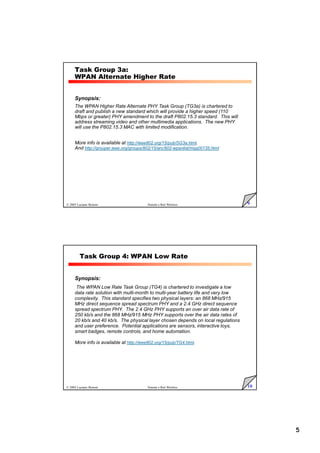
Task Group 3a:
WPAN Alternate Higher Rate
Synopsis:
The WPAN Higher Rate Alternate PHY Task Group (TG3a) is chartered to
draft and publish a new standard which will provide a higher speed (110
Mbps or greater) PHY amendment to the draft P802.15.3 standard. This will
address streaming video and other multimedia applications. The new PHY
will use the P802.15.3 MAC with limited modification.
More info is available at http://ieee802.org/15/pub/SG3a.html.
And http://grouper.ieee.org/groups/802/15/arc/802-wpanlist/msg00735.html
10
© 2005 Luciano Bononi Sistemi e Reti Wireless
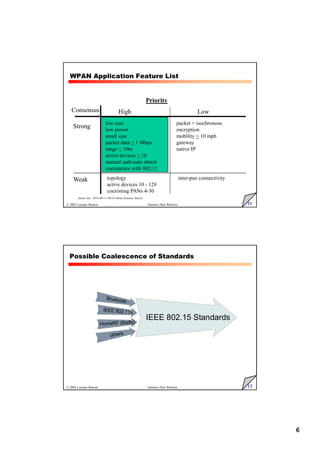
Task Group 4: WPAN Low Rate
Synopsis:
The WPAN Low Rate Task Group (TG4) is chartered to investigate a low
data rate solution with multi-month to multi-year battery life and very low
complexity. This standard specifies two physical layers: an 868 MHz/915
MHz direct sequence spread spectrum PHY and a 2.4 GHz direct sequence
spread spectrum PHY. The 2.4 GHz PHY supports an over air data rate of
250 kb/s and the 868 MHz/915 MHz PHY supports over the air data rates of
20 kb/s and 40 kb/s. The physical layer chosen depends on local regulations
and user preference. Potential applications are sensors, interactive toys,
smart badges, remote controls, and home automation.
More info is available at http://ieee802.org/15/pub/TG4.html.
6
11
© 2005 Luciano Bononi Sistemi e Reti Wireless
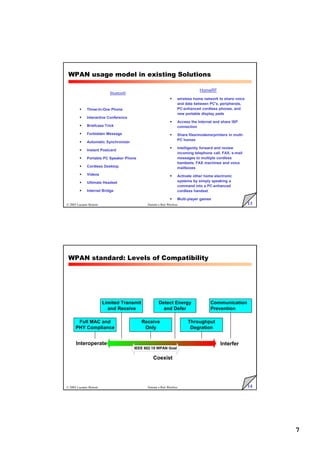
WPAN Application Feature List
Consensus
Strong
Weak
Priority
High Low
low cost
low power
small size
packet data < 1 Mbps
range < 10m
active devices < 10
manual auth/auto attach
coexistence with 802.11
packet + isochronous
encryption
mobility < 10 mph
gateway
native IP
inter-pan connectivity
topology
active devices 10 - 128
coexisting PANs 4-30
Source: doc.: IEEE 802.11-98/353 (Bruce Kraemer, Harris)
12
© 2005 Luciano Bononi Sistemi e Reti Wireless
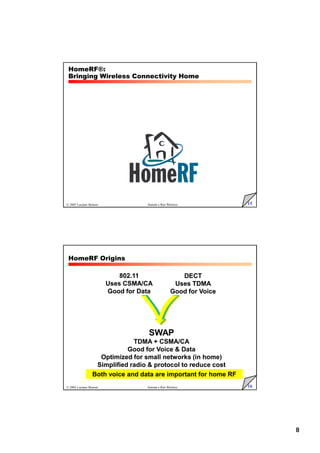
Possible Coalescence of Standards
IEEE 802.15 Standards
Bluetooth
IEEE 802.11x
HomeRF (firefly)
others
7
13
© 2005 Luciano Bononi Sistemi e Reti Wireless
WPAN usage model in existing Solutions
Bluetooth
 Three-In-One Phone
 Interactive Conference
 Briefcase Trick
 Forbidden Message
 Automatic Synchronizer
 Instant Postcard
 Portable PC Speaker Phone
 Cordless Desktop
 Videos
 Ultimate Headset
 Internet Bridge
HomeRF
 wireless home network to share voice
and data between PC's, peripherals,
PC-enhanced cordless phones, and
new portable display pads
 Access the Internet and share ISP
connection
 Share files/modems/printers in multi-
PC homes
 Intelligently forward and review
incoming telephone call, FAX, e-mail
messages to multiple cordless
handsets, FAX machines and voice
mailboxes
 Activate other home electronic
systems by simply speaking a
command into a PC-enhanced
cordless handset
 Multi-player games
14
© 2005 Luciano Bononi Sistemi e Reti Wireless
WPAN standard: Levels of Compatibility
Interoperate Interfer
Coexist
IEEE 802.15 WPAN Goal
Communication
Prevention
Throughput
Degration
Detect Energy
and Defer
Receive
Only
Limited Transmit
and Receive
Full MAC and
PHY Compliance
8
15
© 2005 Luciano Bononi Sistemi e Reti Wireless
HomeRF®:
Bringing Wireless Connectivity Home
16
© 2005 Luciano Bononi Sistemi e Reti Wireless
HomeRF Origins
802.11
802.11
Uses CSMA/CA
Uses CSMA/CA
Good for Data
Good for Data
DECT
DECT
Uses TDMA
Uses TDMA
Good for Voice
Good for Voice
SWAP
SWAP
TDMA + CSMA/CA
TDMA + CSMA/CA
Good for Voice  Data
Optimized for small networks (in home)
Simplified radio  protocol to reduce cost
Both voice and data are important for home RF
9
17
© 2005 Luciano Bononi Sistemi e Reti Wireless
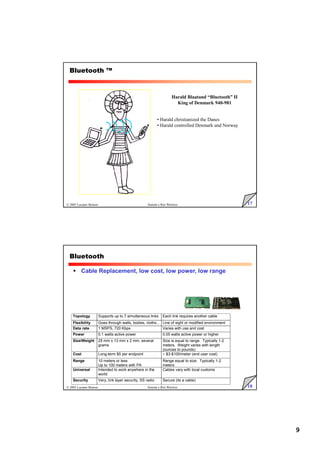
Bluetooth ™
• Harald christianized the Danes
• Harald controlled Denmark and Norway
Harald Blaatand “Bluetooth” II
King of Denmark 940-981
18
© 2005 Luciano Bononi Sistemi e Reti Wireless
Bluetooth
Topology Supports up to 7 simultaneous links Each link requires another cable
Flexibility Goes through walls, bodies, cloths... Line of sight or modified environment
Data rate 1 MSPS, 720 Kbps Varies with use and cost
Power 0.1 watts active power 0.05 watts active power or higher
Size/Weight 25 mm x 13 mm x 2 mm, several
grams
Size is equal to range. Typically 1-2
meters. Weight varies with length
(ounces to pounds)
Cost Long-term $5 per endpoint ~ $3-$100/meter (end user cost)
Range 10 meters or less
Up to 100 meters with PA
Range equal to size. Typically 1-2
meters
Universal Intended to work anywhere in the
world
Cables vary with local customs
Security Very, link layer security, SS radio Secure (its a cable)
 Cable Replacement, low cost, low power, low range
10
19
© 2005 Luciano Bononi Sistemi e Reti Wireless
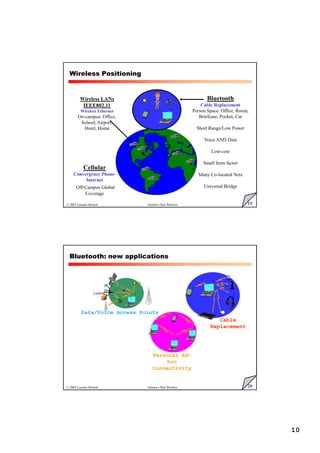
Wireless Positioning
Cellular
Convergence Phone-
Internet
Off-Campus Global
Coverage
Wireless LA3s
IEEE802.11
Wireless Ethernet
On-campus: Office,
School, Airport,
Hotel, Home
Bluetooth
Cable Replacement
Person Space: Office, Room,
Briefcase, Pocket, Car
Short Range/Low Power
Voice AND Data
Low-cost
Small form factor
Many Co-located Nets
Universal Bridge
20
© 2005 Luciano Bononi Sistemi e Reti Wireless
Bluetooth: new applications
Personal Ad
Personal Ad-
-
hoc
hoc
Connectivity
Connectivity
Cable
Cable
Replacement
Replacement
Landline
Data/Voice Access Points
11
21
© 2005 Luciano Bononi Sistemi e Reti Wireless
Characteristics
•Operates in the 2.4 GHz band at a data rate of 720Kb/s.
•Uses Frequency Hopping (FH) spread spectrum, which divides
the frequency band into a number of channels (2.402 - 2.480 GHz
yielding 79 channels).
•Radio transceivers hop from one channel to another in a pseudo-
random fashion, determined by the master.
•Supports up to 8 devices in a piconet (1 master and 7 slaves).
•Piconets can combine to form scatternets.
22
© 2005 Luciano Bononi Sistemi e Reti Wireless
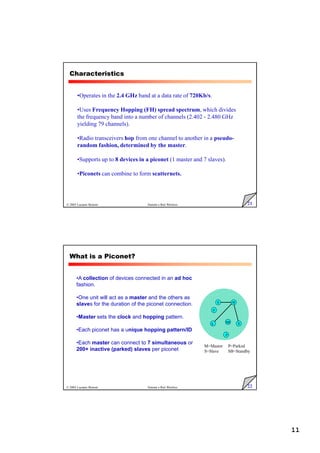
•A collection of devices connected in an ad hoc
fashion.
•One unit will act as a master and the others as
slaves for the duration of the piconet connection.
•Master sets the clock and hopping pattern.
•Each piconet has a unique hopping pattern/ID
•Each master can connect to 7 simultaneous or
200+ inactive (parked) slaves per piconet
What is a Piconet?
M
S
S
S
SB
P
P
M=Master
S=Slave
P=Parked
SB=Standby
12
23
© 2005 Luciano Bononi Sistemi e Reti Wireless
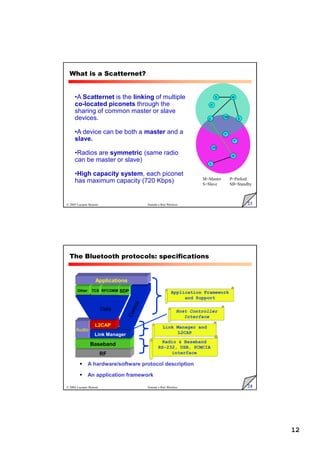
•A Scatternet is the linking of multiple
co-located piconets through the
sharing of common master or slave
devices.
•A device can be both a master and a
slave.
•Radios are symmetric (same radio
can be master or slave)
•High capacity system, each piconet
has maximum capacity (720 Kbps)
What is a Scatternet?
M
M
S
S
S
S
P
SB
SB
P
P
M=Master
S=Slave
P=Parked
SB=Standby
24
© 2005 Luciano Bononi Sistemi e Reti Wireless
The Bluetooth protocols: specifications
 A hardware/software protocol description
 An application framework
Application Framework
and Support
Link Manager and
L2CAP
Radio  Baseband
RS-232, USB, PCMCIA
interface
Host Controller
Interface
RF
Baseband
Audio
Link Manager
L2CAP
Other TCS RFCOMM
Data
SDP
Applications
13
25
© 2005 Luciano Bononi Sistemi e Reti Wireless
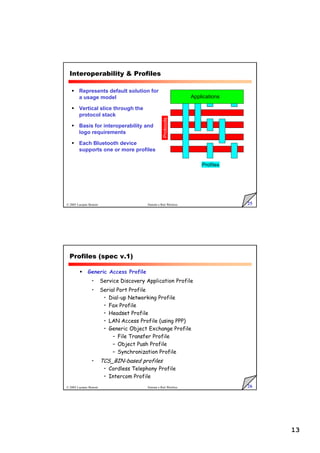
Interoperability  Profiles
Profiles
Protocols
Applications
 Represents default solution for
a usage model
 Vertical slice through the
protocol stack
 Basis for interoperability and
logo requirements
 Each Bluetooth device
supports one or more profiles
26
© 2005 Luciano Bononi Sistemi e Reti Wireless
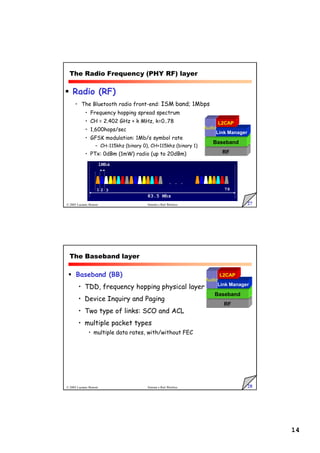
Profiles (spec v.1)
 Generic Access Profile
• Service Discovery Application Profile
• Serial Port Profile
• Dial-up Networking Profile
• Fax Profile
• Headset Profile
• LAN Access Profile (using PPP)
• Generic Object Exchange Profile
– File Transfer Profile
– Object Push Profile
– Synchronization Profile
• TCS_BIN-based profiles
• Cordless Telephony Profile
• Intercom Profile
14
27
© 2005 Luciano Bononi Sistemi e Reti Wireless
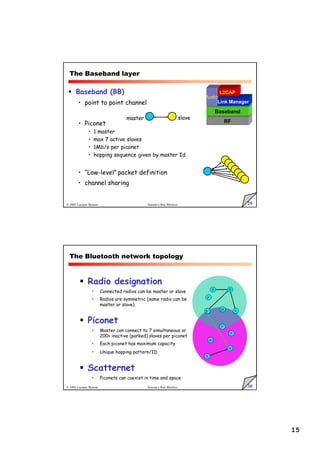
The Radio Frequency (PHY RF) layer
 Radio (RF)
• The Bluetooth radio front-end: ISM band; 1Mbps
• Frequency hopping spread spectrum
• CH = 2.402 GHz + k MHz, k=0..78
• 1,600hops/sec
• GFSK modulation: 1Mb/s symbol rate
– CH-115khz (binary 0), CH+115khz (binary 1)
• PTx: 0dBm (1mW) radio (up to 20dBm) RF
Baseband
Audio
Link Manager
L2CAP
28
© 2005 Luciano Bononi Sistemi e Reti Wireless
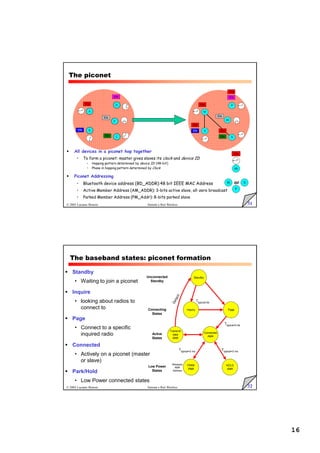
The Baseband layer
 Baseband (BB)
• TDD, frequency hopping physical layer
• Device Inquiry and Paging
• Two type of links: SCO and ACL
• multiple packet types
• multiple data rates, with/without FEC
RF
Baseband
Audio
Link Manager
L2CAP
15
29
© 2005 Luciano Bononi Sistemi e Reti Wireless
The Baseband layer
 Baseband (BB)
• point to point channel
• Piconet
• 1 master
• max 7 active slaves
• 1Mb/s per piconet
• hopping sequence given by master Id
• “Low-level” packet definition
• channel sharing
RF
Baseband
Audio
Link Manager
L2CAP
master slave
30
© 2005 Luciano Bononi Sistemi e Reti Wireless
M
M
S
S
S
S
P
sb
sb
P
P
The Bluetooth network topology
 Radio designation
• Connected radios can be master or slave
• Radios are symmetric (same radio can be
master or slave)
 Piconet
• Master can connect to 7 simultaneous or
200+ inactive (parked) slaves per piconet
• Each piconet has maximum capacity
• Unique hopping pattern/ID
 Scatternet
• Piconets can coexist in time and space
16
31
© 2005 Luciano Bononi Sistemi e Reti Wireless
The piconet
IDa
P
M S
or
sb
A
D
C
B
E
IDb
IDa
IDc
IDd
IDe
M
P
S
S
sb
IDa
IDc
IDd
IDa
IDa
IDa
IDe
IDb
 All devices in a piconet hop together
• To form a piconet: master gives slaves its clock and device ID
• Hopping pattern determined by device ID (48-bit)
• Phase in hopping pattern determined by Clock
 Piconet Addressing
• Bluetooth device address (BD_ADDR):48 bit IEEE MAC Address
• Active Member Address (AM_ADDR): 3-bits active slave, all-zero broadcast
• Parked Member Address (PM_Addr): 8-bits parked slave
32
© 2005 Luciano Bononi Sistemi e Reti Wireless
The baseband states: piconet formation
 Standby
• Waiting to join a piconet
 Inquire
• looking about radios to
connect to
 Page
• Connect to a specific
inquired radio
 Connected
• Actively on a piconet (master
or slave)
 Park/Hold
• Low Power connected states
Inquiry Page
Connected
AMA
Transmit
data
AMA
Ttypical=0.6s
Ttypical=2s
HOLD
AMA
PARK
PMA
Ttypical=2 ms
Ttypical=2 ms
Releases
AMA
Address
Low Power
States
Active
States
Standby
Connecting
States
Unconnected
Standby
D
e
t
a
c
h
17
33
© 2005 Luciano Bononi Sistemi e Reti Wireless
625 µsec
312.5 µsec
68 µsec
ft[k]P ft[k+1]P ft[k+2]P
fr[k]P fr[k+1]P fr[k+2]P
master listens
master pages
master listens
master responds
IDi IDi
IDi
FHSi
IDi
slave responds slave responds
625 µsec
A: slave acquires half-slot synchronization
B: slave acquires full-slot synchronization
C: slave capable to join master’s piconet
D: piconet communications start with master Tx slot
(C) (D)
(A) (B)
ft[m]C
1.25 msec
625 µsec
Paging sequence
34
© 2005 Luciano Bononi Sistemi e Reti Wireless
Inquire
Scan
Page Scan
Ttypical=1.25
Sleep
Ttypical=11 ms
18 slots
Ttypical=11 ms
18 slots
Standby
Inquire
Scan
Page Scan
Ttypical=1.25
Connected
Ttypical=11 ms
18 slots
Ttypical=11 ms
18 slots
Connected
Page and Inquire Scans
 A radio must be enabled to accept pages or inquires
• Consumes 18 slots (18*0.625=11ms) every 1.25 sec.
(or so) for each scan
• Inquiry has unique device address (all BT radio use)
• Unique set of “Inquiry” hop frequencies (32 predefined channels)
• Any device can inquire by paging the Inquiry address
• Correlater hit causes slave to respond with FHS packet (Device ID and Clock)
18
35
© 2005 Luciano Bononi Sistemi e Reti Wireless
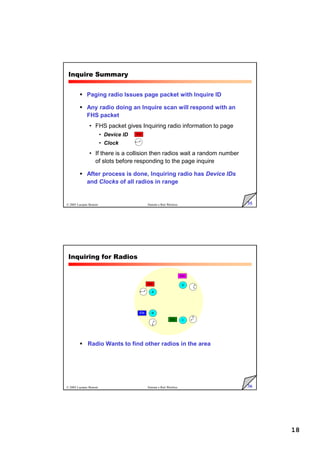
Inquire Summary
 Paging radio Issues page packet with Inquire ID
 Any radio doing an Inquire scan will respond with an
FHS packet
• FHS packet gives Inquiring radio information to page
• Device ID
• Clock
• If there is a collision then radios wait a random number
of slots before responding to the page inquire
 After process is done, Inquiring radio has Device IDs
and Clocks of all radios in range
IDa
36
© 2005 Luciano Bononi Sistemi e Reti Wireless
Inquiring for Radios
 Radio Wants to find other radios in the area
A
D
C
B
IDb
IDa
IDc
IDd
19
37
© 2005 Luciano Bononi Sistemi e Reti Wireless
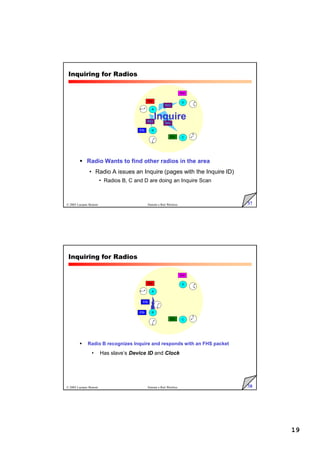
 Radio Wants to find other radios in the area
• Radio A issues an Inquire (pages with the Inquire ID)
• Radios B, C and D are doing an Inquire Scan
A
D
C
B
IDb
IDa
IDc
IDd
Inquire
INQ
INQ
INQ
Inquiring for Radios
38
© 2005 Luciano Bononi Sistemi e Reti Wireless
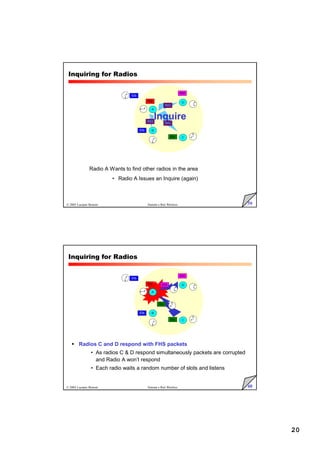
 Radio B recognizes Inquire and responds with an FHS packet
• Has slave’s Device ID and Clock
A
D
C
B
IDb
IDa
IDc
IDd
IDb
Inquiring for Radios
20
39
© 2005 Luciano Bononi Sistemi e Reti Wireless
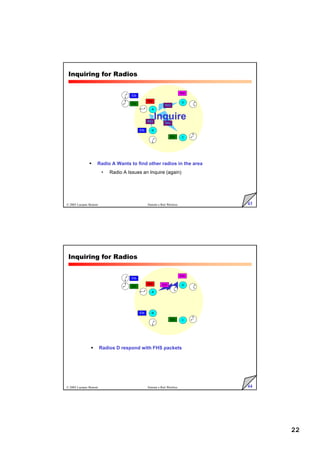
Radio A Wants to find other radios in the area
• Radio A Issues an Inquire (again)
A
D
C
B
IDb
IDa
IDc
IDd
Inquire
IDb
INQ
INQ
INQ
Inquiring for Radios
40
© 2005 Luciano Bononi Sistemi e Reti Wireless
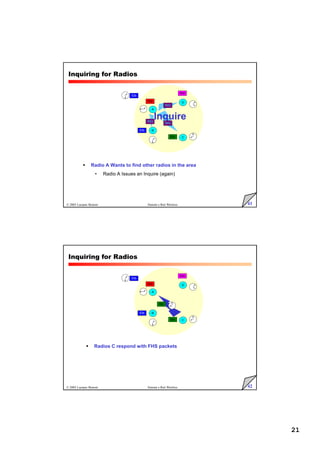
 Radios C and D respond with FHS packets
• As radios C  D respond simultaneously packets are corrupted
and Radio A won’t respond
• Each radio waits a random number of slots and listens
IDb
IDa
IDc
IDd
IDb
IDc
IDd
A
D
C
B
Inquiring for Radios
21
41
© 2005 Luciano Bononi Sistemi e Reti Wireless
 Radio A Wants to find other radios in the area
• Radio A Issues an Inquire (again)
A
D
C
B
IDb
IDa
IDc
IDd
Inquire
IDb
INQ
INQ
INQ
Inquiring for Radios
42
© 2005 Luciano Bononi Sistemi e Reti Wireless
 Radios C respond with FHS packets
IDb
IDa
IDc
IDd
IDb
IDc
A
D
C
B
Inquiring for Radios
22
43
© 2005 Luciano Bononi Sistemi e Reti Wireless
 Radio A Wants to find other radios in the area
• Radio A Issues an Inquire (again)
A
D
C
B
IDb
IDa
IDc
IDd
INQ
IDb
IDc
INQ
INQ
Inquire
Inquiring for Radios
44
© 2005 Luciano Bononi Sistemi e Reti Wireless
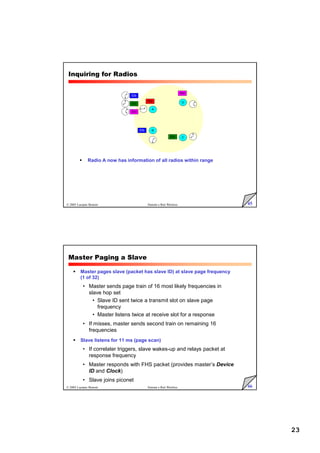
 Radios D respond with FHS packets
IDb
IDa
IDc
IDd
IDd
A
D
C
B
IDb
IDc
Inquiring for Radios
23
45
© 2005 Luciano Bononi Sistemi e Reti Wireless
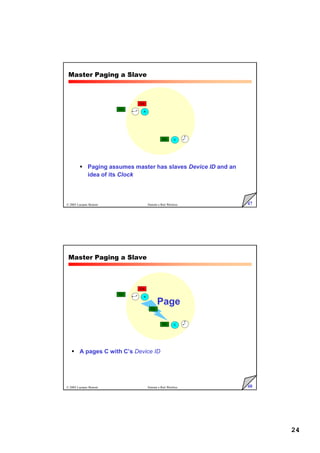
 Radio A now has information of all radios within range
IDb
IDa
IDc
IDd
A
D
C
B
IDb
IDc
IDd
Inquiring for Radios
46
© 2005 Luciano Bononi Sistemi e Reti Wireless
Master Paging a Slave
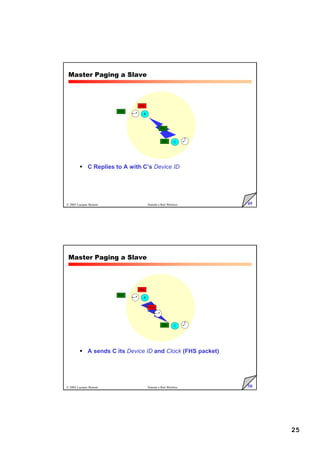
 Master pages slave (packet has slave ID) at slave page frequency
(1 of 32)
• Master sends page train of 16 most likely frequencies in
slave hop set
• Slave ID sent twice a transmit slot on slave page
frequency
• Master listens twice at receive slot for a response
• If misses, master sends second train on remaining 16
frequencies
 Slave listens for 11 ms (page scan)
• If correlater triggers, slave wakes-up and relays packet at
response frequency
• Master responds with FHS packet (provides master’s Device
ID and Clock)
• Slave joins piconet
24
47
© 2005 Luciano Bononi Sistemi e Reti Wireless
Master Paging a Slave
 Paging assumes master has slaves Device ID and an
idea of its Clock
A
C
IDa
IDc
IDc
48
© 2005 Luciano Bononi Sistemi e Reti Wireless
Master Paging a Slave
 A pages C with C’s Device ID
A
C
IDa
IDc
IDc
IDc
Page
25
49
© 2005 Luciano Bononi Sistemi e Reti Wireless
Master Paging a Slave
 C Replies to A with C’s Device ID
A
C
IDa
IDc
IDc
IDc
50
© 2005 Luciano Bononi Sistemi e Reti Wireless
Master Paging a Slave
 A sends C its Device ID and Clock (FHS packet)
A
C
IDa
IDc
IDc
IDa
26
51
© 2005 Luciano Bononi Sistemi e Reti Wireless
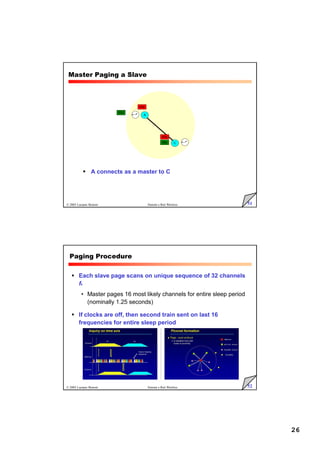
Master Paging a Slave
 A connects as a master to C
A
C
IDa
IDc
IDc
IDa
52
© 2005 Luciano Bononi Sistemi e Reti Wireless
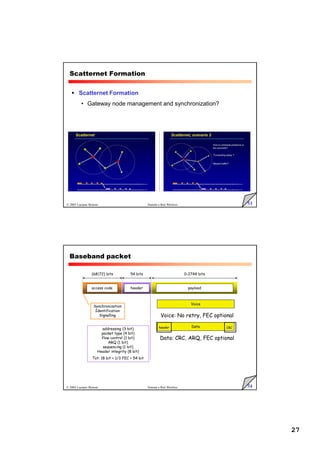
Paging Procedure
 Each slave page scans on unique sequence of 32 channels
fk
• Master pages 16 most likely channels for entire sleep period
(nominally 1.25 seconds)
 If clocks are off, then second train sent on last 16
frequencies for entire sleep period
27
53
© 2005 Luciano Bononi Sistemi e Reti Wireless
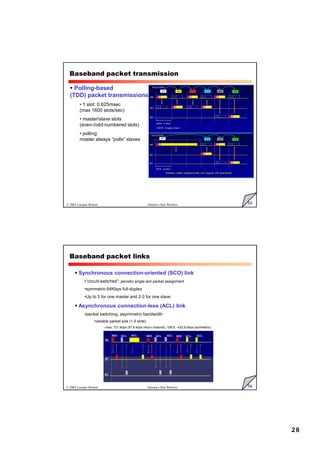
Scatternet Formation
 Scatternet Formation
• Gateway node management and synchronization?
54
© 2005 Luciano Bononi Sistemi e Reti Wireless
header payload
access code
(68|72) bits 54 bits 0-2744 bits
Baseband packet
Voice
Data
header CRC
Voice: No retry, FEC optional
Data: CRC, ARQ, FEC optional
Synchronization
Identification
Signalling
addressing (3 bit)
packet type (4 bit)
flow control (1 bit)
ARQ (1 bit)
sequencing (1 bit)
Header integrity (8 bit)
Tot: 18 bit + 1/3 FEC = 54 bit
28
55
© 2005 Luciano Bononi Sistemi e Reti Wireless
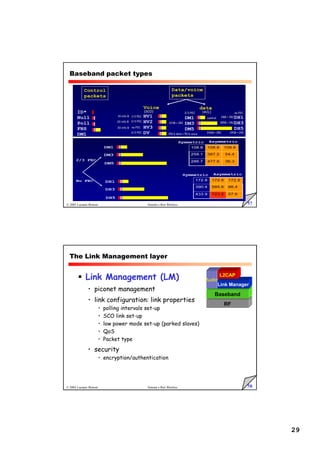
Baseband packet transmission
 Polling-based
(TDD) packet transmissions
• 1 slot: 0.625msec
(max 1600 slots/sec)
• master/slave slots
(even-/odd-numbered slots)
• polling:
master always “polls” slaves
56
© 2005 Luciano Bononi Sistemi e Reti Wireless
Baseband packet links
 Synchronous connection-oriented (SCO) link
•“circuit-switched”: periodic single-slot packet assignment
•symmetric 64Kbps full-duplex
•Up to 3 for one master and 2-3 for one slave
 Asynchronous connection-less (ACL) link
•packet switching, asymmetric bandwidth
•variable packet size (1-5 slots)
–max. 721 kbps (57.6 kbps return channel), 108.8 - 432.6 kbps (symmetric)
29
57
© 2005 Luciano Bononi Sistemi e Reti Wireless
Baseband packet types
2/3 FEC no FEC
control
(SCO)
10 info B
20 info B
30 info B
2/3 FEC
1/3 FEC
no FEC
150 b data + 50 b voice
2/3 FEC
(ACL)
28B + CRC
123B + CRC 185B + CRC
226B + CRC 341B + CRC
58
© 2005 Luciano Bononi Sistemi e Reti Wireless
The Link Management layer
 Link Management (LM)
• piconet management
• link configuration: link properties
• polling intervals set-up
• SCO link set-up
• low power mode set-up (parked slaves)
• QoS
• Packet type
• security
• encryption/authentication
RF
Baseband
Audio
Link Manager
L2CAP
30
59
© 2005 Luciano Bononi Sistemi e Reti Wireless
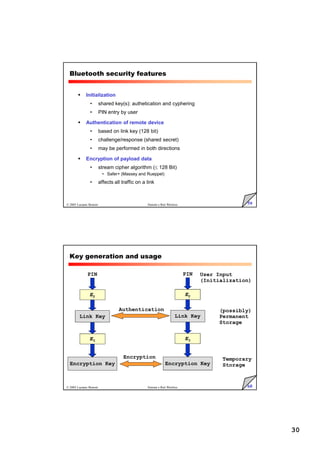
Bluetooth security features
 Initialization
• shared key(s): authetication and cyphering
• PIN entry by user
 Authentication of remote device
• based on link key (128 bit)
• challenge/response (shared secret)
• may be performed in both directions
 Encryption of payload data
• stream cipher algorithm (≤ 128 Bit)
• Safer+ (Massey and Rueppel)
• affects all traffic on a link
60
© 2005 Luciano Bononi Sistemi e Reti Wireless
Key generation and usage
PIN
E2
Link Key
Encryption Key
E3
Encryption
Authentication
PIN
E2
Link Key
Encryption Key
E3
User Input
(Initialization)
(possibly)
Permanent
Storage
Temporary
Storage
31
61
© 2005 Luciano Bononi Sistemi e Reti Wireless
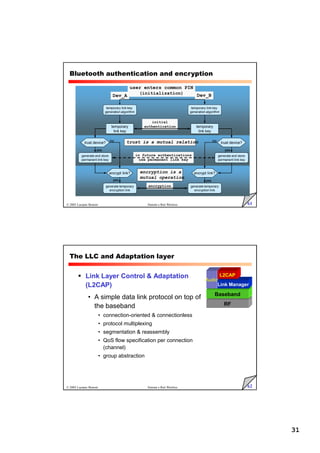
Dev_A Dev_B
initial
authentication
temporary
link key
temporary
link key
temporary link key
generation algorithm
temporary link key
generation algorithm
user enters common PIN
(initialization)
trust device? trust device?
trust is a mutual relation
in future authentications
use permanent link key
encrypt link? encrypt link?
no no
generate and store
permanent link key
generate and store
permanent link key
yes yes
encryption
generate temporary
encryption link
generate temporary
encryption link
yes yes
encryption is a
mutual operation
Bluetooth authentication and encryption
62
© 2005 Luciano Bononi Sistemi e Reti Wireless
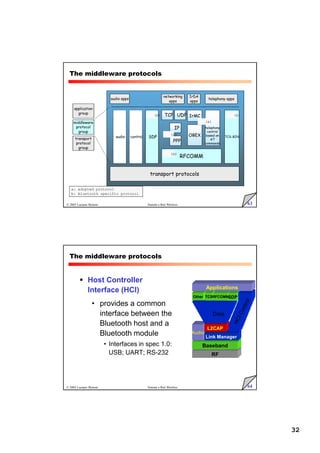
The LLC and Adaptation layer
 Link Layer Control  Adaptation
(L2CAP)
• A simple data link protocol on top of
the baseband
• connection-oriented  connectionless
• protocol multiplexing
• segmentation  reassembly
• QoS flow specification per connection
(channel)
• group abstraction
RF
Baseband
Audio
Link Manager
L2CAP
32
63
© 2005 Luciano Bononi Sistemi e Reti Wireless
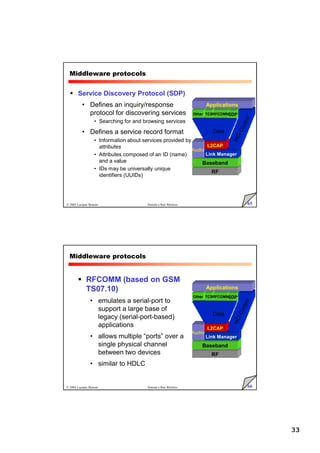
a: adopted protocol
b: Bluetooth specific protocol
transport
transport
protocol
group
middleware
middleware
protocol
group
application
group
transport protocols
networking
networking
apps
audio apps
IrDA
IrDA
apps
OBEX
control
control
audio
RFCOMM
PPP
IP
TCP
TCP UDP
UDP
SDP
telephony
commands
telephony
control
based on
AT
commands
IrMC
TCS-BIN
(b)
(b)
(b)
(b)
(a)
(a)
(a)
(a)
(b)
(b)
telephony apps
The middleware protocols
64
© 2005 Luciano Bononi Sistemi e Reti Wireless
The middleware protocols
 Host Controller
Interface (HCI)
• provides a common
interface between the
Bluetooth host and a
Bluetooth module
• Interfaces in spec 1.0:
USB; UART; RS-232 RF
Baseband
Audio
Link Manager
L2CAP
Other TCSRFCOMM
Data
SDP
Applications
33
65
© 2005 Luciano Bononi Sistemi e Reti Wireless
Middleware protocols
 Service Discovery Protocol (SDP)
• Defines an inquiry/response
protocol for discovering services
• Searching for and browsing services
• Defines a service record format
• Information about services provided by
attributes
• Attributes composed of an ID (name)
and a value
• IDs may be universally unique
identifiers (UUIDs)
RF
Baseband
Audio
Link Manager
L2CAP
Other TCSRFCOMM
Data
SDP
Applications
66
© 2005 Luciano Bononi Sistemi e Reti Wireless
Middleware protocols
 RFCOMM (based on GSM
TS07.10)
• emulates a serial-port to
support a large base of
legacy (serial-port-based)
applications
• allows multiple “ports” over a
single physical channel
between two devices
• similar to HDLC
RF
Baseband
Audio
Link Manager
L2CAP
Other TCSRFCOMM
Data
SDP
Applications
34
67
© 2005 Luciano Bononi Sistemi e Reti Wireless
Middleware protocols
 Telephony Control Protocol
Spec (TCS)
• call control (setup  release)
• group management for
gateway serving multiple
devices
 Legacy protocol reuse
• reuse existing protocols, e.g.,
IrDA’s OBEX, or WAP for
interacting with applications on
phones
RF
Baseband
Audio
Link Manager
L2CAP
Other TCSRFCOMM
Data
SDP
Applications
68
© 2005 Luciano Bononi Sistemi e Reti Wireless
RFCOMM
ACL SCO
Bluetooth Baseband
LMP
L2CAP
PPP
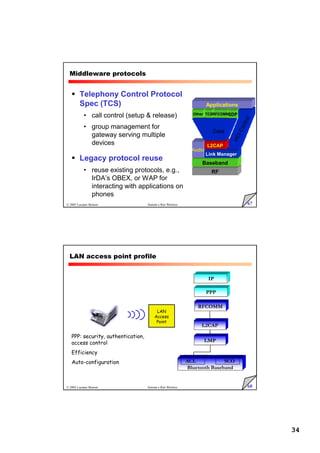
LAN access point profile
IP
PPP: security, authentication,
access control
Efficiency
Auto-configuration
LAN
Access
Point
35
69
© 2005 Luciano Bononi Sistemi e Reti Wireless
ACL SCO
Bluetooth Baseband
LMP
L2CAP
IP over Bluetooth
IP
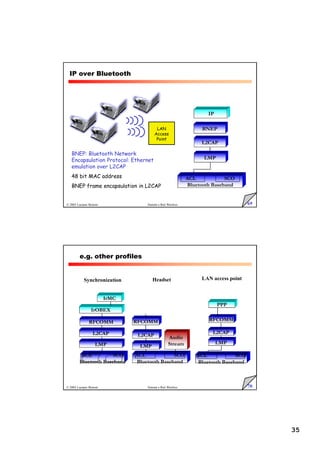
BNEP: Bluetooth Network
Encapsulation Protocol: Ethernet
emulation over L2CAP
48 bit MAC address
BNEP frame encapsulation in L2CAP
LAN
Access
Point
BNEP
70
© 2005 Luciano Bononi Sistemi e Reti Wireless
ACL SCO
Bluetooth Baseband
RFCOMM
LMP
L2CAP
IrOBEX
IrMC
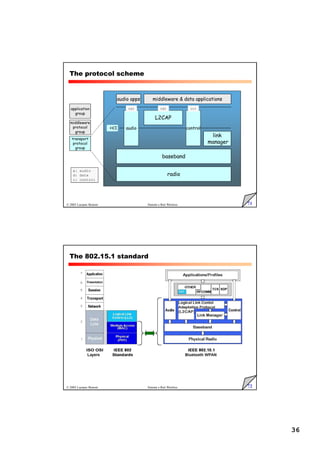
e.g. other profiles
Synchronization
RFCOMM
ACL SCO
Bluetooth Baseband
LMP
L2CAP Audio
Stream
Headset
RFCOMM
ACL SCO
Bluetooth Baseband
LMP
L2CAP
PPP
LA3 access point
36
71
© 2005 Luciano Bononi Sistemi e Reti Wireless
middleware  data applications
audio apps
a: audio
d: data
c: control
radio
baseband
link
link
manager
L2CAP
control
audio
HCI
HCI
transport
transport
protocol
group
middleware
middleware
protocol
group
application
group
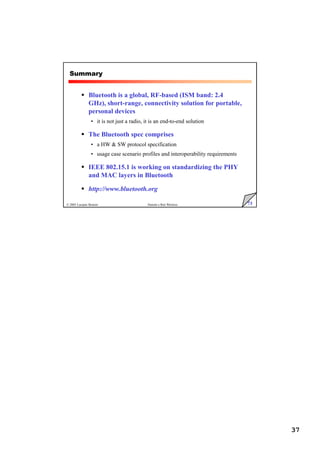
The protocol scheme
(a)
(a) (d)
(d) (c)
(c)
72
© 2005 Luciano Bononi Sistemi e Reti Wireless
The 802.15.1 standard
37
73
© 2005 Luciano Bononi Sistemi e Reti Wireless
Summary
 Bluetooth is a global, RF-based (ISM band: 2.4
GHz), short-range, connectivity solution for portable,
personal devices
• it is not just a radio, it is an end-to-end solution
 The Bluetooth spec comprises
• a HW  SW protocol specification
• usage case scenario profiles and interoperability requirements
 IEEE 802.15.1 is working on standardizing the PHY
and MAC layers in Bluetooth
 http://www.bluetooth.org

Wireless Personal Area Network for mobile communication

  • 1.
    1 1 © 2005 LucianoBononi Sistemi e Reti Wireless IEEE 802.15 (WPAN) (Bluetooth) Luciano Bononi (bononi@cs.unibo.it) Figure Credits: some figures have been taken form slides found on the web by the following authors (in alfabethical order): Pravin Bhagwat (acm.org), Chatschik Bisdikian (ibm.com), Tom Siep (ti) 2 © 2005 Luciano Bononi Sistemi e Reti Wireless IEEE 802.xy Wireless Standards Data Rate (Mbps) Range ZigBee 802.15.4 802.15.3 802.15.3a 802.15.3c WPAN WLAN WMAN WWAN WiFi 802.11 0.01 0.1 1 10 100 1000 Bluetooth 802.15.1 IEEE 802.22 WiMax IEEE 802.16 IEEE 802.20
  • 2.
    2 3 © 2005 LucianoBononi Sistemi e Reti Wireless IEEE 802.15 Wireless Personal Area Network (WPAN) Working Group Task Group 1 WPAN/Bluetooth™ Task Group 2 Coexistence Task Group 3 WPAN High Rate Task Group 3a WPAN Alt. Higher Rate Task Group 4 WPAN Low Rate IEEE 802.11 WLAN Working Group IEEE 802.16 WMAN Working Group IEEE 802.20 Mobile BWA Working Group Working Group 802.15 and the Other IEEE Wireless Standards Areas IEEE 802.18 Radio Regulatory TAG IEEE 802.19 Coexistence TAG IEEE 1451.5 Working Group for Wireless Sensors 4 © 2005 Luciano Bononi Sistemi e Reti Wireless Working Group 15: Wireless Personal Area Networks Synopsis: 802.15 focuses on the development of consensus standards for Personal Area Networks or short distance wireless networks. These WPANs address wireless networking of portable and mobile computing devices such as PCs, PDAs, peripherals, cell phones and consumer electronics. The goal is to publish standards, recommended practices, or guides that have broad market applicability and deal effectively with the issues of coexistence and interoperability with other wired and wireless networking solutions. 802.15 is part of the 802 Local and Metropolitan Area Network Standards Committee of the IEEE Computer Society. The IEEE-SA is an international membership organization serving today's industries with a complete portfolio of standards programs. The latest status of 802.15 and other IEEE802 activities is available at http://standards.ieee.org/802news/.
  • 3.
    3 5 © 2005 LucianoBononi Sistemi e Reti Wireless 802.15 WG is developing 3 MACs and 5 PHYs, TG3a is the 6th PHY = Draft in process or complete = Draft not defined e.g., CFP, etc. 1 Mb/s 2.4 GHz WPAN-Bluetooth Bluetooth(TM) 802.15.1 MAC Sublayer 802.15.1 11 Mb/s 22 Mb/s 55 Mb/s 2.4 GHz WPAN-HR High Rate 802.15.3 110 Mb/s ? Mb/s ? WPAN-HR Higher Rate 802.15.3a MAC Sublayer 802.15.3 2 kb/s 20 kb/s 868-868.6 MHz WPAN-LR Low Rate 802.15.4 2 kb/s 20 kb/s 902-928 MHz WPAN-LR Low Rate 802.15.4 2 kb/s 250 kb/s 2400-2483.5 GHz WPAN-LR Low Rate 802.15.4 MAC Sublayer 802.15.4 802.15 802.2 LLC Physical Layer{ { { = Other LLC Service Specific Convergence Sublayer (SSCS) 6 © 2005 Luciano Bononi Sistemi e Reti Wireless Task Group 1: WPAN/Bluetooth™ Synopsis: Bluetooth is an industry specification for short-range RF-based connectivity for portable personal devices. The WPAN/Bluetooth™ Task Group (TG1) has reviewed and provided a standard adaptation of the Bluetooth Specification v1.1 Foundation MAC and PHY (L2CAP, LMP, Baseband, and radio). Also specified are: a clause on SAPs which includes a LLC/MAC interface for the ISO/IEC 8802-2 LLC; a normative annex which provides a Protocol Implementation Conformance Statement (PICS) proforma; and a informative annex high level behavioral ITU-T Z.100 Specification and Description Language (SDL) model for an integrated Bluetooth MAC Sublayer. More info is available at http://ieee802.org/15/pub/TG1.html.
  • 4.
    4 7 © 2005 LucianoBononi Sistemi e Reti Wireless Task Group 2: Coexistence Synopsis: The Coexistence Task Group (TG2) is developing Recommended Practices to facilitate coexistence of Wireless Personal Area Networks (802.15) and Wireless Local Area Networks (802.11). The group is developing a Coexistence Model to quantify the mutual interference of a WLAN and a WPAN. They are also developing a set of Coexistence Mechanisms to facilitate coexistence of WLAN and WPAN devices. More info is available at http://ieee802.org/15/pub/TG2.html. 8 © 2005 Luciano Bononi Sistemi e Reti Wireless Task Group 3: WPAN High Rate Synopsis: The WPAN High Rate Task Group (TG3) for Wireless Personal Area Networks (WPANs™) is chartered to draft and publish a new standard for high-rate (20Mbps or greater) WPANs. Besides a high data rate, the new standard will provide for low power, low cost solutions addressing the needs of portable consumer digital imaging and multimedia applications. More info is available at http://ieee802.org/15/pub/TG3.html.
  • 5.
    5 9 © 2005 LucianoBononi Sistemi e Reti Wireless Task Group 3a: WPAN Alternate Higher Rate Synopsis: The WPAN Higher Rate Alternate PHY Task Group (TG3a) is chartered to draft and publish a new standard which will provide a higher speed (110 Mbps or greater) PHY amendment to the draft P802.15.3 standard. This will address streaming video and other multimedia applications. The new PHY will use the P802.15.3 MAC with limited modification. More info is available at http://ieee802.org/15/pub/SG3a.html. And http://grouper.ieee.org/groups/802/15/arc/802-wpanlist/msg00735.html 10 © 2005 Luciano Bononi Sistemi e Reti Wireless Task Group 4: WPAN Low Rate Synopsis: The WPAN Low Rate Task Group (TG4) is chartered to investigate a low data rate solution with multi-month to multi-year battery life and very low complexity. This standard specifies two physical layers: an 868 MHz/915 MHz direct sequence spread spectrum PHY and a 2.4 GHz direct sequence spread spectrum PHY. The 2.4 GHz PHY supports an over air data rate of 250 kb/s and the 868 MHz/915 MHz PHY supports over the air data rates of 20 kb/s and 40 kb/s. The physical layer chosen depends on local regulations and user preference. Potential applications are sensors, interactive toys, smart badges, remote controls, and home automation. More info is available at http://ieee802.org/15/pub/TG4.html.
  • 6.
    6 11 © 2005 LucianoBononi Sistemi e Reti Wireless WPAN Application Feature List Consensus Strong Weak Priority High Low low cost low power small size packet data < 1 Mbps range < 10m active devices < 10 manual auth/auto attach coexistence with 802.11 packet + isochronous encryption mobility < 10 mph gateway native IP inter-pan connectivity topology active devices 10 - 128 coexisting PANs 4-30 Source: doc.: IEEE 802.11-98/353 (Bruce Kraemer, Harris) 12 © 2005 Luciano Bononi Sistemi e Reti Wireless Possible Coalescence of Standards IEEE 802.15 Standards Bluetooth IEEE 802.11x HomeRF (firefly) others
  • 7.
    7 13 © 2005 LucianoBononi Sistemi e Reti Wireless WPAN usage model in existing Solutions Bluetooth Three-In-One Phone Interactive Conference Briefcase Trick Forbidden Message Automatic Synchronizer Instant Postcard Portable PC Speaker Phone Cordless Desktop Videos Ultimate Headset Internet Bridge HomeRF wireless home network to share voice and data between PC's, peripherals, PC-enhanced cordless phones, and new portable display pads Access the Internet and share ISP connection Share files/modems/printers in multi- PC homes Intelligently forward and review incoming telephone call, FAX, e-mail messages to multiple cordless handsets, FAX machines and voice mailboxes Activate other home electronic systems by simply speaking a command into a PC-enhanced cordless handset Multi-player games 14 © 2005 Luciano Bononi Sistemi e Reti Wireless WPAN standard: Levels of Compatibility Interoperate Interfer Coexist IEEE 802.15 WPAN Goal Communication Prevention Throughput Degration Detect Energy and Defer Receive Only Limited Transmit and Receive Full MAC and PHY Compliance
  • 8.
    8 15 © 2005 LucianoBononi Sistemi e Reti Wireless HomeRF®: Bringing Wireless Connectivity Home 16 © 2005 Luciano Bononi Sistemi e Reti Wireless HomeRF Origins 802.11 802.11 Uses CSMA/CA Uses CSMA/CA Good for Data Good for Data DECT DECT Uses TDMA Uses TDMA Good for Voice Good for Voice SWAP SWAP TDMA + CSMA/CA TDMA + CSMA/CA Good for Voice Data Good for Voice Data Optimized for small networks (in home) Optimized for small networks (in home) Simplified radio protocol to reduce cost Simplified radio protocol to reduce cost Both voice and data are important for home RF Both voice and data are important for home RF Both voice and data are important for home RF Both voice and data are important for home RF
  • 9.
    9 17 © 2005 LucianoBononi Sistemi e Reti Wireless Bluetooth ™ • Harald christianized the Danes • Harald controlled Denmark and Norway Harald Blaatand “Bluetooth” II King of Denmark 940-981 18 © 2005 Luciano Bononi Sistemi e Reti Wireless Bluetooth Topology Supports up to 7 simultaneous links Each link requires another cable Flexibility Goes through walls, bodies, cloths... Line of sight or modified environment Data rate 1 MSPS, 720 Kbps Varies with use and cost Power 0.1 watts active power 0.05 watts active power or higher Size/Weight 25 mm x 13 mm x 2 mm, several grams Size is equal to range. Typically 1-2 meters. Weight varies with length (ounces to pounds) Cost Long-term $5 per endpoint ~ $3-$100/meter (end user cost) Range 10 meters or less Up to 100 meters with PA Range equal to size. Typically 1-2 meters Universal Intended to work anywhere in the world Cables vary with local customs Security Very, link layer security, SS radio Secure (its a cable) Cable Replacement, low cost, low power, low range
  • 10.
    10 19 © 2005 LucianoBononi Sistemi e Reti Wireless Wireless Positioning Cellular Convergence Phone- Internet Off-Campus Global Coverage Wireless LA3s IEEE802.11 Wireless Ethernet On-campus: Office, School, Airport, Hotel, Home Bluetooth Cable Replacement Person Space: Office, Room, Briefcase, Pocket, Car Short Range/Low Power Voice AND Data Low-cost Small form factor Many Co-located Nets Universal Bridge 20 © 2005 Luciano Bononi Sistemi e Reti Wireless Bluetooth: new applications Personal Ad Personal Ad- - hoc hoc Connectivity Connectivity Cable Cable Replacement Replacement Landline Data/Voice Access Points Data/Voice Access Points
  • 11.
    11 21 © 2005 LucianoBononi Sistemi e Reti Wireless Characteristics •Operates in the 2.4 GHz band at a data rate of 720Kb/s. •Uses Frequency Hopping (FH) spread spectrum, which divides the frequency band into a number of channels (2.402 - 2.480 GHz yielding 79 channels). •Radio transceivers hop from one channel to another in a pseudo- random fashion, determined by the master. •Supports up to 8 devices in a piconet (1 master and 7 slaves). •Piconets can combine to form scatternets. 22 © 2005 Luciano Bononi Sistemi e Reti Wireless •A collection of devices connected in an ad hoc fashion. •One unit will act as a master and the others as slaves for the duration of the piconet connection. •Master sets the clock and hopping pattern. •Each piconet has a unique hopping pattern/ID •Each master can connect to 7 simultaneous or 200+ inactive (parked) slaves per piconet What is a Piconet? M S S S SB P P M=Master S=Slave P=Parked SB=Standby
  • 12.
    12 23 © 2005 LucianoBononi Sistemi e Reti Wireless •A Scatternet is the linking of multiple co-located piconets through the sharing of common master or slave devices. •A device can be both a master and a slave. •Radios are symmetric (same radio can be master or slave) •High capacity system, each piconet has maximum capacity (720 Kbps) What is a Scatternet? M M S S S S P SB SB P P M=Master S=Slave P=Parked SB=Standby 24 © 2005 Luciano Bononi Sistemi e Reti Wireless The Bluetooth protocols: specifications A hardware/software protocol description An application framework Application Framework and Support Link Manager and L2CAP Radio Baseband RS-232, USB, PCMCIA interface Host Controller Interface RF Baseband Audio Link Manager L2CAP Other TCS RFCOMM Data SDP Applications
  • 13.
    13 25 © 2005 LucianoBononi Sistemi e Reti Wireless Interoperability Profiles Profiles Protocols Applications Represents default solution for a usage model Vertical slice through the protocol stack Basis for interoperability and logo requirements Each Bluetooth device supports one or more profiles 26 © 2005 Luciano Bononi Sistemi e Reti Wireless Profiles (spec v.1) Generic Access Profile • Service Discovery Application Profile • Serial Port Profile • Dial-up Networking Profile • Fax Profile • Headset Profile • LAN Access Profile (using PPP) • Generic Object Exchange Profile – File Transfer Profile – Object Push Profile – Synchronization Profile • TCS_BIN-based profiles • Cordless Telephony Profile • Intercom Profile
  • 14.
    14 27 © 2005 LucianoBononi Sistemi e Reti Wireless The Radio Frequency (PHY RF) layer Radio (RF) • The Bluetooth radio front-end: ISM band; 1Mbps • Frequency hopping spread spectrum • CH = 2.402 GHz + k MHz, k=0..78 • 1,600hops/sec • GFSK modulation: 1Mb/s symbol rate – CH-115khz (binary 0), CH+115khz (binary 1) • PTx: 0dBm (1mW) radio (up to 20dBm) RF Baseband Audio Link Manager L2CAP 28 © 2005 Luciano Bononi Sistemi e Reti Wireless The Baseband layer Baseband (BB) • TDD, frequency hopping physical layer • Device Inquiry and Paging • Two type of links: SCO and ACL • multiple packet types • multiple data rates, with/without FEC RF Baseband Audio Link Manager L2CAP
  • 15.
    15 29 © 2005 LucianoBononi Sistemi e Reti Wireless The Baseband layer Baseband (BB) • point to point channel • Piconet • 1 master • max 7 active slaves • 1Mb/s per piconet • hopping sequence given by master Id • “Low-level” packet definition • channel sharing RF Baseband Audio Link Manager L2CAP master slave 30 © 2005 Luciano Bononi Sistemi e Reti Wireless M M S S S S P sb sb P P The Bluetooth network topology Radio designation • Connected radios can be master or slave • Radios are symmetric (same radio can be master or slave) Piconet • Master can connect to 7 simultaneous or 200+ inactive (parked) slaves per piconet • Each piconet has maximum capacity • Unique hopping pattern/ID Scatternet • Piconets can coexist in time and space
  • 16.
    16 31 © 2005 LucianoBononi Sistemi e Reti Wireless The piconet IDa P M S or sb A D C B E IDb IDa IDc IDd IDe M P S S sb IDa IDc IDd IDa IDa IDa IDe IDb All devices in a piconet hop together • To form a piconet: master gives slaves its clock and device ID • Hopping pattern determined by device ID (48-bit) • Phase in hopping pattern determined by Clock Piconet Addressing • Bluetooth device address (BD_ADDR):48 bit IEEE MAC Address • Active Member Address (AM_ADDR): 3-bits active slave, all-zero broadcast • Parked Member Address (PM_Addr): 8-bits parked slave 32 © 2005 Luciano Bononi Sistemi e Reti Wireless The baseband states: piconet formation Standby • Waiting to join a piconet Inquire • looking about radios to connect to Page • Connect to a specific inquired radio Connected • Actively on a piconet (master or slave) Park/Hold • Low Power connected states Inquiry Page Connected AMA Transmit data AMA Ttypical=0.6s Ttypical=2s HOLD AMA PARK PMA Ttypical=2 ms Ttypical=2 ms Releases AMA Address Low Power States Active States Standby Connecting States Unconnected Standby D e t a c h
  • 17.
    17 33 © 2005 LucianoBononi Sistemi e Reti Wireless 625 µsec 312.5 µsec 68 µsec ft[k]P ft[k+1]P ft[k+2]P fr[k]P fr[k+1]P fr[k+2]P master listens master pages master listens master responds IDi IDi IDi FHSi IDi slave responds slave responds 625 µsec A: slave acquires half-slot synchronization B: slave acquires full-slot synchronization C: slave capable to join master’s piconet D: piconet communications start with master Tx slot (C) (D) (A) (B) ft[m]C 1.25 msec 625 µsec Paging sequence 34 © 2005 Luciano Bononi Sistemi e Reti Wireless Inquire Scan Page Scan Ttypical=1.25 Sleep Ttypical=11 ms 18 slots Ttypical=11 ms 18 slots Standby Inquire Scan Page Scan Ttypical=1.25 Connected Ttypical=11 ms 18 slots Ttypical=11 ms 18 slots Connected Page and Inquire Scans A radio must be enabled to accept pages or inquires • Consumes 18 slots (18*0.625=11ms) every 1.25 sec. (or so) for each scan • Inquiry has unique device address (all BT radio use) • Unique set of “Inquiry” hop frequencies (32 predefined channels) • Any device can inquire by paging the Inquiry address • Correlater hit causes slave to respond with FHS packet (Device ID and Clock)
  • 18.
    18 35 © 2005 LucianoBononi Sistemi e Reti Wireless Inquire Summary Paging radio Issues page packet with Inquire ID Any radio doing an Inquire scan will respond with an FHS packet • FHS packet gives Inquiring radio information to page • Device ID • Clock • If there is a collision then radios wait a random number of slots before responding to the page inquire After process is done, Inquiring radio has Device IDs and Clocks of all radios in range IDa 36 © 2005 Luciano Bononi Sistemi e Reti Wireless Inquiring for Radios Radio Wants to find other radios in the area A D C B IDb IDa IDc IDd
  • 19.
    19 37 © 2005 LucianoBononi Sistemi e Reti Wireless Radio Wants to find other radios in the area • Radio A issues an Inquire (pages with the Inquire ID) • Radios B, C and D are doing an Inquire Scan A D C B IDb IDa IDc IDd Inquire INQ INQ INQ Inquiring for Radios 38 © 2005 Luciano Bononi Sistemi e Reti Wireless Radio B recognizes Inquire and responds with an FHS packet • Has slave’s Device ID and Clock A D C B IDb IDa IDc IDd IDb Inquiring for Radios
  • 20.
    20 39 © 2005 LucianoBononi Sistemi e Reti Wireless Radio A Wants to find other radios in the area • Radio A Issues an Inquire (again) A D C B IDb IDa IDc IDd Inquire IDb INQ INQ INQ Inquiring for Radios 40 © 2005 Luciano Bononi Sistemi e Reti Wireless Radios C and D respond with FHS packets • As radios C D respond simultaneously packets are corrupted and Radio A won’t respond • Each radio waits a random number of slots and listens IDb IDa IDc IDd IDb IDc IDd A D C B Inquiring for Radios
  • 21.
    21 41 © 2005 LucianoBononi Sistemi e Reti Wireless Radio A Wants to find other radios in the area • Radio A Issues an Inquire (again) A D C B IDb IDa IDc IDd Inquire IDb INQ INQ INQ Inquiring for Radios 42 © 2005 Luciano Bononi Sistemi e Reti Wireless Radios C respond with FHS packets IDb IDa IDc IDd IDb IDc A D C B Inquiring for Radios
  • 22.
    22 43 © 2005 LucianoBononi Sistemi e Reti Wireless Radio A Wants to find other radios in the area • Radio A Issues an Inquire (again) A D C B IDb IDa IDc IDd INQ IDb IDc INQ INQ Inquire Inquiring for Radios 44 © 2005 Luciano Bononi Sistemi e Reti Wireless Radios D respond with FHS packets IDb IDa IDc IDd IDd A D C B IDb IDc Inquiring for Radios
  • 23.
    23 45 © 2005 LucianoBononi Sistemi e Reti Wireless Radio A now has information of all radios within range IDb IDa IDc IDd A D C B IDb IDc IDd Inquiring for Radios 46 © 2005 Luciano Bononi Sistemi e Reti Wireless Master Paging a Slave Master pages slave (packet has slave ID) at slave page frequency (1 of 32) • Master sends page train of 16 most likely frequencies in slave hop set • Slave ID sent twice a transmit slot on slave page frequency • Master listens twice at receive slot for a response • If misses, master sends second train on remaining 16 frequencies Slave listens for 11 ms (page scan) • If correlater triggers, slave wakes-up and relays packet at response frequency • Master responds with FHS packet (provides master’s Device ID and Clock) • Slave joins piconet
  • 24.
    24 47 © 2005 LucianoBononi Sistemi e Reti Wireless Master Paging a Slave Paging assumes master has slaves Device ID and an idea of its Clock A C IDa IDc IDc 48 © 2005 Luciano Bononi Sistemi e Reti Wireless Master Paging a Slave A pages C with C’s Device ID A C IDa IDc IDc IDc Page
  • 25.
    25 49 © 2005 LucianoBononi Sistemi e Reti Wireless Master Paging a Slave C Replies to A with C’s Device ID A C IDa IDc IDc IDc 50 © 2005 Luciano Bononi Sistemi e Reti Wireless Master Paging a Slave A sends C its Device ID and Clock (FHS packet) A C IDa IDc IDc IDa
  • 26.
    26 51 © 2005 LucianoBononi Sistemi e Reti Wireless Master Paging a Slave A connects as a master to C A C IDa IDc IDc IDa 52 © 2005 Luciano Bononi Sistemi e Reti Wireless Paging Procedure Each slave page scans on unique sequence of 32 channels fk • Master pages 16 most likely channels for entire sleep period (nominally 1.25 seconds) If clocks are off, then second train sent on last 16 frequencies for entire sleep period
  • 27.
    27 53 © 2005 LucianoBononi Sistemi e Reti Wireless Scatternet Formation Scatternet Formation • Gateway node management and synchronization? 54 © 2005 Luciano Bononi Sistemi e Reti Wireless header payload access code (68|72) bits 54 bits 0-2744 bits Baseband packet Voice Data header CRC Voice: No retry, FEC optional Data: CRC, ARQ, FEC optional Synchronization Identification Signalling addressing (3 bit) packet type (4 bit) flow control (1 bit) ARQ (1 bit) sequencing (1 bit) Header integrity (8 bit) Tot: 18 bit + 1/3 FEC = 54 bit
  • 28.
    28 55 © 2005 LucianoBononi Sistemi e Reti Wireless Baseband packet transmission Polling-based (TDD) packet transmissions • 1 slot: 0.625msec (max 1600 slots/sec) • master/slave slots (even-/odd-numbered slots) • polling: master always “polls” slaves 56 © 2005 Luciano Bononi Sistemi e Reti Wireless Baseband packet links Synchronous connection-oriented (SCO) link •“circuit-switched”: periodic single-slot packet assignment •symmetric 64Kbps full-duplex •Up to 3 for one master and 2-3 for one slave Asynchronous connection-less (ACL) link •packet switching, asymmetric bandwidth •variable packet size (1-5 slots) –max. 721 kbps (57.6 kbps return channel), 108.8 - 432.6 kbps (symmetric)
  • 29.
    29 57 © 2005 LucianoBononi Sistemi e Reti Wireless Baseband packet types 2/3 FEC no FEC control (SCO) 10 info B 20 info B 30 info B 2/3 FEC 1/3 FEC no FEC 150 b data + 50 b voice 2/3 FEC (ACL) 28B + CRC 123B + CRC 185B + CRC 226B + CRC 341B + CRC 58 © 2005 Luciano Bononi Sistemi e Reti Wireless The Link Management layer Link Management (LM) • piconet management • link configuration: link properties • polling intervals set-up • SCO link set-up • low power mode set-up (parked slaves) • QoS • Packet type • security • encryption/authentication RF Baseband Audio Link Manager L2CAP
  • 30.
    30 59 © 2005 LucianoBononi Sistemi e Reti Wireless Bluetooth security features Initialization • shared key(s): authetication and cyphering • PIN entry by user Authentication of remote device • based on link key (128 bit) • challenge/response (shared secret) • may be performed in both directions Encryption of payload data • stream cipher algorithm (≤ 128 Bit) • Safer+ (Massey and Rueppel) • affects all traffic on a link 60 © 2005 Luciano Bononi Sistemi e Reti Wireless Key generation and usage PIN E2 Link Key Encryption Key E3 Encryption Authentication PIN E2 Link Key Encryption Key E3 User Input (Initialization) (possibly) Permanent Storage Temporary Storage
  • 31.
    31 61 © 2005 LucianoBononi Sistemi e Reti Wireless Dev_A Dev_B initial authentication temporary link key temporary link key temporary link key generation algorithm temporary link key generation algorithm user enters common PIN (initialization) trust device? trust device? trust is a mutual relation in future authentications use permanent link key encrypt link? encrypt link? no no generate and store permanent link key generate and store permanent link key yes yes encryption generate temporary encryption link generate temporary encryption link yes yes encryption is a mutual operation Bluetooth authentication and encryption 62 © 2005 Luciano Bononi Sistemi e Reti Wireless The LLC and Adaptation layer Link Layer Control Adaptation (L2CAP) • A simple data link protocol on top of the baseband • connection-oriented connectionless • protocol multiplexing • segmentation reassembly • QoS flow specification per connection (channel) • group abstraction RF Baseband Audio Link Manager L2CAP
  • 32.
    32 63 © 2005 LucianoBononi Sistemi e Reti Wireless a: adopted protocol b: Bluetooth specific protocol transport transport protocol group middleware middleware protocol group application group transport protocols networking networking apps audio apps IrDA IrDA apps OBEX control control audio RFCOMM PPP IP TCP TCP UDP UDP SDP telephony commands telephony control based on AT commands IrMC TCS-BIN (b) (b) (b) (b) (a) (a) (a) (a) (b) (b) telephony apps The middleware protocols 64 © 2005 Luciano Bononi Sistemi e Reti Wireless The middleware protocols Host Controller Interface (HCI) • provides a common interface between the Bluetooth host and a Bluetooth module • Interfaces in spec 1.0: USB; UART; RS-232 RF Baseband Audio Link Manager L2CAP Other TCSRFCOMM Data SDP Applications
  • 33.
    33 65 © 2005 LucianoBononi Sistemi e Reti Wireless Middleware protocols Service Discovery Protocol (SDP) • Defines an inquiry/response protocol for discovering services • Searching for and browsing services • Defines a service record format • Information about services provided by attributes • Attributes composed of an ID (name) and a value • IDs may be universally unique identifiers (UUIDs) RF Baseband Audio Link Manager L2CAP Other TCSRFCOMM Data SDP Applications 66 © 2005 Luciano Bononi Sistemi e Reti Wireless Middleware protocols RFCOMM (based on GSM TS07.10) • emulates a serial-port to support a large base of legacy (serial-port-based) applications • allows multiple “ports” over a single physical channel between two devices • similar to HDLC RF Baseband Audio Link Manager L2CAP Other TCSRFCOMM Data SDP Applications
  • 34.
    34 67 © 2005 LucianoBononi Sistemi e Reti Wireless Middleware protocols Telephony Control Protocol Spec (TCS) • call control (setup release) • group management for gateway serving multiple devices Legacy protocol reuse • reuse existing protocols, e.g., IrDA’s OBEX, or WAP for interacting with applications on phones RF Baseband Audio Link Manager L2CAP Other TCSRFCOMM Data SDP Applications 68 © 2005 Luciano Bononi Sistemi e Reti Wireless RFCOMM ACL SCO Bluetooth Baseband LMP L2CAP PPP LAN access point profile IP PPP: security, authentication, access control Efficiency Auto-configuration LAN Access Point
  • 35.
    35 69 © 2005 LucianoBononi Sistemi e Reti Wireless ACL SCO Bluetooth Baseband LMP L2CAP IP over Bluetooth IP BNEP: Bluetooth Network Encapsulation Protocol: Ethernet emulation over L2CAP 48 bit MAC address BNEP frame encapsulation in L2CAP LAN Access Point BNEP 70 © 2005 Luciano Bononi Sistemi e Reti Wireless ACL SCO Bluetooth Baseband RFCOMM LMP L2CAP IrOBEX IrMC e.g. other profiles Synchronization RFCOMM ACL SCO Bluetooth Baseband LMP L2CAP Audio Stream Headset RFCOMM ACL SCO Bluetooth Baseband LMP L2CAP PPP LA3 access point
  • 36.
    36 71 © 2005 LucianoBononi Sistemi e Reti Wireless middleware data applications audio apps a: audio d: data c: control radio baseband link link manager L2CAP control audio HCI HCI transport transport protocol group middleware middleware protocol group application group The protocol scheme (a) (a) (d) (d) (c) (c) 72 © 2005 Luciano Bononi Sistemi e Reti Wireless The 802.15.1 standard
  • 37.
    37 73 © 2005 LucianoBononi Sistemi e Reti Wireless Summary Bluetooth is a global, RF-based (ISM band: 2.4 GHz), short-range, connectivity solution for portable, personal devices • it is not just a radio, it is an end-to-end solution The Bluetooth spec comprises • a HW SW protocol specification • usage case scenario profiles and interoperability requirements IEEE 802.15.1 is working on standardizing the PHY and MAC layers in Bluetooth http://www.bluetooth.org