BASICS OF COST
ACCOUNTING UNIT -1
MRS.N.MANJU
ASSISTANT PROFESSOR
DEPARTMENT OF COMMERCE
SRMIST-RAMAPURAM
Define of costing
The costing terminology of C.I.M.A., London defines costing as the “the techniques and
processes of ascertaining costs”. These techniques consist of principles and rules which govern
the procedure of ascertaining cost of products or services. The techniques to be followed for the
analysis of expenses and the processes by which such an analysis should be related to different
products or services differ from industry to industry. These techniques are also dynamic and
they change with time.
Define of Cost Accounting
Cost Accounting may be defined as “Accounting for costs classification and analysis of
expenditure as will enable the total cost of any particular unit of production to be ascertained
with reasonable degree of accuracy and at the same time to disclose exactly how such total cost
is constituted”. Thus Cost Accounting is classifying, recording an appropriate allocation of
expenditure for the determination of the costs of products or services, and for the presentation of
suitably arranged data for the purpose of control and guidance of management.
Objectives of cost accounting:
There is a relationship among information needs of management, cost accounting
objectives, and techniques and tools used for analysis in cost accounting. Cost accounting has the
following main objectives to serve:
1. Determining selling price
2. Controlling cost
3. Providing information for decision-making
4. Ascertaining costing profit
5. Facilitating preparation of financial and other statements.
1. Determining selling price
The objective of determining the cost of products is of main importance in cost
accounting. The total product cost and cost per unit of product are important in deciding selling
price of product.
Cost accounting provides information regarding the cost to make and sell product or
services. Other factors such as the quality of product, the condition of the market, the area of
distribution, the quantity which can be supplied etc., are also to be given consideration by the
management before deciding the selling price, but the cost of product plays a major role.
2. Controlling cost
Cost accounting helps in attaining aim of controlling cost by using various techniques
such as Budgetary Control, Standard costing, and inventory control. Each item of cost [viz.
material, labour, and expense] is budgeted at the beginning of the period and actual expenses
incurred are compared with the budget. This increases the efficiency of the enterprise.
3. Providing information for decision-making
Cost accounting helps the management in providing information for managerial decisions
for formulating operative policies. These policies relate to the following matters:
(i) Determination of cost-volume-profit relationship.
(ii) Make or buy a component
(iii) Shut down or continue operation at a loss
(iv) Continuing with the existing machinery or replacing them by improved and economical
machines.
4. Ascertaining costing profit
Cost accounting helps in ascertaining the costing profit or loss of any activity on an
objective basis by matching cost with the revenue of the activity.
5. Facilitating preparation of financial and other statements
Cost accounting helps to produce statements at short intervals as the management may
require. The financial statements are prepared generally once a year or half year to meet the
needs of the management. In order to operate the business at high efficiency, it is essential for
management to have a review of production, sales and operating results.
Cost accounting provides daily, weekly or monthly statements of units produced,
accumulated cost with analysis. Cost accounting system provides immediate information
regarding stock of raw material, semi-finished and finished goods. This helps in preparation of
financial statements.
Scope of Cost Accounting
The terms ‘costing’ and ‘cost accounting’ are many times used interchangeably. However,
the scope of cost accounting is broader than that of costing. Following functional activities are
included in the scope of cost accounting:
1. Cost book-keeping:
It involves maintaining complete record of all costs incurred from their incurrence to their
charge to departments, products and services. Such recording is preferably done on the basis of
double entry system.
2. Cost system:
Systems and procedures are devised for proper accounting for costs.
3. Cost ascertainment:
Ascertaining cost of products, processes, jobs, services, etc., is the important function of
cost accounting. Cost ascertainment becomes the basis of managerial decision making such as
pricing, planning and control.
4. Cost Analysis:
It involves the process of finding out the causal factors of actual costs varying from the
budgeted costs and fixation of responsibility for cost increases.
5. Cost comparisons:
Cost accounting also includes comparisons between cost from alternative courses of
action such as use of technology for production, cost of making different products and activities,
and cost of same product/ service over a period of time.
6. Cost Control:
Cost accounting is the utilisation of cost information for exercising control. It involves a
detailed examination of each cost in the light of benefit derived from the incurrence of the cost.
Thus, we can state that cost is analysed to know whether the current level of costs is satisfactory
in the light of standards set in advance.
7. Cost Reports:
Presentation of cost is the ultimate function of cost accounting. These reports are
primarily for use by the management at different levels. Cost Reports form the basis for planning
and control, performance appraisal and managerial decision making.
Nature of Cost Accounting
1. Cost accounting is a branch of knowledge:
Though considered as a branch of financial accounting, cost accounting is one of the
important branch of knowledge, that is a discipline by itself. It is an organised body of
knowledge consisting of its own principles, concepts and conventions. These principles and rules
vary from industry to industry.
2. Cost accounting is a science:
Cost accounting is a science as it is a body of systematic knowledge relating to not only
cost accounting but relating to a wide variety of subjects such as law, office practice and
procedure, data processing, production and material control, etc.
It is necessary for a cost accountant to have intimate knowledge of all these field of study
in order to carry on his day-to-day activities. But it is to be admitted that it is not a perfect
science as in the case of natural science.
3. Cost accounting is an art:
Cost accounting is an art in the sense it requires the ability and skill on the part of cost
accountant in applying the principles, methods and techniques of cost accountancy to various
management problems. These problems include the ascertainment of cost, control of costs,
ascertainment of profitability, etc.
4. Cost accounting is a profession:
In recent years cost accounting has become one of the important professions which has
become more challenging. This view is evident from two facts. First, the setting up of various
professional bodies such as National Association of Accountants (NAA) in USA.
The Institute of Cost and Management Accountants in UK, the Institute of Cost and
Works Accountants in India and such other professional bodies both in developed and
developing
countries have increased the growing awareness of costing profession among the people.
Secondly, a large number of students have enrolled in these institutes to obtain costing
certificates and memberships for earning their livelihood.
Advantages of Cost Accounting
1. Advantages of Cost Accounting to Management
1. Fixation of responsibility: Whenever a cost centre is established, it implies
establishing a kind of relationship between superior and subordinates. Thus, responsibilities are
fixed on every individual who is concerned with incurrence of cost.
2. Measures economic performance: By applying cost control techniques such as
budgetary control and standard costing it helps in knowing the performance of business.
3. Fixation of price: By providing cost data it helps management to fix the selling price
in advance. Hence, quotations can be supplied to prospective customers to secure orders.
4. Aids in decision-making: It helps management in making suitable decisions such as
make or buy, replace manual labour by machines, shut down or continue operations based on
cost reports.
5. Helps in the preparation of interim final accounts: By the process of continuous
stock taking it enables to know the value of closing stock of materials at any time. This facilitates
preparation of final accounts wherever desired.
6. Helps in minimising wastages and losses: Cost accounting system enables to locate
the losses relating to materials, idle time and under utilisation of plant and machinery.
7. Facilitates comparison: It facilitates cost comparison in respect of jobs, process,
departments and also between two periods. This reveals the efficiency or otherwise of each job,
process or department.
8. Assists in increasing profitability: Costing reports provide information about
profitable or unprofitable areas of operation. The management can discontinue that product line
or that department which are responsible for incurring losses and only profitable line of activities
alone are retained.
9. Reconciliation with financial accounts: A well maintained cost accounting system
facilitates reconciliation with financial accounts to check the arithmetical accuracy of both the
systems.
10. It guides future production policy: Cost data help management in determining future
production policy. Any expansion or contraction of production for the future is based on past
cost data.
2. Advantages to Employees
1. Cost accounting system enables employees to earn better wages through overtime
wages and incentive systems of wage payment.
2. By providing better facilities it ensures job security to employees.
3. Employees benefit by merit rating techniques which is conducted by scientific process.
3. Advantages to Creditors
1. It increases the confidence of creditors in the capital employed in the business.
2. The frequent preparation of reports and statements help in knowing solvency position
of the business.
4. Advantages to Government
1. It helps government in formulating policies regarding export, import, taxation, price
control measures, wage fixation, etc.
2. It helps in assessing excise duty, sales tax and income tax of the business.
3. Costing information helps in preparing national plans.
5. Advantages to Society
1. Cost reduction and cost control programmes go to minimise cost of production of goods
and services. A portion of the reduced cost of production is shared bycustomers by paying less
price for goods and services.
2. It offers employment opportunities in the cost accounting department in the capacity of
cost accountants and cost clerks.
Disadvantages of Cost Accounting
Cost accounting like other branches of accountancy is not an exact science but is art which
has developed through theories and accounting practice based on reasoning and common sense.
Many theories can be proved or disproved in the light of conventions and basic principles of cost
accounting. These Principles are not static but changing with the change of time and
circumstances. The following are the main limitations of cost accounting:
1. Cost accounting lacks a uniform procedure: It is possible that two equally competent cost
accountants may arrive at different results from the same information. Keeping in view this
limitation, all cost accounting results can be taken as mere estimates.
2. There are a large number of conventions, estimates and flexible factors such as
classification of costs into its elements, issue of materials on average or standard price,
apportionment of overhead expenses, arbitrary allocation of joint costs, division of overheads
into fixed and variable costs, division of costs into normal and abnormal and controllable and
non- controllable and adoption of marginal costs and standard costs due to which it becomes
difficult to have exact costs.
Moreover, no one cost is suitable for all purposes and under all circumstances. Virtually
its calculation depends on the use to which the data are required to be put to. Because of
inclusion of some items of cost on estimated basis it is difficult to have actual true cost. On this
basis when the valuation of stock is done, that will not be based on true facts and naturally the
profit calculated from the cost records will not be true.
3. For getting the benefits of cost accounting many formalities are to be observed by a small
and medium size concern due to which the establishment and running costs are so much that it
becomes difficult for these concerns to afford its cost. Thus, cost accounting can be used only by
big concerns.
4. The contribution of cost accounting for handling futuristic situations has not been much.
For example, it has not evolved so far any tool for handling inflationary situation.
Cost classification
Costs can be classified or grouped according to their common characteristics. Proper
classification of costs is very important for identifying the costs with the cost centers or cost
units.
The same costs are classified according to different ways of costing depending upon the purpose
to be achieved and requirements of a particular concern. The important ways of classification
are:
1. By Nature or Elements:
According to this classification the costs are classified into three categories i.e., Materials,
Labour and Expenses. Materials can further be sub-classified as raw materials components, spare
parts, consumable stores, packing materials etc.
This helps in finding the total cost of production and the percentage of materials (labour or
other expenses) constituted in the total cost. It also helps in valuation of work-in-progress.
2. By Functions:
This classification is on the basis of costs incurred in various functions of an organization
ie. Production, administration, selling and distribution.
According to this classification, costs are divided into Manufacturing and Production
Costs and Commercial costs.
Manufacturing and Production Costs are costs involved in manufacture, construction
and Fabrication of products.
Commercial Costs are (a) administration costs (b) selling and distribution costs.
3. By Degree of Traceability to the Product:
According to this, costs are divided indirect costs and indirect costs. Direct Costs are
those costs which are incurred for a particular product and can be identified with a particular cost
centre or cost unit. Eg:- Materials, Labour.
Indirect Costs are those costs which are incurred for the benefit of a number of cost
centre or cost units and cannot be conveniently identified with a particular cost centre or cost
unit. Eg:- Rent of Building, electricity charges, salary of staff etc.
4. By Changes in Activity or Volume:
According to this costs are classified according to their behavior in relation to changes in
the level of activity or volume of production. They are fixed, variable and semi-variable.
Fixed Costs are those costs which remain fixed in total amount with increase or decrease
in the volume of the output or productive activity for a given period of time. Fixed Costs per unit
decreases as production increases and vice versa. Eg:- rent, insurance of factory building, factory
manager’s salary etc.
Variable Costs are those costs which vary indirect proportion to the volume of output.
These costs fluctuate in total but remain constant per unit as production activity changes. Eg:-
direct material costs, direct labour costs, power, repairs etc.
Semi-variable Costs are those which are partly fixed and partly variable. For example;
Depreciation, for two shifts working the total depreciation may be only 50% more than that for
single shift working. They may change with comparatively small changes in output but not in the
same proportion.
5. Association with the Product:
Cost can be classified as product costs and period costs. Product costs are those which are
traceable to the product and included in inventory cost, thus product cost is full factory cost.
Period costs are incurred on the basis of time such as rent, salaries etc. thus it includes all
selling and administration costs. These costs are incurred for a period and are treated as
expenses.
6. By Controllability:
The CIMA defines controllable cost as “a cost which can be influenced by the action of a
specified member of an undertaking” and a non-controllable cost as “a cost which cannot be
influenced by the action of a specified member of an undertaking”.
7. By Normality:
There are normal costs and abnormal costs. Normal costs are the costs which are normally
incurred at a given level of output under normal conditions. Abnormal costs are costs incurred
under abnormal conditions which are not normally incurred in the normal course of production.
Eg:-damaged goods due to machine break down, extra expenses due to disruption of electricity,
inefficiency of workers etc.
8. By Relationship with Accounting Period:
There are capital and revenue expenses depending on the length of the period for which it
is incurred. The cost which is incurred in purchasing an asset either to earn income or increasing
the earning capacity of the business is called capital cost, for example, the cost of a machine in a
factory.
Such cost is incurred at one point of time but the benefits accruing from it are spread over
a number of accounting years. The cost which is incurred for maintaining an asset or running a
business is revenue expenditure. Eg:- cost of materials, salary and wages paid, depreciation,
repairs and maintenance, selling and distribution.
9. By Time: Costs can be classified as 1) Historical cost and 2) Predetermined Costs.
The costs which are ascertained and recorded after it has been incurred is called historical
costs. They are based on recorded facts hence they can be verified and are always supported by
evidences.
Predetermined costs are also known as estimated costs as they are computed in advance of
production taking into consideration the previous periods’ costs and the factors affecting such
costs. Predetermined costs when calculated scientifically become standard costs. Standard costs
are used to prepare budgets and then the actual cost incurred is later-on compared with such
predetermined cost and the variance is studied for future correction.
Types, Methods and Techniques of Costing
The general fundamental principles of ascertaining costs are the same in every system of
cost accounting, but the methods of analysis and presenting the costs vary from industry to
industry. Different methods are used because business enterprises vary in their nature and in the
type of products or services they produce or render. Basically, there are two principal methods of
costing, namely (i) Job Costing, and (ii) Process costing.
1. Job costing:
It refers to a system of costing in which costs are ascertained in terms of specific jobs or
orders which are not comparable with each other. Industries where this method of costing is
generally applied are Printing Process, Automobile Garages, Repair Shops, Ship-building, House
building, Engine and Machine construction, etc. Job Costing includes the following methods of
costing:
(a) Contract Costing: Although contract costing does not differ in principle from job costing, it
is convenient to treat contract cost accounts separately. The term is usually applied to the costing
method adopted where large scale contracts at different sites are carried out, as in the case of
building construction.
(b)Bach Costing: This method is also a type of job costing. A batch of similar products is
regarded as one job and the cost of this complete batch is ascertained. It is then used to determine
the unit cost of the articles produced. It should, however, be noted that the articles produced
should not lose their identity in manufacturing operations.
(c)Terminal Costing: This method is also a type of job costing. This method emphasizes the
essential nature of job costing, ie, the cost can be properly terminated at some point and related
to a particular job.
(d) Operation Costing: This method is adopted when it is desired to ascertain the cost of
carrying out an operation in a department, for example, welding. For large undertaking, it is
frequently necessary to ascertain the cost of various operations.
2. Process Costing:
Where a product passes through distinct stages or processes, the output of one
Process being the input of the subsequent process, it is frequently desired to ascertain the cost of
each stage or process of production. This is known as process costing.
This method is used where it is difficult to trace the item of prime cost to a particular
order because its identity is lost in volume of continuous production. Process costing is generally
adopted in textile industries, chemical industries, oil refineries, soap manufacturing, paper
manufacturing, tanneries, etc.
3. Unit or single or output or single output costing:
This method is used where a single article is produced or service is rendered by
continuous manufacturing activity. The cost of the whole production cycle is ascertained as a
process or series of processes and the cost per unit is arrived at by dividing the total cost by the
number of units produced. The unit of costing is chosen according to the nature of the product.
Cost statements or cost sheets are prepared under which various items of expenses are
classified and the total expenditure is divided by total quantity produced in order to arrive at unit
cost of production. This method is suitable in industries like brick-making, collieries, flour mills,
cement manufacturing, etc. this method is useful for the assembly department in a factory
producing a mechanical article eg. Bicycle.
4. Operating Costing:
This method is applicable where services are rendered rather than goods produced. The
procedure is same as in the case of single output costing. The total expenses of the operation are
divided by the units and cost per unit of services is arrived at. This method is employed in
Railways, Road Transport, Water supply undertakings, Telephone services, Electricity
companies, Hospital services, Municipal services, etc.
5. Multiple or Complete Costing:
Some products are so complex that no single system of costing is applicable. It is used
where there are a variety of components separately produced and subsequently assembled in a
complex production. Total cost is ascertained by computing component costs which are collected
by job or process costing and then aggregating the costs through use of the single or output
costing system. This method is applicable to manufacturing concerns producing Motor Cars,
Aeroplanes, Machine tools, Type-writers, Radios, Cycles, Sewing Machines, etc.
6. Uniform Costing:
It is not a distinct method of costing by itself. It is the name given to a common system of
costing followed by a number of firms in the same industry. This helps in comparing
performance of one firm with that of another.
7. Departmental Costing:
When costs are ascertained department by department, the method is called “Departmental
Costing”. Usually, for ascertaining the cost of various goods or services produced by the
department, the total costs will have to be analysed, say, by the use of job costing or unit costing.
In addition to the above methods of costing, mention can be made of the following techniques of
costing which can be applied to any one of the above method of costing for special purposes of
cost control and policy making:
a) Standard or Predetermined Costs.
b) Marginal Costs
Explain the Terms
1. Cost units 2. Cost centre 3.Profit centre
1. Cost units
The Chartered Institute of Management Accountants, London, defines a unit of cost as “a
unit of quantity of product, service or time in relation to which costs may be ascertained or
expressed”.
The forms of measurement used as cost units are usually the units of physical
measurements like number, weight, area, length, value, time etc.
Following are some examples of cost unit.
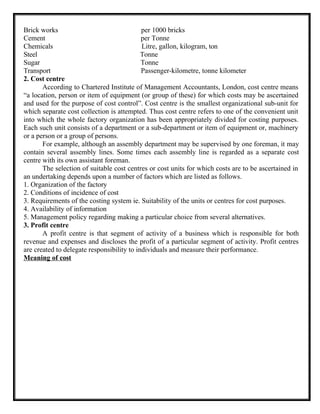
Industry/product Cost unit basis
Automobile Numbers
Brick works per 1000 bricks
Cement per Tonne
Chemicals Litre, gallon, kilogram, ton
Steel Tonne
Sugar Tonne
Transport Passenger-kilometre, tonne kilometer
2. Cost centre
According to Chartered Institute of Management Accountants, London, cost centre means
“a location, person or item of equipment (or group of these) for which costs may be ascertained
and used for the purpose of cost control”. Cost centre is the smallest organizational sub-unit for
which separate cost collection is attempted. Thus cost centre refers to one of the convenient unit
into which the whole factory organization has been appropriately divided for costing purposes.
Each such unit consists of a department or a sub-department or item of equipment or, machinery
or a person or a group of persons.
For example, although an assembly department may be supervised by one foreman, it may
contain several assembly lines. Some times each assembly line is regarded as a separate cost
centre with its own assistant foreman.
The selection of suitable cost centres or cost units for which costs are to be ascertained in
an undertaking depends upon a number of factors which are listed as follows.
1. Organization of the factory
2. Conditions of incidence of cost
3. Requirements of the costing system ie. Suitability of the units or centres for cost purposes.
4. Availability of information
5. Management policy regarding making a particular choice from several alternatives.
3. Profit centre
A profit centre is that segment of activity of a business which is responsible for both
revenue and expenses and discloses the profit of a particular segment of activity. Profit centres
are created to delegate responsibility to individuals and measure their performance.
Meaning of cost
The term ‘cost’ means the amount of expenses [actual or notional] incurred on or
attributable to specified thing or activity.
As per Institute of cost and work accounts (ICWA) India, Cost is ‘measurement in
monetary terms of the amount of resources used for the purpose of production of goods or
rendering services. To get the results we make efforts. Efforts constitute cost of getting the
results. It can be expressed in terms of money; it means the amount of expenses incurred on or
attributable to some
specific thing or activity.
The term cost is used in this very form. In reference to production/manufacturing of goods
and services cost refers to sum total of the value of resources used like raw material and labour
and expenses incurred in producing or manufacturing of given quantity.
Elements of cost
Cost of production/manufacturing consists of various expenses incurred on
production/manufacturing of goods or services. These are the elements of cost which can be
divided into three groups : Material, Labour and Expenses.
1. Material
To produce or manufacture material is required. For example to manufacture shirts cloth is
required and to produce flour wheat is required. All material which becomes an integral part of
finished product and which can be conveniently assigned to specific physical unit is termed as
“Direct Material”.
It is also described as raw material, process material, prime material, production material,
stores material, etc. The substance from which the product is made is known as material. It may
be in a raw or manufactured state. Material is classified into two categories:
1. Direct Material
2. Indirect Material
1. Direct Material
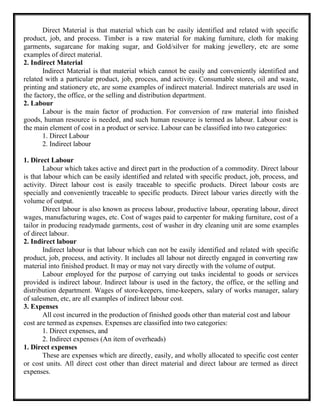
Direct Material is that material which can be easily identified and related with specific
product, job, and process. Timber is a raw material for making furniture, cloth for making
garments, sugarcane for making sugar, and Gold/silver for making jewellery, etc are some
examples of direct material.
2. Indirect Material
Indirect Material is that material which cannot be easily and conveniently identified and
related with a particular product, job, process, and activity. Consumable stores, oil and waste,
printing and stationery etc, are some examples of indirect material. Indirect materials are used in
the factory, the office, or the selling and distribution department.
2. Labour
Labour is the main factor of production. For conversion of raw material into finished
goods, human resource is needed, and such human resource is termed as labour. Labour cost is
the main element of cost in a product or service. Labour can be classified into two categories:
1. Direct Labour
2. Indirect labour
1. Direct Labour
Labour which takes active and direct part in the production of a commodity. Direct labour
is that labour which can be easily identified and related with specific product, job, process, and
activity. Direct labour cost is easily traceable to specific products. Direct labour costs are
specially and conveniently traceable to specific products. Direct labour varies directly with the
volume of output.
Direct labour is also known as process labour, productive labour, operating labour, direct
wages, manufacturing wages, etc. Cost of wages paid to carpenter for making furniture, cost of a
tailor in producing readymade garments, cost of washer in dry cleaning unit are some examples
of direct labour.
2. Indirect labour
Indirect labour is that labour which can not be easily identified and related with specific
product, job, process, and activity. It includes all labour not directly engaged in converting raw
material into finished product. It may or may not vary directly with the volume of output.
Labour employed for the purpose of carrying out tasks incidental to goods or services
provided is indirect labour. Indirect labour is used in the factory, the office, or the selling and
distribution department. Wages of store-keepers, time-keepers, salary of works manager, salary
of salesmen, etc, are all examples of indirect labour cost.
3. Expenses
All cost incurred in the production of finished goods other than material cost and labour
cost are termed as expenses. Expenses are classified into two categories:
1. Direct expenses, and
2. Indirect expenses (An item of overheads)
1. Direct expenses
These are expenses which are directly, easily, and wholly allocated to specific cost center
or cost units. All direct cost other than direct material and direct labour are termed as direct
expenses.
Direct expenses are also termed as chargeable expenses. Some examples of the direct
expenses are hire of special machinery, cost of special designs, moulds or patterns, feed paid to
architects, surveyors and other consultants, inward carriage and freight charges on special
material, Cost of patents and royalties.
2. Indirect expenses (An item of overheads)
These expenses cannot be directly, easily, and wholly allocated to specific cost center or
cost units. All indirect costs other than indirect material and indirect labour are termed as indirect
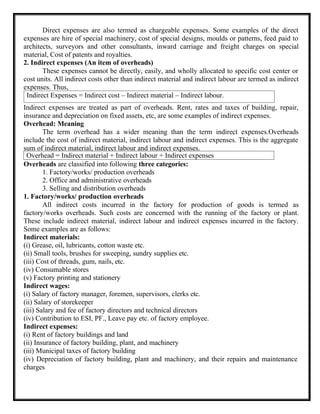
expenses. Thus,
Indirect expenses are treated as part of overheads. Rent, rates and taxes of building, repair,
insurance and depreciation on fixed assets, etc, are some examples of indirect expenses.
Overhead: Meaning
The term overhead has a wider meaning than the term indirect expenses.Overheads
include the cost of indirect material, indirect labour and indirect expenses. This is the aggregate
sum of indirect material, indirect labour and indirect expenses.
Overheads are classified into following three categories:
1. Factory/works/ production overheads
2. Office and administrative overheads
3. Selling and distribution overheads
1. Factory/works/ production overheads
All indirect costs incurred in the factory for production of goods is termed as
factory/works overheads. Such costs are concerned with the running of the factory or plant.
These include indirect material, indirect labour and indirect expenses incurred in the factory.
Some examples are as follows:
Indirect materials:
(i) Grease, oil, lubricants, cotton waste etc.
(ii) Small tools, brushes for sweeping, sundry supplies etc.
(iii) Cost of threads, gum, nails, etc.
(iv) Consumable stores
(v) Factory printing and stationery
Indirect wages:
(i) Salary of factory manager, foremen, supervisors, clerks etc.
(ii) Salary of storekeeper
(iii) Salary and fee of factory directors and technical directors
(iv) Contribution to ESI, PF., Leave pay etc. of factory employee.
Indirect expenses:
(i) Rent of factory buildings and land
(ii) Insurance of factory building, plant, and machinery
(iii) Municipal taxes of factory building
(iv) Depreciation of factory building, plant and machinery, and their repairs and maintenance
charges
Indirect Expenses = Indirect cost – Indirect material – Indirect labour.
Overhead = Indirect material + Indirect labour + Indirect expenses
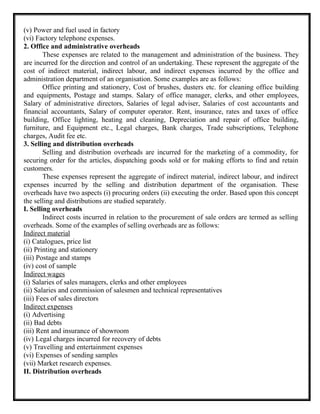
(v) Power and fuel used in factory
(vi) Factory telephone expenses.
2. Office and administrative overheads
These expenses are related to the management and administration of the business. They
are incurred for the direction and control of an undertaking. These represent the aggregate of the
cost of indirect material, indirect labour, and indirect expenses incurred by the office and
administration department of an organisation. Some examples are as follows:
Office printing and stationery, Cost of brushes, dusters etc. for cleaning office building
and equipments, Postage and stamps. Salary of office manager, clerks, and other employees,
Salary of administrative directors, Salaries of legal adviser, Salaries of cost accountants and
financial accountants, Salary of computer operator. Rent, insurance, rates and taxes of office
building, Office lighting, heating and cleaning, Depreciation and repair of office building,
furniture, and Equipment etc., Legal charges, Bank charges, Trade subscriptions, Telephone
charges, Audit fee etc.
3. Selling and distribution overheads
Selling and distribution overheads are incurred for the marketing of a commodity, for
securing order for the articles, dispatching goods sold or for making efforts to find and retain
customers.
These expenses represent the aggregate of indirect material, indirect labour, and indirect
expenses incurred by the selling and distribution department of the organisation. These
overheads have two aspects (i) procuring orders (ii) executing the order. Based upon this concept
the selling and distributions are studied separately.
I. Selling overheads
Indirect costs incurred in relation to the procurement of sale orders are termed as selling
overheads. Some of the examples of selling overheads are as follows:
Indirect material
(i) Catalogues, price list
(ii) Printing and stationery
(iii) Postage and stamps
(iv) cost of sample
Indirect wages
(i) Salaries of sales managers, clerks and other employees
(ii) Salaries and commission of salesmen and technical representatives
(iii) Fees of sales directors
Indirect expenses
(i) Advertising
(ii) Bad debts
(iii) Rent and insurance of showroom
(iv) Legal charges incurred for recovery of debts
(v) Travelling and entertainment expenses
(vi) Expenses of sending samples
(vii) Market research expenses.
II. Distribution overheads
Indirect costs incurred in relation to the execution of the sales order is termed as distribution
overheads. Some of the examples of distribution
overheads are as follows:
Indirect material
(i) Cost of packing material
(ii) oil, grease, spare parts etc. for maintaining delivery
vans Indirect wages
(i) Salaries of godown employees
(ii) Wages of drivers of delivery vans
(iii) Wages of packers and dispatch staff.
Indirect expenses
(i) Packing expenses
(ii) Godown rent, insurance, depreciation, and repair etc.
(iii) Freight carriage outwards and other transport charges .
(iv) Running expenses of delivery vans, repair, and depreciation.
(v) Insurance in transit etc.
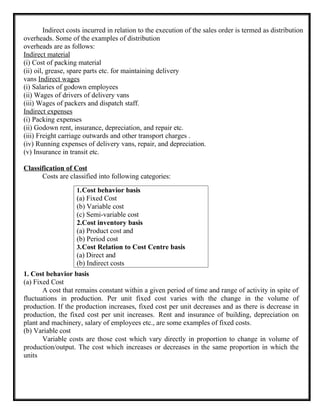
Classification of Cost
Costs are classified into following categories:
1. Cost behavior basis
(a) Fixed Cost
A cost that remains constant within a given period of time and range of activity in spite of
fluctuations in production. Per unit fixed cost varies with the change in the volume of
production. If the production increases, fixed cost per unit decreases and as there is decrease in
production, the fixed cost per unit increases. Rent and insurance of building, depreciation on
plant and machinery, salary of employees etc., are some examples of fixed costs.
(b) Variable cost
Variable costs are those cost which vary directly in proportion to change in volume of
production/output. The cost which increases or decreases in the same proportion in which the
units
1.Cost behavior basis
(a) Fixed Cost
(b) Variable cost
(c) Semi-variable cost
2.Cost inventory basis
(a) Product cost and
(b) Period cost
3.Cost Relation to Cost Centre basis
(a) Direct and
(b) Indirect costs
produced is termed as variable cost. Direct material, direct labour, direct expenses, variable
overheads are some examples of variable cost.
(c) Semi-variable cost
A cost contains both fixed and variable component and which is thus partly affected by
fluctuations in the level of activity. Semi-variable costs is that cost of which some part remains
fixed at the given level of production and other part varies with the change in the volume of
production but not in the same proportion of change in production.
For example, expenses may not change if output is upto50% capacity but may increase by
5% for every 20% increase in output over 50% but up to 70%. For example, Telephone expenses
of which rent portion is fixed and call charges are variable.
Segregation of semi-variable cost
Semi-variable costs are segregated into fixed and variable cost by using the
following formula :
2. Costs by inventory : Product cost and period cost
Product costs are those cost which are charged and identified with the product and
included in stock value. In other words, the costs that are the cost of manufacturing a product are
called product cost. Product cost includes direct material, direct labour, direct expenses, and
manufacturing overheads. Period costs are those costs which are not charged to products but are
written off as expenses against revenue of the period during which these are incurred.
They are not transferred as a part of value of stock to the next accounting year. They are
charged against the revenue of the relevant period. Period costs include all fixed costs and total
administration, selling and distribution costs.
3. Cost Relation to Cost Centre : Direct and Indirect costs
All costs are subdivided into direct and indirect costs. The concept of direct and indirect
cost is of basic importance in costing. Costs which are easily and directly allocated to products or
units are termed as direct cost. Direct costs include all traceable costs. In the process of
manufacturing of a product, materials are purchased, wages are paid to labour, and certain other
expenses are also incurred directly.
All these expenses are called as direct costs. The expenses incurred on those items which
are not directly charged to a single product because they are incurred for many products are
termed as indirect Costs. The example of indirect costs are Oil and scrap materials, [indirect
materials], salary of factory supervisors [indirect labour], rent rates and depreciation [indirect
expenses]. Indirect costs, often referred to as overheads have to be apportioned to different
products on suitable criterion/criteria.
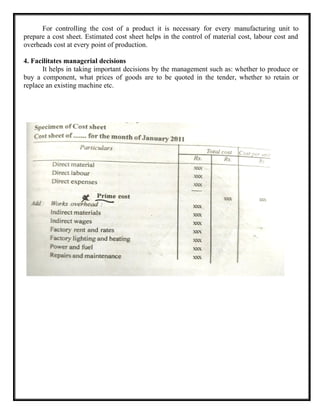
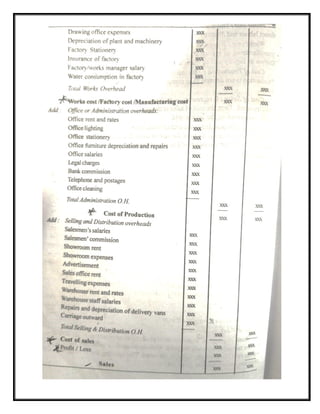
Meaning of Cost Sheet:
Cost sheet is a statement, which shows various components of total cost of a product. It
classifies and analyses the components of cost of a product. Previous periods data is given in the
cost sheet for comparative study.
It is a statement which shows per unit cost in addition to Total Cost. Selling price is
ascertained with the help of cost sheet. The details of total cost
Semi-variable cost= Fixed cost + variable cost
Variable cost per unit = change in cost/change in output
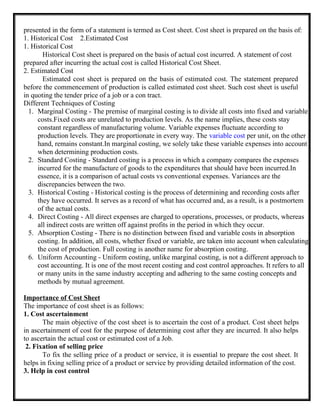
presented in the form of a statement is termed as Cost sheet. Cost sheet is prepared on the basis of:
1. Historical Cost 2.Estimated Cost
1. Historical Cost
Historical Cost sheet is prepared on the basis of actual cost incurred. A statement of cost
prepared after incurring the actual cost is called Historical Cost Sheet.
2. Estimated Cost
Estimated cost sheet is prepared on the basis of estimated cost. The statement prepared
before the commencement of production is called estimated cost sheet. Such cost sheet is useful
in quoting the tender price of a job or a con tract.
Different Techniques of Costing
1. Marginal Costing - The premise of marginal costing is to divide all costs into fixed and variable
costs.Fixed costs are unrelated to production levels. As the name implies, these costs stay
constant regardless of manufacturing volume. Variable expenses fluctuate according to
production levels. They are proportionate in every way. The variable cost per unit, on the other
hand, remains constant.In marginal costing, we solely take these variable expenses into account
when determining production costs.
2. Standard Costing - Standard costing is a process in which a company compares the expenses
incurred for the manufacture of goods to the expenditures that should have been incurred.In
essence, it is a comparison of actual costs vs conventional expenses. Variances are the
discrepancies between the two.
3. Historical Costing - Historical costing is the process of determining and recording costs after
they have occurred. It serves as a record of what has occurred and, as a result, is a postmortem
of the actual costs.
4. Direct Costing - All direct expenses are charged to operations, processes, or products, whereas
all indirect costs are written off against profits in the period in which they occur.
5. Absorption Costing - There is no distinction between fixed and variable costs in absorption
costing. In addition, all costs, whether fixed or variable, are taken into account when calculating
the cost of production. Full costing is another name for absorption costing.
6. Uniform Accounting - Uniform costing, unlike marginal costing, is not a different approach to
cost accounting. It is one of the most recent costing and cost control approaches. It refers to all
or many units in the same industry accepting and adhering to the same costing concepts and
methods by mutual agreement.
Importance of Cost Sheet
The importance of cost sheet is as follows:
1. Cost ascertainment
The main objective of the cost sheet is to ascertain the cost of a product. Cost sheet helps
in ascertainment of cost for the purpose of determining cost after they are incurred. It also helps
to ascertain the actual cost or estimated cost of a Job.
2. Fixation of selling price
To fix the selling price of a product or service, it is essential to prepare the cost sheet. It
helps in fixing selling price of a product or service by providing detailed information of the cost.
3. Help in cost control
For controlling the cost of a product it is necessary for every manufacturing unit to
prepare a cost sheet. Estimated cost sheet helps in the control of material cost, labour cost and
overheads cost at every point of production.
4. Facilitates managerial decisions
It helps in taking important decisions by the management such as: whether to produce or
buy a component, what prices of goods are to be quoted in the tender, whether to retain or
replace an existing machine etc.
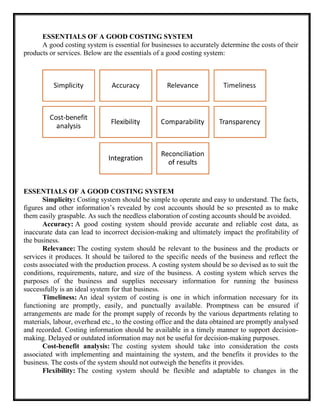
ESSENTIALS OF A GOOD COSTING SYSTEM
A good costing system is essential for businesses to accurately determine the costs of their
products or services. Below are the essentials of a good costing system:
ESSENTIALS OF A GOOD COSTING SYSTEM
Simplicity: Costing system should be simple to operate and easy to understand. The facts,
figures and other information’s revealed by cost accounts should be so presented as to make
them easily graspable. As such the needless elaboration of costing accounts should be avoided.
Accuracy: A good costing system should provide accurate and reliable cost data, as
inaccurate data can lead to incorrect decision-making and ultimately impact the profitability of
the business.
Relevance: The costing system should be relevant to the business and the products or
services it produces. It should be tailored to the specific needs of the business and reflect the
costs associated with the production process. A costing system should be so devised as to suit the
conditions, requirements, nature, and size of the business. A costing system which serves the
purposes of the business and supplies necessary information for running the business
successfully is an ideal system for that business.
Timeliness: An ideal system of costing is one in which information necessary for its
functioning are promptly, easily, and punctually available. Promptness can be ensured if
arrangements are made for the prompt supply of records by the various departments relating to
materials, labour, overhead etc., to the costing office and the data obtained are promptly analysed
and recorded. Costing information should be available in a timely manner to support decision-
making. Delayed or outdated information may not be useful for decision-making purposes.
Cost-benefit analysis: The costing system should take into consideration the costs
associated with implementing and maintaining the system, and the benefits it provides to the
business. The costs of the system should not outweigh the benefits it provides.
Flexibility: The costing system should be flexible and adaptable to changes in the
business environment, such as changes in production processes, product lines, or technology. It
should, in particular, be suitable to handle a large volume of the work as also to deal with the
changes in the nature of the business.
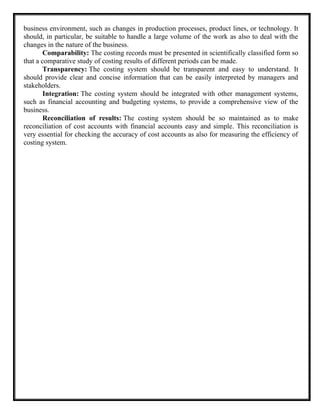
Comparability: The costing records must be presented in scientifically classified form so
that a comparative study of costing results of different periods can be made.
Transparency: The costing system should be transparent and easy to understand. It
should provide clear and concise information that can be easily interpreted by managers and
stakeholders.
Integration: The costing system should be integrated with other management systems,
such as financial accounting and budgeting systems, to provide a comprehensive view of the
business.
Reconciliation of results: The costing system should be so maintained as to make
reconciliation of cost accounts with financial accounts easy and simple. This reconciliation is
very essential for checking the accuracy of cost accounts as also for measuring the efficiency of
costing system.
unit 1    COST ACCOUNTING AND COST SHEET

unit 1 COST ACCOUNTING AND COST SHEET

  • 1.
    BASICS OF COST ACCOUNTINGUNIT -1 MRS.N.MANJU ASSISTANT PROFESSOR DEPARTMENT OF COMMERCE SRMIST-RAMAPURAM
  • 2.
    Define of costing Thecosting terminology of C.I.M.A., London defines costing as the “the techniques and processes of ascertaining costs”. These techniques consist of principles and rules which govern the procedure of ascertaining cost of products or services. The techniques to be followed for the analysis of expenses and the processes by which such an analysis should be related to different products or services differ from industry to industry. These techniques are also dynamic and they change with time. Define of Cost Accounting Cost Accounting may be defined as “Accounting for costs classification and analysis of expenditure as will enable the total cost of any particular unit of production to be ascertained with reasonable degree of accuracy and at the same time to disclose exactly how such total cost is constituted”. Thus Cost Accounting is classifying, recording an appropriate allocation of expenditure for the determination of the costs of products or services, and for the presentation of suitably arranged data for the purpose of control and guidance of management. Objectives of cost accounting: There is a relationship among information needs of management, cost accounting objectives, and techniques and tools used for analysis in cost accounting. Cost accounting has the following main objectives to serve: 1. Determining selling price 2. Controlling cost 3. Providing information for decision-making 4. Ascertaining costing profit 5. Facilitating preparation of financial and other statements. 1. Determining selling price The objective of determining the cost of products is of main importance in cost accounting. The total product cost and cost per unit of product are important in deciding selling price of product. Cost accounting provides information regarding the cost to make and sell product or services. Other factors such as the quality of product, the condition of the market, the area of distribution, the quantity which can be supplied etc., are also to be given consideration by the management before deciding the selling price, but the cost of product plays a major role. 2. Controlling cost Cost accounting helps in attaining aim of controlling cost by using various techniques such as Budgetary Control, Standard costing, and inventory control. Each item of cost [viz. material, labour, and expense] is budgeted at the beginning of the period and actual expenses incurred are compared with the budget. This increases the efficiency of the enterprise. 3. Providing information for decision-making Cost accounting helps the management in providing information for managerial decisions for formulating operative policies. These policies relate to the following matters: (i) Determination of cost-volume-profit relationship. (ii) Make or buy a component
  • 3.
    (iii) Shut downor continue operation at a loss (iv) Continuing with the existing machinery or replacing them by improved and economical machines. 4. Ascertaining costing profit Cost accounting helps in ascertaining the costing profit or loss of any activity on an objective basis by matching cost with the revenue of the activity. 5. Facilitating preparation of financial and other statements Cost accounting helps to produce statements at short intervals as the management may require. The financial statements are prepared generally once a year or half year to meet the needs of the management. In order to operate the business at high efficiency, it is essential for management to have a review of production, sales and operating results. Cost accounting provides daily, weekly or monthly statements of units produced, accumulated cost with analysis. Cost accounting system provides immediate information regarding stock of raw material, semi-finished and finished goods. This helps in preparation of financial statements. Scope of Cost Accounting The terms ‘costing’ and ‘cost accounting’ are many times used interchangeably. However, the scope of cost accounting is broader than that of costing. Following functional activities are included in the scope of cost accounting: 1. Cost book-keeping: It involves maintaining complete record of all costs incurred from their incurrence to their charge to departments, products and services. Such recording is preferably done on the basis of double entry system. 2. Cost system: Systems and procedures are devised for proper accounting for costs. 3. Cost ascertainment: Ascertaining cost of products, processes, jobs, services, etc., is the important function of cost accounting. Cost ascertainment becomes the basis of managerial decision making such as pricing, planning and control. 4. Cost Analysis: It involves the process of finding out the causal factors of actual costs varying from the budgeted costs and fixation of responsibility for cost increases. 5. Cost comparisons: Cost accounting also includes comparisons between cost from alternative courses of action such as use of technology for production, cost of making different products and activities, and cost of same product/ service over a period of time. 6. Cost Control: Cost accounting is the utilisation of cost information for exercising control. It involves a detailed examination of each cost in the light of benefit derived from the incurrence of the cost. Thus, we can state that cost is analysed to know whether the current level of costs is satisfactory in the light of standards set in advance. 7. Cost Reports:
  • 4.
    Presentation of costis the ultimate function of cost accounting. These reports are primarily for use by the management at different levels. Cost Reports form the basis for planning and control, performance appraisal and managerial decision making. Nature of Cost Accounting 1. Cost accounting is a branch of knowledge: Though considered as a branch of financial accounting, cost accounting is one of the important branch of knowledge, that is a discipline by itself. It is an organised body of knowledge consisting of its own principles, concepts and conventions. These principles and rules vary from industry to industry. 2. Cost accounting is a science: Cost accounting is a science as it is a body of systematic knowledge relating to not only cost accounting but relating to a wide variety of subjects such as law, office practice and procedure, data processing, production and material control, etc. It is necessary for a cost accountant to have intimate knowledge of all these field of study in order to carry on his day-to-day activities. But it is to be admitted that it is not a perfect science as in the case of natural science. 3. Cost accounting is an art: Cost accounting is an art in the sense it requires the ability and skill on the part of cost accountant in applying the principles, methods and techniques of cost accountancy to various management problems. These problems include the ascertainment of cost, control of costs, ascertainment of profitability, etc. 4. Cost accounting is a profession: In recent years cost accounting has become one of the important professions which has become more challenging. This view is evident from two facts. First, the setting up of various professional bodies such as National Association of Accountants (NAA) in USA. The Institute of Cost and Management Accountants in UK, the Institute of Cost and Works Accountants in India and such other professional bodies both in developed and developing
  • 5.
    countries have increasedthe growing awareness of costing profession among the people. Secondly, a large number of students have enrolled in these institutes to obtain costing certificates and memberships for earning their livelihood. Advantages of Cost Accounting 1. Advantages of Cost Accounting to Management 1. Fixation of responsibility: Whenever a cost centre is established, it implies establishing a kind of relationship between superior and subordinates. Thus, responsibilities are fixed on every individual who is concerned with incurrence of cost. 2. Measures economic performance: By applying cost control techniques such as budgetary control and standard costing it helps in knowing the performance of business. 3. Fixation of price: By providing cost data it helps management to fix the selling price in advance. Hence, quotations can be supplied to prospective customers to secure orders. 4. Aids in decision-making: It helps management in making suitable decisions such as make or buy, replace manual labour by machines, shut down or continue operations based on cost reports. 5. Helps in the preparation of interim final accounts: By the process of continuous stock taking it enables to know the value of closing stock of materials at any time. This facilitates preparation of final accounts wherever desired. 6. Helps in minimising wastages and losses: Cost accounting system enables to locate the losses relating to materials, idle time and under utilisation of plant and machinery. 7. Facilitates comparison: It facilitates cost comparison in respect of jobs, process, departments and also between two periods. This reveals the efficiency or otherwise of each job, process or department. 8. Assists in increasing profitability: Costing reports provide information about profitable or unprofitable areas of operation. The management can discontinue that product line or that department which are responsible for incurring losses and only profitable line of activities alone are retained. 9. Reconciliation with financial accounts: A well maintained cost accounting system facilitates reconciliation with financial accounts to check the arithmetical accuracy of both the systems. 10. It guides future production policy: Cost data help management in determining future production policy. Any expansion or contraction of production for the future is based on past cost data. 2. Advantages to Employees 1. Cost accounting system enables employees to earn better wages through overtime wages and incentive systems of wage payment. 2. By providing better facilities it ensures job security to employees. 3. Employees benefit by merit rating techniques which is conducted by scientific process. 3. Advantages to Creditors 1. It increases the confidence of creditors in the capital employed in the business.
  • 6.
    2. The frequentpreparation of reports and statements help in knowing solvency position of the business. 4. Advantages to Government 1. It helps government in formulating policies regarding export, import, taxation, price control measures, wage fixation, etc. 2. It helps in assessing excise duty, sales tax and income tax of the business. 3. Costing information helps in preparing national plans. 5. Advantages to Society 1. Cost reduction and cost control programmes go to minimise cost of production of goods and services. A portion of the reduced cost of production is shared bycustomers by paying less price for goods and services. 2. It offers employment opportunities in the cost accounting department in the capacity of cost accountants and cost clerks. Disadvantages of Cost Accounting Cost accounting like other branches of accountancy is not an exact science but is art which has developed through theories and accounting practice based on reasoning and common sense. Many theories can be proved or disproved in the light of conventions and basic principles of cost accounting. These Principles are not static but changing with the change of time and circumstances. The following are the main limitations of cost accounting: 1. Cost accounting lacks a uniform procedure: It is possible that two equally competent cost accountants may arrive at different results from the same information. Keeping in view this limitation, all cost accounting results can be taken as mere estimates. 2. There are a large number of conventions, estimates and flexible factors such as classification of costs into its elements, issue of materials on average or standard price, apportionment of overhead expenses, arbitrary allocation of joint costs, division of overheads into fixed and variable costs, division of costs into normal and abnormal and controllable and non- controllable and adoption of marginal costs and standard costs due to which it becomes difficult to have exact costs. Moreover, no one cost is suitable for all purposes and under all circumstances. Virtually its calculation depends on the use to which the data are required to be put to. Because of inclusion of some items of cost on estimated basis it is difficult to have actual true cost. On this basis when the valuation of stock is done, that will not be based on true facts and naturally the profit calculated from the cost records will not be true. 3. For getting the benefits of cost accounting many formalities are to be observed by a small and medium size concern due to which the establishment and running costs are so much that it becomes difficult for these concerns to afford its cost. Thus, cost accounting can be used only by big concerns. 4. The contribution of cost accounting for handling futuristic situations has not been much. For example, it has not evolved so far any tool for handling inflationary situation. Cost classification Costs can be classified or grouped according to their common characteristics. Proper classification of costs is very important for identifying the costs with the cost centers or cost units.
  • 7.
    The same costsare classified according to different ways of costing depending upon the purpose to be achieved and requirements of a particular concern. The important ways of classification are: 1. By Nature or Elements: According to this classification the costs are classified into three categories i.e., Materials, Labour and Expenses. Materials can further be sub-classified as raw materials components, spare parts, consumable stores, packing materials etc. This helps in finding the total cost of production and the percentage of materials (labour or other expenses) constituted in the total cost. It also helps in valuation of work-in-progress. 2. By Functions: This classification is on the basis of costs incurred in various functions of an organization ie. Production, administration, selling and distribution. According to this classification, costs are divided into Manufacturing and Production Costs and Commercial costs. Manufacturing and Production Costs are costs involved in manufacture, construction and Fabrication of products. Commercial Costs are (a) administration costs (b) selling and distribution costs. 3. By Degree of Traceability to the Product: According to this, costs are divided indirect costs and indirect costs. Direct Costs are those costs which are incurred for a particular product and can be identified with a particular cost centre or cost unit. Eg:- Materials, Labour. Indirect Costs are those costs which are incurred for the benefit of a number of cost centre or cost units and cannot be conveniently identified with a particular cost centre or cost unit. Eg:- Rent of Building, electricity charges, salary of staff etc. 4. By Changes in Activity or Volume: According to this costs are classified according to their behavior in relation to changes in the level of activity or volume of production. They are fixed, variable and semi-variable. Fixed Costs are those costs which remain fixed in total amount with increase or decrease in the volume of the output or productive activity for a given period of time. Fixed Costs per unit decreases as production increases and vice versa. Eg:- rent, insurance of factory building, factory manager’s salary etc. Variable Costs are those costs which vary indirect proportion to the volume of output. These costs fluctuate in total but remain constant per unit as production activity changes. Eg:- direct material costs, direct labour costs, power, repairs etc. Semi-variable Costs are those which are partly fixed and partly variable. For example; Depreciation, for two shifts working the total depreciation may be only 50% more than that for single shift working. They may change with comparatively small changes in output but not in the same proportion. 5. Association with the Product: Cost can be classified as product costs and period costs. Product costs are those which are traceable to the product and included in inventory cost, thus product cost is full factory cost. Period costs are incurred on the basis of time such as rent, salaries etc. thus it includes all selling and administration costs. These costs are incurred for a period and are treated as
  • 8.
  • 9.
    The CIMA definescontrollable cost as “a cost which can be influenced by the action of a specified member of an undertaking” and a non-controllable cost as “a cost which cannot be influenced by the action of a specified member of an undertaking”. 7. By Normality: There are normal costs and abnormal costs. Normal costs are the costs which are normally incurred at a given level of output under normal conditions. Abnormal costs are costs incurred under abnormal conditions which are not normally incurred in the normal course of production. Eg:-damaged goods due to machine break down, extra expenses due to disruption of electricity, inefficiency of workers etc. 8. By Relationship with Accounting Period: There are capital and revenue expenses depending on the length of the period for which it is incurred. The cost which is incurred in purchasing an asset either to earn income or increasing the earning capacity of the business is called capital cost, for example, the cost of a machine in a factory. Such cost is incurred at one point of time but the benefits accruing from it are spread over a number of accounting years. The cost which is incurred for maintaining an asset or running a business is revenue expenditure. Eg:- cost of materials, salary and wages paid, depreciation, repairs and maintenance, selling and distribution. 9. By Time: Costs can be classified as 1) Historical cost and 2) Predetermined Costs. The costs which are ascertained and recorded after it has been incurred is called historical costs. They are based on recorded facts hence they can be verified and are always supported by evidences. Predetermined costs are also known as estimated costs as they are computed in advance of production taking into consideration the previous periods’ costs and the factors affecting such costs. Predetermined costs when calculated scientifically become standard costs. Standard costs are used to prepare budgets and then the actual cost incurred is later-on compared with such predetermined cost and the variance is studied for future correction. Types, Methods and Techniques of Costing The general fundamental principles of ascertaining costs are the same in every system of cost accounting, but the methods of analysis and presenting the costs vary from industry to industry. Different methods are used because business enterprises vary in their nature and in the type of products or services they produce or render. Basically, there are two principal methods of costing, namely (i) Job Costing, and (ii) Process costing. 1. Job costing: It refers to a system of costing in which costs are ascertained in terms of specific jobs or orders which are not comparable with each other. Industries where this method of costing is generally applied are Printing Process, Automobile Garages, Repair Shops, Ship-building, House building, Engine and Machine construction, etc. Job Costing includes the following methods of costing: (a) Contract Costing: Although contract costing does not differ in principle from job costing, it is convenient to treat contract cost accounts separately. The term is usually applied to the costing method adopted where large scale contracts at different sites are carried out, as in the case of building construction.
  • 10.
    (b)Bach Costing: Thismethod is also a type of job costing. A batch of similar products is regarded as one job and the cost of this complete batch is ascertained. It is then used to determine the unit cost of the articles produced. It should, however, be noted that the articles produced should not lose their identity in manufacturing operations. (c)Terminal Costing: This method is also a type of job costing. This method emphasizes the essential nature of job costing, ie, the cost can be properly terminated at some point and related to a particular job. (d) Operation Costing: This method is adopted when it is desired to ascertain the cost of carrying out an operation in a department, for example, welding. For large undertaking, it is frequently necessary to ascertain the cost of various operations. 2. Process Costing: Where a product passes through distinct stages or processes, the output of one Process being the input of the subsequent process, it is frequently desired to ascertain the cost of each stage or process of production. This is known as process costing. This method is used where it is difficult to trace the item of prime cost to a particular order because its identity is lost in volume of continuous production. Process costing is generally adopted in textile industries, chemical industries, oil refineries, soap manufacturing, paper manufacturing, tanneries, etc. 3. Unit or single or output or single output costing: This method is used where a single article is produced or service is rendered by continuous manufacturing activity. The cost of the whole production cycle is ascertained as a process or series of processes and the cost per unit is arrived at by dividing the total cost by the number of units produced. The unit of costing is chosen according to the nature of the product. Cost statements or cost sheets are prepared under which various items of expenses are classified and the total expenditure is divided by total quantity produced in order to arrive at unit cost of production. This method is suitable in industries like brick-making, collieries, flour mills, cement manufacturing, etc. this method is useful for the assembly department in a factory producing a mechanical article eg. Bicycle. 4. Operating Costing: This method is applicable where services are rendered rather than goods produced. The procedure is same as in the case of single output costing. The total expenses of the operation are divided by the units and cost per unit of services is arrived at. This method is employed in Railways, Road Transport, Water supply undertakings, Telephone services, Electricity companies, Hospital services, Municipal services, etc. 5. Multiple or Complete Costing: Some products are so complex that no single system of costing is applicable. It is used where there are a variety of components separately produced and subsequently assembled in a complex production. Total cost is ascertained by computing component costs which are collected by job or process costing and then aggregating the costs through use of the single or output costing system. This method is applicable to manufacturing concerns producing Motor Cars, Aeroplanes, Machine tools, Type-writers, Radios, Cycles, Sewing Machines, etc. 6. Uniform Costing:
  • 11.
    It is nota distinct method of costing by itself. It is the name given to a common system of costing followed by a number of firms in the same industry. This helps in comparing performance of one firm with that of another. 7. Departmental Costing: When costs are ascertained department by department, the method is called “Departmental Costing”. Usually, for ascertaining the cost of various goods or services produced by the department, the total costs will have to be analysed, say, by the use of job costing or unit costing. In addition to the above methods of costing, mention can be made of the following techniques of costing which can be applied to any one of the above method of costing for special purposes of cost control and policy making: a) Standard or Predetermined Costs. b) Marginal Costs Explain the Terms 1. Cost units 2. Cost centre 3.Profit centre 1. Cost units The Chartered Institute of Management Accountants, London, defines a unit of cost as “a unit of quantity of product, service or time in relation to which costs may be ascertained or expressed”. The forms of measurement used as cost units are usually the units of physical measurements like number, weight, area, length, value, time etc. Following are some examples of cost unit. Industry/product Cost unit basis Automobile Numbers
  • 12.
    Brick works per1000 bricks Cement per Tonne Chemicals Litre, gallon, kilogram, ton Steel Tonne Sugar Tonne Transport Passenger-kilometre, tonne kilometer 2. Cost centre According to Chartered Institute of Management Accountants, London, cost centre means “a location, person or item of equipment (or group of these) for which costs may be ascertained and used for the purpose of cost control”. Cost centre is the smallest organizational sub-unit for which separate cost collection is attempted. Thus cost centre refers to one of the convenient unit into which the whole factory organization has been appropriately divided for costing purposes. Each such unit consists of a department or a sub-department or item of equipment or, machinery or a person or a group of persons. For example, although an assembly department may be supervised by one foreman, it may contain several assembly lines. Some times each assembly line is regarded as a separate cost centre with its own assistant foreman. The selection of suitable cost centres or cost units for which costs are to be ascertained in an undertaking depends upon a number of factors which are listed as follows. 1. Organization of the factory 2. Conditions of incidence of cost 3. Requirements of the costing system ie. Suitability of the units or centres for cost purposes. 4. Availability of information 5. Management policy regarding making a particular choice from several alternatives. 3. Profit centre A profit centre is that segment of activity of a business which is responsible for both revenue and expenses and discloses the profit of a particular segment of activity. Profit centres are created to delegate responsibility to individuals and measure their performance. Meaning of cost
  • 13.
    The term ‘cost’means the amount of expenses [actual or notional] incurred on or attributable to specified thing or activity. As per Institute of cost and work accounts (ICWA) India, Cost is ‘measurement in monetary terms of the amount of resources used for the purpose of production of goods or rendering services. To get the results we make efforts. Efforts constitute cost of getting the results. It can be expressed in terms of money; it means the amount of expenses incurred on or attributable to some specific thing or activity. The term cost is used in this very form. In reference to production/manufacturing of goods and services cost refers to sum total of the value of resources used like raw material and labour and expenses incurred in producing or manufacturing of given quantity. Elements of cost Cost of production/manufacturing consists of various expenses incurred on production/manufacturing of goods or services. These are the elements of cost which can be divided into three groups : Material, Labour and Expenses. 1. Material To produce or manufacture material is required. For example to manufacture shirts cloth is required and to produce flour wheat is required. All material which becomes an integral part of finished product and which can be conveniently assigned to specific physical unit is termed as “Direct Material”. It is also described as raw material, process material, prime material, production material, stores material, etc. The substance from which the product is made is known as material. It may be in a raw or manufactured state. Material is classified into two categories: 1. Direct Material 2. Indirect Material
  • 14.
  • 15.
    Direct Material isthat material which can be easily identified and related with specific product, job, and process. Timber is a raw material for making furniture, cloth for making garments, sugarcane for making sugar, and Gold/silver for making jewellery, etc are some examples of direct material. 2. Indirect Material Indirect Material is that material which cannot be easily and conveniently identified and related with a particular product, job, process, and activity. Consumable stores, oil and waste, printing and stationery etc, are some examples of indirect material. Indirect materials are used in the factory, the office, or the selling and distribution department. 2. Labour Labour is the main factor of production. For conversion of raw material into finished goods, human resource is needed, and such human resource is termed as labour. Labour cost is the main element of cost in a product or service. Labour can be classified into two categories: 1. Direct Labour 2. Indirect labour 1. Direct Labour Labour which takes active and direct part in the production of a commodity. Direct labour is that labour which can be easily identified and related with specific product, job, process, and activity. Direct labour cost is easily traceable to specific products. Direct labour costs are specially and conveniently traceable to specific products. Direct labour varies directly with the volume of output. Direct labour is also known as process labour, productive labour, operating labour, direct wages, manufacturing wages, etc. Cost of wages paid to carpenter for making furniture, cost of a tailor in producing readymade garments, cost of washer in dry cleaning unit are some examples of direct labour. 2. Indirect labour Indirect labour is that labour which can not be easily identified and related with specific product, job, process, and activity. It includes all labour not directly engaged in converting raw material into finished product. It may or may not vary directly with the volume of output. Labour employed for the purpose of carrying out tasks incidental to goods or services provided is indirect labour. Indirect labour is used in the factory, the office, or the selling and distribution department. Wages of store-keepers, time-keepers, salary of works manager, salary of salesmen, etc, are all examples of indirect labour cost. 3. Expenses All cost incurred in the production of finished goods other than material cost and labour cost are termed as expenses. Expenses are classified into two categories: 1. Direct expenses, and 2. Indirect expenses (An item of overheads) 1. Direct expenses These are expenses which are directly, easily, and wholly allocated to specific cost center or cost units. All direct cost other than direct material and direct labour are termed as direct expenses.
  • 16.
    Direct expenses arealso termed as chargeable expenses. Some examples of the direct expenses are hire of special machinery, cost of special designs, moulds or patterns, feed paid to architects, surveyors and other consultants, inward carriage and freight charges on special material, Cost of patents and royalties. 2. Indirect expenses (An item of overheads) These expenses cannot be directly, easily, and wholly allocated to specific cost center or cost units. All indirect costs other than indirect material and indirect labour are termed as indirect expenses. Thus, Indirect expenses are treated as part of overheads. Rent, rates and taxes of building, repair, insurance and depreciation on fixed assets, etc, are some examples of indirect expenses. Overhead: Meaning The term overhead has a wider meaning than the term indirect expenses.Overheads include the cost of indirect material, indirect labour and indirect expenses. This is the aggregate sum of indirect material, indirect labour and indirect expenses. Overheads are classified into following three categories: 1. Factory/works/ production overheads 2. Office and administrative overheads 3. Selling and distribution overheads 1. Factory/works/ production overheads All indirect costs incurred in the factory for production of goods is termed as factory/works overheads. Such costs are concerned with the running of the factory or plant. These include indirect material, indirect labour and indirect expenses incurred in the factory. Some examples are as follows: Indirect materials: (i) Grease, oil, lubricants, cotton waste etc. (ii) Small tools, brushes for sweeping, sundry supplies etc. (iii) Cost of threads, gum, nails, etc. (iv) Consumable stores (v) Factory printing and stationery Indirect wages: (i) Salary of factory manager, foremen, supervisors, clerks etc. (ii) Salary of storekeeper (iii) Salary and fee of factory directors and technical directors (iv) Contribution to ESI, PF., Leave pay etc. of factory employee. Indirect expenses: (i) Rent of factory buildings and land (ii) Insurance of factory building, plant, and machinery (iii) Municipal taxes of factory building (iv) Depreciation of factory building, plant and machinery, and their repairs and maintenance charges Indirect Expenses = Indirect cost – Indirect material – Indirect labour. Overhead = Indirect material + Indirect labour + Indirect expenses
  • 17.
    (v) Power andfuel used in factory (vi) Factory telephone expenses. 2. Office and administrative overheads These expenses are related to the management and administration of the business. They are incurred for the direction and control of an undertaking. These represent the aggregate of the cost of indirect material, indirect labour, and indirect expenses incurred by the office and administration department of an organisation. Some examples are as follows: Office printing and stationery, Cost of brushes, dusters etc. for cleaning office building and equipments, Postage and stamps. Salary of office manager, clerks, and other employees, Salary of administrative directors, Salaries of legal adviser, Salaries of cost accountants and financial accountants, Salary of computer operator. Rent, insurance, rates and taxes of office building, Office lighting, heating and cleaning, Depreciation and repair of office building, furniture, and Equipment etc., Legal charges, Bank charges, Trade subscriptions, Telephone charges, Audit fee etc. 3. Selling and distribution overheads Selling and distribution overheads are incurred for the marketing of a commodity, for securing order for the articles, dispatching goods sold or for making efforts to find and retain customers. These expenses represent the aggregate of indirect material, indirect labour, and indirect expenses incurred by the selling and distribution department of the organisation. These overheads have two aspects (i) procuring orders (ii) executing the order. Based upon this concept the selling and distributions are studied separately. I. Selling overheads Indirect costs incurred in relation to the procurement of sale orders are termed as selling overheads. Some of the examples of selling overheads are as follows: Indirect material (i) Catalogues, price list (ii) Printing and stationery (iii) Postage and stamps (iv) cost of sample Indirect wages (i) Salaries of sales managers, clerks and other employees (ii) Salaries and commission of salesmen and technical representatives (iii) Fees of sales directors Indirect expenses (i) Advertising (ii) Bad debts (iii) Rent and insurance of showroom (iv) Legal charges incurred for recovery of debts (v) Travelling and entertainment expenses (vi) Expenses of sending samples (vii) Market research expenses. II. Distribution overheads
  • 18.
    Indirect costs incurredin relation to the execution of the sales order is termed as distribution overheads. Some of the examples of distribution overheads are as follows: Indirect material (i) Cost of packing material (ii) oil, grease, spare parts etc. for maintaining delivery vans Indirect wages (i) Salaries of godown employees (ii) Wages of drivers of delivery vans (iii) Wages of packers and dispatch staff. Indirect expenses (i) Packing expenses (ii) Godown rent, insurance, depreciation, and repair etc. (iii) Freight carriage outwards and other transport charges . (iv) Running expenses of delivery vans, repair, and depreciation. (v) Insurance in transit etc. Classification of Cost Costs are classified into following categories: 1. Cost behavior basis (a) Fixed Cost A cost that remains constant within a given period of time and range of activity in spite of fluctuations in production. Per unit fixed cost varies with the change in the volume of production. If the production increases, fixed cost per unit decreases and as there is decrease in production, the fixed cost per unit increases. Rent and insurance of building, depreciation on plant and machinery, salary of employees etc., are some examples of fixed costs. (b) Variable cost Variable costs are those cost which vary directly in proportion to change in volume of production/output. The cost which increases or decreases in the same proportion in which the units 1.Cost behavior basis (a) Fixed Cost (b) Variable cost (c) Semi-variable cost 2.Cost inventory basis (a) Product cost and (b) Period cost 3.Cost Relation to Cost Centre basis (a) Direct and (b) Indirect costs
  • 19.
    produced is termedas variable cost. Direct material, direct labour, direct expenses, variable overheads are some examples of variable cost. (c) Semi-variable cost A cost contains both fixed and variable component and which is thus partly affected by fluctuations in the level of activity. Semi-variable costs is that cost of which some part remains fixed at the given level of production and other part varies with the change in the volume of production but not in the same proportion of change in production. For example, expenses may not change if output is upto50% capacity but may increase by 5% for every 20% increase in output over 50% but up to 70%. For example, Telephone expenses of which rent portion is fixed and call charges are variable. Segregation of semi-variable cost Semi-variable costs are segregated into fixed and variable cost by using the following formula : 2. Costs by inventory : Product cost and period cost Product costs are those cost which are charged and identified with the product and included in stock value. In other words, the costs that are the cost of manufacturing a product are called product cost. Product cost includes direct material, direct labour, direct expenses, and manufacturing overheads. Period costs are those costs which are not charged to products but are written off as expenses against revenue of the period during which these are incurred. They are not transferred as a part of value of stock to the next accounting year. They are charged against the revenue of the relevant period. Period costs include all fixed costs and total administration, selling and distribution costs. 3. Cost Relation to Cost Centre : Direct and Indirect costs All costs are subdivided into direct and indirect costs. The concept of direct and indirect cost is of basic importance in costing. Costs which are easily and directly allocated to products or units are termed as direct cost. Direct costs include all traceable costs. In the process of manufacturing of a product, materials are purchased, wages are paid to labour, and certain other expenses are also incurred directly. All these expenses are called as direct costs. The expenses incurred on those items which are not directly charged to a single product because they are incurred for many products are termed as indirect Costs. The example of indirect costs are Oil and scrap materials, [indirect materials], salary of factory supervisors [indirect labour], rent rates and depreciation [indirect expenses]. Indirect costs, often referred to as overheads have to be apportioned to different products on suitable criterion/criteria. Meaning of Cost Sheet: Cost sheet is a statement, which shows various components of total cost of a product. It classifies and analyses the components of cost of a product. Previous periods data is given in the cost sheet for comparative study. It is a statement which shows per unit cost in addition to Total Cost. Selling price is ascertained with the help of cost sheet. The details of total cost Semi-variable cost= Fixed cost + variable cost Variable cost per unit = change in cost/change in output
  • 20.
    presented in theform of a statement is termed as Cost sheet. Cost sheet is prepared on the basis of: 1. Historical Cost 2.Estimated Cost 1. Historical Cost Historical Cost sheet is prepared on the basis of actual cost incurred. A statement of cost prepared after incurring the actual cost is called Historical Cost Sheet. 2. Estimated Cost Estimated cost sheet is prepared on the basis of estimated cost. The statement prepared before the commencement of production is called estimated cost sheet. Such cost sheet is useful in quoting the tender price of a job or a con tract. Different Techniques of Costing 1. Marginal Costing - The premise of marginal costing is to divide all costs into fixed and variable costs.Fixed costs are unrelated to production levels. As the name implies, these costs stay constant regardless of manufacturing volume. Variable expenses fluctuate according to production levels. They are proportionate in every way. The variable cost per unit, on the other hand, remains constant.In marginal costing, we solely take these variable expenses into account when determining production costs. 2. Standard Costing - Standard costing is a process in which a company compares the expenses incurred for the manufacture of goods to the expenditures that should have been incurred.In essence, it is a comparison of actual costs vs conventional expenses. Variances are the discrepancies between the two. 3. Historical Costing - Historical costing is the process of determining and recording costs after they have occurred. It serves as a record of what has occurred and, as a result, is a postmortem of the actual costs. 4. Direct Costing - All direct expenses are charged to operations, processes, or products, whereas all indirect costs are written off against profits in the period in which they occur. 5. Absorption Costing - There is no distinction between fixed and variable costs in absorption costing. In addition, all costs, whether fixed or variable, are taken into account when calculating the cost of production. Full costing is another name for absorption costing. 6. Uniform Accounting - Uniform costing, unlike marginal costing, is not a different approach to cost accounting. It is one of the most recent costing and cost control approaches. It refers to all or many units in the same industry accepting and adhering to the same costing concepts and methods by mutual agreement. Importance of Cost Sheet The importance of cost sheet is as follows: 1. Cost ascertainment The main objective of the cost sheet is to ascertain the cost of a product. Cost sheet helps in ascertainment of cost for the purpose of determining cost after they are incurred. It also helps to ascertain the actual cost or estimated cost of a Job. 2. Fixation of selling price To fix the selling price of a product or service, it is essential to prepare the cost sheet. It helps in fixing selling price of a product or service by providing detailed information of the cost. 3. Help in cost control
  • 21.
    For controlling thecost of a product it is necessary for every manufacturing unit to prepare a cost sheet. Estimated cost sheet helps in the control of material cost, labour cost and overheads cost at every point of production. 4. Facilitates managerial decisions It helps in taking important decisions by the management such as: whether to produce or buy a component, what prices of goods are to be quoted in the tender, whether to retain or replace an existing machine etc.
  • 23.
    ESSENTIALS OF AGOOD COSTING SYSTEM A good costing system is essential for businesses to accurately determine the costs of their products or services. Below are the essentials of a good costing system: ESSENTIALS OF A GOOD COSTING SYSTEM Simplicity: Costing system should be simple to operate and easy to understand. The facts, figures and other information’s revealed by cost accounts should be so presented as to make them easily graspable. As such the needless elaboration of costing accounts should be avoided. Accuracy: A good costing system should provide accurate and reliable cost data, as inaccurate data can lead to incorrect decision-making and ultimately impact the profitability of the business. Relevance: The costing system should be relevant to the business and the products or services it produces. It should be tailored to the specific needs of the business and reflect the costs associated with the production process. A costing system should be so devised as to suit the conditions, requirements, nature, and size of the business. A costing system which serves the purposes of the business and supplies necessary information for running the business successfully is an ideal system for that business. Timeliness: An ideal system of costing is one in which information necessary for its functioning are promptly, easily, and punctually available. Promptness can be ensured if arrangements are made for the prompt supply of records by the various departments relating to materials, labour, overhead etc., to the costing office and the data obtained are promptly analysed and recorded. Costing information should be available in a timely manner to support decision- making. Delayed or outdated information may not be useful for decision-making purposes. Cost-benefit analysis: The costing system should take into consideration the costs associated with implementing and maintaining the system, and the benefits it provides to the business. The costs of the system should not outweigh the benefits it provides. Flexibility: The costing system should be flexible and adaptable to changes in the
  • 24.
    business environment, suchas changes in production processes, product lines, or technology. It should, in particular, be suitable to handle a large volume of the work as also to deal with the changes in the nature of the business. Comparability: The costing records must be presented in scientifically classified form so that a comparative study of costing results of different periods can be made. Transparency: The costing system should be transparent and easy to understand. It should provide clear and concise information that can be easily interpreted by managers and stakeholders. Integration: The costing system should be integrated with other management systems, such as financial accounting and budgeting systems, to provide a comprehensive view of the business. Reconciliation of results: The costing system should be so maintained as to make reconciliation of cost accounts with financial accounts easy and simple. This reconciliation is very essential for checking the accuracy of cost accounts as also for measuring the efficiency of costing system.