1
Unit 5 Direct Marketing
2
What is Direct Marketing?
A form of advertising in which physical marketing materials are provided to
consumers in order to communicate information about a product or
service. Direct marketing does not involve advertisements placed on the
internet, on television or over the radio. Types of direct marketing
materials include catalogs, mailers and fliers.
Direct marketing removes the “middle man” from the promotion process,
as a company’s message is provided directly to a potential customer. This
type of marketing is typically used by companies with smaller advertising
budgets, since they cannot afford to pay for advertisements on television
and often do not have the brand recognition of larger firms.
3
4 Major Characteristics of Direct
Marketing
Characteristic # 1. A Set of Database: A database of names (prospects,
customers, businesses, etc.), often with certain other relevant information
such as – contact number/address, demographic information, purchase
habits/history, company history, etc., is used to develop a list of targeted
entities with some existing common interests, traits or characteristics.
Generating such a database is often considered part of the Direct
Marketing campaign.
Characteristic # 2. Addressing the Listed Customers:Marketing
messages are addressed directly to this list of customer and/or prospects.
Direct marketing relies on being able to address the members of a target
market. Addressability comes in a variety of forms including email
addresses, phone numbers, Web browser cookies, fax numbers and
postal addresses.
4
Characteristic # 3. Direct Action related:Direct marketing seeks to drive
a specific “call to action.” For example, an advertisement may ask the
prospect to call a free phone number, mail in a response or order, or click
on a link to a website.
Characteristic # 4. Specific Emphasis:Direct marketing emphasizes
trackable, measurable responses, results and costs from prospects and/or
customers – regardless of medium.
5
Benefits of Direct Marketing
High segmentation and targeting. One of the great advantages of this type
of marketing is that you can reach your specific audience segments with
personalized messages.
Optimize your marketing budget. Addressing online direct marketing to a
specific audience allows you to set realistic goals and improve your sales on a
tight budget. If you properly optimize your direct campaign, you will achieve
results with only a small percentage of the cost of traditional advertising.
Increase your sales with current and former clients. Digital direct
marketing lets you communicate with your current customers to keep the
relationship alive while continuing to bring value. It also allows you to get back
in touch with old customers and generate new sales opportunities.
Upgrade your loyalty strategies. Direct contact with your customers allows
you to customize your promotions, emails, and offers to create an instant bond.
To maximize results, you can combine your direct marketing methods with your
loyalty program.
6
Types Of Direct Marketing
Face-to-Face Marketing- This is one of the oldest forms of direct
marketing. Authorised sales representatives are employed to meet
prospects directly. The goal of each representative is to reach out to these
prospects, convert them into profitable consumers and thus promote the
business of your organization.
Door-to-Door Marketing- Door-to-Door sales (D2D) are another form of
face-to-face marketing. It simply means that your sales representative is
participating in door-to-door prospective, which indicates a system of
direct contact with your targeted audience. Rather than relying on any
other kind of marketing, a D2D salesman goes from one place to another,
engaging prospects in a conversation about the products and services you
offer implementing various compliance techniques with the intention of
doing business with them.
Kiosk Marketing- Public places that get a lot of crowds are always full of
opportunities to gain people’s attention towards your business.
Representatives stationed at kiosks in these places such as shopping
malls can directly talk to potential customers by catching their eyes with
your products and services.
7
Leaflet Handouts- This type of direct marketing involves handing out
leaflets to the targeted audience that contain printed information about
the products and services you offer, giving your potential customers
the option to contact you, should they decide to make a purchase.
Leaflets are sometimes also handed out at kiosks, to encourage a
more positive engagement from your prospects. These leaflets may
also sometimes contain offers and coupon codes that are redeemable
for only a limited amount of time, thereby enticing your prospects
further into making a purchase from you.
8
Policy Issues in Direct Marketing
Privacy Issues :An issue of great concern among the public
pertaining to direct marketing concerns privacy. Telemarketers and
mail order salesmen, for example, must obtain their list of potential
customers from somewhere. While walking door-to-door and
looking phone numbers up in a city phone book may be technically
feasible ways of locating customer information, a more practical
way to reach larger amounts of customers is to compile databases
where individuals' private information is stored.
Honesty Issues: According to the Direct Marketing Association's
Guidelines for Ethical Business Practice, the issue of honesty
about a company and its products is also of major concern to
consumers. Direct marketers have an advantage over retail stores
in that they don't need to keep an inventory of product on hand.
Items are marketed to consumers, then orders are placed and
filled. Since consumers aren't able to physically touch and inspect
item quality, the opportunity for deception exists.
9
Harassment Issues: Direct marketing companies often use databases of
personal information to find clients that can sometimes be traded or
purchased. If a particular list is sold to many groups, there are individuals
in the database who may be contacted repeatedly by numerous
salespeople.
Deceptive Tactics: Direct marketing companies will often use gimmicks to
interest potential customers, such as the promise of winning great prizes
or money in sweepstakes.
10
The 4 P’s of Global Marketing
11
Plan: Strategy before execution-Collaborate with relevant stakeholders on
regional and country teams to create a global content marketing strategy that
aligns target audiences, key success metrics, priority countries, and strategic
editorial topics with your business objectives.
Alignment of objectives and strategy is vital because it dictates content
creation, promotion, and measurement.
Produce: Create content that matters- Develop relevant stories that meet
identified countries’ needs with different formats based on strategic editorial
topics that address the target audience’s pain points, desires, and chal-
lenges.
Promote: Distribute content in the digital era- Establish a market-driven
content distribution process with paid and social media. Publish the
appropriate formats of content with the optimal frequency in targeted
channels. Use tools and data to optimize the media buy and social media
content distribution.
12
Perfect: Measure and optimize to drive the maximum impact- Continuously
optimize and measure the impact of content marketing as part of an ongoing
feedback loop. Define goals and use tools and processes to maximize the
effectiveness of content production and content syndication.
13
What is Global Marketing?
Global marketing is defined as the process of adjusting the marketing
strategies of your company to adapt to the conditions of other
countries. Of course, global marketing is more than selling your
product or service globally. It is the full process of planning, creating,
positioning, and promoting your products in a global market.
There are many benefits of global marketing, when it is done right.
First, it can improve the effectiveness of your product or service.
This is because the more you grow, the more you learn, and the
faster you learn, you become more effective at producing new
product or service offerings.
Second, you are able to have a strong competitive advantage. It is
easy enough for companies to be competing in the local market. But
there are very few companies who can do so on the worldwide arena.
Hence, if you can compete in the worldwide market and your
competitors cannot, you have become a strong force in your industry!
14
Third, you increase consumer awareness of your brand and product or
service. Through the internet, consumers can keep track of your progress in
the world.
Finally, global marketing can reduce your costs and increase your
savings. In focusing on other markets, you can attain economies of scale
and range by standardizing your processes.
Amazing Example of Global Marketing
https://www.youtube.com/watch?v=wwzBcNjzqvg
15
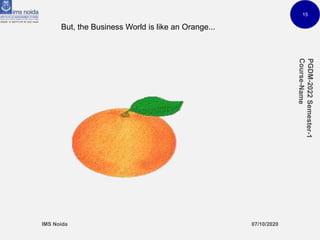
But, the Business World is like an Orange...
16
Marketing Environment
Marketing Environment- consists of the actors and forces outside marketing
that affect marketing management’s ability to develop and maintain
successful relationships with its target customers.
Includes:
Microenvironment - forces close to the company that affect its ability to
serve its customers.
Macroenvironment - larger societal forces that affect the whole
microenvironment.
17
•The Company’s Microenvironment includes – Company’s Internal
Environment- functional areas such as top management, finance, and
manufacturing, etc.
Suppliers - provide the resources needed to produce goods and services and
are an important link in the “value delivery system”.
Marketing Intermediaries - help the company to promote, sell, and distribute its
goods to final buyers.
Customers - five types of markets that purchase a company’s goods and
services.
Competitors - those who serve a target market with similar products and
services against whom a company must gain strategic advantage.
Publics - any group that perceives itself having an interest in a company’s ability
to achieve its objectives.
18
The Company’s Macroenvironment-
Demographic - studies populations in terms of age, gender, race,
occupation, location and other statistics.
Economic - factors that affect consumer purchasing power and spending
patterns.
Natural - natural resources needed as inputs by marketers or that are
affected by marketing activities.
19

Unit 5

  • 1.
    1 Unit 5 DirectMarketing
  • 2.
    2 What is DirectMarketing? A form of advertising in which physical marketing materials are provided to consumers in order to communicate information about a product or service. Direct marketing does not involve advertisements placed on the internet, on television or over the radio. Types of direct marketing materials include catalogs, mailers and fliers. Direct marketing removes the “middle man” from the promotion process, as a company’s message is provided directly to a potential customer. This type of marketing is typically used by companies with smaller advertising budgets, since they cannot afford to pay for advertisements on television and often do not have the brand recognition of larger firms.
  • 3.
    3 4 Major Characteristicsof Direct Marketing Characteristic # 1. A Set of Database: A database of names (prospects, customers, businesses, etc.), often with certain other relevant information such as – contact number/address, demographic information, purchase habits/history, company history, etc., is used to develop a list of targeted entities with some existing common interests, traits or characteristics. Generating such a database is often considered part of the Direct Marketing campaign. Characteristic # 2. Addressing the Listed Customers:Marketing messages are addressed directly to this list of customer and/or prospects. Direct marketing relies on being able to address the members of a target market. Addressability comes in a variety of forms including email addresses, phone numbers, Web browser cookies, fax numbers and postal addresses.
  • 4.
    4 Characteristic # 3.Direct Action related:Direct marketing seeks to drive a specific “call to action.” For example, an advertisement may ask the prospect to call a free phone number, mail in a response or order, or click on a link to a website. Characteristic # 4. Specific Emphasis:Direct marketing emphasizes trackable, measurable responses, results and costs from prospects and/or customers – regardless of medium.
  • 5.
    5 Benefits of DirectMarketing High segmentation and targeting. One of the great advantages of this type of marketing is that you can reach your specific audience segments with personalized messages. Optimize your marketing budget. Addressing online direct marketing to a specific audience allows you to set realistic goals and improve your sales on a tight budget. If you properly optimize your direct campaign, you will achieve results with only a small percentage of the cost of traditional advertising. Increase your sales with current and former clients. Digital direct marketing lets you communicate with your current customers to keep the relationship alive while continuing to bring value. It also allows you to get back in touch with old customers and generate new sales opportunities. Upgrade your loyalty strategies. Direct contact with your customers allows you to customize your promotions, emails, and offers to create an instant bond. To maximize results, you can combine your direct marketing methods with your loyalty program.
  • 6.
    6 Types Of DirectMarketing Face-to-Face Marketing- This is one of the oldest forms of direct marketing. Authorised sales representatives are employed to meet prospects directly. The goal of each representative is to reach out to these prospects, convert them into profitable consumers and thus promote the business of your organization. Door-to-Door Marketing- Door-to-Door sales (D2D) are another form of face-to-face marketing. It simply means that your sales representative is participating in door-to-door prospective, which indicates a system of direct contact with your targeted audience. Rather than relying on any other kind of marketing, a D2D salesman goes from one place to another, engaging prospects in a conversation about the products and services you offer implementing various compliance techniques with the intention of doing business with them. Kiosk Marketing- Public places that get a lot of crowds are always full of opportunities to gain people’s attention towards your business. Representatives stationed at kiosks in these places such as shopping malls can directly talk to potential customers by catching their eyes with your products and services.
  • 7.
    7 Leaflet Handouts- Thistype of direct marketing involves handing out leaflets to the targeted audience that contain printed information about the products and services you offer, giving your potential customers the option to contact you, should they decide to make a purchase. Leaflets are sometimes also handed out at kiosks, to encourage a more positive engagement from your prospects. These leaflets may also sometimes contain offers and coupon codes that are redeemable for only a limited amount of time, thereby enticing your prospects further into making a purchase from you.
  • 8.
    8 Policy Issues inDirect Marketing Privacy Issues :An issue of great concern among the public pertaining to direct marketing concerns privacy. Telemarketers and mail order salesmen, for example, must obtain their list of potential customers from somewhere. While walking door-to-door and looking phone numbers up in a city phone book may be technically feasible ways of locating customer information, a more practical way to reach larger amounts of customers is to compile databases where individuals' private information is stored. Honesty Issues: According to the Direct Marketing Association's Guidelines for Ethical Business Practice, the issue of honesty about a company and its products is also of major concern to consumers. Direct marketers have an advantage over retail stores in that they don't need to keep an inventory of product on hand. Items are marketed to consumers, then orders are placed and filled. Since consumers aren't able to physically touch and inspect item quality, the opportunity for deception exists.
  • 9.
    9 Harassment Issues: Directmarketing companies often use databases of personal information to find clients that can sometimes be traded or purchased. If a particular list is sold to many groups, there are individuals in the database who may be contacted repeatedly by numerous salespeople. Deceptive Tactics: Direct marketing companies will often use gimmicks to interest potential customers, such as the promise of winning great prizes or money in sweepstakes.
  • 10.
    10 The 4 P’sof Global Marketing
  • 11.
    11 Plan: Strategy beforeexecution-Collaborate with relevant stakeholders on regional and country teams to create a global content marketing strategy that aligns target audiences, key success metrics, priority countries, and strategic editorial topics with your business objectives. Alignment of objectives and strategy is vital because it dictates content creation, promotion, and measurement. Produce: Create content that matters- Develop relevant stories that meet identified countries’ needs with different formats based on strategic editorial topics that address the target audience’s pain points, desires, and chal- lenges. Promote: Distribute content in the digital era- Establish a market-driven content distribution process with paid and social media. Publish the appropriate formats of content with the optimal frequency in targeted channels. Use tools and data to optimize the media buy and social media content distribution.
  • 12.
    12 Perfect: Measure andoptimize to drive the maximum impact- Continuously optimize and measure the impact of content marketing as part of an ongoing feedback loop. Define goals and use tools and processes to maximize the effectiveness of content production and content syndication.
  • 13.
    13 What is GlobalMarketing? Global marketing is defined as the process of adjusting the marketing strategies of your company to adapt to the conditions of other countries. Of course, global marketing is more than selling your product or service globally. It is the full process of planning, creating, positioning, and promoting your products in a global market. There are many benefits of global marketing, when it is done right. First, it can improve the effectiveness of your product or service. This is because the more you grow, the more you learn, and the faster you learn, you become more effective at producing new product or service offerings. Second, you are able to have a strong competitive advantage. It is easy enough for companies to be competing in the local market. But there are very few companies who can do so on the worldwide arena. Hence, if you can compete in the worldwide market and your competitors cannot, you have become a strong force in your industry!
  • 14.
    14 Third, you increaseconsumer awareness of your brand and product or service. Through the internet, consumers can keep track of your progress in the world. Finally, global marketing can reduce your costs and increase your savings. In focusing on other markets, you can attain economies of scale and range by standardizing your processes. Amazing Example of Global Marketing https://www.youtube.com/watch?v=wwzBcNjzqvg
  • 15.
    15 But, the BusinessWorld is like an Orange...
  • 16.
    16 Marketing Environment Marketing Environment-consists of the actors and forces outside marketing that affect marketing management’s ability to develop and maintain successful relationships with its target customers. Includes: Microenvironment - forces close to the company that affect its ability to serve its customers. Macroenvironment - larger societal forces that affect the whole microenvironment.
  • 17.
    17 •The Company’s Microenvironmentincludes – Company’s Internal Environment- functional areas such as top management, finance, and manufacturing, etc. Suppliers - provide the resources needed to produce goods and services and are an important link in the “value delivery system”. Marketing Intermediaries - help the company to promote, sell, and distribute its goods to final buyers. Customers - five types of markets that purchase a company’s goods and services. Competitors - those who serve a target market with similar products and services against whom a company must gain strategic advantage. Publics - any group that perceives itself having an interest in a company’s ability to achieve its objectives.
  • 18.
    18 The Company’s Macroenvironment- Demographic- studies populations in terms of age, gender, race, occupation, location and other statistics. Economic - factors that affect consumer purchasing power and spending patterns. Natural - natural resources needed as inputs by marketers or that are affected by marketing activities.
  • 19.

Editor's Notes

  • #14 What is Global Marketing?