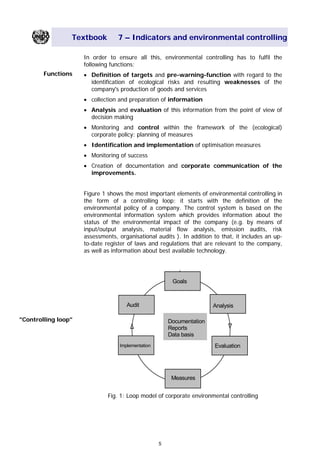
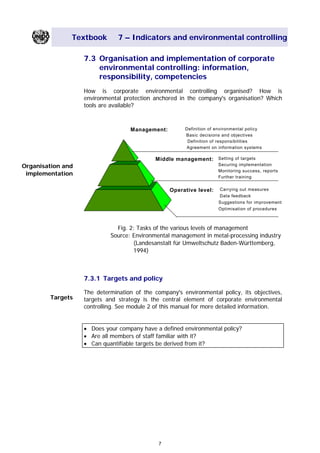
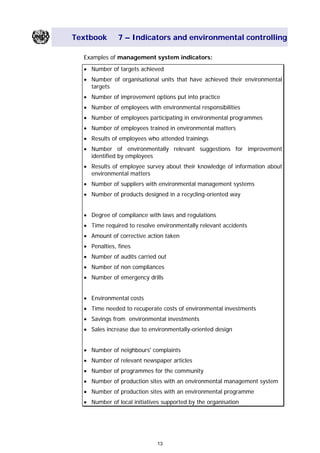
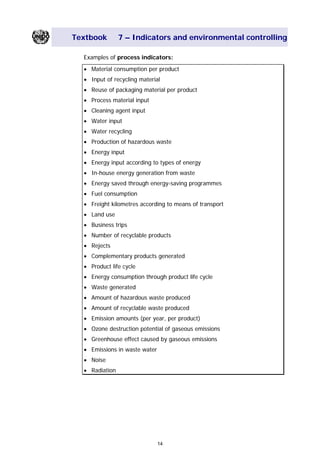
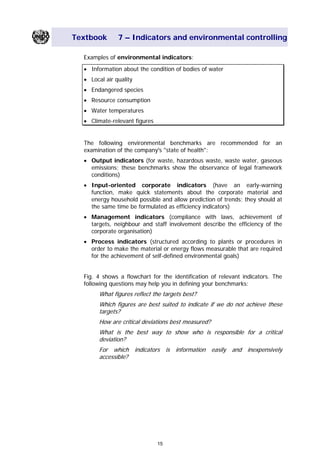
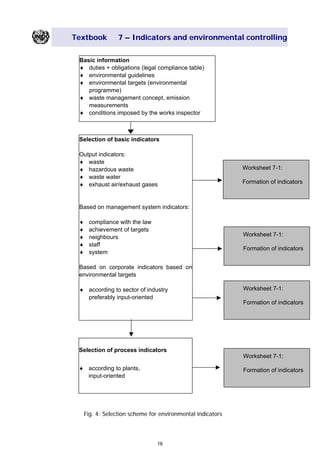
This document provides an introduction to environmental controlling and indicators. It discusses how environmental controlling can help companies achieve legal compliance, increase transparency of material and energy usage, systematically analyze optimization potentials, and continuously improve environmental impacts. Environmental controlling involves defining targets, collecting and analyzing information, planning and implementing measures, and monitoring success. Key aspects include establishing an environmental policy, clearly defining roles and responsibilities, designating an environmental representative, forming an environmental team, and developing an environmental information system using indicators to track and benchmark performance. Ratios, proportional values, and index figures are introduced as common types of indicators.