Universidad Autónoma de Nuevo LeónPreparatoria Núm. 13Students: Emmanuel Cavazos                 Alexis Campos                 Elmer Hinojosa                 Oscar Tamez                 Alexis SilviaLic. Víctor Hugo Almaguer Beltrán EnglishDate: 3 of April 2011Allende NL. 24/marzo/2011
Likes/dislikes + ing forms
Use the verb "to like", when you talk about things that you enjoy doing:Structure: subject pronoun + like + verb (-ing) + complementFor example: I like playing tennis.You like going out to clubs.He likes riding his bike.We like going to the cinema.They like watching TV.
Instead of the verb like, you can also use the following verbs: to enjoyto loveto preferNote: They all require the ing-form:He likes running.He enjoys running.He loves running.He prefers running.
The opposite of "to like" is "to dislike". It also requires the -ing form of the following verb:He likes running but he dislikes swimming.
Of course, you can also negate the verb to like instead of using a different verbThey don't like playing boardgames.She doesn't like listening to country music.He doesn't like being alone.
Questions    When you pose a question with the verbs to like, to enjoy, to love, to hate, etc. they also require the -ing form of the following verb
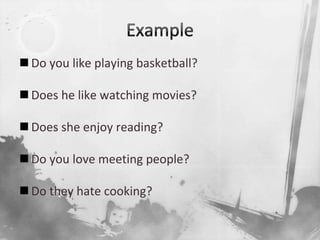
ExampleDo you like playing basketball?Does he like watching movies?Does she enjoy reading?Do you love meeting people?Do they hate cooking?
Likes vs. would like
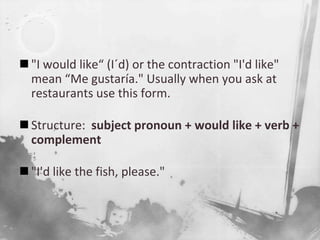
"I would like“ (I´d) or the contraction "I'd like" mean “Me gustaría." Usually when you ask at restaurants use this form.Structure:  subject pronoun + would like + verb + complement"I'd like the fish, please."
Used the same way with other subjects.Would I like - I'd likeWould you like - You'd likeWould I like - He'd likeWould she like - She'd likeetc.
To form a question just change the order.   Structure: Would / ‘d + subject pronouns + verb      + complement Would do you like play soccer?Yes, I would like .No, I Would not like.
Structurehttp://www.youtube.com/watch?v=LcBI7O-y6kI

unidad 12

  • 1.
    Universidad Autónoma deNuevo LeónPreparatoria Núm. 13Students: Emmanuel Cavazos Alexis Campos Elmer Hinojosa Oscar Tamez Alexis SilviaLic. Víctor Hugo Almaguer Beltrán EnglishDate: 3 of April 2011Allende NL. 24/marzo/2011
  • 2.
  • 3.
    Use the verb"to like", when you talk about things that you enjoy doing:Structure: subject pronoun + like + verb (-ing) + complementFor example: I like playing tennis.You like going out to clubs.He likes riding his bike.We like going to the cinema.They like watching TV.
  • 4.
    Instead of theverb like, you can also use the following verbs: to enjoyto loveto preferNote: They all require the ing-form:He likes running.He enjoys running.He loves running.He prefers running.
  • 5.
    The opposite of"to like" is "to dislike". It also requires the -ing form of the following verb:He likes running but he dislikes swimming.
  • 6.
    Of course, youcan also negate the verb to like instead of using a different verbThey don't like playing boardgames.She doesn't like listening to country music.He doesn't like being alone.
  • 7.
    Questions When you pose a question with the verbs to like, to enjoy, to love, to hate, etc. they also require the -ing form of the following verb
  • 8.
    ExampleDo you likeplaying basketball?Does he like watching movies?Does she enjoy reading?Do you love meeting people?Do they hate cooking?
  • 9.
  • 10.
    "I would like“(I´d) or the contraction "I'd like" mean “Me gustaría." Usually when you ask at restaurants use this form.Structure: subject pronoun + would like + verb + complement"I'd like the fish, please."
  • 11.
    Used the sameway with other subjects.Would I like - I'd likeWould you like - You'd likeWould I like - He'd likeWould she like - She'd likeetc.
  • 12.
    To form aquestion just change the order. Structure: Would / ‘d + subject pronouns + verb + complement Would do you like play soccer?Yes, I would like .No, I Would not like.
  • 13.