
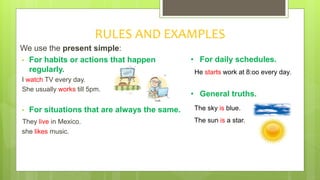
RULES AND EXAMPLES
We use the present simple:
• For habits or actions that happen
regularly.
I watch TV every day.
She usually works till 5pm.
• For situations that are always the same.
They live in Mexico.
she likes music.
• For daily schedules.
He starts work at 8:oo every day.
• General truths.
The sky is blue.
The sun is a star.
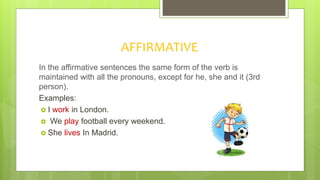
AFFIRMATIVE
In the affirmative sentences the same form of the verb is
maintained with all the pronouns, except for he, she and it (3rd
person).
Examples:
 I work in London.
 We play football every weekend.
 She lives In Madrid.
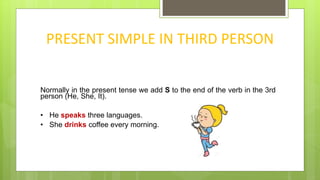
PRESENT SIMPLE IN THIRD PERSON
Normally in the present tense we add S to the end of the verb in the 3rd
person (He, She, It).
• He speaks three languages.
• She drinks coffee every morning.
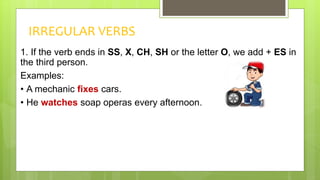
IRREGULAR VERBS
1. If the verb ends in SS, X, CH, SH or the letter O, we add + ES in
the third person.
Examples:
• A mechanic fixes cars.
• He watches soap operas every afternoon.
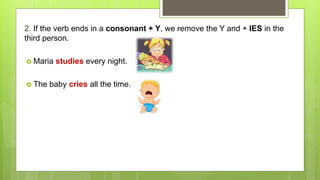
2. If the verb ends in a consonant + Y, we remove the Y and + IES in the
third person.
 Maria studies every night.
 The baby cries all the time.
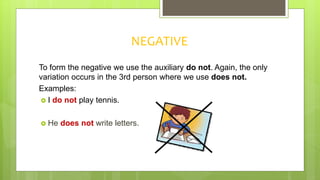
NEGATIVE
To form the negative we use the auxiliary do not. Again, the only
variation occurs in the 3rd person where we use does not.
Examples:
 I do not play tennis.
 He does not write letters.
Remember: Do not can be abbreviated to Don't and Does not can be
abbreviated to Doesn’t.
Examples:
 I don‘t have any pets.
 She doesn’t study for the exam.
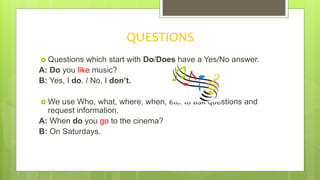
QUESTIONS
 Questions which start with Do/Does have a Yes/No answer.
A: Do you like music?
B: Yes, I do. / No, I don’t.
 We use Who, what, where, when, etc. to ask questions and
request information.
A: When do you go to the cinema?
B: On Saturdays.
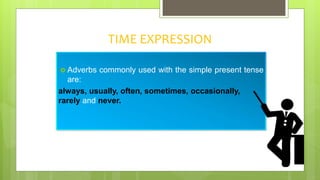
TIME EXPRESSION
 Adverbs commonly used with the simple present tense
are:
always, usually, often, sometimes, occasionally,
rarely and never.
REFERENCES
 British council (2018). present simple (basic) Retrieved from
https://learnenglish.britishcouncil.org/en/english-grammar/present-simple-
basic
 Woodward English (2018). Present tense-third person Retrieved from
http://www.grammar.cl/Present/Verbs_Third_Person.htm
Present simple

Present simple

  • 1.
  • 2.
    RULES AND EXAMPLES Weuse the present simple: • For habits or actions that happen regularly. I watch TV every day. She usually works till 5pm. • For situations that are always the same. They live in Mexico. she likes music. • For daily schedules. He starts work at 8:oo every day. • General truths. The sky is blue. The sun is a star.
  • 3.
    AFFIRMATIVE In the affirmativesentences the same form of the verb is maintained with all the pronouns, except for he, she and it (3rd person). Examples:  I work in London.  We play football every weekend.  She lives In Madrid.
  • 4.
    PRESENT SIMPLE INTHIRD PERSON Normally in the present tense we add S to the end of the verb in the 3rd person (He, She, It). • He speaks three languages. • She drinks coffee every morning.
  • 5.
    IRREGULAR VERBS 1. Ifthe verb ends in SS, X, CH, SH or the letter O, we add + ES in the third person. Examples: • A mechanic fixes cars. • He watches soap operas every afternoon.
  • 6.
    2. If theverb ends in a consonant + Y, we remove the Y and + IES in the third person.  Maria studies every night.  The baby cries all the time.
  • 7.
    NEGATIVE To form thenegative we use the auxiliary do not. Again, the only variation occurs in the 3rd person where we use does not. Examples:  I do not play tennis.  He does not write letters.
  • 8.
    Remember: Do notcan be abbreviated to Don't and Does not can be abbreviated to Doesn’t. Examples:  I don‘t have any pets.  She doesn’t study for the exam.
  • 9.
    QUESTIONS  Questions whichstart with Do/Does have a Yes/No answer. A: Do you like music? B: Yes, I do. / No, I don’t.  We use Who, what, where, when, etc. to ask questions and request information. A: When do you go to the cinema? B: On Saturdays.
  • 10.
    TIME EXPRESSION  Adverbscommonly used with the simple present tense are: always, usually, often, sometimes, occasionally, rarely and never.
  • 11.
    REFERENCES  British council(2018). present simple (basic) Retrieved from https://learnenglish.britishcouncil.org/en/english-grammar/present-simple- basic  Woodward English (2018). Present tense-third person Retrieved from http://www.grammar.cl/Present/Verbs_Third_Person.htm