I love living
here!
LEVEL NUMBER
GRAMMAR
LANGUAGE
Beginner A2_1037G_EN English
2
www.lingoda.com
■ Learn about words that are
followed by verb + ing
■ Learn about words that are
followed by to + verb
Goals
3
www.lingoda.com
I hate searching for new apartments,
but I love to move into a new place!
4
www.lingoda.com 4
Some verbs are often followed by the to + verb form of another verb. Verbs like
need, try, start are all often followed by to + verb.
Verbs followed by an infinitive
helping verb to + infinitive
I need… to study.
I try… to stay healthy.
5
www.lingoda.com 5
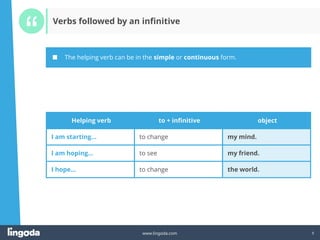
■ The helping verb can be in the simple or continuous form.
Verbs followed by an infinitive
Helping verb to + infinitive object
I am starting… to change my mind.
I am hoping… to see my friend.
I hope… to change the world.
6
www.lingoda.com
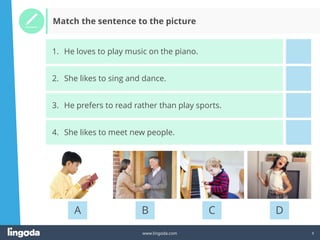
A B C D
1. He loves to play music on the piano.
2. She likes to sing and dance.
3. He prefers to read rather than play sports.
4. She likes to meet new people.
Match the sentence to the picture
7
www.lingoda.com
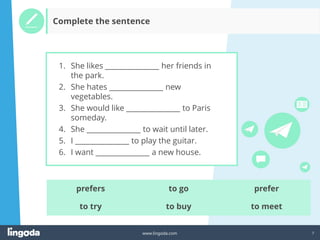
Complete the sentence
1. She likes _______________ her friends in
the park.
2. She hates _______________ new
vegetables.
3. She would like _______________ to Paris
someday.
4. She _______________ to wait until later.
5. I _______________ to play the guitar.
6. I want _______________ a new house.
prefers
to try
to go
to buy
prefer
to meet
8
www.lingoda.com
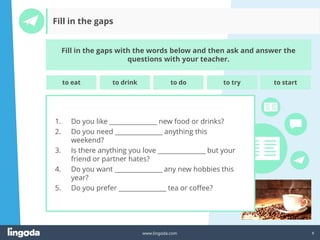
Fill in the gaps
Fill in the gaps with the words below and then ask and answer the
questions with your teacher.
1. Do you like _______________ new food or drinks?
2. Do you need _______________ anything this
weekend?
3. Is there anything you love _______________ but your
friend or partner hates?
4. Do you want _______________ any new hobbies this
year?
5. Do you prefer _______________ tea or coffee?
to eat to drink to do to try to start
9
www.lingoda.com
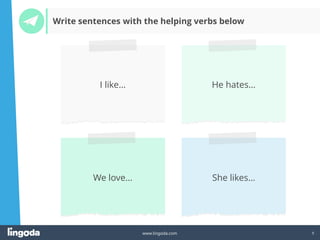
I like… He hates…
We love… She likes…
Write sentences with the helping verbs below
10
www.lingoda.com 10
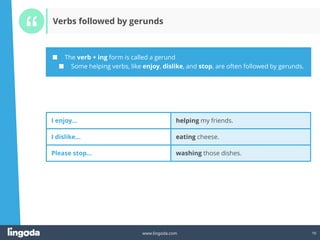
I enjoy… helping my friends.
I dislike… eating cheese.
Please stop… washing those dishes.
■ The verb + ing form is called a gerund
■ Some helping verbs, like enjoy, dislike, and stop, are often followed by gerunds.
Verbs followed by gerunds
11
www.lingoda.com 11
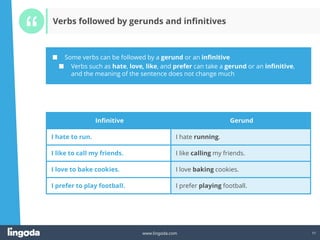
Infinitive Gerund
I hate to run. I hate running.
I like to call my friends. I like calling my friends.
I love to bake cookies. I love baking cookies.
I prefer to play football. I prefer playing football.
■ Some verbs can be followed by a gerund or an infinitive
■ Verbs such as hate, love, like, and prefer can take a gerund or an infinitive,
and the meaning of the sentence does not change much
Verbs followed by gerunds and infinitives
12
www.lingoda.com
eating
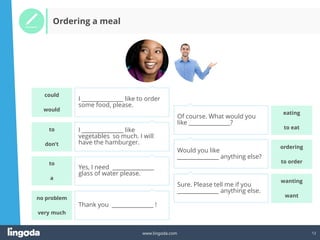
Ordering a meal
I _______________ like to order
some food, please.
I _______________ like
vegetables so much. I will
have the hamburger.
Yes, I need _______________
glass of water please.
Thank you _______________ !
Of course. What would you
like _______________?
Would you like
_______________ anything else?
Sure. Please tell me if you
_______________ anything else.
to eat
could
would
to
don’t
no problem
very much
wanting
want
to
a
ordering
to order
13
www.lingoda.com
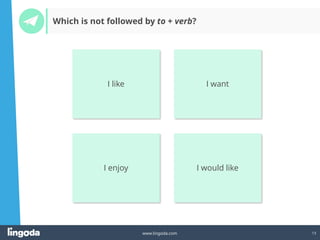
Which is not followed by to + verb?
I like I want
I enjoy I would like
14
www.lingoda.com
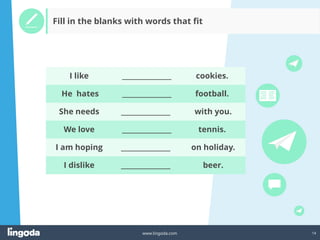
Fill in the blanks with words that fit
He hates
She needs
We love
I am hoping
I dislike
I like
_______________
_______________
_______________
_______________
_______________
_______________
football.
with you.
tennis.
on holiday.
beer.
cookies.
15
www.lingoda.com
__________________________________
__________________________________
__________________________________
__________________________________
__________________________________
__________________________________
__________________________________
__________________________________
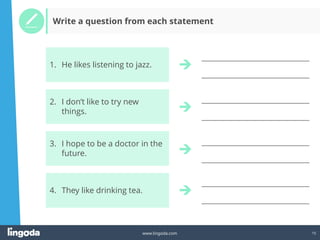
Write a question from each statement
3. I hope to be a doctor in the
future.
4. They like drinking tea.
2. I don’t like to try new
things.
1. He likes listening to jazz.
16
www.lingoda.com
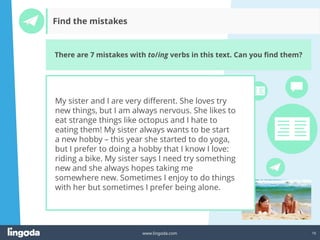
Find the mistakes
There are 7 mistakes with to/ing verbs in this text. Can you find them?
My sister and I are very different. She loves try
new things, but I am always nervous. She likes to
eat strange things like octopus and I hate to
eating them! My sister always wants to be start
a new hobby – this year she started to do yoga,
but I prefer to doing a hobby that I know I love:
riding a bike. My sister says I need try something
new and she always hopes taking me
somewhere new. Sometimes I enjoy to do things
with her but sometimes I prefer being alone.
17
www.lingoda.com
?
?
?
?
?
?
?
?
?
?
?
?
? ?
?
?
?
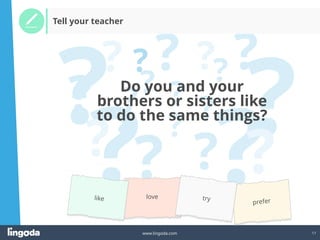
Tell your teacher
Do you and your
brothers or sisters like
to do the same things?
love
18
www.lingoda.com
Game
Then share their answers with the class!
■ Think of three questions for your classmate using hate, would
like, and want.
19
www.lingoda.com
Go back to the second slide of the lesson and check
if you have achieved all the goals of the lesson.
yes no
_______________________________
_______________________________
_______________________________
_______________________________
Reflect on the goals
20
www.lingoda.com
Think about everything you have seen in this lesson.
What were the most difficult activities or words? The easiest?
+
+
–
– If you have time, go over
the most difficult slides again
_______________________________
_______________________________
_______________________________
_______________________________
_______________________________
_______________________________
_______________________________
_______________________________
Reflect on this lesson
21
www.lingoda.com
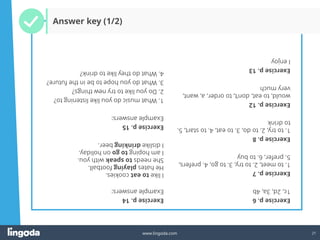
Exercise
p.
6
1c,
2d,
3a,
4b
Exercise
p.
7
1.
to
meet,
2.
to
try,
3.
to
go,
4.
prefers,
5.
prefer,
6.
to
buy
Exercise
p.
8
1.
to
try,
2.
to
do,
3.
to
eat,
4.
to
start,
5.
to
drink
Exercise
p.
12
would,
to
eat,
don’t,
to
order,
a,
want,
very
much
Exercise
p.
13
I
enjoy
Exercise
p.
14
Example
answers:
I
like
to
eat
cookies.
He
hates
playing
football.
She
needs
to
speak
with
you.
I
am
hoping
to
go
on
holiday.
I
dislike
drinking
beer.
Exercise
p.
15
Example
answers:
1.
What
music
do
you
like
listening
to?
2.
Do
you
like
to
try
new
things?
3.
What
do
you
hope
to
be
in
the
future?
4.
What
do
they
like
to
drink?
Answer key (1/2)
22
www.lingoda.com
Exercise
p.
16
My
sister
and
I
are
very
different.
She
loves
try
[trying]
new
things,
but
I
am
always
nervous.
She
likes
to
eat
strange
things
like
octopus
and
I
hate
to
eating
[eating/to
eat]
them!
My
sister
always
wants
to
be
start
[start]
a
new
hobby
–
this
year
she
started
to
do
yoga,
but
I
prefer
to
doing
[doing/to
do]
a
hobby
that
I
know
I
love:
riding
a
bike.
My
sister
says
I
need
try
[to
try]
something
new
and
she
always
hopes
taking
[to
take]
me
somewhere
new.
Sometimes
I
enjoy
to
do
[doing]
things
with
her
but
sometimes
I
prefer
being
alone.
Answer key (2/2)
23
www.lingoda.com
Homework
24
www.lingoda.com
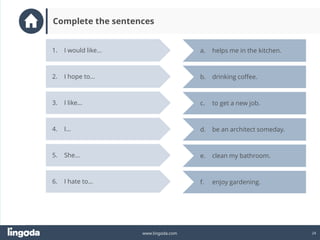
1. I would like…
2. I hope to…
3. I like…
4. I…
5. She…
a. helps me in the kitchen.
e. clean my bathroom.
d. be an architect someday.
c. to get a new job.
b. drinking coffee.
6. I hate to… f. enjoy gardening.
Complete the sentences
25
www.lingoda.com
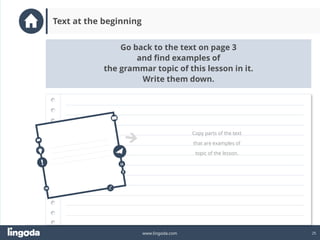
Go back to the text on page 3
and find examples of
the grammar topic of this lesson in it.
Write them down.
Text at the beginning
Copy parts of the text
that are examples of
topic of the lesson.
26
www.lingoda.com
Find the verbs
Verbs
Find the verbs in this lesson and write them down.
Which are new? Do you know all of them?
Look these words up.
27
www.lingoda.com
Choose five sentences from this lesson.
Copy them and write them about you and a friend.
Sentences in the first person plural
Examples:
I don’t understand
→ My friend Maria and I don’t understand.
He has a book
→ We have a book
…
28
www.lingoda.com
+
–
Is the grammar topic of this lesson…
easy or difficult?
Write down what is difficult for you and what is easy.
Easy or difficult?
29
www.lingoda.com
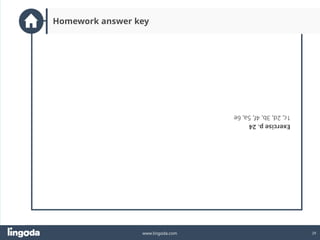
Homework answer key
Exercise
p.
24
1c,
2d,
3b,
4f,
5a,
6e
30
www.lingoda.com
Who are we?
Why learn English online?
What kinds of English classes do we offer?
Who are our English teachers?
How do our English certificates work?
We also have a language blog!
This material is proudly provided by
and can be used by anyone for free and
for any purpose.
About this material

A2_1037G_EN VERBS ING - TO.pdf