Touch and Mobile Technologies for the Classroom


           Giorgio Ungania | http://about.me/giorgioungania
M-learning Vs. E-learning


M-learning Vs. E-learning

                 M-learning

Mobile learning is the ability to obtain or provide
educational content on personal mobile devices
   such as PDAs, smartphones and tablets.
M-learning Vs. E-learning

                E-learning

 E-learning is any dissemination of educational
  knowledge over the Internet. This makes e-
learning a subset of technology-based training.
M-learning Vs. E-learning

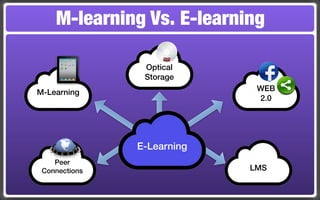
                Optical
                Storage
M-Learning                   WEB
                             2.0


               E-Learning
    Peer
 Connections                LMS
M-learning Vs. E-learning

              E-learning

E-learning can be real-time or self-paced,
     also known as “synchronous” or
         “asynchronous” learning.
M-learning Vs. E-learning

                M-learning


Mobile learning is often self-paced, un-tethered
        and informal in its presentation.
M-learning Vs. E-learning

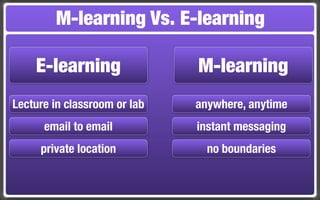
    E-learning                M-learning
Lecture in classroom or lab   anywhere, anytime
      email to email          instant messaging
     private location           no boundaries
M-learning Vs. E-learning
       E-learning Facts
M-learning Vs. E-learning
           E-learning Challenges


Digitalization of National Curriculums
M-learning Vs. E-learning
  Prof. William Rankin on M-Learning
M-learning Vs. E-learning
      Prof. William Rankin on M Learning


      Defragmentation of information

Discover new ways of seeing the full picture

    Library of information in one pocket
M-learning Vs. E-learning
                M-learning Challenges


 Unlike traditional eLearning, which relies on fairly
 common web standards to make things work , on
mobile devices there is a wide range of very different
       and distinct mobile operating systems.
M-learning Vs. E-learning
                M-learning Challenges


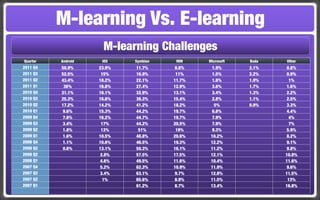
     The real challenge is that the learners are using
different smartphones with different operating systems.
M-learning Vs. E-learning
                     M-learning Challenges
Quarter   Android    iOS    Symbian    RIM    Microsoft   Bada   Other
2011 Q4   50.9%     23.9%   11.7%     8.8%     1.9%       2.1%   0.8%
2011 Q3   52.5%      15%    16.9%      11%     1.5%       2.2%   0.9%
2011 Q2   43.4%     18.2%   22.1%     11.7%    1.6%       1.9%    1%
2011 Q1    36%      16.8%   27.4%     12.9%    3.6%       1.7%   1.6%
2010 Q4   31.1%     16.1%   32.9%     13.1%    3.4%       1.3%   2.2%
2010 Q3   25.3%     16.6%   36.3%     15.4%    2.8%       1.1%   2.5%
2010 Q2   17.2%     14.2%   41.2%     18.2%     5%        0.9%   3.3%
2010 Q1   9.6%      15.3%   44.2%     19.7%    6.8%              4.4%
2009 Q4   7.6%      16.2%   44.7%     19.7%    7.9%               4%
2009 Q3   3.4%       17%    44.2%     20.5%    7.9%               7%
2009 Q2   1.8%       13%     51%       19%     9.3%              5.9%
2009 Q1   1.6%      10.5%   48.8%     20.6%    10.2%             8.2%
2008 Q4   1.1%      10.6%   46.5%     19.3%    12.2%             9.1%
2008 Q3   0.6%      13.1%   50.3%     16.1%    11.2%             9.8%
2008 Q2             2.8%    57.5%     17.5%    12.1%             10.8%
2008 Q1             4.6%    49.5%     11.6%    10.4%             11.6%
2007 Q4             5.2%    62.3%     10.9%    11.9%             9.6%
2007 Q3             3.4%    63.1%     9.7%     12.8%             11.5%
2007 Q2              1%     65.6%     8.9%     11.5%              13%
2007 Q1                     61.2%     8.7%     13.4%             16.8%
M-learning Vs. E-learning
                M-learning Challenges


Mobile content must be developed in different ways to
  work on all of these competing mobile platforms.

This can add greatly to the complexity and expense of
        developing and delivering M-Learning
M-learning Vs. E-learning
     M-learning Challenges

            Size
M-learning Vs. E-learning
     M-learning Challenges


  Digital Divide
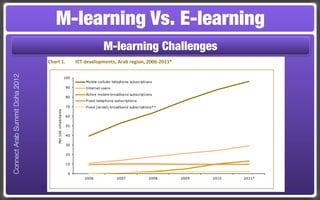
countries of the region has driven the number of active mobile-broadband subscriptions and helped


                                    M-learning Vs. E-learning
                                bring more people online. ITU estimates that by the end of 2011, around 30 per cent of the population in
                                the Arab States were using the Internet. Compared to mobile-cellular services (and in comparison to
                                other regions) both fixed-telephone and fixed (wired)-broadband penetration rates in the region remain
                                relatively low. The penetration for fixed-telephone subscriptions reached ten per cent at its highest and
                                has been declining since 2008. The number of fixed (wired)-broadband subscriptions has grown from one

                                                                               M-learning Challenges
                                million in 2006, to an estimated eight million in 2011, but penetration remains relatively low, at 2.2 per
                                cent (Chart 1).

                                Chart 1.                         ICT developments, Arab region, 2006-2011*
Connect Arab Summit Doha 2012


                                                           100
                                                                     Mobile-cellular telephone subscriptions
                                                            90       Internet users
                                                                     Active mobile-broadband subscriptions
                                                            80
                                                                     Fixed-telephone subscriptions
                                                            70       Fixed (wired)-broadband subscriptions**
                                     Per 100 inhabitants


                                                            60

                                                            50

                                                            40

                                                            30

                                                            20

                                                            10

                                                             0
                                                                     2006              2007               2008   2009    2010             2011*


                                Note: * 2011 data are ITU estimates ** Data on fixed (wired)-broadband subscriptions exclude WiMAX subscriptions
                                Source: ITU World Telecommunication/ICT Indicators database
M-learning Vs. E-learning
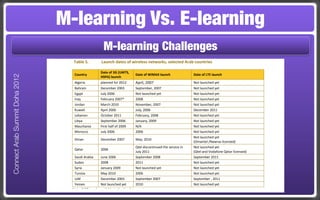
                                 In order to provide a regional outlook on NGANs and services, this section focuses on 3G, WiMAX and
                                 LTE network deployments in the region. Annex 1 of this report provides an overview of the main
                                 operators in the region, and the technologies they provide.

                                 In terms of NGANs, the GCC countries tend to be the early adopters (Table 5 presents the launch date of
                                 different 3G technologies UMTS/ HSPA, WiMAX and LTE). Bahrain and UAE launched 3G services as early


                                                     M-learning Challenges
                                 as 2003, and Kuwait, Qatar and Saudi Arabia followed in 2006. Kuwait, Saudi Arabia and UAE are
                                 currently the only countries to have launched LTE networks. The non-GCC countries that launched 3G
                                 services in 2006 are Egypt, Libya and Morocco. Morocco also launched WiMAX as early as 2006.

                                  Table 5.          Launch dates of wireless networks, selected Arab countries

                                                   Date of 3G (UMTS,
                                  Country                                  Date of WiMAX launch                 Date of LTE launch
Connect Arab Summit Doha 2012


                                                   HSPA) launch
                                  Algeria          planned for 2012        April, 2007                          Not launched yet
                                  Bahrain          December 2003           September, 2007                      Not launched yet
                                  Egypt            July 2006               Not launched yet                     Not launched yet
                                  Iraq             February 2007*          2008                                 Not launched yet
                                  Jordan           March 2010              November, 2007                       Not launched yet
                                  Kuwait           April 2006              July, 2006                           December 2011
                                  Lebanon          October 2011            February, 2008                       Not launched yet
                                  Libya            September 2006          January, 2009                        Not launched yet
                                  Mauritania       First half of 2009      N/A                                  Not launched yet
                                  Morocco          July 2006               2006                                 Not launched yet
                                                                                                                Not launched yet
                                  Oman             December 2007           May, 2010
                                                                                                                (Omantel /Nawras licensed)
                                                                             Qtel discontinued the service in   Not launched yet
                                  Qatar            2006
                                                                             July 2011                          (Qtel and Vodafone Qatar licensed)
                                  Saudi Arabia       June 2006               September 2008                     September 2011
                                  Sudan              2008                    2011                               Not launched yet
                                  Syria              January 2009            Not launched yet                   Not launched yet
                                  Tunisia            May 2010                2006                               Not launched yet
                                  UAE                December 2003           September 2007                     September , 2011
                                  Yemen              Not launched yet        2010                               Not launched yet
                                 Note: * 3G is only available in the Kurdistan region
                                 Source: ITU, national regulatory authorities, operators, Arab Advisors Group
M-learning Vs. E-learning
                                                        M-learning Challenges
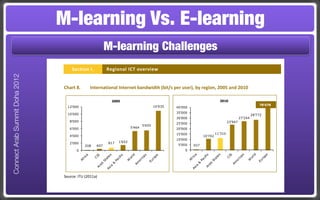
                                    Section I.          Regional ICT overview
Connect Arab Summit Doha 2012


                                Chart 8.      International Internet bandwidth (bit/s per user), by region, 2005 and 2010

                                                          2005                                                           2010
                                                                                                                                                      78'678
                                  12'000                                              10'935   40'000

                                  10'000                                                       35'000
                                                                                                                                                  28'772
                                                                                               30'000                                    27'244
                                   8'000                                                                                        23'947
                                                                                               25'000
                                                                              5'655
                                   6'000                              5'464                    20'000
                                                                                               15'000                  11'310
                                   4'000                                                                      10'742
                                                                                               10'000
                                   2'000                817   1'652
                                           208    607                                           5'000   937
                                       0                                                           0


                                Source: ITU (2011a)
M-learning Vs. E-learning
                                                 M-learning Challenges
                                       Section I.             Regional ICT overview
Connect Arab Summit Doha 2012


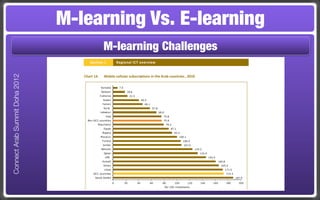
                                   Chart 14.     Mobile-cellular subscriptions in the Arab countries , 2010

                                               Somalia         7.0
                                               Djibouti               18.6
                                               Comoros                    22.5
                                                 Sudan                                40.5
                                                Yemen                                   46.1
                                                 Syria                                         57.8
                                               Lebanon                                                68.0
                                                   Iraq                                                  75.8
                                     Non GCC countries                                                   75.9
                                             Mauritania                                                       79.3
                                                 Egypt                                                           87.1
                                                Algeria                                                              92.4
                                               Morocco                                                                  100.1
                                                Tunisia                                                                     106.0
                                                Jordan                                                                      107.0
                                               Bahrain                                                                                124.2
                                                 Qatar                                                                                   132.4
                                                  UAE                                                                                            145.5
                                                Kuwait                                                                                                    160.8
                                                 Oman                                                                                                       165.5
                                                  Libya                                                                                                       171.5
                                         GCC countries                                                                                                            173.3
                                           Saudi Arabia                                                                                                                   187.9

                                                          0          20          40          60          80          100        120       140       160           180       200
                                                                                                             Per 100 inhabitants


                                   Source: ITU World Telecommunication/ICT Indicators database
M-learning Vs. E-learning
                                            M-learning Challenges
                                        Section I.              Regional ICT overview


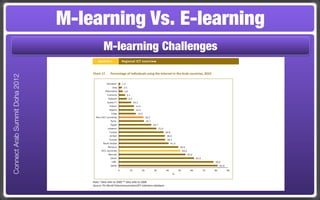
                                    Chart 17.      Percentage of individuals using the Internet in the Arab countries, 2010
Connect Arab Summit Doha 2012


                                                Somalia*        1.2
                                                    Iraq         2.5
                                              Mauritania         3.0
                                                Comoros               5.1
                                                 Djibouti              6.5
                                                Sudan**                      10.2
                                                  Yemen                        12.4
                                                  Algeria                      12.5
                                                   Libya                        14.0
                                      Non-GCC countries                                    20.2
                                                   Syria                                   20.7
                                                   Egypt                                          26.7
                                                Lebanon                                                  31.0
                                                 Tunisia                                                        36.8
                                                  Jordan                                                         38.0
                                                  Kuwait                                                         38.3
                                            Saudi Arabia                                                               41.0
                                                Morocco                                                                        49.0
                                           GCC countries                                                                           50.6
                                                 Bahrain                                                                                  55.0
                                                  Oman                                                                                           62.0
                                                    UAE                                                                                                      78.0
                                                   Qatar                                                                                                          81.6

                                                            0           10            20          30            40            50            60          70   80          90
                                                                                                                        %


                                    Note: *data refer to 2009 ** data refer to 2008
                                    Source: ITU World Telecommunication/ICT Indicators database
M-learning Vs. E-learning
                   A Personal Story
              Curriculum Obsolescence
              Underutilized technology
               LImited Wireless Access
                       Distance
                 Flipped Classroom
               Online video ( YouTube)
Free Online Solutions ( Slide Share, Facebook, Twitter )
            Online Testing (SurveyMonkey)
DISCUSSION POINTS

     Digitalization of Curriculums
                    c
Open Source vs Proprietary Solutions
            Arabic Content
Wireless Access and the Digital Divide
       Giorgio Ungania | http://about.me/giorgioungania

UNESCO | Touch and Mobile Technologies for the Classroom session 4

  • 1.
    Touch and MobileTechnologies for the Classroom Giorgio Ungania | http://about.me/giorgioungania
  • 2.
  • 3.
    M-learning Vs. E-learning M-learning Mobile learning is the ability to obtain or provide educational content on personal mobile devices such as PDAs, smartphones and tablets.
  • 4.
    M-learning Vs. E-learning E-learning E-learning is any dissemination of educational knowledge over the Internet. This makes e- learning a subset of technology-based training.
  • 5.
    M-learning Vs. E-learning Optical Storage M-Learning WEB 2.0 E-Learning Peer Connections LMS
  • 6.
    M-learning Vs. E-learning E-learning E-learning can be real-time or self-paced, also known as “synchronous” or “asynchronous” learning.
  • 7.
    M-learning Vs. E-learning M-learning Mobile learning is often self-paced, un-tethered and informal in its presentation.
  • 8.
    M-learning Vs. E-learning E-learning M-learning Lecture in classroom or lab anywhere, anytime email to email instant messaging private location no boundaries
  • 9.
  • 10.
    M-learning Vs. E-learning E-learning Challenges Digitalization of National Curriculums
  • 11.
    M-learning Vs. E-learning Prof. William Rankin on M-Learning
  • 12.
    M-learning Vs. E-learning Prof. William Rankin on M Learning Defragmentation of information Discover new ways of seeing the full picture Library of information in one pocket
  • 13.
    M-learning Vs. E-learning M-learning Challenges Unlike traditional eLearning, which relies on fairly common web standards to make things work , on mobile devices there is a wide range of very different and distinct mobile operating systems.
  • 14.
    M-learning Vs. E-learning M-learning Challenges The real challenge is that the learners are using different smartphones with different operating systems.
  • 15.
    M-learning Vs. E-learning M-learning Challenges Quarter Android iOS Symbian RIM Microsoft Bada Other 2011 Q4 50.9% 23.9% 11.7% 8.8% 1.9% 2.1% 0.8% 2011 Q3 52.5% 15% 16.9% 11% 1.5% 2.2% 0.9% 2011 Q2 43.4% 18.2% 22.1% 11.7% 1.6% 1.9% 1% 2011 Q1 36% 16.8% 27.4% 12.9% 3.6% 1.7% 1.6% 2010 Q4 31.1% 16.1% 32.9% 13.1% 3.4% 1.3% 2.2% 2010 Q3 25.3% 16.6% 36.3% 15.4% 2.8% 1.1% 2.5% 2010 Q2 17.2% 14.2% 41.2% 18.2% 5% 0.9% 3.3% 2010 Q1 9.6% 15.3% 44.2% 19.7% 6.8% 4.4% 2009 Q4 7.6% 16.2% 44.7% 19.7% 7.9% 4% 2009 Q3 3.4% 17% 44.2% 20.5% 7.9% 7% 2009 Q2 1.8% 13% 51% 19% 9.3% 5.9% 2009 Q1 1.6% 10.5% 48.8% 20.6% 10.2% 8.2% 2008 Q4 1.1% 10.6% 46.5% 19.3% 12.2% 9.1% 2008 Q3 0.6% 13.1% 50.3% 16.1% 11.2% 9.8% 2008 Q2 2.8% 57.5% 17.5% 12.1% 10.8% 2008 Q1 4.6% 49.5% 11.6% 10.4% 11.6% 2007 Q4 5.2% 62.3% 10.9% 11.9% 9.6% 2007 Q3 3.4% 63.1% 9.7% 12.8% 11.5% 2007 Q2 1% 65.6% 8.9% 11.5% 13% 2007 Q1 61.2% 8.7% 13.4% 16.8%
  • 16.
    M-learning Vs. E-learning M-learning Challenges Mobile content must be developed in different ways to work on all of these competing mobile platforms. This can add greatly to the complexity and expense of developing and delivering M-Learning
  • 17.
    M-learning Vs. E-learning M-learning Challenges Size
  • 18.
    M-learning Vs. E-learning M-learning Challenges Digital Divide
  • 19.
    countries of theregion has driven the number of active mobile-broadband subscriptions and helped M-learning Vs. E-learning bring more people online. ITU estimates that by the end of 2011, around 30 per cent of the population in the Arab States were using the Internet. Compared to mobile-cellular services (and in comparison to other regions) both fixed-telephone and fixed (wired)-broadband penetration rates in the region remain relatively low. The penetration for fixed-telephone subscriptions reached ten per cent at its highest and has been declining since 2008. The number of fixed (wired)-broadband subscriptions has grown from one M-learning Challenges million in 2006, to an estimated eight million in 2011, but penetration remains relatively low, at 2.2 per cent (Chart 1). Chart 1. ICT developments, Arab region, 2006-2011* Connect Arab Summit Doha 2012 100 Mobile-cellular telephone subscriptions 90 Internet users Active mobile-broadband subscriptions 80 Fixed-telephone subscriptions 70 Fixed (wired)-broadband subscriptions** Per 100 inhabitants 60 50 40 30 20 10 0 2006 2007 2008 2009 2010 2011* Note: * 2011 data are ITU estimates ** Data on fixed (wired)-broadband subscriptions exclude WiMAX subscriptions Source: ITU World Telecommunication/ICT Indicators database
  • 20.
    M-learning Vs. E-learning In order to provide a regional outlook on NGANs and services, this section focuses on 3G, WiMAX and LTE network deployments in the region. Annex 1 of this report provides an overview of the main operators in the region, and the technologies they provide. In terms of NGANs, the GCC countries tend to be the early adopters (Table 5 presents the launch date of different 3G technologies UMTS/ HSPA, WiMAX and LTE). Bahrain and UAE launched 3G services as early M-learning Challenges as 2003, and Kuwait, Qatar and Saudi Arabia followed in 2006. Kuwait, Saudi Arabia and UAE are currently the only countries to have launched LTE networks. The non-GCC countries that launched 3G services in 2006 are Egypt, Libya and Morocco. Morocco also launched WiMAX as early as 2006. Table 5. Launch dates of wireless networks, selected Arab countries Date of 3G (UMTS, Country Date of WiMAX launch Date of LTE launch Connect Arab Summit Doha 2012 HSPA) launch Algeria planned for 2012 April, 2007 Not launched yet Bahrain December 2003 September, 2007 Not launched yet Egypt July 2006 Not launched yet Not launched yet Iraq February 2007* 2008 Not launched yet Jordan March 2010 November, 2007 Not launched yet Kuwait April 2006 July, 2006 December 2011 Lebanon October 2011 February, 2008 Not launched yet Libya September 2006 January, 2009 Not launched yet Mauritania First half of 2009 N/A Not launched yet Morocco July 2006 2006 Not launched yet Not launched yet Oman December 2007 May, 2010 (Omantel /Nawras licensed) Qtel discontinued the service in Not launched yet Qatar 2006 July 2011 (Qtel and Vodafone Qatar licensed) Saudi Arabia June 2006 September 2008 September 2011 Sudan 2008 2011 Not launched yet Syria January 2009 Not launched yet Not launched yet Tunisia May 2010 2006 Not launched yet UAE December 2003 September 2007 September , 2011 Yemen Not launched yet 2010 Not launched yet Note: * 3G is only available in the Kurdistan region Source: ITU, national regulatory authorities, operators, Arab Advisors Group
  • 21.
    M-learning Vs. E-learning M-learning Challenges Section I. Regional ICT overview Connect Arab Summit Doha 2012 Chart 8. International Internet bandwidth (bit/s per user), by region, 2005 and 2010 2005 2010 78'678 12'000 10'935 40'000 10'000 35'000 28'772 30'000 27'244 8'000 23'947 25'000 5'655 6'000 5'464 20'000 15'000 11'310 4'000 10'742 10'000 2'000 817 1'652 208 607 5'000 937 0 0 Source: ITU (2011a)
  • 22.
    M-learning Vs. E-learning M-learning Challenges Section I. Regional ICT overview Connect Arab Summit Doha 2012 Chart 14. Mobile-cellular subscriptions in the Arab countries , 2010 Somalia 7.0 Djibouti 18.6 Comoros 22.5 Sudan 40.5 Yemen 46.1 Syria 57.8 Lebanon 68.0 Iraq 75.8 Non GCC countries 75.9 Mauritania 79.3 Egypt 87.1 Algeria 92.4 Morocco 100.1 Tunisia 106.0 Jordan 107.0 Bahrain 124.2 Qatar 132.4 UAE 145.5 Kuwait 160.8 Oman 165.5 Libya 171.5 GCC countries 173.3 Saudi Arabia 187.9 0 20 40 60 80 100 120 140 160 180 200 Per 100 inhabitants Source: ITU World Telecommunication/ICT Indicators database
  • 23.
    M-learning Vs. E-learning M-learning Challenges Section I. Regional ICT overview Chart 17. Percentage of individuals using the Internet in the Arab countries, 2010 Connect Arab Summit Doha 2012 Somalia* 1.2 Iraq 2.5 Mauritania 3.0 Comoros 5.1 Djibouti 6.5 Sudan** 10.2 Yemen 12.4 Algeria 12.5 Libya 14.0 Non-GCC countries 20.2 Syria 20.7 Egypt 26.7 Lebanon 31.0 Tunisia 36.8 Jordan 38.0 Kuwait 38.3 Saudi Arabia 41.0 Morocco 49.0 GCC countries 50.6 Bahrain 55.0 Oman 62.0 UAE 78.0 Qatar 81.6 0 10 20 30 40 50 60 70 80 90 % Note: *data refer to 2009 ** data refer to 2008 Source: ITU World Telecommunication/ICT Indicators database
  • 24.
    M-learning Vs. E-learning A Personal Story Curriculum Obsolescence Underutilized technology LImited Wireless Access Distance Flipped Classroom Online video ( YouTube) Free Online Solutions ( Slide Share, Facebook, Twitter ) Online Testing (SurveyMonkey)
  • 25.
    DISCUSSION POINTS Digitalization of Curriculums c Open Source vs Proprietary Solutions Arabic Content Wireless Access and the Digital Divide Giorgio Ungania | http://about.me/giorgioungania