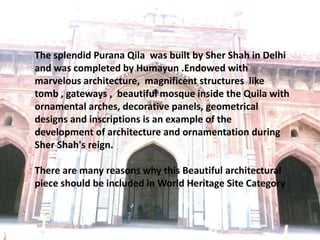
The splendid Purana Qila was built by Sher Shah in Delhi
and was completed by Humayun .Endowed with
marvelous architecture, magnificent structures like
tomb , gateways , beautiful mosque inside the Quila with
ornamental arches, decorative panels, geometrical
designs and inscriptions is an example of the
development of architecture and ornamentation during
Sher Shah's reign.
There are many reasons why this Beautiful architectural
piece should be included in World Heritage Site Category
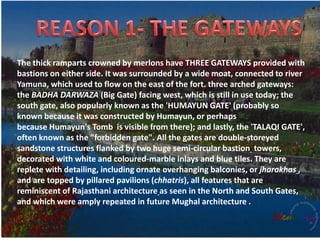
The thick ramparts crowned by merlons have THREE GATEWAYS provided with
bastions on either side. It was surrounded by a wide moat, connected to river
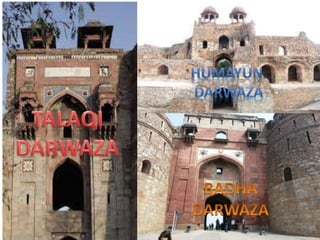
Yamuna, which used to flow on the east of the fort. three arched gateways:
the BADHA DARWAZA (Big Gate) facing west, which is still in use today; the
south gate, also popularly known as the 'HUMAYUN GATE' (probably so
known because it was constructed by Humayun, or perhaps
because Humayun's Tomb is visible from there); and lastly, the 'TALAQI GATE',
often known as the "forbidden gate". All the gates are double-storeyed
sandstone structures flanked by two huge semi-circular bastion towers,
decorated with white and coloured-marble inlays and blue tiles. They are
replete with detailing, including ornate overhanging balconies, or jharokhas ,
and are topped by pillared pavilions (chhatris), all features that are
reminiscent of Rajasthani architecture as seen in the North and South Gates,
and which were amply repeated in future Mughal architecture .
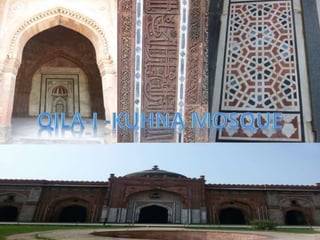
The single-domed Qila-i-Kuna Mosque, built by Sher Shah in 1541 is an
excellent example of a pre-Mughal design, and an early example of the
extensive use of the pointed arch in the region as seen in its five doorways with
the 'true' horseshoe-shaped arches. It was designed as a Jami Mosque, or
Friday mosque for the Sultan and his courtiers. The prayer hall inside, the
single-aisled mosque, measures 51.20m by 14.90m and has five elegant arched
prayer niches or mihrabs set in its western wall. Marble in shades of red, white
and slate is used for the calligraphic inscriptions on the central iwan , marks a
transition from Lodhi to Mughal architecture . At one time, the courtyard had a
shallow tank, with a fountain.
A second storey, accessed through staircases from the prayer hall, with a
narrow passage running along the rectangular hall, provided space for female
courtiers to pray, while the arched doorway on the left wall, framed by
ornate jharokas , was reserved for members of the royal family. On a marble
slab within the mosque an inscription reads: "As long as there are people on
the earth, may this edifice be frequented and people be happy and cheerful in
it". Today it is the best preserved building in Purana Qila.
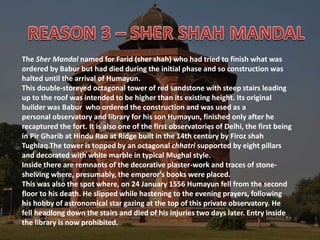
The Sher Mandal named for Farid (sher shah) who had tried to finish what was
ordered by Babur but had died during the initial phase and so construction was
halted until the arrival of Humayun.
This double-storeyed octagonal tower of red sandstone with steep stairs leading
up to the roof was intended to be higher than its existing height. Its original
builder was Babur who ordered the construction and was used as a
personal observatory and library for his son Humayun, finished only after he
recaptured the fort. It is also one of the first observatories of Delhi, the first being
in Pir Gharib at Hindu Rao at Ridge built in the 14th century by Firoz shah
Tughlaq.The tower is topped by an octagonal chhatri supported by eight pillars
and decorated with white marble in typical Mughal style.
Inside there are remnants of the decorative plaster-work and traces of stone-
shelving where, presumably, the emperor's books were placed.
This was also the spot where, on 24 January 1556 Humayun fell from the second
floor to his death. He slipped while hastening to the evening prayers, following
his hobby of astronomical star gazing at the top of this private observatory. He
fell headlong down the stairs and died of his injuries two days later. Entry inside
the library is now prohibited.
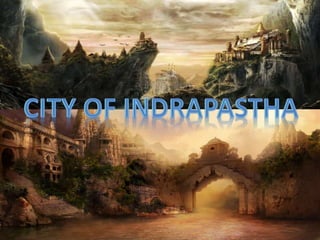
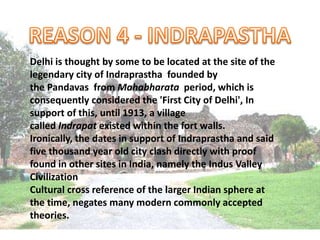
Delhi is thought by some to be located at the site of the
legendary city of Indraprastha founded by
the Pandavas from Mahabharata period, which is
consequently considered the 'First City of Delhi', In
support of this, until 1913, a village
called Indrapat existed within the fort walls.
Ironically, the dates in support of Indraprastha and said
five thousand year old city clash directly with proof
found in other sites in India, namely the Indus Valley
Civilization
Cultural cross reference of the larger Indian sphere at
the time, negates many modern commonly accepted
theories.
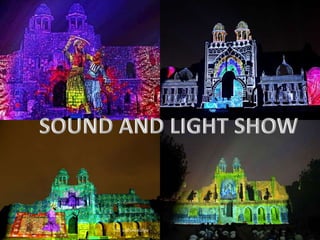
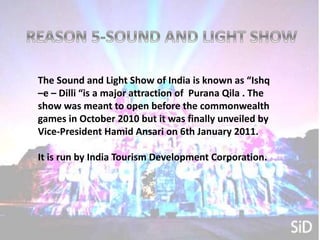
The Sound and Light show named as
The Sound and Light Show of India is known as “Ishq
–e – Dilli “is a major attraction of Purana Qila . The
show was meant to open before the commonwealth
games in October 2010 but it was finally unveiled by
Vice-President Hamid Ansari on 6th January 2011.
It is run by India Tourism Development Corporation.
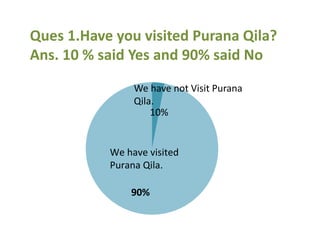
Ques 1.Have you visited Purana Qila?
Ans. 10 % said Yes and 90% said No
90%
10%
We have visited
Purana Qila.
We have not Visit Purana
Qila.
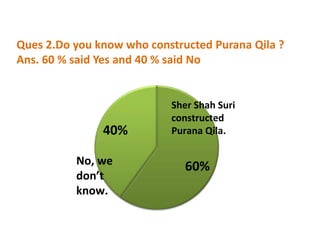
Ques 2.Do you know who constructed Purana Qila ?
Ans. 60 % said Yes and 40 % said No
60%
40%
Sher Shah Suri
constructed
Purana Qila.
No, we
don’t
know.
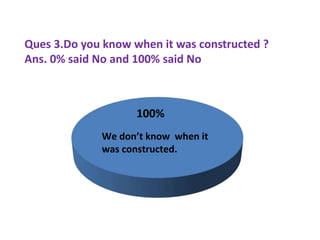
Ques 3.Do you know when it was constructed ?
Ans. 0% said No and 100% said No
We don’t know when it
was constructed.
100%
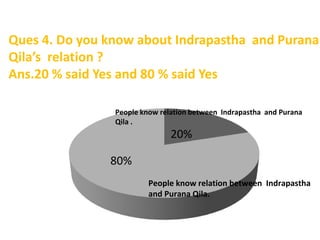
Ques 4. Do you know about Indrapastha and Purana
Qila’s relation ?
Ans.20 % said Yes and 80 % said Yes
20%
80%
People know relation between Indrapastha
and Purana Qila.
People know relation between Indrapastha and Purana
Qila .
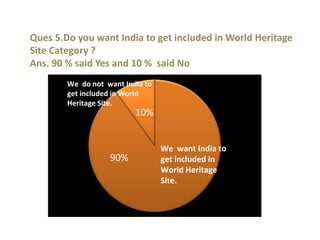
Ques 5.Do you want India to get included in World Heritage
Site Category ?
Ans. 90 % said Yes and 10 % said No
We want India to
get included in
World Heritage
Site.
90%
We do not want India to
get included in World
Heritage Site.
10%
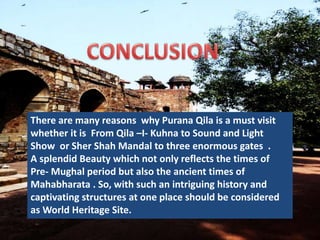
CONCLUSIONThere are many reasons why Purana Qila is a must visit
whether it is From Qila –I- Kuhna to Sound and Light
Show or Sher Shah Mandal to three enormous gates .
A splendid Beauty which not only reflects the times of
Pre- Mughal period but also the ancient times of
Mahabharata . So, with such an intriguing history and
captivating structures at one place should be considered
as World Heritage Site.

old fort

  • 2.
    The splendid PuranaQila was built by Sher Shah in Delhi and was completed by Humayun .Endowed with marvelous architecture, magnificent structures like tomb , gateways , beautiful mosque inside the Quila with ornamental arches, decorative panels, geometrical designs and inscriptions is an example of the development of architecture and ornamentation during Sher Shah's reign. There are many reasons why this Beautiful architectural piece should be included in World Heritage Site Category
  • 3.
    The thick rampartscrowned by merlons have THREE GATEWAYS provided with bastions on either side. It was surrounded by a wide moat, connected to river Yamuna, which used to flow on the east of the fort. three arched gateways: the BADHA DARWAZA (Big Gate) facing west, which is still in use today; the south gate, also popularly known as the 'HUMAYUN GATE' (probably so known because it was constructed by Humayun, or perhaps because Humayun's Tomb is visible from there); and lastly, the 'TALAQI GATE', often known as the "forbidden gate". All the gates are double-storeyed sandstone structures flanked by two huge semi-circular bastion towers, decorated with white and coloured-marble inlays and blue tiles. They are replete with detailing, including ornate overhanging balconies, or jharokhas , and are topped by pillared pavilions (chhatris), all features that are reminiscent of Rajasthani architecture as seen in the North and South Gates, and which were amply repeated in future Mughal architecture .
  • 5.
    The single-domed Qila-i-KunaMosque, built by Sher Shah in 1541 is an excellent example of a pre-Mughal design, and an early example of the extensive use of the pointed arch in the region as seen in its five doorways with the 'true' horseshoe-shaped arches. It was designed as a Jami Mosque, or Friday mosque for the Sultan and his courtiers. The prayer hall inside, the single-aisled mosque, measures 51.20m by 14.90m and has five elegant arched prayer niches or mihrabs set in its western wall. Marble in shades of red, white and slate is used for the calligraphic inscriptions on the central iwan , marks a transition from Lodhi to Mughal architecture . At one time, the courtyard had a shallow tank, with a fountain. A second storey, accessed through staircases from the prayer hall, with a narrow passage running along the rectangular hall, provided space for female courtiers to pray, while the arched doorway on the left wall, framed by ornate jharokas , was reserved for members of the royal family. On a marble slab within the mosque an inscription reads: "As long as there are people on the earth, may this edifice be frequented and people be happy and cheerful in it". Today it is the best preserved building in Purana Qila.
  • 7.
    The Sher Mandalnamed for Farid (sher shah) who had tried to finish what was ordered by Babur but had died during the initial phase and so construction was halted until the arrival of Humayun. This double-storeyed octagonal tower of red sandstone with steep stairs leading up to the roof was intended to be higher than its existing height. Its original builder was Babur who ordered the construction and was used as a personal observatory and library for his son Humayun, finished only after he recaptured the fort. It is also one of the first observatories of Delhi, the first being in Pir Gharib at Hindu Rao at Ridge built in the 14th century by Firoz shah Tughlaq.The tower is topped by an octagonal chhatri supported by eight pillars and decorated with white marble in typical Mughal style. Inside there are remnants of the decorative plaster-work and traces of stone- shelving where, presumably, the emperor's books were placed. This was also the spot where, on 24 January 1556 Humayun fell from the second floor to his death. He slipped while hastening to the evening prayers, following his hobby of astronomical star gazing at the top of this private observatory. He fell headlong down the stairs and died of his injuries two days later. Entry inside the library is now prohibited.
  • 9.
    Delhi is thoughtby some to be located at the site of the legendary city of Indraprastha founded by the Pandavas from Mahabharata period, which is consequently considered the 'First City of Delhi', In support of this, until 1913, a village called Indrapat existed within the fort walls. Ironically, the dates in support of Indraprastha and said five thousand year old city clash directly with proof found in other sites in India, namely the Indus Valley Civilization Cultural cross reference of the larger Indian sphere at the time, negates many modern commonly accepted theories.
  • 11.
    The Sound andLight show named as The Sound and Light Show of India is known as “Ishq –e – Dilli “is a major attraction of Purana Qila . The show was meant to open before the commonwealth games in October 2010 but it was finally unveiled by Vice-President Hamid Ansari on 6th January 2011. It is run by India Tourism Development Corporation.
  • 13.
    Ques 1.Have youvisited Purana Qila? Ans. 10 % said Yes and 90% said No 90% 10% We have visited Purana Qila. We have not Visit Purana Qila.
  • 14.
    Ques 2.Do youknow who constructed Purana Qila ? Ans. 60 % said Yes and 40 % said No 60% 40% Sher Shah Suri constructed Purana Qila. No, we don’t know.
  • 15.
    Ques 3.Do youknow when it was constructed ? Ans. 0% said No and 100% said No We don’t know when it was constructed. 100%
  • 16.
    Ques 4. Doyou know about Indrapastha and Purana Qila’s relation ? Ans.20 % said Yes and 80 % said Yes 20% 80% People know relation between Indrapastha and Purana Qila. People know relation between Indrapastha and Purana Qila .
  • 17.
    Ques 5.Do youwant India to get included in World Heritage Site Category ? Ans. 90 % said Yes and 10 % said No We want India to get included in World Heritage Site. 90% We do not want India to get included in World Heritage Site. 10%
  • 18.
    CONCLUSIONThere are manyreasons why Purana Qila is a must visit whether it is From Qila –I- Kuhna to Sound and Light Show or Sher Shah Mandal to three enormous gates . A splendid Beauty which not only reflects the times of Pre- Mughal period but also the ancient times of Mahabharata . So, with such an intriguing history and captivating structures at one place should be considered as World Heritage Site.