Understing the work team
and work group
By: Imtiaz Hussain Rajar
1
Team
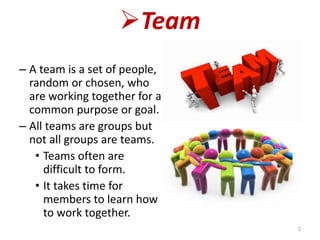
– A team is a set of people,
random or chosen, who
are working together for a
common purpose or goal.
– All teams are groups but
not all groups are teams.
• Teams often are
difficult to form.
• It takes time for
members to learn how
to work together.
2
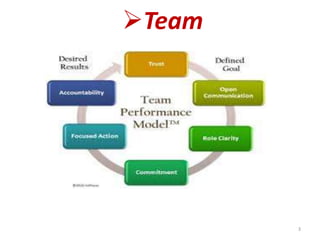
Team
3
Group
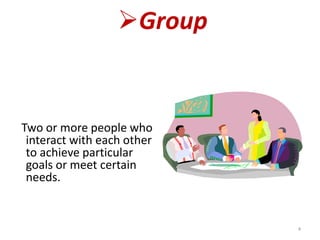
Two or more people who
interact with each other
to achieve particular
goals or meet certain
needs.
4
Types of teams
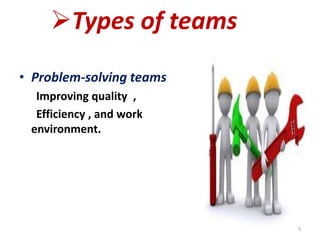
• Problem-solving teams
Improving quality ,
Efficiency , and work
environment.
5
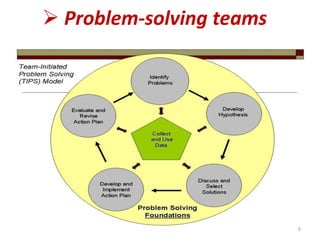
 Problem-solving teams
6
Types of teams cont’
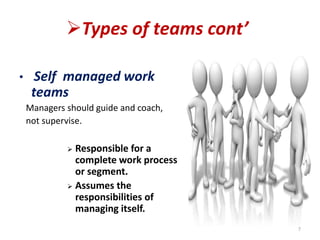
• Self managed work
teams
Managers should guide and coach,
not supervise.
 Responsible for a
complete work process
or segment.
 Assumes the
responsibilities of
managing itself.
7
Types of teams cont’
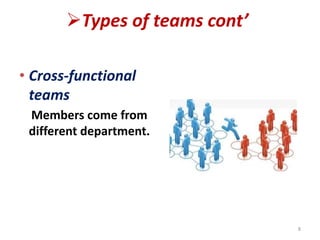
• Cross-functional
teams
Members come from
different department.
8
Types of teams cont’
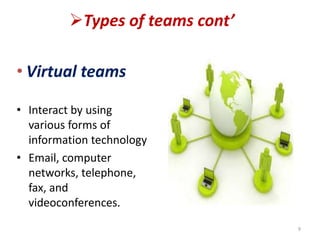
• Virtual teams
• Interact by using
various forms of
information technology
• Email, computer
networks, telephone,
fax, and
videoconferences.
9
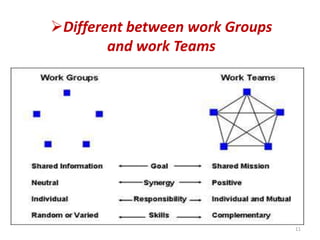
Different between Groups and Teams
Groups
A work group is a group that interacts primarily to
share information and to make decisions to help
each member perform within his or her area of
responsibility.
Teams
A work team generates positive synergy through
coordinated effort. The individual efforts result in
a level of performance that is greater than the
sum of those individual inputs.
10
Different between work Groups
and work Teams
11
12

understanding the work groups and work teams

  • 1.
    Understing the workteam and work group By: Imtiaz Hussain Rajar 1
  • 2.
    Team – A teamis a set of people, random or chosen, who are working together for a common purpose or goal. – All teams are groups but not all groups are teams. • Teams often are difficult to form. • It takes time for members to learn how to work together. 2
  • 3.
  • 4.
    Group Two or morepeople who interact with each other to achieve particular goals or meet certain needs. 4
  • 5.
    Types of teams •Problem-solving teams Improving quality , Efficiency , and work environment. 5
  • 6.
  • 7.
    Types of teamscont’ • Self managed work teams Managers should guide and coach, not supervise.  Responsible for a complete work process or segment.  Assumes the responsibilities of managing itself. 7
  • 8.
    Types of teamscont’ • Cross-functional teams Members come from different department. 8
  • 9.
    Types of teamscont’ • Virtual teams • Interact by using various forms of information technology • Email, computer networks, telephone, fax, and videoconferences. 9
  • 10.
    Different between Groupsand Teams Groups A work group is a group that interacts primarily to share information and to make decisions to help each member perform within his or her area of responsibility. Teams A work team generates positive synergy through coordinated effort. The individual efforts result in a level of performance that is greater than the sum of those individual inputs. 10
  • 11.
    Different between workGroups and work Teams 11
  • 12.