Challenges, Highlights, and Pivotal Moments:
Understanding the Graduate
Student Experience
October 25, 2018
AzLA Annual Conference
Rebecca Blakiston & Gardie Lueders
University of Arizona Libraries
I am Rebecca
Blakiston
User Experience Strategist at UA Libraries
You can find me at @blakistonr
Hello!
2
I am Gardie Lueders
Research Program Coordinator at UA Libraries,
Research & Learning Department
You can find me at gklueders@email.arizona.edu
Hello!
3
A brief introduction
User Experience
“
User experience (UX) focuses
on having a deep
understanding of users, what
they need, what they value,
their abilities, and also their
limitations.
- usability.gov
The graduate student
audience
◉ Students
◉ Instructors
◉ Researchers
◉ Future faculty members
“
A persona is a user archetype you can use to
help guide decisions about product features,
navigation, interactions, and even visual
design.
- Kim Goodwin
User Interface Engineering
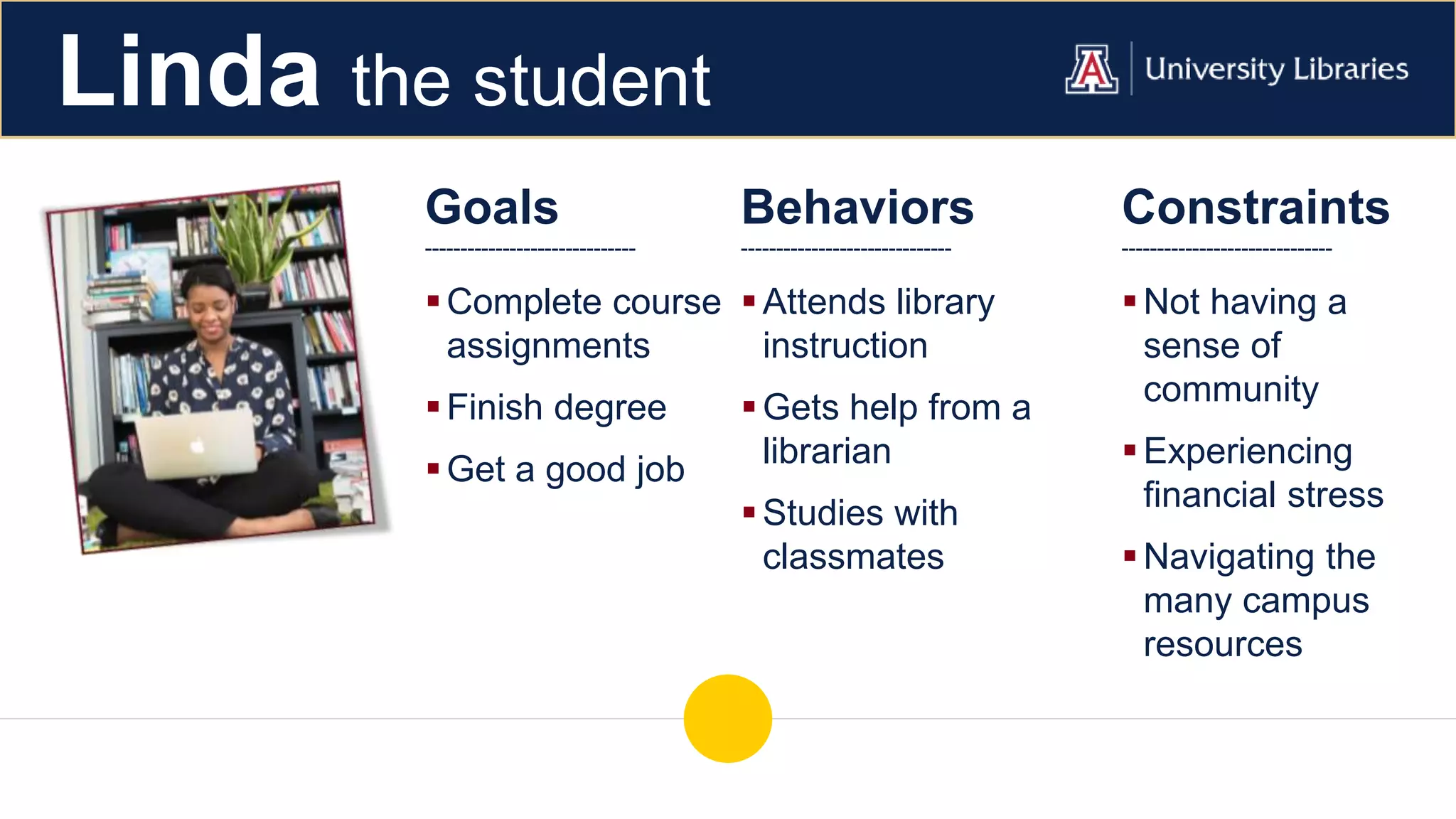
Goals
------------------------------
Complete course
assignments
Finish degree
Get a good job
Behaviors
------------------------------
Attends library
instruction
Gets help from a
librarian
Studies with
classmates
Constraints
------------------------------
Not having a
sense of
community
Experiencing
financial stress
Navigating the
many campus
resources
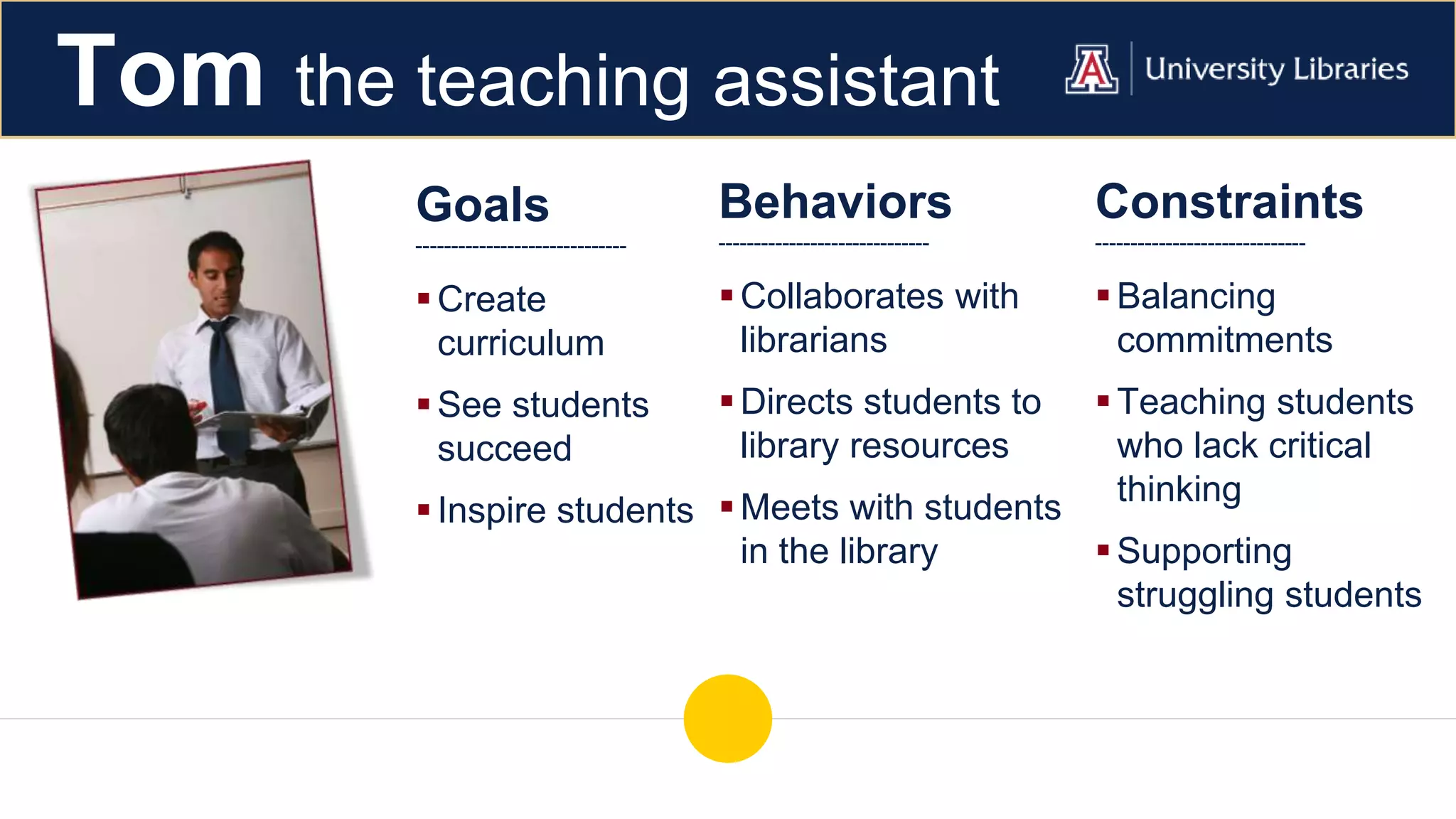
Linda the student
Goals
------------------------------
Create
curriculum
See students
succeed
Inspire students
Behaviors
------------------------------
Collaborates with
librarians
Directs students to
library resources
Meets with students
in the library
Constraints
------------------------------
Balancing
commitments
Teaching students
who lack critical
thinking
Supporting
struggling students
Tom the teaching assistant
Sam the emerging scholar
Goals
------------------------------
Secure funding
Share research
with the world
Obtain a faculty
position
Behaviors
------------------------------
Uses databases,
journals, and
interlibrary loan
Manages citations
Consults with their
librarian
Constraints
------------------------------
Getting access
quickly
Managing
research data
Balancing
competing
priorities
“
Design thinking is an iterative process in which we seek
to understand the user, challenge assumptions, and
redefine problems in an attempt to identify alternative
strategies and solutions that might not be instantly
apparent with our initial level of understanding.
- Rikke Dam & Teo Siang
Interaction Design Foundation
The what, when, and why
Project Beginnings
Why this project?
◉ Interest among research and learning
librarians
◉ Mix of interest and expertise
◉ Focus area within strategic map
“
In collaboration with campus partners, develop
a comprehensive plan for delivering
instructional, consulting, and research services
that support graduate and professional student
success.
- UAL Strategic Map
The study
Understanding the
Graduate Student
Experience
What did we already
know?
◉ Research, Teaching, and Learning Task
Force Recommendations
◉ Library Design-thinking Project 2018 -
Strategic Directions and Commitments
Goal 1
Identify ways to improve library services to
graduate students by:
○ Collecting data on their experiences
○ Learning about their awareness of library services
○ Identifying their points of need
Goal 2
Identify which library services are most valuable and
useful for grads.
Goal 3
Identify opportunities of new services or variations of
current services to grad students.
Designing our study
Data collection methods
◉ Small group interviews, experience mapping, and
discussion
o Box Notes
◉ Survey -
o AirTable
Recruitment plan
◉ March 2 – 9, 2018...
○ Use existing database to email grads to get participants.
○ Prepare questions and interview method.
◉ March 16, 2018... Hold four sessions of small group
interviews of graduate students from a range of
disciplines.
Survey
?
AirTable
Session in action
Timeline
◉ Early
◉ Mid-program
◉ Near graduation
Mapping their
grad experiences
Interview questions
Think about your path so far as a grad student here at the UA. Go
all the way to the beginning, think of all the things that happened up
until today.
Identify significant moments on your path. Identify your feelings.
Think about times you interacted with the library and note those
moments as well.
What were the challenges or obstacles that you encountered
along the way? High points and highlights?
Interview questions
With the most significant things that happened along the
way, what happened before or after that helped you decide on
a direction or prepared you for a future position?
What things did you learn along the way that you wished that
you had known earlier?
What, if any, person(s) or opportunities did you encounter
that helped you succeed along the way to your degree? How
did you discover the person/opportunity?
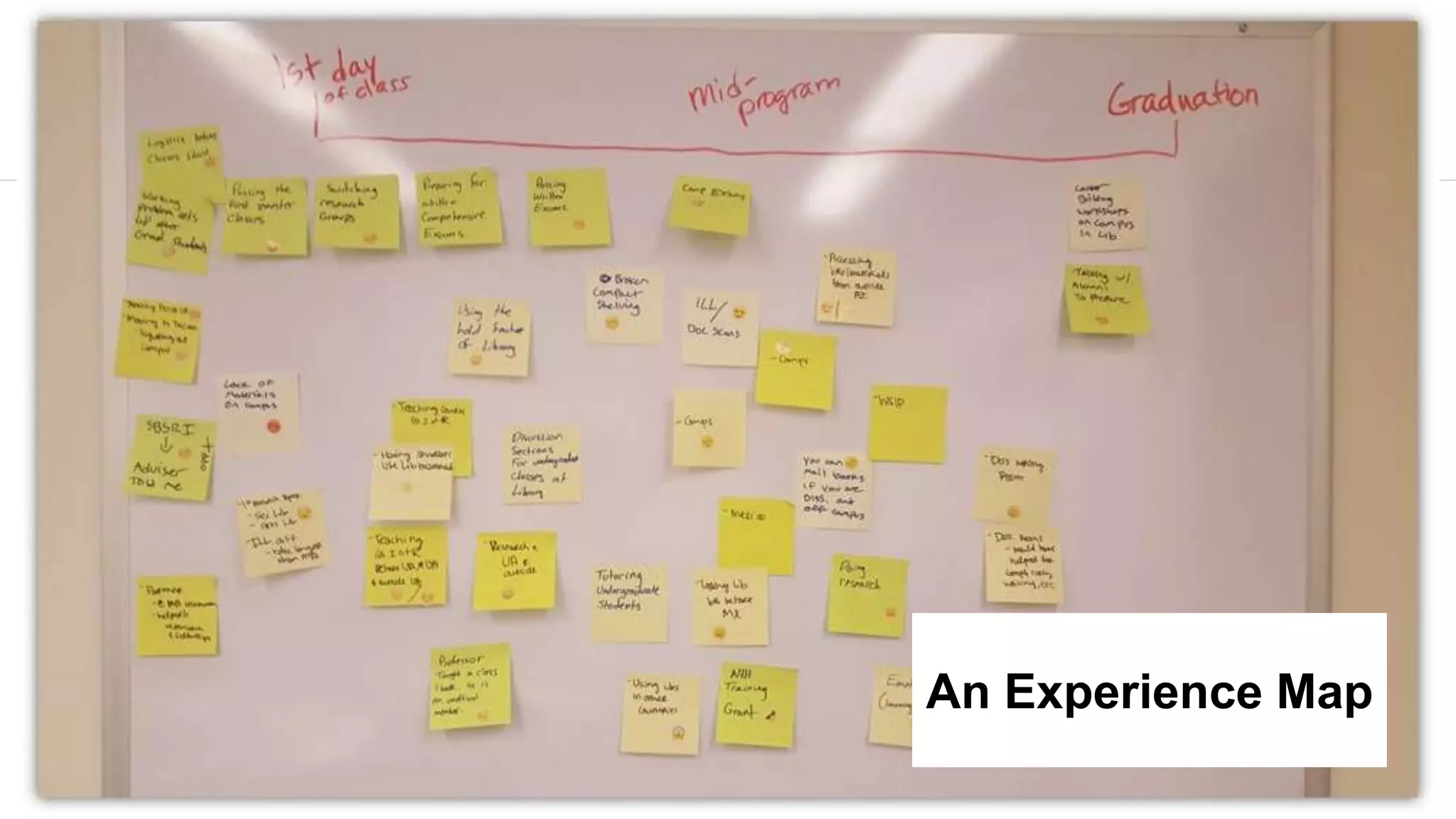
An Experience Map
Findings
Theme: Access to books & journals
"[The] most important thing for preparing for oral comprehensive
exams was reading a lot of papers. The library has a lot of
databases for physics, like Physics Review. All of those I can
download free, which is very good.
Downside is when I try to borrow books. For example, Quantum
Mechanics - some of them are really old. Versions are really
old. Some we don't have in the library...[example] spatial topics
in physics. I'm surprised because I started in China for undergrad
and I can access those English books there, but not here. “
- Physics PhD Student
Theme: Access to technology
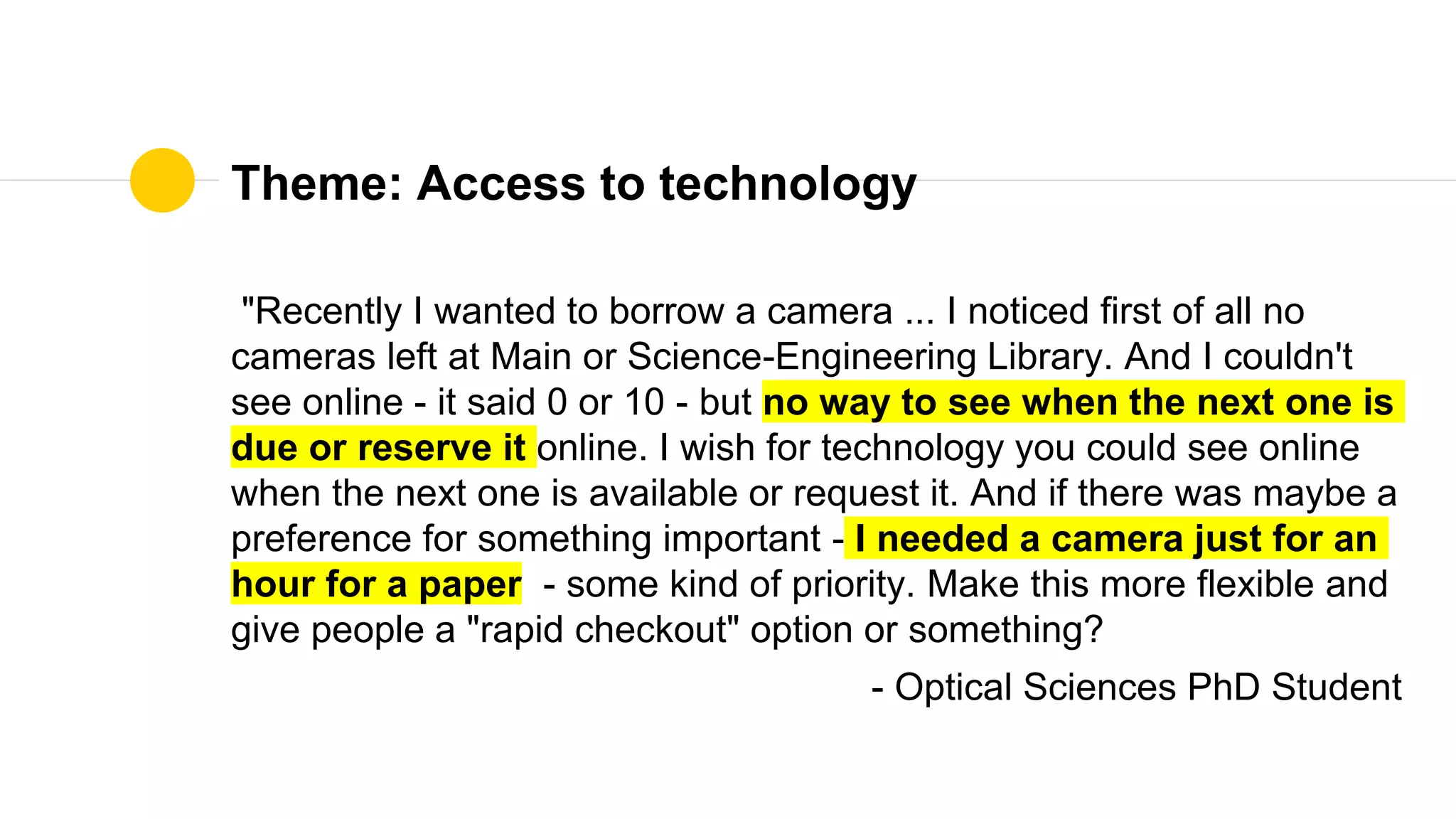
"Recently I wanted to borrow a camera ... I noticed first of all no
cameras left at Main or Science-Engineering Library. And I couldn't
see online - it said 0 or 10 - but no way to see when the next one is
due or reserve it online. I wish for technology you could see online
when the next one is available or request it. And if there was maybe a
preference for something important - I needed a camera just for an
hour for a paper - some kind of priority. Make this more flexible and
give people a "rapid checkout" option or something?
- Optical Sciences PhD Student
Theme: Access to technology
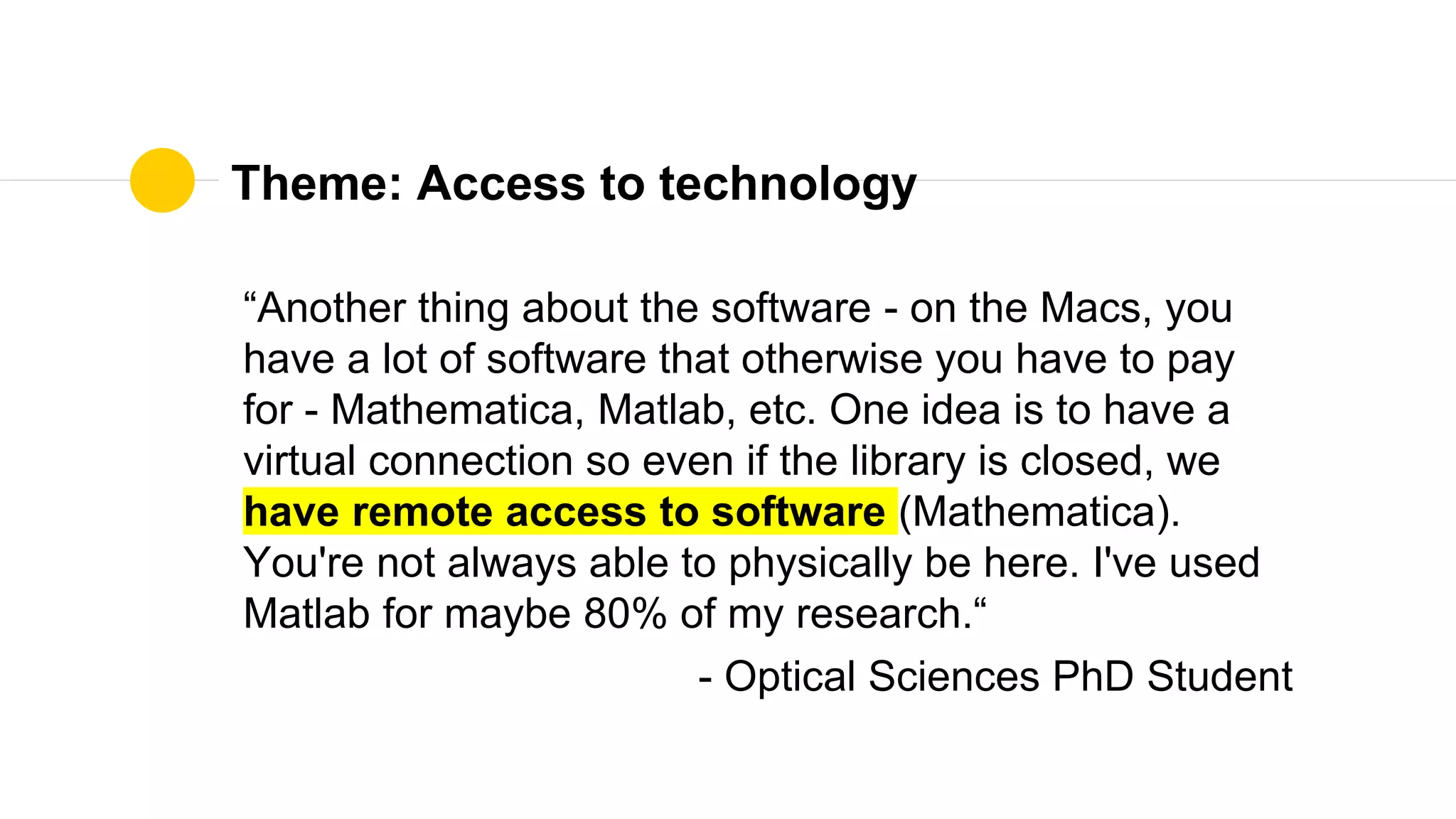
“Another thing about the software - on the Macs, you
have a lot of software that otherwise you have to pay
for - Mathematica, Matlab, etc. One idea is to have a
virtual connection so even if the library is closed, we
have remote access to software (Mathematica).
You're not always able to physically be here. I've used
Matlab for maybe 80% of my research.“
- Optical Sciences PhD Student
Theme: Rooms & spaces
"When librarians do presentations, it would be good to hear
about rooms - getting them around comps. "
- Art History PhD Student
"I heard about this thing that they were going to start letting
people take naps. I actually bike home a lot and take a nap -
helps me work longer in the afternoon. Might be logistically tough,
maybe against our culture, may take time for people to accept.
But I'm all for taking naps in the afternoon.“
- Physics PhD Student
Theme: Librarian liaisons
"It would be nice to have our college's librarian be
more proactive and come to our departments,
maybe do something with each particular college.
Like social sciences - have some kind of
presentation or round table, develop some kind of
connection, specifically for graduate students. I don't
think I've ever really talked to the person, but I met
them in Special Collections - it would be nice to
meet them sooner.“
- History PhD Student
Theme: Training & workshops
"Sometimes it’s hard to edit my resume, edit my CV. We have that
service in Think Center but those are undergrad students with different
majors. They look at my CV and say "Woah cool - fancy research!" If we
could have some more specific feedback from a physics related
person."
- Physics PhD Student
"If it's for your thesis or dissertation, formatting, citing - I didn't even
know there were resources for that. I tried using one of the citation
softwares on my own - Mendeley - it was complicated, so I let it go.“
- Optical Science PhD Student
Study outcomes
◉ Spreadsheet of ideas
◉ Focus on themes
◉ Touchpoints and tactics based on student
activities
Quick wins
Survey results
What I’m working on now
◉ UA Library Research and Learning study on
disciplinary discourse
Lightweight UX methods
Getting started
UX no matter your setting
 Academic libraries
 Public libraries
 Archives and museums
 Special libraries
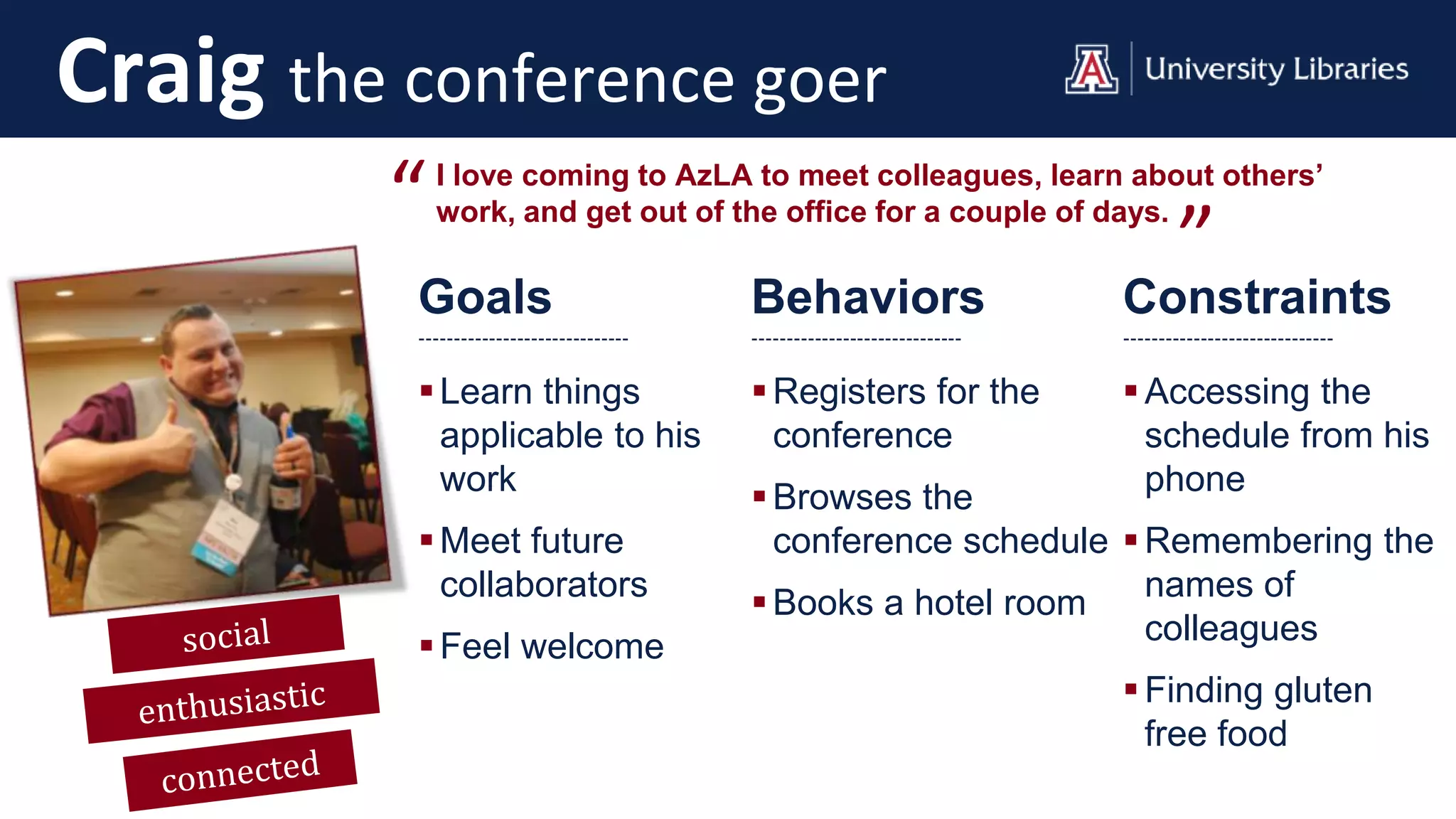
Creating personas
◉ Use existing data about your users
◉ Try segmenting your audience by purpose
◉ Focus on goals, behaviors, and constraints
Goals
------------------------------
Learn things
applicable to his
work
Meet future
collaborators
Feel welcome
Behaviors
------------------------------
Registers for the
conference
Browses the
conference schedule
Books a hotel room
Constraints
------------------------------
Accessing the
schedule from his
phone
Remembering the
names of
colleagues
Finding gluten
free food
I love coming to AzLA to meet colleagues, learn about others’
work, and get out of the office for a couple of days.“ ”
Craig the conference goer
Mapping the experience
◉ Bring together staff or recruit people from
your audience
◉ Put aside assumptions
◉ Select a mapping tool that will be most useful
Talking to your users
o Intercept recruitment
o User interviews
o Impression and 5-second tests
o Lightweight, iterative methods
Questions & discussion

Understanding the Graduate Student Experience

  • 1.
    Challenges, Highlights, andPivotal Moments: Understanding the Graduate Student Experience October 25, 2018 AzLA Annual Conference Rebecca Blakiston & Gardie Lueders University of Arizona Libraries
  • 2.
    I am Rebecca Blakiston UserExperience Strategist at UA Libraries You can find me at @blakistonr Hello! 2
  • 3.
    I am GardieLueders Research Program Coordinator at UA Libraries, Research & Learning Department You can find me at gklueders@email.arizona.edu Hello! 3
  • 4.
  • 5.
    “ User experience (UX)focuses on having a deep understanding of users, what they need, what they value, their abilities, and also their limitations. - usability.gov
  • 6.
    The graduate student audience ◉Students ◉ Instructors ◉ Researchers ◉ Future faculty members
  • 7.
    “ A persona isa user archetype you can use to help guide decisions about product features, navigation, interactions, and even visual design. - Kim Goodwin User Interface Engineering
  • 8.
    Goals ------------------------------ Complete course assignments Finish degree Geta good job Behaviors ------------------------------ Attends library instruction Gets help from a librarian Studies with classmates Constraints ------------------------------ Not having a sense of community Experiencing financial stress Navigating the many campus resources Linda the student
  • 9.
    Goals ------------------------------ Create curriculum See students succeed Inspire students Behaviors ------------------------------ Collaborateswith librarians Directs students to library resources Meets with students in the library Constraints ------------------------------ Balancing commitments Teaching students who lack critical thinking Supporting struggling students Tom the teaching assistant
  • 10.
    Sam the emergingscholar Goals ------------------------------ Secure funding Share research with the world Obtain a faculty position Behaviors ------------------------------ Uses databases, journals, and interlibrary loan Manages citations Consults with their librarian Constraints ------------------------------ Getting access quickly Managing research data Balancing competing priorities
  • 11.
    “ Design thinking isan iterative process in which we seek to understand the user, challenge assumptions, and redefine problems in an attempt to identify alternative strategies and solutions that might not be instantly apparent with our initial level of understanding. - Rikke Dam & Teo Siang Interaction Design Foundation
  • 14.
    The what, when,and why Project Beginnings
  • 15.
    Why this project? ◉Interest among research and learning librarians ◉ Mix of interest and expertise ◉ Focus area within strategic map
  • 16.
    “ In collaboration withcampus partners, develop a comprehensive plan for delivering instructional, consulting, and research services that support graduate and professional student success. - UAL Strategic Map
  • 17.
  • 18.
    What did wealready know? ◉ Research, Teaching, and Learning Task Force Recommendations ◉ Library Design-thinking Project 2018 - Strategic Directions and Commitments
  • 19.
    Goal 1 Identify waysto improve library services to graduate students by: ○ Collecting data on their experiences ○ Learning about their awareness of library services ○ Identifying their points of need
  • 20.
    Goal 2 Identify whichlibrary services are most valuable and useful for grads.
  • 21.
    Goal 3 Identify opportunitiesof new services or variations of current services to grad students.
  • 22.
  • 23.
    Data collection methods ◉Small group interviews, experience mapping, and discussion o Box Notes ◉ Survey - o AirTable
  • 24.
    Recruitment plan ◉ March2 – 9, 2018... ○ Use existing database to email grads to get participants. ○ Prepare questions and interview method. ◉ March 16, 2018... Hold four sessions of small group interviews of graduate students from a range of disciplines.
  • 25.
  • 26.
  • 27.
  • 28.
  • 29.
  • 30.
    Interview questions Think aboutyour path so far as a grad student here at the UA. Go all the way to the beginning, think of all the things that happened up until today. Identify significant moments on your path. Identify your feelings. Think about times you interacted with the library and note those moments as well. What were the challenges or obstacles that you encountered along the way? High points and highlights?
  • 31.
    Interview questions With themost significant things that happened along the way, what happened before or after that helped you decide on a direction or prepared you for a future position? What things did you learn along the way that you wished that you had known earlier? What, if any, person(s) or opportunities did you encounter that helped you succeed along the way to your degree? How did you discover the person/opportunity?
  • 32.
  • 33.
  • 34.
    Theme: Access tobooks & journals "[The] most important thing for preparing for oral comprehensive exams was reading a lot of papers. The library has a lot of databases for physics, like Physics Review. All of those I can download free, which is very good. Downside is when I try to borrow books. For example, Quantum Mechanics - some of them are really old. Versions are really old. Some we don't have in the library...[example] spatial topics in physics. I'm surprised because I started in China for undergrad and I can access those English books there, but not here. “ - Physics PhD Student
  • 35.
    Theme: Access totechnology "Recently I wanted to borrow a camera ... I noticed first of all no cameras left at Main or Science-Engineering Library. And I couldn't see online - it said 0 or 10 - but no way to see when the next one is due or reserve it online. I wish for technology you could see online when the next one is available or request it. And if there was maybe a preference for something important - I needed a camera just for an hour for a paper - some kind of priority. Make this more flexible and give people a "rapid checkout" option or something? - Optical Sciences PhD Student
  • 36.
    Theme: Access totechnology “Another thing about the software - on the Macs, you have a lot of software that otherwise you have to pay for - Mathematica, Matlab, etc. One idea is to have a virtual connection so even if the library is closed, we have remote access to software (Mathematica). You're not always able to physically be here. I've used Matlab for maybe 80% of my research.“ - Optical Sciences PhD Student
  • 37.
    Theme: Rooms &spaces "When librarians do presentations, it would be good to hear about rooms - getting them around comps. " - Art History PhD Student "I heard about this thing that they were going to start letting people take naps. I actually bike home a lot and take a nap - helps me work longer in the afternoon. Might be logistically tough, maybe against our culture, may take time for people to accept. But I'm all for taking naps in the afternoon.“ - Physics PhD Student
  • 38.
    Theme: Librarian liaisons "Itwould be nice to have our college's librarian be more proactive and come to our departments, maybe do something with each particular college. Like social sciences - have some kind of presentation or round table, develop some kind of connection, specifically for graduate students. I don't think I've ever really talked to the person, but I met them in Special Collections - it would be nice to meet them sooner.“ - History PhD Student
  • 39.
    Theme: Training &workshops "Sometimes it’s hard to edit my resume, edit my CV. We have that service in Think Center but those are undergrad students with different majors. They look at my CV and say "Woah cool - fancy research!" If we could have some more specific feedback from a physics related person." - Physics PhD Student "If it's for your thesis or dissertation, formatting, citing - I didn't even know there were resources for that. I tried using one of the citation softwares on my own - Mendeley - it was complicated, so I let it go.“ - Optical Science PhD Student
  • 40.
    Study outcomes ◉ Spreadsheetof ideas ◉ Focus on themes ◉ Touchpoints and tactics based on student activities
  • 41.
  • 42.
  • 43.
    What I’m workingon now ◉ UA Library Research and Learning study on disciplinary discourse
  • 44.
  • 45.
    UX no matteryour setting  Academic libraries  Public libraries  Archives and museums  Special libraries
  • 46.
    Creating personas ◉ Useexisting data about your users ◉ Try segmenting your audience by purpose ◉ Focus on goals, behaviors, and constraints
  • 47.
    Goals ------------------------------ Learn things applicable tohis work Meet future collaborators Feel welcome Behaviors ------------------------------ Registers for the conference Browses the conference schedule Books a hotel room Constraints ------------------------------ Accessing the schedule from his phone Remembering the names of colleagues Finding gluten free food I love coming to AzLA to meet colleagues, learn about others’ work, and get out of the office for a couple of days.“ ” Craig the conference goer
  • 48.
    Mapping the experience ◉Bring together staff or recruit people from your audience ◉ Put aside assumptions ◉ Select a mapping tool that will be most useful
  • 50.
    Talking to yourusers o Intercept recruitment o User interviews o Impression and 5-second tests o Lightweight, iterative methods
  • 52.

Editor's Notes

  • #2 Introduction:
  • #4 Currently, I’m working as a Research in the UA Libraries Research & Learning Dept., but last spring I was an intern in the UX Team, where my project was to study the Graduate Student Library Experience.
  • #16 RB will do. We consulted several existing resources to gain a background understanding of grads in the library, and to give scope to the project.
  • #19 Thanks, Rebecca! So what did we already know about the Graduate Student Experience at the UA Library? We reviewed recommendations from prior studies done by the UA Research and Learning Librarians, and the recent UA Library Strategic Design-thinking project. Both of these sources provided us some background on the needs of grad students, and the aim of the library to meet them. They gave us a baseline that helped us develop our goals for this study.
  • #20 First of all, our overall goal was to identify ways to improve library services to graduate students. This experience mapping project specifically planned to collect data over the entire grad student degree progress timeline. We wanted to see which library experiences occur at what points on that timeline.
  • #21 Another goal was to identify which currently available library services are most valuable and useful to grads.
  • #22 And finally, to seek out possible opportunities for new services or variations of current services to better serve grad students.
  • #23 How would we gather our information for this study? We decided on a mixed-method approach. We wanted to gather first-hand information from the grads about their experiences and develop a time-based map from their responses to find out unmet needs and potential new services, but we also wanted to track, compare, and analyze how we were doing with our current services.
  • #24 We used small group interviews to gather qualitative information, and surveys to gather quantitative data. We entered our raw data in Box Notes and AirTable. (I'll explain more on those applications a bit later.)
  • #25 This was a quick, but intensive study. The preparation took a little over a month, but the interviews all occurred on one day, Friday, March 16, 2018, when we held four, 1-hour-long sessions. We chose to collect the data in small group interviews because of the potential for many data points and inputs. We also felt that in a small group, participants would be most likely to take cues or ideas from others to elaborate on, making more of a discussion, and giving us richer detail and better quotes. We used an existing User Experience database of potential research participants to recruit our graduate students. Their willingness to participate in previous usability studies meant they might be willing to spend some more time talking with us. We offered a modest incentive of bagels and coffee for their assistance.
  • #26 The survey for our quantitative analysis was simply the list of library services for grad students from the UA Library website. Interview participants were instructed to mark their sheet with + for familiar, - for unfamiliar, and ? for possibly familiar, but not well understood. I entered this data in AirTable.
  • #27 AirTable is a cloud-based, collaborative spreadsheet-database hybrid that is simple to use and customize. You can store all your project pieces in one folder: your recruitment email list, your survey data, and notes on the project. You can even create a custom survey form in AirTable, in which the data entered into the form automatically populates a database. Using AirTable, I could see how many grad students were familiar, unfamiliar, or had questions about our current services. Then I calculated the percentage of students in each category. 
  • #28 Here you can see a small group session in action. Our goal was to have participants representing a range of levels and disciplines. We ended up with students from both the PhD and Master's level, and from the sciences, art, social sciences, education and business. Participants were instructed to answer the questions on post-it notes and attach them to the white board along the timeline at the point they recalled the event happening. We gave out emoji stickers for the students to indicate their feelings on the experience. Rebecca took notes (in BoxNotes) as the students brought up their experiences, feelings, and ideas. Box Notes is an online collaborative document creator, but you could use Word, or whatever software you prefer to take the notes.  We also made sound recordings of the sessions.
  • #29 We chose to start with three simple time periods to divide up the grad student experience. Early, which would include pre-admission if necessary, and cover the first semester of a program, mid-program, which covers second semester up to the semester before graduation, and near graduation. 
  • #30 Our thinking was that we would allow the students to inform us of any important different or missing periods of time.
  • #31 Our interview script emphasized that this was intended to be an idea-generating, think out-of-the-box, nothing is off-limits kind of discussion. Here are the questions we used:  Think about your path so far as a grad student here at the UA. Go all the way to the beginning, think of all the things that happened up until today. Identify significant moments on your path. Identify your feelings.  Think about times you interacted with the library and note those moments as well.  What were the challenges or obstacles that you encountered along the way? High points and highlights?
  • #32 With the most significant things that happened along the way, what happened before or after that helped you decide on a direction or prepared you for a future position? What things did you learn along the way that you wished that you had known earlier? What, if any, person(s) or opportunities did you encounter that helped you succeed along the way to your degree? How did you discover the person or opportunity?
  • #33 We photographed each of the maps created by the students for analysis. The mapping seemed to show that most encounters with the library happen early to mid-program for most grad students. Exceptions were training, and workshops on building CVs and formatting theses. These were posted nearer to graduation. You can see in the photograph that they used Neon green post-its for General Grad Student Experiences And Pale Yellow post-its for Grad Student Library Experiences Some examples of Early Grad Experiences were: the 1st Research Paper and TA training, and some obstacles were lack of materials on campus and a long wait for ILL. Some Mid-program Experiences: Tutoring undergraduate students, studying for comprehensive exams in library. And an Obstacle: some students were not aware of dedicated grad study spaces. Near Graduation Experiences were Career-building workshops in the library, and talking to alumni to prepare for their post-grad career.
  • #34 We found five major themes among the participants responses: access as it relates to availability of books and journals, access to technology, library rooms and spaces, Librarian liaisons, and training workshops.
  • #35 We pulled out quotes from our notes on the students small group interviews that stood out as points of need, areas of potential improvement or possible new services. These next quotes fall under the theme of access to books and journals. Here are some quotes from a Physics PhD student.
  • #36 This quote points to a possible way to improve our access to technology (in this case cameras). The quote is from an Optical Sciences PhD student.
  • #37 This is another quote about access to technology. It shows an idea that was generated by a student.
  • #38 Next we have quotes about rooms and spaces.
  • #39 On the theme of Librarian Liaisons we have a quote from a History PhD student.
  • #40 On the theme of training and workshops we have two quotes:
  • #41 After the interviews I gave a version of this presentation to our Research & Learning Librarians, in sort of a roundtable setting. Afterwards, everyone discussed their immediate takeaways from the Grad Experience Study and I created a spreadsheet of these ideas focusing on the five themes. We talked about the touchpoints and tactics for communicating with the students.
  • #42 From that spreadsheet I created an infographic to summarize some of the study’s findings, and the quick wins that came up during our post-presentation discussion. Here is an example page. If you’d like to see the full infographic, we have some copies that you can find on the back table. The theme on this example is Library Liaison awareness, and the student activity is studying. We identified three touchpoints with corresponding tactics we could employ to promote the Library Liaisons. Touchpoint 1: Study rooms, Tactic: Library Liaison Trading Cards on the study room door key tags. Touchpoint 2: Book stacks, Tactic: Library Liaison posters on shelf ends, and Touchpoint 3: Hallways, Tactic: Library Liaison posters on walls. Our next steps were to develop tactics for all the themes found in the study.
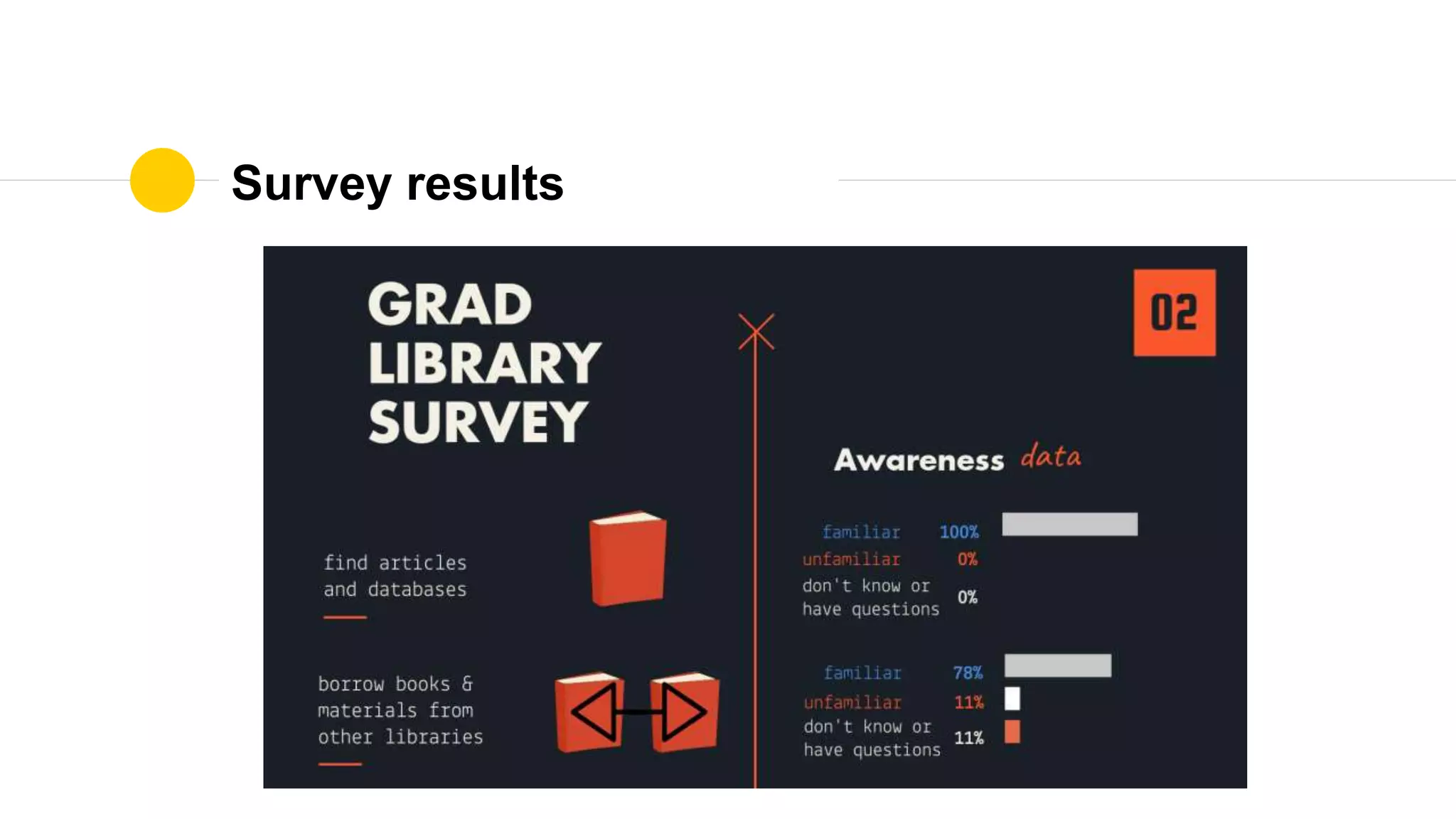
  • #43 Here is a portion of the survey results presented in the infographic. For each, survey item, (such as borrow books & materials from other libraries) I calculated the percentages of each response. These are two areas where grads were quite familiar, but other areas showed quite different results. 
  • #44 Since the Grad Experience Study and my internship on the UX Team ended, I've started working as a Research Program Coordinator in the Research & Learning Department at the UA Library. In this role, I'm working on another fun and interesting study on the differences in academic discourse between disciplines to help the Research & Learning Librarians hone in on the areas where they can help develop grad students into experts in their fields.
  • #45 RB will do. We found five major themes among the participants responses: Access as it relates to availability of books and journals, access to technology, library rooms and spaces, librarians/liaisons, and training workshops.
  • #46 How would you adapt these tools to your library setting? Try it. Who are your users?
  • #47 Create a few personas. Give each a name and a few character traits. Sketch out your own experience map. Can you draft a timeline of a customer’s journey using one of your products or services? What are their milestones? What types of obstacles or rewards might happen along the way?
  • #49 Sketch out your own experience map. Can you draft a timeline of a customer’s journey using one of your products or services? What are their milestones? What types of obstacles or rewards might happen along the way?
  • #51 Sketch out your own experience map. Can you draft a timeline of a customer’s journey using one of your products or services? What are their milestones? What types of obstacles or rewards might happen along the way?