Understanding
Text Structures
What is a text structure?
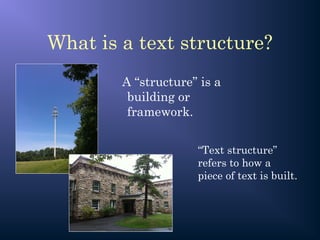
A “structure” is a
building or
framework.
“Text structure”
refers to how a
piece of text is built.
What is a text structure?
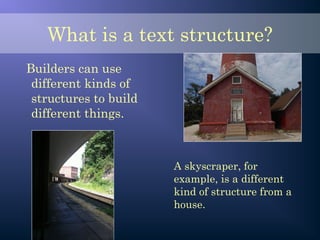
Builders can use
different kinds of
structures to build
different things.
A skyscraper, for
example, is a different
kind of structure from a
house.
What is a text structure?
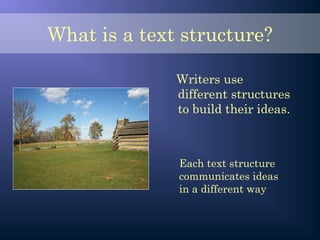
Writers use
different structures
to build their ideas.
Each text structure
communicates ideas
in a different way
Chronological order
Authors use
chronological order
to explain how
things happen in
order
Chronological order is
also called sequence or
time order
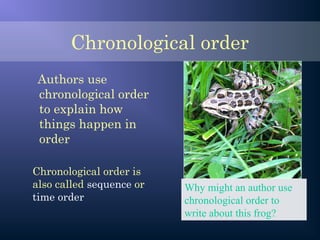
Why might an author use
chronological order to
write about this frog?
Chronological order
You will know that
you are reading a
text in
chronological order
because you will
see words like first,
next, later, then,
and finally
Chronological order
You will often see chronological order in
directions:
Have you ever made macaroni and cheese?
It’s simple! First, boil some water and make
some macaroni. Then, make your cheese
sauce. After the cheese sauce is ready, mix
it with the macaroni. Bake the entire thing
in the oven. Finally, it’s time to eat!
Chronological order
Notice the transition words that connect the
events in these directions.
Have you ever made macaroni and cheese?
It’s simple! First, boil some water and make
some macaroni. Then, make your cheese
sauce. After the cheese sauce is ready, mix
it with the macaroni. Bake the entire thing
in the oven. Finally, it’s time to eat!
Which paragraph is in
chronological order?
Pennsylvania has many
historic sites. You can visit
Revolutionary war sites,
like Valley Forge. You can
also visit important
locations from the Civil
War, like Gettysburg.
Finally, you can also see the
site of the first oil well in
Titusville. Pennsylvania has
many neat places to visit!
Through the ages,
Pennsylvania has seen
many interesting events.
The state was founded in
1681 by William Penn.
Later, Pennsylvania was the
site of important
Revolutionary War battles.
After that, Pennsylvania
was home to new factories
during the Industrial
Revolution. Today,
Pennsylvania continues to
make history.
Which paragraph is in
chronological order?
Through the ages,
Pennsylvania has seen
many interesting events.
The state was founded in
1681 by William Penn.
Later, Pennsylvania was the
site of important
Revolutionary War battles.
After that, Pennsylvania
was home to new factories
during the Industrial
Revolution. Today,
Pennsylvania continues to
make history.
This is the
paragraph in
chronological
order. Can you
find the clue
words that show
this order?
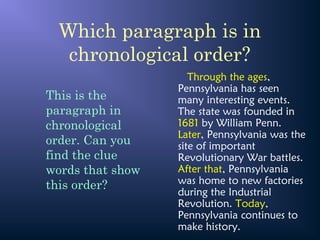
Which paragraph is in
chronological order?
Through the ages,
Pennsylvania has seen
many interesting events.
The state was founded in
1681 by William Penn.
Later, Pennsylvania was the
site of important
Revolutionary War battles.
After that, Pennsylvania
was home to new factories
during the Industrial
Revolution. Today,
Pennsylvania continues to
make history.
This is the
paragraph in
chronological
order. Can you
find the clue
words that show
this order?
Think about it!
•What is a structure?
•What does chronological order
mean?
•What are some clue words that
show chronological order?
Another text structure
• But what if an
author doesn’t
want to show how
something
happened in
sequence?
• The author would
need to use another
text structure!
Compare and contrast
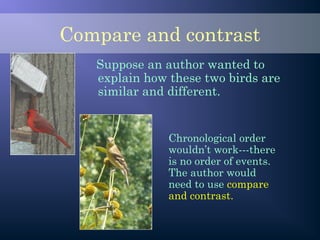
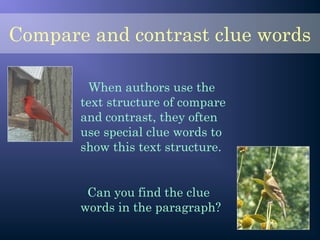
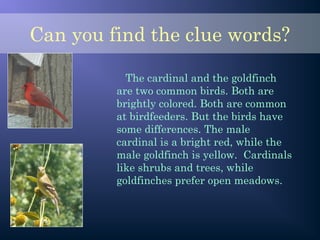
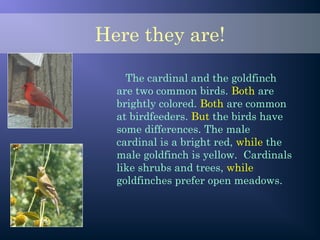
Suppose an author wanted to
explain how these two birds are
similar and different.
Chronological order
wouldn’t work---there
is no order of events.
The author would
need to use compare
and contrast.
Compare and contrast
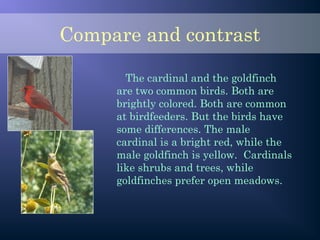
The cardinal and the goldfinch
are two common birds. Both are
brightly colored. Both are common
at birdfeeders. But the birds have
some differences. The male
cardinal is a bright red, while the
male goldfinch is yellow. Cardinals
like shrubs and trees, while
goldfinches prefer open meadows.
When authors use the
text structure of compare
and contrast, they often
use special clue words to
show this text structure.
Can you find the clue
words in the paragraph?
Compare and contrast clue words
Can you find the clue words?
The cardinal and the goldfinch
are two common birds. Both are
brightly colored. Both are common
at birdfeeders. But the birds have
some differences. The male
cardinal is a bright red, while the
male goldfinch is yellow. Cardinals
like shrubs and trees, while
goldfinches prefer open meadows.
Here they are!
The cardinal and the goldfinch
are two common birds. Both are
brightly colored. Both are common
at birdfeeders. But the birds have
some differences. The male
cardinal is a bright red, while the
male goldfinch is yellow. Cardinals
like shrubs and trees, while
goldfinches prefer open meadows.
Graphic Organizers
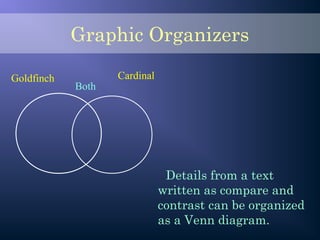
Details from a text
written as compare and
contrast can be organized
as a Venn diagram.
Goldfinch Cardinal
Both
Graphic Organizers
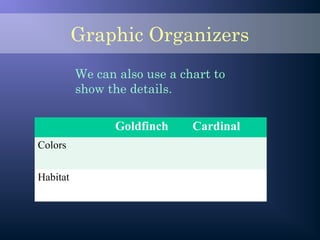
We can also use a chart to
show the details.
Goldfinch Cardinal
Colors
Habitat
• Can you explain the difference
between chronological order and
compare and contrast?
• How can clue words help you as a
reader?
Graphic Organizers
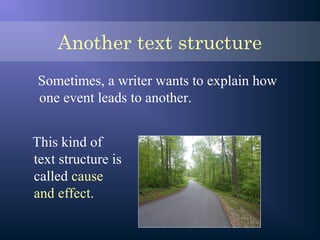
Another text structure
Sometimes, a writer wants to explain how
one event leads to another.
This kind of
text structure is
called cause
and effect.
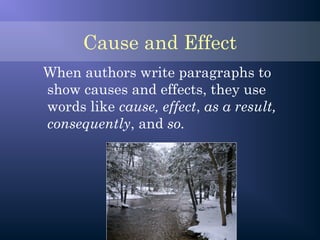
Cause and Effect
When authors write paragraphs to
show causes and effects, they use
words like cause, effect, as a result,
consequently, and so.
Can you find the clue words?
The night’s snowstorm had many
effects. People were out shoveling
snow from their sidewalks. The power
lines were draped with ice. Snow
plows drove down every street.
Children were the happiest of all. The
unexpected snow caused school to be
cancelled!
Can you find the clue words?
The night’s snowstorm had many
effects. People were out shoveling
snow from their sidewalks. The power
lines were draped with ice. Snow
plows drove down every street.
Children were the happiest of all. The
unexpected snow caused school to be
cancelled!
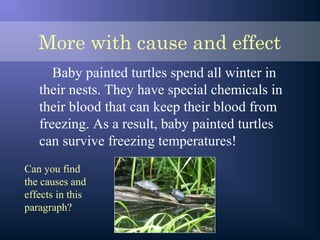
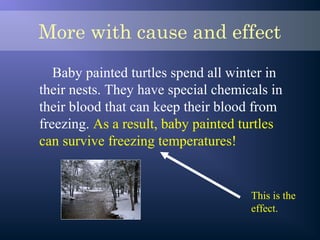
More with cause and effect
Baby painted turtles spend all winter in
their nests. They have special chemicals in
their blood that can keep their blood from
freezing. As a result, baby painted turtles
can survive freezing temperatures!
Can you find
the causes and
effects in this
paragraph?
More with cause and effect
Baby painted turtles spend all winter in
their nests. They have special chemicals in
their blood that can keep their blood from
freezing. As a result, baby painted turtles
can survive freezing temperatures!
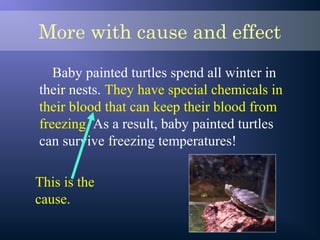
This is the
cause.
More with cause and effect
Baby painted turtles spend all winter in
their nests. They have special chemicals in
their blood that can keep their blood from
freezing. As a result, baby painted turtles
can survive freezing temperatures!
This is the
effect.
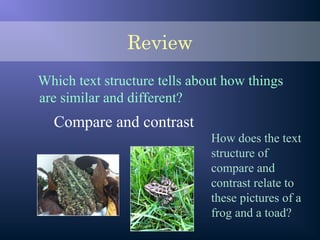
Review
Which text structure tells about how things
are similar and different?
Compare and contrast
How does the text
structure of
compare and
contrast relate to
these pictures of a
frog and a toad?
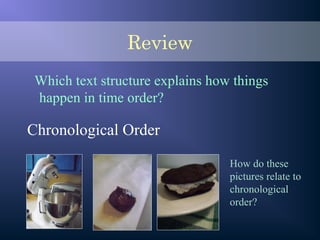
Review
Which text structure explains how things
happen in time order?
Chronological Order
How do these
pictures relate to
chronological
order?
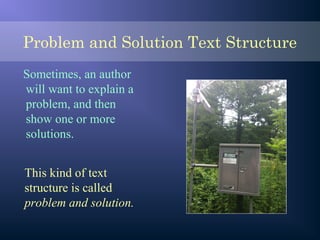
Problem and Solution Text Structure
Sometimes, an author
will want to explain a
problem, and then
show one or more
solutions.
This kind of text
structure is called
problem and solution.
An example of problem and solution
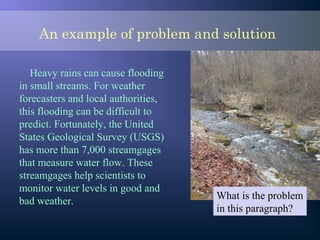
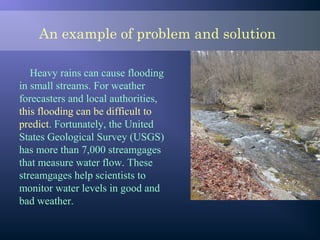
Heavy rains can cause flooding
in small streams. For weather
forecasters and local authorities,
this flooding can be difficult to
predict. Fortunately, the United
States Geological Survey (USGS)
has more than 7,000 streamgages
that measure water flow. These
streamgages help scientists to
monitor water levels in good and
bad weather.
What is the problem
in this paragraph?
An example of problem and solution
Heavy rains can cause flooding
in small streams. For weather
forecasters and local authorities,
this flooding can be difficult to
predict. Fortunately, the United
States Geological Survey (USGS)
has more than 7,000 streamgages
that measure water flow. These
streamgages help scientists to
monitor water levels in good and
bad weather.
An example of problem and solution
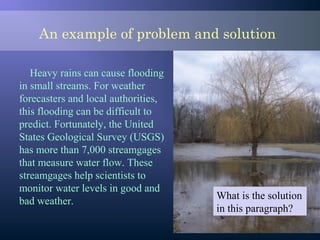
Heavy rains can cause flooding
in small streams. For weather
forecasters and local authorities,
this flooding can be difficult to
predict. Fortunately, the United
States Geological Survey (USGS)
has more than 7,000 streamgages
that measure water flow. These
streamgages help scientists to
monitor water levels in good and
bad weather.
What is the solution
in this paragraph?
An example of problem and solution
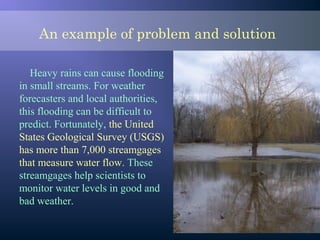
Heavy rains can cause flooding
in small streams. For weather
forecasters and local authorities,
this flooding can be difficult to
predict. Fortunately, the United
States Geological Survey (USGS)
has more than 7,000 streamgages
that measure water flow. These
streamgages help scientists to
monitor water levels in good and
bad weather.
Problem and Solution
Often, authors will
signal problem and
solution structure with
clue words like
problem and solution.
Problem and Solution
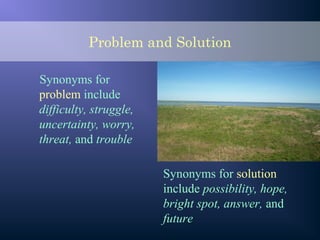
Synonyms for
problem include
difficulty, struggle,
uncertainty, worry,
threat, and trouble
Synonyms for solution
include possibility, hope,
bright spot, answer, and
future
Can you find the problems and solutions?
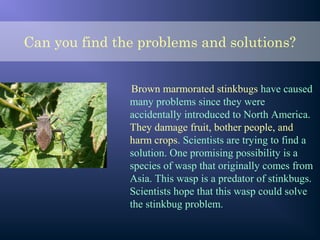
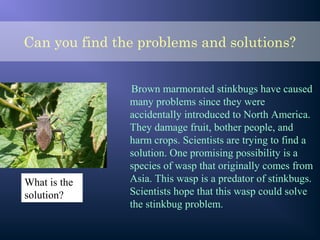
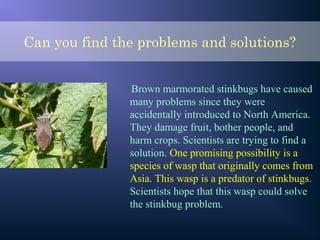
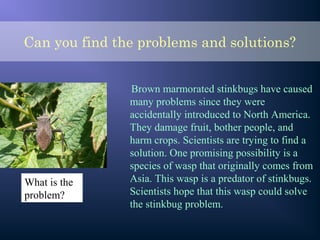
Brown marmorated stinkbugs have caused
many problems since they were
accidentally introduced to North America.
They damage fruit, bother people, and
harm crops. Scientists are trying to find a
solution. One promising possibility is a
species of wasp that originally comes from
Asia. This wasp is a predator of stinkbugs.
Scientists hope that this wasp could solve
the stinkbug problem.
What is the
problem?
Can you find the problems and solutions?
Brown marmorated stinkbugs have caused
many problems since they were
accidentally introduced to North America.
They damage fruit, bother people, and
harm crops. Scientists are trying to find a
solution. One promising possibility is a
species of wasp that originally comes from
Asia. This wasp is a predator of stinkbugs.
Scientists hope that this wasp could solve
the stinkbug problem.
Can you find the problems and solutions?
Brown marmorated stinkbugs have caused
many problems since they were
accidentally introduced to North America.
They damage fruit, bother people, and
harm crops. Scientists are trying to find a
solution. One promising possibility is a
species of wasp that originally comes from
Asia. This wasp is a predator of stinkbugs.
Scientists hope that this wasp could solve
the stinkbug problem.
What is the
solution?
Can you find the problems and solutions?
Brown marmorated stinkbugs have caused
many problems since they were
accidentally introduced to North America.
They damage fruit, bother people, and
harm crops. Scientists are trying to find a
solution. One promising possibility is a
species of wasp that originally comes from
Asia. This wasp is a predator of stinkbugs.
Scientists hope that this wasp could solve
the stinkbug problem.
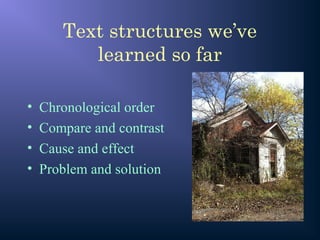
Text structures we’ve
learned so far
• Chronological order
• Compare and contrast
• Cause and effect
• Problem and solution
Match the clue words!
however, on the other
hand, similarity, like,
unlike
Can you figure out the text structure that these clue
words point to?
Compare and
contrast
Match the clue words!
as a result,
consequently,
therefore, so, cause,
effect
Can you figure out the text structure that these clue
words point to?
Cause and effect
Match the clue words!
problem, solution,
threat, difficulty, hope,
answer, possibility
Can you figure out the text structure that these clue
words point to?
Problem and
solution
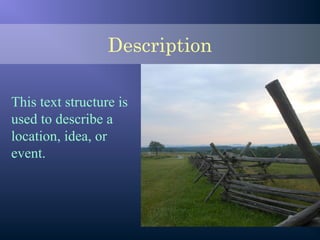
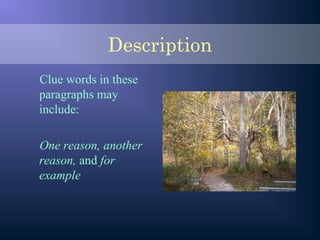
Description
This text structure is
used to describe a
location, idea, or
event.
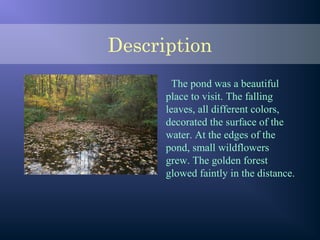
The pond was a beautiful
place to visit. The falling
leaves, all different colors,
decorated the surface of the
water. At the edges of the
pond, small wildflowers
grew. The golden forest
glowed faintly in the distance.
Description
The pond was a beautiful
place to visit. The falling
leaves, all different colors,
decorated the surface of the
water. At the edges of the
pond, small wildflowers
grew. The golden forest
glowed faintly in the distance.
Main idea
Description
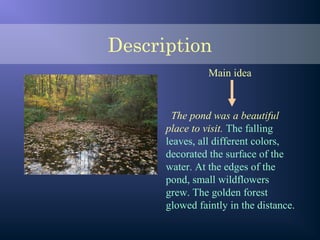
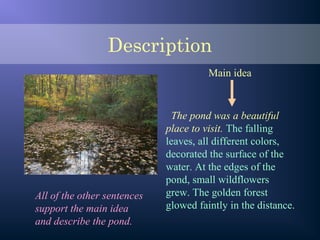
The pond was a beautiful
place to visit. The falling
leaves, all different colors,
decorated the surface of the
water. At the edges of the
pond, small wildflowers
grew. The golden forest
glowed faintly in the distance.
Main idea
All of the other sentences
support the main idea
and describe the pond.
Description
Clue words in these
paragraphs may
include:
One reason, another
reason, and for
example
Description
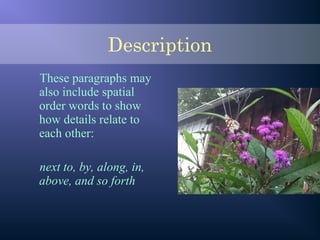
These paragraphs may
also include spatial
order words to show
how details relate to
each other:
next to, by, along, in,
above, and so forth
Description
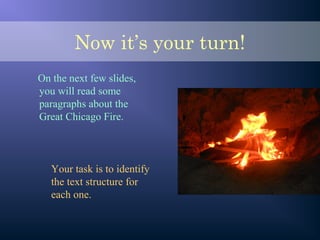
Now it’s your turn!
On the next few slides,
you will read some
paragraphs about the
Great Chicago Fire.
Your task is to identify
the text structure for
each one.
What’s the text structure?
• Chronological
order
• Compare and
contrast
• Cause and
effect
• Problem and
solution
• Description
Daniel Sullivan was the first to notice
the flames coming from the O’Leary
barn at around 8:30 pm on October 8.
A problem with the alarm box made it
impossible for the people in the area
to call for the fire department. By 9:30
pm, the entire block was blazing. In
another 3 hours, there were fires all
over Chicago. The heavy wind coming
from the lake only made the fire
bigger. It would be another day before
the fire would be completely out. By
that time, 17,500 buildings had been
burned.
What’s the text structure?
• Chronological
order
• Compare and
contrast
• Problem and
solution
Daniel Sullivan was the first to notice
the flames coming from the O’Leary
barn at around 8:30 pm on October 8.
A problem with the alarm box made it
impossible for the people in the area
to call for the fire department. By 9:30
pm, the entire block was blazing. In
another 3 hours, there were fires all
over Chicago. The heavy wind coming
from the lake only made the fire
bigger. It would be another day before
the fire would be completely out. By
that time, 17,500 buildings had been
burned.
What’s the text structure?
• Chronological
order
Daniel Sullivan was the first to notice
the flames coming from the O’Leary
barn at around 8:30 pm on October 8.
A problem with the alarm box made it
impossible for the people in the area
to call for the fire department. By 9:30
pm, the entire block was blazing. In
another 3 hours, there were fires all
over Chicago. The heavy wind coming
from the lake only made the fire
bigger. It would be another day before
the fire would be completely out. By
that time, 17,500 buildings had been
burned.
What’s the text structure?
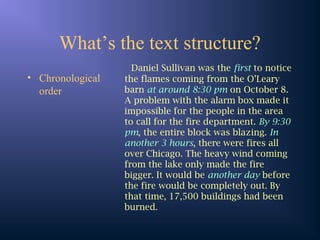
• Chronological
order
Daniel Sullivan was the first to notice
the flames coming from the O’Leary
barn at around 8:30 pm on October 8.
A problem with the alarm box made it
impossible for the people in the area
to call for the fire department. By 9:30
pm, the entire block was blazing. In
another 3 hours, there were fires all
over Chicago. The heavy wind coming
from the lake only made the fire
bigger. It would be another day before
the fire would be completely out. By
that time, 17,500 buildings had been
burned.
What’s the text structure?
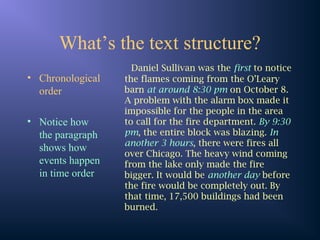
• Chronological
order
• Notice how
the paragraph
shows how
events happen
in time order
Daniel Sullivan was the first to notice
the flames coming from the O’Leary
barn at around 8:30 pm on October 8.
A problem with the alarm box made it
impossible for the people in the area
to call for the fire department. By 9:30
pm, the entire block was blazing. In
another 3 hours, there were fires all
over Chicago. The heavy wind coming
from the lake only made the fire
bigger. It would be another day before
the fire would be completely out. By
that time, 17,500 buildings had been
burned.
What’s the text structure?
Understanding
that this text is
written in
chronological
order can help
you to
understand
how the Great
Fire started.
Daniel Sullivan was the first to notice
the flames coming from the O’Leary
barn at around 8:30 pm on October 8.
A problem with the alarm box made it
impossible for the people in the area
to call for the fire department. By 9:30
pm, the entire block was blazing. In
another 3 hours, there were fires all
over Chicago. The heavy wind coming
from the lake only made the fire
bigger. It would be another day before
the fire would be completely out. By
that time, 17,500 buildings had been
burned.
Try another!
• Chronological
order
• Compare and
contrast
• Cause and
effect
• Problem and
solution
• Description
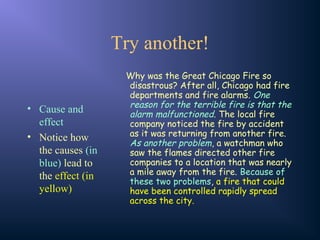
Why was the Great Chicago Fire so
disastrous? After all, Chicago had fire
departments and fire alarms. One
reason for the terrible fire is that the
alarm malfunctioned. The local fire
company noticed the fire by accident
as it was returning from another fire.
As another problem, a watchman who
saw the flames directed other fire
companies to a location that was nearly
a mile away from the fire. Because of
these two problems, a fire that could
have been controlled rapidly spread
across the city.
Try another!
• Compare and
contrast
• Cause and
effect
• Problem and
solution
Why was the Great Chicago Fire so
disastrous? After all, Chicago had fire
departments and fire alarms. One
reason for the terrible fire is that the
alarm malfunctioned. The local fire
company noticed the fire by accident
as it was returning from another fire.
As another problem, a watchman who
saw the flames directed other fire
companies to a location that was nearly
a mile away from the fire. Because of
these two problems, a fire that could
have been controlled rapidly spread
across the city.
Try another!
• Cause and
effect
Why was the Great Chicago Fire so
disastrous? After all, Chicago had fire
departments and fire alarms. One
reason for the terrible fire is that the
alarm malfunctioned. The local fire
company noticed the fire by accident
as it was returning from another fire.
As another problem, a watchman who
saw the flames directed other fire
companies to a location that was nearly
a mile away from the fire. Because of
these two problems, a fire that could
have been controlled rapidly spread
across the city.
Try another!
• Cause and
effect
• Notice how
the causes (in
blue) lead to
the effect (in
yellow)
Why was the Great Chicago Fire so
disastrous? After all, Chicago had fire
departments and fire alarms. One
reason for the terrible fire is that the
alarm malfunctioned. The local fire
company noticed the fire by accident
as it was returning from another fire.
As another problem, a watchman who
saw the flames directed other fire
companies to a location that was nearly
a mile away from the fire. Because of
these two problems, a fire that could
have been controlled rapidly spread
across the city.
What text structure is here?
• Chronological
order
• Compare and
contrast
• Cause and effect
• Problem and
solution
• Description
After the fire, thousands of people
were left homeless. Many escaped the
fire with nothing except the clothes
on their backs. Providing all of these
people with food, clean water, and
shelter was a huge task. Luckily, the
city quickly formed a Relief and Aid
Society. This group started giving out
the food donations that were pouring
in from other cities. The society built
places for people to live, gathered the
tools that people needed to rebuild
their houses, and even vaccinated
64,000 people against smallpox.
What text structure is here?
• Chronological
order
• Cause and effect
• Problem and
solution
After the fire, thousands of people
were left homeless. Many escaped the
fire with nothing except the clothes
on their backs. Providing all of these
people with food, clean water, and
shelter was a huge task. Luckily, the
city quickly formed a Relief and Aid
Society. This group started giving out
the food donations that were pouring
in from other cities. The society built
places for people to live, gathered the
tools that people needed to rebuild
their houses, and even vaccinated
64,000 people against smallpox.
What text structure is here?
• Problem and
solution
After the fire, thousands of people
were left homeless. Many escaped the
fire with nothing except the clothes
on their backs. Providing all of these
people with food, clean water, and
shelter was a huge task. Luckily, the
city quickly formed a Relief and Aid
Society. This group started giving out
the food donations that were pouring
in from other cities. The society built
places for people to live, gathered the
tools that people needed to rebuild
their houses, and even vaccinated
64,000 people against smallpox.
What text structure is here?
• Problem and
solution
• Here is the
problem
After the fire, thousands of people
were left homeless. Many escaped the
fire with nothing except the clothes
on their backs. Providing all of these
people with food, clean water, and
shelter was a huge task. Luckily, the
city quickly formed a Relief and Aid
Society. This group started giving out
the food donations that were pouring
in from other cities. The society built
places for people to live, gathered the
tools that people needed to rebuild
their houses, and even vaccinated
64,000 people against smallpox.
What text structure is here?
• Problem and
solution
• Here is the
solution
After the fire, thousands of people
were left homeless. Many escaped the
fire with nothing except the clothes
on their backs. Providing all of these
people with food, clean water, and
shelter was a huge task. Luckily, the
city quickly formed a Relief and Aid
Society. This group started giving out
the food donations that were pouring
in from other cities. The society built
places for people to live, gathered the
tools that people needed to rebuild
their houses, and even vaccinated
64,000 people against smallpox.
Can you find the text structure?
• Chronological
order
• Compare and
contrast
• Cause and
effect
• Problem and
solution
• Description
Chicago changed in many ways after
the fire. Before the fire, most of the
buildings were less than five stories
high. The buildings that were
constructed after the fire, however,
were some of the first skyscrapers in
the country. Before the fire, most of
the houses were made of wood. After
the fire, people chose to build their
houses out of stone or brick. There were
changes in where people lived, as well.
The poor people in the city lived close to
the center of the city before the fire.
After the fire, they moved into
neighborhoods that were farther away
from the downtown area.
Can you find the text structure?
• Compare and
contrast
• Cause and
effect
• Description
Chicago changed in many ways after
the fire. Before the fire, most of the
buildings were less than five stories
high. The buildings that were
constructed after the fire, however,
were some of the first skyscrapers in
the country. Before the fire, most of
the houses were made of wood. After
the fire, people chose to build their
houses out of stone or brick. There were
changes in where people lived, as well.
The poor people in the city lived close to
the center of the city before the fire.
After the fire, they moved into
neighborhoods that were farther away
from the downtown area.
Can you find the text structure?
• Compare and
contrast
Chicago changed in many ways after
the fire. Before the fire, most of the
buildings were less than five stories
high. The buildings that were
constructed after the fire, however,
were some of the first skyscrapers in
the country. Before the fire, most of
the houses were made of wood. After
the fire, people chose to build their
houses out of stone or brick. There were
changes in where people lived, as well.
The poor people in the city lived close to
the center of the city before the fire.
After the fire, they moved into
neighborhoods that were farther away
from the downtown area.
Can you find the text structure?
• Compare and
contrast
Notice how this
paragraph is
comparing
Chicago
BEFORE the
fire to Chicago
AFTER the fire.
Chicago changed in many ways after
the fire. Before the fire, most of the
buildings were less than five stories
high. The buildings that were
constructed after the fire, however,
were some of the first skyscrapers in
the country. Before the fire, most of
the houses were made of wood. After
the fire, people chose to build their
houses out of stone or brick. There were
changes in where people lived, as well.
The poor people in the city lived close to
the center of the city before the fire.
After the fire, they moved into
neighborhoods that were farther away
from the downtown area.
Can you find the text structure?
• Compare and
contrast
Notice how this
paragraph is
comparing
Chicago
BEFORE the
fire to Chicago
AFTER the fire.
Chicago changed in many ways after
the fire. Before the fire, most of the
buildings were less than five stories
high. The buildings that were
constructed after the fire, however,
were some of the first skyscrapers in
the country. Before the fire, most of
the houses were made of wood. After
the fire, people chose to build their
houses out of stone or brick. There were
changes in where people lived, as well.
The poor people in the city lived close to
the center of the city before the fire.
After the fire, they moved into
neighborhoods that were farther away
from the downtown area.
One more paragraph!
By Monday night, the town
of Chicago was burning.
People described it as
terrible, but amazing. The
flames were brighter than
anything people had ever
seen. The harsh winds swept
the fire across the city with
terrible speed. For many
who watched, it was a sight
to remember for the rest of
their lives.
• Chronological
order
• Compare and
contrast
• Cause and effect
• Problem and
solution
• Description
One more paragraph!
By Monday night, the town
of Chicago was burning.
People described it as
terrible, but amazing. The
flames were brighter than
anything people had ever
seen. The harsh winds swept
the fire across the city with
terrible speed. For many
who watched, it was a sight
to remember for the rest of
their lives.
• Compare and
contrast
• Cause and effect
• Description
One more paragraph!
By Monday night, the town
of Chicago was burning.
People described it as
terrible, but amazing. The
flames were brighter than
anything people had ever
seen. The harsh winds swept
the fire across the city with
terrible speed. For many
who watched, it was a sight
to remember for the rest of
their lives.
• Description
One more paragraph!
By Monday night, the town
of Chicago was burning.
People described it as
terrible, but amazing. The
flames were brighter than
anything people had ever
seen. The harsh winds swept
the fire across the city with
terrible speed. For many
who watched, it was a sight
to remember for the rest of
their lives.
• Description
• Notice the
main idea that
drives the
description.
Reflect on what you have learned
Which text structure
do you find most
interesting to read?
Why?
Reflect on what you have learned
Usually, authors use
many different text
structures in one text.
Can you explain an
example of how two
text structures could
work together?
Reflect on what you have learned
What other questions
do you have about
text structures?

Understanding textstructure informational text

  • 1.
  • 2.
    What is atext structure? A “structure” is a building or framework. “Text structure” refers to how a piece of text is built.
  • 3.
    What is atext structure? Builders can use different kinds of structures to build different things. A skyscraper, for example, is a different kind of structure from a house.
  • 4.
    What is atext structure? Writers use different structures to build their ideas. Each text structure communicates ideas in a different way
  • 5.
    Chronological order Authors use chronologicalorder to explain how things happen in order Chronological order is also called sequence or time order Why might an author use chronological order to write about this frog?
  • 6.
    Chronological order You willknow that you are reading a text in chronological order because you will see words like first, next, later, then, and finally
  • 7.
    Chronological order You willoften see chronological order in directions: Have you ever made macaroni and cheese? It’s simple! First, boil some water and make some macaroni. Then, make your cheese sauce. After the cheese sauce is ready, mix it with the macaroni. Bake the entire thing in the oven. Finally, it’s time to eat!
  • 8.
    Chronological order Notice thetransition words that connect the events in these directions. Have you ever made macaroni and cheese? It’s simple! First, boil some water and make some macaroni. Then, make your cheese sauce. After the cheese sauce is ready, mix it with the macaroni. Bake the entire thing in the oven. Finally, it’s time to eat!
  • 9.
    Which paragraph isin chronological order? Pennsylvania has many historic sites. You can visit Revolutionary war sites, like Valley Forge. You can also visit important locations from the Civil War, like Gettysburg. Finally, you can also see the site of the first oil well in Titusville. Pennsylvania has many neat places to visit! Through the ages, Pennsylvania has seen many interesting events. The state was founded in 1681 by William Penn. Later, Pennsylvania was the site of important Revolutionary War battles. After that, Pennsylvania was home to new factories during the Industrial Revolution. Today, Pennsylvania continues to make history.
  • 10.
    Which paragraph isin chronological order? Through the ages, Pennsylvania has seen many interesting events. The state was founded in 1681 by William Penn. Later, Pennsylvania was the site of important Revolutionary War battles. After that, Pennsylvania was home to new factories during the Industrial Revolution. Today, Pennsylvania continues to make history. This is the paragraph in chronological order. Can you find the clue words that show this order?
  • 11.
    Which paragraph isin chronological order? Through the ages, Pennsylvania has seen many interesting events. The state was founded in 1681 by William Penn. Later, Pennsylvania was the site of important Revolutionary War battles. After that, Pennsylvania was home to new factories during the Industrial Revolution. Today, Pennsylvania continues to make history. This is the paragraph in chronological order. Can you find the clue words that show this order?
  • 12.
    Think about it! •Whatis a structure? •What does chronological order mean? •What are some clue words that show chronological order?
  • 13.
    Another text structure •But what if an author doesn’t want to show how something happened in sequence? • The author would need to use another text structure!
  • 14.
    Compare and contrast Supposean author wanted to explain how these two birds are similar and different. Chronological order wouldn’t work---there is no order of events. The author would need to use compare and contrast.
  • 15.
    Compare and contrast Thecardinal and the goldfinch are two common birds. Both are brightly colored. Both are common at birdfeeders. But the birds have some differences. The male cardinal is a bright red, while the male goldfinch is yellow. Cardinals like shrubs and trees, while goldfinches prefer open meadows.
  • 16.
    When authors usethe text structure of compare and contrast, they often use special clue words to show this text structure. Can you find the clue words in the paragraph? Compare and contrast clue words
  • 17.
    Can you findthe clue words? The cardinal and the goldfinch are two common birds. Both are brightly colored. Both are common at birdfeeders. But the birds have some differences. The male cardinal is a bright red, while the male goldfinch is yellow. Cardinals like shrubs and trees, while goldfinches prefer open meadows.
  • 18.
    Here they are! Thecardinal and the goldfinch are two common birds. Both are brightly colored. Both are common at birdfeeders. But the birds have some differences. The male cardinal is a bright red, while the male goldfinch is yellow. Cardinals like shrubs and trees, while goldfinches prefer open meadows.
  • 19.
    Graphic Organizers Details froma text written as compare and contrast can be organized as a Venn diagram. Goldfinch Cardinal Both
  • 20.
    Graphic Organizers We canalso use a chart to show the details. Goldfinch Cardinal Colors Habitat
  • 21.
    • Can youexplain the difference between chronological order and compare and contrast? • How can clue words help you as a reader? Graphic Organizers
  • 22.
    Another text structure Sometimes,a writer wants to explain how one event leads to another. This kind of text structure is called cause and effect.
  • 23.
    Cause and Effect Whenauthors write paragraphs to show causes and effects, they use words like cause, effect, as a result, consequently, and so.
  • 24.
    Can you findthe clue words? The night’s snowstorm had many effects. People were out shoveling snow from their sidewalks. The power lines were draped with ice. Snow plows drove down every street. Children were the happiest of all. The unexpected snow caused school to be cancelled!
  • 25.
    Can you findthe clue words? The night’s snowstorm had many effects. People were out shoveling snow from their sidewalks. The power lines were draped with ice. Snow plows drove down every street. Children were the happiest of all. The unexpected snow caused school to be cancelled!
  • 26.
    More with causeand effect Baby painted turtles spend all winter in their nests. They have special chemicals in their blood that can keep their blood from freezing. As a result, baby painted turtles can survive freezing temperatures! Can you find the causes and effects in this paragraph?
  • 27.
    More with causeand effect Baby painted turtles spend all winter in their nests. They have special chemicals in their blood that can keep their blood from freezing. As a result, baby painted turtles can survive freezing temperatures! This is the cause.
  • 28.
    More with causeand effect Baby painted turtles spend all winter in their nests. They have special chemicals in their blood that can keep their blood from freezing. As a result, baby painted turtles can survive freezing temperatures! This is the effect.
  • 29.
    Review Which text structuretells about how things are similar and different? Compare and contrast How does the text structure of compare and contrast relate to these pictures of a frog and a toad?
  • 30.
    Review Which text structureexplains how things happen in time order? Chronological Order How do these pictures relate to chronological order?
  • 31.
    Problem and SolutionText Structure Sometimes, an author will want to explain a problem, and then show one or more solutions. This kind of text structure is called problem and solution.
  • 32.
    An example ofproblem and solution Heavy rains can cause flooding in small streams. For weather forecasters and local authorities, this flooding can be difficult to predict. Fortunately, the United States Geological Survey (USGS) has more than 7,000 streamgages that measure water flow. These streamgages help scientists to monitor water levels in good and bad weather. What is the problem in this paragraph?
  • 33.
    An example ofproblem and solution Heavy rains can cause flooding in small streams. For weather forecasters and local authorities, this flooding can be difficult to predict. Fortunately, the United States Geological Survey (USGS) has more than 7,000 streamgages that measure water flow. These streamgages help scientists to monitor water levels in good and bad weather.
  • 34.
    An example ofproblem and solution Heavy rains can cause flooding in small streams. For weather forecasters and local authorities, this flooding can be difficult to predict. Fortunately, the United States Geological Survey (USGS) has more than 7,000 streamgages that measure water flow. These streamgages help scientists to monitor water levels in good and bad weather. What is the solution in this paragraph?
  • 35.
    An example ofproblem and solution Heavy rains can cause flooding in small streams. For weather forecasters and local authorities, this flooding can be difficult to predict. Fortunately, the United States Geological Survey (USGS) has more than 7,000 streamgages that measure water flow. These streamgages help scientists to monitor water levels in good and bad weather.
  • 36.
    Problem and Solution Often,authors will signal problem and solution structure with clue words like problem and solution.
  • 37.
    Problem and Solution Synonymsfor problem include difficulty, struggle, uncertainty, worry, threat, and trouble Synonyms for solution include possibility, hope, bright spot, answer, and future
  • 38.
    Can you findthe problems and solutions? Brown marmorated stinkbugs have caused many problems since they were accidentally introduced to North America. They damage fruit, bother people, and harm crops. Scientists are trying to find a solution. One promising possibility is a species of wasp that originally comes from Asia. This wasp is a predator of stinkbugs. Scientists hope that this wasp could solve the stinkbug problem. What is the problem?
  • 39.
    Can you findthe problems and solutions? Brown marmorated stinkbugs have caused many problems since they were accidentally introduced to North America. They damage fruit, bother people, and harm crops. Scientists are trying to find a solution. One promising possibility is a species of wasp that originally comes from Asia. This wasp is a predator of stinkbugs. Scientists hope that this wasp could solve the stinkbug problem.
  • 40.
    Can you findthe problems and solutions? Brown marmorated stinkbugs have caused many problems since they were accidentally introduced to North America. They damage fruit, bother people, and harm crops. Scientists are trying to find a solution. One promising possibility is a species of wasp that originally comes from Asia. This wasp is a predator of stinkbugs. Scientists hope that this wasp could solve the stinkbug problem. What is the solution?
  • 41.
    Can you findthe problems and solutions? Brown marmorated stinkbugs have caused many problems since they were accidentally introduced to North America. They damage fruit, bother people, and harm crops. Scientists are trying to find a solution. One promising possibility is a species of wasp that originally comes from Asia. This wasp is a predator of stinkbugs. Scientists hope that this wasp could solve the stinkbug problem.
  • 42.
    Text structures we’ve learnedso far • Chronological order • Compare and contrast • Cause and effect • Problem and solution
  • 43.
    Match the cluewords! however, on the other hand, similarity, like, unlike Can you figure out the text structure that these clue words point to? Compare and contrast
  • 44.
    Match the cluewords! as a result, consequently, therefore, so, cause, effect Can you figure out the text structure that these clue words point to? Cause and effect
  • 45.
    Match the cluewords! problem, solution, threat, difficulty, hope, answer, possibility Can you figure out the text structure that these clue words point to? Problem and solution
  • 46.
    Description This text structureis used to describe a location, idea, or event.
  • 47.
    The pond wasa beautiful place to visit. The falling leaves, all different colors, decorated the surface of the water. At the edges of the pond, small wildflowers grew. The golden forest glowed faintly in the distance. Description
  • 48.
    The pond wasa beautiful place to visit. The falling leaves, all different colors, decorated the surface of the water. At the edges of the pond, small wildflowers grew. The golden forest glowed faintly in the distance. Main idea Description
  • 49.
    The pond wasa beautiful place to visit. The falling leaves, all different colors, decorated the surface of the water. At the edges of the pond, small wildflowers grew. The golden forest glowed faintly in the distance. Main idea All of the other sentences support the main idea and describe the pond. Description
  • 50.
    Clue words inthese paragraphs may include: One reason, another reason, and for example Description
  • 51.
    These paragraphs may alsoinclude spatial order words to show how details relate to each other: next to, by, along, in, above, and so forth Description
  • 52.
    Now it’s yourturn! On the next few slides, you will read some paragraphs about the Great Chicago Fire. Your task is to identify the text structure for each one.
  • 53.
    What’s the textstructure? • Chronological order • Compare and contrast • Cause and effect • Problem and solution • Description Daniel Sullivan was the first to notice the flames coming from the O’Leary barn at around 8:30 pm on October 8. A problem with the alarm box made it impossible for the people in the area to call for the fire department. By 9:30 pm, the entire block was blazing. In another 3 hours, there were fires all over Chicago. The heavy wind coming from the lake only made the fire bigger. It would be another day before the fire would be completely out. By that time, 17,500 buildings had been burned.
  • 54.
    What’s the textstructure? • Chronological order • Compare and contrast • Problem and solution Daniel Sullivan was the first to notice the flames coming from the O’Leary barn at around 8:30 pm on October 8. A problem with the alarm box made it impossible for the people in the area to call for the fire department. By 9:30 pm, the entire block was blazing. In another 3 hours, there were fires all over Chicago. The heavy wind coming from the lake only made the fire bigger. It would be another day before the fire would be completely out. By that time, 17,500 buildings had been burned.
  • 55.
    What’s the textstructure? • Chronological order Daniel Sullivan was the first to notice the flames coming from the O’Leary barn at around 8:30 pm on October 8. A problem with the alarm box made it impossible for the people in the area to call for the fire department. By 9:30 pm, the entire block was blazing. In another 3 hours, there were fires all over Chicago. The heavy wind coming from the lake only made the fire bigger. It would be another day before the fire would be completely out. By that time, 17,500 buildings had been burned.
  • 56.
    What’s the textstructure? • Chronological order Daniel Sullivan was the first to notice the flames coming from the O’Leary barn at around 8:30 pm on October 8. A problem with the alarm box made it impossible for the people in the area to call for the fire department. By 9:30 pm, the entire block was blazing. In another 3 hours, there were fires all over Chicago. The heavy wind coming from the lake only made the fire bigger. It would be another day before the fire would be completely out. By that time, 17,500 buildings had been burned.
  • 57.
    What’s the textstructure? • Chronological order • Notice how the paragraph shows how events happen in time order Daniel Sullivan was the first to notice the flames coming from the O’Leary barn at around 8:30 pm on October 8. A problem with the alarm box made it impossible for the people in the area to call for the fire department. By 9:30 pm, the entire block was blazing. In another 3 hours, there were fires all over Chicago. The heavy wind coming from the lake only made the fire bigger. It would be another day before the fire would be completely out. By that time, 17,500 buildings had been burned.
  • 58.
    What’s the textstructure? Understanding that this text is written in chronological order can help you to understand how the Great Fire started. Daniel Sullivan was the first to notice the flames coming from the O’Leary barn at around 8:30 pm on October 8. A problem with the alarm box made it impossible for the people in the area to call for the fire department. By 9:30 pm, the entire block was blazing. In another 3 hours, there were fires all over Chicago. The heavy wind coming from the lake only made the fire bigger. It would be another day before the fire would be completely out. By that time, 17,500 buildings had been burned.
  • 59.
    Try another! • Chronological order •Compare and contrast • Cause and effect • Problem and solution • Description Why was the Great Chicago Fire so disastrous? After all, Chicago had fire departments and fire alarms. One reason for the terrible fire is that the alarm malfunctioned. The local fire company noticed the fire by accident as it was returning from another fire. As another problem, a watchman who saw the flames directed other fire companies to a location that was nearly a mile away from the fire. Because of these two problems, a fire that could have been controlled rapidly spread across the city.
  • 60.
    Try another! • Compareand contrast • Cause and effect • Problem and solution Why was the Great Chicago Fire so disastrous? After all, Chicago had fire departments and fire alarms. One reason for the terrible fire is that the alarm malfunctioned. The local fire company noticed the fire by accident as it was returning from another fire. As another problem, a watchman who saw the flames directed other fire companies to a location that was nearly a mile away from the fire. Because of these two problems, a fire that could have been controlled rapidly spread across the city.
  • 61.
    Try another! • Causeand effect Why was the Great Chicago Fire so disastrous? After all, Chicago had fire departments and fire alarms. One reason for the terrible fire is that the alarm malfunctioned. The local fire company noticed the fire by accident as it was returning from another fire. As another problem, a watchman who saw the flames directed other fire companies to a location that was nearly a mile away from the fire. Because of these two problems, a fire that could have been controlled rapidly spread across the city.
  • 62.
    Try another! • Causeand effect • Notice how the causes (in blue) lead to the effect (in yellow) Why was the Great Chicago Fire so disastrous? After all, Chicago had fire departments and fire alarms. One reason for the terrible fire is that the alarm malfunctioned. The local fire company noticed the fire by accident as it was returning from another fire. As another problem, a watchman who saw the flames directed other fire companies to a location that was nearly a mile away from the fire. Because of these two problems, a fire that could have been controlled rapidly spread across the city.
  • 63.
    What text structureis here? • Chronological order • Compare and contrast • Cause and effect • Problem and solution • Description After the fire, thousands of people were left homeless. Many escaped the fire with nothing except the clothes on their backs. Providing all of these people with food, clean water, and shelter was a huge task. Luckily, the city quickly formed a Relief and Aid Society. This group started giving out the food donations that were pouring in from other cities. The society built places for people to live, gathered the tools that people needed to rebuild their houses, and even vaccinated 64,000 people against smallpox.
  • 64.
    What text structureis here? • Chronological order • Cause and effect • Problem and solution After the fire, thousands of people were left homeless. Many escaped the fire with nothing except the clothes on their backs. Providing all of these people with food, clean water, and shelter was a huge task. Luckily, the city quickly formed a Relief and Aid Society. This group started giving out the food donations that were pouring in from other cities. The society built places for people to live, gathered the tools that people needed to rebuild their houses, and even vaccinated 64,000 people against smallpox.
  • 65.
    What text structureis here? • Problem and solution After the fire, thousands of people were left homeless. Many escaped the fire with nothing except the clothes on their backs. Providing all of these people with food, clean water, and shelter was a huge task. Luckily, the city quickly formed a Relief and Aid Society. This group started giving out the food donations that were pouring in from other cities. The society built places for people to live, gathered the tools that people needed to rebuild their houses, and even vaccinated 64,000 people against smallpox.
  • 66.
    What text structureis here? • Problem and solution • Here is the problem After the fire, thousands of people were left homeless. Many escaped the fire with nothing except the clothes on their backs. Providing all of these people with food, clean water, and shelter was a huge task. Luckily, the city quickly formed a Relief and Aid Society. This group started giving out the food donations that were pouring in from other cities. The society built places for people to live, gathered the tools that people needed to rebuild their houses, and even vaccinated 64,000 people against smallpox.
  • 67.
    What text structureis here? • Problem and solution • Here is the solution After the fire, thousands of people were left homeless. Many escaped the fire with nothing except the clothes on their backs. Providing all of these people with food, clean water, and shelter was a huge task. Luckily, the city quickly formed a Relief and Aid Society. This group started giving out the food donations that were pouring in from other cities. The society built places for people to live, gathered the tools that people needed to rebuild their houses, and even vaccinated 64,000 people against smallpox.
  • 68.
    Can you findthe text structure? • Chronological order • Compare and contrast • Cause and effect • Problem and solution • Description Chicago changed in many ways after the fire. Before the fire, most of the buildings were less than five stories high. The buildings that were constructed after the fire, however, were some of the first skyscrapers in the country. Before the fire, most of the houses were made of wood. After the fire, people chose to build their houses out of stone or brick. There were changes in where people lived, as well. The poor people in the city lived close to the center of the city before the fire. After the fire, they moved into neighborhoods that were farther away from the downtown area.
  • 69.
    Can you findthe text structure? • Compare and contrast • Cause and effect • Description Chicago changed in many ways after the fire. Before the fire, most of the buildings were less than five stories high. The buildings that were constructed after the fire, however, were some of the first skyscrapers in the country. Before the fire, most of the houses were made of wood. After the fire, people chose to build their houses out of stone or brick. There were changes in where people lived, as well. The poor people in the city lived close to the center of the city before the fire. After the fire, they moved into neighborhoods that were farther away from the downtown area.
  • 70.
    Can you findthe text structure? • Compare and contrast Chicago changed in many ways after the fire. Before the fire, most of the buildings were less than five stories high. The buildings that were constructed after the fire, however, were some of the first skyscrapers in the country. Before the fire, most of the houses were made of wood. After the fire, people chose to build their houses out of stone or brick. There were changes in where people lived, as well. The poor people in the city lived close to the center of the city before the fire. After the fire, they moved into neighborhoods that were farther away from the downtown area.
  • 71.
    Can you findthe text structure? • Compare and contrast Notice how this paragraph is comparing Chicago BEFORE the fire to Chicago AFTER the fire. Chicago changed in many ways after the fire. Before the fire, most of the buildings were less than five stories high. The buildings that were constructed after the fire, however, were some of the first skyscrapers in the country. Before the fire, most of the houses were made of wood. After the fire, people chose to build their houses out of stone or brick. There were changes in where people lived, as well. The poor people in the city lived close to the center of the city before the fire. After the fire, they moved into neighborhoods that were farther away from the downtown area.
  • 72.
    Can you findthe text structure? • Compare and contrast Notice how this paragraph is comparing Chicago BEFORE the fire to Chicago AFTER the fire. Chicago changed in many ways after the fire. Before the fire, most of the buildings were less than five stories high. The buildings that were constructed after the fire, however, were some of the first skyscrapers in the country. Before the fire, most of the houses were made of wood. After the fire, people chose to build their houses out of stone or brick. There were changes in where people lived, as well. The poor people in the city lived close to the center of the city before the fire. After the fire, they moved into neighborhoods that were farther away from the downtown area.
  • 73.
    One more paragraph! ByMonday night, the town of Chicago was burning. People described it as terrible, but amazing. The flames were brighter than anything people had ever seen. The harsh winds swept the fire across the city with terrible speed. For many who watched, it was a sight to remember for the rest of their lives. • Chronological order • Compare and contrast • Cause and effect • Problem and solution • Description
  • 74.
    One more paragraph! ByMonday night, the town of Chicago was burning. People described it as terrible, but amazing. The flames were brighter than anything people had ever seen. The harsh winds swept the fire across the city with terrible speed. For many who watched, it was a sight to remember for the rest of their lives. • Compare and contrast • Cause and effect • Description
  • 75.
    One more paragraph! ByMonday night, the town of Chicago was burning. People described it as terrible, but amazing. The flames were brighter than anything people had ever seen. The harsh winds swept the fire across the city with terrible speed. For many who watched, it was a sight to remember for the rest of their lives. • Description
  • 76.
    One more paragraph! ByMonday night, the town of Chicago was burning. People described it as terrible, but amazing. The flames were brighter than anything people had ever seen. The harsh winds swept the fire across the city with terrible speed. For many who watched, it was a sight to remember for the rest of their lives. • Description • Notice the main idea that drives the description.
  • 77.
    Reflect on whatyou have learned Which text structure do you find most interesting to read? Why?
  • 78.
    Reflect on whatyou have learned Usually, authors use many different text structures in one text. Can you explain an example of how two text structures could work together?
  • 79.
    Reflect on whatyou have learned What other questions do you have about text structures?

Editor's Notes

  • #2 By Emily Kissner, including all photos.