Learning Objectives
This lesson will help students
 Recognize the structure and features of a variety of information based
text
 Understand how information based texts are used and how they help
readers
 Know strategies for reading information-based texts
 Identify different types of information-based texts
Author’s purpose
Authors write for different purposes. They may
write
To entertain
To persuade
To inform
Sometimes the author's purpose (reason for
writing) affects what they write.
It's important for you to recognize that as you read.
What is the author’s purpose
For example, if an author is writing to persuade, then his/her writing
will contain only information that will encourage you to share his/her
beliefs.
Look at the reading passage on the next page. This writing is trying
to persuade you by sharing their opinion.
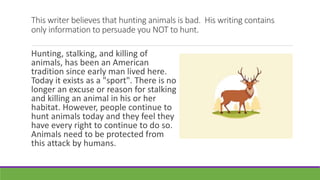
This writer believes that hunting animals is bad. His writing contains
only information to persuade you NOT to hunt.
Hunting, stalking, and killing of
animals, has been an American
tradition since early man lived here.
Today it exists as a "sport". There is no
longer an excuse or reason for stalking
and killing an animal in his or her
habitat. However, people continue to
hunt animals today and they feel they
have every right to continue to do so.
Animals need to be protected from
this attack by humans.
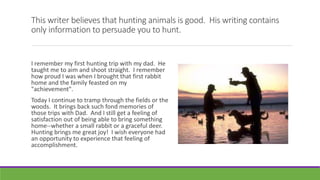
This writer believes that hunting animals is good. His writing contains
only information to persuade you to hunt.
I remember my first hunting trip with my dad. He
taught me to aim and shoot straight. I remember
how proud I was when I brought that first rabbit
home and the family feasted on my
"achievement".
Today I continue to tramp through the fields or the
woods. It brings back such fond memories of
those trips with Dad. And I still get a feeling of
satisfaction out of being able to bring something
home--whether a small rabbit or a graceful deer.
Hunting brings me great joy! I wish everyone had
an opportunity to experience that feeling of
accomplishment.
Think about the author’s purpose when
you are reading information text.
The author's purpose, or reason for
writing, affects the content of what
he/she writes. As a reader, you need
to become aware of that purpose so
that you can evaluate the content of
what the author is writing.
In other words…YOU CAN'T BELIEVE
EVERYTHING YOU READ!
Think about why the author is writing
as you read for information.
Writing that is meant to inform is called
information text. Some examples are:
newspaper or
magazine articles
information leaflets
websites
biographies
advertisements
reviews
literary nonfiction
documentaries
news clips
public service
announcements
manuals
maps
Remember, even when reading information text the
author may have a purpose. Read below. What is
this author’s purpose?
The Surgeon General has reported on the effects
smoking has on the health of adults. Furthermore
recent studies have found that individuals exposed
to second-hand smoke over a period of time also
suffer adverse affects to their health. Parents
should avoid exposing their children to cigarette
smoke and should educate their children on the
affects smoking can have on health.

Ela grade 4 lesson 1 Author's Purpose

  • 1.
    Learning Objectives This lessonwill help students  Recognize the structure and features of a variety of information based text  Understand how information based texts are used and how they help readers  Know strategies for reading information-based texts  Identify different types of information-based texts
  • 2.
    Author’s purpose Authors writefor different purposes. They may write To entertain To persuade To inform Sometimes the author's purpose (reason for writing) affects what they write. It's important for you to recognize that as you read.
  • 3.
    What is theauthor’s purpose For example, if an author is writing to persuade, then his/her writing will contain only information that will encourage you to share his/her beliefs. Look at the reading passage on the next page. This writing is trying to persuade you by sharing their opinion.
  • 4.
    This writer believesthat hunting animals is bad. His writing contains only information to persuade you NOT to hunt. Hunting, stalking, and killing of animals, has been an American tradition since early man lived here. Today it exists as a "sport". There is no longer an excuse or reason for stalking and killing an animal in his or her habitat. However, people continue to hunt animals today and they feel they have every right to continue to do so. Animals need to be protected from this attack by humans.
  • 5.
    This writer believesthat hunting animals is good. His writing contains only information to persuade you to hunt. I remember my first hunting trip with my dad. He taught me to aim and shoot straight. I remember how proud I was when I brought that first rabbit home and the family feasted on my "achievement". Today I continue to tramp through the fields or the woods. It brings back such fond memories of those trips with Dad. And I still get a feeling of satisfaction out of being able to bring something home--whether a small rabbit or a graceful deer. Hunting brings me great joy! I wish everyone had an opportunity to experience that feeling of accomplishment.
  • 6.
    Think about theauthor’s purpose when you are reading information text. The author's purpose, or reason for writing, affects the content of what he/she writes. As a reader, you need to become aware of that purpose so that you can evaluate the content of what the author is writing. In other words…YOU CAN'T BELIEVE EVERYTHING YOU READ! Think about why the author is writing as you read for information.
  • 7.
    Writing that ismeant to inform is called information text. Some examples are: newspaper or magazine articles information leaflets websites biographies advertisements reviews literary nonfiction documentaries news clips public service announcements manuals maps
  • 8.
    Remember, even whenreading information text the author may have a purpose. Read below. What is this author’s purpose? The Surgeon General has reported on the effects smoking has on the health of adults. Furthermore recent studies have found that individuals exposed to second-hand smoke over a period of time also suffer adverse affects to their health. Parents should avoid exposing their children to cigarette smoke and should educate their children on the affects smoking can have on health.