Class 4:
Understanding
Stakeholders &
    MAkers

Instructor: Abby Covert
Last Class we...


                   2
Last Class we...

• Shared our findings from exploring our
  problem space’s complexity


                                          2
Last Class we...

• Shared our findings from exploring our
  problem space’s complexity
• Learned about understanding people and
  their needs as users


                                           2
Last Class we...

• Shared our findings from exploring our
  problem space’s complexity
• Learned about understanding people and
  their needs as users
• Admitted our assumptions


                                           2
Last Class we...

• Shared our findings from exploring our
  problem space’s complexity
• Learned about understanding people and
  their needs as users
• Admitted our assumptions
• Mapped our potential users and prioritized
  them to do further research


                                               2
Last Class we...

• Shared our findings from exploring our
  problem space’s complexity
• Learned about understanding people and
  their needs as users
• Admitted our assumptions
• Mapped our potential users and prioritized
  them to do further research
• Assigned some homework, due today!

                                               2
Homework Share


                 3
Homework Share

• Each team will have the next 15 minutes to share
  with each other the results of their homework
  assignment


                                                     3
Homework Share

• Each team will have the next 15 minutes to share
  with each other the results of their homework
  assignment
• Make a list as a group of all the things you would like
  to do as research.


                                                            3
Homework Share

• Each team will have the next 15 minutes to share
  with each other the results of their homework
  assignment
• Make a list as a group of all the things you would like
  to do as research.
• Place a * next to the ones you could do in the next
  week if I asked you to


                                                            3
Homework Share

• Each team will have the next 15 minutes to share
  with each other the results of their homework
  assignment
• Make a list as a group of all the things you would like
  to do as research.
• Place a * next to the ones you could do in the next
  week if I asked you to
• Place a ** next to those that would take more time
  than a week but you feel you could do with what you
  have

                                                            3
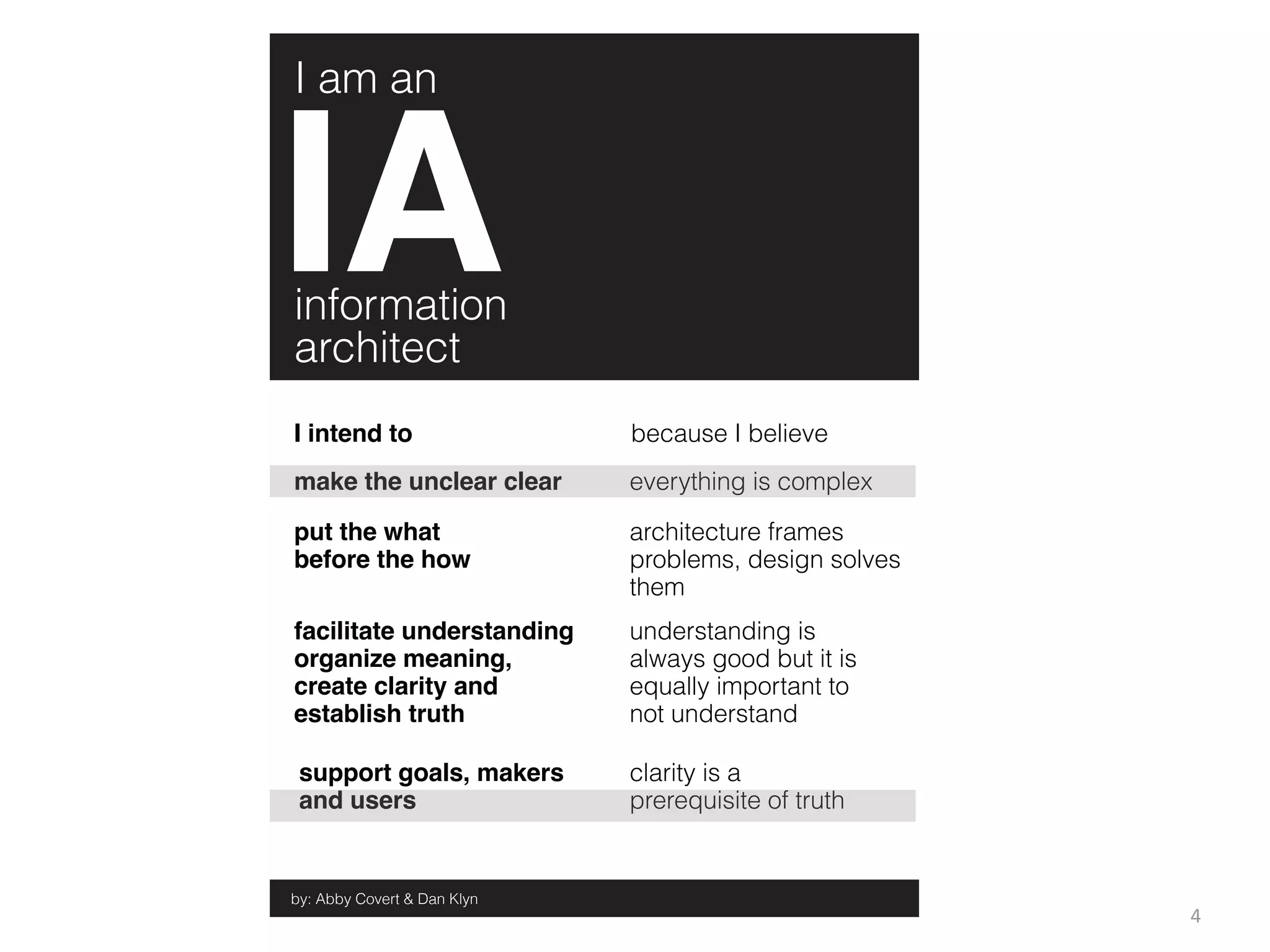
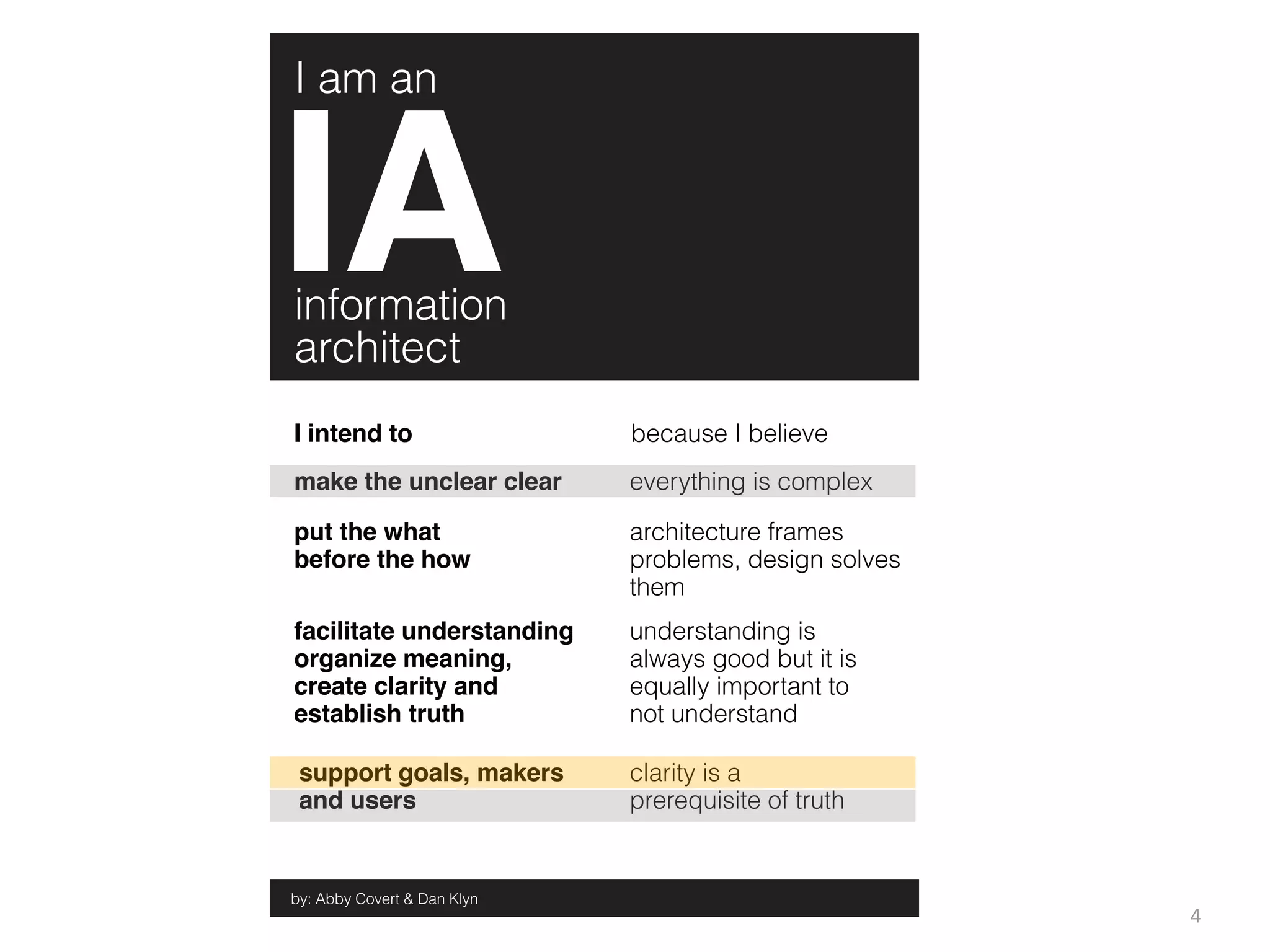
I am an


information
architect
I intend to                  because I believe
make the unclear clear       everything is complex

put the what                 architecture frames
before the how               problems, design solves
                             them
facilitate understanding     understanding is
organize meaning,            always good but it is
create clarity and           equally important to
establish truth              not understand

 support goals, makers       clarity is a
 and users                   prerequisite of truth


by: Abby Covert & Dan Klyn
                                                       4
I am an


information
architect
I intend to                  because I believe
make the unclear clear       everything is complex

put the what                 architecture frames
before the how               problems, design solves
                             them
facilitate understanding     understanding is
organize meaning,            always good but it is
create clarity and           equally important to
establish truth              not understand

 support goals, makers       clarity is a
 and users                   prerequisite of truth


by: Abby Covert & Dan Klyn
                                                       4
What does
it mean to
have Stake?


              5
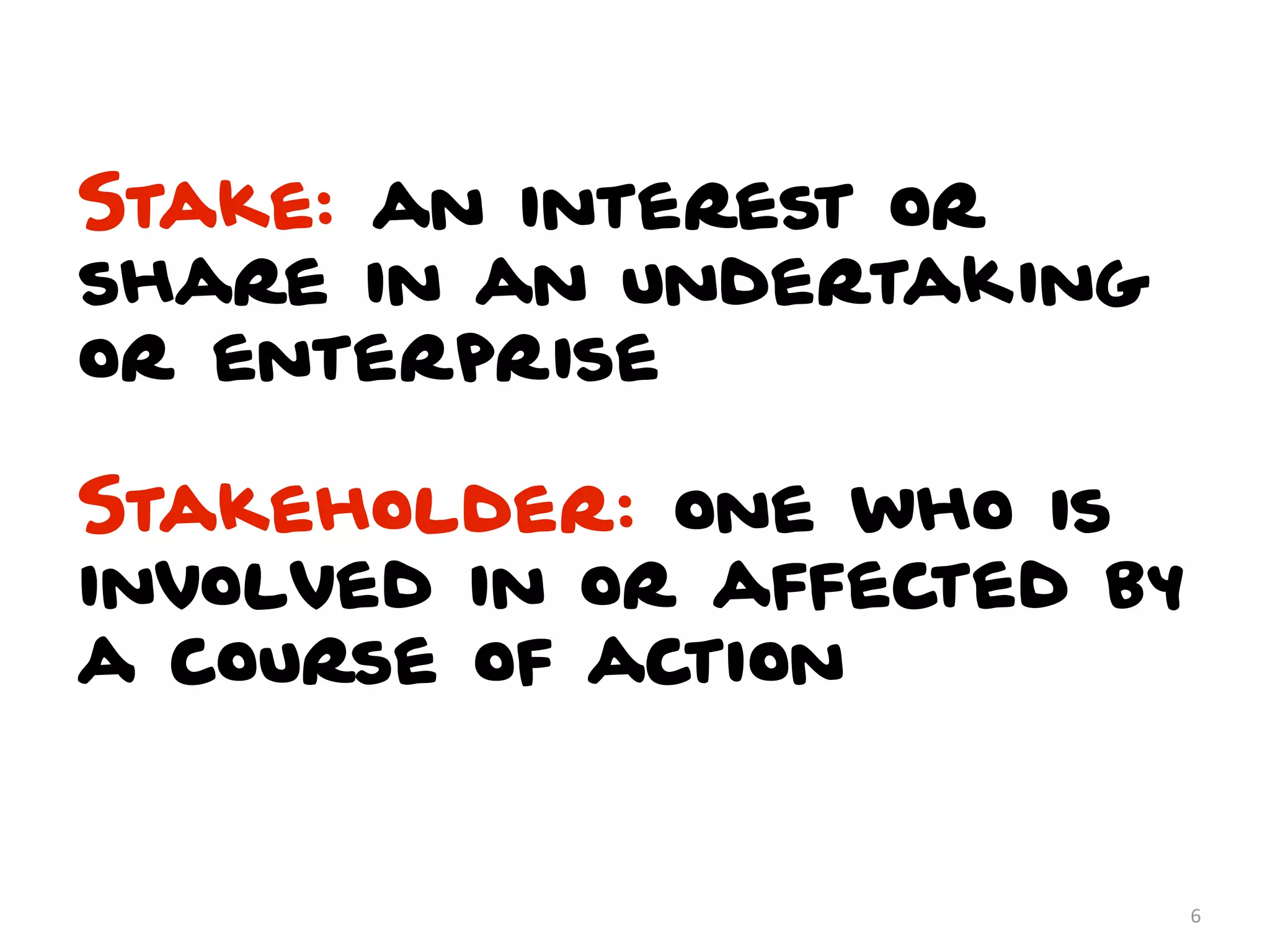
Stake: an interest or
share in an undertaking
or enterprise

Stakeholder: one who is
involved in or affected by
a course of action


                             6
Who makes
the Stake?


             7
Make:

1. to cause to happen to or be
experienced by someone

2. to cause to exist, occur, or
appear

Maker: a person, company or
machine who makes something


                                  8
What do you need
 to make stake?


                   9
MAkers Need:
- to understand goals
- To have a clear sense of scope
- To know what is next

Stakeholders Need:
- To set measurable goals
- to understand the implications of scope
- To plan for the future


                                       10
Scope: The extent of the
 area or subject matter
that something deals with
or to which it is relevant.


                              11
Why is scope
important?


               12
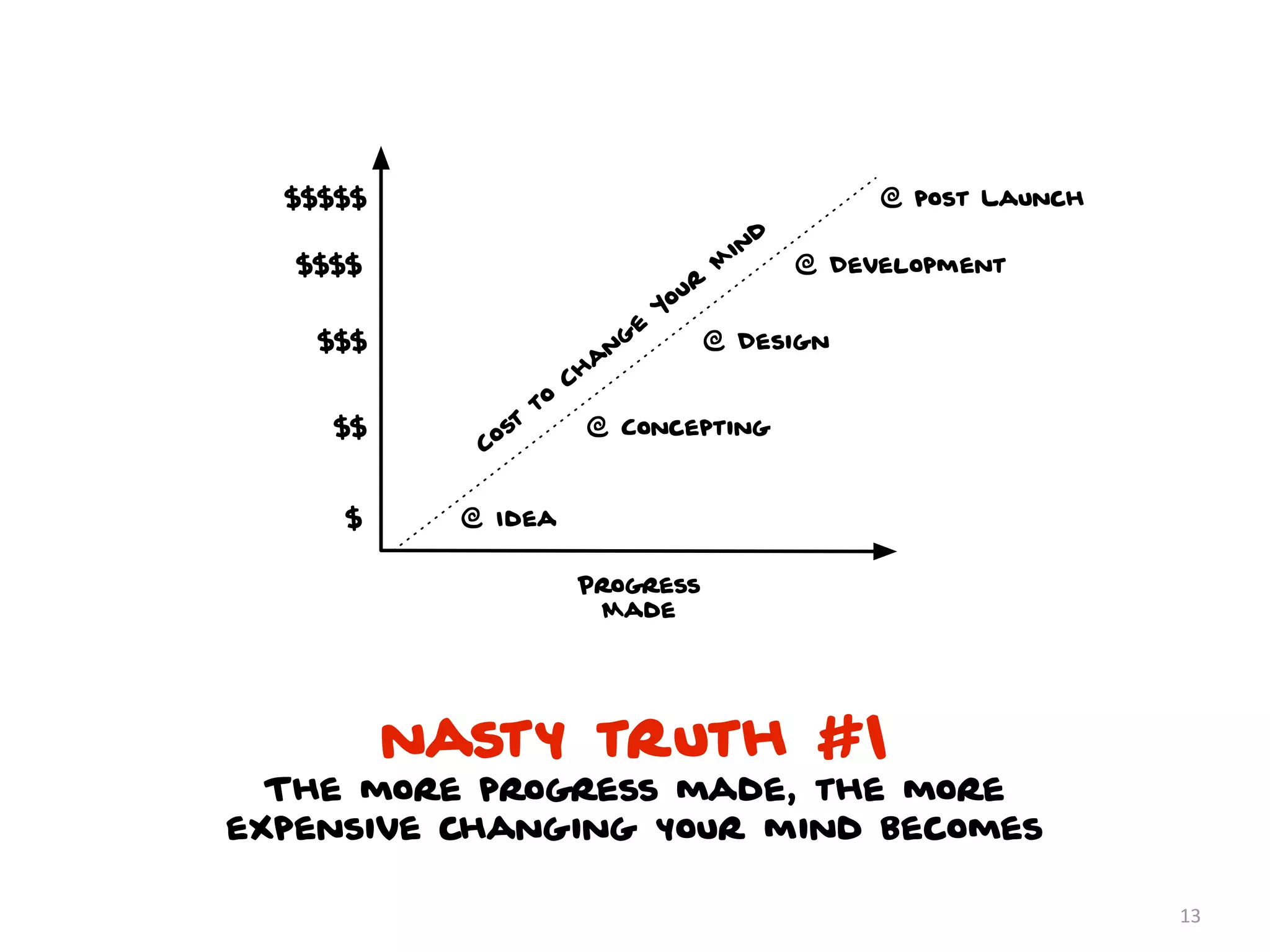
$$$$$                                                 @ post Launch
                                               d
                                            in
   $$$$                                    M       @ Development
                                      ur
                                    Yo
                                e
    $$$                        g         @ Design
                            n
                           a
                         Ch
                    to
     $$         t         @ Concepting
             Cos


      $     @ Idea


                         Progress
                          Made


          nasty truth #1
  The more progress made, the more
expensive changing your mind becomes

                                                                        13
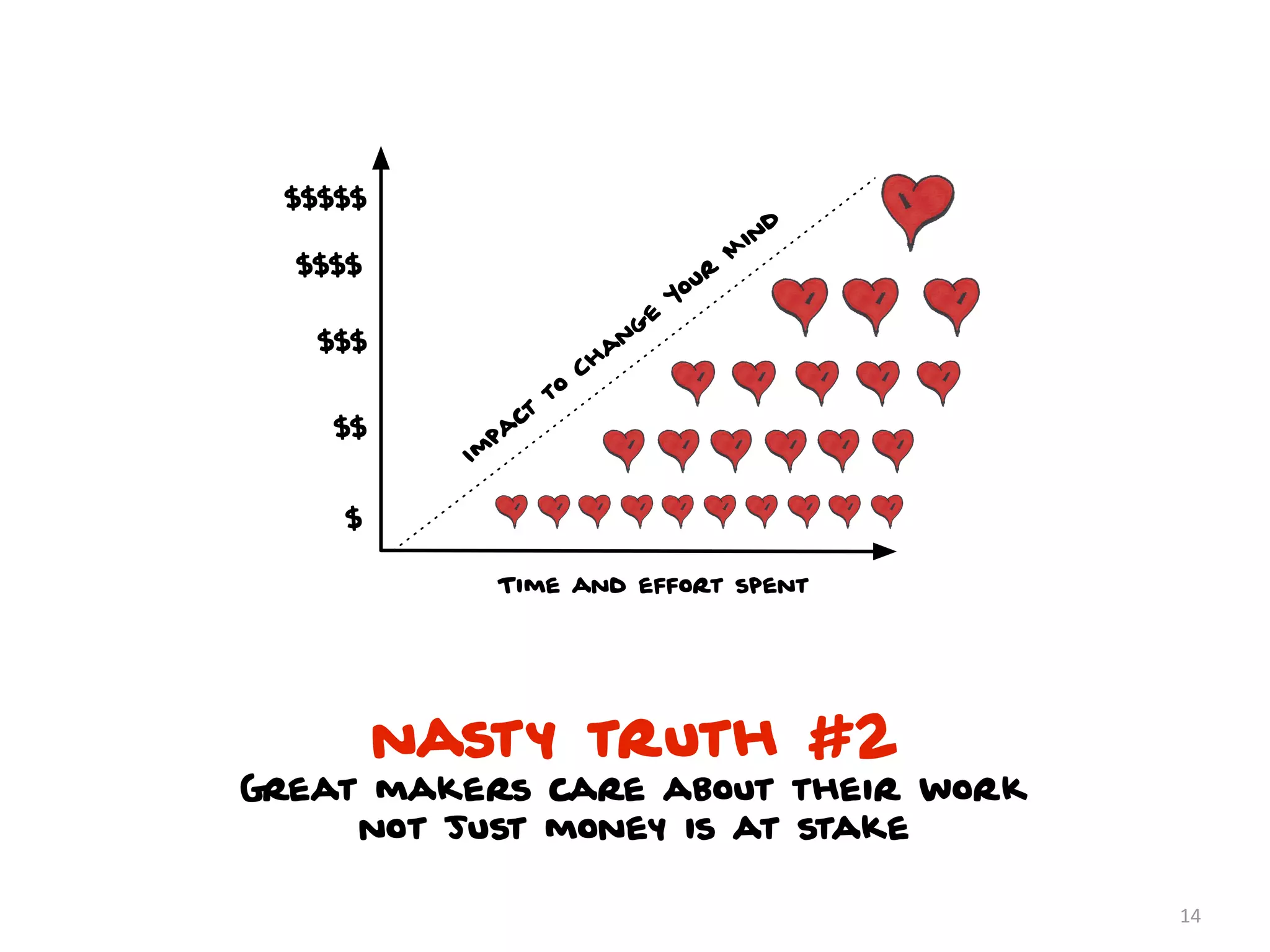
$$$$$
                                                  d
                                                in
                                               M
  $$$$
                                          ur
                                     Yo
                                 e
                                g
   $$$                         n
                           a
                         Ch
                    to
    $$         ct
             pa
           Im

     $


             Time and effort spent


         nasty truth #2
Great makers care about their work
     not just money is at stake

                                                      14
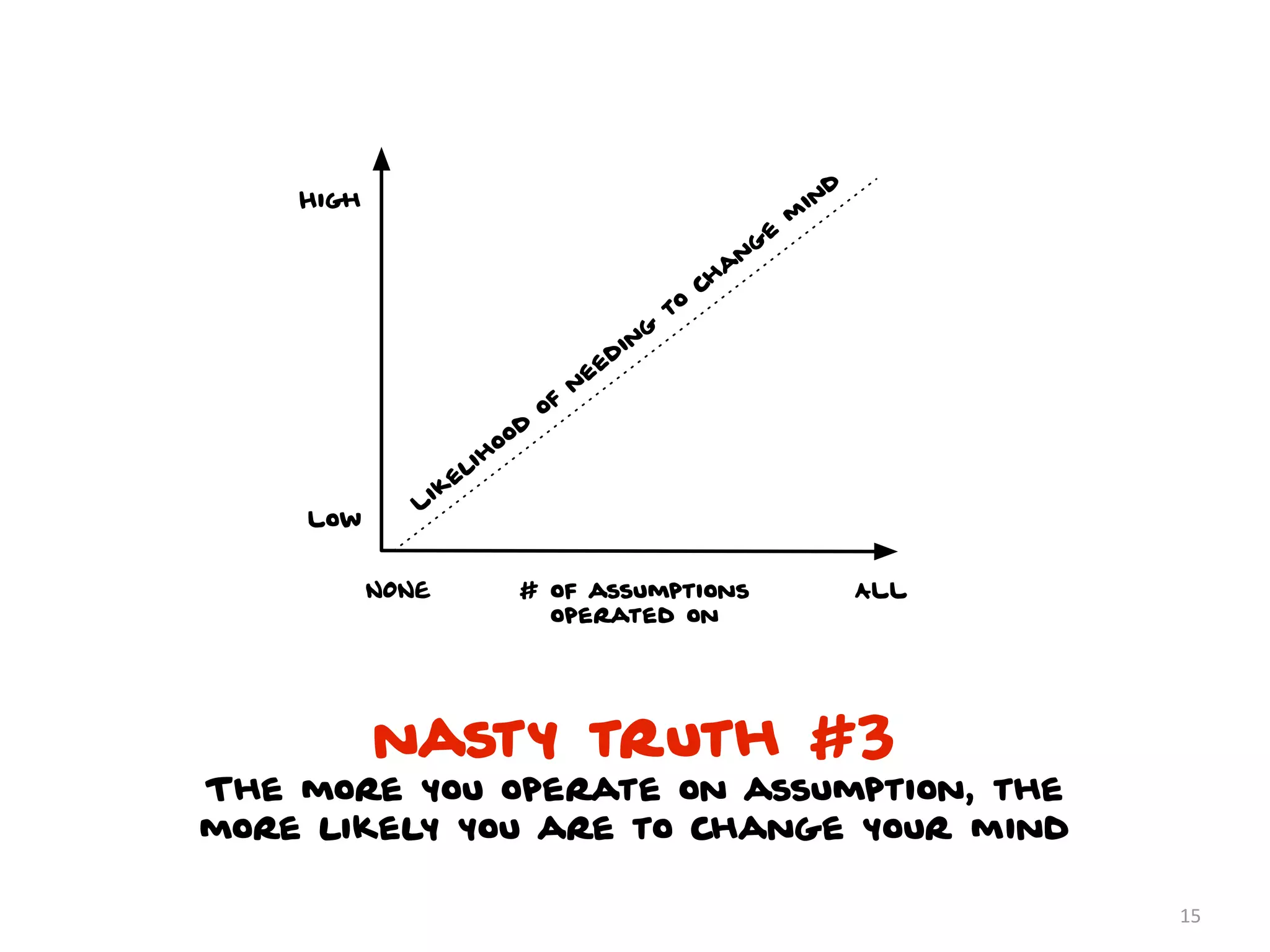
d
    High                                                       in
                                                              m
                                                          e
                                                         g
                                                       n
                                                      a
                                                    ch
                                               to
                                           g
                                         in
                                       d
                                    ee
                                   n
                              of
                          d
                        oo
                      ih
                    el
                  ik
              L
    Low


           NONE            # of assumptions                           ALL
                             operated on


           nasty truth #3
The more you operate on assumption, the
more likely you are to change your mind

                                                                            15
Assumptions that are common


                              16
Assumptions that are common

• Complexity Involved: “This is simple...”


                                             16
Assumptions that are common

• Complexity Involved: “This is simple...”
• User Needs: “What they need is...”


                                             16
Assumptions that are common

• Complexity Involved: “This is simple...”
• User Needs: “What they need is...”
• Resources: “So-n-so knows how to do that...”


                                             16
Assumptions that are common

•   Complexity Involved: “This is simple...”
•   User Needs: “What they need is...”
•   Resources: “So-n-so knows how to do that...”
•   Money: “Yea, a week should be enough...”


                                               16
What eliminates
 assumptions so
progress can be
  productive?


                  17
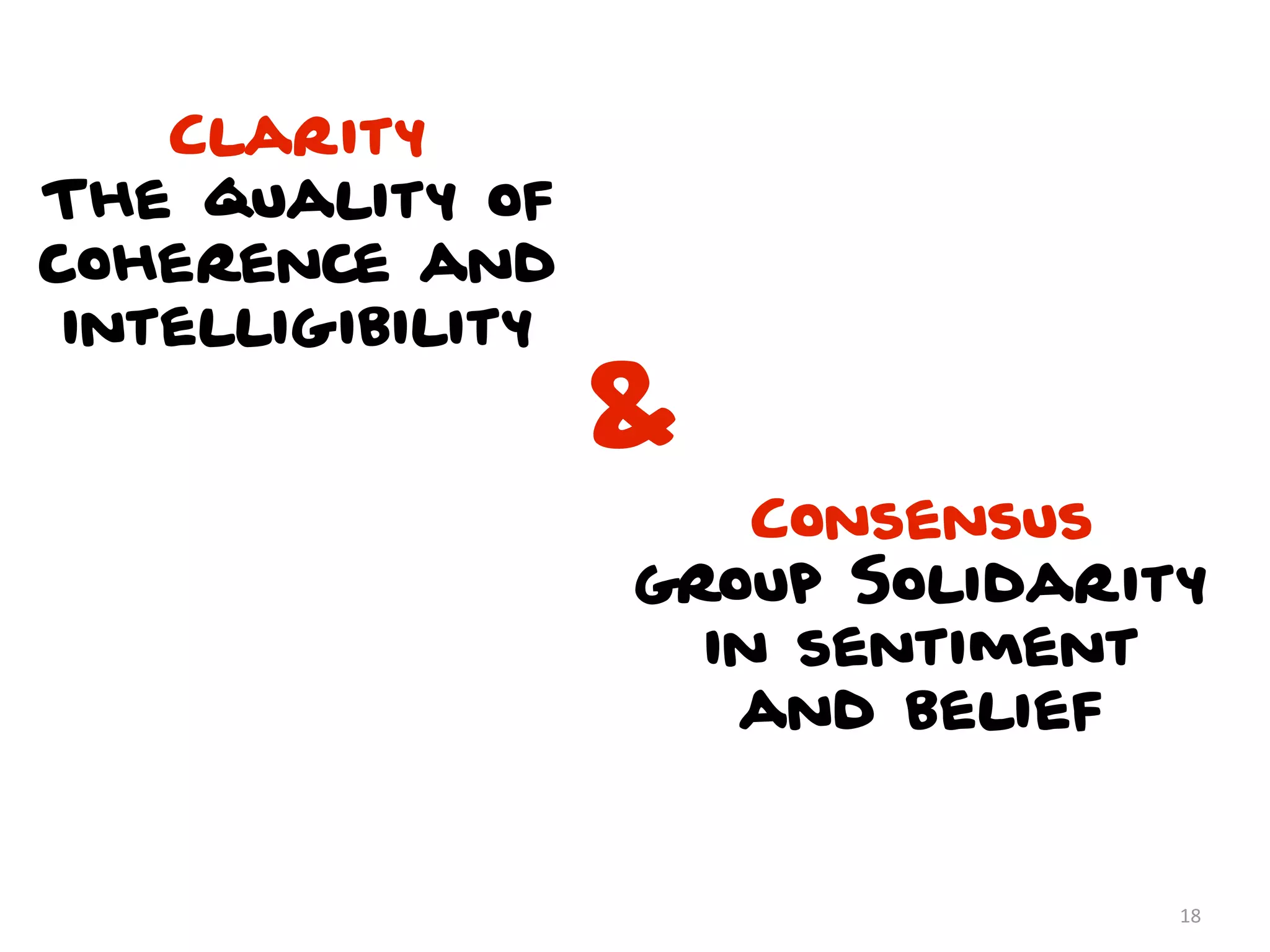
Clarity
The quality of
coherence and
 intelligibility
                   &
                       Consensus
                   group Solidarity
                     in sentiment
                      and belief


                                  18
Our focus for the next few
      weeks will be
  Clarity and Consensus


                             19
Our focus for the next few
           weeks will be
       Clarity and Consensus

• 10/1: Stakeholder alignment thru directional goals


                                                       19
Our focus for the next few
           weeks will be
       Clarity and Consensus

• 10/1: Stakeholder alignment thru directional goals
• 10/8: Measurable Goals & Requirements


                                                       19
Our focus for the next few
           weeks will be
       Clarity and Consensus

• 10/1: Stakeholder alignment thru directional goals
• 10/8: Measurable Goals & Requirements
• 10/15: Features & Roadmaps


                                                       19
Pop Quiz:
  What do we
remember from
 class 2 about
  continuums?


                 20
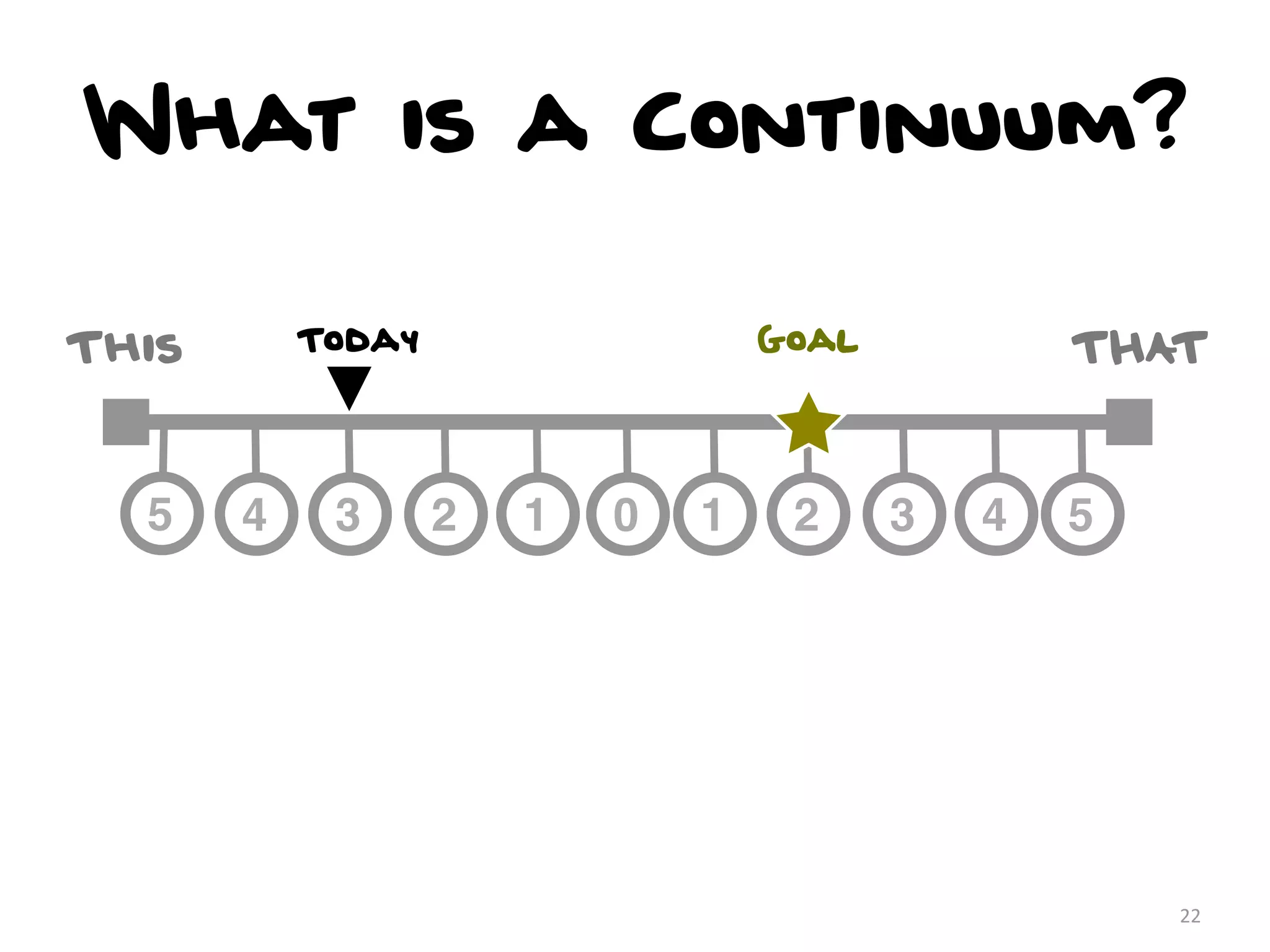
Performance Continuums
 spectrums that can be used to
discuss and align on direction


                             21
What is a Continuum?

This       Today                   Goal           THAT


  5    4    3      2   1   0   1    2     3   4   5


                                                      22
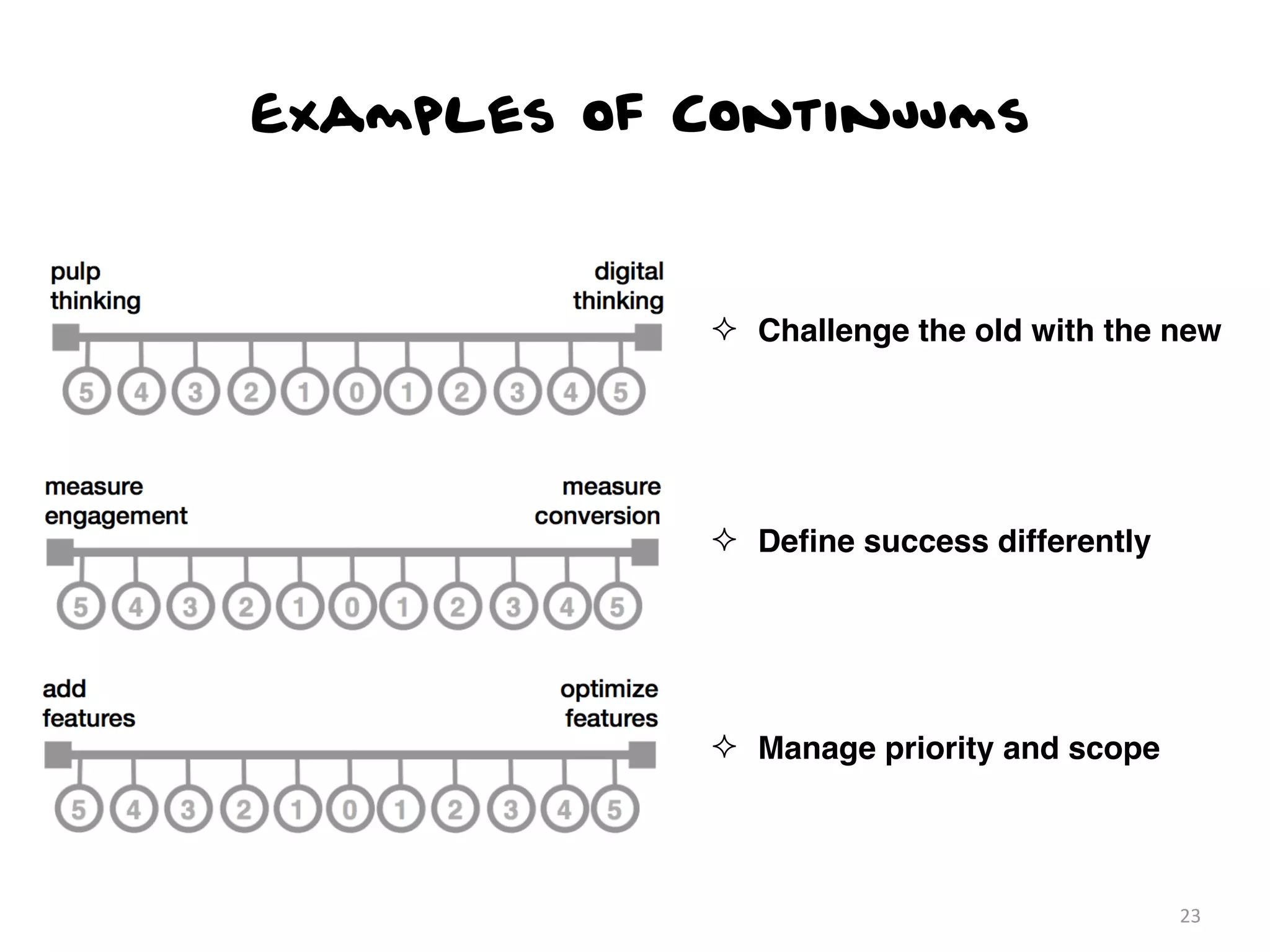
Examples of Continuums


             ² Challenge the old with the new


             ² Define success differently


             ² Manage priority and scope


                                            23
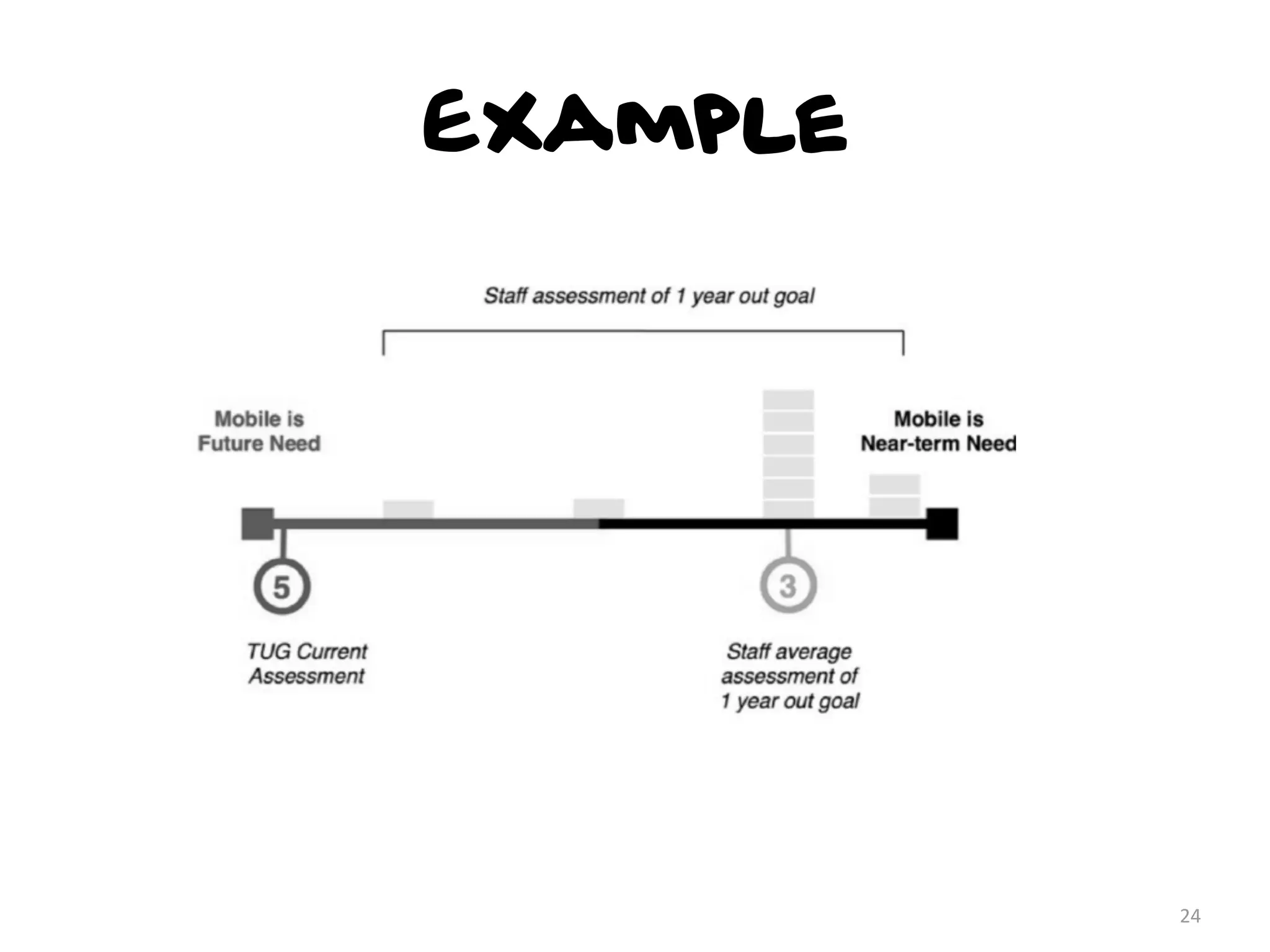
Example


          24
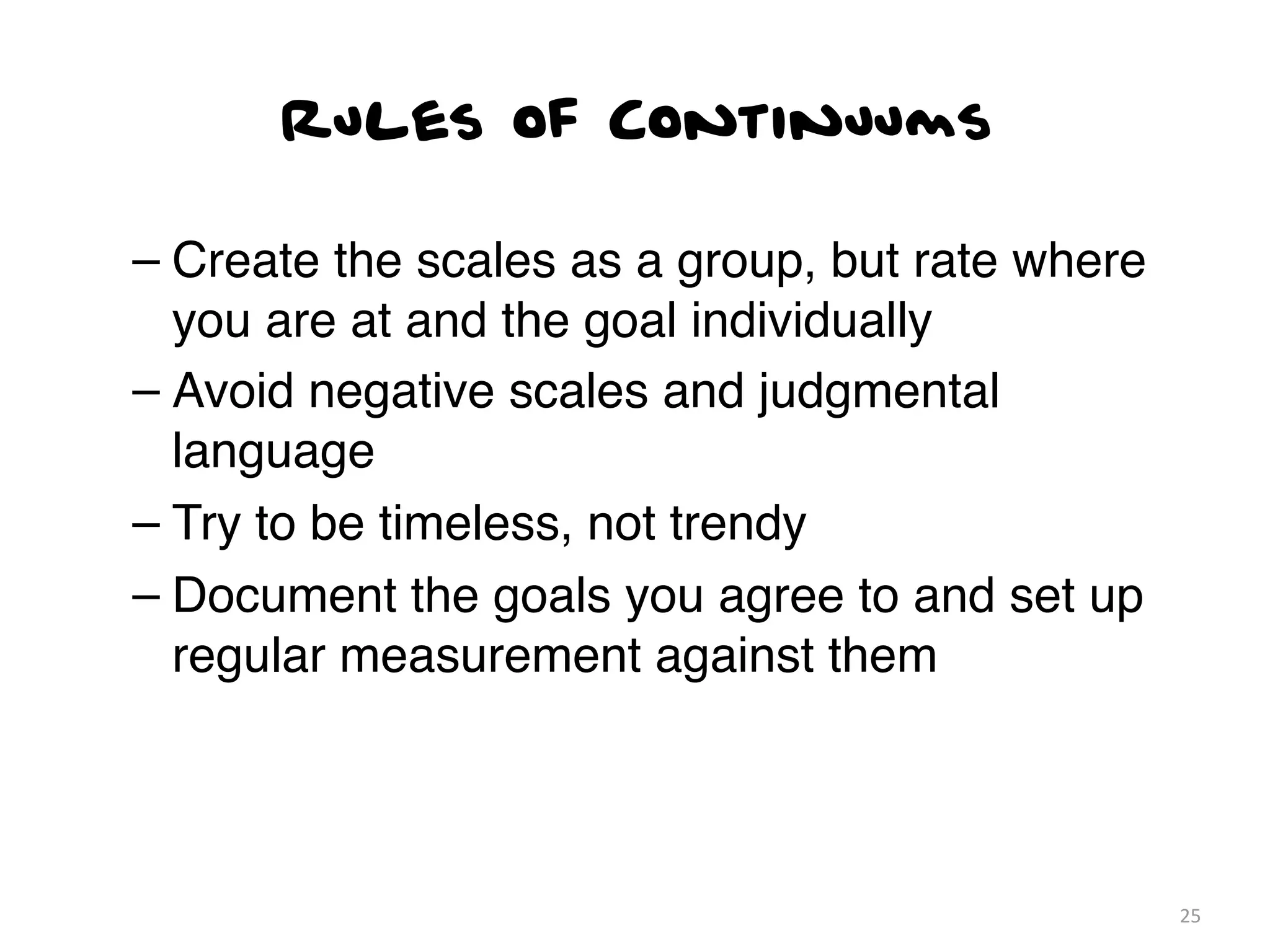
Rules of Continuums


                      25
Rules of Continuums

– Create the scales as a group, but rate where
  you are at and the goal individually


                                                 25
Rules of Continuums

– Create the scales as a group, but rate where
  you are at and the goal individually
– Avoid negative scales and judgmental
  language


                                                 25
Rules of Continuums

– Create the scales as a group, but rate where
  you are at and the goal individually
– Avoid negative scales and judgmental
  language
– Try to be timeless, not trendy


                                                 25
Rules of Continuums

– Create the scales as a group, but rate where
  you are at and the goal individually
– Avoid negative scales and judgmental
  language
– Try to be timeless, not trendy
– Document the goals you agree to and set up
  regular measurement against them


                                                 25
Attaching measurement
to make specify goals


                         26
Specific Goals should be
S.M.A.R.T so you know if you are
 going in the right direction


         q Specific
         q Measurable
         q Achievable
         q Relevant
         q Time bound
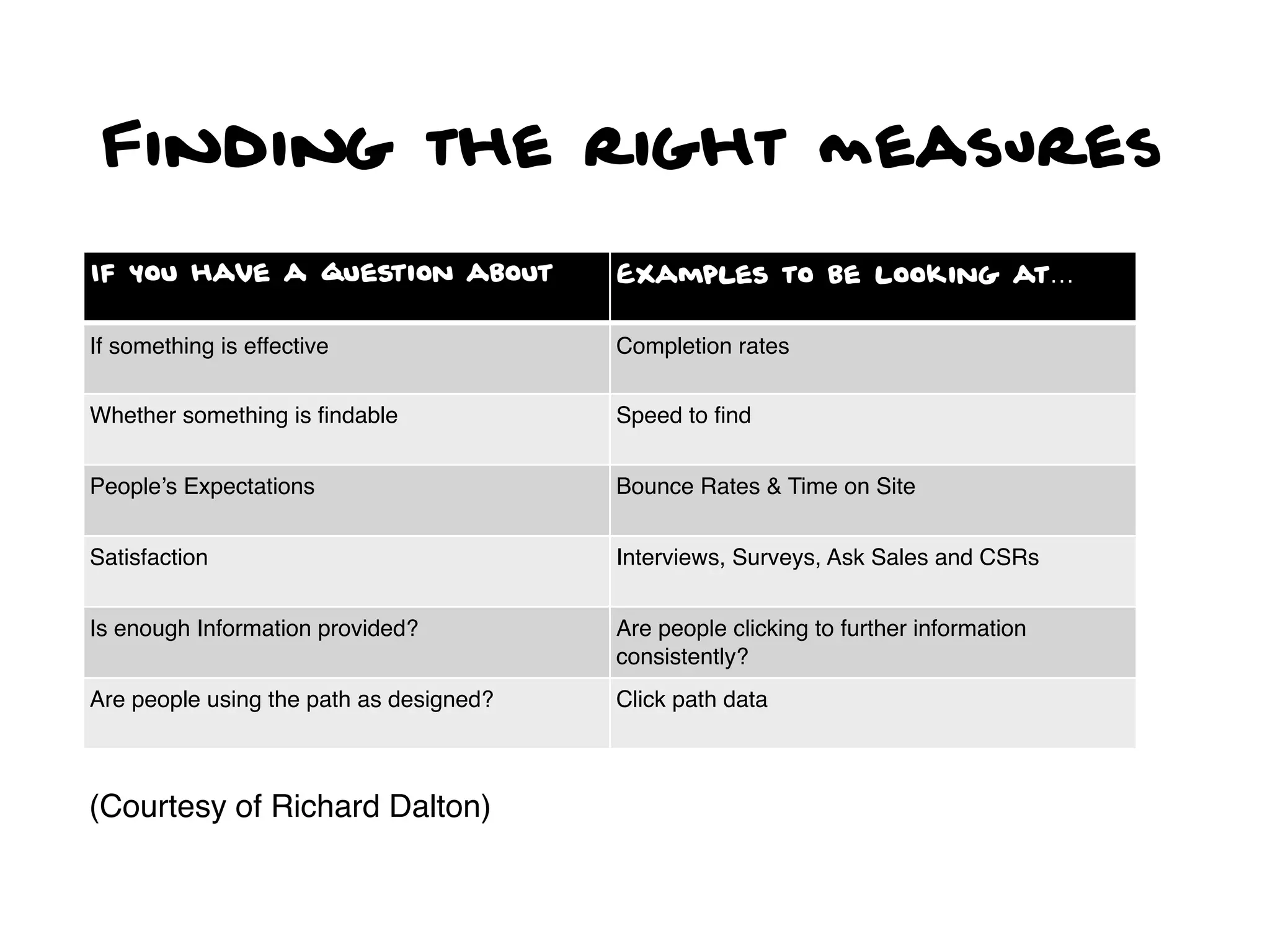
Finding the right measures

If you have a question about             Examples to be looking at…

If something is effective                Completion rates


Whether something is findable             Speed to find


People’s Expectations                    Bounce Rates & Time on Site


Satisfaction                             Interviews, Surveys, Ask Sales and CSRs


Is enough Information provided?          Are people clicking to further information
                                         consistently?
Are people using the path as designed?   Click path data


(Courtesy of Richard Dalton)
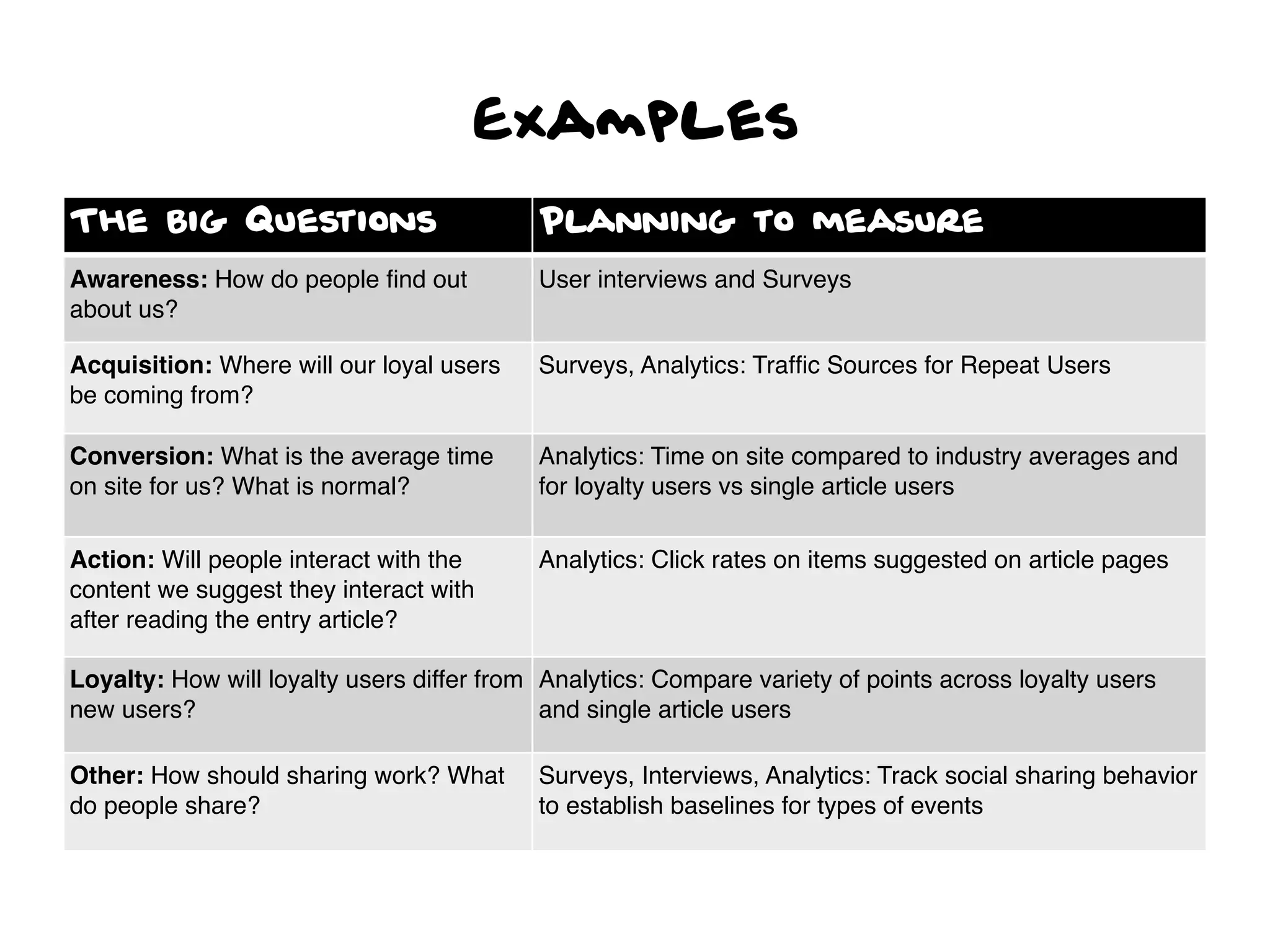
Examples
The Big Questions                          Planning to measure
Awareness: How do people find out           User interviews and Surveys
about us?

Acquisition: Where will our loyal users    Surveys, Analytics: Traffic Sources for Repeat Users
be coming from?

Conversion: What is the average time       Analytics: Time on site compared to industry averages and
on site for us? What is normal?            for loyalty users vs single article users

Action: Will people interact with the      Analytics: Click rates on items suggested on article pages
content we suggest they interact with
after reading the entry article?

Loyalty: How will loyalty users differ from Analytics: Compare variety of points across loyalty users
new users?                                  and single article users

Other: How should sharing work? What       Surveys, Interviews, Analytics: Track social sharing behavior
do people share?                           to establish baselines for types of events
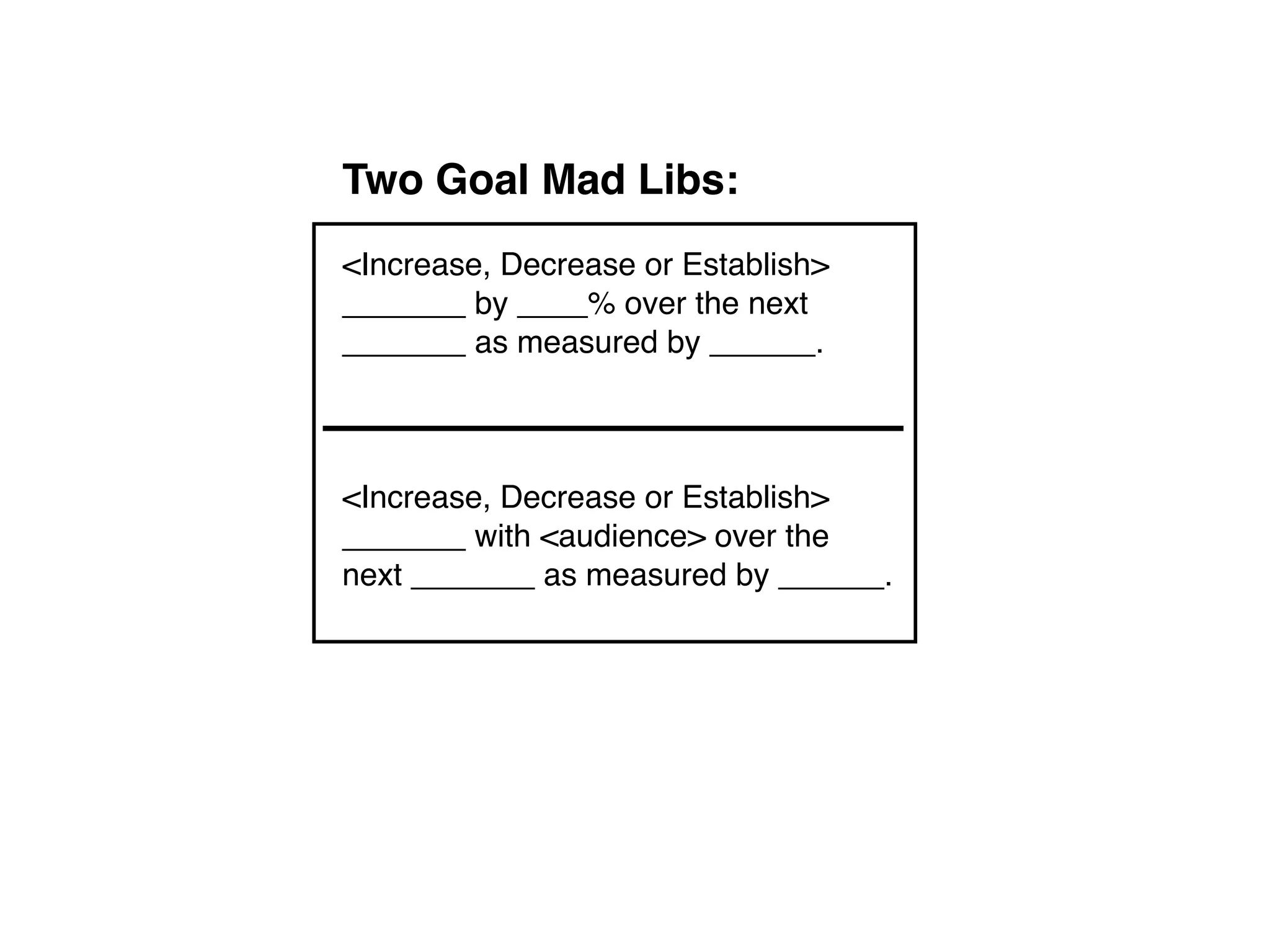
Two Goal Mad Libs:
<Increase, Decrease or Establish>
_______ by ____% over the next
_______ as measured by ______.


<Increase, Decrease or Establish>
_______ with <audience> over the
next _______ as measured by ______.
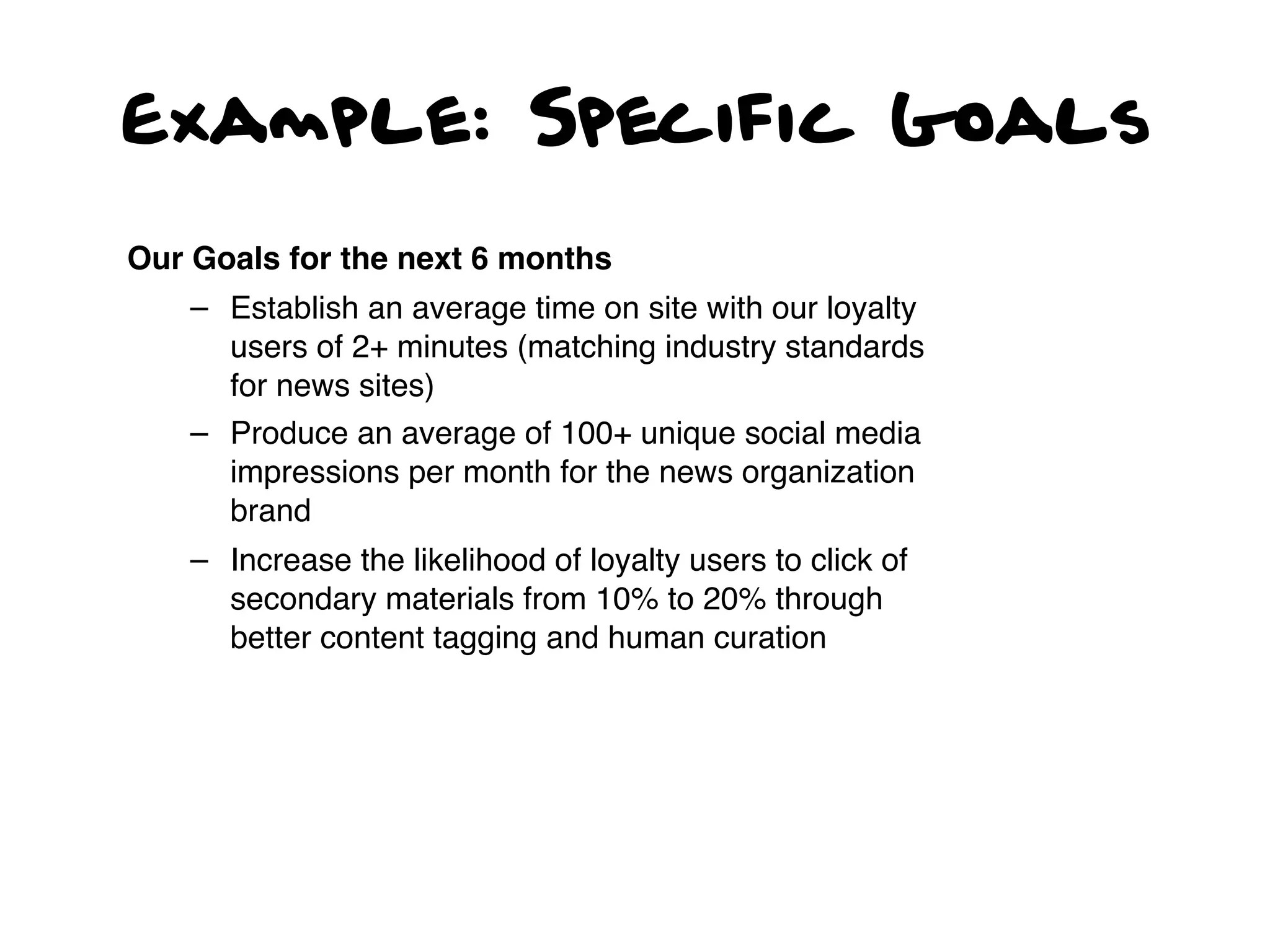
Example: Specific Goals

Our Goals for the next 6 months
    – Establish an average time on site with our loyalty
      users of 2+ minutes (matching industry standards
      for news sites)
    – Produce an average of 100+ unique social media
      impressions per month for the news organization
      brand
    – Increase the likelihood of loyalty users to click of
      secondary materials from 10% to 20% through
      better content tagging and human curation
Common Question
 What if we don’t
have enough data?


                    32
Answer
Your goal if you have no data is
to get data And establish what
     is called a baseline.


                               33
Other questions?


                   34
Workshop:
Consensus on goals


                     35
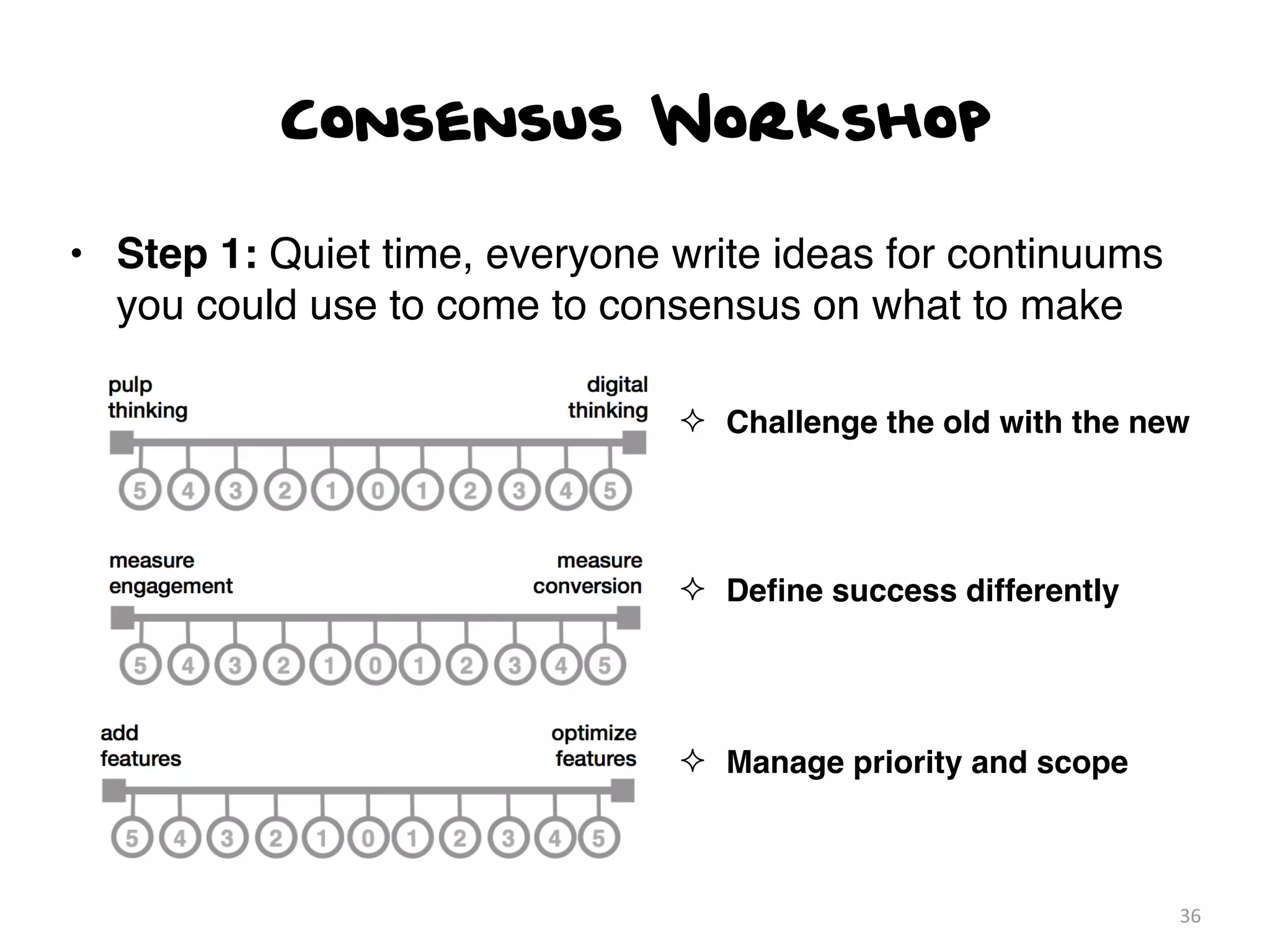
Consensus Workshop

• Step 1: Quiet time, everyone write ideas for continuums
  you could use to come to consensus on what to make

                               ² Challenge the old with the new


                               ² Define success differently


                               ² Manage priority and scope


                                                               36
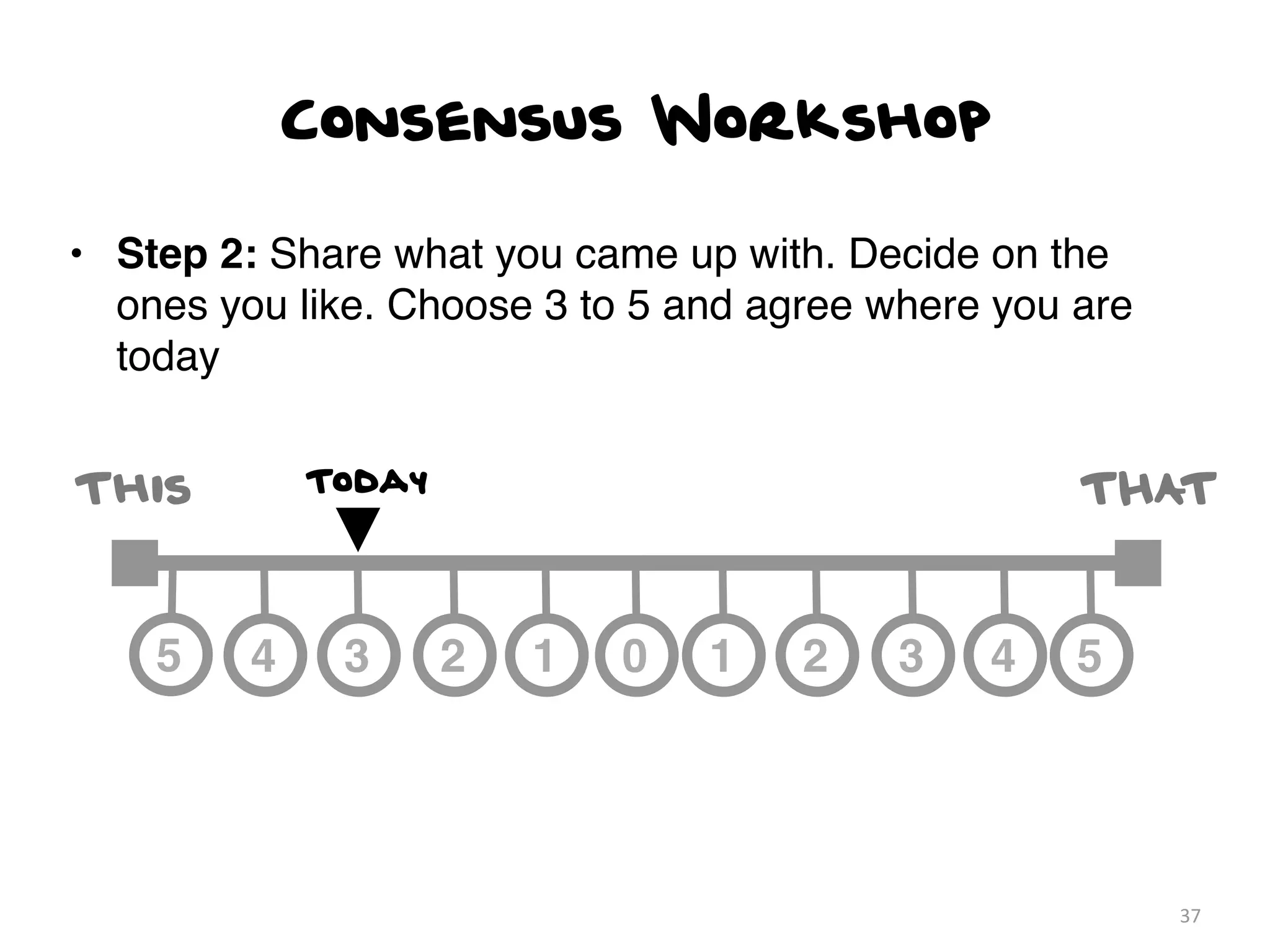
Consensus Workshop

• Step 2: Share what you came up with. Decide on the
  ones you like. Choose 3 to 5 and agree where you are
  today


This         Today                                 THAT


    5    4    3      2   1   0   1   2    3   4    5


                                                         37
Consensus Workshop

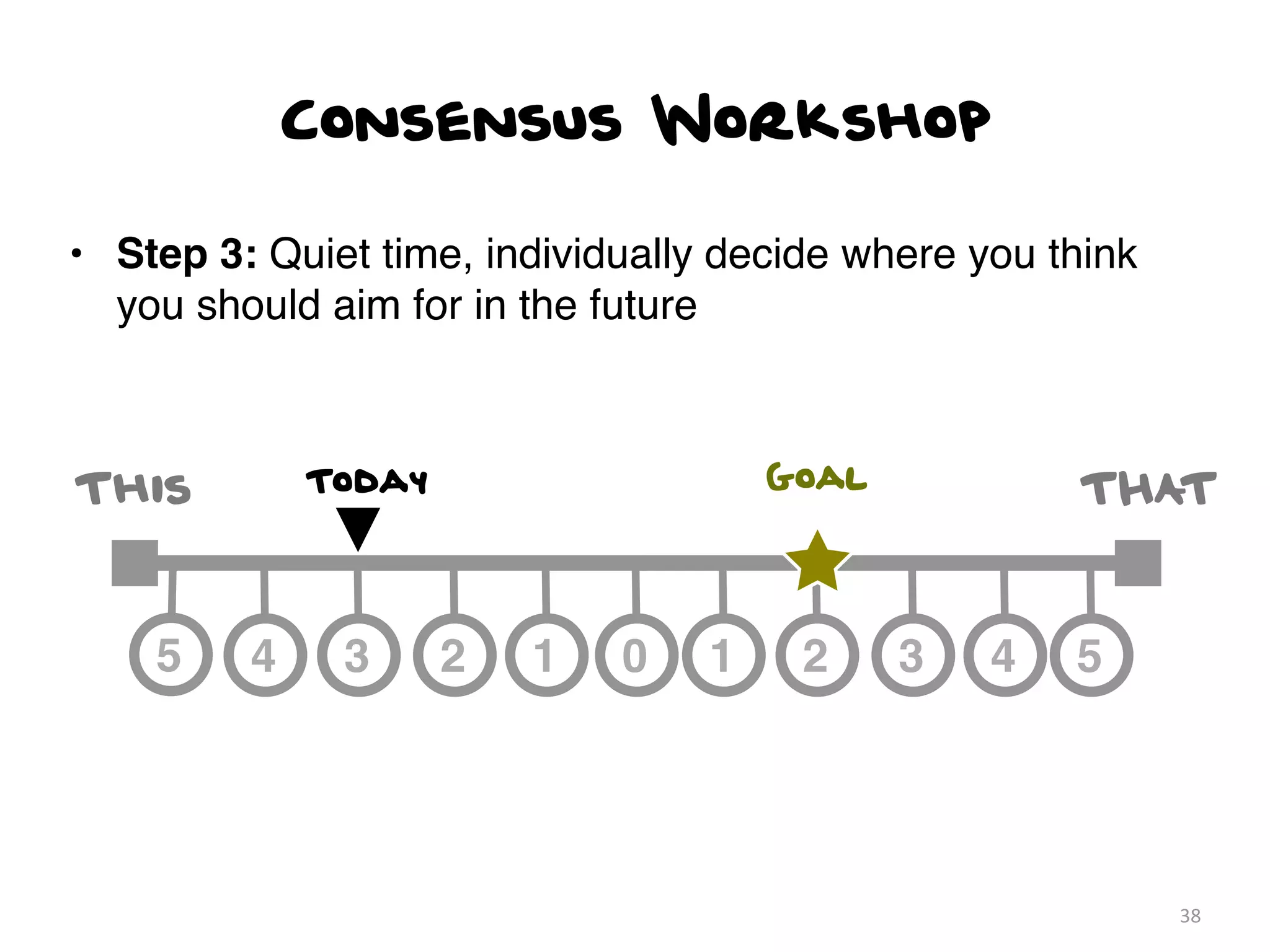
• Step 3: Quiet time, individually decide where you think
  you should aim for in the future


This         Today                    Goal           THAT


    5    4    3      2   1   0    1    2     3   4   5


                                                            38
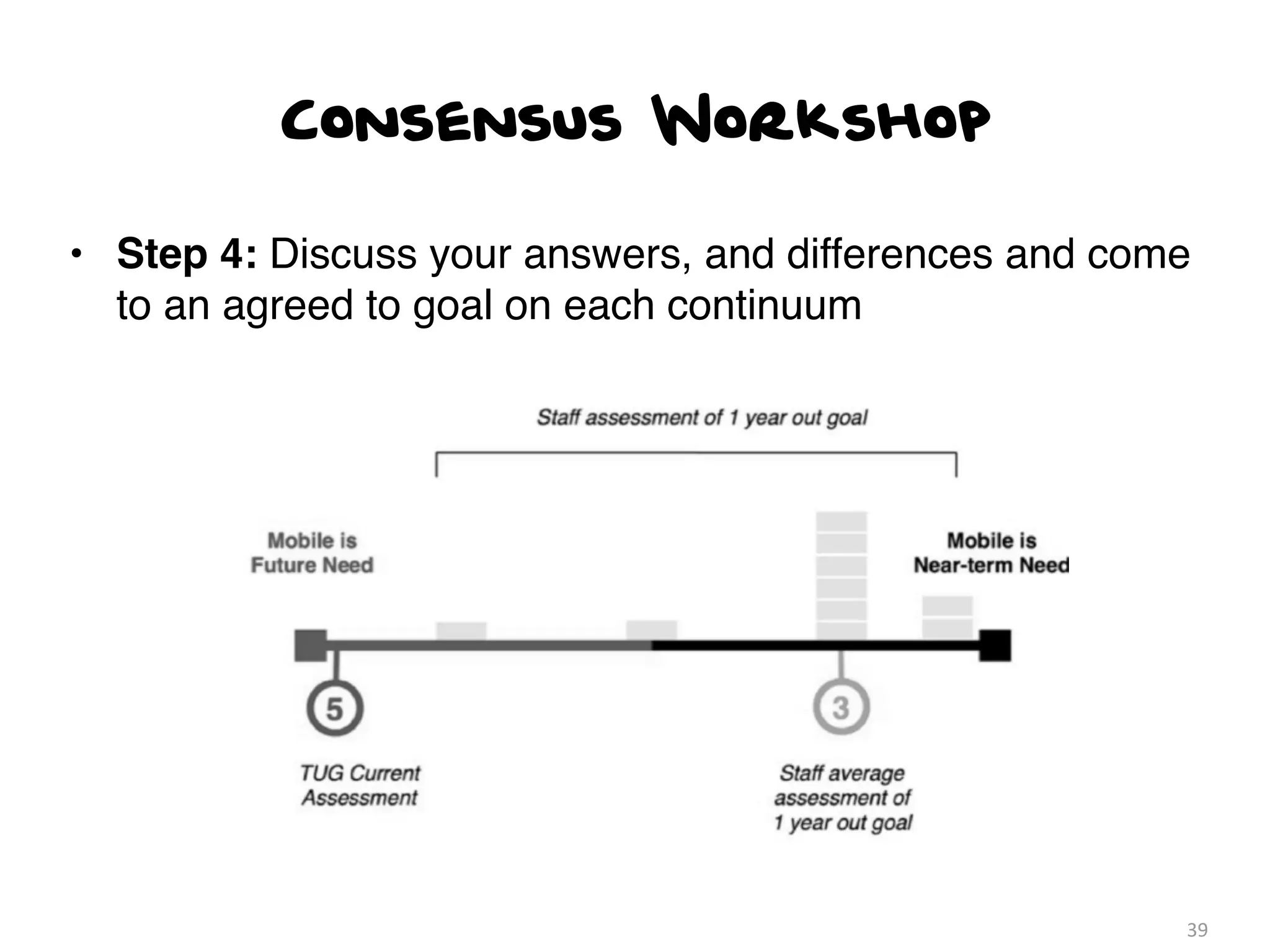
Consensus Workshop

• Step 4: Discuss your answers, and differences and come
  to an agreed to goal on each continuum


                                                       39
Homework

• As a group: Document your directional goals as continuums
   – What are the continuums and why?
   – What is your group rating of today’s state?
   – What is your group’s goal?
• Please submit your group homework by 6 PM Monday
  October 8 via email
• Each of you should additionally come to the next class with
  a list of measurable goal ideas to ladder up to the directional
  goals. We will be using your homework in class to workshop


                                                              40
Questions?

CovertA@newschool.edu
    @ Abby_The_IA

  www.Abbytheia.com

Understanding Stakeholders and Makers

  • 1.
    Class 4: Understanding Stakeholders & MAkers Instructor: Abby Covert
  • 2.
  • 3.
    Last Class we... •Shared our findings from exploring our problem space’s complexity 2
  • 4.
    Last Class we... •Shared our findings from exploring our problem space’s complexity • Learned about understanding people and their needs as users 2
  • 5.
    Last Class we... •Shared our findings from exploring our problem space’s complexity • Learned about understanding people and their needs as users • Admitted our assumptions 2
  • 6.
    Last Class we... •Shared our findings from exploring our problem space’s complexity • Learned about understanding people and their needs as users • Admitted our assumptions • Mapped our potential users and prioritized them to do further research 2
  • 7.
    Last Class we... •Shared our findings from exploring our problem space’s complexity • Learned about understanding people and their needs as users • Admitted our assumptions • Mapped our potential users and prioritized them to do further research • Assigned some homework, due today! 2
  • 8.
  • 9.
    Homework Share • Eachteam will have the next 15 minutes to share with each other the results of their homework assignment 3
  • 10.
    Homework Share • Eachteam will have the next 15 minutes to share with each other the results of their homework assignment • Make a list as a group of all the things you would like to do as research. 3
  • 11.
    Homework Share • Eachteam will have the next 15 minutes to share with each other the results of their homework assignment • Make a list as a group of all the things you would like to do as research. • Place a * next to the ones you could do in the next week if I asked you to 3
  • 12.
    Homework Share • Eachteam will have the next 15 minutes to share with each other the results of their homework assignment • Make a list as a group of all the things you would like to do as research. • Place a * next to the ones you could do in the next week if I asked you to • Place a ** next to those that would take more time than a week but you feel you could do with what you have 3
  • 13.
    I am an information architect Iintend to because I believe make the unclear clear everything is complex put the what architecture frames before the how problems, design solves them facilitate understanding understanding is organize meaning, always good but it is create clarity and equally important to establish truth not understand support goals, makers clarity is a and users prerequisite of truth by: Abby Covert & Dan Klyn 4
  • 14.
    I am an information architect Iintend to because I believe make the unclear clear everything is complex put the what architecture frames before the how problems, design solves them facilitate understanding understanding is organize meaning, always good but it is create clarity and equally important to establish truth not understand support goals, makers clarity is a and users prerequisite of truth by: Abby Covert & Dan Klyn 4
  • 15.
    What does it meanto have Stake? 5
  • 16.
    Stake: an interestor share in an undertaking or enterprise Stakeholder: one who is involved in or affected by a course of action 6
  • 17.
  • 18.
    Make: 1. to causeto happen to or be experienced by someone 2. to cause to exist, occur, or appear Maker: a person, company or machine who makes something 8
  • 19.
    What do youneed to make stake? 9
  • 20.
    MAkers Need: - tounderstand goals - To have a clear sense of scope - To know what is next Stakeholders Need: - To set measurable goals - to understand the implications of scope - To plan for the future 10
  • 21.
    Scope: The extentof the area or subject matter that something deals with or to which it is relevant. 11
  • 22.
  • 23.
    $$$$$ @ post Launch d in $$$$ M @ Development ur Yo e $$$ g @ Design n a Ch to $$ t @ Concepting Cos $ @ Idea Progress Made nasty truth #1 The more progress made, the more expensive changing your mind becomes 13
  • 24.
    $$$$$ d in M $$$$ ur Yo e g $$$ n a Ch to $$ ct pa Im $ Time and effort spent nasty truth #2 Great makers care about their work not just money is at stake 14
  • 25.
    d High in m e g n a ch to g in d ee n of d oo ih el ik L Low NONE # of assumptions ALL operated on nasty truth #3 The more you operate on assumption, the more likely you are to change your mind 15
  • 26.
  • 27.
    Assumptions that arecommon • Complexity Involved: “This is simple...” 16
  • 28.
    Assumptions that arecommon • Complexity Involved: “This is simple...” • User Needs: “What they need is...” 16
  • 29.
    Assumptions that arecommon • Complexity Involved: “This is simple...” • User Needs: “What they need is...” • Resources: “So-n-so knows how to do that...” 16
  • 30.
    Assumptions that arecommon • Complexity Involved: “This is simple...” • User Needs: “What they need is...” • Resources: “So-n-so knows how to do that...” • Money: “Yea, a week should be enough...” 16
  • 31.
    What eliminates assumptionsso progress can be productive? 17
  • 32.
    Clarity The quality of coherenceand intelligibility & Consensus group Solidarity in sentiment and belief 18
  • 33.
    Our focus forthe next few weeks will be Clarity and Consensus 19
  • 34.
    Our focus forthe next few weeks will be Clarity and Consensus • 10/1: Stakeholder alignment thru directional goals 19
  • 35.
    Our focus forthe next few weeks will be Clarity and Consensus • 10/1: Stakeholder alignment thru directional goals • 10/8: Measurable Goals & Requirements 19
  • 36.
    Our focus forthe next few weeks will be Clarity and Consensus • 10/1: Stakeholder alignment thru directional goals • 10/8: Measurable Goals & Requirements • 10/15: Features & Roadmaps 19
  • 37.
    Pop Quiz: What do we remember from class 2 about continuums? 20
  • 38.
    Performance Continuums spectrumsthat can be used to discuss and align on direction 21
  • 39.
    What is aContinuum? This Today Goal THAT 5 4 3 2 1 0 1 2 3 4 5 22
  • 40.
    Examples of Continuums ² Challenge the old with the new ² Define success differently ² Manage priority and scope 23
  • 41.
  • 42.
  • 43.
    Rules of Continuums –Create the scales as a group, but rate where you are at and the goal individually 25
  • 44.
    Rules of Continuums –Create the scales as a group, but rate where you are at and the goal individually – Avoid negative scales and judgmental language 25
  • 45.
    Rules of Continuums –Create the scales as a group, but rate where you are at and the goal individually – Avoid negative scales and judgmental language – Try to be timeless, not trendy 25
  • 46.
    Rules of Continuums –Create the scales as a group, but rate where you are at and the goal individually – Avoid negative scales and judgmental language – Try to be timeless, not trendy – Document the goals you agree to and set up regular measurement against them 25
  • 47.
  • 48.
    Specific Goals shouldbe S.M.A.R.T so you know if you are going in the right direction q Specific q Measurable q Achievable q Relevant q Time bound
  • 49.
    Finding the rightmeasures If you have a question about Examples to be looking at… If something is effective Completion rates Whether something is findable Speed to find People’s Expectations Bounce Rates & Time on Site Satisfaction Interviews, Surveys, Ask Sales and CSRs Is enough Information provided? Are people clicking to further information consistently? Are people using the path as designed? Click path data (Courtesy of Richard Dalton)
  • 50.
    Examples The Big Questions Planning to measure Awareness: How do people find out User interviews and Surveys about us? Acquisition: Where will our loyal users Surveys, Analytics: Traffic Sources for Repeat Users be coming from? Conversion: What is the average time Analytics: Time on site compared to industry averages and on site for us? What is normal? for loyalty users vs single article users Action: Will people interact with the Analytics: Click rates on items suggested on article pages content we suggest they interact with after reading the entry article? Loyalty: How will loyalty users differ from Analytics: Compare variety of points across loyalty users new users? and single article users Other: How should sharing work? What Surveys, Interviews, Analytics: Track social sharing behavior do people share? to establish baselines for types of events
  • 51.
    Two Goal MadLibs: <Increase, Decrease or Establish> _______ by ____% over the next _______ as measured by ______. <Increase, Decrease or Establish> _______ with <audience> over the next _______ as measured by ______.
  • 52.
    Example: Specific Goals OurGoals for the next 6 months – Establish an average time on site with our loyalty users of 2+ minutes (matching industry standards for news sites) – Produce an average of 100+ unique social media impressions per month for the news organization brand – Increase the likelihood of loyalty users to click of secondary materials from 10% to 20% through better content tagging and human curation
  • 53.
    Common Question Whatif we don’t have enough data? 32
  • 54.
    Answer Your goal ifyou have no data is to get data And establish what is called a baseline. 33
  • 55.
  • 56.
  • 57.
    Consensus Workshop • Step1: Quiet time, everyone write ideas for continuums you could use to come to consensus on what to make ² Challenge the old with the new ² Define success differently ² Manage priority and scope 36
  • 58.
    Consensus Workshop • Step2: Share what you came up with. Decide on the ones you like. Choose 3 to 5 and agree where you are today This Today THAT 5 4 3 2 1 0 1 2 3 4 5 37
  • 59.
    Consensus Workshop • Step3: Quiet time, individually decide where you think you should aim for in the future This Today Goal THAT 5 4 3 2 1 0 1 2 3 4 5 38
  • 60.
    Consensus Workshop • Step4: Discuss your answers, and differences and come to an agreed to goal on each continuum 39
  • 61.
    Homework • As agroup: Document your directional goals as continuums – What are the continuums and why? – What is your group rating of today’s state? – What is your group’s goal? • Please submit your group homework by 6 PM Monday October 8 via email • Each of you should additionally come to the next class with a list of measurable goal ideas to ladder up to the directional goals. We will be using your homework in class to workshop 40
  • 62.
    Questions? CovertA@newschool.edu @ Abby_The_IA www.Abbytheia.com