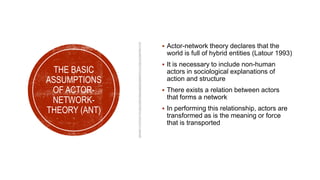
Actor-network theory is a sociological approach that views both social and technical elements as integral parts of a network. It was developed in the 1980s by scholars including John Law, Michel Callon, and Bruno Latour. A key concept is that an actor network includes not just people but also objects and organizations that act within the network. Actor-network theory proposes three main principles: generalized symmetry between human and non-human actors, agnosticism toward various interpretations, and the idea that relationships freely associate actors into a network. Critics argue it fails to account for human-specific attributes like intentionality or pre-existing social structures.