Understanding Repetitive
Manufacturing
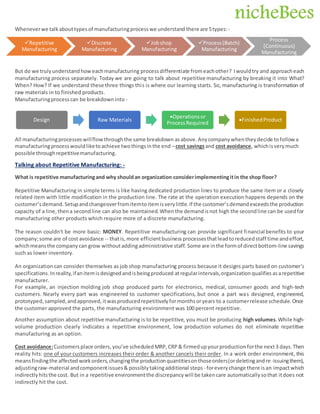
Wheneverwe talkabouttypes of manufacturingprocesswe understand there are 5types:-
But do we trulyunderstandhoweachmanufacturing processdifferentiate fromeachother? Iwouldtry and approacheach
manufacturing process separately. Today we are going to talk about repetitive manufacturing by breaking it into What?
When? How? If we understand these three things this is where our learning starts. So, manufacturing is transformation of
raw materials in to finished products.
Manufacturingprocesscan be breakdowninto -
All manufacturingprocesseswillflow throughthe same breakdown asabove. Anycompanywhentheydecide tofollowa
manufacturingprocesswouldliketoachieve twothingsinthe end –cost savingsand cost avoidance, whichisverymuch
possible throughrepetitivemanufacturing.
Talking about Repetitive Manufacturing: -
What is repetitive manufacturingand why shouldan organization considerimplementingitin the shop floor?
Repetitive Manufacturing in simple terms is like having dedicated production lines to produce the same item or a closely
related item with little modification in the production line. The rate at the operation execution happens depends on the
customer’sdemand.Setupandchangeoverfromitemtoitemisverylittle.If the customer’sdemandexceedsthe production
capacity of a line,thena secondline can also be maintained.Whenthe demandisnot high the secondline can be usedfor
manufacturing other products which require more of a discrete manufacturing.
The reason couldn't be more basic: MONEY. Repetitive manufacturing can provide significant financial benefits to your
company;some are of cost avoidance -- thatis,more efficientbusinessprocessesthatleadtoreducedstaff time andeffort,
whichmeansthe companycan grow withoutaddingadministrative staff. Some are inthe formof directbottom-line savings
such as lower inventory.
An organization can consider themselves as job shop manufacturing process because it designs parts based on customer’s
specifications.Inreality,ifanitemisdesignedandisbeingproduced atregularintervals,organization qualifies asarepetitive
manufacturer.
For example, an injection molding job shop produced parts for electronics, medical, consumer goods and high-tech
customers. Nearly every part was engineered to customer specifications, but once a part was designed, engineered,
prototyped,sampled,andapproved,itwasproducedrepetitivelyformonthsoryears to a customerrelease schedule.Once
the customer approved the parts, the manufacturing environment was 100 percent repetitive.
Another assumption about repetitive manufacturing is to be repetitive, you must be producing high volumes.While high-
volume production clearly indicates a repetitive environment, low production volumes do not eliminate repetitive
manufacturing as an option.
Cost avoidance:Customers place orders,you’ve scheduled MRP,CRP & firmedupyourproduction forthe next3 days.Then
reality hits: one of your customers increases their order & another cancels their order. In a work order environment, this
meansfindingthe affected workorders,changingthe productionquantitiesonthoseorders(ordeletingandre-issuingthem),
adjustingraw-material andcomponentissues&possiblytakingadditional steps - foreverychange there isan impactwhich
indirectlyhitsthe cost. But in a repetitive environmentthe discrepancywill be takencare automaticallysothat itdoes not
indirectly hit the cost.
Design Raw Materials
Operationsor
ProcessRequired
FinishedProduct
Repetitive
Manufacturing
Discrete
Manufacturing
Jobshop
Manufacturing
Process(Batch)
Manufacturing
Process
(Continuous)
Manufacturing

Understanding Repetitive Manufacturing

  • 1.
  • 2.
    Wheneverwe talkabouttypes ofmanufacturingprocesswe understand there are 5types:- But do we trulyunderstandhoweachmanufacturing processdifferentiate fromeachother? Iwouldtry and approacheach manufacturing process separately. Today we are going to talk about repetitive manufacturing by breaking it into What? When? How? If we understand these three things this is where our learning starts. So, manufacturing is transformation of raw materials in to finished products. Manufacturingprocesscan be breakdowninto - All manufacturingprocesseswillflow throughthe same breakdown asabove. Anycompanywhentheydecide tofollowa manufacturingprocesswouldliketoachieve twothingsinthe end –cost savingsand cost avoidance, whichisverymuch possible throughrepetitivemanufacturing. Talking about Repetitive Manufacturing: - What is repetitive manufacturingand why shouldan organization considerimplementingitin the shop floor? Repetitive Manufacturing in simple terms is like having dedicated production lines to produce the same item or a closely related item with little modification in the production line. The rate at the operation execution happens depends on the customer’sdemand.Setupandchangeoverfromitemtoitemisverylittle.If the customer’sdemandexceedsthe production capacity of a line,thena secondline can also be maintained.Whenthe demandisnot high the secondline can be usedfor manufacturing other products which require more of a discrete manufacturing. The reason couldn't be more basic: MONEY. Repetitive manufacturing can provide significant financial benefits to your company;some are of cost avoidance -- thatis,more efficientbusinessprocessesthatleadtoreducedstaff time andeffort, whichmeansthe companycan grow withoutaddingadministrative staff. Some are inthe formof directbottom-line savings such as lower inventory. An organization can consider themselves as job shop manufacturing process because it designs parts based on customer’s specifications.Inreality,ifanitemisdesignedandisbeingproduced atregularintervals,organization qualifies asarepetitive manufacturer. For example, an injection molding job shop produced parts for electronics, medical, consumer goods and high-tech customers. Nearly every part was engineered to customer specifications, but once a part was designed, engineered, prototyped,sampled,andapproved,itwasproducedrepetitivelyformonthsoryears to a customerrelease schedule.Once the customer approved the parts, the manufacturing environment was 100 percent repetitive. Another assumption about repetitive manufacturing is to be repetitive, you must be producing high volumes.While high- volume production clearly indicates a repetitive environment, low production volumes do not eliminate repetitive manufacturing as an option. Cost avoidance:Customers place orders,you’ve scheduled MRP,CRP & firmedupyourproduction forthe next3 days.Then reality hits: one of your customers increases their order & another cancels their order. In a work order environment, this meansfindingthe affected workorders,changingthe productionquantitiesonthoseorders(ordeletingandre-issuingthem), adjustingraw-material andcomponentissues&possiblytakingadditional steps - foreverychange there isan impactwhich indirectlyhitsthe cost. But in a repetitive environmentthe discrepancywill be takencare automaticallysothat itdoes not indirectly hit the cost. Design Raw Materials Operationsor ProcessRequired FinishedProduct Repetitive Manufacturing Discrete Manufacturing Jobshop Manufacturing Process(Batch) Manufacturing Process (Continuous) Manufacturing