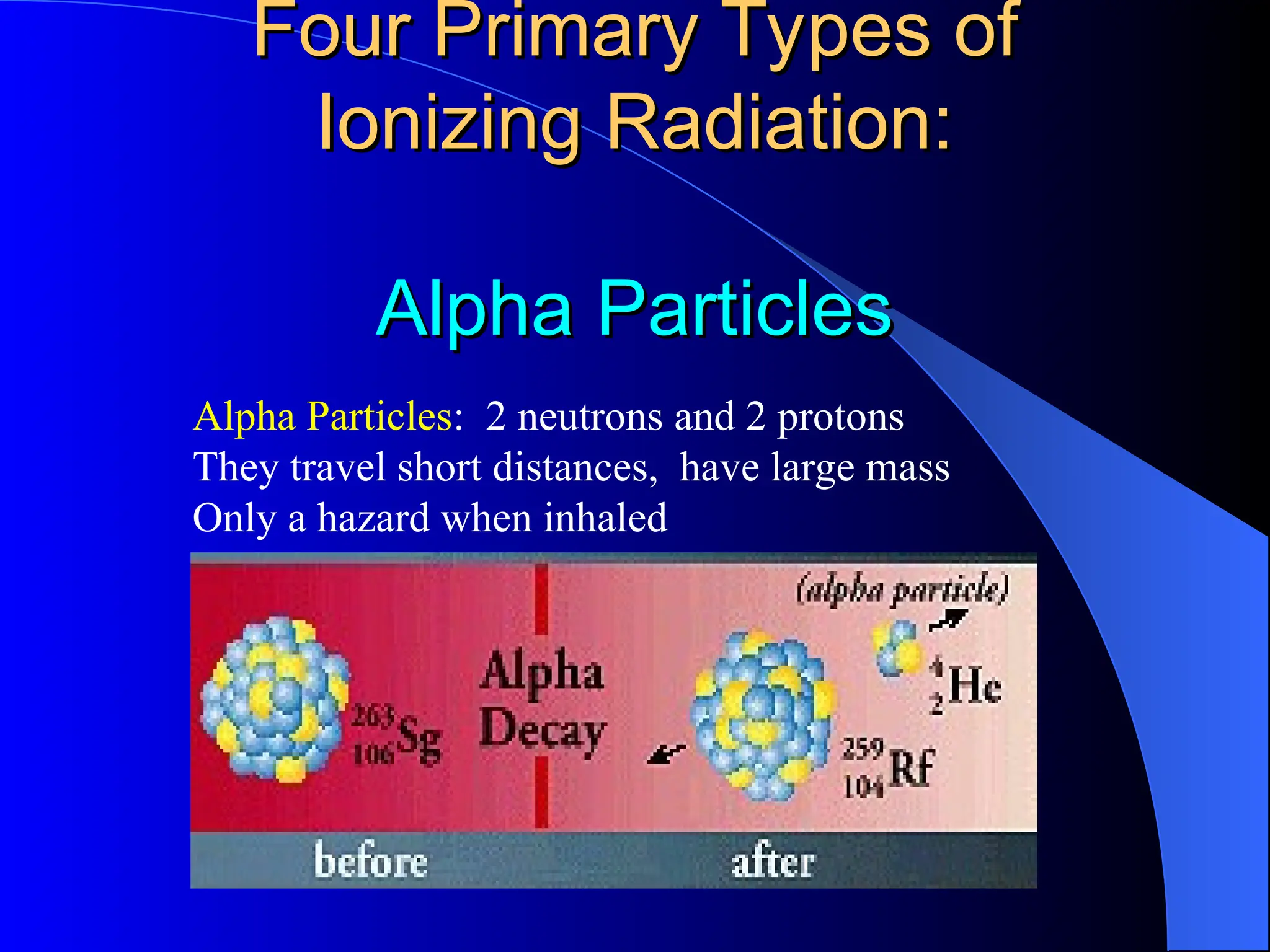
Alpha Particles: 2 neutrons and 2 protons
They travel short distances, have large mass
Only a hazard when inhaled
Four Primary Types of
Ionizing Radiation:
Ionizing Radiation:
Alpha Particles
Alpha Particles
Four Primary Types of
Ionizing Radiation:
Ionizing Radiation:
Beta Particles
Beta Particles
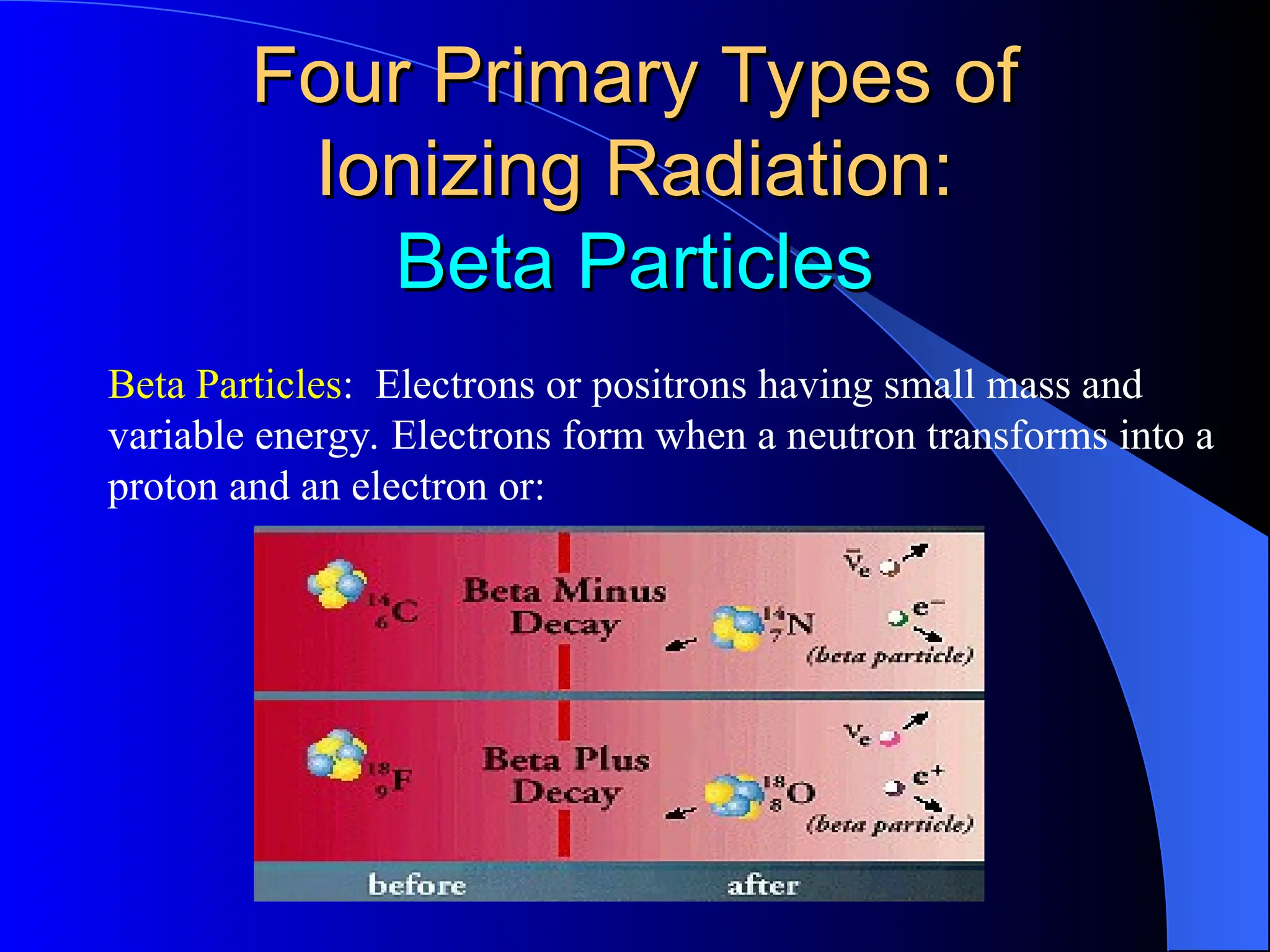
Beta Particles: Electrons or positrons having small mass and
variable energy. Electrons form when a neutron transforms into a
proton and an electron or:
Four Primary Types of
Ionizing Radiation:
Ionizing Radiation:
Gamma Rays
Gamma Rays
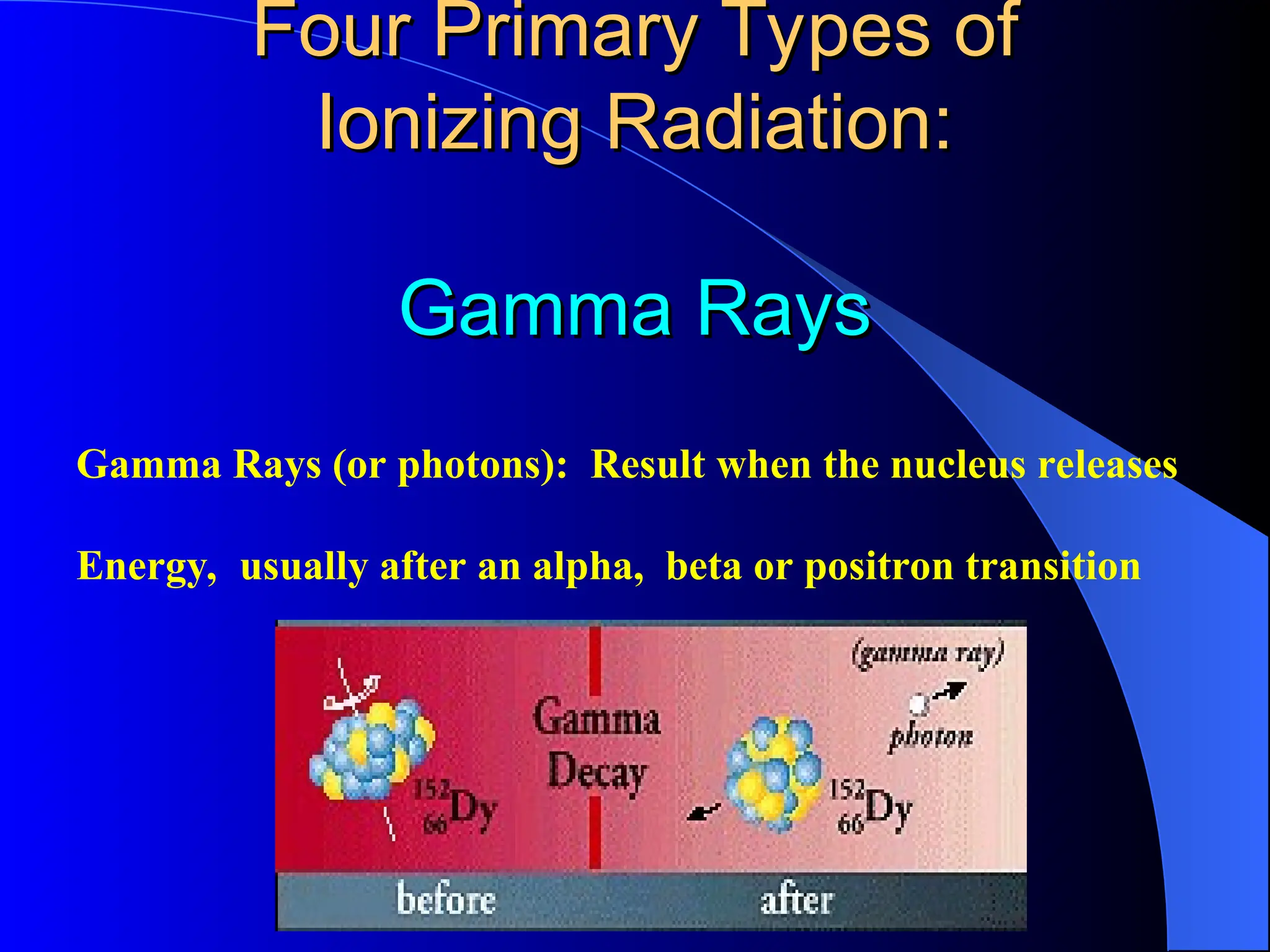
Gamma Rays (or photons): Result when the nucleus releases
Energy, usually after an alpha, beta or positron transition
Four Primary Types of
Ionizing Radiation:
Ionizing Radiation:
X-Rays
X-Rays
X-Rays: Occur whenever an inner shell orbital electron is removed
and rearrangement of the atomic electrons results with the release of
the elements characteristic X-Ray energy
Four Primary Types of
Ionizing Radiation:
Ionizing Radiation:
Neutrons
Neutrons
Neutrons: Have the same mass as protons but are uncharged
They behave like bowling balls
Four Primary Types of
Ionizing Radiation
Ionizing Radiation
Alpha particles
Beta particles
Gamma rays (or photons)
X-Rays (or photons)
Neutrons
RADIATION
RADIATION
FUNDAMENTALS
FUNDAMENTALS
ATOMIC AND NUCLEAR
ATOMIC AND NUCLEAR
STRUCTURE
STRUCTURE
Bureau of Radiation Control
Radioactivity: Elements &
Atoms
Atoms
Atoms are composed of smaller particles
referred to as:
– Protons
– Neutrons
– Electrons
Ionization
Ionization
 Ionizing radiation is produced by unstable
atoms. Unstable atoms differ from stable
atoms because they have an excess of
energy or mass or both.
 Unstable atoms are said to be radioactive. In
order to reach stability, these atoms give off,
or emit, the excess energy or mass. These
emissions are called radiation.
Types or Products of Ionizing
Radiation
Radiation


or X-
ray
neutron
Ionizing Radiation
alpha particle
beta particle
Radioactive Atom
X-ray
gamma ray
Ionizing Radiation
alpha particle
beta particle
Radioactive Atom
X-ray
gamma ray
Direct Ionization Caused By:
Protons
Alpha Particles
Beta Particles
Positron Particles
Indirect Ionization Caused By:
Neutrons
Gamma Rays
X-Rays
DNA and Radiation
DNA and Radiation
Ionizing Radiation at the
Cellular Level
Cellular Level
 Causes breaks in
one or both DNA
strands or;
 Causes Free Radical
formation
Commonly Transported
Radioisotopes
Radioisotopes
Americium-241= Diagnose thyroid
disorders, smoke detectors.
Cesium-137= Cancer treatment.
Iodine-125,131= Diagnosis & treatment
liver, kidney,heart, lung and brain.
Technetium-99m=Bone and brain imaging;
thyroid and liver studies; localization of
brain tumors.
Radiation Measurement
Terminology:
– Exposure rate = amount radiation possible to
receive per unit time.
– Dose = total amount of radiation received.
Radiation and Radioactivity:
Units and Quantities
Department of Health
Bureau of Radiation Control
Introduction
Introduction
Quantities (mass, volume, time, etc.) vs.
Units (grams, gallons, hours)
Units of exposure, radioactivity, and energy
associated with ionizing radioactivity
As hours and minutes are to time ...
Objectives
Objectives
Define
– ROENTGEN, RAD, REM, CURIE, GRAY,
SIEVERT, BECQUEREL.
– SI units vs. Standard English units
Discuss the use and conversion of unit
prefixes
Transform units using “unit analysis”
Background
Background
Early risk associated with use of ionizing
radiation
skin erythema dose - 25yrs
1928 - ROENTGEN introduced by ICRP
Roentgen
Roentgen
Roentgen
Roentgen
Pronounced rent’gen with a hard “g”
Limitations
– only applies to photons
– only applies in air
– only applies to energies less than 3 MeV
 Named after Wilhelm C. Roentgen
(thus the abbr... is capital “R”)
rad
rad
rad
rad
1 rad = 1 Roentgen
rem
rem
rem
rem
The unit of dose equivalent for any type of
ionizing radiation absorbed by body tissue
in terms of estimated biological effect -
Unit of dose equivalent
Dose in health record is in units of rem
1 rem = 1 Roentgen
 Roentgen Equivalent Man
Quality Factor (Q)
Quality Factor (Q)
The specific value that accounts for the
ability of different types of ionizing
radiation to cause varying degrees of
biological damage
– X-rays, gamma rays, & beta particles 1
– Neutrons & High energy protons 10
– Alpha Particles 20
Curie (Ci)
Curie (Ci)
Radiation hazard does not solely depend on
the activity. It also depends on the type of
decay (alpha, beta, photon, etc.)
 Named in honor of Pierre Curie
SI Radiation Protection Units
Becquerel (Bq) for Curie
– 1 Ci = 3.7 x 10¹⁰
Bq
Gray (Gy) for rad
– 1 Gy = 100 rad
Sievert (Sv) for rem
– 1 Sv = 100 rem
Unit Analysis
Unit Analysis
BASE UNIT CONVERSION TABLE
Unit Unit Conversion
1 Bq 2.7 x 10⁻¹¹
Ci
1 Ci 3.7 x 10¹⁰
Bq
1 Bq 1 dis/sec
1 dis/sec 2.7 x 10⁻¹¹
Ci
1 Ci 3.7 x 10¹⁰
dis/sec
Unit Analysis (Con’t.)
BASE UNIT CONVERSION TABLE
Unit Unit Conversion
1 rem 0.01 Sv
1 Sv 100 rem
1 rad 0.01 Gy
1 Gy 100 rad
1 R 2.58 x 10⁻⁴
C/kg
1 meter 3.28 ft (39.37in)
Summary
Summary
Radiation Protection unit definitions
(including SI units)
Unit Prefixes
Unit conversions
Old Terms
Old Terms
Roentgen-Based on the quantity of electrical charges
produced in air by X or Gamma photons 1R=2 billion pr
RAD-Radiation Absorbed Dose is the work energy
resulting from the absorption of one ROENTGEN or 6.24
E5 Mev
More Old Terms
More Old Terms
REM- Roentgen Equivalent Mammal is equal to the
absorbed does in RADS multiplied by a quality factor
Quality Factors
Beta = 1
Gamma & X ray photons = 1
Alpha = 10
Neutrons = 20
New Terms
New Terms sort of
sort of
International Units have replaced the RAD
and REM
GRAY (Gy) = 100 RAD
SIEVERT (Sv) = 100 REM
Same Quality Factors apply to the Sv
Units of Radioactivity
 Curie (Ci) = 2.22 E12 dpm or 3.7E10 dps
Becquerel (Bq) = 1 dps
Maximum Dose/year = 5 REM or 50 mSv
Maximum Dose/year for Declared Pregnant
Woman & Minors= 0.5 REM or 5 mSv
Half Life Calculation
Annual Dose Limits
Annual Dose Limits
External/Internal Exposure Limits for Occupationally Exposed Individuals
Adult ($18 yrs) Minor (< 18 yrs)
Whole body* 5000 mrem/yr 500 mrem/yr
Lens of eye 15000 mrem/yr 1500 mrem/yr
Extremities 50000 mrem/yr 5000 mrem/yr
Skin 50000 mrem/yr 5000 mrem/yr
Organ 50000 mrem/yr 5000 mrem/yr
Dose Response Relationships
0-150 rem—No or minimal symptoms
150-400 rem—Moderate to severe illness
400-800 rem—Severe illness deaths start
above 500 rem
Above 800 rem—Fatal
***Acute whole body doses
Your Annual Exposure
Activity Typical Dose
Smoking 280 millirem/year
Radioactive materials use
in a UM lab
<10 millirem/year
Dental x-ray
10 millirem per x-
ray
Chest x-ray
8 millirem per x-
ray
Drinking water 5 millirem/year
Cross country round trip by
air
5 millirem per trip
Coal Burning power plant
0.165
millirem/year
Estimated Exposure To The
National Population
National Population
Between 320 – 360 mr/yr
Another Look at Sources
Some Exposure Limits
 2 mr/hr Dose rate to public / Federal
 500 mr Emergency responder limit / State/BRC
 5 r/yr Occupational /Federal
 5 r/hr Turn back value / State/BRC
 10 r Property / Federal
 25 r Life saving / Federal
 >25r Volunteers only / Federal
Ref - 10CFR PART 20, EPA 400, FL-SOP
Security
Security
All Radioactive Materials must be secured
or under direct supervision at all times
There MUST be someone in the room at all
times OR the door must be locked.
Spill Response
Spill Response
On Skin—flush completely
On Clothing—remove
If Injury—administer first aid
Radioactive Gas Release—vacate area,
shut off fans, post warning
Monitor all persons and define the area of
contamination
ALARA
ALARA
As Low As Reasonably Achievable—means making every reasonable
effort to maintain exposures to radiation as far below the dose limits as
is practicable consistent with the purpose for which the licensed
activity is undertaken, taking into account the state of technology, the
economics of improvements in relation to the state of technology, the
economics of improvements in relation to benefits to the public health
and safety, and other societal and socioeconomic considerations, and
in relation to utilization of nuclear energy and licensed materials in the
public interest.
Radiation Protection
Decrease Time
Increase Distance
Increase Shielding

primary types of radiation Ionizing h.ppt

  • 1.
    Alpha Particles: 2neutrons and 2 protons They travel short distances, have large mass Only a hazard when inhaled Four Primary Types of Four Primary Types of Ionizing Radiation: Ionizing Radiation: Alpha Particles Alpha Particles
  • 2.
    Four Primary Typesof Four Primary Types of Ionizing Radiation: Ionizing Radiation: Beta Particles Beta Particles Beta Particles: Electrons or positrons having small mass and variable energy. Electrons form when a neutron transforms into a proton and an electron or:
  • 3.
    Four Primary Typesof Four Primary Types of Ionizing Radiation: Ionizing Radiation: Gamma Rays Gamma Rays Gamma Rays (or photons): Result when the nucleus releases Energy, usually after an alpha, beta or positron transition
  • 4.
    Four Primary Typesof Four Primary Types of Ionizing Radiation: Ionizing Radiation: X-Rays X-Rays X-Rays: Occur whenever an inner shell orbital electron is removed and rearrangement of the atomic electrons results with the release of the elements characteristic X-Ray energy
  • 5.
    Four Primary Typesof Four Primary Types of Ionizing Radiation: Ionizing Radiation: Neutrons Neutrons Neutrons: Have the same mass as protons but are uncharged They behave like bowling balls
  • 6.
    Four Primary Typesof Four Primary Types of Ionizing Radiation Ionizing Radiation Alpha particles Beta particles Gamma rays (or photons) X-Rays (or photons) Neutrons
  • 7.
    RADIATION RADIATION FUNDAMENTALS FUNDAMENTALS ATOMIC AND NUCLEAR ATOMICAND NUCLEAR STRUCTURE STRUCTURE Bureau of Radiation Control
  • 8.
    Radioactivity: Elements & Radioactivity:Elements & Atoms Atoms Atoms are composed of smaller particles referred to as: – Protons – Neutrons – Electrons
  • 9.
    Ionization Ionization  Ionizing radiationis produced by unstable atoms. Unstable atoms differ from stable atoms because they have an excess of energy or mass or both.  Unstable atoms are said to be radioactive. In order to reach stability, these atoms give off, or emit, the excess energy or mass. These emissions are called radiation.
  • 10.
    Types or Productsof Ionizing Types or Products of Ionizing Radiation Radiation   or X- ray neutron
  • 11.
    Ionizing Radiation alpha particle betaparticle Radioactive Atom X-ray gamma ray
  • 12.
    Ionizing Radiation alpha particle betaparticle Radioactive Atom X-ray gamma ray
  • 13.
    Direct Ionization CausedBy: Direct Ionization Caused By: Protons Alpha Particles Beta Particles Positron Particles
  • 14.
    Indirect Ionization CausedBy: Indirect Ionization Caused By: Neutrons Gamma Rays X-Rays
  • 15.
    DNA and Radiation DNAand Radiation
  • 16.
    Ionizing Radiation atthe Ionizing Radiation at the Cellular Level Cellular Level  Causes breaks in one or both DNA strands or;  Causes Free Radical formation
  • 17.
    Commonly Transported Commonly Transported Radioisotopes Radioisotopes Americium-241=Diagnose thyroid disorders, smoke detectors. Cesium-137= Cancer treatment. Iodine-125,131= Diagnosis & treatment liver, kidney,heart, lung and brain. Technetium-99m=Bone and brain imaging; thyroid and liver studies; localization of brain tumors.
  • 18.
    Radiation Measurement Radiation Measurement Terminology: –Exposure rate = amount radiation possible to receive per unit time. – Dose = total amount of radiation received.
  • 19.
    Radiation and Radioactivity: Radiationand Radioactivity: Units and Quantities Units and Quantities Department of Health Bureau of Radiation Control
  • 20.
    Introduction Introduction Quantities (mass, volume,time, etc.) vs. Units (grams, gallons, hours) Units of exposure, radioactivity, and energy associated with ionizing radioactivity As hours and minutes are to time ...
  • 21.
    Objectives Objectives Define – ROENTGEN, RAD,REM, CURIE, GRAY, SIEVERT, BECQUEREL. – SI units vs. Standard English units Discuss the use and conversion of unit prefixes Transform units using “unit analysis”
  • 22.
    Background Background Early risk associatedwith use of ionizing radiation skin erythema dose - 25yrs 1928 - ROENTGEN introduced by ICRP
  • 23.
  • 24.
    Roentgen Roentgen Pronounced rent’gen witha hard “g” Limitations – only applies to photons – only applies in air – only applies to energies less than 3 MeV  Named after Wilhelm C. Roentgen (thus the abbr... is capital “R”)
  • 25.
  • 26.
  • 27.
  • 28.
    rem rem The unit ofdose equivalent for any type of ionizing radiation absorbed by body tissue in terms of estimated biological effect - Unit of dose equivalent Dose in health record is in units of rem 1 rem = 1 Roentgen  Roentgen Equivalent Man
  • 29.
    Quality Factor (Q) QualityFactor (Q) The specific value that accounts for the ability of different types of ionizing radiation to cause varying degrees of biological damage – X-rays, gamma rays, & beta particles 1 – Neutrons & High energy protons 10 – Alpha Particles 20
  • 30.
    Curie (Ci) Curie (Ci) Radiationhazard does not solely depend on the activity. It also depends on the type of decay (alpha, beta, photon, etc.)  Named in honor of Pierre Curie
  • 31.
    SI Radiation ProtectionUnits SI Radiation Protection Units Becquerel (Bq) for Curie – 1 Ci = 3.7 x 10¹⁰ Bq Gray (Gy) for rad – 1 Gy = 100 rad Sievert (Sv) for rem – 1 Sv = 100 rem
  • 32.
    Unit Analysis Unit Analysis BASEUNIT CONVERSION TABLE Unit Unit Conversion 1 Bq 2.7 x 10⁻¹¹ Ci 1 Ci 3.7 x 10¹⁰ Bq 1 Bq 1 dis/sec 1 dis/sec 2.7 x 10⁻¹¹ Ci 1 Ci 3.7 x 10¹⁰ dis/sec
  • 33.
    Unit Analysis (Con’t.) UnitAnalysis (Con’t.) BASE UNIT CONVERSION TABLE Unit Unit Conversion 1 rem 0.01 Sv 1 Sv 100 rem 1 rad 0.01 Gy 1 Gy 100 rad 1 R 2.58 x 10⁻⁴ C/kg 1 meter 3.28 ft (39.37in)
  • 34.
    Summary Summary Radiation Protection unitdefinitions (including SI units) Unit Prefixes Unit conversions
  • 35.
    Old Terms Old Terms Roentgen-Basedon the quantity of electrical charges produced in air by X or Gamma photons 1R=2 billion pr RAD-Radiation Absorbed Dose is the work energy resulting from the absorption of one ROENTGEN or 6.24 E5 Mev
  • 36.
    More Old Terms MoreOld Terms REM- Roentgen Equivalent Mammal is equal to the absorbed does in RADS multiplied by a quality factor Quality Factors Beta = 1 Gamma & X ray photons = 1 Alpha = 10 Neutrons = 20
  • 37.
    New Terms New Termssort of sort of International Units have replaced the RAD and REM GRAY (Gy) = 100 RAD SIEVERT (Sv) = 100 REM Same Quality Factors apply to the Sv
  • 38.
    Units of Radioactivity Unitsof Radioactivity  Curie (Ci) = 2.22 E12 dpm or 3.7E10 dps Becquerel (Bq) = 1 dps Maximum Dose/year = 5 REM or 50 mSv Maximum Dose/year for Declared Pregnant Woman & Minors= 0.5 REM or 5 mSv
  • 39.
  • 40.
    Annual Dose Limits AnnualDose Limits External/Internal Exposure Limits for Occupationally Exposed Individuals Adult ($18 yrs) Minor (< 18 yrs) Whole body* 5000 mrem/yr 500 mrem/yr Lens of eye 15000 mrem/yr 1500 mrem/yr Extremities 50000 mrem/yr 5000 mrem/yr Skin 50000 mrem/yr 5000 mrem/yr Organ 50000 mrem/yr 5000 mrem/yr
  • 41.
    Dose Response Relationships DoseResponse Relationships 0-150 rem—No or minimal symptoms 150-400 rem—Moderate to severe illness 400-800 rem—Severe illness deaths start above 500 rem Above 800 rem—Fatal ***Acute whole body doses
  • 42.
    Your Annual Exposure YourAnnual Exposure Activity Typical Dose Smoking 280 millirem/year Radioactive materials use in a UM lab <10 millirem/year Dental x-ray 10 millirem per x- ray Chest x-ray 8 millirem per x- ray Drinking water 5 millirem/year Cross country round trip by air 5 millirem per trip Coal Burning power plant 0.165 millirem/year
  • 45.
    Estimated Exposure ToThe Estimated Exposure To The National Population National Population Between 320 – 360 mr/yr
  • 46.
    Another Look atSources Another Look at Sources
  • 47.
    Some Exposure Limits SomeExposure Limits  2 mr/hr Dose rate to public / Federal  500 mr Emergency responder limit / State/BRC  5 r/yr Occupational /Federal  5 r/hr Turn back value / State/BRC  10 r Property / Federal  25 r Life saving / Federal  >25r Volunteers only / Federal Ref - 10CFR PART 20, EPA 400, FL-SOP
  • 48.
    Security Security All Radioactive Materialsmust be secured or under direct supervision at all times There MUST be someone in the room at all times OR the door must be locked.
  • 49.
    Spill Response Spill Response OnSkin—flush completely On Clothing—remove If Injury—administer first aid Radioactive Gas Release—vacate area, shut off fans, post warning Monitor all persons and define the area of contamination
  • 50.
    ALARA ALARA As Low AsReasonably Achievable—means making every reasonable effort to maintain exposures to radiation as far below the dose limits as is practicable consistent with the purpose for which the licensed activity is undertaken, taking into account the state of technology, the economics of improvements in relation to the state of technology, the economics of improvements in relation to benefits to the public health and safety, and other societal and socioeconomic considerations, and in relation to utilization of nuclear energy and licensed materials in the public interest.
  • 51.
    Radiation Protection Radiation Protection DecreaseTime Increase Distance Increase Shielding

Editor's Notes

  • #3 A gamma particle is a photon. It is produced as a step in a radioactive decay chain when a massive nucleus produced by fission relaxes from the excited state in which it first formed towards its lowest energy or ground-state configuration.
  • #9  How this can be dangerous How we can protect ourselves - Types will be discussed later
  • #10 - Symbols
  • #19 - Saved as UNITQ.PPT - Presentation time: 1 hr 45min - 28 Total slides covering Vol. I, Tab D
  • #20 - Explain difference and relate to next bullet - Introduce some of the units students will learn - Compare importance of rad protection units with units of time
  • #21 - 4 bullets will transition 1 by 1 - Using a conversion table located on Pg. 10 - Using conversion table on Pgs. 9, 12
  • #22 - Radiation studies began in 1895 with the discovery of x-rays - Early physicist and therapist eventually knew that ionizing radiation was hazardous, however, there was no definite way to quantify the dose or damage. No suitable unit. Many injuries and deaths. - For therapy-dose making skin red - International Committee of Radiation Protection
  • #23 - Unit of exposure
  • #24 - 4 bullets will transition 1 by 1 - Imphasize abbv. rules - Ionizations produced in air
  • #25 - Unit of absorbed dose
  • #26 - 3 bullets will transition 1 by 1 - 1953 - dose relates to an irradiated medium - 1 Roentgen equivalent to 95 ergs/g of tissue - gamma vs. neutron (LET)
  • #27 - Unit of dose equivalence
  • #28 - 5 bullets will transition 1 by 1 - For biological damage (tissue) purposes
  • #29 - Table Pg. 5 - Function of LET - Higher LET - Higher Q
  • #30 - 2 bullets will transition 1 by 1 - Transformation of the nucleus- DECAY - Decay per unit time - Activity - Beta(H3) vs. Photon(Co-60) - A transformation may produce more than one photon/particle emmision (dependent on radionuclide-Table Vol. II, Tab M)
  • #31 - 3 bullets will transition 1 by 1 - Pg. 8 - Abbreviations
  • #32 - 2nd Method for prefix conversion - Only method to go from one unit to another - Relations Pg. 12. Imagine an (=) between columns. WRITE ON BOARD - Reference Ex. 6- .25 in/week to _ mi/hr - Imphasize units must be diagonal to cancel
  • #33 Continuation - In some cases will need both conversion table and unit analysis - Lights on work examples (1) 12 ft to _ m (2) 25 mi/hr to _ ft/sec (3) 22 Ci to _ Bq (4) Ex. 7 (5) 35 GBq to _ Ci ( w/out table)
  • #34 - 3 bullets will transition 1 by 1 - Terms very important - Methods: Table, Unit analysis, your own BE CAREFUL! Check quantity in relation to prefix (quarters, dimes, nickels) - Units must be diagonal to cancel -QUESTIONS?????????
  • #41 0-150 Perhaps increased cancer with long latency\\\150-400 increased cancer risk---400-800 GI damage at higher rates
  • #46 The cosmic radiation which strikes the earth induces radioactivity in the atmosphere in the same way that the TRIUMF accelerators induce radioactivity in their shielding. Most of this radioactivity is very short-lived. Some radionuclides however survive to eventually reach the surface of the earth. Among these are H (tritium), Be (beryllium-7) and C (carbon-14) which has the longest half-life (5730 years). The concentration of these radionuclides in the air is quite low and they are all radioactive species with low radio-toxicity. As a result the average dose equivalent from this source is small: only approximately 0.01 mSv per year.