Understanding
COGAT score
Presented by www.top-grader.com
COGAT Overview
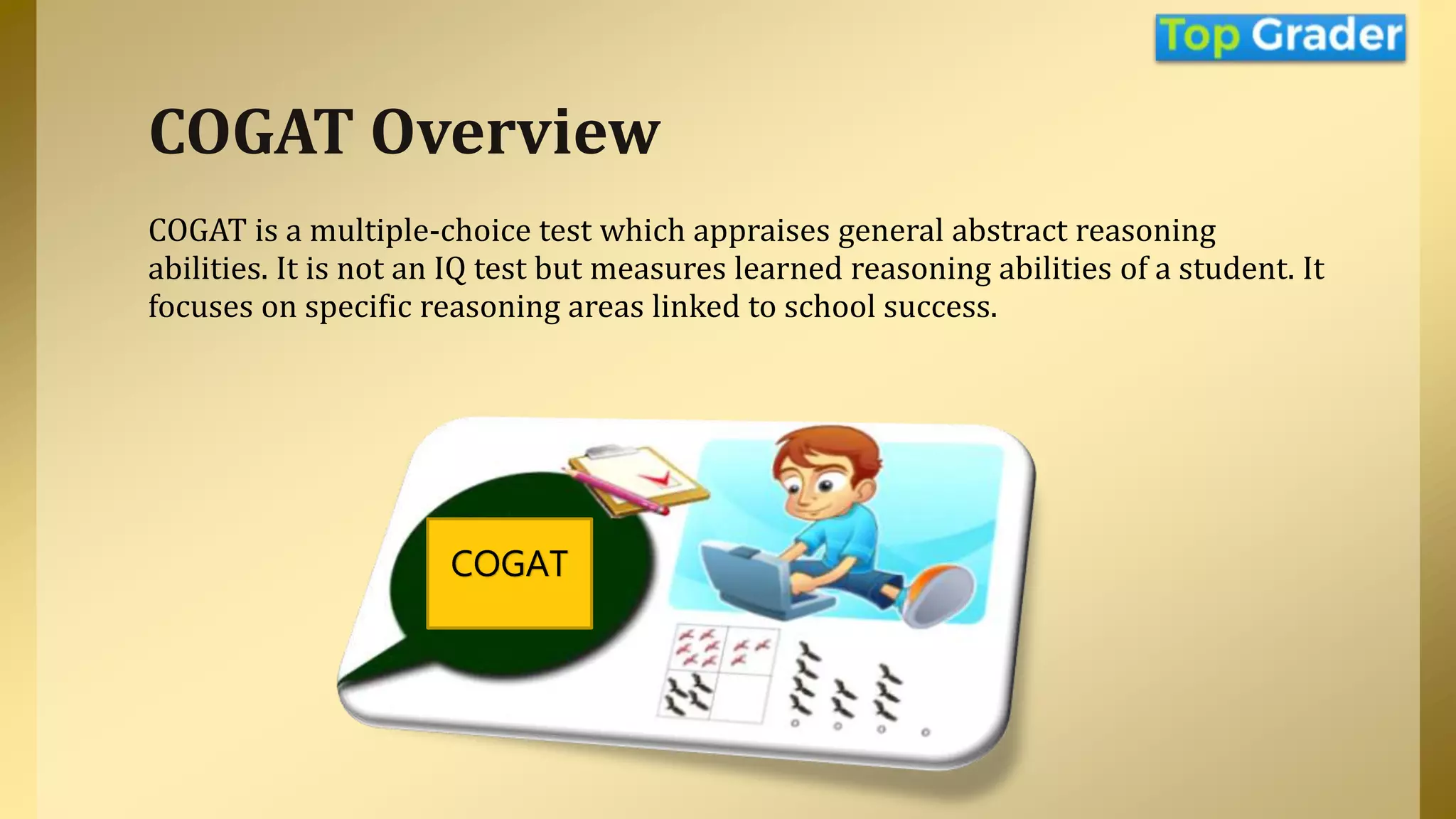
COGAT is a multiple-choice test which appraises general abstract reasoning
abilities. It is not an IQ test but measures learned reasoning abilities of a student. It
focuses on specific reasoning areas linked to school success.
COGAT
Understanding COGAT score
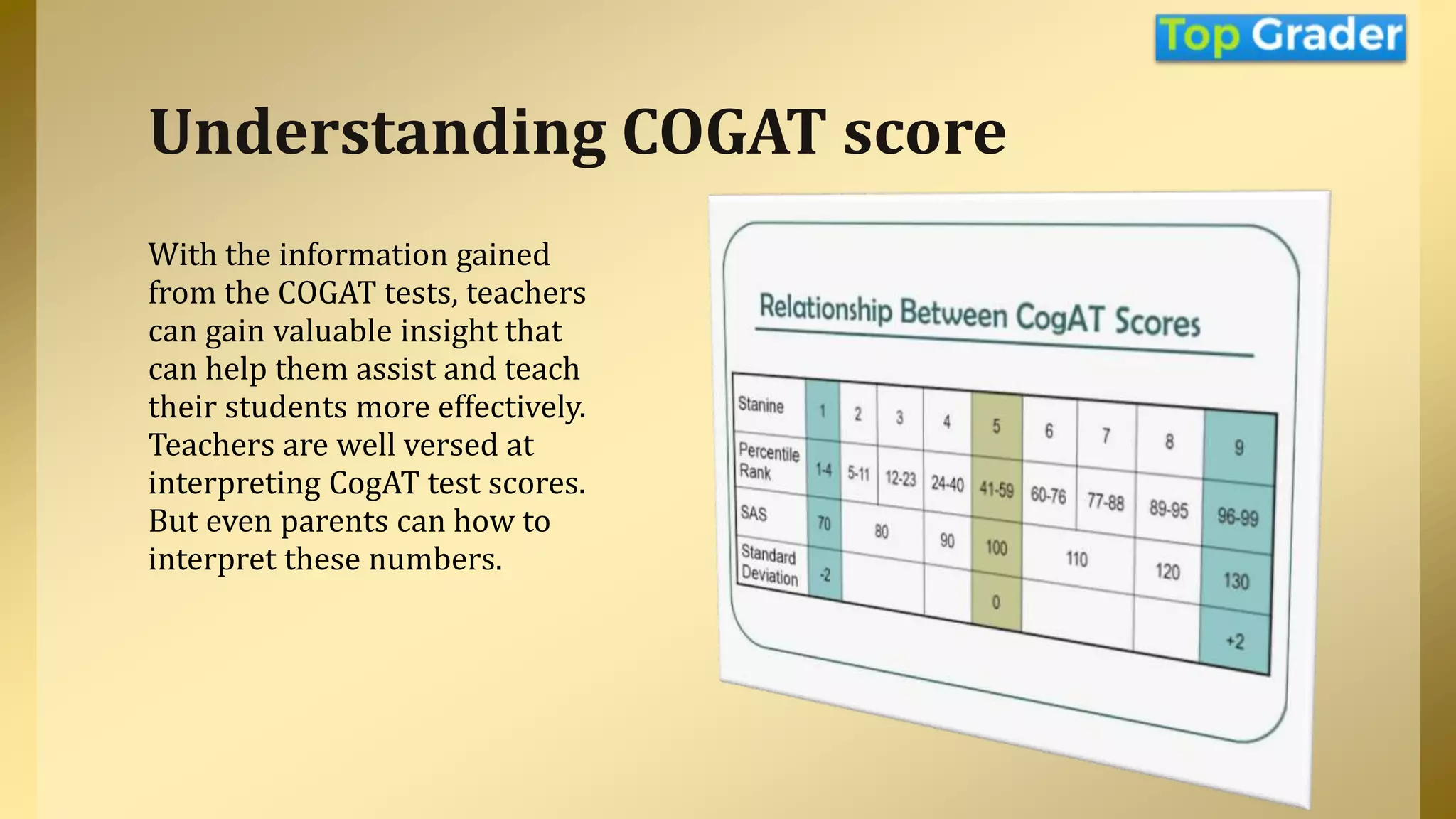
With the information gained
from the COGAT tests, teachers
can gain valuable insight that
can help them assist and teach
their students more effectively.
Teachers are well versed at
interpreting CogAT test scores.
But even parents can how to
interpret these numbers.
The following explanation for various parts of COGAT test scores will help
parents to understand their child’s performance:
• Abilities
• Standard Age Scores
• Stanine Age Scores
• Age Percentile Rank
• APR Graph
• Grade scores
• Local scores
• CoGAT profile
• Abilities: The CogAT, as earlier mentioned, tests
three different types of cognitive
abilities. Verbal section evaluates your child’s
ability to remember and change sequences of
English words. Quantitative portion test child’s
ability to find relationships among numbers and
equations are measured. Nonverbal part examines
the reasoning skills of your child when it does not
involve words at all. Your child may be asked to
choose which shapes are most alike.
• Standard Age Scores: These scores compare
your child to the other students in their age group.
Talk about homework expectations
• Stanine Age Scores: This score gives a clearer
idea of your child’s ranking among others of their
age. The score ranges from a low of 1 to a high of 9.
• Age Percentile Rank: This gives a specific
idea of how the child ranks among their age
group in the entire country.
• Standard Age Scores: These scores
compare your child to the other students in
their age group. Talk about homework
expectations
• APR Graph Age Scores: It is simply a graph
which shows your child’s age percentile rank.
• Raw scores: This part gives three numbers
for each test portion. These numbers
represent the number of questions on the test,
the number of questions your child tried to
answer, and the number of correct answers for
each portion.
• Grade scores Percentile Rank: These
explain how your child compares to other
students in the same age group in the entire
country.
• Local scores: These explain how your child
compares to other students in the same age
group in the same school system.
• CogAT profile: The various scores for all the
portions of the test as a whole also gives the
profile for the child. With the profile,
appropriate measures can then be taken so that
your child gets the right kind of educational
help from the teachers.
Get Expert COGAT Tutoring by Top Grader
Visit us at www.top-grader.com

Understanding COGAT score presentation

  • 1.
  • 2.
    COGAT Overview COGAT isa multiple-choice test which appraises general abstract reasoning abilities. It is not an IQ test but measures learned reasoning abilities of a student. It focuses on specific reasoning areas linked to school success. COGAT
  • 3.
    Understanding COGAT score Withthe information gained from the COGAT tests, teachers can gain valuable insight that can help them assist and teach their students more effectively. Teachers are well versed at interpreting CogAT test scores. But even parents can how to interpret these numbers.
  • 4.
    The following explanationfor various parts of COGAT test scores will help parents to understand their child’s performance: • Abilities • Standard Age Scores • Stanine Age Scores • Age Percentile Rank • APR Graph • Grade scores • Local scores • CoGAT profile
  • 5.
    • Abilities: TheCogAT, as earlier mentioned, tests three different types of cognitive abilities. Verbal section evaluates your child’s ability to remember and change sequences of English words. Quantitative portion test child’s ability to find relationships among numbers and equations are measured. Nonverbal part examines the reasoning skills of your child when it does not involve words at all. Your child may be asked to choose which shapes are most alike. • Standard Age Scores: These scores compare your child to the other students in their age group. Talk about homework expectations • Stanine Age Scores: This score gives a clearer idea of your child’s ranking among others of their age. The score ranges from a low of 1 to a high of 9.
  • 6.
    • Age PercentileRank: This gives a specific idea of how the child ranks among their age group in the entire country. • Standard Age Scores: These scores compare your child to the other students in their age group. Talk about homework expectations • APR Graph Age Scores: It is simply a graph which shows your child’s age percentile rank. • Raw scores: This part gives three numbers for each test portion. These numbers represent the number of questions on the test, the number of questions your child tried to answer, and the number of correct answers for each portion.
  • 7.
    • Grade scoresPercentile Rank: These explain how your child compares to other students in the same age group in the entire country. • Local scores: These explain how your child compares to other students in the same age group in the same school system. • CogAT profile: The various scores for all the portions of the test as a whole also gives the profile for the child. With the profile, appropriate measures can then be taken so that your child gets the right kind of educational help from the teachers.
  • 8.
    Get Expert COGATTutoring by Top Grader Visit us at www.top-grader.com