Cognitive Abilities Test (CogAT)
Understanding the
Student Profile and its
Use for Educational
Planning
Fall Semester 2015
Educational Planning
 The Cognitive Abilities Test (CogAT) is
administered to all third grade students in
WCPSS.
 The CogAT benchmark testing is used for
educational planning.
 Individual student data is accessed by the
Academically or Intellectually Gifted (AIG)
Program and other WCPSS educational
programs.
CogAT Scores
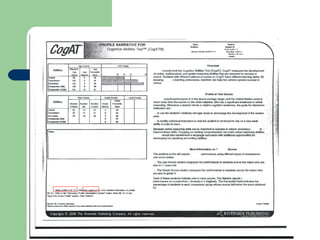
Please refer to the sample CogAT Report
included with the meeting hand-outs.
The CogAT Batteries are:
– Verbal – measure of verbal reasoning skills
– Quantitative– measure of math reasoning skills
– Nonverbal – measure of visual-spatial reasoning
CogAT Composite Scores
 The Quantitative-Nonverbal Partial
Composite score (QN Partial Composite)
indicates cognitive reasoning resources for
nonverbal learning.
 The Composite score indicates the overall
strength of the student’s cognitive resources
for learning.
National Age Scores
 Stanine – a type of normalized standard
score scale ranging from 1 to 9 with 5
being the mean (average).
 Percentile – indicates the percent of
students in the representative age group
who obtained lower raw scores on the
test.
Graphs and Profiles
 A bar graph of the student’s scores appears
on the score report as a visual representation
of the student’s percentile score.
 Your student’s individual profile code is listed
after the subtitle “Ability Profile”.
 Additional information regarding your child’s
profile can be found at: www.cogat.com by
keying in the profile code of your student.
Profile Codes
 The profile code contains a number and a
letter, for example, 8E (V-N+) or 7B (V+).
 The number represents the median stanine
and the letter indicates the type of score
pattern.
 The letter score patterns are: A, B, C or E.
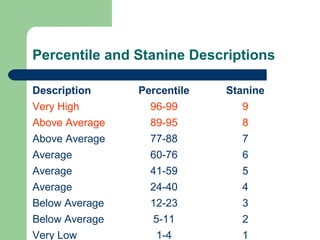
Percentile and Stanine Descriptions
Description Percentile Stanine
Very High 96-99 9
Above Average 89-95 8
Above Average 77-88 7
Average 60-76 6
Average 41-59 5
Average 24-40 4
Below Average 12-23 3
Below Average 5-11 2
Very Low 1-4 1
Student Profiles
 A Profile – all subtest scores are roughly the sAme
 B Profile – one subtest score is either aBove or
Below the other two subtest scores
 C Profile – two subtest scores Contrast indicating a
relative strength and a relative weakness
 E Profile – the difference between the high and low
subtest scores is Extreme
Raw Scores
 Number of Items = the number of
questions on the subtests.
 Number Att. (attempted) = the number of
questions the student answered.
 Number Correct = the total number of
items the student answered correctly.
National Grade Scores
 The grade scores compare the student to
other students at the same grade level
nationally.
 Grade scores are NOT used for
identification since students in a given
grade may vary greatly in terms of their
age.
The Next Step……..
 Students with an age-based Composite or
subtest battery score at or above the 85th
percentile (85%) are eligible to take the
Iowa Assessments (Iowa).
 Parents will receive a permission form that
must be signed and returned to the school
before the student can take the Iowa.
AIG Identification
 The CogAT and Iowa scores are reviewed.
 Additional factors (Informal Indicators) are
considered in determining AIG eligibility. These
factors include student interest, motivation,
classroom performance, third grade Explorers’ work
samples, parent and teacher checklists, etc.
 The overall profile of the student is considered in the
overall identification process.
Additional Steps in the AG
Identification Process
 School Based Committee for Gifted Education
(SBCGE) meets to nominate and refer
students.
 Parents sign and return the Consent For
Evaluation.
 Formal and Informal data are compiled.
 SBCGE makes final recommendations for
reading and/or math identification and level of
service.
AIG Identification Process
continued….
 SBCGE recommendations from schools are
reviewed by the AIG Program Central Services
Committee.
 Parents are informed of the final AIG
recommendations during 2nd
semester.
 AIG service begins in the second half of the 3rd
grade year after the ISP has been approved and
parents sign and return the Initial Consent for
Service.
AIG Program and Testing Information
 Test Coordinator: Tanya Churchill
 School Counselor: Victoria Romero
 3rd
Grade Classroom Teachers: Scott Brown, Rhonda
Connor & Heather Peaden
 AIG Resource Teachers: Heather Callahan &
Jennifer Page
 AIG Parent Guide
 AIG Program Website:
http://www.wcpss.net/curriculum-instruction/ag/
 AIG Program Office: Crossroads 1
5625 Dillard Drive, Cary, 431-7657

CogAt Parent Presentation

  • 1.
    Cognitive Abilities Test(CogAT) Understanding the Student Profile and its Use for Educational Planning Fall Semester 2015
  • 2.
    Educational Planning  TheCognitive Abilities Test (CogAT) is administered to all third grade students in WCPSS.  The CogAT benchmark testing is used for educational planning.  Individual student data is accessed by the Academically or Intellectually Gifted (AIG) Program and other WCPSS educational programs.
  • 3.
    CogAT Scores Please referto the sample CogAT Report included with the meeting hand-outs. The CogAT Batteries are: – Verbal – measure of verbal reasoning skills – Quantitative– measure of math reasoning skills – Nonverbal – measure of visual-spatial reasoning
  • 4.
    CogAT Composite Scores The Quantitative-Nonverbal Partial Composite score (QN Partial Composite) indicates cognitive reasoning resources for nonverbal learning.  The Composite score indicates the overall strength of the student’s cognitive resources for learning.
  • 6.
    National Age Scores Stanine – a type of normalized standard score scale ranging from 1 to 9 with 5 being the mean (average).  Percentile – indicates the percent of students in the representative age group who obtained lower raw scores on the test.
  • 7.
    Graphs and Profiles A bar graph of the student’s scores appears on the score report as a visual representation of the student’s percentile score.  Your student’s individual profile code is listed after the subtitle “Ability Profile”.  Additional information regarding your child’s profile can be found at: www.cogat.com by keying in the profile code of your student.
  • 8.
    Profile Codes  Theprofile code contains a number and a letter, for example, 8E (V-N+) or 7B (V+).  The number represents the median stanine and the letter indicates the type of score pattern.  The letter score patterns are: A, B, C or E.
  • 9.
    Percentile and StanineDescriptions Description Percentile Stanine Very High 96-99 9 Above Average 89-95 8 Above Average 77-88 7 Average 60-76 6 Average 41-59 5 Average 24-40 4 Below Average 12-23 3 Below Average 5-11 2 Very Low 1-4 1
  • 10.
    Student Profiles  AProfile – all subtest scores are roughly the sAme  B Profile – one subtest score is either aBove or Below the other two subtest scores  C Profile – two subtest scores Contrast indicating a relative strength and a relative weakness  E Profile – the difference between the high and low subtest scores is Extreme
  • 11.
    Raw Scores  Numberof Items = the number of questions on the subtests.  Number Att. (attempted) = the number of questions the student answered.  Number Correct = the total number of items the student answered correctly.
  • 12.
    National Grade Scores The grade scores compare the student to other students at the same grade level nationally.  Grade scores are NOT used for identification since students in a given grade may vary greatly in terms of their age.
  • 13.
    The Next Step…….. Students with an age-based Composite or subtest battery score at or above the 85th percentile (85%) are eligible to take the Iowa Assessments (Iowa).  Parents will receive a permission form that must be signed and returned to the school before the student can take the Iowa.
  • 14.
    AIG Identification  TheCogAT and Iowa scores are reviewed.  Additional factors (Informal Indicators) are considered in determining AIG eligibility. These factors include student interest, motivation, classroom performance, third grade Explorers’ work samples, parent and teacher checklists, etc.  The overall profile of the student is considered in the overall identification process.
  • 15.
    Additional Steps inthe AG Identification Process  School Based Committee for Gifted Education (SBCGE) meets to nominate and refer students.  Parents sign and return the Consent For Evaluation.  Formal and Informal data are compiled.  SBCGE makes final recommendations for reading and/or math identification and level of service.
  • 16.
    AIG Identification Process continued…. SBCGE recommendations from schools are reviewed by the AIG Program Central Services Committee.  Parents are informed of the final AIG recommendations during 2nd semester.  AIG service begins in the second half of the 3rd grade year after the ISP has been approved and parents sign and return the Initial Consent for Service.
  • 17.
    AIG Program andTesting Information  Test Coordinator: Tanya Churchill  School Counselor: Victoria Romero  3rd Grade Classroom Teachers: Scott Brown, Rhonda Connor & Heather Peaden  AIG Resource Teachers: Heather Callahan & Jennifer Page  AIG Parent Guide  AIG Program Website: http://www.wcpss.net/curriculum-instruction/ag/  AIG Program Office: Crossroads 1 5625 Dillard Drive, Cary, 431-7657

Editor's Notes

  • #2 Recommendations for the AIG Teacher: Remember to consult with your building level administrator as to how he/she wants to distribute and interpret the CogAT scores to parents. It is their decision!! AIG teachers are expected to review and practice the power point presentation PRIOR to the meeting/s. The following school personnel should be represented at the meeting: Principal, Assistant Principal, or designee Test Coordinator, AIG Teacher, Counselor, IRT, Grade Three Teachers, Exceptional Children Program Teacher/Representative, and/or any other personnel designated by the principal Instructions for the AIG Teachers and Third Grade Teachers: Schedule a large meeting space, for example the media center or gym, in advance. Order student address labels from the NCWISE Technician. Prepare a brown envelope/folder for each student including the following items: Student name and address label placed on the outside of the envelope/folder Individual Student Profile CogAT Narrative Sheet for each student (the individual student’s score sheet) CogAT Form 7 General Information sheet 85% rationale for the Iowa AIG Program Pamphlet/AIG Brochure 4. Prepare the following handouts to be given to parents upon arrival at the meeting: Handouts of CogAT power point Sample CogAT Profile Narrative 5. Prepare the following sign-in sheets: Parent attendance sign-in sheet, by third grade class Sign-up sheet for parents wanting an individual conference 6. At the start of the parent meeting: Announce the following to parents and staff members in attendance: This general informational meeting is to provide an overview of the CogAT scores. It is not a time to take specific questions about a student’s individual scores. A sign-up sheet for individual consultation/interpretation of scores will be provided at the end of the meeting. Also let the parents know what items will be in the envelope that they pick up at the end of the presentation. Hold up the hard copy of the CogAT Power Point notes and the sample CogAT student profile to see if any parents still need a copy. Begin Power Point presentation. At the conclusion of the Power Point, ask if there are any general questions Provide parents with directions on how envelopes will be distributed (by classroom teachers, A-B-C by counselor, etc). If additional tables are going to be set up for explanations following the general meeting, direct parents to that location. Thank parents for attending and adjourn meeting.
  • #3 The CogAT appraises general thinking skills that the student gradually develops from both in-school and out-of-school experiences. The classroom teacher is able to use the data from the CogAT Test for instructional planning. Counselors, Student Support Teams, and other support personnel in the schools may also use the CogAT data to assist in educational planning.
  • #4 Each of the CogAT batteries (Verbal, Quantitative and Nonverbal) was administered on a separate day. The total testing time each day was approximately 30 minutes. There are three subtests that comprise each Battery.
  • #5 The Composite Score is the best representation of cognitive ability for most students. It is not an average of the subtest scores but a compilation of all three test batteries. The Quantitative-Nonverbal Partial Composite is combines the three Quantitative subtests and the three Nonverbal subtests. This composite score better predicts achievement in mathematics and some technical domains than either the Quantitative Battery or Nonverbal Battery alone. Additionally this score allows for meaningful score interpretation for students with verbal weaknesses or language differences. In some situations the individual battery scores (Verbal and Quantitative) may reflect specific strengths and/or weaknesses for a student. Use of battery scores instead of composite or partial composite scores is considered based on the individual student profile.
  • #6 DO NOT give parents their child’s copy of this CogAT profile until the end of the meeting. Parents should have a copy of this example page printed for them as a hand-out to read and follow along as a sample only.
  • #7 The Stanine score is relatively easy to use because it is a one digit number. An advantage of the stanine score is that it discourages over-interpretation of small, insignificant differences among test scores. There must be a difference between stanine scores of at least 2 points for the difference to be considered significant. The Percentile Rank is NOT the percentage of correct answers. The CogAT is not an IQ test. IQ is no longer used in assessment and the CogAT does not give IQ scores. The same information that used to be provided by the IQ score is now provided by percentile ranks and other scores.
  • #8 The bar graph represents the student’s actual percentile score as compared with their age group. Percentiles falling between the 24th and 76th percentile ranking indicate a student with average abilities as compared with their age group. This student’s performance on the Verbal abilities subtest is average, but is a relative weakness as compared with the other scores. On the sample profile, the Ability Profile is: 8E (V-). The V- reflects the verbal weakness. You can go to the CogAT website to access further information about your child’s strengths and weaknesses.
  • #9 The median stanine is the middle stanine when the individual battery stanine scores are listed in numerical order. In the example, the student’s stanines are 6, 8 and 9; therefore the middle stanine is 8, thus the median. The letter indicates the general form of the student’s score pattern. The symbols in parenthesis indicate a student’s relative strength (+ scores) or relative weakness (- scores). In the sample, the student has a relative weakness on the Verbal Battery and a relative strength on the Nonverbal Battery.
  • #10 This table provides a description of all percentile and stanine score ranges and the accompanying verbal descriptor. Please note the scores highlighted in red are the general ranges considered for AIG identification. The Percentile Rank scale ranges from a low of 1 to a high of 99. For example, if a student scores at the 52nd percentile, this indicates that his raw score on the test was higher than that of 52 percent but lower than that of 48 percent of the students in his age group. This compares the student to a national standardization group of his age, not the students in his classroom. Half the students in an age norm group fall between the 24th and 76th percentiles, and this is considered average for the age group.
  • #11 Here are the general interpretations of the student profiles. In your example the student has an E Profile, which indicates there is an extreme difference between the Verbal and Nonverbal Battery scores.
  • #12 In the example, the student did not attempt all of the items on each test battery. The number that was correct varied in each battery. Note that the area of relative weakness is the Verbal Battery. The student only attempted 44 of the 62 items and only answered 37 of the items correctly. The area of relative strength is the Nonverbal Battery, where 46 of the 56 items were answered correctly. The student attempted 53 of the 56 items.
  • #13 Growth in cognitive abilities continues throughout most of an individual’s life. However, the rate of growth is much more rapid between birth and age 8 than it is after age 8 and somewhat more rapid between ages 8 and 14 than after age 14. The rate of cognitive growth slows as age increases. Therefore, being younger or older than other students in a grade has a greater effect on the differences between age and grade scores. Since growth in cognitive skills is a developmental process that is correlated with chronological age, such comparisons can result in lower grade scores than age scores for younger students in a grade and higher grade scores than age scores for older students in a grade. This is why Age Scores are used for identification instead of Grade Scores. In the example, the student’s grade scores are slightly higher than her age scores. This student is one of the older students in the third grade since there is an October date of birth.
  • #14 Any age-based battery score or composite score of 85% or higher on the CogAT qualifies students to take the Iowa in the 3rd grade. Parents must give permission for their student to take the Iowa. Students taking the Iowa will be assessed in reading and mathematics. The Iowa is a standardized achievement test that appraises skills that are directly taught and practiced in school.
  • #15 Data from the entire third grade first semester is used as part of the AIG identification process. Identification is a year-long process and includes data and work samples collected from the Third Grade Explorers’ lessons as well as the third grade classroom. Parent input is important, and so parents will be asked to complete a checklist during this AIG identification process describing gifted learning behaviors demonstrated by their child. Parents are should provide specific examples of gifted behaviors observed at home and/or samples of work products when submitting the AIG Parent checklist.
  • #16 Note to teacher: one bullet at a time appears on this page and the next. The members of the School Based Committee for Gifted Education may include a school administrator, classroom teacher, AIG teacher, counselor and/or a grade level representative. The SBCGE provides a team framework for evaluating data and recommending the most appropriate service options for individual students who demonstrate a need for differentiation. Parents must sign the Consent For Evaluation before the SBCGE can access the CogAT and IOWA data on a student. The Consent for Evaluation gives parent permission for the SBCGE to use the available CogAT and IOWA scores to determine the need for differentiated services within the Academically or Intellectually Gifted Program.
  • #17 Even though the CogAT scores have been returned and the Iowa will be administered within the next month, the AIG identification process is not completed until the end of the academic year. All parents will be informed of recommendations at that time. The SBCGE continues to monitor student progress and performance yearly in making nominations and referrals to the AIG program.
  • #18 Note to AIG Teacher: the specific names and email addresses for these positions at your school should be added to this slide.