GRE Graduate Record Examination
Topics What does the GRE measure? Interpreting and Using GRE Scores P&P versus Computerized: What’s the Difference? Test Taking Strategies  Reliability and Validity Evidence Culture, Fairness, and Subgroup Differences
What does the GRE measure? Analytical Writing (GRE-W) Issue Essay (“Present Your Perspective on an Issue”) Argument Essay (“Critique a Perspective”) The skills measured include the test taker's ability to articulate complex ideas clearly and effectively  examine claims and accompanying evidence  support ideas with relevant reasons and examples  sustain a well-focused, coherent discussion  control the elements of standard written English
What does the GRE measure? Verbal Reasoning (GRE-V) The skills measured include the test taker's ability to analyze and evaluate written material and synthesize information obtained from it  analyze relationships among component parts of sentences  recognize relationships between words and concepts
What does the GRE measure? Quantitative Reasoning (GRE-Q) The skills measured include the test taker's ability to understand basic concepts of arithmetic, algebra, geometry, and data analysis  reason quantitatively  solve problems in a quantitative setting
GRE Scores Three scores are reported on the General Test: a  verbal reasoning  score reported on a 200-800 score scale, in 10-point increments a  quantitative reasoning  score reported on a 200-800 score scale, in 10-point increments an  analytical writing  score reported on a 0 to 6 score scale in half-point increments. Average of two raters for each essay Two essay ratings then averaged and rounded up
What does the score mean? GRE Score = (z-score)(100) + 500 Z-score = (X – u) / s If you score 1 SD above the mean, your GRE score would be 600 If you score 2 SD below the mean, your GRE score would be 300
GRE scores in the admission process Do NOT rely solely on the GRE to select students Do NOT use combined or total scores Do NOT report only mean GREs of accepted applicants DO use other pieces of information, such as: Relevant coursework GPA Letters of recommendation Personal statement Interview Research experience DO conduct validity studies
P&P versus Computerized P&P and CAT GRE scores are comparable (i.e., equated) (r = .97,  Mead & Drasgow, 1992 ) Scores are calculated differently, but interpretation is equivalent P&P = # correct  CAT is a function of: # Items answered correctly AND Item difficulty
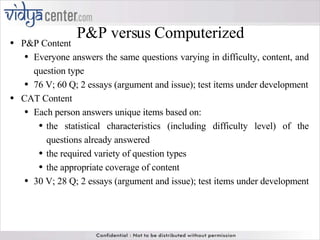
P&P versus Computerized P&P Content Everyone answers the same questions varying in difficulty, content, and question type 76 V; 60 Q; 2 essays (argument and issue); test items under development CAT Content Each person answers unique items based on: the statistical characteristics (including difficulty level) of the questions already answered  the required variety of question types  the appropriate coverage of content 30 V; 28 Q; 2 essays (argument and issue); test items under development
CAT GRE Test Taking Strategies Educated Guessing? YES Rule of First 5 There’s no going back…and no skipping Pace yourself Towards end, answer as many as possible But, don’t blow it at the end either ☺ Be happy if the questions keep getting harder Concentrate more if they start getting easy
P&P GRE Test Taking Strategies Leave no question unanswered Feel free to change answers (although first choice is usually correct) Record all answers in test booklet – If it’s not there, it doesn’t count
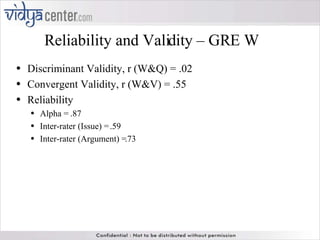
Reliability and Validity – GRE W  Discriminant Validity, r (W&Q) = .02 Convergent Validity, r (W&V) = .55  Reliability Alpha = .87 Inter-rater (Issue) = .59 Inter-rater (Argument) =.73
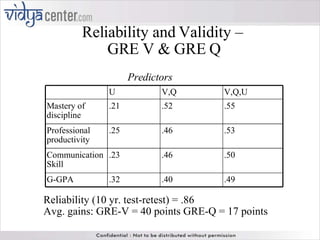
Reliability and Validity –  GRE V & GRE Q U V,Q V,Q,U Mastery of discipline .21 .52 .55 Professional productivity .25 .46 .53 Communication Skill .23 .46 .50 G-GPA .32 .40 .49 Predictors Reliability (10 yr. test-retest) = .86 Avg. gains: GRE-V = 40 points GRE-Q = 17 points
Culture, Fairness, and Subgroup Differences Exhaustive Review of  Item Content DIF Statistics Have to look at which programs students are applying to Ex: men traditionally go into math/science grad school programs; women gravitate towards social sciences and humanities  Therefore, not surprising that men score higher than women on the GRE-Q
Non-traditional students 1 st  generation college students Perform more poorly on GRE-V and GRE-Q Why? More motivation at home More resources (e.g., Kaplan, no need to work) Higher income (better educational opportunities) Older students GRE-V & GRE-W do not change with age GRE-Q decreases over time

Gre Ppt

  • 1.
  • 2.
    Topics What doesthe GRE measure? Interpreting and Using GRE Scores P&P versus Computerized: What’s the Difference? Test Taking Strategies Reliability and Validity Evidence Culture, Fairness, and Subgroup Differences
  • 3.
    What does theGRE measure? Analytical Writing (GRE-W) Issue Essay (“Present Your Perspective on an Issue”) Argument Essay (“Critique a Perspective”) The skills measured include the test taker's ability to articulate complex ideas clearly and effectively examine claims and accompanying evidence support ideas with relevant reasons and examples sustain a well-focused, coherent discussion control the elements of standard written English
  • 4.
    What does theGRE measure? Verbal Reasoning (GRE-V) The skills measured include the test taker's ability to analyze and evaluate written material and synthesize information obtained from it analyze relationships among component parts of sentences recognize relationships between words and concepts
  • 5.
    What does theGRE measure? Quantitative Reasoning (GRE-Q) The skills measured include the test taker's ability to understand basic concepts of arithmetic, algebra, geometry, and data analysis reason quantitatively solve problems in a quantitative setting
  • 6.
    GRE Scores Threescores are reported on the General Test: a verbal reasoning score reported on a 200-800 score scale, in 10-point increments a quantitative reasoning score reported on a 200-800 score scale, in 10-point increments an analytical writing score reported on a 0 to 6 score scale in half-point increments. Average of two raters for each essay Two essay ratings then averaged and rounded up
  • 7.
    What does thescore mean? GRE Score = (z-score)(100) + 500 Z-score = (X – u) / s If you score 1 SD above the mean, your GRE score would be 600 If you score 2 SD below the mean, your GRE score would be 300
  • 8.
    GRE scores inthe admission process Do NOT rely solely on the GRE to select students Do NOT use combined or total scores Do NOT report only mean GREs of accepted applicants DO use other pieces of information, such as: Relevant coursework GPA Letters of recommendation Personal statement Interview Research experience DO conduct validity studies
  • 9.
    P&P versus ComputerizedP&P and CAT GRE scores are comparable (i.e., equated) (r = .97, Mead & Drasgow, 1992 ) Scores are calculated differently, but interpretation is equivalent P&P = # correct CAT is a function of: # Items answered correctly AND Item difficulty
  • 10.
    P&P versus ComputerizedP&P Content Everyone answers the same questions varying in difficulty, content, and question type 76 V; 60 Q; 2 essays (argument and issue); test items under development CAT Content Each person answers unique items based on: the statistical characteristics (including difficulty level) of the questions already answered the required variety of question types the appropriate coverage of content 30 V; 28 Q; 2 essays (argument and issue); test items under development
  • 11.
    CAT GRE TestTaking Strategies Educated Guessing? YES Rule of First 5 There’s no going back…and no skipping Pace yourself Towards end, answer as many as possible But, don’t blow it at the end either ☺ Be happy if the questions keep getting harder Concentrate more if they start getting easy
  • 12.
    P&P GRE TestTaking Strategies Leave no question unanswered Feel free to change answers (although first choice is usually correct) Record all answers in test booklet – If it’s not there, it doesn’t count
  • 13.
    Reliability and Validity– GRE W Discriminant Validity, r (W&Q) = .02 Convergent Validity, r (W&V) = .55 Reliability Alpha = .87 Inter-rater (Issue) = .59 Inter-rater (Argument) =.73
  • 14.
    Reliability and Validity– GRE V & GRE Q U V,Q V,Q,U Mastery of discipline .21 .52 .55 Professional productivity .25 .46 .53 Communication Skill .23 .46 .50 G-GPA .32 .40 .49 Predictors Reliability (10 yr. test-retest) = .86 Avg. gains: GRE-V = 40 points GRE-Q = 17 points
  • 15.
    Culture, Fairness, andSubgroup Differences Exhaustive Review of Item Content DIF Statistics Have to look at which programs students are applying to Ex: men traditionally go into math/science grad school programs; women gravitate towards social sciences and humanities Therefore, not surprising that men score higher than women on the GRE-Q
  • 16.
    Non-traditional students 1st generation college students Perform more poorly on GRE-V and GRE-Q Why? More motivation at home More resources (e.g., Kaplan, no need to work) Higher income (better educational opportunities) Older students GRE-V & GRE-W do not change with age GRE-Q decreases over time