Understanding Children through their Creations
"The teacher whose child within has become like dead wood is not qualified to take responsibility of children. There ought to be not only closeness but also identity and mental similitude, otherwise there cannot be any exchange between the two .... The  eternal  child in a born teacher comes out in the open at the first call of the children.” Rabindranath Tagore
Exploring the Perceptual World of the Child
The Growing Child What Sources Can we use to understand the Growing Child – her emotions, capabilities and so on?
The Growing Child Understand the Children by Exploring their unique perceptual world  In other words, Every Child has his or her own unique  personal life space  – Exploring this holds the key to proper understanding
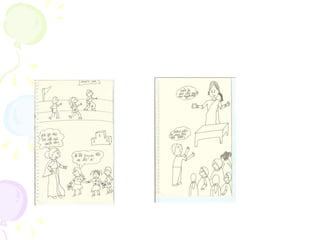
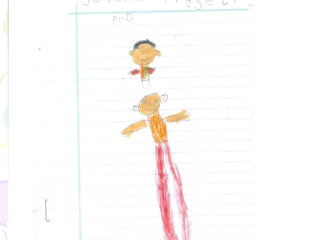
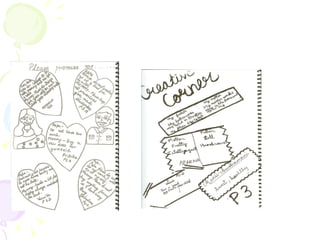
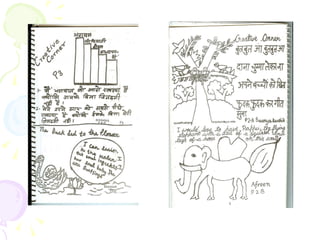
How do we explore? Child’s creations are the best source for Exploring their World, their Perceptions and Emotions  what they talk what they draw, what they play and play with, stories and characters they play-act   In many ways, Creations of a Child mirror his or her personality


The Growing Child Emotions and capabilities are not static or finished goods Let us remember that we are DEALING WITH A GROWING CHILD – emotions and capabilities are also evolving with age and environment
 
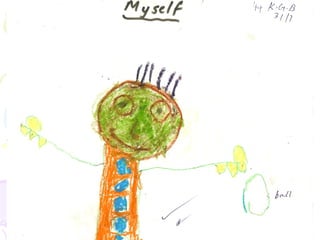
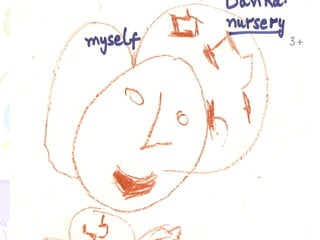
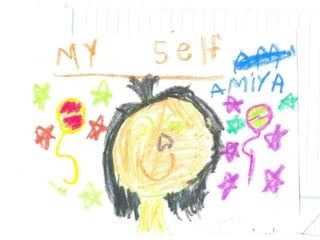
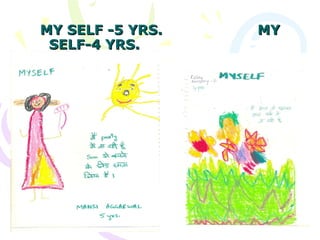
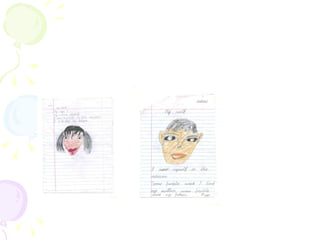
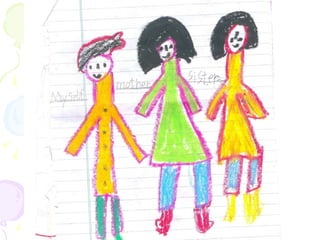
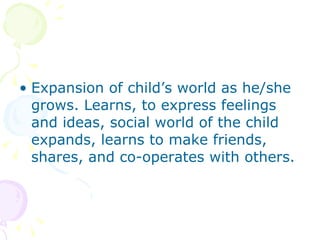
MY SELF -5 YRS.  MY SELF-4 YRS.


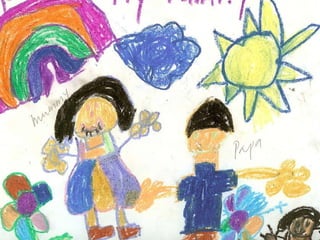
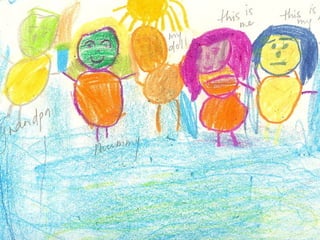
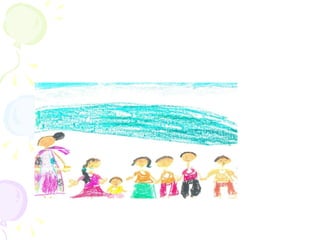
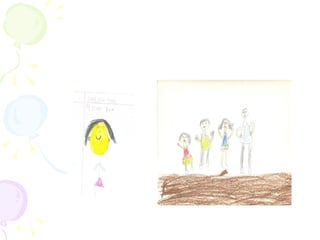
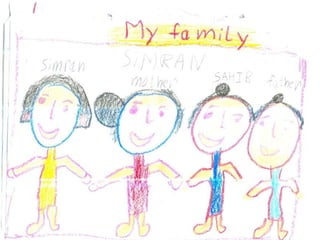
Personal Life Space to Social Life Space Need not be the social space that we draw around them   Social space has its own hierarchy – mother, father, grand parents, other adults, siblings, neighbours, even pets, and so on  It is Originally Constructed by Every Child – not given by the adult world Influence of media – fantasy world and the real world in the life of the Child
 
 
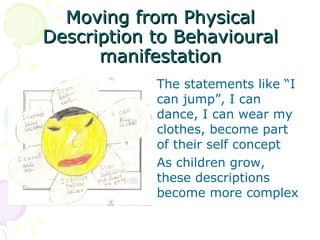
Moving from Physical Description to Behavioural manifestation The statements like “I can jump”, I can dance, I can wear my clothes, become part of their self concept As children grow, these descriptions become more complex
 
Personal Life Space to Social Life Space With Growth and Development the  personal life space of the Child Expands Becomes Complex by Incorporating Other’s Perspectives through Interaction, Emulation and Learning Leads to Creation of Unique Social Space by Every Child
 
 
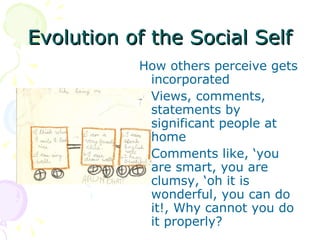
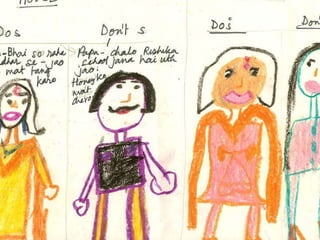
Evolution of the Social Self How others perceive gets incorporated Views, comments, statements by significant people at home Comments like, ‘you are smart, you are clumsy, ‘oh it is wonderful, you can do it!, Why cannot you do it properly?


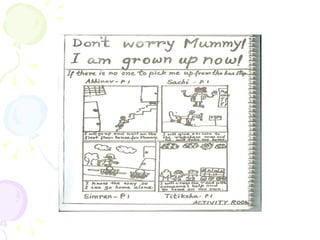
Expansion of child’s world as he/she grows. Learns, to express feelings and ideas, social world of the child expands, learns to make friends, shares, and co-operates with others.


Framework for Analyzing the Child’s Creation Recognize that Each Child is a Unique Individual All children of a particular age share certain common characteristics but each child is still unique and different.  Identify and Tap Potential in Children  Every child has a natural urge to develop one’s own hidden potential and talent.  Satisfaction/deprivation of needs affect growth and development of children
Framework for Analyzing the Child’s Creation Create an Environment of Trust   Accept children with their strength and limitations   Environment of trust develop them into secured and confident individuals.    Pleasant childhood experiences help them to develop positive concept of self
Framework for Analyzing the Child’s Creation Age and Stage Appropriate tasks create a Sense of Achievement    Every child has to go through different stages of development   Rate of development may be different but sequence remains largely the same.    Match your expectation with their age and stage of development
Framework for Analyzing the Child’s Creation Freedom – A Precondition Freedom to explore, freedom to express, freedom to think, freedom to act, freedom to create. We cannot park our ideas in the child’s mind Freedom to explore and fear do not go together Freedom to explore cannot be compartmentalised
Summing Up … “ Child as a natural explorer” and “Freedom to explore as a major educational strategy” as central themes in early childhood education programme “ Free Exploration” is the heart of ‘Building Creative Spaces for Children’
 

Understanding children through their creations

  • 1.
  • 2.
    "The teacher whosechild within has become like dead wood is not qualified to take responsibility of children. There ought to be not only closeness but also identity and mental similitude, otherwise there cannot be any exchange between the two .... The eternal child in a born teacher comes out in the open at the first call of the children.” Rabindranath Tagore
  • 3.
    Exploring the PerceptualWorld of the Child
  • 4.
    The Growing ChildWhat Sources Can we use to understand the Growing Child – her emotions, capabilities and so on?
  • 5.
    The Growing ChildUnderstand the Children by Exploring their unique perceptual world In other words, Every Child has his or her own unique personal life space – Exploring this holds the key to proper understanding
  • 6.
    How do weexplore? Child’s creations are the best source for Exploring their World, their Perceptions and Emotions what they talk what they draw, what they play and play with, stories and characters they play-act In many ways, Creations of a Child mirror his or her personality
  • 7.
  • 8.
  • 9.
  • 10.
  • 11.
    The Growing ChildEmotions and capabilities are not static or finished goods Let us remember that we are DEALING WITH A GROWING CHILD – emotions and capabilities are also evolving with age and environment
  • 12.
  • 13.
    MY SELF -5YRS. MY SELF-4 YRS.
  • 14.
  • 15.
  • 16.
  • 17.
    Personal Life Spaceto Social Life Space Need not be the social space that we draw around them Social space has its own hierarchy – mother, father, grand parents, other adults, siblings, neighbours, even pets, and so on It is Originally Constructed by Every Child – not given by the adult world Influence of media – fantasy world and the real world in the life of the Child
  • 18.
  • 19.
  • 20.
    Moving from PhysicalDescription to Behavioural manifestation The statements like “I can jump”, I can dance, I can wear my clothes, become part of their self concept As children grow, these descriptions become more complex
  • 21.
  • 22.
    Personal Life Spaceto Social Life Space With Growth and Development the personal life space of the Child Expands Becomes Complex by Incorporating Other’s Perspectives through Interaction, Emulation and Learning Leads to Creation of Unique Social Space by Every Child
  • 23.
  • 24.
  • 25.
    Evolution of theSocial Self How others perceive gets incorporated Views, comments, statements by significant people at home Comments like, ‘you are smart, you are clumsy, ‘oh it is wonderful, you can do it!, Why cannot you do it properly?
  • 26.
  • 27.
  • 28.
  • 29.
    Expansion of child’sworld as he/she grows. Learns, to express feelings and ideas, social world of the child expands, learns to make friends, shares, and co-operates with others.
  • 30.
  • 31.
  • 32.
  • 33.
  • 34.
  • 35.
  • 36.
  • 37.
    Framework for Analyzingthe Child’s Creation Recognize that Each Child is a Unique Individual All children of a particular age share certain common characteristics but each child is still unique and different. Identify and Tap Potential in Children Every child has a natural urge to develop one’s own hidden potential and talent. Satisfaction/deprivation of needs affect growth and development of children
  • 38.
    Framework for Analyzingthe Child’s Creation Create an Environment of Trust   Accept children with their strength and limitations   Environment of trust develop them into secured and confident individuals.   Pleasant childhood experiences help them to develop positive concept of self
  • 39.
    Framework for Analyzingthe Child’s Creation Age and Stage Appropriate tasks create a Sense of Achievement   Every child has to go through different stages of development   Rate of development may be different but sequence remains largely the same.   Match your expectation with their age and stage of development
  • 40.
    Framework for Analyzingthe Child’s Creation Freedom – A Precondition Freedom to explore, freedom to express, freedom to think, freedom to act, freedom to create. We cannot park our ideas in the child’s mind Freedom to explore and fear do not go together Freedom to explore cannot be compartmentalised
  • 41.
    Summing Up …“ Child as a natural explorer” and “Freedom to explore as a major educational strategy” as central themes in early childhood education programme “ Free Exploration” is the heart of ‘Building Creative Spaces for Children’
  • 42.

Editor's Notes

  • #5 Exercise on Analysis of Drawings in small Groups