CONFIDENTIAL: The information in this document belongs to Boston Institute of Analytics LLC. Any unauthorized sharing of this
material is prohibited and subject to legal action under breach of IP and confidentiality clauses.
Report on Broken Link Hijacking Vulnerability
Manish Kumar
CONFIDENTIAL: The information in this document belongs to Boston Institute of Analytics LLC. Any unauthorized sharing of this
material is prohibited and subject to legal action under breach of IP and confidentiality clauses.
Introduction:
• Broken Link Hijacking (BLH) is a technique where attackers exploit
broken or dead hyperlinks on websites. When a web page or resource
that a hyperlink points to no longer exists, the link becomes "broken."
Attackers can take advantage of these broken links by redirecting them
to their own websites, which can serve various purposes ranging from
SEO manipulation to malicious activities.
• Scope and Objectives of the Report: This report aims to analyze a
website vulnerable to BLH, demonstrate a Proof of Concept (PoC), and
provide mitigation strategies.
CONFIDENTIAL: The information in this document belongs to Boston Institute of Analytics LLC. Any unauthorized sharing of this
material is prohibited and subject to legal action under breach of IP and confidentiality clauses.
Abstract:
• Broken Link Hijacking (BLH) is an emerging vulnerability in web security
that exploits inactive or broken hyperlinks on a website. When a hyperlink
points to a resource that no longer exists or an expired domain, it
becomes "broken." Attackers leverage these broken links by acquiring the
expired domains or redirecting the broken links to malicious websites. This
technique can lead to various malicious activities, including defacement,
impersonation, phishing attacks, and cross-site scripting (XSS).
• The report also provides comprehensive mitigation strategies to prevent
BLH, emphasizing regular link maintenance, proper redirection, and the
use of security scanners. Policy recommendations for web developers and
organizations are included to enhance overall web security and prevent
similar vulnerabilities
CONFIDENTIAL: The information in this document belongs to Boston Institute of Analytics LLC. Any unauthorized sharing of this
material is prohibited and subject to legal action under breach of IP and confidentiality clauses.
• This report examines the BLH vulnerability in a specific website,
example.com, which exhibits multiple broken external links. By
analyzing these vulnerabilities, we highlight the potential risks and
impact of BLH on the website's integrity and user trust. A detailed Proof
of Concept (PoC) is demonstrated, showcasing how attackers can
exploit these broken links to redirect users to malicious websites.
• The findings underscore the importance of proactive measures and
continuous monitoring to safeguard websites from BLH and other web
security threats. This report aims to raise awareness and provide
actionable insights for web developers and organizations to protect
their digital assets effectively.
CONFIDENTIAL: The information in this document belongs to Boston Institute of Analytics LLC. Any unauthorized sharing of this
material is prohibited and subject to legal action under breach of IP and confidentiality clauses.
Research:
• Name: Wageningen University & Research
• URL: https://www.wur.nl.com
• Category Type: Educational Domain
• Overall Ranking/Usage/Popularity: Wageningen University & Research is
ranked #113 in Best Global Universities. Schools are ranked according to their
performance across a set of widely accepted indicators of excellence. Read more
about how we rank schools. Grants degrees at the BSc, MSc and PhD level in life and
social sciences. It focuses its research on scientific, social and commercial problems
in the field of life sciences and natural resources. #151 in the world. The new global
QS ranking shows Wageningen University & Research among the 10 percent best
universities in the world.
CONFIDENTIAL: The information in this document belongs to Boston Institute of Analytics LLC. Any unauthorized sharing of this
material is prohibited and subject to legal action under breach of IP and confidentiality clauses.
Proof of Concept(POC)
• Step-by-Step Guide to Create a PoC: A detailed guide to creating a PoC
for BLH was provided, including the tools and techniques used.
• Tools and Techniques Used: Tools such as Broken Link Checker were
used to identify broken links.
• Implementation Details: The implementation process was explained in
detail, including the setup of a fake page and redirection of users.
CONFIDENTIAL: The information in this document belongs to Boston Institute of Analytics LLC. Any unauthorized sharing of this
material is prohibited and subject to legal action under breach of IP and confidentiality clauses.
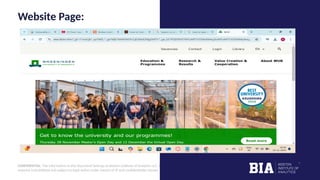
Website Page:
CONFIDENTIAL: The information in this document belongs to Boston Institute of Analytics LLC. Any unauthorized sharing of this
material is prohibited and subject to legal action under breach of IP and confidentiality clauses.
CONFIDENTIAL: The information in this document belongs to Boston Institute of Analytics LLC. Any unauthorized sharing of this
material is prohibited and subject to legal action under breach of IP and confidentiality clauses.
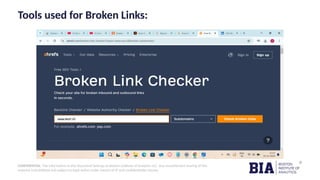
Tools used for Broken Links:
CONFIDENTIAL: The information in this document belongs to Boston Institute of Analytics LLC. Any unauthorized sharing of this
material is prohibited and subject to legal action under breach of IP and confidentiality clauses.
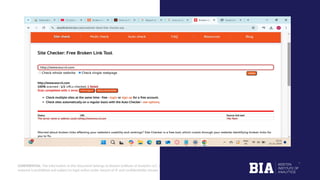
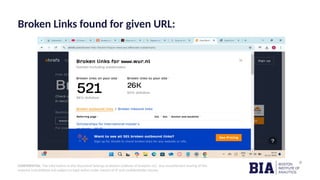
Broken Links found for given URL:
CONFIDENTIAL: The information in this document belongs to Boston Institute of Analytics LLC. Any unauthorized sharing of this
material is prohibited and subject to legal action under breach of IP and confidentiality clauses.
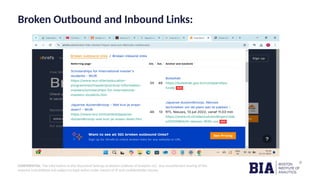
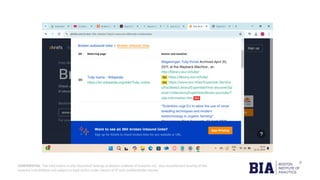
Broken Outbound and Inbound Links:
CONFIDENTIAL: The information in this document belongs to Boston Institute of Analytics LLC. Any unauthorized sharing of this
material is prohibited and subject to legal action under breach of IP and confidentiality clauses.
CONFIDENTIAL: The information in this document belongs to Boston Institute of Analytics LLC. Any unauthorized sharing of this
material is prohibited and subject to legal action under breach of IP and confidentiality clauses.
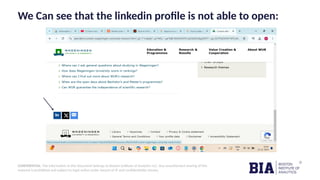
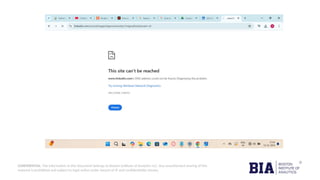
We Can see that the linkedin profile is not able to open:
CONFIDENTIAL: The information in this document belongs to Boston Institute of Analytics LLC. Any unauthorized sharing of this
material is prohibited and subject to legal action under breach of IP and confidentiality clauses.
CONFIDENTIAL: The information in this document belongs to Boston Institute of Analytics LLC. Any unauthorized sharing of this
material is prohibited and subject to legal action under breach of IP and confidentiality clauses.
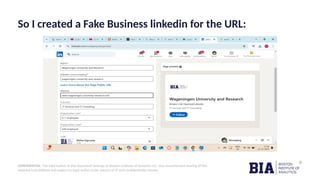
So I created a Fake Business linkedin for the URL:
CONFIDENTIAL: The information in this document belongs to Boston Institute of Analytics LLC. Any unauthorized sharing of this
material is prohibited and subject to legal action under breach of IP and confidentiality clauses.
Now if any user visits the link then they will redirect to my business profile:
CONFIDENTIAL: The information in this document belongs to Boston Institute of Analytics LLC. Any unauthorized sharing of this
material is prohibited and subject to legal action under breach of IP and confidentiality clauses.
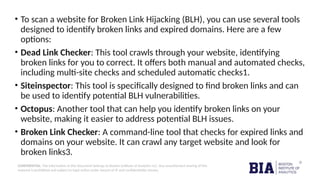
• To scan a website for Broken Link Hijacking (BLH), you can use several tools
designed to identify broken links and expired domains. Here are a few
options:
• Dead Link Checker: This tool crawls through your website, identifying
broken links for you to correct. It offers both manual and automated checks,
including multi-site checks and scheduled automatic checks1.
• Siteinspector: This tool is specifically designed to find broken links and can
be used to identify potential BLH vulnerabilities.
• Octopus: Another tool that can help you identify broken links on your
website, making it easier to address potential BLH issues.
• Broken Link Checker: A command-line tool that checks for expired links and
domains on your website. It can crawl any target website and look for
broken links3.
CONFIDENTIAL: The information in this document belongs to Boston Institute of Analytics LLC. Any unauthorized sharing of this
material is prohibited and subject to legal action under breach of IP and confidentiality clauses.
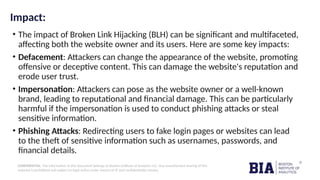
Impact:
• The impact of Broken Link Hijacking (BLH) can be significant and multifaceted,
affecting both the website owner and its users. Here are some key impacts:
• Defacement: Attackers can change the appearance of the website, promoting
offensive or deceptive content. This can damage the website's reputation and
erode user trust.
• Impersonation: Attackers can pose as the website owner or a well-known
brand, leading to reputational and financial damage. This can be particularly
harmful if the impersonation is used to conduct phishing attacks or steal
sensitive information.
• Phishing Attacks: Redirecting users to fake login pages or websites can lead
to the theft of sensitive information such as usernames, passwords, and
financial details.
CONFIDENTIAL: The information in this document belongs to Boston Institute of Analytics LLC. Any unauthorized sharing of this
material is prohibited and subject to legal action under breach of IP and confidentiality clauses.
• Cross-Site Scripting (XSS) Attacks: Attackers can inject malicious scripts into the
website, which are automatically loaded by users' browsers. This can lead to further
exploitation, such as stealing cookies or session tokens.
• Loss of Search Engine Ranking: Broken links can negatively impact a website's
search engine ranking, as search engines may penalize sites with many broken links.
• Legal and Compliance Issues: If the hijacked links lead to the distribution of illegal
content or violate regulations, the website owner could face legal consequences and
fines.
• User Experience Degradation: Users encountering broken links or redirected
malicious content can lead to frustration and a poor user experience, potentially
driving them away from the website.
• Addressing BLH requires regular maintenance, proper redirection, and the use of
security tools to monitor and fix broken links. Proactive measures and continuous
monitoring are essential to safeguard websites from BLH and other web security
threats.
CONFIDENTIAL: The information in this document belongs to Boston Institute of Analytics LLC. Any unauthorized sharing of this
material is prohibited and subject to legal action under breach of IP and confidentiality clauses.
Conclusion:
• Broken Link Hijacking (BLH) presents a significant security threat to websites, exploiting
inactive or broken hyperlinks to redirect users to malicious sites. This vulnerability can
lead to various malicious activities, including defacement, impersonation, phishing
attacks, and cross-site scripting (XSS). The impact of BLH can be detrimental to the
integrity and trustworthiness of a website, potentially causing reputational damage,
financial loss, and legal consequences.
• To combat BLH, it is crucial for website administrators to engage in proactive measures.
Regularly checking and updating external links, implementing proper redirection
strategies, and utilizing security scanners are essential steps in mitigating the risk of BLH.
Additionally, keeping track of domain expirations and renewing them timely can prevent
attackers from hijacking expired domains.
• By adopting these best practices and continuously monitoring website links, organizations
can significantly reduce the risk of BLH and protect their digital assets. It is imperative to
prioritize web security to ensure a safe and trustworthy online environment for users.
CONFIDENTIAL: The information in this document belongs to Boston Institute of Analytics LLC. Any unauthorized sharing of this
material is prohibited and subject to legal action under breach of IP and confidentiality clauses.
References:
• Cobalt Blog - Hunting for Broken Link Hijacking (BLH): This article explains how attackers
can exploit broken links and provides examples of potential security risks.
• Exploit Notes - Broken Link Hijacking: This resource details how attackers can execute
arbitrary code by hijacking broken links, including examples and exploitation techniques.
• GitHub - Broken Link Hijacking Overview: A comprehensive overview of BLH, including
different issues that can arise from expired links.
• Dev.to - Broken Link Hijacking: This post discusses how expired links can be exploited and
the potential consequences of BLH.
• Cure53/HTTPLeaks on GitHub: A repository that provides insights into BLH and how to
protect against it.
• These references should provide a solid foundation for understanding BLH and how to
mitigate its risks.
CONFIDENTIAL: The information in this document belongs to Boston Institute of Analytics LLC. Any unauthorized sharing of this
material is prohibited and subject to legal action under breach of IP and confidentiality clauses.
References:
• www.cobalt.io
• www.exploit-notes.hdks.org
• www.gist.github.com
• www.dev.to
CONFIDENTIAL: The information in this document belongs to Boston Institute of Analytics LLC. Any unauthorized sharing of this
material is prohibited and subject to legal action under breach of IP and confidentiality clauses.
Questions ?
CONFIDENTIAL: The information in this document belongs to Boston Institute of Analytics LLC. Any unauthorized sharing of this
material is prohibited and subject to legal action under breach of IP and confidentiality clauses.
Thank You!

Understanding and Mitigating Broken Link Hijacking Vulnerabilities

  • 1.
    CONFIDENTIAL: The informationin this document belongs to Boston Institute of Analytics LLC. Any unauthorized sharing of this material is prohibited and subject to legal action under breach of IP and confidentiality clauses. Report on Broken Link Hijacking Vulnerability Manish Kumar
  • 2.
    CONFIDENTIAL: The informationin this document belongs to Boston Institute of Analytics LLC. Any unauthorized sharing of this material is prohibited and subject to legal action under breach of IP and confidentiality clauses. Introduction: • Broken Link Hijacking (BLH) is a technique where attackers exploit broken or dead hyperlinks on websites. When a web page or resource that a hyperlink points to no longer exists, the link becomes "broken." Attackers can take advantage of these broken links by redirecting them to their own websites, which can serve various purposes ranging from SEO manipulation to malicious activities. • Scope and Objectives of the Report: This report aims to analyze a website vulnerable to BLH, demonstrate a Proof of Concept (PoC), and provide mitigation strategies.
  • 3.
    CONFIDENTIAL: The informationin this document belongs to Boston Institute of Analytics LLC. Any unauthorized sharing of this material is prohibited and subject to legal action under breach of IP and confidentiality clauses. Abstract: • Broken Link Hijacking (BLH) is an emerging vulnerability in web security that exploits inactive or broken hyperlinks on a website. When a hyperlink points to a resource that no longer exists or an expired domain, it becomes "broken." Attackers leverage these broken links by acquiring the expired domains or redirecting the broken links to malicious websites. This technique can lead to various malicious activities, including defacement, impersonation, phishing attacks, and cross-site scripting (XSS). • The report also provides comprehensive mitigation strategies to prevent BLH, emphasizing regular link maintenance, proper redirection, and the use of security scanners. Policy recommendations for web developers and organizations are included to enhance overall web security and prevent similar vulnerabilities
  • 4.
    CONFIDENTIAL: The informationin this document belongs to Boston Institute of Analytics LLC. Any unauthorized sharing of this material is prohibited and subject to legal action under breach of IP and confidentiality clauses. • This report examines the BLH vulnerability in a specific website, example.com, which exhibits multiple broken external links. By analyzing these vulnerabilities, we highlight the potential risks and impact of BLH on the website's integrity and user trust. A detailed Proof of Concept (PoC) is demonstrated, showcasing how attackers can exploit these broken links to redirect users to malicious websites. • The findings underscore the importance of proactive measures and continuous monitoring to safeguard websites from BLH and other web security threats. This report aims to raise awareness and provide actionable insights for web developers and organizations to protect their digital assets effectively.
  • 5.
    CONFIDENTIAL: The informationin this document belongs to Boston Institute of Analytics LLC. Any unauthorized sharing of this material is prohibited and subject to legal action under breach of IP and confidentiality clauses. Research: • Name: Wageningen University & Research • URL: https://www.wur.nl.com • Category Type: Educational Domain • Overall Ranking/Usage/Popularity: Wageningen University & Research is ranked #113 in Best Global Universities. Schools are ranked according to their performance across a set of widely accepted indicators of excellence. Read more about how we rank schools. Grants degrees at the BSc, MSc and PhD level in life and social sciences. It focuses its research on scientific, social and commercial problems in the field of life sciences and natural resources. #151 in the world. The new global QS ranking shows Wageningen University & Research among the 10 percent best universities in the world.
  • 6.
    CONFIDENTIAL: The informationin this document belongs to Boston Institute of Analytics LLC. Any unauthorized sharing of this material is prohibited and subject to legal action under breach of IP and confidentiality clauses. Proof of Concept(POC) • Step-by-Step Guide to Create a PoC: A detailed guide to creating a PoC for BLH was provided, including the tools and techniques used. • Tools and Techniques Used: Tools such as Broken Link Checker were used to identify broken links. • Implementation Details: The implementation process was explained in detail, including the setup of a fake page and redirection of users.
  • 7.
    CONFIDENTIAL: The informationin this document belongs to Boston Institute of Analytics LLC. Any unauthorized sharing of this material is prohibited and subject to legal action under breach of IP and confidentiality clauses. Website Page:
  • 8.
    CONFIDENTIAL: The informationin this document belongs to Boston Institute of Analytics LLC. Any unauthorized sharing of this material is prohibited and subject to legal action under breach of IP and confidentiality clauses.
  • 9.
    CONFIDENTIAL: The informationin this document belongs to Boston Institute of Analytics LLC. Any unauthorized sharing of this material is prohibited and subject to legal action under breach of IP and confidentiality clauses. Tools used for Broken Links:
  • 10.
    CONFIDENTIAL: The informationin this document belongs to Boston Institute of Analytics LLC. Any unauthorized sharing of this material is prohibited and subject to legal action under breach of IP and confidentiality clauses. Broken Links found for given URL:
  • 11.
    CONFIDENTIAL: The informationin this document belongs to Boston Institute of Analytics LLC. Any unauthorized sharing of this material is prohibited and subject to legal action under breach of IP and confidentiality clauses. Broken Outbound and Inbound Links:
  • 12.
    CONFIDENTIAL: The informationin this document belongs to Boston Institute of Analytics LLC. Any unauthorized sharing of this material is prohibited and subject to legal action under breach of IP and confidentiality clauses.
  • 13.
    CONFIDENTIAL: The informationin this document belongs to Boston Institute of Analytics LLC. Any unauthorized sharing of this material is prohibited and subject to legal action under breach of IP and confidentiality clauses. We Can see that the linkedin profile is not able to open:
  • 14.
    CONFIDENTIAL: The informationin this document belongs to Boston Institute of Analytics LLC. Any unauthorized sharing of this material is prohibited and subject to legal action under breach of IP and confidentiality clauses.
  • 15.
    CONFIDENTIAL: The informationin this document belongs to Boston Institute of Analytics LLC. Any unauthorized sharing of this material is prohibited and subject to legal action under breach of IP and confidentiality clauses. So I created a Fake Business linkedin for the URL:
  • 16.
    CONFIDENTIAL: The informationin this document belongs to Boston Institute of Analytics LLC. Any unauthorized sharing of this material is prohibited and subject to legal action under breach of IP and confidentiality clauses. Now if any user visits the link then they will redirect to my business profile:
  • 17.
    CONFIDENTIAL: The informationin this document belongs to Boston Institute of Analytics LLC. Any unauthorized sharing of this material is prohibited and subject to legal action under breach of IP and confidentiality clauses. • To scan a website for Broken Link Hijacking (BLH), you can use several tools designed to identify broken links and expired domains. Here are a few options: • Dead Link Checker: This tool crawls through your website, identifying broken links for you to correct. It offers both manual and automated checks, including multi-site checks and scheduled automatic checks1. • Siteinspector: This tool is specifically designed to find broken links and can be used to identify potential BLH vulnerabilities. • Octopus: Another tool that can help you identify broken links on your website, making it easier to address potential BLH issues. • Broken Link Checker: A command-line tool that checks for expired links and domains on your website. It can crawl any target website and look for broken links3.
  • 18.
    CONFIDENTIAL: The informationin this document belongs to Boston Institute of Analytics LLC. Any unauthorized sharing of this material is prohibited and subject to legal action under breach of IP and confidentiality clauses. Impact: • The impact of Broken Link Hijacking (BLH) can be significant and multifaceted, affecting both the website owner and its users. Here are some key impacts: • Defacement: Attackers can change the appearance of the website, promoting offensive or deceptive content. This can damage the website's reputation and erode user trust. • Impersonation: Attackers can pose as the website owner or a well-known brand, leading to reputational and financial damage. This can be particularly harmful if the impersonation is used to conduct phishing attacks or steal sensitive information. • Phishing Attacks: Redirecting users to fake login pages or websites can lead to the theft of sensitive information such as usernames, passwords, and financial details.
  • 19.
    CONFIDENTIAL: The informationin this document belongs to Boston Institute of Analytics LLC. Any unauthorized sharing of this material is prohibited and subject to legal action under breach of IP and confidentiality clauses. • Cross-Site Scripting (XSS) Attacks: Attackers can inject malicious scripts into the website, which are automatically loaded by users' browsers. This can lead to further exploitation, such as stealing cookies or session tokens. • Loss of Search Engine Ranking: Broken links can negatively impact a website's search engine ranking, as search engines may penalize sites with many broken links. • Legal and Compliance Issues: If the hijacked links lead to the distribution of illegal content or violate regulations, the website owner could face legal consequences and fines. • User Experience Degradation: Users encountering broken links or redirected malicious content can lead to frustration and a poor user experience, potentially driving them away from the website. • Addressing BLH requires regular maintenance, proper redirection, and the use of security tools to monitor and fix broken links. Proactive measures and continuous monitoring are essential to safeguard websites from BLH and other web security threats.
  • 20.
    CONFIDENTIAL: The informationin this document belongs to Boston Institute of Analytics LLC. Any unauthorized sharing of this material is prohibited and subject to legal action under breach of IP and confidentiality clauses. Conclusion: • Broken Link Hijacking (BLH) presents a significant security threat to websites, exploiting inactive or broken hyperlinks to redirect users to malicious sites. This vulnerability can lead to various malicious activities, including defacement, impersonation, phishing attacks, and cross-site scripting (XSS). The impact of BLH can be detrimental to the integrity and trustworthiness of a website, potentially causing reputational damage, financial loss, and legal consequences. • To combat BLH, it is crucial for website administrators to engage in proactive measures. Regularly checking and updating external links, implementing proper redirection strategies, and utilizing security scanners are essential steps in mitigating the risk of BLH. Additionally, keeping track of domain expirations and renewing them timely can prevent attackers from hijacking expired domains. • By adopting these best practices and continuously monitoring website links, organizations can significantly reduce the risk of BLH and protect their digital assets. It is imperative to prioritize web security to ensure a safe and trustworthy online environment for users.
  • 21.
    CONFIDENTIAL: The informationin this document belongs to Boston Institute of Analytics LLC. Any unauthorized sharing of this material is prohibited and subject to legal action under breach of IP and confidentiality clauses. References: • Cobalt Blog - Hunting for Broken Link Hijacking (BLH): This article explains how attackers can exploit broken links and provides examples of potential security risks. • Exploit Notes - Broken Link Hijacking: This resource details how attackers can execute arbitrary code by hijacking broken links, including examples and exploitation techniques. • GitHub - Broken Link Hijacking Overview: A comprehensive overview of BLH, including different issues that can arise from expired links. • Dev.to - Broken Link Hijacking: This post discusses how expired links can be exploited and the potential consequences of BLH. • Cure53/HTTPLeaks on GitHub: A repository that provides insights into BLH and how to protect against it. • These references should provide a solid foundation for understanding BLH and how to mitigate its risks.
  • 22.
    CONFIDENTIAL: The informationin this document belongs to Boston Institute of Analytics LLC. Any unauthorized sharing of this material is prohibited and subject to legal action under breach of IP and confidentiality clauses. References: • www.cobalt.io • www.exploit-notes.hdks.org • www.gist.github.com • www.dev.to
  • 23.
    CONFIDENTIAL: The informationin this document belongs to Boston Institute of Analytics LLC. Any unauthorized sharing of this material is prohibited and subject to legal action under breach of IP and confidentiality clauses. Questions ?
  • 24.
    CONFIDENTIAL: The informationin this document belongs to Boston Institute of Analytics LLC. Any unauthorized sharing of this material is prohibited and subject to legal action under breach of IP and confidentiality clauses. Thank You!