CONFIDENTIAL: The information in this document belongs to Boston Institute of Analytics LLC. Any unauthorized sharing of this
material is prohibited and subject to legal action under breach of IP and confidentiality clauses.
Perform a Scan of the Website to Identify the
Actively Running Open Ports, Analyze the
Functions, Benefits, and Potential Security
Threats Associated.
CONFIDENTIAL: The information in this document belongs to Boston Institute of Analytics LLC. Any unauthorized sharing of this
material is prohibited and subject to legal action under breach of IP and confidentiality clauses.
• Research, Data Collection & Tool Used
• Introduction to NMAP
• Key Features & Benefits of Nmap Network Scanner
• Nmap Scanning for the Website & Details of Open Ports
• Functions, Benefits and Threats of different Open Ports for the Website
• Mitigation Measures & Recommendations
CONFIDENTIAL: The information in this document belongs to Boston Institute of Analytics LLC. Any unauthorized sharing of this
material is prohibited and subject to legal action under breach of IP and confidentiality clauses.
Research
Modern Energy Rental Pvt.Ltd. - An Energy Rental Organization.
Modern Energy Rental is India’s most sought after energy equipment rental company situated in
Mumbai providing diesel and gas generators, Transformers, Air-Cooled Chillers / Air
conditioning Roof Top Units, Compressors, Mobile Lighting Tower, Load Banks, Fuel Tanks on
Rental Basis to Mining & Heavy Industries, Oil & Gas sector, Manufacturing Industries.
Client base includes Tata Motors, ONGC, TCS, SBI, ACC Cement, Bridge stone
• URL: www.modernenergy.co.in
• Category: Generator and Chiller Rental Services
• Global Traffic Rank: 1,411,277
• India Rank: 85,459
• Estimated Worth: $36,352
• Daily Unique Visitors (popularity): Approximately 2,213 (SiteIndices).
CONFIDENTIAL: The information in this document belongs to Boston Institute of Analytics LLC. Any unauthorized sharing of this
material is prohibited and subject to legal action under breach of IP and confidentiality clauses.
Data Collection
Technology stack Information:
https://builtwith.com/modernenergy.co.in
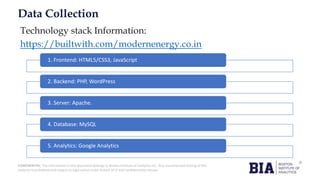
1. Frontend: HTML5/CSS3, JavaScript
2. Backend: PHP, WordPress
3. Server: Apache.
4. Database: MySQL
5. Analytics: Google Analytics
CONFIDENTIAL: The information in this document belongs to Boston Institute of Analytics LLC. Any unauthorized sharing of this
material is prohibited and subject to legal action under breach of IP and confidentiality clauses.
Reference
https://www.whois.com/whois/modernenergy.co.in
CONFIDENTIAL: The information in this document belongs to Boston Institute of Analytics LLC. Any unauthorized sharing of this
material is prohibited and subject to legal action under breach of IP and confidentiality clauses.
Tools Used
Network Mapper: NMAP:- https://nmap.org/
CONFIDENTIAL: The information in this document belongs to Boston Institute of Analytics LLC. Any unauthorized sharing of this
material is prohibited and subject to legal action under breach of IP and confidentiality clauses.
Introduction to NMAP Tool
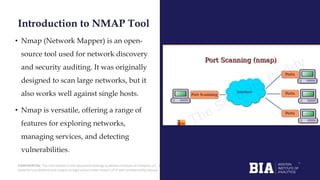
• Nmap (Network Mapper) is an open-
source tool used for network discovery
and security auditing. It was originally
designed to scan large networks, but it
also works well against single hosts.
• Nmap is versatile, offering a range of
features for exploring networks,
managing services, and detecting
vulnerabilities.
CONFIDENTIAL: The information in this document belongs to Boston Institute of Analytics LLC. Any unauthorized sharing of this
material is prohibited and subject to legal action under breach of IP and confidentiality clauses.
1. Network Scanning: Discovers hosts and
services
2. Port Scanning: Identifies open ports on
target hosts.
3. Service & Version Detection: Detects
running applications and versions.
4. OS Detection: Identifies operating systems
via TCP/IP stack fingerprinting
5. Scripting Engine (NSE): Automates tasks
with custom scripts.
6. Network Mapping: Visualizes network
topology.
7. Security Auditing: Identifies
vulnerabilities and misconfigurations.
1. Versatile: Supports multiple platforms
and both small and large networks.
2. Open Source: Free, with community
support and regular updates.
3. Extensible: Custom scripts and integration
with other tools.
4. Performance: Efficient scanning
algorithms.
5. User-Friendly: CLI for detailed control;
GUI (Zenmap) available
Features Benefits
CONFIDENTIAL: The information in this document belongs to Boston Institute of Analytics LLC. Any unauthorized sharing of this
material is prohibited and subject to legal action under breach of IP and confidentiality clauses.
Proof of Concept - Nmap Scanning for
www.modernenergy.co.in
CONFIDENTIAL: The information in this document belongs to Boston Institute of Analytics LLC. Any unauthorized sharing of this
material is prohibited and subject to legal action under breach of IP and confidentiality clauses.
PORT SERVICE
21 FTP
22 SSH
53 DOMAIN
80 HTTP
110 POP3
143 IMAP
443 HTTPS
465 SMPTS
587 SUBMISSION
993 IMAPS
995 POP3S
2000 CISCO-SCCP
5060 SIP
Details of Open Ports
CONFIDENTIAL: The information in this document belongs to Boston Institute of Analytics LLC. Any unauthorized sharing of this
material is prohibited and subject to legal action under breach of IP and confidentiality clauses.
FTP PORT
Functions : FTP (File Transfer Protocol) is used to transfer files between computers on a
network.
1.File Transfer:
• Uploading files from a local computer to a remote server & vice versa.
• Transferring files between two remote servers.
2.File Management:
• Listing files and directories.
• Creating, renaming and deleting files and directories.
• Changing file permissions and attributes.
3.Data Organization:
• Organizing files into directories and subdirectories.
• Managing file structures for efficient storage and retrieval
CONFIDENTIAL: The information in this document belongs to Boston Institute of Analytics LLC. Any unauthorized sharing of this
material is prohibited and subject to legal action under breach of IP and confidentiality clauses.
• Ease of Use: Simple command structure
and widely supported by various client
applications.
• Efficiency: Capable of transferring large
files and multiple files in batches.
• Compatibility: Supported on almost all
platforms and operating systems.
• Automation: Can be scripted for
automated file transfers, making it useful
for regular, repetitive tasks.
• Lack of Encryption: Transfers data, including
usernames and passwords in plain text
making it vulnerable to interception by
attackers, such as man-in-the-middle attacks."
• Anonymous Access: Anyone can access the
server without authentication, which can lead
to unauthorized access and data breaches.
• Data Integrity: No built-in mechanism to
ensure that the files are not altered during
transmission.
• Directory Traversal Attacks: Attackers can
exploit vulnerabilities to navigate the
directory structure, gaining access to
unauthorized areas of the server.
Benefits Threats
CONFIDENTIAL: The information in this document belongs to Boston Institute of Analytics LLC. Any unauthorized sharing of this
material is prohibited and subject to legal action under breach of IP and confidentiality clauses.
Secure Shell (SSH) Port
Functions:
SSH, also known as Secure Shell or Secure Socket Shell, is a network protocol that gives
users, particularly system administrators, a secure way to access a computer over an
unsecured network.
1. Secure Remote Login:- Securely log into a remote computer over a network.
2. Command Execution:- Execute commands on a remote machine.
3. File Transfer:- Secure file transfer using SFTP and SCP.
4. Port Forwarding/Tunneling:- Redirect network traffic securely.
5. Secure Shell Sessions:-Support multiple shell sessions over a single connection.
CONFIDENTIAL: The information in this document belongs to Boston Institute of Analytics LLC. Any unauthorized sharing of this
material is prohibited and subject to legal action under breach of IP and confidentiality clauses.
• Encryption: Ensures confidentiality and
integrity of data in transit.
• Authentication: Various methods including
passwords, public keys, and 2FA.
• Security: Protects against eavesdropping
and connection hijacking.
• Versatility: Useful for remote administration
and secure file transfers.
• Compression: Can improve transfer speeds
by compressing data.
• Exploit of Vulnerabilities: Unpatched servers
may have exploitable vulnerabilities.
• Misconfiguration: Weak configurations can
lead to security weaknesses.
• Default Port Usage: Default port 22 is more
visible to automated attacks.
• Insider Threats: Authorized users may
misuse their access.
Benefits Threats
CONFIDENTIAL: The information in this document belongs to Boston Institute of Analytics LLC. Any unauthorized sharing of this
material is prohibited and subject to legal action under breach of IP and confidentiality clauses.
Functions:
1. Domain Name Resolution: Translates domain names to IP addresses.
2. Email Routing: Supports mail exchange (MX) records for email delivery.
3. Web Traffic Management: Directs web traffic to appropriate servers using A and CNAME
records.
4. Service Discovery: Helps clients discover services via SRV records.
5. Load Balancing: Distributes traffic across multiple servers to manage load.
The standard port numbers used by DNS are:
1. Port 53: This is the default port used for DNS services.
• UDP 53: Primarily used for DNS queries due to its efficiency.
• TCP 53: Used for DNS zone transfers (AXFR/IXFR) and in cases where the response data
size exceeds 512 bytes or DNSSEC is used.
Domain Name System (DNS)
CONFIDENTIAL: The information in this document belongs to Boston Institute of Analytics LLC. Any unauthorized sharing of this
material is prohibited and subject to legal action under breach of IP and confidentiality clauses.
• Accessibility: Ensures that services
(websites, emails) are accessible by domain
names.
• Redundancy: Provides failover mechanisms
through DNS redundancy.
• Scalability: Easily scalable to handle
increased traffic and service demands.
• User-Friendly: Simplifies access to services
with human-readable domain names.
• Efficient Management: Centralized
management of domain records for various
services.
• DNS Spoofing/Poisoning: Attackers can
manipulate DNS data to redirect traffic to
malicious sites.
• DDoS Attacks: DNS servers can be targeted
to disrupt service availability.
• DNS Amplification Attacks: Exploits DNS
servers to launch large-scale DDoS attacks.
• Cache Poisoning: Malicious data is inserted
into DNS cache, leading to incorrect domain
resolution.
• Data Interception: Unsecured DNS queries
can be intercepted and monitored.
Benefits Threats
CONFIDENTIAL: The information in this document belongs to Boston Institute of Analytics LLC. Any unauthorized sharing of this
material is prohibited and subject to legal action under breach of IP and confidentiality clauses.
HTTP & HTTPS Port
Functions:
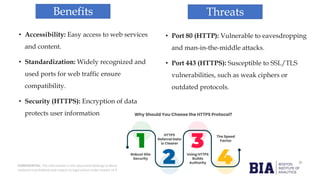
1. HTTP uses TCP port 80 (unencrypted) and HTTPS uses TCP port 443 (encrypted).
2. These ports facilitate web traffic by allowing browsers to communicate with web
servers, enabling data exchange for website content.
CONFIDENTIAL: The information in this document belongs to Boston Institute of Analytics LLC. Any unauthorized sharing of this
material is prohibited and subject to legal action under breach of IP and confidentiality clauses.
• Accessibility: Easy access to web services
and content.
• Standardization: Widely recognized and
used ports for web traffic ensure
compatibility.
• Security (HTTPS): Encryption of data
protects user information
• Port 80 (HTTP): Vulnerable to eavesdropping
and man-in-the-middle attacks.
• Port 443 (HTTPS): Susceptible to SSL/TLS
vulnerabilities, such as weak ciphers or
outdated protocols.
Benefits Threats
CONFIDENTIAL: The information in this document belongs to Boston Institute of Analytics LLC. Any unauthorized sharing of this
material is prohibited and subject to legal action under breach of IP and confidentiality clauses.
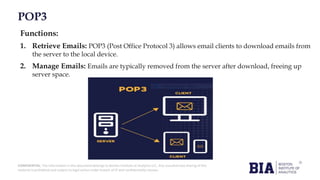
POP3
Functions:
1. Retrieve Emails: POP3 (Post Office Protocol 3) allows email clients to download emails from
the server to the local device.
2. Manage Emails: Emails are typically removed from the server after download, freeing up
server space.
CONFIDENTIAL: The information in this document belongs to Boston Institute of Analytics LLC. Any unauthorized sharing of this
material is prohibited and subject to legal action under breach of IP and confidentiality clauses.
• Offline Access: Emails are stored locally,
allowing offline access.
• Reduced Server Load: Downloaded emails
are removed from the server, reducing
storage requirements.
• Unencrypted Communication: Vulnerable to
interception and eavesdropping on port 110.
• Account Hijacking: Potential for
unauthorized access to email accounts.
Benefits Threats
CONFIDENTIAL: The information in this document belongs to Boston Institute of Analytics LLC. Any unauthorized sharing of this
material is prohibited and subject to legal action under breach of IP and confidentiality clauses.
IMAP
Functions:
1. Port: 143 (Unencrypted), 993 (Encrypted with SSL/TLS).
2. Retrieve Emails: IMAP (Internet Message Access Protocol) allows email clients to
access emails on the server without downloading them.
3. Manage Emails: Enables Management of Emails directly on the server, including reading,
deleting, and organizing.
CONFIDENTIAL: The information in this document belongs to Boston Institute of Analytics LLC. Any unauthorized sharing of this
material is prohibited and subject to legal action under breach of IP and confidentiality clauses.
• Server Synchronization: Emails remain
on the server, accessible from multiple
devices.
• Efficient Management: Server-side
management of emails allows for better
organization and real-time updates.
• Unencrypted Communication: Vulnerable to
interception and eavesdropping on port 143.
• Server Overload: Continuous connection to
the server can lead to higher server load and
potential performance issues.
Benefits Threats
CONFIDENTIAL: The information in this document belongs to Boston Institute of Analytics LLC. Any unauthorized sharing of this
material is prohibited and subject to legal action under breach of IP and confidentiality clauses.
SMTPS Functions:
1. Port: 465 (used for SMTP over SSL/TLS).
2. Send Emails: Securely sends emails from email clients to email servers.
3. Relay Emails: Facilitates the relay of emails between servers.
CONFIDENTIAL: The information in this document belongs to Boston Institute of Analytics LLC. Any unauthorized sharing of this
material is prohibited and subject to legal action under breach of IP and confidentiality clauses.
• Encryption: Protects email content from
interception during transmission.
• Authentication: Verifies the identity of
the sending server
• Man-in-the-Middle Attacks: Potential
for attacks if SSL/TLS is not properly
configured.
• Vulnerabilities: Outdated protocols
and weak ciphers can be exploited.
Benefits Threats
CONFIDENTIAL: The information in this document belongs to Boston Institute of Analytics LLC. Any unauthorized sharing of this
material is prohibited and subject to legal action under breach of IP and confidentiality clauses.
Submission Port Number Port: 587
Functions:
• Send Emails: Port 587 is used for submitting email messages from clients to mail servers
using the Simple Mail Transfer Protocol (SMTP).
• Authentication and Encryption: Ensures secure transmission of emails with mandatory
authentication and TLS encryption.
CONFIDENTIAL: The information in this document belongs to Boston Institute of Analytics LLC. Any unauthorized sharing of this
material is prohibited and subject to legal action under breach of IP and confidentiality clauses.
• Security: Encrypts email transmissions to
protect against interception.
• Authentication: Requires user
authentication, reducing spam and
unauthorized use.
• Standards Compliance: Widely adopted
standard for secure email submission.
• Man-in-the-Middle Attacks: Potential
risk if TLS is not properly configured.
• Exploitation: Vulnerabilities in the email
server software could be exploited.
Benefits Threats
CONFIDENTIAL: The information in this document belongs to Boston Institute of Analytics LLC. Any unauthorized sharing of this
material is prohibited and subject to legal action under breach of IP and confidentiality clauses.
SCCP (Skinny Client Control Protocol)
Uses port 2000 for communication.
Functions:
SCCP is a lightweight protocol used in VoIP (Voice over IP) environments,
primarily associated with Cisco's Unified Communications Manager (formerly
Call Manager). It handles call signaling, call setup, and control messages
between IP phones, gateways, and other endpoints within a Cisco VoIP
system.
CONFIDENTIAL: The information in this document belongs to Boston Institute of Analytics LLC. Any unauthorized sharing of this
material is prohibited and subject to legal action under breach of IP and confidentiality clauses.
• Efficiency: SCCP is efficient in terms of
bandwidth usage, making it suitable for
environments with limited network
resources.
• Integration: It integrates well with Cisco's
Unified Communications solutions,
providing robust call control features.
• Security: It offers some built-in security
features, such as authentication and
encryption options
• Security Vulnerabilities: Like any
protocol, SCCP may be susceptible to
security vulnerabilities such as denial-of-
service attacks, spoofing, or
eavesdropping.
• Interoperability Issues: Since SCCP is
proprietary to Cisco, interoperability with
non-Cisco systems or devices can be
limited without additional gateways or
conversion tools.
Benefits Threats
CONFIDENTIAL: The information in this document belongs to Boston Institute of Analytics LLC. Any unauthorized sharing of this
material is prohibited and subject to legal action under breach of IP and confidentiality clauses.
SIP (Session Initiation Protocol)
SIP typically uses port 5060 for UDP (User Datagram Protocol) & TCP (Transmission
Control Protocol) traffic. Port 5061 is used for secure SIP communication over TLS
(Transport Layer Security).
Functions
SIP is a signaling protocol used for initiating, maintaining and terminating
multimedia sessions such as voice and video calls over IP networks. It establishes
sessions between clients (e.g., SIP phones) and manages features such as call setup,
teardown, and transfer.
CONFIDENTIAL: The information in this document belongs to Boston Institute of Analytics LLC. Any unauthorized sharing of this
material is prohibited and subject to legal action under breach of IP and confidentiality clauses.
• Flexibility: SIP is highly versatile,
supporting various media types (voice,
video & messaging) and enabling
multimedia sessions.
• Scalability: It allows for easy integration
with existing IP-based networks and can
scale to accommodate large deployments.
• Interoperability: SIP is an open standard
protocol, facilitating interoperability
between different vendors' products and
services.
• Denial-of-Service (DoS) Attacks: SIP
services can be targeted by DoS attacks to
disrupt communication or overload
resources.
• Eavesdropping: Without encryption, SIP
signaling and media streams can be
intercepted, compromising confidentiality.
• Spoofing and Fraud: Attackers may spoof
SIP messages or manipulate headers to
impersonate users or gain unauthorized
access.
Benefits Threats
CONFIDENTIAL: The information in this document belongs to Boston Institute of Analytics LLC. Any unauthorized sharing of this
material is prohibited and subject to legal action under breach of IP and confidentiality clauses.
Mitigation Measures
To Mitigate Risks Associated with Open Ports for any Domain.
1. Identify Open Port:- Identify which ports are open on your server by using tools like Nmap
2. Close Unnecessary Ports: Only keep necessary ports open. Close all unnecessary ports to reduce
the attack surface.
3. Use Firewalls:- Implement firewalls to control and monitor incoming and outgoing network
traffic based on predetermined security rules.
Configure Firewall Rules:
•Allow traffic on necessary ports (e.g., port 80 for HTTP, port 443 for HTTPS).
•Deny all other traffic by default and allow exceptions as needed.
4. Update and Patch Regularly:- Ensure that all software, including the operating system and
applications, is up to date with the latest security patches.
CONFIDENTIAL: The information in this document belongs to Boston Institute of Analytics LLC. Any unauthorized sharing of this
material is prohibited and subject to legal action under breach of IP and confidentiality clauses.
5. Implement Intrusion Detection and Prevention Systems – Deploy IDPs
6. Use Secure Protocols
•Replace insecure protocols with secure ones (e.g., use HTTPS instead of HTTP).
•Ensure SSH access is secured (e.g., use key-based authentication instead of password-based).
7. Monitor Logs
Regularly monitor server and application logs for suspicious activities.
8. Implement Network Segmentation
Segment your network to limit the spread of potential intrusions.
9. Use VPNs for Remote Access
For remote access to internal services, use a Virtual Private Network (VPN) to ensure that the
connection is encrypted and secure.
10. Regular Security Audits
Conduct regular security audits and vulnerability assessments to identify and remediate potential weaknesses.
CONFIDENTIAL: The information in this document belongs to Boston Institute of Analytics LLC. Any unauthorized sharing of this
material is prohibited and subject to legal action under breach of IP and confidentiality clauses.
Click to edit
Master title style
Continuous Monitoring and
Response
• Implement continuous monitoring
solutions and establish an incident
response plan to quickly detect and
respond to security incidents.
• By following these mitigation measures,
you can significantly enhance the security
of your open ports and protect your
domain from potential threats
CONFIDENTIAL: The information in this document belongs to Boston Institute of Analytics LLC. Any unauthorized sharing of this
material is prohibited and subject to legal action under breach of IP and confidentiality clauses.
Click to edit
Master title style
CONFIDENTIAL: The information in this document belongs to Boston Institute of Analytics LLC. Any unauthorized sharing of this
material is prohibited and subject to legal action under breach of IP and confidentiality clauses.
Questions ?
CONFIDENTIAL: The information in this document belongs to Boston Institute of Analytics LLC. Any unauthorized sharing of this
material is prohibited and subject to legal action under breach of IP and confidentiality clauses.
Thank You!

Scan Website Vulnerability - Project Presentation

  • 1.
    CONFIDENTIAL: The informationin this document belongs to Boston Institute of Analytics LLC. Any unauthorized sharing of this material is prohibited and subject to legal action under breach of IP and confidentiality clauses. Perform a Scan of the Website to Identify the Actively Running Open Ports, Analyze the Functions, Benefits, and Potential Security Threats Associated.
  • 2.
    CONFIDENTIAL: The informationin this document belongs to Boston Institute of Analytics LLC. Any unauthorized sharing of this material is prohibited and subject to legal action under breach of IP and confidentiality clauses. • Research, Data Collection & Tool Used • Introduction to NMAP • Key Features & Benefits of Nmap Network Scanner • Nmap Scanning for the Website & Details of Open Ports • Functions, Benefits and Threats of different Open Ports for the Website • Mitigation Measures & Recommendations
  • 3.
    CONFIDENTIAL: The informationin this document belongs to Boston Institute of Analytics LLC. Any unauthorized sharing of this material is prohibited and subject to legal action under breach of IP and confidentiality clauses. Research Modern Energy Rental Pvt.Ltd. - An Energy Rental Organization. Modern Energy Rental is India’s most sought after energy equipment rental company situated in Mumbai providing diesel and gas generators, Transformers, Air-Cooled Chillers / Air conditioning Roof Top Units, Compressors, Mobile Lighting Tower, Load Banks, Fuel Tanks on Rental Basis to Mining & Heavy Industries, Oil & Gas sector, Manufacturing Industries. Client base includes Tata Motors, ONGC, TCS, SBI, ACC Cement, Bridge stone • URL: www.modernenergy.co.in • Category: Generator and Chiller Rental Services • Global Traffic Rank: 1,411,277 • India Rank: 85,459 • Estimated Worth: $36,352 • Daily Unique Visitors (popularity): Approximately 2,213 (SiteIndices).
  • 4.
    CONFIDENTIAL: The informationin this document belongs to Boston Institute of Analytics LLC. Any unauthorized sharing of this material is prohibited and subject to legal action under breach of IP and confidentiality clauses. Data Collection Technology stack Information: https://builtwith.com/modernenergy.co.in 1. Frontend: HTML5/CSS3, JavaScript 2. Backend: PHP, WordPress 3. Server: Apache. 4. Database: MySQL 5. Analytics: Google Analytics
  • 5.
    CONFIDENTIAL: The informationin this document belongs to Boston Institute of Analytics LLC. Any unauthorized sharing of this material is prohibited and subject to legal action under breach of IP and confidentiality clauses. Reference https://www.whois.com/whois/modernenergy.co.in
  • 6.
    CONFIDENTIAL: The informationin this document belongs to Boston Institute of Analytics LLC. Any unauthorized sharing of this material is prohibited and subject to legal action under breach of IP and confidentiality clauses. Tools Used Network Mapper: NMAP:- https://nmap.org/
  • 7.
    CONFIDENTIAL: The informationin this document belongs to Boston Institute of Analytics LLC. Any unauthorized sharing of this material is prohibited and subject to legal action under breach of IP and confidentiality clauses. Introduction to NMAP Tool • Nmap (Network Mapper) is an open- source tool used for network discovery and security auditing. It was originally designed to scan large networks, but it also works well against single hosts. • Nmap is versatile, offering a range of features for exploring networks, managing services, and detecting vulnerabilities.
  • 8.
    CONFIDENTIAL: The informationin this document belongs to Boston Institute of Analytics LLC. Any unauthorized sharing of this material is prohibited and subject to legal action under breach of IP and confidentiality clauses. 1. Network Scanning: Discovers hosts and services 2. Port Scanning: Identifies open ports on target hosts. 3. Service & Version Detection: Detects running applications and versions. 4. OS Detection: Identifies operating systems via TCP/IP stack fingerprinting 5. Scripting Engine (NSE): Automates tasks with custom scripts. 6. Network Mapping: Visualizes network topology. 7. Security Auditing: Identifies vulnerabilities and misconfigurations. 1. Versatile: Supports multiple platforms and both small and large networks. 2. Open Source: Free, with community support and regular updates. 3. Extensible: Custom scripts and integration with other tools. 4. Performance: Efficient scanning algorithms. 5. User-Friendly: CLI for detailed control; GUI (Zenmap) available Features Benefits
  • 9.
    CONFIDENTIAL: The informationin this document belongs to Boston Institute of Analytics LLC. Any unauthorized sharing of this material is prohibited and subject to legal action under breach of IP and confidentiality clauses. Proof of Concept - Nmap Scanning for www.modernenergy.co.in
  • 10.
    CONFIDENTIAL: The informationin this document belongs to Boston Institute of Analytics LLC. Any unauthorized sharing of this material is prohibited and subject to legal action under breach of IP and confidentiality clauses. PORT SERVICE 21 FTP 22 SSH 53 DOMAIN 80 HTTP 110 POP3 143 IMAP 443 HTTPS 465 SMPTS 587 SUBMISSION 993 IMAPS 995 POP3S 2000 CISCO-SCCP 5060 SIP Details of Open Ports
  • 11.
    CONFIDENTIAL: The informationin this document belongs to Boston Institute of Analytics LLC. Any unauthorized sharing of this material is prohibited and subject to legal action under breach of IP and confidentiality clauses. FTP PORT Functions : FTP (File Transfer Protocol) is used to transfer files between computers on a network. 1.File Transfer: • Uploading files from a local computer to a remote server & vice versa. • Transferring files between two remote servers. 2.File Management: • Listing files and directories. • Creating, renaming and deleting files and directories. • Changing file permissions and attributes. 3.Data Organization: • Organizing files into directories and subdirectories. • Managing file structures for efficient storage and retrieval
  • 12.
    CONFIDENTIAL: The informationin this document belongs to Boston Institute of Analytics LLC. Any unauthorized sharing of this material is prohibited and subject to legal action under breach of IP and confidentiality clauses. • Ease of Use: Simple command structure and widely supported by various client applications. • Efficiency: Capable of transferring large files and multiple files in batches. • Compatibility: Supported on almost all platforms and operating systems. • Automation: Can be scripted for automated file transfers, making it useful for regular, repetitive tasks. • Lack of Encryption: Transfers data, including usernames and passwords in plain text making it vulnerable to interception by attackers, such as man-in-the-middle attacks." • Anonymous Access: Anyone can access the server without authentication, which can lead to unauthorized access and data breaches. • Data Integrity: No built-in mechanism to ensure that the files are not altered during transmission. • Directory Traversal Attacks: Attackers can exploit vulnerabilities to navigate the directory structure, gaining access to unauthorized areas of the server. Benefits Threats
  • 13.
    CONFIDENTIAL: The informationin this document belongs to Boston Institute of Analytics LLC. Any unauthorized sharing of this material is prohibited and subject to legal action under breach of IP and confidentiality clauses. Secure Shell (SSH) Port Functions: SSH, also known as Secure Shell or Secure Socket Shell, is a network protocol that gives users, particularly system administrators, a secure way to access a computer over an unsecured network. 1. Secure Remote Login:- Securely log into a remote computer over a network. 2. Command Execution:- Execute commands on a remote machine. 3. File Transfer:- Secure file transfer using SFTP and SCP. 4. Port Forwarding/Tunneling:- Redirect network traffic securely. 5. Secure Shell Sessions:-Support multiple shell sessions over a single connection.
  • 14.
    CONFIDENTIAL: The informationin this document belongs to Boston Institute of Analytics LLC. Any unauthorized sharing of this material is prohibited and subject to legal action under breach of IP and confidentiality clauses. • Encryption: Ensures confidentiality and integrity of data in transit. • Authentication: Various methods including passwords, public keys, and 2FA. • Security: Protects against eavesdropping and connection hijacking. • Versatility: Useful for remote administration and secure file transfers. • Compression: Can improve transfer speeds by compressing data. • Exploit of Vulnerabilities: Unpatched servers may have exploitable vulnerabilities. • Misconfiguration: Weak configurations can lead to security weaknesses. • Default Port Usage: Default port 22 is more visible to automated attacks. • Insider Threats: Authorized users may misuse their access. Benefits Threats
  • 15.
    CONFIDENTIAL: The informationin this document belongs to Boston Institute of Analytics LLC. Any unauthorized sharing of this material is prohibited and subject to legal action under breach of IP and confidentiality clauses. Functions: 1. Domain Name Resolution: Translates domain names to IP addresses. 2. Email Routing: Supports mail exchange (MX) records for email delivery. 3. Web Traffic Management: Directs web traffic to appropriate servers using A and CNAME records. 4. Service Discovery: Helps clients discover services via SRV records. 5. Load Balancing: Distributes traffic across multiple servers to manage load. The standard port numbers used by DNS are: 1. Port 53: This is the default port used for DNS services. • UDP 53: Primarily used for DNS queries due to its efficiency. • TCP 53: Used for DNS zone transfers (AXFR/IXFR) and in cases where the response data size exceeds 512 bytes or DNSSEC is used. Domain Name System (DNS)
  • 16.
    CONFIDENTIAL: The informationin this document belongs to Boston Institute of Analytics LLC. Any unauthorized sharing of this material is prohibited and subject to legal action under breach of IP and confidentiality clauses. • Accessibility: Ensures that services (websites, emails) are accessible by domain names. • Redundancy: Provides failover mechanisms through DNS redundancy. • Scalability: Easily scalable to handle increased traffic and service demands. • User-Friendly: Simplifies access to services with human-readable domain names. • Efficient Management: Centralized management of domain records for various services. • DNS Spoofing/Poisoning: Attackers can manipulate DNS data to redirect traffic to malicious sites. • DDoS Attacks: DNS servers can be targeted to disrupt service availability. • DNS Amplification Attacks: Exploits DNS servers to launch large-scale DDoS attacks. • Cache Poisoning: Malicious data is inserted into DNS cache, leading to incorrect domain resolution. • Data Interception: Unsecured DNS queries can be intercepted and monitored. Benefits Threats
  • 17.
    CONFIDENTIAL: The informationin this document belongs to Boston Institute of Analytics LLC. Any unauthorized sharing of this material is prohibited and subject to legal action under breach of IP and confidentiality clauses. HTTP & HTTPS Port Functions: 1. HTTP uses TCP port 80 (unencrypted) and HTTPS uses TCP port 443 (encrypted). 2. These ports facilitate web traffic by allowing browsers to communicate with web servers, enabling data exchange for website content.
  • 18.
    CONFIDENTIAL: The informationin this document belongs to Boston Institute of Analytics LLC. Any unauthorized sharing of this material is prohibited and subject to legal action under breach of IP and confidentiality clauses. • Accessibility: Easy access to web services and content. • Standardization: Widely recognized and used ports for web traffic ensure compatibility. • Security (HTTPS): Encryption of data protects user information • Port 80 (HTTP): Vulnerable to eavesdropping and man-in-the-middle attacks. • Port 443 (HTTPS): Susceptible to SSL/TLS vulnerabilities, such as weak ciphers or outdated protocols. Benefits Threats
  • 19.
    CONFIDENTIAL: The informationin this document belongs to Boston Institute of Analytics LLC. Any unauthorized sharing of this material is prohibited and subject to legal action under breach of IP and confidentiality clauses. POP3 Functions: 1. Retrieve Emails: POP3 (Post Office Protocol 3) allows email clients to download emails from the server to the local device. 2. Manage Emails: Emails are typically removed from the server after download, freeing up server space.
  • 20.
    CONFIDENTIAL: The informationin this document belongs to Boston Institute of Analytics LLC. Any unauthorized sharing of this material is prohibited and subject to legal action under breach of IP and confidentiality clauses. • Offline Access: Emails are stored locally, allowing offline access. • Reduced Server Load: Downloaded emails are removed from the server, reducing storage requirements. • Unencrypted Communication: Vulnerable to interception and eavesdropping on port 110. • Account Hijacking: Potential for unauthorized access to email accounts. Benefits Threats
  • 21.
    CONFIDENTIAL: The informationin this document belongs to Boston Institute of Analytics LLC. Any unauthorized sharing of this material is prohibited and subject to legal action under breach of IP and confidentiality clauses. IMAP Functions: 1. Port: 143 (Unencrypted), 993 (Encrypted with SSL/TLS). 2. Retrieve Emails: IMAP (Internet Message Access Protocol) allows email clients to access emails on the server without downloading them. 3. Manage Emails: Enables Management of Emails directly on the server, including reading, deleting, and organizing.
  • 22.
    CONFIDENTIAL: The informationin this document belongs to Boston Institute of Analytics LLC. Any unauthorized sharing of this material is prohibited and subject to legal action under breach of IP and confidentiality clauses. • Server Synchronization: Emails remain on the server, accessible from multiple devices. • Efficient Management: Server-side management of emails allows for better organization and real-time updates. • Unencrypted Communication: Vulnerable to interception and eavesdropping on port 143. • Server Overload: Continuous connection to the server can lead to higher server load and potential performance issues. Benefits Threats
  • 23.
    CONFIDENTIAL: The informationin this document belongs to Boston Institute of Analytics LLC. Any unauthorized sharing of this material is prohibited and subject to legal action under breach of IP and confidentiality clauses. SMTPS Functions: 1. Port: 465 (used for SMTP over SSL/TLS). 2. Send Emails: Securely sends emails from email clients to email servers. 3. Relay Emails: Facilitates the relay of emails between servers.
  • 24.
    CONFIDENTIAL: The informationin this document belongs to Boston Institute of Analytics LLC. Any unauthorized sharing of this material is prohibited and subject to legal action under breach of IP and confidentiality clauses. • Encryption: Protects email content from interception during transmission. • Authentication: Verifies the identity of the sending server • Man-in-the-Middle Attacks: Potential for attacks if SSL/TLS is not properly configured. • Vulnerabilities: Outdated protocols and weak ciphers can be exploited. Benefits Threats
  • 25.
    CONFIDENTIAL: The informationin this document belongs to Boston Institute of Analytics LLC. Any unauthorized sharing of this material is prohibited and subject to legal action under breach of IP and confidentiality clauses. Submission Port Number Port: 587 Functions: • Send Emails: Port 587 is used for submitting email messages from clients to mail servers using the Simple Mail Transfer Protocol (SMTP). • Authentication and Encryption: Ensures secure transmission of emails with mandatory authentication and TLS encryption.
  • 26.
    CONFIDENTIAL: The informationin this document belongs to Boston Institute of Analytics LLC. Any unauthorized sharing of this material is prohibited and subject to legal action under breach of IP and confidentiality clauses. • Security: Encrypts email transmissions to protect against interception. • Authentication: Requires user authentication, reducing spam and unauthorized use. • Standards Compliance: Widely adopted standard for secure email submission. • Man-in-the-Middle Attacks: Potential risk if TLS is not properly configured. • Exploitation: Vulnerabilities in the email server software could be exploited. Benefits Threats
  • 27.
    CONFIDENTIAL: The informationin this document belongs to Boston Institute of Analytics LLC. Any unauthorized sharing of this material is prohibited and subject to legal action under breach of IP and confidentiality clauses. SCCP (Skinny Client Control Protocol) Uses port 2000 for communication. Functions: SCCP is a lightweight protocol used in VoIP (Voice over IP) environments, primarily associated with Cisco's Unified Communications Manager (formerly Call Manager). It handles call signaling, call setup, and control messages between IP phones, gateways, and other endpoints within a Cisco VoIP system.
  • 28.
    CONFIDENTIAL: The informationin this document belongs to Boston Institute of Analytics LLC. Any unauthorized sharing of this material is prohibited and subject to legal action under breach of IP and confidentiality clauses. • Efficiency: SCCP is efficient in terms of bandwidth usage, making it suitable for environments with limited network resources. • Integration: It integrates well with Cisco's Unified Communications solutions, providing robust call control features. • Security: It offers some built-in security features, such as authentication and encryption options • Security Vulnerabilities: Like any protocol, SCCP may be susceptible to security vulnerabilities such as denial-of- service attacks, spoofing, or eavesdropping. • Interoperability Issues: Since SCCP is proprietary to Cisco, interoperability with non-Cisco systems or devices can be limited without additional gateways or conversion tools. Benefits Threats
  • 29.
    CONFIDENTIAL: The informationin this document belongs to Boston Institute of Analytics LLC. Any unauthorized sharing of this material is prohibited and subject to legal action under breach of IP and confidentiality clauses. SIP (Session Initiation Protocol) SIP typically uses port 5060 for UDP (User Datagram Protocol) & TCP (Transmission Control Protocol) traffic. Port 5061 is used for secure SIP communication over TLS (Transport Layer Security). Functions SIP is a signaling protocol used for initiating, maintaining and terminating multimedia sessions such as voice and video calls over IP networks. It establishes sessions between clients (e.g., SIP phones) and manages features such as call setup, teardown, and transfer.
  • 30.
    CONFIDENTIAL: The informationin this document belongs to Boston Institute of Analytics LLC. Any unauthorized sharing of this material is prohibited and subject to legal action under breach of IP and confidentiality clauses. • Flexibility: SIP is highly versatile, supporting various media types (voice, video & messaging) and enabling multimedia sessions. • Scalability: It allows for easy integration with existing IP-based networks and can scale to accommodate large deployments. • Interoperability: SIP is an open standard protocol, facilitating interoperability between different vendors' products and services. • Denial-of-Service (DoS) Attacks: SIP services can be targeted by DoS attacks to disrupt communication or overload resources. • Eavesdropping: Without encryption, SIP signaling and media streams can be intercepted, compromising confidentiality. • Spoofing and Fraud: Attackers may spoof SIP messages or manipulate headers to impersonate users or gain unauthorized access. Benefits Threats
  • 31.
    CONFIDENTIAL: The informationin this document belongs to Boston Institute of Analytics LLC. Any unauthorized sharing of this material is prohibited and subject to legal action under breach of IP and confidentiality clauses. Mitigation Measures To Mitigate Risks Associated with Open Ports for any Domain. 1. Identify Open Port:- Identify which ports are open on your server by using tools like Nmap 2. Close Unnecessary Ports: Only keep necessary ports open. Close all unnecessary ports to reduce the attack surface. 3. Use Firewalls:- Implement firewalls to control and monitor incoming and outgoing network traffic based on predetermined security rules. Configure Firewall Rules: •Allow traffic on necessary ports (e.g., port 80 for HTTP, port 443 for HTTPS). •Deny all other traffic by default and allow exceptions as needed. 4. Update and Patch Regularly:- Ensure that all software, including the operating system and applications, is up to date with the latest security patches.
  • 32.
    CONFIDENTIAL: The informationin this document belongs to Boston Institute of Analytics LLC. Any unauthorized sharing of this material is prohibited and subject to legal action under breach of IP and confidentiality clauses. 5. Implement Intrusion Detection and Prevention Systems – Deploy IDPs 6. Use Secure Protocols •Replace insecure protocols with secure ones (e.g., use HTTPS instead of HTTP). •Ensure SSH access is secured (e.g., use key-based authentication instead of password-based). 7. Monitor Logs Regularly monitor server and application logs for suspicious activities. 8. Implement Network Segmentation Segment your network to limit the spread of potential intrusions. 9. Use VPNs for Remote Access For remote access to internal services, use a Virtual Private Network (VPN) to ensure that the connection is encrypted and secure. 10. Regular Security Audits Conduct regular security audits and vulnerability assessments to identify and remediate potential weaknesses.
  • 33.
    CONFIDENTIAL: The informationin this document belongs to Boston Institute of Analytics LLC. Any unauthorized sharing of this material is prohibited and subject to legal action under breach of IP and confidentiality clauses. Click to edit Master title style Continuous Monitoring and Response • Implement continuous monitoring solutions and establish an incident response plan to quickly detect and respond to security incidents. • By following these mitigation measures, you can significantly enhance the security of your open ports and protect your domain from potential threats
  • 34.
    CONFIDENTIAL: The informationin this document belongs to Boston Institute of Analytics LLC. Any unauthorized sharing of this material is prohibited and subject to legal action under breach of IP and confidentiality clauses. Click to edit Master title style
  • 35.
    CONFIDENTIAL: The informationin this document belongs to Boston Institute of Analytics LLC. Any unauthorized sharing of this material is prohibited and subject to legal action under breach of IP and confidentiality clauses. Questions ?
  • 36.
    CONFIDENTIAL: The informationin this document belongs to Boston Institute of Analytics LLC. Any unauthorized sharing of this material is prohibited and subject to legal action under breach of IP and confidentiality clauses. Thank You!